
12 Best Dental Practice Software in 2026, Compared
Compare the 12 best dental practice software options on price, cloud vs server, and AI features, with every price checked live on November 7, 2026.
 Shamim Mia, Founder, SerpAstraLast verified November 7, 202613 min read
We compare pricing pages, documentation and public reviews. We never accept payment for rankings.

Key takeaways
- Open Dental is the best value at $199/month per location in year one ($149 after); tab32 follows at $125/month in year one for a cloud system, and DentiMax at $169/month for the in-office edition.
- Four of the twelve vendors publish no starting price at all — Dentrix, Dentrix Ascend, Curve and Eaglesoft are quote-only, so budget for a demo-driven sales process.
- The single most important buying factor is deployment: server systems need hardware, backups and IT, while cloud systems cost more per month but remove the server closet.
- Add-ons decide the real bill: Open Dental's eServices bundle adds $165/month, tab32 charges per claim, and CareStack's AI notes need the $1,299/month Intelligence tier.
On this page
Quick comparison
| Tool | Best for | Starting price | Free plan |
|---|---|---|---|
| Open Dental | Cost-conscious practices that want to own their data and pay a flat per-location fee | $199/mo | No |
| tab32 | Solo dentists and small groups that want cloud software with published pricing | $125/mo | No (14-day trial) |
| Dentrix | Established practices already in the Henry Schein ecosystem with staff who know Dentrix | Custom quote | No |
| Dentrix Ascend | Practices that like Dentrix workflows but want cloud delivery and no server | Custom quote | No |
| Curve Dental | Practices wanting a mature cloud platform with AI help at the front desk | Custom quote | No |
| CareStack | Growing practices and groups wanting one connected cloud system | $829/mo | No |
| Eaglesoft | Practices supplied by Patterson Dental that want one vendor for equipment, supplies and software | Custom quote | No |
| Denticon | DSOs and multi-location groups needing centralized management on one database | From $795/mo | No |
| Oryx | Startups and solo practices wanting an all-in-one cloud system with imaging and claims bundled | $650/mo | No (Startup Offer) |
| Adit | Practices wanting AI call handling and patient engagement layered over their existing PMS | $399/mo | No |
| DentiMax | Practices wanting software and imaging sensors from one vendor at a published price | $169/mo | No |
| Practice-Web | Solo and small practices wanting simple server-based software at a low flat fee | $179/mo | No |
Make one of these tools?
We re-check this list every quarter. Send a correction, request a review, or ask about a clearly labeled sponsored spot.
Request a listingThe best dental practice software

Open Dental
Best for: Cost-conscious practices that want to own their data and pay a flat per-location fee
Open Dental is the price-transparency champion of this list. The fees page lists everything: $199 a month per location for the first year, covering up to three providers, dropping to $149 after twelve months, with extra providers at $20 a month each. The eServices bundle for texting, reminders and online scheduling runs $165 a month on top, so a practice that wants the full front desk pays $364 a month in year one.
The product matches the philosophy: open-source code, a documented public API and full data ownership, which is why technically inclined practices and groups that build their own integrations stay loyal. The trade is hosting it yourself or paying extra for Open Dental Cloud, and an interface that prioritizes function over polish. Buy it when control and the lowest honest price matter more than a modern look.
What we like
- The only major vendor with a fully published fee schedule
- Open-source codebase with a documented public API
- Flat per-location price with no per-provider fees for the first three providers
- Price drops to $149/month per location after the first 12 months
Watch out for
- Self-hosted, so you manage the server or pay for Open Dental Cloud on top
- Interface prioritizes function over polish
- eServices (texting, online scheduling) cost $165/month extra as a bundle
tab32
Best for: Solo dentists and small groups that want cloud software with published pricing
tab32 is the startup-friendly cloud option with honest pricing on its homepage. Alpine starts at $125 a month for year one for up to three providers and moves to $225 a month from year two for up to five providers, with claims at $0.20 each, attachments at $0.50 and eligibility checks at $1.25. The 14-day free trial needs no sales call, which is rare in this category.
The product is fully cloud-based: scheduling with online booking, clinical charting, integrated imaging, automated eligibility, claims with e-attachments, billing and real-time analytics. The honest catch is the add-on structure: texting, reminders and online booking engagement tools cost extra, and the per-transaction fees mean the real monthly total exceeds the base price for busy practices.
What we like
- Published pricing on the vendor's own page, starting at $125/month in year one
- Fully cloud-based, so there is no server to buy or maintain
- 14-day free trial with no sales call required
- Built-in imaging sits alongside the chart, with no separate program to open
Watch out for
- Price rises to $225/month from year two
- Per-claim ($0.20), attachment ($0.50) and eligibility ($1.25) fees add to the base price
- AI voice documentation is pay-per-use and its rates are not published

Dentrix
Best for: Established practices already in the Henry Schein ecosystem with staff who know Dentrix
Dentrix is the default answer in American dentistry, and that matters when you hire. Most experienced front-desk staff and office managers have used it, which cuts training time to near zero. As a Henry Schein One product, it connects to Dexis imaging, Lighthouse patient communications and the rest of the Schein stack, and its insurance and ledger workflows are the reference point the whole industry compares against.
The honest trade is age. Dentrix is a server-based system in a market moving to the cloud, which means a server closet, backups you manage, and IT costs that never appear in the quote. Henry Schein's cloud future is Dentrix Ascend, and core Dentrix gets incremental updates rather than reinvention. Choose it if your team knows it and your infrastructure is already built around it.
What we like
- The largest installed base in US dentistry, so experienced staff already know it
- Deep integration with Dexis imaging, Lighthouse 360 and the rest of the Henry Schein One stack
- Mature insurance, ledger and reporting workflows refined over decades
- Used by 35,000+ practices, per the vendor
Watch out for
- Server-based, so the practice buys hardware and manages backups and IT
- Quote-only pricing, with modules and add-ons that stack on top of the base fee
- Modernization runs through Dentrix Ascend, not the core product

Dentrix Ascend
Best for: Practices that like Dentrix workflows but want cloud delivery and no server
Dentrix Ascend is Henry Schein's answer to the cloud, and it keeps what Dentrix users like while dropping the server. Scheduling, charting, imaging, billing and patient communication run in the browser on Mac, PC or Chromebook. The vendor pushes AI-assisted claims workflows, which matters as insurers lean harder on automated reviews and faster denials.
For a practice outgrowing paper or an old server system, Ascend is the safe modernization path: the workflows feel familiar, data conversion from Dentrix is the vendor's home turf, and support is US-based. New practices get a real entry point: Ascend Starter costs $199 a month for the first year for practices with fewer than 500 patients a year. The catch is the same as Dentrix: standard pricing lives behind a demo.
What we like
- Cloud-native, so there is no server, no backups and no on-site IT
- Familiar Dentrix-style workflows that shorten the learning curve
- AI-assisted claims workflows for cleaner submissions
- Conversion from Dentrix is the vendor's home turf
Watch out for
- Quote-only pricing with no public starting point for the standard packages
- Younger platform, so some advanced workflows are still maturing
- Henry Schein ecosystem lock-in for imaging and add-ons

Curve Dental
Best for: Practices wanting a mature cloud platform with AI help at the front desk
Curve has been cloud-based longer than most competitors have existed, and it shows in the details. Scheduling, two-step charting, perio, imaging, billing, payments and the Curve GRO patient engagement layer all share one patient record, and the platform now layers AI over the front desk: answering patient questions, assisting with scheduling and helping with insurance verification.
The honest catch is pricing opacity. Curve's own FAQ says cost depends on practice size and features, so you negotiate blind. Conversion from Dentrix, Eaglesoft, Open Dental and others is handled by Curve's own team, which de-risks the switch. Evaluate it against Dentrix Ascend and CareStack, and make the AI claims prove themselves in a live demo with your own workflows.
What we like
- Cloud-native since 2004, with the vendor reporting 100,000+ active users
- AI assistance for patient questions, scheduling and insurance verification
- 24/7 US-based support with in-house implementation and conversion teams
- Scheduling, charting, billing, payments and engagement share one patient record
Watch out for
- Quote-only pricing — the vendor's own FAQ says price depends on practice size
- No public price to anchor negotiations
- AI features are new enough to test in a live demo, not a slide

CareStack
Best for: Growing practices and groups wanting one connected cloud system
CareStack sells the all-in-one story and mostly delivers it. Scheduling, clinical charting, imaging, billing, claims, payments and patient engagement live in one cloud system, and the open API has real traction: one group customer has made 27M+ API calls consolidating data from multiple systems, per the vendor. For a growing group that wants to standardize on one platform instead of stitching five tools together, that matters.
The positioning sits between solo tools and enterprise DSO platforms. A single-location practice can use it, but the product and the sales process lean toward groups with growth plans. Pricing is published as a starting point — Essentials from $829 a month, Intelligence from $1,299 — with the final figure set after a demo. Shortlist CareStack when the goal is one system for the whole operation.
What we like
- All-in-one cloud platform covering clinical, scheduling, billing, imaging and engagement
- Open API with real traction — the vendor cites 27M+ API calls from one group customer
- Modern interface that staff learn quickly
- Starting prices published on the vendor's own pricing page
Watch out for
- $829/month starting price is high for a solo practice
- Final price is set after a demo and varies with locations, chairs and providers
- AI clinical notes need the Intelligence tier at $1,299/month

Eaglesoft
Best for: Practices supplied by Patterson Dental that want one vendor for equipment, supplies and software
Eaglesoft's pitch has always been the single vendor. If Patterson Dental supplies your equipment, services your chairs and supports your software, one phone number covers the practice. The product itself is complete: scheduling, charting, imaging, billing, insurance and reporting, with the kind of depth that comes from decades in the market.
That completeness comes in a server-based package. You buy hardware, manage backups and keep an IT relationship, and the interface reflects its era. Patterson has cloud offerings in its portfolio, but Eaglesoft itself remains the on-premise workhorse. It fits practices already committed to Patterson that value the relationship over the architecture. Everyone else should compare the cloud options first.
What we like
- Tight integration with Patterson Dental equipment, supplies and support
- Full clinical and practice management in one system
- Large user community and a track record of more than 30 years
- Strong imaging workflows from Patterson's imaging brands
Watch out for
- Server-based, with a server and backups to manage at each location
- Quote-only pricing with no public starting point
- Interface shows its age next to cloud competitors

Denticon
Best for: DSOs and multi-location groups needing centralized management on one database
Denticon is the group practice platform. Where most dental software started with a single office and bolted on multi-location features, Denticon (now part of Planet DDS) was designed for organizations that need every location on the same playbook: one database, consolidated reporting, standardized scheduling and billing rules, and central control over users and permissions.
The fit is narrow and deliberate. A solo practice will find it heavy and expensive; a ten-location group will find it exactly right. Pricing starts at $795 a month, with full pricing quoted by group size, and the implementation is a real project with data migration and training. If you run or are building a DSO, Denticon belongs on the shortlist next to CareStack. If you run one office, it does not.
What we like
- Built from the start for groups: centralized reporting, standardized workflows and enterprise controls
- Cloud delivery across all locations with no per-site servers
- Planet DDS ecosystem (Apteryx imaging, Legwork engagement) around the same core
- One database for every location, so reporting is consolidated by default
Watch out for
- Enterprise sales process; full pricing is quoted by group size above the $795/month starting figure
- Overkill and expensive for a single-location practice
- Implementation is a project, not a signup

Oryx
Best for: Startups and solo practices wanting an all-in-one cloud system with imaging and claims bundled
Oryx is a browser-based dental platform built around the clinical workflow rather than bolted onto billing. One subscription covers native imaging, billing, patient communication and a fully integrated insurance clearinghouse, with no add-ons required for core functionality. Plans start at $650 a month for Pro, $899 for Automate and $1,399 for the AI tier, each covering up to two providers.
New practices get a genuine on-ramp: the Startup Offer runs Pro and Automate at $0 a month with a $1 setup fee until the practice reaches 200 patients or 12 months, whichever comes first. The trade is the price after that: $650 a month looks steep next to Open Dental and tab32, though those two charge extra for the imaging and engagement tools Oryx bundles in.
What we like
- Published tier prices on the vendor's own pages: Pro $650, Automate $899, AI $1,399 a month
- Native imaging and a built-in insurance clearinghouse bundled, with no add-ons for core work
- $0 Startup Offer for new practices until 200 patients or 12 months
- AI voice charting and x-ray analysis included on the AI tier
Watch out for
- $650/month is steep next to Open Dental at $199 and tab32 at $125
- Per-location pricing is built around up to 2 providers
- Enterprise tier for DSOs and multi-location groups is quote-only

Adit
Best for: Practices wanting AI call handling and patient engagement layered over their existing PMS
Adit takes a different angle: it is an AI-powered patient engagement and practice management platform built around the phone. Its AI agent handles after-hours and missed calls with human-like conversation, books appointments, and delivers care consistent with practice standards. Phones, texting, email, internal chat and eFax all sit in one interface.
The honest limit is scope. Adit is not a full clinical system, so practices needing deep charting pair it with a full PMS — it integrates with Dentrix, Ascend, Eaglesoft, Open Dental, Denticon and Curve. At $399 a month it costs more than basic engagement tools, and recent reviews are mixed on setup and support. Shortlist it when missed calls are the leak, not the chart.
What we like
- AI agent answers after-hours and missed calls with human-like conversation
- Consolidates phones, texting, email, internal chat and eFax in one interface
- Integrates with Dentrix, Dentrix Ascend, Eaglesoft, Open Dental, Denticon and Curve
- Rated 4.7/5 on Capterra from 304 ratings
Watch out for
- $399/month is steep next to basic engagement tools
- Not a full clinical PMS — deep charting needs a separate system
- Recent reviews are mixed on setup and support

DentiMax
Best for: Practices wanting software and imaging sensors from one vendor at a published price
DentiMax is a dental technology company that builds practice management software, cloud-based solutions, imaging software and digital x-ray sensors in one integrated ecosystem. The In-Office edition costs $169 a month on the vendor's own product page, and the platform covers scheduling, charting, billing, insurance verification, patient communication and e-prescriptions.
The appeal is buying the software and the sensors from the same vendor: the imaging bridges to most major sensors, and the vendor offers free trials for each product. The trade is scope: the entry price covers the in-office edition, the cloud-based DentiMax Flow edition is priced on request, and the integration ecosystem is smaller than Dentrix or Open Dental. Pick it when one vendor for software and sensors simplifies your setup.
What we like
- Published $169/month entry price on the vendor's own product page
- Software, imaging and digital x-ray sensors from one vendor
- Free trials offered for each product
- Rated 5.0 by Dental Product Shopper, per the vendor
Watch out for
- Entry price covers the in-office edition; cloud Flow pricing is on request
- Smaller integration ecosystem than Dentrix or Open Dental
- Higher tiers (Core, Executive, Unlimited) are priced on request

Practice-Web
Best for: Solo and small practices wanting simple server-based software at a low flat fee
Practice-Web is a comprehensive dental practice management solution built to maximize productivity for modern offices. It combines a robust desktop interface with scheduling, billing, patient communication and reporting, plus a patient portal, and it includes automated texting for appointment reminders. A free trial is available before committing.
The catch is the fine print. The vendor's pricing page lists a special price of $179 a month for 12 months (regular $199), then $135 a month (regular $155), with $20 a month extra per dentist beyond three. Older directory listings quote $109 to $169 a month, but the vendor's own page is current. It fits solo and small practices that want simple desktop software at a low flat fee.
What we like
- Simple flat-fee structure that is easy to learn
- Automated texting for appointment reminders included
- Free trial available before committing
- Patient portal included in the core system
Watch out for
- Special pricing expires after 12 months, then the rate drops to $135/month; add-ons cost extra
- Desktop-first, with cloud access only as add-ons
- Smaller ecosystem and fewer integrations than the big systems
The best dental practice software does one job well: it runs the whole office — scheduling, charts, insurance, billing and patient messages — from one patient record, without making the front desk retype the same information into three systems. We ranked the twelve tools below by fit for the most common buyer, a US single-location practice, starting with the transparently priced options and ending with the quote-only enterprise systems, and every price was checked on November 7, 2026.
How to choose the best dental practice software
- Decide cloud or server first. Cloud systems (Ascend, Curve, CareStack, Denticon, tab32, Oryx) need no server, backups or on-site IT. Server systems (Dentrix, Eaglesoft, Open Dental, DentiMax In-Office) cost less per month but need hardware and an IT relationship.
- Check the price basis before comparing amounts. Open Dental and tab32 charge per location, Curve and Eaglesoft price per user, and Oryx prices per location for up to two providers. The same practice can look cheap on one basis and expensive on another.
- Count the add-ons, not just the subscription. Open Dental's eServices bundle adds $165/month, tab32 charges per claim, and CareStack's AI notes need the $1,299/month Intelligence tier.
- Ask what migrates before you sign. Data conversion is the hidden project: charts, images, ledgers and perio records do not all move cleanly, and the scope, cost and timeline belong in writing.
- Check who already knows the system. Dentrix and Eaglesoft staff are the easiest to hire; a cloud system with a modern interface trains faster but needs a conversion plan.
Software runs the practice, but new patients still have to find it. Our guide to local SEO for dentists covers the visibility side, and the free local business schema generator helps Google show the practice correctly in search. If the practice also needs a broader visibility plan, our local SEO service handles rankings, reviews and map-pack presence.
Whatever you shortlist, take the demo with your own workflows, not the vendor's script. Book a fake patient, run an eligibility check, submit a test claim and post a payment, then ask for the quote in writing with every add-on itemized. The two cheapest published prices here — tab32 at $125/month and Open Dental at $199/month — are only cheap if the add-ons stay off the invoice.
Dental practice software pricing: what you will actually pay
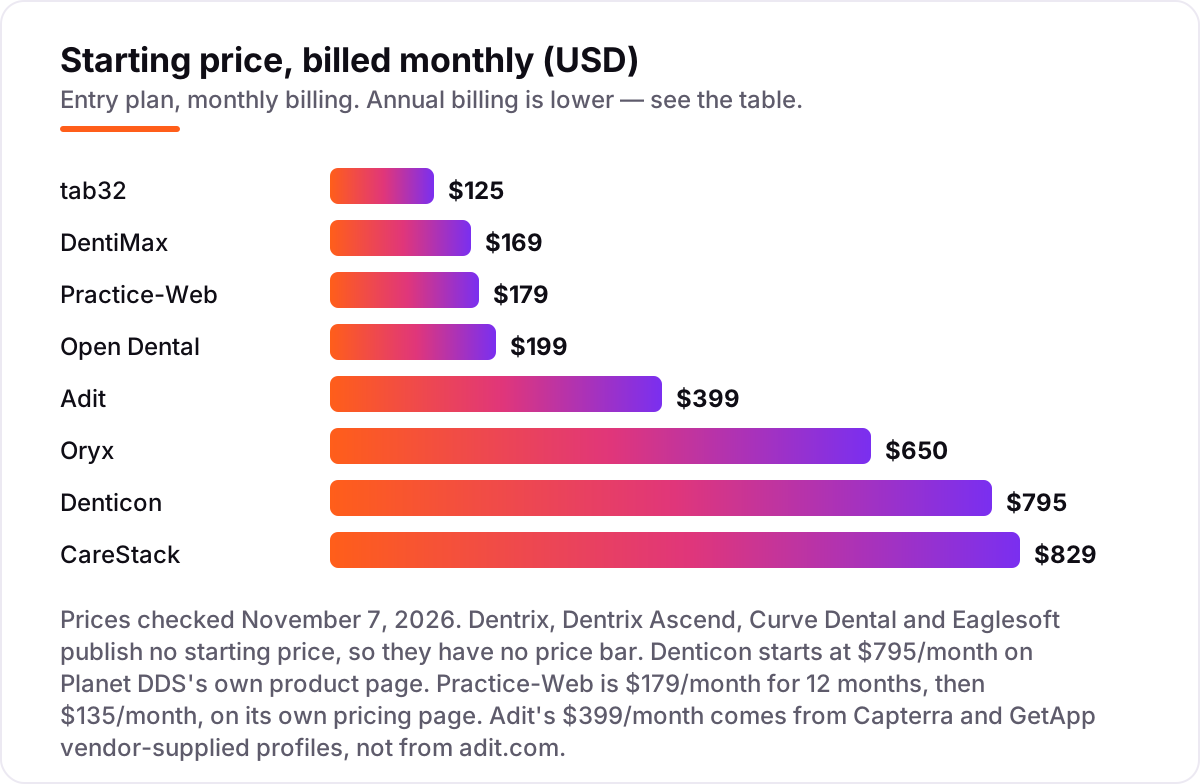
Take a single-location practice with three providers that files about 100 claims a month. On list prices, the subscription costs $125 a month on tab32 Alpine, $169 on DentiMax In-Office, $179 on Practice-Web, $199 on Open Dental, $399 on Adit, $650 on Oryx Pro, $795 on Denticon and $829 on CareStack Essentials. Three of those numbers need adjusting before they are real: tab32 adds 100 claims at $0.20 each, which brings it to $145 a month, and Open Dental's front desk usually needs the $165 eServices bundle, which brings it to $364 a month.
Over a year, that is $1,740 on tab32 with claims, $2,028 on DentiMax, $2,388 on Open Dental before eServices ($4,368 with it), $4,788 on Adit, $7,800 on Oryx Pro and $9,948 on CareStack Essentials. The same three providers and the same 100 claims cost $1,740 a year at the cheap end and $9,948 at the dear end — an $8,208 gap that comes from deployment, bundled features and AI tiers, not from the number of chairs.
Three costs sit outside every number above. First, the quote-only tools — Dentrix, Dentrix Ascend, Curve and Eaglesoft — publish no price, so their cost only appears after a demo; practitioner reports put Dentrix roughly at $400–$1,200 a month depending on edition, but that is a third-party estimate, not a vendor price. Second, data conversion, which vendors quote per practice and rarely publish. Third, the server: a server-based system needs hardware ($2,000–$5,000), backups and IT support that a cloud subscription already includes. A new practice can dodge the first year entirely with Oryx's $0 Startup Offer or Ascend Starter at $199 a month — both run until the practice grows past their limits.
Know the difference: practice management software vs patient engagement software
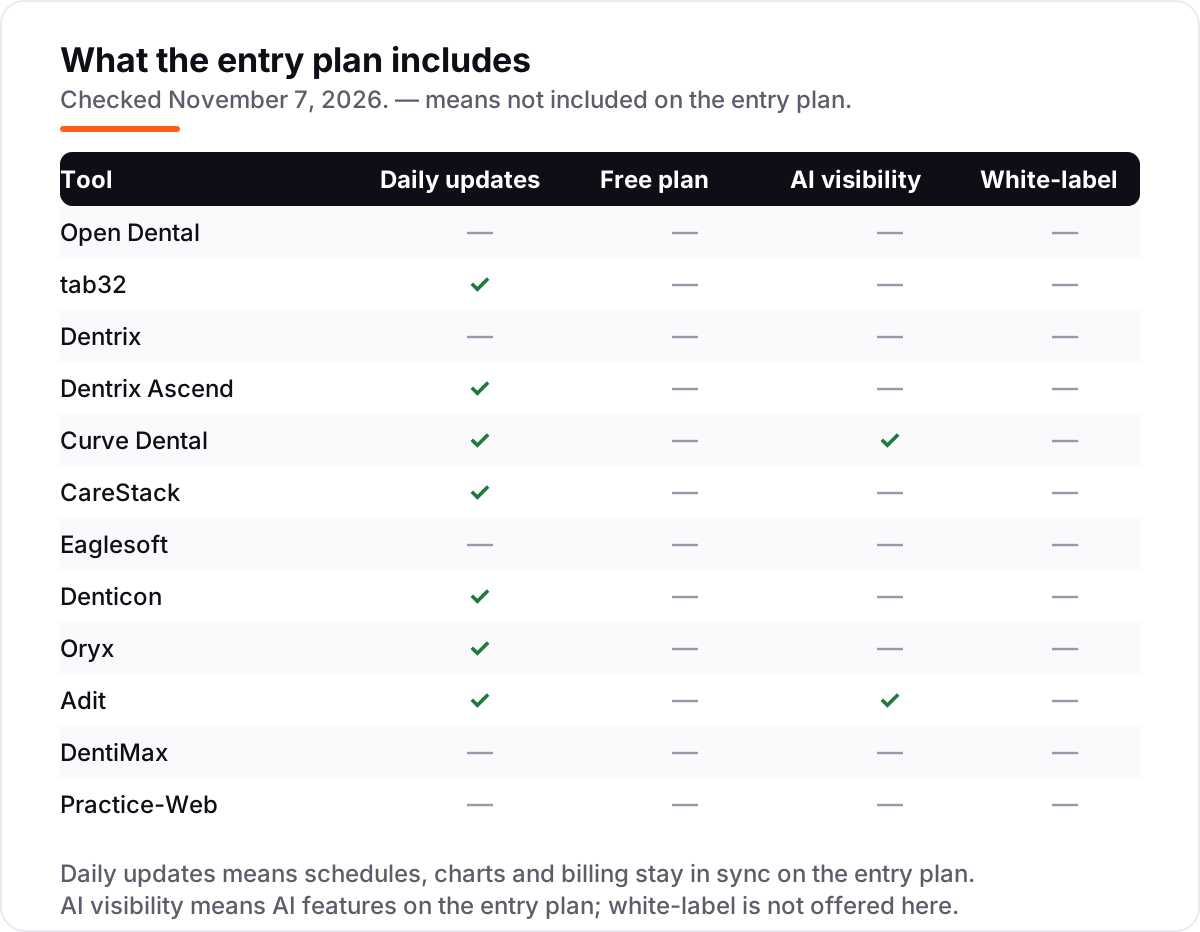
The confusion in this category is between the system of record and the front desk. Practice management software — Dentrix, Open Dental, Curve, CareStack — holds the schedule, the chart, the ledger and the claims. It is the system the practice cannot run without. Patient engagement software — reminders, texting, online booking, review requests — sits on top of it and keeps the chairs full.
Most tools in this list bundle both jobs now, but not at the same price. Open Dental sells engagement as a separate $165/month eServices bundle, tab32 charges for texting and reminders as add-ons, and Dentrix leans on Lighthouse 360 or partners like Weave. Adit is the pure engagement play: an AI agent that answers the phone, layered over whatever PMS already holds the chart.
A third distinction worth knowing is the clearinghouse. Oryx bundles its own insurance clearinghouse into the subscription, so claims go out with no middleman. Open Dental and tab32 charge per claim through theirs. If the practice files hundreds of claims a month, the per-claim model and the bundled model can cost very different amounts for the same work — check the claim volume before comparing the subscription prices.
Quick comparison: tool type by need
| Buyer | Best pick | Why |
|---|---|---|
| Solo practice on a budget | tab32 | Cloud system with published pricing, $125/month in year one |
| Practice that wants to own its data | Open Dental | Open-source, flat $199/month per location, full database access |
| Established practice, staff know it | Dentrix | The standard choice, deepest Henry Schein integrations, custom quote |
| Cloud without leaving Dentrix behind | Dentrix Ascend | Familiar workflows in the browser, Starter $199/month for new practices |
| Growing group or DSO | Denticon | One database and centralized reporting across locations, from $795/month |
| Startup that wants everything bundled | Oryx | Imaging and clearinghouse included, $650/month, $0 startup offer |
| Missed calls are the leak | Adit | AI agent answers after-hours calls, $399/month over your PMS |
Mistakes to avoid
- Budgeting on the subscription alone. The eServices bundle, per-claim fees, AI tiers and server hardware all sit outside the headline price. Price the add-ons for your actual claim and message volume.
- Comparing prices across different bases. A per-location price, a per-user price and a per-provider price are three different numbers. Convert every quote to the same basis — one location, three providers — before comparing.
- Skipping the conversion question. Ask exactly what migrates (charts, images, ledgers, perio) and get the scope, cost and timeline in writing before signing. Conversion is the hidden project.
- Buying the enterprise tier for a solo practice. Denticon and CareStack Intelligence are built for groups. A solo practice pays group prices for group features it will never use.
- Signing without an exit clause. Ask how your data exports, in what format, and what it costs to leave. Server systems and open APIs (Open Dental) make exit easy; closed cloud systems make it a negotiation.
How we chose
We checked each vendor's own pricing page on November 7, 2026 and recorded the starting price exactly as shown, including the year-one and year-two figures where the page lists them. Four vendors publish no starting price — Dentrix, Dentrix Ascend, Curve Dental and Eaglesoft — and those are listed as custom quote, never estimated. Adit's $399/month comes from Capterra and GetApp vendor-supplied profiles, not from adit.com, which publishes no price page we could verify. Denticon starts at $795/month on Planet DDS's own product page, and Practice-Web is $179/month for 12 months, then $135/month, on its own pricing page. Ratings come from G2 and Capterra pages crawled in early November 2026. We omitted ratings for DentiMax and Practice-Web: G2 has no usable DentiMax rating and its Capterra figures conflict between sources, while Practice-Web's G2 base is six reviews and its Capterra page was last crawled months ago. No vendor paid for a place in this list, and none of the links here are affiliate links.
What to do next
Shortlist two or three tools that match your deployment — cloud or server — and take each demo with your own workflows: book a patient, run eligibility, submit a claim and post a payment. Get the quote in writing with every add-on itemized, and ask for the conversion scope and the exit terms before you sign. If the software is sorted but new patients are not finding the practice, our local SEO service handles the visibility side — or compare providers in our guide to medical SEO companies. Once your tools are in place, find out what's holding your rankings back.
Your stack only works if people find you
SerpAstra fixes what keeps your site off page one and makes it easy for AI assistants to recommend.
Get a free audit→Sources we checked (22)
- Open Dental fees — opendental.com/site/fees.html (checked November 7, 2026)
- tab32 pricing — tab32.com/pricing (checked November 7, 2026)
- Dentrix — dentrix.com (checked November 7, 2026)
- Dentrix Ascend — dentrixascend.com (checked November 7, 2026)
- Ascend Starter launch — Henry Schein One press release, October 23, 2026
- Curve Dental — curvedental.com (checked November 7, 2026)
- CareStack pricing — carestack.com/pricing (checked November 7, 2026)
- Eaglesoft — eaglesoft.net (checked November 7, 2026)
- Denticon pricing — planetdds.com (starts at $795/month, checked November 7, 2026)
- Oryx pricing FAQ — oryxdental.com/faqs (checked November 7, 2026)
- Adit pricing and reviews — Capterra (checked November 7, 2026)
- DentiMax product page — dentimax.com/dental-software (checked November 7, 2026)
- Practice-Web pricing — practice-web.com/pricing (special $179/month for 12 months, then $135/month, checked November 7, 2026)
- G2 Dentrix reviews — g2.com (checked November 7, 2026)
- G2 Dentrix vs Open Dental — g2.com (checked November 7, 2026)
- G2 Dentrix vs Dentrix Ascend — g2.com (checked November 7, 2026)
- G2 Dentrix vs Eaglesoft — g2.com (checked November 7, 2026)
- G2 Curve Dental vs Denticon — g2.com (checked November 7, 2026)
- G2 CareStack vs Dentrix — g2.com (checked November 7, 2026)
- G2 Denticon vs Dentrix Ascend — g2.com (checked November 7, 2026)
- G2 Curve Dental vs Oryx — g2.com (checked November 7, 2026)
- G2 tab32 reviews — g2.com (checked November 7, 2026)
Shamim
Founder of SerpAstra
A full-stack SEO and digital marketer who spends most days on Local SEO for dental practices, AI search visibility and lead generation.
Frequently asked questions
What is the best dental practice software?
Open Dental is the best value for most practices: a published flat fee from $199/month per location, open-source code and full data ownership. Dentrix is the best pick for practices whose staff already know it, and Curve Dental is the best cloud option for practices that want AI help at the front desk.
How much does dental practice software cost?
Published starting prices run from $125/month (tab32, year one) to $829/month (CareStack Essentials). Open Dental costs $199/month in year one, DentiMax $169/month, Practice-Web $179/month for 12 months, Denticon from $795/month, Oryx $650/month and Adit $399/month. Four vendors publish no price at all, so their cost only appears in a custom quote.
Is there free dental practice software?
No tool in this list has a free plan. The closest thing is Oryx's Startup Offer: new practices run Pro and Automate at $0 a month with a $1 setup fee until they reach 200 patients or 12 months. tab32, CareStack, Adit, DentiMax and Practice-Web offer free trials instead.
Should I choose cloud or server-based dental software?
Cloud systems (Ascend, Curve, CareStack, Denticon, tab32, Oryx) need no server, backups or on-site IT, and staff can log in from anywhere. Server systems (Dentrix, Eaglesoft, Open Dental, DentiMax In-Office) cost less per month but need hardware, backups and an IT relationship. New practices should start in the cloud.
Can I switch dental practice software later?
Yes, but budget weeks for data conversion and ask every vendor exactly what migrates — charts, images, ledgers and perio records — before signing. Conversion is the hidden project in this category: get the scope, the cost and the timeline in writing, and plan the move for a quiet week.
Do I need separate patient engagement software?
It depends on the PMS. Open Dental, Curve, CareStack and Oryx bundle reminders, texting and online scheduling into the core system or a priced bundle. Dentrix and Eaglesoft lean on add-ons or partners. Adit is the dedicated option: an AI agent that answers missed calls, layered over your existing PMS.
Free SEO and AI visibility audit
Find out what is holding your rankings back
Send us your site. Within 2 business days you get a written audit, an AI visibility check and a short fix list ranked by impact. Free, with no contract attached.
Request my free audit→Related guides
 Local SEOLocal SEO for dentists: a practical patient growth guideA practical local SEO guide for dental practices: Google Business Profile, service pages, reviews, citations and tracking that turn searches into booked patients.Read guide →
 Digital Marketing & AdsBest Medspa Software for 2026: 12 Options Compared by Use CaseCompare the 12 best medspa software options for 2026 on price, charting, booking and marketplace fees, with every price checked November 5, 2026.Read guide →
 SEO & AI Search9 Best Medical SEO Companies (2026): Who to Hire and What It Costs9 best medical SEO companies compared on price, specialty and AI visibility, with real starting prices where published and custom-quote warnings where not.Read guide →