
10 Best Dental Software in 2026: Pricing, Features and Pros & Cons
Compare the 10 best dental software options for 2026 on price, cloud vs server, imaging and multi-location features, with every price checked November 7, 2026.
 Shamim Mia, Founder, SerpAstraLast verified November 7, 202613 min read
We compare pricing pages, documentation and public reviews. We never accept payment for rankings.
Key takeaways
- Dentrix is the default pick for most US practices, but it is quote-only; Open Dental is the value pick at $199 a month for the first year, then $149, and tab32 is the cheapest cloud start at $125 a month in year one.
- Only four vendors here publish a starting price on their own site — Open Dental, tab32, Practice-Web and CareStack — plus Denticon's $795 starting figure and DentiMax's $169, while Dentrix, Eaglesoft and Curve Dental sell by quote.
- The single most important buying factor is deployment: server software needs your own IT and backups, cloud software needs reliable internet and a per-location or per-user price that scales with the practice.
- Switching practice management software means migrating years of charts, images and ledgers, so pick the system that fits the practice you expect to be in five years.
On this page
Quick comparison
| Tool | Best for | Starting price | Free plan |
|---|---|---|---|
| Dentrix | Established US practices that want the proven standard with the deepest feature set | Custom quote | No |
| Eaglesoft | Patterson-aligned practices that want software, equipment and supplies from one vendor | Custom quote | No |
| Open Dental | Cost-conscious practices that want a published price and control of their own data | $199/mo | No (free trial) |
| Curve Dental | Single and small-group practices that want modern cloud software with no server | Custom quote | No |
| Denticon | Multi-location groups and DSOs that want one cloud record across all offices | From $795/mo | No |
| CareStack | Growing groups that want clinical, billing, marketing and analytics in one platform | $829/mo | No |
| tab32 | Solo and small practices that want the cheapest published cloud start | $125/mo | No (14-day trial) |
| Practice-Web | Small practices that want real practice management at the lowest published price | $179/mo | No (free trial) |
| DentiMax | Practices buying sensors and software together that want one hardware-plus-software bundle | $169/mo | No (free trial) |
| Dentally | UK practices that want cloud simplicity with NHS claiming built in | £134/mo | No |
Make one of these tools?
We re-check this list every quarter. Send a correction, request a review, or ask about a clearly labeled sponsored spot.
Request a listingThe best dental software

Dentrix
Best for: Established US practices that want the proven standard with the deepest feature set
Dentrix, from Henry Schein One, is the practice management system most US dental offices run. Scheduling, charting, billing, imaging integration and reporting are deep and refined over decades, and the user community is enormous, so finding trained staff, consultants and third-party integrations is easy. It is the safe choice for an established practice that wants the proven standard.
The price is the catch: Henry Schein One publishes no list price, so every practice negotiates a quote, and modules such as eClaims, ePrescribe and patient communication add to the bill. The interface is dated and the system runs on a server in the office, so hardware, backups and IT support sit with the practice. Buy Dentrix when depth and familiarity matter most; look at Curve Dental or Open Dental when a modern cloud system or a published price matters more.
What we like
- Deepest feature set in dentistry, refined over decades of use
- Huge user community, so trained staff, consultants and integrations are easy to find
- Henry Schein One ecosystem covers imaging, supplies and support in one relationship
- eClaims, eligibility and reporting run deep for complex practices
Watch out for
- No published price — every practice negotiates a quote, and modules add up
- Dated interface and server-based, so hardware, backups and IT sit with the practice
- Implementation is a genuine project, with training and migration to budget for

Eaglesoft
Best for: Patterson-aligned practices that want software, equipment and supplies from one vendor
Eaglesoft, from Patterson Dental, is Dentrix's longtime rival. The clinical charting, scheduling and practice management features are deep, and integration with Patterson's equipment, supplies and support creates a unified vendor relationship. Practices standardized on Patterson get the most from it, and reviewers on G2 rate its scheduling and reporting above Dentrix.
The ecosystem tie is also the limit: the value concentrates for Patterson customers, the interface is dated, and pricing is quote-based, with training and support adding to the bill. The system is server-based, so the practice owns the hardware and the IT. Choose Eaglesoft when the practice already buys Patterson equipment and wants one vendor to call; choose Dentrix when the practice wants the largest community, and Open Dental when a published price matters.
What we like
- Deep Patterson Dental integration across software, hardware and supplies
- Strong clinical charting, scheduling and practice management features
- Long track record, with support from a large US vendor network
- Reviewers rate its scheduling and reporting above Dentrix on G2
Watch out for
- No published price — sold by quote, with training and support adding to the bill
- Value concentrates for Patterson customers; less compelling outside that ecosystem
- Dated interface and server-based, so the practice owns hardware and IT

Open Dental
Best for: Cost-conscious practices that want a published price and control of their own data
Open Dental is the price-transparency champion of dental software. The fees page lists everything: $199 per month per location for the first year, covering all computers and up to 3 providers, dropping to $149 per month after 12 months, with extra providers at $20 per month each. The feature set covers scheduling, charting, billing and imaging, and customization goes deeper than closed platforms allow.
It demands more technical comfort than turnkey products: self-hosted by default, it needs a server and someone to maintain it, and the eServices bundle for texting, reminders and online scheduling costs $165 a month on top. Open Dental Cloud removes the server from $250 a month. Buy Open Dental when control and a published price matter most; buy Curve Dental when the practice wants cloud software without running its own server.
What we like
- Only major vendor here that publishes its whole price list
- Flat per-location price covers every computer for up to 3 providers
- Highly customizable, with a public API and hundreds of integrations
- Support fee drops to $149/month after 12 months
Watch out for
- Self-hosted by default, so the practice owns the server, backups and IT
- eServices bundle (texting, reminders, online scheduling) costs $165/month on top
- No longer open-source software since version 24.4, though database access stayed open

Curve Dental
Best for: Single and small-group practices that want modern cloud software with no server
Curve Dental built cloud-native from the start: no servers in the closet, access from anywhere, automatic updates. The interface is modern by dental software standards, and support gets good marks. Single and small-group practices get enterprise-style capability without IT overhead, and reviewers rate it the highest of the cloud tools here at 4.6 out of 5 on G2.
Feature depth trails the decades-old giants in some specialty areas, and per-user pricing adds up with staff. Pricing is quote-only, so the practice must book a demo to learn its price. Buy Curve Dental when the practice wants modern cloud software without the legacy weight; buy Dentrix when specialty depth matters more, and Open Dental when a published price matters more.
What we like
- True cloud platform with no servers, access from anywhere and automatic updates
- Modern interface by dental software standards, with a good support reputation
- Fast onboarding and easy staff training, reviewers consistently note
- Enterprise-style capability for single practices without IT overhead
Watch out for
- No published price — sold by demo and personalized quote
- Feature depth trails the decades-old giants in some specialty areas
- Per-user pricing adds up as staff numbers grow

Denticon
Best for: Multi-location groups and DSOs that want one cloud record across all offices
Denticon, from Planet DDS, proved cloud dental software at DSO scale. Multi-location groups get centralized scheduling, billing, reporting and compliance across all offices from one platform, with a single patient record that follows the patient between locations. The vendor's site puts pricing from $795 a month, with packages and add-ons that depend on practice size.
It is sold and priced for groups, so solo practices get less value, and the enterprise process suits larger buyers. The platform runs only on Windows, so an office with Macs at the chair will need to plan around that. Buy Denticon when the practice is a growing group standardizing on one cloud platform; buy Curve Dental or CareStack when a single practice or a smaller group wants the same idea at a lower entry point.
What we like
- Cloud platform proven at DSO scale, with centralized scheduling, billing and reporting
- Single patient record across locations, built for groups from day one
- API supports connections to more than 50 outside tools
- Planet DDS backing, with Cloud 9 and Apteryx imaging in the same platform
Watch out for
- Sold and priced for groups; solo practices get less value from it
- Enterprise sales process, with implementation quoted per location
- Windows only, with no Mac support, so Mac-based offices must plan around it

CareStack
Best for: Growing groups that want clinical, billing, marketing and analytics in one platform
CareStack aims to be the all-in-one for dental groups: clinical, scheduling, billing, marketing, analytics and patient engagement in one modern platform. The analytics give group operators visibility that stitched-together systems cannot, and the architecture is contemporary, not retrofitted. Its pricing page lays out two tiers: Essentials from $829 a month, and Intelligence from $1,299.
That gap is the main thing to understand. If AI notes are the reason for buying, the real entry price is the Intelligence tier, not the headline $829. Pricing and implementation are enterprise-grade, and the company is newer than the incumbents. Buy CareStack when a group wants one platform instead of four to six tools; buy Denticon when the priority is a proven multi-location record, and tab32 when the budget is far smaller.
What we like
- All-in-one cloud platform: clinical, scheduling, billing, marketing and analytics
- Strong group analytics give operators visibility stitched-together systems cannot
- Modern architecture, not a retrofitted legacy system
- Published two-tier pricing, so the entry price is known before the demo
Watch out for
- AI features (notes, voice perio, x-ray analysis) wait for Intelligence at $1,299/month
- Enterprise-grade pricing and implementation for a single-location practice
- Steep learning curve while staff master the full platform
tab32
Best for: Solo and small practices that want the cheapest published cloud start
tab32 built cloud-native for multi-location dental groups, with an open API that encourages integration. Alpine, the entry tier, costs $125 a month in year one for up to 3 providers, then $225 a month from year two for up to 5 providers. Automation across locations reduces the administrative drag of growth, and the modern architecture appeals to tech-forward practices.
The enterprise focus means less attention to solo practices, and the price rises after year one — the opposite of Open Dental, whose price drops. Per-use fees add up too: claims at $0.20, attachments at $0.50 and eligibility checks at $1.25. Buy tab32 when a small practice wants the cheapest published cloud start with room to grow; buy Open Dental when a flat price that falls over time matters more.
What we like
- Cheapest published cloud start here: Alpine from $125/month in year one
- Cloud-native with an open API that encourages integration
- Automation across locations reduces the admin drag of growth
- 14-day free trial, so a small practice can test it before paying
Watch out for
- Price rises after year one, from $125 to $225/month, with more providers covered
- Per-claim, per-attachment and per-eligibility-check fees add to the monthly price
- Summit tier for larger groups has no published price

Practice-Web
Best for: Small practices that want real practice management at the lowest published price
Practice-Web serves small practices that need real practice management without enterprise pricing. The vendor's pricing page lists a special price of $179 a month for the first 12 months, then $135 a month, covering the software, installation, training, upgrades, portals and support for up to 3 dentists. Scheduling, charting, billing and imaging integration cover the essentials at accessible prices.
Polish and ecosystem trail the leaders, and advanced specialty features vary — but many practices never need those. The Smart Tools are priced separately per feature, so texting, forms and online scheduling add to the bill, and database conversion costs $1,195. Buy Practice-Web when the budget is tight and the core job is what matters; buy Open Dental when deeper customization matters more.
What we like
- Lowest published per-location price among the server tools here
- Flat price covers installation, training, upgrades, portals and support
- Dentist and patient portals, mobile forms and online registration included
- Straightforward value: the core job at a fair price, without enterprise cost
Watch out for
- Smart Tools (texting, forms, online scheduling) are priced separately per feature
- Polish and ecosystem trail the leaders, and advanced specialty features vary
- Database conversion costs $1,195 on top of the subscription

DentiMax
Best for: Practices buying sensors and software together that want one hardware-plus-software bundle
DentiMax comes from imaging: digital sensors and x-ray equipment with practice management software alongside. The vendor's page lists the In-Office plan at $169 a month, the top bundle at $358, and the cloud Flow tiers from $299 a month for Core. Practices buying sensors get software designed to work with them, and bundled pricing can beat separate vendors.
As pure practice management software it has a smaller footprint than the leaders, and the cloud tiers cost far more than the In-Office plan. But for practices equipping operatories and choosing software together, the hardware-plus-software bundle deserves a look. Buy DentiMax when sensors and software are bought as one decision; buy Dentrix or Open Dental when practice management depth matters more than the hardware.
What we like
- Strong imaging heritage: digital sensors and x-ray equipment with software alongside
- Bundled hardware-plus-software pricing can beat separate vendors
- In-Office plan includes treatment planning, document center and card processing
- The top bundle at $358/month adds the extras most practices want
Watch out for
- Cloud Flow tiers cost far more than In-Office: Core is $299/month, Executive $579
- As pure practice management software it has a smaller footprint than the leaders
- Imaging-first heritage means the ecosystem beyond sensors is narrow

Dentally
Best for: UK practices that want cloud simplicity with NHS claiming built in
Dentally leads cloud dental software in the UK with a clean, simple experience. Scheduling, charting, billing and patient communications work without the complexity of the US giants, and NHS claiming is built in for England, Wales and Scotland, with HSC support in Northern Ireland. Its pricing page lists Starter from £134 a month for one surgery, excluding VAT, with Essentials and Pro above it.
The UK focus means less fit for US practices with American insurance and compliance needs, and depth trails the US incumbents. Recent Capterra reviews criticize a redesign, and the rating here is the lowest in the list at 3.6 out of 5. Buy Dentally when the practice is in the UK and wants modern cloud simplicity; buy Curve Dental when the practice is in the US and wants the same idea.
What we like
- Clean cloud experience with scheduling, charting, billing and patient communications
- Full NHS integration in England, Wales and Scotland, and HSC in Northern Ireland
- Published tiered pricing by surgery count, so small practices can budget
- Unlimited users and unlimited storage on all three packages
Watch out for
- UK focus limits fit for US practices with American insurance and compliance needs
- Lowest rating here at 3.6/5 on Capterra, with recent reviews criticizing a redesign
- Prices exclude VAT, so the real monthly cost is higher than the headline
The best dental software for a practice is the one that runs scheduling, charting, billing and imaging without daily workarounds — and the right choice depends far more on deployment and scale than on brand. We ranked the ten tools below by fit for the most common buyer, a US general practice choosing its system of record, starting with the installed-base leaders, then the cloud platforms, then the value and UK options, and every price was checked on the vendor's own pricing page on November 7, 2026.
How to choose the best dental software
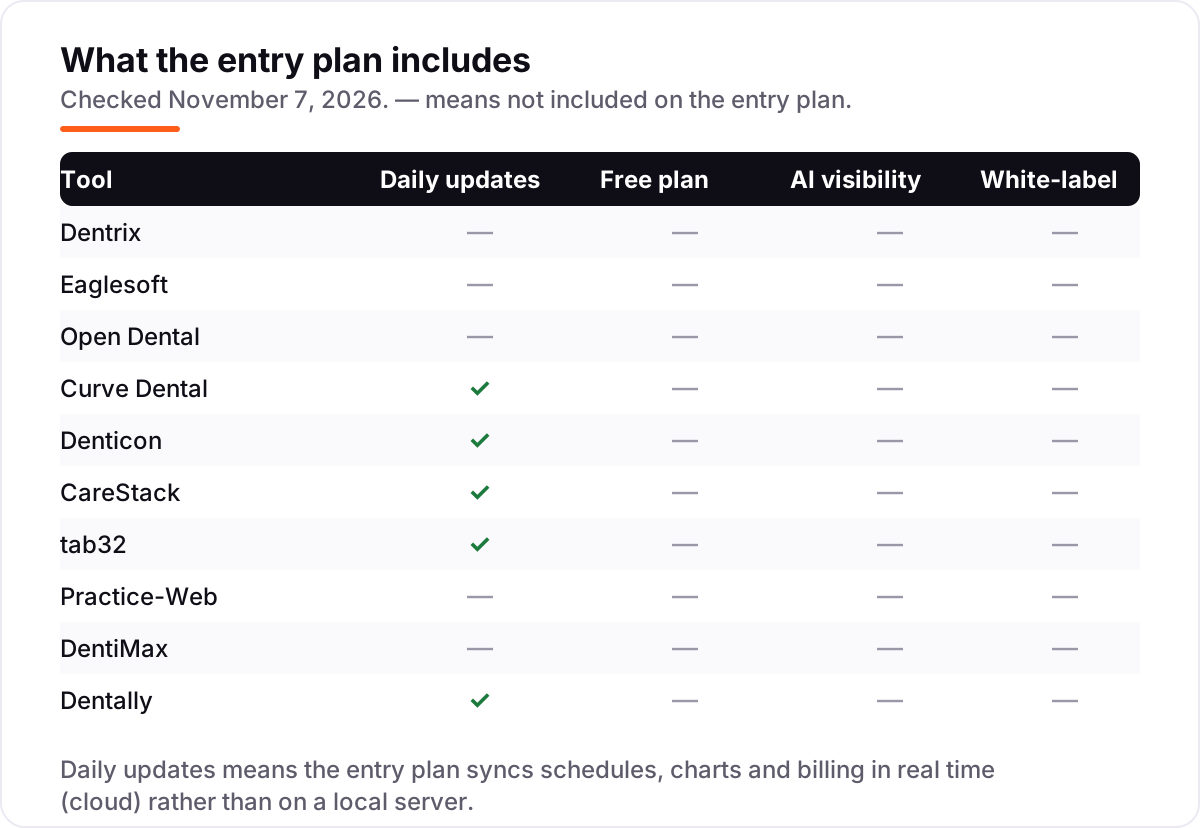
- Start with deployment. Server software (Dentrix, Eaglesoft, Open Dental, Practice-Web) needs hardware, backups and IT support in the office; cloud software (Curve Dental, Denticon, CareStack, tab32, Dentally) needs reliable internet and no server, but the subscription never stops.
- Count providers, not just users. Open Dental covers up to 3 providers per location, tab32 up to 3 in year one, and Practice-Web charges $20 a month per dentist beyond 3. The provider cap is the number that decides the real price.
- Check imaging before anything else. Sensors, panoramic units and CBCT must work with the software, and native support beats a third-party bridge — one vendor to call when an image will not load.
- Price the add-ons, not the headline. Texting, reminders, online scheduling and claims fees are often sold separately; Open Dental's eServices bundle adds $165 a month, and tab32 charges per claim, attachment and eligibility check.
- Plan for the practice in five years. A solo office that adds locations needs multi-location reporting and a single patient record now, not a migration later — and switching systems means moving years of charts, images and ledgers.
Dental software runs the practice, but new patients still have to find it. Our guide to local SEO for dentists covers how practices show up on Google Maps and in AI answers, and our local SEO service handles rankings, reviews and map listings for practices that would rather hand that work over. Before you publish new service pages, run your titles through the free local business schema generator — it builds the structured data that helps Google understand a dental practice.
Whatever you shortlist, run it with real data before you sign. The trials and demos in this list are long enough to test scheduling, charting and one real claims run — and that test tells you more than any review can. Check two things in the trial: that your imaging hardware connects without a bridge, and that you can export your patient and financial data in full. Every tool here should let you leave with your data; confirm that in writing before you commit.
Dental software pricing: what you will actually pay
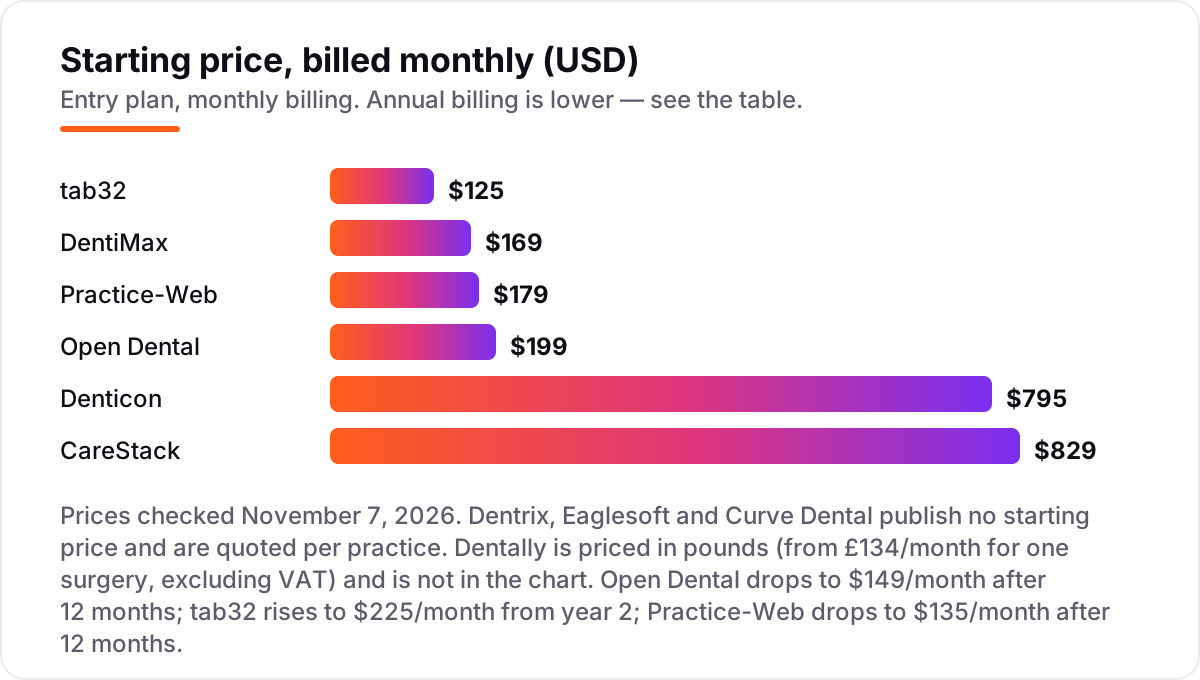
Take a single-location general practice with three providers. On published starting prices, the first year costs $1,500 on tab32 Alpine, $2,028 on DentiMax In-Office, $2,148 on Practice-Web at its special price, and $2,388 on Open Dental. The group platforms cost far more: Denticon starts at $9,540 a year and CareStack Essentials at $9,948 a year. Dentally Starter for one surgery costs £1,608 a year excluding VAT.
Year two changes the order. Open Dental drops to $149 a month, or $1,788 a year, and Practice-Web drops to $135 a month, or $1,620 a year, while tab32 rises to $225 a month, or $2,700 a year. Add the extras before comparing: Open Dental's eServices bundle adds $165 a month, or $1,980 a year, which takes its year-two total to $3,768, and tab32 adds $0.20 per claim, $0.50 per attachment and $1.25 per eligibility check.
Three costs sit outside every number above. First, the quote-only tools — Dentrix, Eaglesoft and Curve Dental — publish no price, so budget on a written quote and ask what it includes: licences, implementation, training, support and renewal terms. Second, data conversion: Practice-Web lists conversion at $1,195, and other vendors charge for migration and training too. Third, imaging hardware: sensors and CBCT units are a separate purchase, and a bridge to unsupported hardware adds a second vendor to every support call.
Know the difference: practice management software vs patient engagement tools
The confusion in this category is between the system of record and the tools that sit on top of it. Practice management software — everything in this list — runs scheduling, charting, billing, claims and the patient ledger. Patient engagement tools such as Weave and NexHealth handle texting, reminders, online scheduling and reviews, and they connect to the practice management system rather than replacing it. Buying an engagement tool when the practice needs a new system of record is the most common expensive mistake in this category.
There is a second confusion: cloud versus server. Cloud software runs in a browser with no server in the office, automatic updates and access from anywhere; server software runs on hardware the practice owns, which means the practice controls its data and its uptime, but also its backups and IT bills. Neither is better in general — a rural practice with unreliable internet may be safer on a server, while a multi-location group gains more from one cloud record.
A third distinction is Dentrix versus Dentrix Ascend. They are separate products from the same company: Dentrix is the long-running server system, while Dentrix Ascend is a cloud rewrite sold in tiers. A quote for one is not a quote for the other, so confirm which product a price covers before comparing it with anything else.
Quick comparison: tool type by need
| Buyer | Best pick | Why |
|---|---|---|
| Established US practice that wants the standard | Dentrix | Deepest feature set, quote-only pricing |
| Practice that wants a published price and control | Open Dental | $199 a month in year one, then $149, per location |
| Single practice that wants modern cloud software | Curve Dental | Cloud-native, no servers, quote-only pricing |
| Multi-location group or DSO | Denticon | Cloud platform built for groups, from $795 a month |
| Group that wants AI built in | CareStack | All-in-one with AI notes on Intelligence at $1,299 a month |
| Small practice on a budget | tab32 | Alpine from $125 a month in year one, 14-day trial |
Mistakes to avoid
- Budgeting on a directory price for a quote-only tool. Dentrix, Eaglesoft and Curve Dental publish no price; the $200–$500 figures in software directories are third-party estimates, not vendor prices. Get a written quote.
- Comparing per-location prices with per-user prices. Open Dental charges per location for up to 3 providers; a per-user tool can look cheaper at one provider and cost far more at ten.
- Forgetting the add-ons. Texting, reminders, eServices, claims fees and imaging bridges are often billed separately and can add $100–$200 a month to a cheap headline price.
- Buying without testing imaging. Ask for your exact sensor and CBCT models in writing, and test them in the trial — a bridge that launches the imaging app without syncing the patient is barely better than no integration.
- Signing before checking the exit. Ask how to export charts, images and the full ledger, what it costs, and how long the vendor keeps data after termination. The ability to leave is the best negotiating position.
How we chose
We checked each vendor's own pricing page on November 7, 2026 and recorded the starting price exactly as shown, or marked the tool as quote-only where the vendor publishes no price. Dentrix, Eaglesoft and Curve Dental publish no starting price, so we show no price for them rather than repeating a directory estimate. Dentally is priced in pounds on its UK pricing page, so its figure is shown in pounds excluding VAT. Ratings come from G2 or Capterra pages checked the same week; Practice-Web carries no rating because we could not verify a G2 or Capterra rating for it. One correction to older lists: Open Dental is no longer open-source software — it moved to a proprietary licence in version 24.4, though database access stayed open. No vendor paid for a place in this list, and none of the links here are affiliate links.
What to do next
Shortlist two tools — one cloud and one server, or one group platform and one single-practice platform — and run a demo of each with your real schedule, your real imaging hardware and one real claims run. Ask each vendor for a written quote that lists licences, implementation, training, support and renewal terms, and confirm data export in writing. If the software is sorted but new patients are not finding the practice, our guide to the best medical SEO companies covers the visibility side. Once your tools are in place, find out what's holding your rankings back.
Your stack only works if people find you
SerpAstra fixes what keeps your site off page one and makes it easy for AI assistants to recommend.
Get a free audit→Sources we checked (19)
- Dentrix — dentrix.com (checked November 7, 2026)
- Eaglesoft — pattersondental.com/cp/software/dental-practice-management-software/eaglesoft (checked November 7, 2026)
- Open Dental fees — opendental.com/fees (checked November 7, 2026)
- Curve Dental — curvedental.com (checked November 7, 2026)
- Denticon pricing — planetdds.com/cloud-based-dental-software (checked November 7, 2026)
- CareStack pricing — carestack.com/pricing (checked November 7, 2026)
- tab32 — tab32.com (checked November 7, 2026)
- Practice-Web pricing — practice-web.com/pricing (checked November 7, 2026)
- DentiMax pricing — dentimax.com/dental-software (checked November 7, 2026)
- Dentally — dentally.com (checked November 7, 2026)
- Dentrix reviews — g2.com/products/dentrix/reviews (checked November 7, 2026)
- Eaglesoft reviews — g2.com/compare/dentrix-vs-eaglesoft (checked November 7, 2026)
- Open Dental reviews — g2.com/products/open-dental/reviews (checked November 7, 2026)
- Curve Dental reviews — g2.com/compare/curve-dental-curve-dental-vs-dentrix (checked November 7, 2026)
- Denticon reviews — g2.com/products/denticon/reviews (checked November 7, 2026)
- CareStack reviews — g2.com/products/carestack/reviews (checked November 7, 2026)
- tab32 reviews — capterra.in/alternatives/149415/tab32 (checked November 7, 2026)
- DentiMax reviews — capterra.com.au/software/44751/dentimax (checked November 7, 2026)
- Dentally reviews — capterra.co.uk/software/153816/dentally (checked November 7, 2026)
Shamim
Founder of SerpAstra
A full-stack SEO and digital marketer who spends most days on Local SEO for dental practices, AI search visibility and lead generation.
Frequently asked questions
What is the best dental software?
Dentrix is the best fit for most established US practices: the deepest feature set, the largest user community and the most integrations. Open Dental is the best value, at $199 a month for the first year and $149 after, per location. Curve Dental is the best cloud pick for a single practice that wants no server. The right answer depends on practice size and deployment.
How much does dental software cost?
Published starting prices run from $125 a month for tab32 Alpine in year one to $1,299 a month for CareStack Intelligence. Open Dental costs $199 a month in year one, then $149. Dentrix, Eaglesoft and Curve Dental publish no price and sell by quote, so budget on a written quote, not a directory estimate.
Is there free dental software?
No tool in this list has a free plan. Open Dental, tab32, Practice-Web and DentiMax offer free trials, and CareStack lists a free trial too. Open Dental used to be open-source software, but it moved to a proprietary licence in version 24.4, so the free self-hosted route no longer exists.
What is the difference between Dentrix and Dentrix Ascend?
They are separate products from Henry Schein One. Dentrix is the long-running server-based system with the deepest feature set. Dentrix Ascend is a cloud rewrite sold in tiers, with browser access and no server. A quote for one is not a quote for the other, so confirm which product a price covers before comparing.
Is cloud or server dental software better?
Cloud software needs no server, updates itself and works from anywhere, but it needs reliable internet and the subscription never ends. Server software gives the practice control of its data and uptime, but the practice pays for hardware, backups and IT support. Multi-location groups usually gain more from cloud; a rural practice with weak internet may prefer a server.
Can I switch dental software later?
Yes, but it is one of the most disruptive projects a practice undertakes. Years of charts, treatment plans, images and financial data must migrate, and staff must retrain. Plan the move for a quiet period, confirm the export format and cost in writing before signing with a new vendor, and run both systems in parallel until the ledger reconciles.
Does dental software include patient texting and reminders?
Usually as a paid add-on, not in the entry price. Open Dental sells its eServices bundle, including texting and reminders, for $165 a month per location. tab32 charges per claim, attachment and eligibility check on top of its monthly price. Check what communication tools are included before comparing headline prices.
Free SEO and AI visibility audit
Find out what is holding your rankings back
Send us your site. Within 2 business days you get a written audit, an AI visibility check and a short fix list ranked by impact. Free, with no contract attached.
Request my free audit→Related guides
 Local SEOLocal SEO for dentists: a practical patient growth guideA practical local SEO guide for dental practices: Google Business Profile, service pages, reviews, citations and tracking that turn searches into booked patients.Read guide →
 SEO & AI Search9 Best Medical SEO Companies (2026): Who to Hire and What It Costs9 best medical SEO companies compared on price, specialty and AI visibility, with real starting prices where published and custom-quote warnings where not.Read guide →
 Digital Marketing & Ads8 Best Automation Tools for Marketing in Healthcare in 2026, ComparedThe 8 best automation tools for marketing in healthcare, compared on price, HIPAA readiness and patient-journey automation. Prices checked November 4, 2026.Read guide →