
7 Best Digital Credential Management Software in 2026, Compared
Compare the 7 best digital credential management software options on price, free plans and verification, with every price checked November 10, 2026.
 Shamim Mia, Founder, SerpAstraLast verified November 10, 202612 min read
We compare pricing pages, documentation and public reviews. We never accept payment for rankings.

Key takeaways
- Certifier leads for most buyers at $58/month billed monthly ($49 billed annually), with a free plan for 250 credentials a year; Accredible follows at $45/month for 50 recipients, and SimpleCert is the cheapest paid plan at $19/month.
- Sertifier is free for up to 250 recipients a year and then costs $1 per extra recipient, so a small program can start at $0 with no monthly bill.
- The single most important buying factor is the pricing unit: per credential, per recipient or per monthly credit. The unit, not the headline price, decides what 1,000 certificates actually cost.
- Three of the seven tools publish no price at all: Credly, Parchment Digital Badges and Digitary are all custom quote, so budget them by sales call, not by price page.
- Badgr is gone as a standalone free tool: free issuing ended on January 1, 2026, and its successor is Parchment Digital Badges, a quote-only enterprise product.
On this page
Quick comparison
| Tool | Best for | Starting price | Free plan |
|---|---|---|---|
| Certifier | Small training providers and course creators who want a free start and transparent paid plans for certificates and badges | $49/mo (annual) | Yes (250/year) |
| Accredible | Universities, associations and course providers that want blockchain credentials and marketing analytics for up to 50 recipients | $45/mo | No (20-recipient trial) |
| Sertifier | Training providers and associations that issue to a few hundred people a year and want to pay per recipient, not per month | Free to 250/yr | Yes (250/year) |
| SimpleCert | Small businesses and event organisers that need simple PDF certificates on a tight budget | $19/mo | Yes (50 credits) |
| Credly | Large employers and certification bodies that want their badges recognised on the biggest public badge network | Custom quote | No (demo only) |
| Parchment Digital Badges | Colleges and universities already running Canvas that want badges issued automatically from courses | Custom quote | No (demo only) |
| Digitary | Universities that issue official diplomas and transcripts that must stay verifiable for decades | Custom quote | No (demo only) |
Make one of these tools?
We re-check this list every quarter. Send a correction, request a review, or ask about a clearly labeled sponsored spot.
Request a listingThe best digital credential management software

Certifier
Best for: Small training providers and course creators who want a free start and transparent paid plans for certificates and badges
Certifier is the best fit for most buyers because it combines a free plan with published prices at every tier. The free plan issues 250 credentials a year and includes bulk generation, email delivery, LinkedIn sharing and verification, so a small course can run its program without paying. Starter costs $49 a month billed annually, or $58 month to month; Professional at $76 a month billed annually covers 1,000 credentials a year.
The trade-off is the add-on shelf. A branded recipient view costs $49 a month extra and a custom domain $99 a month extra on the lower tiers, so a program wanting full white-label branding pays well above the headline price or jumps to Advanced at $254 a month billed annually. Buy Certifier when you want to start free and know exactly what each step up costs.
What we like
- Free plan covers 250 credentials a year with no credit card required, the most generous free start here
- Every plan includes bulk generation, email delivery, LinkedIn sharing and verifiable credentials
- Publishes every tier on one page: Starter $49/month billed annually, Professional $76, Advanced $254
- Certified for Open Badges 3.0 by 1EdTech, with a 30-day money-back guarantee and no setup fees
Watch out for
- The paid Starter plan starts at $49/month billed annually, so a program outgrowing the free 250 credentials a year pays from the first upgrade
- Branded recipient view costs $49/month extra and a custom domain $99/month extra unless you reach Advanced
- Costs climb fast with volume: Professional is $76/month billed annually and Advanced is $254/month billed annually

Accredible
Best for: Universities, associations and course providers that want blockchain credentials and marketing analytics for up to 50 recipients
Accredible is the marketing-led pick in this list. Launch costs $45 a month for 50 recipients on a 12-month term, and because pricing is per recipient rather than per credential, each person can receive unlimited certificates and badges. Blockchain credentials are included from the entry plan, and engagement analytics show when recipients open, click and share what you issued.
The limits are the trial and the term. There is no free plan, only a 20-recipient trial, and Launch locks you into 12 months billed monthly, with no month-to-month option. The step up is also a sales conversation: Connect and Growth are custom quotes, and API access is a paid add-on. Choose Accredible when sharing and analytics matter as much as issuing.
What we like
- Launch costs $45/month for 50 recipients, with unlimited credentials for each recipient
- Blockchain credentials are included from the Launch plan, with no setup or maintenance fees
- Engagement analytics and digital wallet cards track how recipients share their credentials
- Certified for Open Badges 3.0 by 1EdTech, with Canvas, Moodle, Blackboard and D2L integrations
Watch out for
- No free plan, only a trial capped at 20 recipients, so there is no free way to run a small live program
- Launch is a 12-month term billed monthly, with no month-to-month option
- Connect and Growth are custom quotes, and API access is a paid add-on on Launch

Sertifier
Best for: Training providers and associations that issue to a few hundred people a year and want to pay per recipient, not per month
Sertifier is the simplest deal in this list for a small program: free for up to 250 unique recipients a year, then $1 per extra recipient per year, with no monthly bill at all. A recipient counts once per year no matter how many credentials they receive, and the platform supports Open Badges 3.0 and Europass outputs with one-click LinkedIn sharing. It also carries ISO 27001 and SOC 2 Type II certification.
The catch is that the base plan is deliberately thin. Your branding, advanced analytics and promotion tools are paid add-ons, and the per-recipient meter keeps running as the program grows, so a large program eventually pays more than a flat subscription would cost. Pick Sertifier when your recipient count is modest and you want to pay only for the people you credential.
What we like
- Free for up to 250 unique recipients a year, then $1 per unique recipient per year, with volume discounts
- Supports Open Badges 3.0 and Europass outputs, with one-click LinkedIn sharing for recipients
- ISO 27001 and SOC 2 Type II certified, with GDPR compliance and SSO on the enterprise plan
- 20% discount for nonprofits and accredited institutions, plus a 30-day money-back guarantee
Watch out for
- There is no flat monthly subscription, so costs rise one dollar at a time with every new recipient past 250
- Your branding, advanced analytics and promotion tools are paid add-ons, not included in the base plan
- Smaller public network than Credly, so badges carry less name recognition with employers

SimpleCert
Best for: Small businesses and event organisers that need simple PDF certificates on a tight budget
SimpleCert is the budget pick, and it is honest about what it is: a certificate maker, not a badge platform. Basic costs $19 a month for 150 credits, with one credit buying one certificate, and the free plan gives 50 introductory credits. Pay-as-you-go credit packs never expire, so a seasonal issuer can buy 150 credits for $29 once and use them whenever the next event comes around.
The limit is scope. There is no Open Badges workflow, no recipient wallet and no learning pathways, so if employers need to verify badges rather than open a PDF, look elsewhere. Only one certificate template is included, and each extra template costs $29 once. Choose SimpleCert when the job is certificates, the budget is small and the volume is uneven.
What we like
- Cheapest paid plan here at $19/month for 150 credits, with a free plan of 50 introductory credits
- Pay-as-you-go credit packs never expire, so seasonal issuers can buy credits instead of a subscription
- Recipient portal, LinkedIn profile links, API integration and custom SMTP are included from Basic
- Cancel, upgrade or downgrade at any time, with no contracts and no cost to email or print certificates
Watch out for
- Certificate-first: no Open Badges workflow, wallet or learning pathways, so badges are not its job
- Only one certificate template (Cert Set) is included; each extra template costs $29 once
- Basic covers 150 credits a month, so a busy month needs extra credit packs on top of the subscription

Credly
Best for: Large employers and certification bodies that want their badges recognised on the biggest public badge network
Credly is the name employers already recognise, and that recognition is the product. Owned by Pearson, it runs the largest public badge network in this list, with bulk issuing, skills alignment and detailed analytics built for certification bodies and large employers. It is certified for Open Badges 3.0, and it carries the joint-highest G2 score here at 4.8 out of 5 across 446 reviews.
The price is the barrier, and it is not published: the pricing page is a demo request form, and user-reported year-one costs start around $3,000 for 500 badges, with onboarding fees on top. There is no free plan and no free trial, so a small program cannot test it before committing. Buy Credly when the badge itself must carry weight with employers.
What we like
- The most recognised badge network here, owned by Pearson, so employers already know and trust the badge
- Bulk issuing, skills alignment and detailed analytics built for large certification programs
- Certified for Open Badges 3.0 by 1EdTech, with verified sharing to LinkedIn and other networks
- Highest G2 score in this list at 4.8 out of 5, across 446 reviews
Watch out for
- No published price: the pricing page is a demo request form, so every buyer starts with a sales conversation
- User-reported year-one costs start around $3,000 for 500 badges, with onboarding fees on top
- No free plan and no free trial, so a small program cannot test it before committing

Parchment Digital Badges
Best for: Colleges and universities already running Canvas that want badges issued automatically from courses
Parchment Digital Badges is the successor to Badgr and Canvas Credentials, rebranded on October 31, 2025, and it only makes sense in one setting: a college already running Canvas. Badges issue automatically when a learner completes a course, stackable pathways link several badges toward a larger achievement, and learners keep them in an account-based backpack. It is certified for Open Badges 3.0.
The change that matters most is the end of free issuing. Free Badgr issuing ended on January 1, 2026, and Parchment Digital Badges is now a quote-only product sold on annual contracts, with no published price and no free plan. Outside Canvas it has little to offer. Choose it when the institution already runs Canvas and wants badges without a second system.
What we like
- Badges issue automatically from Canvas course completion, with no manual upload step
- Stackable pathways link several badges toward a larger achievement, with analytics on sharing
- Badges, certificates, transcripts and diplomas sit in one Parchment ecosystem
- Certified for Open Badges 3.0 by 1EdTech, with an account-based backpack for learners
Watch out for
- No published price: institutions must request a quote, and the product is sold on annual contracts
- Free issuing ended on January 1, 2026, so there is no free fallback for former Badgr users
- Only makes sense inside Canvas; outside a Canvas institution it has little to offer

Digitary
Best for: Universities that issue official diplomas and transcripts that must stay verifiable for decades
Digitary, now sold as Parchment Digitary, is the official-records tool in this list rather than a badge platform. It issues cryptographically signed diplomas and transcripts that employers can verify without calling the registrar, and learners share them through a lifelong portal they control. Universities use it worldwide, including in Australia, New Zealand, Canada, the UK and Ireland.
Pricing is quote-only on the vendor site, although the vendor's UK public-sector price list starts at £10,335 a year for up to 3,000 learners, which shows the scale it is built for. A small training provider would pay for institutional process it does not need, and badges are secondary to transcripts and diplomas here. Choose Digitary when the credential is a degree, not a course badge.
What we like
- Issues cryptographically signed diplomas and transcripts that employers can verify without contacting the registrar
- Learners control sharing through a lifelong portal, with URL shares that start from the trusted Digitary domain
- Used by universities worldwide, including in Australia, New Zealand, Canada, the UK and Ireland
- The vendor's UK public-sector price list starts at £10,335 a year for up to 3,000 learners
Watch out for
- No published price on the vendor site: every institution starts with a sales quote
- Built for institutions, so a small training provider pays for scale and process it does not need
- Badges are secondary here; the product is built around transcripts and diplomas, not badge programs
The best digital credential management software turns a course, exam or training program into a badge or certificate that an employer can verify in one click, instead of a PDF that anyone could have made. We ranked the seven tools below by fit for the most common buyer — a small training provider or course creator issuing certificates and badges to a few hundred people a year — starting with the transparent, self-serve options and ending with the enterprise platforms, and every price was checked on the vendor's own pricing page on November 10, 2026.
How to choose the best digital credential management software
- Work out the pricing unit first. Certifier charges per credential, Accredible and Sertifier per recipient, SimpleCert per monthly credit, and Credly, Parchment and Digitary by custom quote. The unit decides the real bill.
- Count the people, not the certificates. If one person earns five badges, per-recipient pricing costs one unit and per-credential pricing costs five. Price the tool at your real annual volume.
- Check what a recipient actually gets. Open Badges 3.0 certification means the badge can be verified outside the issuer's platform; a plain PDF certificate cannot. Five tools here are certified, SimpleCert is not.
- Decide whether the badge must carry a brand name. Credly's network is the one employers already recognise; the self-serve tools trade that recognition for a free plan and a published price.
- Try issuing before you pay. Certifier, Sertifier and SimpleCert all have free plans, and Accredible offers a 20-recipient trial. Issue a real credential, share it to LinkedIn, and verify it from a second account before committing.
A credential only helps if people can find the program behind it. Our monthly SEO service handles the visibility side for training providers, and before you publish new course pages, run your titles through the free SERP snippet preview tool — it shows exactly how the title and description will look in Google. If the credential program sits inside a wider hiring workflow, our guide to HR software for small business covers the tools around it.
Digital credential management software pricing: what you will actually pay
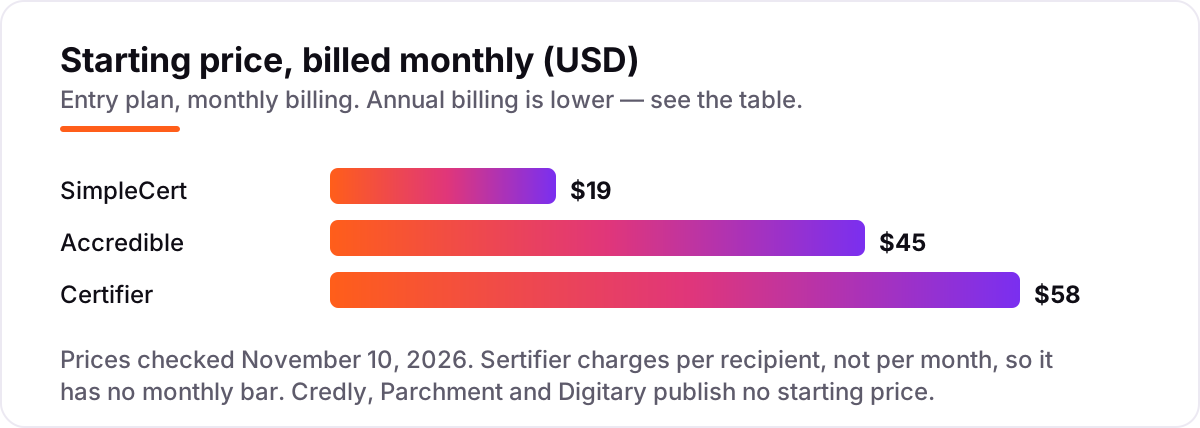
Take a training provider issuing 1,000 certificates to 1,000 different people in a year. On Certifier Professional, billed annually at $76 a month, the year costs $912, and the plan includes 1,000 credentials. On Sertifier, the first 250 recipients are free and the other 750 cost $1 each, so the year costs $750. On SimpleCert Basic at $19 a month, the year costs $228 for 1,800 credits, which covers the 1,000 certificates with room to spare. On Accredible Launch, the $45 a month plan covers only 50 recipients, so 1,000 recipients need the custom-priced Connect plan and cannot be priced from the page.
The same 1,000 certificates cost $228 at the cheap end and $912 on Certifier Professional, before any add-ons — and the cheapest option is not the best one for every buyer. SimpleCert issues PDF certificates, not Open Badges, so the $228 covers a different product from the $912. Sertifier's $750 sits in the middle, but it buys a full badge platform with verification pages and LinkedIn sharing, while Accredible's price for the same 1,000 people is a sales conversation, not a number.
Three costs sit outside every number above. First, the add-ons: a custom domain costs $99 a month extra on Certifier's lower tiers, and branding and advanced analytics are paid add-ons on Sertifier. Second, the contract: Accredible Launch is a 12-month term, and Parchment Digital Badges is sold on annual contracts, so the first year is a commitment, not a trial. Third, onboarding: Credly charges onboarding fees on top of its subscription, with user-reported year-one costs starting around $3,000 for 500 badges. Price the add-ons and the contract length before you compare the headline figures.
Know the difference: per credential, per recipient and per credit
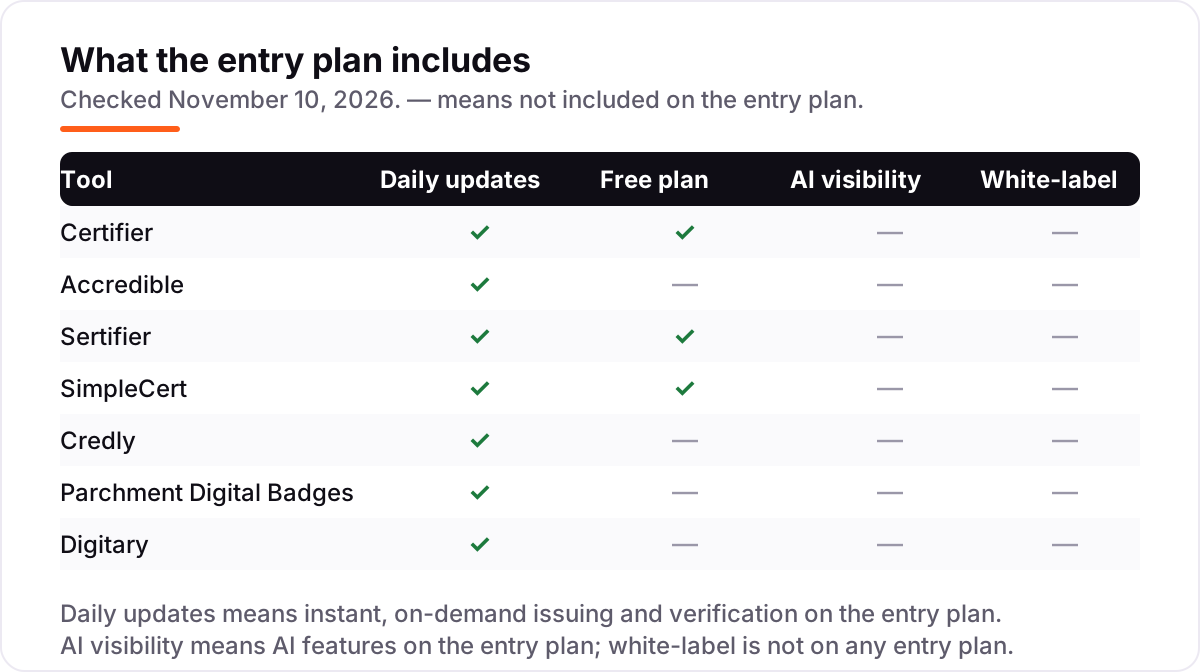
The confusion in this category is the pricing unit, because four tools that all do the same job charge in four different ways. Certifier charges per credential issued, so every certificate or badge counts. Accredible and Sertifier charge per unique recipient per year, so one person can receive five credentials for the price of one. SimpleCert charges per monthly credit, where one credit buys one certificate and unused monthly credits do not roll over, although bought credit packs never expire. Credly, Parchment and Digitary charge by custom quote, so there is no unit to compare at all until sales replies.
The practical rule is simple: count people first, then count credentials per person. If most people earn one certificate, per-credential pricing is the cheapest honest comparison. If one person earns a badge per module, per-recipient pricing wins, because the second, third and fourth credentials for that person are free. And if the volume is seasonal — a graduation week, then nothing for months — SimpleCert's non-expiring credit packs beat a monthly subscription that charges through the quiet months.
There is a second, quieter confusion: certificates and badges are not the same product. A certificate is a document, usually a PDF, that proves completion. A badge is a verifiable, portable credential, usually Open Badges 3.0, that an employer can check without contacting the issuer. SimpleCert sells certificates; the other six tools sell badges, certificates, or both. Buy the certificate tool when a PDF is enough, and buy a badge platform when verification matters.
One more check before you choose: open a credential you issued last year and confirm it still verifies. If the link is dead or the verification page has changed, the platform has broken the promise the credential makes, and no price saving is worth that.
Quick comparison: tool type by need
| Buyer | Best pick | Why |
|---|---|---|
| Most small training providers | Certifier | Free plan for 250 credentials a year, paid plans from $49/month billed annually |
| Blockchain credentials and analytics | Accredible | Blockchain included from Launch at $45/month for 50 recipients |
| Pay only for the people you credential | Sertifier | Free to 250 recipients a year, then $1 per extra recipient |
| Cheapest PDF certificates | SimpleCert | Basic is $19/month for 150 credits, with non-expiring credit packs |
| Badges employers already recognise | Credly | Largest public badge network, but custom quote only |
| Canvas institution | Parchment Digital Badges | Automatic badges from course completion, quote-only since 2026 |
| Official diplomas and transcripts | Digitary | Cryptographically signed academic records, custom quote |
Mistakes to avoid
- Budgeting on the headline price alone. A $45 tool that covers 50 recipients is not cheaper than a $58 tool that covers 1,000 credentials. Price the tool at your real annual volume, in your real unit.
- Calling Badgr free. Free Badgr issuing ended on January 1, 2026. Its successor, Parchment Digital Badges, is quote-only, and older articles that call Badgr free are out of date.
- Buying a certificate tool when you need badges. SimpleCert issues PDF certificates, not Open Badges. If employers must verify the credential, buy a badge platform, not a certificate maker.
- Forgetting the add-ons. A custom domain costs $99 a month extra on Certifier's lower tiers, and branding and analytics are paid add-ons on Sertifier. Check the add-on list before you commit.
- Signing a 12-month term before testing. Accredible Launch is a 12-month commitment and Parchment sells annual contracts. Use the free plan or trial first, and issue a real credential before signing.
How we chose
We checked each vendor's own pricing page on November 10, 2026 and recorded the starting price exactly as shown, including the annual-billing figure where the page lists one, and we ranked the tools by fit for the most common buyer — a small training provider or course creator issuing to a few hundred people a year — not by brand size. Sertifier publishes no flat monthly rate, so its $1-per-recipient figure comes from Sertifier's own site rather than a monthly price, and it appears as a custom price in the chart rather than a monthly bar. Ratings are shown only where a fresh G2 page gave a clear score and review count: Certifier, Accredible, Sertifier and Credly. Direct G2 page opens returned a rate-limit error on November 10, 2026, so those four ratings rest on fresh search-index copies of the exact G2 pages, crawled within the last three days. SimpleCert, Parchment Digital Badges and Digitary carry no rating here because no G2 page gave a verified score and review count. Badgr is not listed: free issuing ended on January 1, 2026 and the product now exists only as Parchment Digital Badges. No vendor paid for a place in this list, and none of the links here are affiliate links.
What to do next
Start with the free plan of your top pick and issue a real credential to a real person, then share it to LinkedIn and verify it from a second account. Check that the verification page opens without a login, that the design looks right on a phone, and that the recipient can find it again a week later. If the credential works, price the next 1,000 recipients before you pay for a year. Once your tools are in place, find out what's holding your rankings back.
Your stack only works if people find you
SerpAstra fixes what keeps your site off page one and makes it easy for AI assistants to recommend.
Get a free audit→Sources we checked (13)
- Certifier pricing — certifier.io/pricing (checked November 10, 2026)
- Accredible pricing — accredible.com/pricing (checked November 10, 2026)
- Sertifier pricing — sertifier.com/pricing (checked November 10, 2026)
- SimpleCert pricing — simplecert.net/pricing (checked November 10, 2026)
- Credly pricing — credly.com/pricing, demo request form, no published price (checked November 10, 2026)
- Parchment Digital Badges pricing — parchment.com, no published price list (checked November 10, 2026)
- Digitary — digitary.net, no published price list (checked November 10, 2026)
- Certifier on G2 — 4.6/5, 565 reviews (checked November 10, 2026)
- Accredible on G2 — 4.7/5, 136 reviews (checked November 10, 2026)
- Sertifier on G2 — 4.8/5, 226 reviews (checked November 10, 2026)
- Credly on G2 — 4.8/5, 446 reviews (checked November 10, 2026)
- Sertifier pricing model — sertifier.com/blog/best-certifier-alternatives (free to 250 recipients, then $1 per recipient)
- Parchment Digitary Services pricing — UK G-Cloud 15 price list, submitted by Instructure, January 2026
Shamim
Founder of SerpAstra
A full-stack SEO and digital marketer who spends most days on Local SEO for dental practices, AI search visibility and lead generation.
Frequently asked questions
What is the best digital credential management software?
Certifier is the best fit for most buyers: a free plan for 250 credentials a year, published prices from $49/month billed annually, and both certificates and badges. Accredible is the pick for blockchain credentials at $45/month, and Sertifier is the cheapest way to start, free to 250 recipients a year.
How much does digital credential management software cost?
From $0 to custom quote. Certifier and Sertifier both start free, SimpleCert starts at $19/month, Accredible at $45/month and Certifier's first paid plan at $49/month billed annually. Credly, Parchment Digital Badges and Digitary publish no price, so budget them through a sales quote.
Is there free digital credential management software?
Yes, with limits. Certifier issues 250 credentials a year free, Sertifier covers 250 recipients a year free, and SimpleCert gives 50 introductory credits. Accredible offers only a 20-recipient trial, and Credly, Parchment Digital Badges and Digitary have no free plan at all.
What happened to Badgr?
Badgr was bought by Instructure, became Canvas Credentials, and was rebranded as Parchment Digital Badges on October 31, 2025. Free issuing ended on January 1, 2026, and former free issuers were moved to read-only backpacks. New issuing now needs a paid Parchment contract, so Badgr is not a free option anymore.
Should I pay per credential or per recipient?
Pay per credential, like Certifier, when each person gets one certificate. Pay per recipient, like Accredible or Sertifier, when one person earns several credentials, because extra badges for the same person cost nothing more. Always price the tool at your real annual volume before comparing headline prices.
Do digital badges need Open Badges 3.0?
Not by law, but it matters for portability. Open Badges 3.0 certification means a badge can be verified and displayed outside the issuer's own platform. Credly, Accredible, Certifier, Sertifier and Parchment Digital Badges are all certified; SimpleCert is certificate-first and does not offer an Open Badges workflow.
Can I switch credential software later?
Yes, but plan the move carefully. Export your recipient lists, designs and issued-credential records first, then check whether old verification links keep working after you cancel. Certifier and Sertifier keep issued credentials valid after cancellation; Accredible credentials also stay active unless you set an expiry date.
Free SEO and AI visibility audit
Find out what is holding your rankings back
Send us your site. Within 2 business days you get a written audit, an AI visibility check and a short fix list ranked by impact. Free, with no contract attached.
Request my free audit→Related guides
 HR & Recruiting8 Best HR Software for Small Business in 2026, ComparedCompare the 8 best hr software for small business options on price, free plans, payroll and hiring, with every price checked November 6, 2026.Read guide →
 HR & Recruiting12 Best Recruiting Software for Small Business in 2026, ComparedCompare the 12 best recruiting software for small business options on price, free plans, job-board reach and AI features, with prices checked November 6, 2026.Read guide →
 HR & Recruiting12 Best Employee Performance Review Software in 2026, ComparedCompare the 12 best employee performance review software tools on price, reviews, calibration and AI features, with prices checked November 6, 2026.Read guide →