
10 Best Digital OOH Advertising Platforms in 2026, Compared
10 best digital ooh advertising platforms compared on real per-play and CPM prices, with no-minimum self-serve picks and enterprise options for 2026.
 Shamim Mia, Founder, SerpAstraLast verified November 4, 202615 min read
We compare pricing pages, documentation and public reviews. We never accept payment for rankings.

Key takeaways
- Blip is the cheapest way in at $0.01 per play with no minimum spend; Blindspot adds global hourly booking from $0.23 a play; Adomni shows all-in CPMs with no minimum spend.
- The single most important buying factor is the buying model: per-play self-serve for testing, CPM programmatic for scale, and a managed plan when you want a team to run it.
- Five of the ten platforms publish no starting price at all — enterprise DOOH is quote-only, so budget by CPM or per play, not by subscription.
- Every price below was checked on the vendor's own site on November 4, 2026. Only Vistar Media (4.5/5, 17 reviews) and Blip (2.1/5, 6 reviews) carry a verified G2 rating.
On this page
Quick comparison
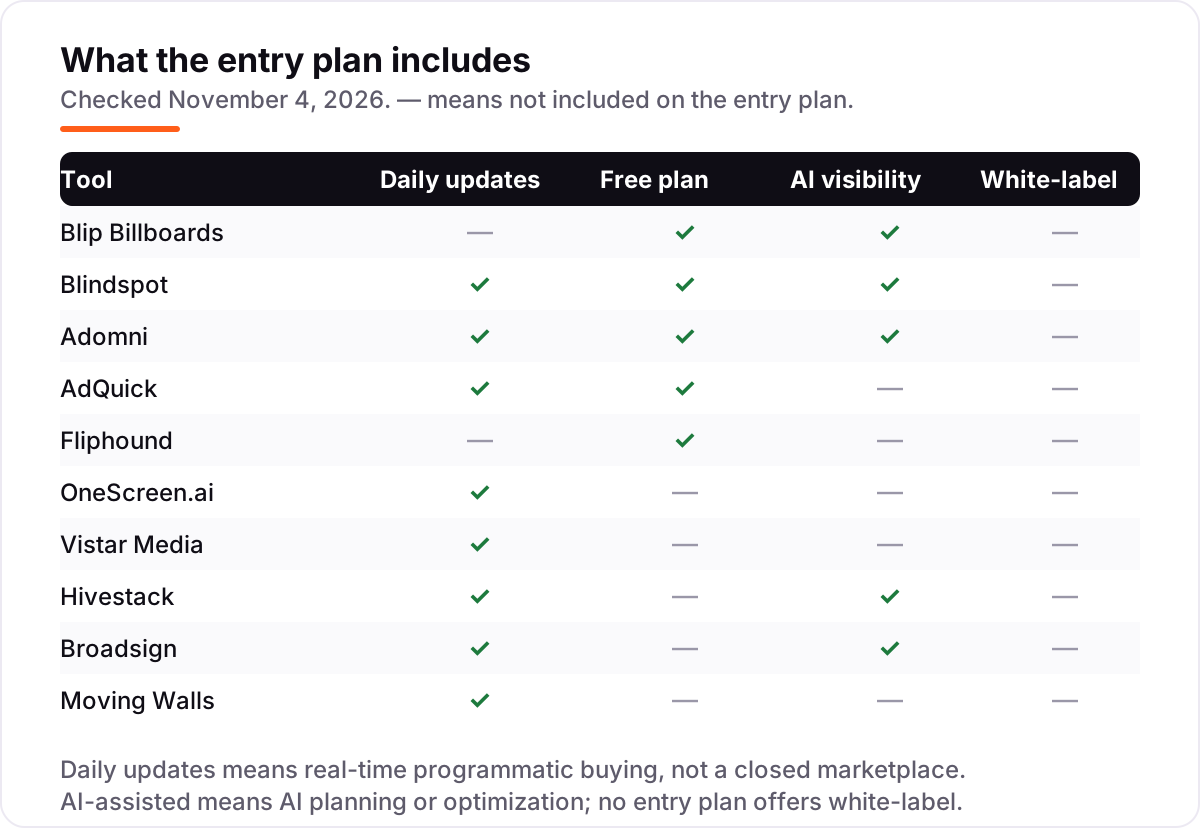
| Tool | Best for | Starting price | Free plan |
|---|---|---|---|
| Blip Billboards | Local businesses and event promoters who want the cheapest self-serve test on US digital billboards | $0 (pay per play) | Yes (free account) |
| Blindspot | Small brands and in-house marketers who want to book exact screens by the hour anywhere in the world | $0 (pay per play) | Yes (free account) |
| Adomni | Small and mid-size advertisers who want transparent CPM pricing and no minimum budget | $0 (pay per CPM) | Yes (free account) |
| AdQuick | Advertisers who want every format — static, digital, transit, airport — from every media owner in one plan | $0 (pay per flight) | Yes (free account) |
| Fliphound | Local advertisers in smaller US markets who want a set slot on a digital board without a contract | $0 (pay per slot) | Yes (free account) |
| OneScreen.ai | B2B and DTC brands that want a managed OOH plan built around their audience, not a self-serve map | Custom quote | No (consultation) |
| Vistar Media | Agencies and enterprise brands running programmatic DOOH at national or global scale | Custom quote | No (demo) |
| Hivestack | Agencies that want a full-stack programmatic DOOH platform — DSP and SSP — under one roof | Custom quote | No (demo) |
| Broadsign | Media owners and large networks that run their own screens and sell the inventory programmatically | Custom quote | No (call) |
| Moving Walls | Brands expanding into Southeast Asia that need programmatic OOH across Singapore, Malaysia and Thailand | Custom quote | No (request) |
Make one of these tools?
We re-check this list every quarter. Send a correction, request a review, or ask about a clearly labeled sponsored spot.
Request a listingThe best digital OOH advertising platforms

Blip Billboards
Best for: Local businesses and event promoters who want the cheapest self-serve test on US digital billboards
Blip is the cheapest door into digital billboards, and the model is simple: you pay only when your ad actually plays. Each blip is a 7.5-to-10-second spot on a rotating digital board, priced from $0.01, and you set a daily budget that the platform bids with. Recent Texas campaigns often spent about $25 a day, which makes a genuine test affordable for a local shop or an event promoter.
The honest catch is the review record. Blip scores 2.1 out of 5 on G2 from only 6 reviews, and several reviewers say their ad did not appear when expected and support was slow to answer. Start with a small daily budget, pick boards you can drive past yourself, and check the play reports before you scale.
What we like
- Cheapest entry in this list: plays start at $0.01, with no minimum spend and no contract
- You pick exact boards on a map and set a daily budget, or let Blip Optimized choose boards for you
- Recent Texas campaigns often spent about $25 a day, so a real test costs very little
Watch out for
- G2 reviewers report ads sometimes not appearing as scheduled, with slow email-only support when it happens
- Inventory covers the US and parts of Canada only, so it cannot run an international campaign

Blindspot
Best for: Small brands and in-house marketers who want to book exact screens by the hour anywhere in the world
Blindspot is the most precise way to buy digital screens without an agency. Pick screens on a map, paint the hours each one runs, set a budget, and publish — the per-play price is shown for every screen before you book, from $0.23 a play in urban markets. The network covers more than 3,000,000 screens in 50-plus countries, and a campaign goes live in about 48 hours after screen-owner approval.
Hourly buying is the feature that matters: you skip the empty hours a full-day flight pays for, which the vendor says removes 30 percent or more of the waste. The free AI planner, Blinky, drafts a plan from a one-line brief if you would rather start from a suggestion than a blank map. Digital screens only, so a static board or painted wall needs a second source.
What we like
- Book exact screens by the hour across 3,000,000+ screens in 50+ countries, with the per-play price shown before you book
- Hourly buying drops the empty hours a full-day flight pays for, which the vendor says removes 30% or more of the waste
- Blinky, the free AI planner, drafts a plan from a one-line brief, and campaigns go live in about 48 hours
Watch out for
- Digital screens only — no static bulletins, painted walls or printed transit, so a classic static buy needs a second source
- Per-play prices vary by screen and city, so the same budget buys very different reach in different markets

Adomni
Best for: Small and mid-size advertisers who want transparent CPM pricing and no minimum budget
Adomni is the self-serve DSP for advertisers who want to see the price before they commit. Its help center publishes an average CPM grid by venue type — digital billboards average $7.29, gyms $7.55, offices $18.78 — and the all-in CPM bundles media, the platform fee, audience data and concierge service with no add-on fees. There is no minimum budget for nearly all inventory, and you pay only for the impressions that are served.
The newer self-serve flow adds Jeen AI, which plans the campaign from your goals, and credit-card payment with launch in under five minutes. The trade-off is that the published CPMs are averages, so the blended cost of a mixed-venue plan is hard to predict until you build it. Build the plan first and read the per-screen prices before you set the budget.
What we like
- No minimum budget or spend requirement for nearly all inventory, with all-in CPMs shown per screen while you plan
- The flat CPM bundles media, platform fee, audience data and concierge service, with no add-on fees
- Jeen AI plans the campaign from your goals, and campaigns can launch in under 5 minutes with credit-card payment
Watch out for
- Average CPMs are from the vendor's own grid and vary by venue — office buildings average $18.78 while gyms average $7.55, so the blended cost is hard to predict
- No G2 product page was found, so there is no independent review score to check against

AdQuick
Best for: Advertisers who want every format — static, digital, transit, airport — from every media owner in one plan
AdQuick is a marketplace, not a single media owner, and that is why it leads on range. One plan covers static bulletins, digital boards, transit, street furniture, wallscapes, mobile and airport inventory from Lamar, Clear Channel Outdoor, OUTFRONT and independents, under one contract and one invoice. Prices are transparent CPMs with Geopath-verified impressions and live availability, and there is no minimum-spend requirement — you can buy a single unit.
The catch is the size of a real flight in a major market: a digital share-of-voice flight in Seattle runs $2,500 to $8,500 per four weeks, so this is not a $100 test. Use AdQuick when you want one plan across many vendors and formats, and use a per-play platform when you want to test a single board for the price of lunch.
What we like
- No minimum-spend requirement: buy a single unit or build a multi-vendor plan under one contract and one invoice
- Transparent CPMs with Geopath-verified impressions and live availability across Lamar, Clear Channel Outdoor, OUTFRONT and independents
- Covers static, digital, transit, street furniture, wallscapes, mobile and airport inventory plus programmatic DOOH
Watch out for
- A single digital flight in a major metro runs $2,500-$8,500 per four weeks, so it is not a small test budget
- Buying across many vendors in one plan means learning one marketplace instead of one media owner's rate card

Fliphound
Best for: Local advertisers in smaller US markets who want a set slot on a digital board without a contract
Fliphound sells digital billboard slots the way a hotel sells rooms: pick a market, pick a slot size, pick one, two or four weeks, and the price is published. A quarter slot in Cedar Rapids runs $228 for one week, a half slot $455, and a full slot $910, with longer flights cheaper per week. It is pay-as-you-go with no budget minimum and no long-term contract, and you change creative online whenever you want.
The limitation is that rates are published per market, so there is no single national price to budget against — the same slot costs more in a busy market than a quiet one. There is also no G2 review score to check. Fliphound fits a local advertiser in a smaller market who wants a set slot on a known board, not a national programmatic buy.
What we like
- Pay-as-you-go with no budget minimum and no long-term contract, on a national network of digital boards
- Slot pricing is published per market — for example $228 for a 1-week quarter slot in Cedar Rapids
- You choose the boards on a map, schedule by daypart, and change creative online whenever you want
Watch out for
- Rates are published per market, so there is no single national price to budget against — the same slot costs more in a busy market
- No G2 product page was found, so there is no independent review score to check against

OneScreen.ai
Best for: B2B and DTC brands that want a managed OOH plan built around their audience, not a self-serve map
OneScreen.ai is a managed service, not a self-serve map, and it sells planning rather than screens. The team starts from where your buyers live, work and commute, then builds the plan across vendors, contracts and timelines. Its cost guide is unusually honest: digital bulletins run from $1,500 a month in smaller markets to $50,000-plus for premium units in top metros, with static from $750.
That honesty is the point — the guide warns that a $5,000 board in front of the wrong audience is worse than a $12 CPM that reaches your buyers every weekday. The trade-off is access: there is no self-serve signup or published starting price, so every engagement starts with a sales conversation. Choose it when you want a team to run OOH, not another dashboard to learn.
What we like
- Audience-first planning: the plan starts from where your buyers live, work and commute, not from a list of boards
- Publishes honest market ranges — digital bulletins from $1,500 a month in smaller markets to $50,000+ in top metros
- Handles the fragmented buy for you: vendors, contracts, timelines and creative specs across many operators
Watch out for
- Managed plans mean a sales conversation first — there is no self-serve signup or published starting price
- No G2 product page was found for the OOH platform itself, so there is no independent review score to check against

Vistar Media
Best for: Agencies and enterprise brands running programmatic DOOH at national or global scale
Vistar Media is the infrastructure behind much of programmatic digital out-of-home. It runs the DSP buyers use, the SSP media owners sell through, and the ad server in between, which is why its name appears on almost every programmatic deal. T-Mobile bought the company in 2025, and in October 2026 it opened T-Mobile audience segments built on carrier data exclusively through Vistar's DSP.
It also carries the highest verified rating in this list: 4.5 out of 5 on G2 from 17 reviews, with support praised most and the dashboard flagged as the weak spot. The barrier is the model — enterprise contracts and a DSP seat, with no published price and no self-serve signup. Vistar fits an agency or a brand buying DOOH at national scale, not a single advertiser testing one market.
What we like
- Runs both the DSP and the SSP, plus an ad server, so it is the infrastructure behind much of programmatic DOOH
- T-Mobile audience segments built on carrier data are available only through Vistar's DSP, announced October 2026
- Highest verified rating in this list: 4.5/5 on G2 from 17 reviews, with support praised most
Watch out for
- Enterprise contracts and a DSP seat are the way in — there is no self-serve signup for a single advertiser
- G2 reviewers note the planning tool resets its view when you change perspective, and some reporting metrics are unclear

Hivestack
Best for: Agencies that want a full-stack programmatic DOOH platform — DSP and SSP — under one roof
Hivestack is a full-stack programmatic DOOH platform, now part of Perion, covering both sides of the trade: a DSP for buyers and an SSP with an ad exchange for media owners. Buying runs on real-time bidding, with open exchange and private marketplace deals, and the platform offers pre-built demographic and behavioral audience segments plus geofencing around points of interest. US programmatic DOOH spend was forecast at $875.1 million for 2024, up 36.1 percent year on year, per eMarketer — the market Hivestack is built for.
Measurement is the differentiator: footfall and brand-awareness lift studies show whether the campaign moved store visits, not just impressions. The barrier is access — no published pricing, no self-serve price list, and no G2 review score. It fits an agency that wants one platform for planning, buying and measurement at programmatic scale.
What we like
- Full-stack platform: a DSP for buyers and an SSP with an ad exchange for media owners, now part of Perion
- Real-time bidding with open exchange and private marketplace deals, plus pre-built demographic and behavioral audience segments
- Footfall and brand-awareness lift studies measure whether the campaign moved store visits, not just impressions
Watch out for
- No published pricing and no self-serve price list — access runs through sales and the platform is built for agency volume
- No G2 product page was found, so there is no independent review score to check against

Broadsign
Best for: Media owners and large networks that run their own screens and sell the inventory programmatically
Broadsign is the platform media owners run their networks on, which makes it a different kind of entry in this list: advertisers usually reach its inventory through a DSP rather than signing up directly. It handles content scheduling, inventory management, proof-of-play reporting and programmatic selling in one system, and it acquired Place Exchange in November 2025, combining that SSP supply with Broadsign Reach into about 1.8 million transactable screens.
Its optimization engine reallocates campaigns to fill gaps in a schedule, which Broadsign says helps owners book 10 percent more campaigns. The catch for a buyer is that there is no published pricing and no overall G2 star score, so budgeting starts with a discovery call. Pick Broadsign if you run screens and want to sell them; buy its inventory through your DSP if you are an advertiser.
What we like
- The platform media owners run on: content scheduling, inventory management, proof-of-play reporting and programmatic selling in one place
- Acquired Place Exchange in November 2025, combining its SSP supply with Broadsign Reach into about 1.8 million transactable screens
- An optimization engine reallocates campaigns to fill gaps, which Broadsign says helps owners book 10% more campaigns
Watch out for
- Built for media owners first — advertisers buy its inventory through a DSP, not by signing up on Broadsign itself
- No published pricing and no overall G2 star score, so budgeting starts with a discovery call

Moving Walls
Best for: Brands expanding into Southeast Asia that need programmatic OOH across Singapore, Malaysia and Thailand
Moving Walls is the programmatic OOH platform to know if your audience is in Southeast Asia. One plan can run across Thailand, Singapore, Malaysia, Indonesia and more, with reach and impressions reported by screen, and every screen is digital and traded programmatically. Campaigns launch in days rather than weeks, creative can change by location and time of day, and flights can be adjusted while they run.
The coverage caveat matters: in Thailand the network is Bangkok-only for now, concentrated in the Siam shopping district, so a national Thai plan is really a capital-city plan. There is no published pricing and no G2 review score, so rates come from the sales team per plan. Choose it for a multi-market Asia plan; choose a US self-serve platform for a single American city.
What we like
- One plan can run across Thailand, Singapore, Malaysia, Indonesia and more, with reach and impressions reported by screen
- Every screen is digital and traded programmatically, with dayparting and creative that changes by location and time of day
- Campaigns launch in days rather than weeks, with no printing or installation, and flights can be adjusted while running
Watch out for
- Its Thailand network is Bangkok-only for now, so a national Thai plan is really a capital-city plan
- No published pricing and no G2 product page, so rates come from the sales team per plan
This list is for advertisers who want screens in the real world — roadside digital billboards, mall panels, transit displays and place-based screens — and want to know what each platform actually charges. The ten best digital ooh advertising platforms below are sorted by fit for the most common buyer: a small or mid-size advertiser testing the channel first, then the enterprise platforms that run it at scale.
What the best digital ooh advertising platforms actually sell
Every platform here sells the same thing in the end — an ad on a screen outside the home — but they sell it in three different ways. Self-serve marketplaces such as Blip, Blindspot and Fliphound let you pick screens, set hours and pay per play or per slot. Self-serve DSPs such as Adomni and AdQuick price by CPM or by flight and show the rate before you commit. Enterprise platforms such as Vistar Media, Hivestack and Broadsign are the pipes: they run the auctions and the ad serving, usually through an agency or a DSP seat.
The channel is growing fast on the programmatic side. US programmatic DOOH ad spend was forecast to reach $875.1 million by the end of 2024, up 36.1 percent year on year, according to an eMarketer forecast from December 2023 cited by Hivestack. That growth is why the list splits the way it does: the self-serve tools are where you test, and the programmatic platforms are where you scale.
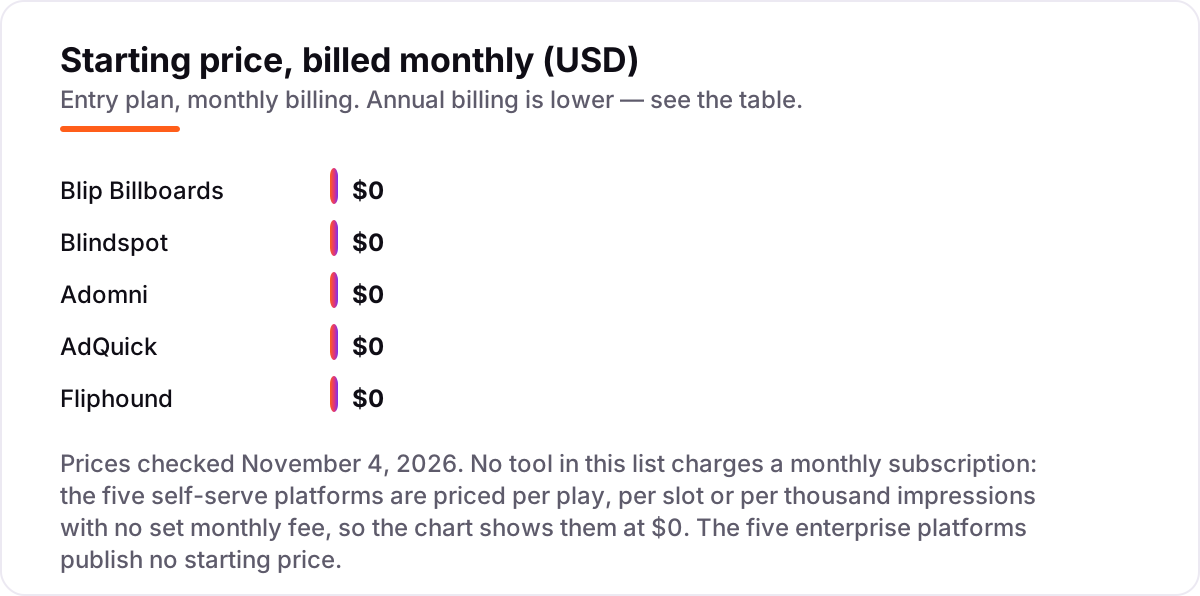
One more thing to know before the prices: nobody in this list charges a monthly subscription. You pay per play, per slot, per thousand impressions or per flight — or you negotiate an enterprise contract. That is why five of the ten starting prices below read as no minimum spend, and the other five read as custom quote.
Digital OOH advertising platforms pricing: what you will actually pay
Take a $3,000 test month and run it through the numbers on the cards. On Blip at $0.01 a play, $3,000 buys 300,000 plays at the floor price — in practice fewer, because prime-time plays cost more than the overnight floor. On Adomni at the $7.29 average digital-billboard CPM, the same $3,000 buys about 411,500 impressions (3,000 divided by 7.29, times 1,000). On Blindspot at $0.23 a play, it buys about 13,000 plays. And one AdQuick digital flight in Seattle runs $2,500 to $8,500 for four weeks, so $3,000 covers the low end of a single market flight.
Now stretch it to a year. Twelve months at $3,000 a month is $36,000 in media. Add creative once — OneScreen puts design at $300 to $1,000-plus — and the first-year total is $36,300 to $37,000 before any platform fee. The enterprise route is steeper: one Seattle digital flight at $2,500 to $8,500 per four-week cycle, run for all 13 cycles in a year, costs $32,500 to $110,500 for a single board. That gap is the whole decision: a per-play test measures the channel for the price of a flight, and a flight is what you buy once the test works.
Know the difference: a self-serve marketplace vs a programmatic exchange
The confusion in this category is that two very different products share the name platform. A self-serve marketplace — Blip, Blindspot, Fliphound, Adomni, AdQuick — is where the advertiser sits: you see the screens, you see the price, you set the budget, you publish. A programmatic exchange — Vistar Media, Hivestack, Broadsign Reach — is where the inventory is traded: media owners list screens, DSPs bid on impressions in real time, and the winning creative is served without anyone exchanging an email.
That split decides who each tool is for. If you are the advertiser, you need a marketplace or a DSP with a self-serve seat. If you run screens, you need the exchange side — Broadsign is built for media owners first, and advertisers reach its inventory through a DSP. Buying the wrong side is the most common mistake here: signing an enterprise contract when a $25-a-day test would have answered the question, or expecting a marketplace to give you the audience segments that only live inside Vistar's DSP.
How to choose the right platform
- Start from the buying model, not the brand. Per play for a first test, CPM programmatic for a scaled flight, managed for a hands-off plan.
- Check the minimum before the features. Five platforms here state no minimum spend; the other five are quote-only, which is a minimum in practice.
- Match the inventory to the audience. Roadside boards for commuters, place-based screens for dwell time, airport and transit for travelers — the venue list matters more than the screen count.
- Demand proof of play. Every appearance should be logged with a screen, a time and a place. If a platform reports only modelled impressions, treat the numbers as estimates.
- Read the review record in full. Blip's 2.1 out of 5 on G2 comes from only 6 reviews, and Vistar's 4.5 from 17 — small samples, but they are the only verified scores in this list.
- Price the creative separately. A static board needs print and install at $500 to $1,500 per board; a digital board needs none of that, which is part of why digital tests are cheap to start.
Before you book, check the timing of your campaign against our local SEO service — screens drive searches, and the businesses that gain most are the ones whose local listings are ready for the extra attention. And if you are still weighing formats, our guide to the best digital billboard advertising companies covers the media owners behind many of these platforms.
Quick comparison: tool type by need
| Buyer | Best pick | Why |
|---|---|---|
| Local business testing one city | Blip or Fliphound | Pay-as-you-go, no minimum, published per-market prices |
| Small brand buying exact screens by the hour | Blindspot | From $0.23 a play, hourly scheduling, 3,000,000+ screens |
| Advertiser who wants the CPM upfront | Adomni | All-in CPM grid by venue, no minimum spend |
| Multi-format plan across many vendors | AdQuick | Every format, one contract, no minimum spend |
| Brand that wants a managed plan | OneScreen.ai | Audience-first planning, honest market ranges |
| Agency buying programmatic at scale | Vistar Media or Hivestack | DSP plus SSP infrastructure, lift measurement |
| Media owner selling its own screens | Broadsign | Scheduling, proof of play and programmatic selling in one system |
| Multi-market campaign in Southeast Asia | Moving Walls | One plan across Thailand, Singapore, Malaysia and more |
How we chose
We checked each vendor's own site on November 4, 2026 and recorded the price exactly as shown. Five platforms publish no starting price at all, so they are listed as custom quote — Vistar Media, Hivestack, Broadsign, OneScreen.ai and Moving Walls. The other five charge per play, per slot or per thousand impressions with no set monthly fee, so they carry a $0 monthly figure with the per-unit price in the card. Ratings are shown only where we opened the G2 page on November 4: Vistar Media at 4.5 out of 5 from 17 reviews and Blip at 2.1 out of 5 from 6 reviews. No G2 product page was found for AdQuick, Adomni, Blindspot, Fliphound, Hivestack or Moving Walls, OneScreen's G2 listing belongs to a different product called OneScreen Hype, and Broadsign's G2 page shows no overall star score — so those eight carry no rating rather than an estimate. One conflict is worth naming: another guide quotes a $1,500 AdQuick test minimum, but AdQuick's own Seattle guide states it has no minimum-spend requirement, and the vendor's own page wins. Fliphound's $228 example rate comes from its published per-market rate table. Place Exchange is not listed separately because Broadsign acquired it in November 2025. We ranked by fit for the most common buyer — a small or mid-size advertiser testing the channel — not by brand size, and no vendor paid for a place in this list. Before you publish the landing page your screens will point to, run it through the free SERP snippet preview tool to check how it will look in search.
What to do next
Start with a per-play test, not a contract: open a free account on Blip or Blindspot, pick a handful of boards near your customers, and run $25 to $50 a day for two weeks. If the play reports and the foot traffic look right, move the budget to Adomni or AdQuick for a CPM-priced flight in the same area. If the test works at scale, that is the moment to talk to Vistar or Hivestack about programmatic buying. Once your tools are in place, find out what's holding your rankings back.
Your stack only works if people find you
SerpAstra fixes what keeps your site off page one and makes it easy for AI assistants to recommend.
Get a free audit→Sources we checked (12)
- Blip Billboards Texas pricing — blipbillboards.com (checked November 4, 2026)
- Blip Billboards on G2 — 2.1/5, 6 reviews (checked November 4, 2026)
- Blindspot first DOOH campaign guide — seeblindspot.com (checked November 4, 2026)
- Adomni pricing of DOOH inventory — adomni.com (checked November 4, 2026)
- AdQuick Seattle outdoor advertising guide — adquick.com (checked November 4, 2026)
- Fliphound Cedar Rapids rates — fliphound.com (checked November 4, 2026)
- OneScreen.ai billboard cost guide 2026 — onescreen.ai (checked November 4, 2026)
- Vistar Media homepage — vistarmedia.com (checked November 4, 2026)
- Vistar Media on G2 — 4.5/5, 17 reviews (checked November 4, 2026)
- Hivestack guide to buying programmatic DOOH — hivestack.com (checked November 4, 2026)
- Broadsign DOOH platform — broadsign.com (checked November 4, 2026)
- Moving Walls Thailand DOOH — movingwalls.com (checked November 4, 2026)
Shamim
Founder of SerpAstra
A full-stack SEO and digital marketer who spends most days on Local SEO for dental practices, AI search visibility and lead generation.
Frequently asked questions
How much does digital OOH advertising cost?
It depends on the buying model. Per-play platforms start at $0.01 a play on Blip and $0.23 on Blindspot, with no minimum spend. CPM programmatic buys run roughly $5 to $18 on digital billboards in most US markets, and a single digital flight in Seattle costs $2,500 to $8,500 for four weeks on AdQuick.
What is the cheapest digital OOH advertising platform?
Blip Billboards, at $0.01 per play with no minimum spend and no contract. Blindspot is next at about $0.23 a play, with hourly booking and no minimum. Both let you test one board for the price of lunch, but Blip's G2 rating is only 2.1 out of 5 from 6 reviews, so start small and check the play reports.
Is there a free digital OOH advertising platform?
No platform gives away free ad plays, but five of the ten offer a free account to browse inventory and build a plan: Blip, Blindspot, Adomni, AdQuick and Fliphound. You only pay when the campaign runs. The enterprise platforms — Vistar, Hivestack, Broadsign, OneScreen and Moving Walls — start with a sales conversation instead.
Do I need a minimum budget for digital OOH advertising?
Not on the self-serve platforms. Blip, Blindspot, Adomni and AdQuick all state no minimum spend, and Fliphound is pay-as-you-go with no budget minimum. The enterprise platforms are different: they are quote-only, and the spend that makes sense there is usually four figures a month or more.
What is the difference between DOOH and programmatic DOOH?
DOOH is the medium — ads on internet-connected screens outside the home. Programmatic DOOH is a way of buying it: software bids for impressions in real time instead of a person negotiating a four-week flight. Vistar, Hivestack and Broadsign Reach are programmatic infrastructure; Blip and Fliphound are self-serve marketplaces that price per play or per slot.
How do you measure a digital OOH campaign?
Start with proof of play: a log of every appearance with its screen, time and place. Then add audience data — Geopath-verified impressions on AdQuick, footfall lift studies on Hivestack — and a business metric such as store visits or search lift. If a platform cannot show you verified plays, do not renew the flight.
Which digital OOH platform is best for a local business?
Blip or Fliphound for a single US city, because both are pay-as-you-go with no minimum and publish per-market prices. Blindspot is the pick if you want hourly control or screens outside North America. Skip the enterprise platforms until one city is working — their contracts and minimums are built for agencies, not a first test.
Free SEO and AI visibility audit
Find out what is holding your rankings back
Send us your site. Within 2 business days you get a written audit, an AI visibility check and a short fix list ranked by impact. Free, with no contract attached.
Request my free audit→Related guides
 Digital Marketing & Ads7 Best Digital Billboard Advertising Companies in 20267 best digital billboard advertising companies compared: custom-quote networks, self-serve prices from $0.01 a blip, and which one fits your budget.Read guide →
 Digital Marketing & Ads10 Best Digital Advertising Platforms in 2026, ComparedCompare the 10 best digital advertising platforms on price, minimum budgets, targeting and AI tools — every figure checked November 4, 2026.Read guide →
 Companies & Services11 Best Digital Signage Companies in 2026Compare the 11 best digital signage companies on per-screen price, free plans and hardware, with every price checked November 4, 2026, before you buy.Read guide →