
8 Best Digital Out of Home Advertising Platforms in 2026, Compared
The 8 best digital out of home advertising platforms compared on price, buying model and reach — with real pricing checked November 4, 2026.
 Shamim Mia, Founder, SerpAstraLast verified November 4, 202615 min read
We compare pricing pages, documentation and public reviews. We never accept payment for rankings.

Key takeaways
- Vistar Media is the short-list leader for programmatic buying at scale; AdQuick is the most transparent first buy, with self-serve tests from $1,500; Adomni and Blip are the cheapest ways in, with no minimum spend.
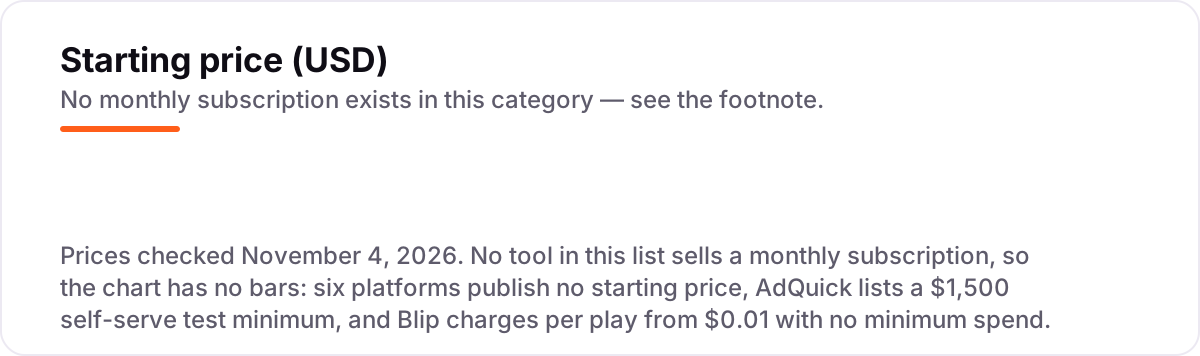
- Six of the eight platforms publish no starting price at all — DOOH is sold by CPM, per play or by quote, not by monthly subscription.
- The single most important buying factor is the buying model: a DSP buys programmatically across exchanges, an SSP sells the screens, and a marketplace sells its own inventory — pick the model before the vendor.
- No ratings appear in this list: G2 rate-limited our verification checks on November 4, 2026, so we left ratings out rather than print scores we could not verify that day.
On this page
Quick comparison
| Tool | Best for | Starting price | Free plan |
|---|---|---|---|
| Vistar Media | Agencies and brands running multi-market programmatic DOOH campaigns who need scale and audience targeting | Custom quote | No |
| AdQuick | Advertisers and agencies who want programmatic and direct OOH in one seat with transparent per-unit pricing | $1,500 test min. | No (tests from $1,500) |
| Adomni | Small businesses and marketers who want self-serve DOOH with no minimum spend and AI-assisted planning | No minimum (CPM) | No |
| Blip | Local advertisers testing digital billboards on the smallest possible budget | $0.01/blip | No (free account) |
| Place Exchange | Omnichannel teams buying DOOH inside their existing DSP alongside display and video | Custom quote | No |
| OneScreen.ai | Brands and agencies who want a managed OOH plan, especially across place-based venue screens | Custom quote | No (free consult) |
| Taggify | OOH-specialist buyers and agencies who plan campaigns around geography, moments and triggers | Custom quote | No |
| Broadsign | Media owners and enterprise teams running their own screen networks at scale | Custom quote | No |
Make one of these tools?
We re-check this list every quarter. Send a correction, request a review, or ask about a clearly labeled sponsored spot.
Request a listingThe best digital out of home advertising platforms

Vistar Media
Best for: Agencies and brands running multi-market programmatic DOOH campaigns who need scale and audience targeting
Vistar Media is the default starting point for programmatic digital out of home advertising. Its demand-side platform buys across media-owner inventory in more than 25 countries, and because Vistar also runs a supply-side platform, the same company sits on both sides of the trade. Since T-Mobile completed its acquisition of Vistar in February 2025, the DSP also carries audience segments built on T-Mobile carrier data, available only through Vistar.
The trade-off is that Vistar is an enterprise sale, not a self-serve signup: pricing is set per order form, with no published rates, and smaller buyers usually reach it through an agency seat. Delivery is proven at scale — about 12 billion monthly impressions. Buy Vistar when programmatic DOOH is a recurring line on the media plan; for a one-off local test, the self-serve tools below cost less and move faster.
What we like
- DSP plus SSP under one roof: programmatic buying across media-owner inventory in 25+ countries, processing 12 billion monthly impressions
- T-Mobile audience segments built on carrier data, available exclusively through the Vistar DSP since October 2026
- Transparent reporting: the platform measures won chances on the RTB standard and is the system of record for delivery
Watch out for
- No published pricing — fees are set per order form, and smaller buyers usually need an agency seat or a managed deal
- Enterprise onboarding: no self-serve signup or free trial for new buyers

AdQuick
Best for: Advertisers and agencies who want programmatic and direct OOH in one seat with transparent per-unit pricing
AdQuick is the most transparent way to buy outdoor advertising without an agency. It works as both a programmatic DSP and a direct marketplace, so one seat covers open-exchange buys across every major supply-side platform and direct bookings with more than 100 media owners, from Lamar and OUTFRONT to Clear Channel. Every unit shows live CPMs and four-week rates before you commit.
Pricing is the honest differentiator. AdQuick publishes a $1,500 self-serve test minimum for a single-market, 30-day flight, with digital billboard CPMs typically running $4 to $12 and place-based screens $6 to $30. That makes it the best first step for a team that wants programmatic buying with real prices attached, rather than a quote behind a sales call.
What we like
- One seat for programmatic and direct: DSP access across every major SSP plus direct bookings with 100+ media owners
- Live CPMs and four-week rates shown on every unit before you commit, with no hidden markups
- Built-in mobile attribution, creative production and proof of performance in the same workflow
Watch out for
- Self-serve tests start around $1,500, so it is not the cheapest first test — Blip and Adomni start lower
- Direct buys still need operator quotes back within 24–48 hours; not everything is instant

Adomni
Best for: Small businesses and marketers who want self-serve DOOH with no minimum spend and AI-assisted planning
Adomni is the self-serve option for marketers who want DOOH to feel like buying Facebook ads. Its AI assistant, Jeen AI, turns a brand goal into a campaign strategy, forecasts spend and recommends inventory, and a campaign can launch in under five minutes with a credit card — no contracts, no credit lines and no minimum spend. The platform covers DOOH plus connected TV and online video, so one plan can run screens and video together.
Pricing is CPM-based and shown as a single all-in gross CPM per screen, combining media-owner rates, the platform fee, audience data and concierge services. Adomni's own pricing page lists average CPMs from $3.94 for a bar jukebox to $23.54 for a spectacular, though the page notes prices are subject to change. The catch: you buy inside Adomni's marketplace, not the open exchange.
What we like
- No minimum spend and no contracts — launch with a credit card in under five minutes
- Jeen AI builds the strategy, forecasts spend and recommends inventory from a plain-language goal
- Single all-in CPM per screen covers media, platform fee, data and concierge — no add-on fees
Watch out for
- You buy inside Adomni's marketplace, not the open exchange, so some premium inventory is out of reach
- CPM averages on its pricing page are dated and marked subject to change, so budget on live in-platform prices

Blip
Best for: Local advertisers testing digital billboards on the smallest possible budget
Blip is the cheapest way onto a real digital billboard. You set a daily budget — there is no minimum spend and no contract — and the platform bids for open slots on rotating digital boards, charging per play, or 'blip', from about $0.01 each. Each blip is a 7.5- to 10-second display, and recent Texas campaigns often spent about $25 a day.
The model is honest about its limits. You are buying leftover rotation slots, not guaranteed placement, so a board may show your ad a few times a day or not at all, and the cost per play varies by time, location and demand. For a local business testing whether billboards move the needle, nothing else in this list starts this cheap — but treat it as a test channel, not a guaranteed buy.
What we like
- Cheapest entry here: plays from about $0.01, no minimum spend and no contract
- Pick your own boards from a map or let Blip Optimized choose signs for your budget
- Hourly and daypart scheduling, with campaigns you can pause or stop at any time
Watch out for
- You buy leftover rotation slots, not guaranteed placement — a board may show your ad rarely or not at all
- Roadside digital billboards and place-based screens only; no static bulletins, posters or wallscapes

Place Exchange
Best for: Omnichannel teams buying DOOH inside their existing DSP alongside display and video
Place Exchange is the supply side of programmatic DOOH: the supply-side platform that connects media owners' screens to the DSPs buyers already use, including The Trade Desk and Google DV360. It now sits inside Broadsign, which acquired it in November 2025, combining its inventory with Broadsign's platform to reach about 1.8 million programmatically transactable screens. Its PerView measurement ties screen exposure to mobile-device data for attribution.
As a buyer you never log into Place Exchange directly — its inventory reaches you through your DSP, which is exactly the point. One workflow covers DOOH and display, with open-auction, private-marketplace and programmatic-guaranteed deals, including guaranteed buying inside DV360 since December 2025. The trade-off is control: you are buying through intermediaries, so screen-level curation depends on your DSP's deal setup. Choose it when DOOH must live inside an omnichannel programmatic plan.
What we like
- Largest premium DOOH supply pool in this list — about 1.8 million programmatically transactable screens
- Buy DOOH inside the DSP you already use (DV360, The Trade Desk), with open auction, PMP and programmatic guaranteed
- PerView measurement ties screen exposure to mobile-device data for unified attribution with online channels
Watch out for
- Sell-side platform: buyers never log in directly, so screen-level curation depends on your DSP's deal setup
- No published pricing — costs are set by the auction or the guaranteed deal, not a rate card

OneScreen.ai
Best for: Brands and agencies who want a managed OOH plan, especially across place-based venue screens
OneScreen.ai is the managed route into out-of-home advertising: a tech-enabled platform that plans, buys and measures OOH campaigns for brands and agencies, covering billboards, transit, street stencils and place-based venue screens. Instead of handing you a self-serve dashboard, its planning team builds the media plan around your audience — where they already spend time — and handles vendor relationships, creative specs and reporting under one point of contact.
That service model is the point and the price. OneScreen publishes no rates and works on custom plans, so budgeting starts with a conversation, not a checkout. It is strongest on place-based and venue inventory — bars, restaurants, cinemas and arenas — where buying well means matching venue category to audience pattern. Pick OneScreen when you want a planned OOH campaign without building the buying muscle in-house.
What we like
- Managed planning and buying under one point of contact — no self-serve learning curve
- Strongest on place-based venues: bars, restaurants, cinemas, arenas and entertainment districts
- Audience-first planning matches venue category to where your buyers already spend time
Watch out for
- No published pricing — every plan is custom, so budgeting starts with a sales conversation
- Managed service trades speed for planning depth; not the tool for a same-day self-serve test

Taggify
Best for: OOH-specialist buyers and agencies who plan campaigns around geography, moments and triggers
Taggify is a programmatic DSP built specifically for out-of-home, rather than a multi-channel DSP with DOOH bolted on. Its planning flow connects brief, geography, audience, inventory, forecast, creatives and launch checks in one place, with an AI planning assistant that turns a conversational brief into an activatable plan. Buying rules, dayparting, geofencing and weather or moment-based triggers let creative change with the context around the screen.
Taggify's roots are in Latin America, where its coverage and measurement depth are strongest, and it has been expanding into the US and Europe — so check inventory depth in your markets before committing. Pricing is quote-only, with no published rates or self-serve tier. For a team that buys OOH often enough to want a specialist tool, Taggify's planning-first design is its edge; for a one-off buy, the bigger DSPs have broader inventory.
What we like
- DSP built only for OOH: brief, geo, audience, inventory, forecast and launch checks in one flow
- AI planning assistant turns a conversational brief into an activatable plan
- Moment-based buying rules, dayparting and geofencing for hyperlocal targeting
Watch out for
- Strongest coverage in Latin America — check inventory depth in your US or European markets first
- Quote-only pricing with no self-serve tier or published rates

Broadsign
Best for: Media owners and enterprise teams running their own screen networks at scale
Broadsign is the platform the screens themselves run on — and that is why it matters to buyers. More than 2 million static and digital signs run on Broadsign infrastructure, and its products cover content management, ad serving, direct sales and programmatic distribution through Broadsign Reach and, since November 2025, the Place Exchange SSP. For advertisers, the buying side is Broadsign Ads, which transacts across that same footprint.
Broadsign's primary customer is the media owner, not the small advertiser. Pricing is quote-only and sales-led, with no self-serve signup, and the platform's depth is built for networks running thousands of screens. That makes it the wrong first stop for a single-market test, and the right one for an enterprise team or agency that wants direct access to the largest pool of programmatic DOOH supply, including advance bookings through partners like StackAdapt.
What we like
- Runs the largest screen footprint here — more than 2 million signs on Broadsign infrastructure
- Full stack in one vendor: CMS, ad server, direct sales and programmatic via Reach and Place Exchange
- Advance bookings and programmatic guaranteed through partners such as StackAdapt
Watch out for
- Built for media owners and enterprises — quote-only, sales-led, no self-serve signup
- Overkill for a single-market test, where a DSP or self-serve marketplace moves faster
What a digital out of home advertising platform actually does
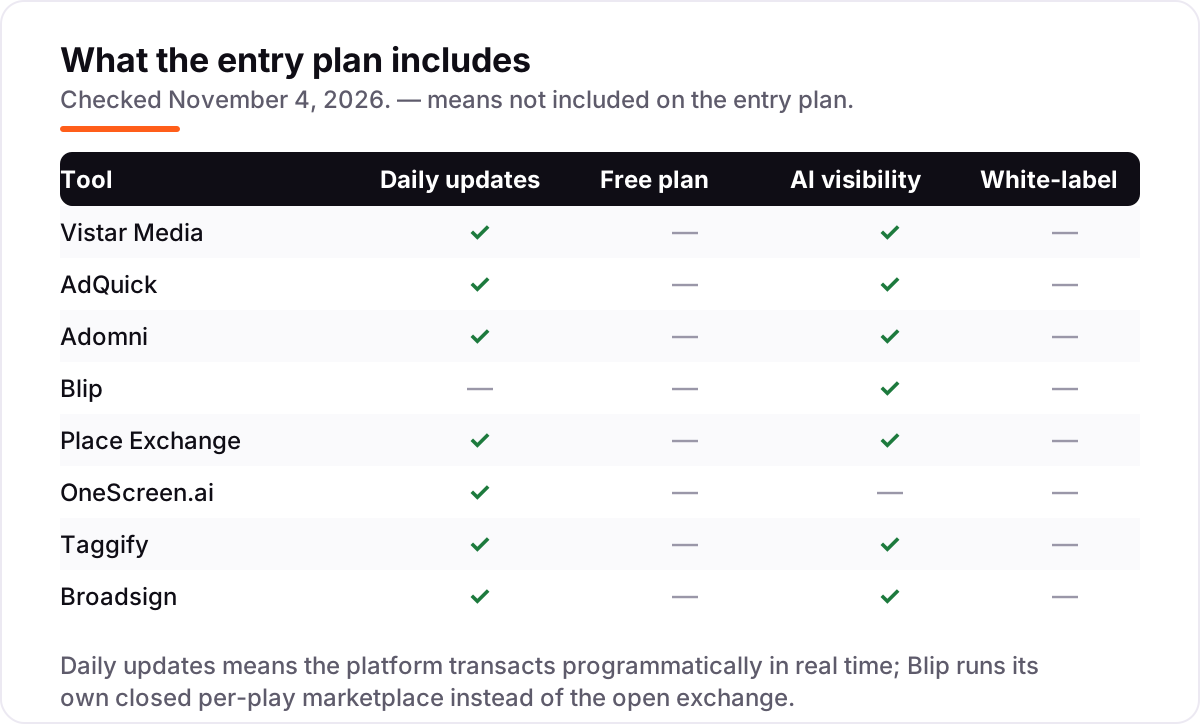
The 8 best digital out of home advertising platforms in this guide all solve the same problem: getting your message onto screens people pass in the real world — roadside billboards, transit shelters, mall panels, gym screens and bar TVs — and proving it worked. A platform is the software layer that plans the buy, books the screens, serves the creative and reports what ran. The buying model is what differs: some sell you their own inventory, some bid on the open exchange, and some plan the whole campaign for you.
The category is growing fast. Digital out-of-home accounted for 36.3% of total US out-of-home revenue and grew 10.5% year over year, according to OAAA industry data, and global digital place-based networks grew 12.4% to $18.2 billion in 2025, according to PQ Media. Screens are cheap to test and hard to ignore: a driver cannot skip a billboard the way they skip a pre-roll ad. The rest of this guide is organized by what you actually need — programmatic scale, a self-serve test, or a managed plan.
Programmatic DSPs: the default buy
If DOOH is a recurring line on your media plan, start with a DSP. Vistar Media is the category default: the largest programmatic footprint, a DSP and an SSP under one roof, and T-Mobile audience segments no other platform can sell. AdQuick pairs DSP buying with a direct marketplace, which matters when the screen you want is not on the open exchange — and it is the only platform here that shows you live prices before you commit.
Taggify is the specialist alternative: a DSP built only for OOH, with planning, forecasting and moment-based triggers in one flow. The trade-off against the generalist DSPs is inventory depth outside Latin America. All three transact programmatically, so campaigns can launch in days and adjust mid-flight — the opposite of the old four-week poster buy. If your team already runs display and video in The Trade Desk or DV360, check whether your DSP already reaches DOOH inventory before adding a new seat.
Self-serve options for smaller budgets
Not every DOOH buy needs a trading desk. Adomni and Blip are built for marketers who want to launch a campaign themselves, and OneScreen.ai covers the middle ground for teams that want a plan built for them. Adomni's Jeen AI turns a plain-language goal into a strategy and a forecast, and its no-minimum, credit-card checkout is the friendliest in this list. Blip is the budget floor: real billboards from about a cent a play, with no contract.
OneScreen.ai is the managed version of the same idea — a planning team that matches venue screens to your audience instead of a dashboard you operate yourself. If the goal is foot traffic to a local business, pair the screens with our local SEO service so the people who see the ad can find you on Maps the same day. Self-serve is the right first step when the budget is under a few thousand dollars; above that, a DSP buys more efficiently.
Supply-side platforms: where the screens come from
Every screen in this guide is sold by someone, and the supply side has consolidated fast. Broadsign acquired Place Exchange in November 2025, Vistar Media is now inside T-Mobile, and Perion absorbed Hivestack — so the names on old shortlists now sit under fewer roofs. As a buyer, that consolidation is mostly good news: fewer integrations, and guaranteed deals that used to need a phone call now clear inside a DSP.
The distinction that matters is DSP versus SSP versus marketplace. A DSP is where buyers sit — Vistar, AdQuick, Taggify. An SSP is where media owners sit — Place Exchange, Broadsign Reach. A marketplace sells its own inventory — Adomni, Blip. You do not choose between them so much as pick the seat that matches your job: a DSP for programmatic scale, a marketplace for a fast test, and an SSP's inventory through whichever DSP you already run. Our guide to the best digital signage companies covers the screen networks themselves, if you want the other side of the trade.
Digital out of home advertising pricing: what you will actually pay
Take a local business testing DOOH for one month. On Blip, recent Texas campaigns spent about $25 a day, so a 30-day test costs about $750 — and the same daily budget run all year costs about $9,000. On Adomni, the same test priced in impressions: 100,000 impressions cost $394 at the $3.94 bar-jukebox CPM and $2,354 at the $23.54 spectacular CPM, so a month of 100,000 impressions costs $394 to $2,354, or $4,728 to $28,248 over twelve months. On AdQuick, the $1,500 self-serve test minimum covers a single-market, 30-day flight — one flight a month for a year costs $18,000 — and its published CPMs run $4 to $12 for digital billboards and $6 to $30 for place-based screens.
The other five platforms — Vistar, Place Exchange, OneScreen.ai, Taggify and Broadsign — publish no price at all, so they are excluded from the math above: there is no vendor-verified number to work from until sales replies. Above the test tier, budgets scale with ambition: mid-market programmatic campaigns typically run $25,000 to $50,000 over 90 days, and Vistar's deal desk takes campaigns from a $15,000 minimum, according to Basis's published Vistar documentation — a third-party figure, not a Vistar-published price. Programmatic DOOH itself is still a small slice of the channel — $1.339 billion in 2025, or 7.0% of all digital out-of-home spend, according to the World Out of Home Organization's first global study of the segment — which is why the largest buys still go direct. Tag the landing page with the free UTM builder so screen-driven visits show up separately in your analytics.
Know the difference: programmatic DOOH vs self-serve buys
The confusion in this category is the word "programmatic": it gets used for any software-bought screen, but it means buying through an exchange auction, not just buying online. Vistar, Taggify and AdQuick run demand-side platforms that bid for inventory on the open exchange; Place Exchange is the supply-side platform on the other side of that trade, making media owners' screens available to those DSPs. Blip and Adomni are different: self-serve marketplaces that sell their own inventory at published rates — per play on Blip, per CPM on Adomni — with no auction and no DSP seat.
Two more roles sit outside that split. Broadsign is supply-side infrastructure: the platform media owners run their screen networks on, with programmatic distribution through Broadsign Reach and Place Exchange — buyers reach it through a DSP, not by logging in. OneScreen.ai is a managed service: a planning team buys for you, so it is neither self-serve nor a DSP you operate. Pick the model before the vendor: programmatic when you are buying across markets and need one workflow, self-serve when you are testing one market on a small budget, managed when you have no buying team at all.
Quick comparison: tool type by need
| Buyer | Best pick | Why |
|---|---|---|
| Agency buying programmatic DOOH at scale | Vistar Media | Largest DSP footprint plus T-Mobile audience segments |
| First-time buyer who wants real prices | AdQuick | Live CPMs on every unit, self-serve tests from $1,500 |
| Small business, no minimum spend | Adomni or Blip | No minimums; Adomni adds AI planning, Blip starts at $0.01 a play |
| Local advertiser on the smallest budget | Blip | Pay per play with no contract |
| Omnichannel team buying inside a DSP | Place Exchange | SSP inventory inside DV360 and The Trade Desk |
| Managed campaign across venue screens | OneScreen.ai | Planning team plus place-based networks |
| OOH-specialist planning and triggers | Taggify | DSP built only for OOH, with AI planning |
| Media owner running a screen network | Broadsign | The platform more than 2 million signs run on |
How to choose the best digital out of home advertising platforms
- Pick the buying model first. DSP for programmatic scale, self-serve marketplace for a fast test, managed plan when you have no buying team.
- Set the test budget before you shop. Under $1,500, Blip or Adomni are the only honest options; at $1,500, AdQuick's self-serve test works; above $15,000, the DSPs open up.
- Match the venue to the audience, not the format to the brief. A gym screen reaches a different person than a highway board — compare paid ads options for local reach if the goal is local calls rather than awareness.
- Check measurement before you buy. Confirm the platform reports plays or impressions you can tie to visits — Geopath, PerView or mobile attribution — and set up tracking first.
- Run one market for 30 days, then decide. Compare cost per visit, not cost per play, and only then expand to more markets or a bigger DSP seat.
Mistakes to avoid
- Comparing monthly prices that do not exist. DOOH is sold by CPM, per play or by quote — a "$49/month" comparison chart is meaningless here.
- Buying screens before checking the audience. A venue's foot traffic is not your audience; a bar screen and a highway board reach different people at different moments.
- Writing creative like a web banner. Screens are silent, eight-second loops — one idea, five words, a logo. If it needs a paragraph, it will not be read.
- Trusting a directory price. Six of these eight platforms publish no price at all; directories that list one are guessing. Check the vendor's own page.
- Forgetting to measure. Without UTM tags or a footfall study, a DOOH test proves nothing — set up tracking before the first flight, and read how a paid ads strategy should be structured before scaling spend.
How we chose
We checked each vendor's own pages on November 4, 2026 and recorded the starting price exactly as shown — which, for six of the eight platforms, means no published price and a custom quote. AdQuick's $1,500 self-serve test minimum comes from AdQuick's own published city DOOH guides, and Vistar's $15,000 deal-desk minimum comes from Basis's published Vistar documentation, a third-party source. No G2 or Capterra ratings appear in this list: G2 rate-limited our verification checks on November 4, so we left ratings out rather than print scores we could not verify that day. We ranked the tools by fit for the most common buyer — an advertiser or agency buying screens — not by brand size. No vendor paid for a place in this list, and none of the links here are affiliate links.
What to do next
Start with the decision path above: pick the buying model, set the test budget, and match the venue to your audience. Then run a 30-day test on your top pick — Blip or Adomni if the budget is small, AdQuick if you want programmatic buying with real prices — and judge it on cost per visit, not cost per play. If the test works, expand to a second market before you commit to a DSP seat. Once your tools are in place, find out what's holding your rankings back.
Your stack only works if people find you
SerpAstra fixes what keeps your site off page one and makes it easy for AI assistants to recommend.
Get a free audit→Sources we checked (13)
- Vistar Media DSP terms of service — fees set per order form (checked November 4, 2026)
- Vistar Media on Datadog — 12 billion monthly impressions across 25+ countries (checked November 4, 2026)
- T-Mobile audience segments for DOOH, exclusive to Vistar's DSP — PPC Land, October 2026 (checked November 4, 2026)
- AdQuick DOOH guide, Chesapeake VA — $1,500 self-serve test minimum, $4–$40 CPMs (checked November 4, 2026)
- Adomni pricing — no minimum spend, average CPMs by venue type (checked November 4, 2026)
- Blip Texas billboards — no minimum spend, plays from $0.01 (checked November 4, 2026)
- Place Exchange sales presentation 2026 — 1.8 million screens (checked November 4, 2026)
- Place Exchange programmatic guaranteed in DV360 — PPC Land, December 2025 (checked November 4, 2026)
- Broadsign — DOOH more with Broadsign, flexible selling tools (checked November 4, 2026)
- Broadsign acquires Place Exchange — AdTech Today, November 2025 (checked November 4, 2026)
- OneScreen.ai — DOOH in entertainment venues, restaurants and bars; cites OAAA and PQ Media data (checked November 4, 2026)
- Taggify DSP for OOH and DOOH campaigns (checked November 4, 2026)
- World Out of Home Organization programmatic DOOH study — $1.339bn in 2025 (via PPC Land, checked November 4, 2026)
Shamim
Founder of SerpAstra
A full-stack SEO and digital marketer who spends most days on Local SEO for dental practices, AI search visibility and lead generation.
Frequently asked questions
What is the best digital out of home advertising platform in 2026?
Vistar Media is the best all-round pick for programmatic buying at scale, with the largest DSP footprint and T-Mobile audience segments. AdQuick is the best first buy for transparency, with live CPMs and self-serve tests from $1,500. For the smallest budgets, Adomni and Blip start with no minimum spend — Blip from about $0.01 per play.
How much does digital out of home advertising cost?
It depends on venue and market. Digital billboard CPMs typically run $4 to $12 and place-based screens $6 to $30, according to AdQuick's published guides. A self-serve test starts at about $1,500 on AdQuick, or from $0.01 per play on Blip with no minimum. Six of the eight platforms in this list publish no price and work by quote.
What is the difference between a DSP, an SSP and a marketplace in DOOH?
A DSP is where buyers sit: it bids for screen inventory on the open exchange — Vistar, AdQuick and Taggify are DSPs. An SSP is where media owners sit: it makes their screens available to DSPs — Place Exchange and Broadsign Reach are SSPs. A marketplace sells its own inventory directly — Adomni and Blip. Most buyers start with a DSP or a marketplace.
Can I buy digital billboards with no minimum spend?
Yes, on two platforms in this list. Blip has no minimum spend and no contract — you set a daily budget and pay per play from about $0.01. Adomni also has no minimum spend and lets you launch with a credit card. AdQuick's self-serve tests start at $1,500, and Vistar and Broadsign are enterprise sales with no self-serve tier.
Is programmatic DOOH worth it for a small business?
Usually not as a first step. Programmatic DOOH was $1.339 billion in 2025 — just 7.0% of all digital out-of-home spend, per the World Out of Home Organization — because most small buys still go direct or self-serve. Test with Blip or Adomni first; move to a DSP when you are buying across several markets and need one workflow.
How is DOOH measured?
By plays and impressions first, then by outcomes. Platforms report how often your ad played and the modelled audience for each screen; Geopath is the industry standard for impressions, Place Exchange's PerView ties exposure to mobile-device data, and several platforms offer footfall or store-visit studies. Tag your landing page with UTM parameters so screen-driven visits show up separately in analytics.
Do I need an agency to run DOOH creative?
No, but the creative rules are strict: screens are silent, loops run about eight seconds, and the audience is moving. One idea, a few words and a clear logo beat a paragraph every time. AdQuick includes creative production in its workflow, and the self-serve platforms accept standard image and video specs — start with one bold message per screen.
Free SEO and AI visibility audit
Find out what is holding your rankings back
Send us your site. Within 2 business days you get a written audit, an AI visibility check and a short fix list ranked by impact. Free, with no contract attached.
Request my free audit→Related guides
 Companies & Services11 Best Digital Signage Companies in 2026Compare the 11 best digital signage companies on per-screen price, free plans and hardware, with every price checked November 4, 2026, before you buy.Read guide →
 MarketingPaid ads strategy for local businesses: PPC that books jobsA paid ads strategy for local businesses that books jobs: Google Ads budgets, Local Services Ads, landing pages and tracking — with real 2026 benchmarks.Read guide →
 MarketingGoogle Ads vs Local Services Ads: which wins local jobs?Google Ads vs Local Services Ads: pay per click or pay per lead, placement, verification, and cost compared, so you can pick the one that wins local jobs.Read guide →