
11 Best Drone Roof Inspection Software in 2026, Compared
Compare the 11 best drone roof inspection software on price, flight automation and measurement reports, with every price checked November 7, 2026.
 Shamim Mia, Founder, SerpAstraLast verified November 7, 202614 min read
We compare pricing pages, documentation and public reviews. We never accept payment for rankings.
Key takeaways
- DroneDeploy is the best fit for teams that already fly drones at $349/month; IMGING is the purpose-built insurance pick by quote, and EagleView delivers measurement reports from $18 each with no drone at all.
- Roofr is the best value for residential roofers: free to start, first paid plan $109/month with unlimited users, and $13 measurement reports that flow into proposals.
- The single most important buying factor is the pricing unit: per-user annual licenses, per-report fees and per-scan charges behave very differently at your real monthly volume.
- Most tools here charge per report or per inspection on top of any subscription, so budget the per-job cost separately from the monthly fee.
On this page
Quick comparison
| Tool | Best for | Starting price | Free plan |
|---|---|---|---|
| DroneDeploy | Contractors and inspectors who already fly drones and want flight planning, cloud processing and 3D models in one platform | $349/mo | No (trial) |
| IMGING | Insurance carriers and independent adjusters who need consistent, repeatable drone roof inspections for claims | Custom quote | No |
| EagleView | Contractors and adjusters who need defensible aerial roof measurements without buying or flying a drone | $18/report | No |
| Roofr | Residential roofers who want measurements, proposals, e-signatures and payments in one modern tool | Free; $109/mo | Yes (free plan) |
| Hover | Exterior contractors who want a measured 3D model of a whole house from smartphone photos, no drone required | Free; $29/scan | Yes (free plan) |
| Pix4D | Surveyors, engineers and forensic investigators who need survey-grade photogrammetry and defensible measurements | $333/mo | No (15-day trial) |
| RoofSnap | Solo roofers and small crews who want to trace roofs themselves and turn measurements into good-better-best proposals | $105/user/mo | No (7-day trial) |
| CompanyCam | Roofing crews who need timestamped job-site photos, checklists and client updates organized by project | $79/mo | No (14-day trial) |
| RoofScope | Contractors and adjusters who want CAD-reviewed aerial measurement reports with fast turnaround | $89/mo | No (trial) |
| Skydio | Inspection teams that need autonomous close-quarters drone flight around structures, with US-made hardware | Custom quote | No |
| AccuLynx | Established roofing companies doing insurance restoration who need CRM, estimating and production in one system | Custom quote | No |
Make one of these tools?
We re-check this list every quarter. Send a correction, request a review, or ask about a clearly labeled sponsored spot.
Request a listingThe best drone roof inspection software

DroneDeploy
Best for: Contractors and inspectors who already fly drones and want flight planning, cloud processing and 3D models in one platform
DroneDeploy is the best-known cloud platform for turning drone flights into maps, 3D models and inspection data. You plan an automated flight in the app, the drone captures overlapping imagery, and DroneDeploy processes it into orthomosaics, 3D models and elevation data you can measure, annotate and share. Roofing contractors use it for pre-job documentation, damage assessment and progress tracking across whole developments.
The strength is the full workflow: flight planning, fleet management, processing and analysis in one place, with AI features that flag issues in captured data. The catch is scope and price: it is a general reality-capture platform, not a roofing specialist, so roof measurements and insurance-ready reports are not built in. Buy it when you already run a drone program across several use cases.
What we like
- Mature automated flight planning and cloud processing for maps, orthomosaics and 3D models
- Works across construction, energy and inspection, not just roofing
- Strong integrations, including Autodesk Construction Cloud and Skydio drones
- AI analysis flags issues in the captured imagery
Watch out for
- Individual plan covers one admin user only, so a team needs a quote-only plan
- No roof measurements or insurance-ready reports out of the box
- $4,188 a year is a steep entry price for a roofer who only inspects roofs

IMGING
Best for: Insurance carriers and independent adjusters who need consistent, repeatable drone roof inspections for claims
IMGING, from Loveland Innovations, is the most purpose-built drone inspection product for property insurance. The software flies a DJI drone through a patented automated pattern that captures the entire roof at consistent high resolution, then builds a 3D model you can measure within an inch. AI detection flags damage types such as hail hits, blistering, ponding and rust on commercial roofs.
The product was designed with adjusters in mind: consistent imagery across every inspection, on-site measurements, virtual test squares and structured reports that fit the claims workflow. Inspection kits bundle the software with the drone and tablet, so a field adjuster can be productive quickly. The limits are hardware lock-in and focus: you need compatible DJI models, and the workflow is tuned for insurance rather than roofing sales.
What we like
- Patented automated flight patterns capture the whole roof at consistent high resolution
- Built specifically for property insurance inspections, with structured claims-ready reports
- AI detection flags hail hits, blistering, ponding and rust on commercial roofs
- On-site measurements accurate within an inch, plus virtual test squares
Watch out for
- Price is not published, so you need a sales quote before you can budget
- Tied to specific DJI drone models for automated flight
- Built for insurance claims first, so roofing sales features are thin

EagleView
Best for: Contractors and adjusters who need defensible aerial roof measurements without buying or flying a drone
EagleView is the pioneer of aerial roof measurement and still the name most insurance carriers default to. Instead of flying a drone, you order a report: EagleView's aircraft-captured imagery library covers most US properties, and you get a detailed measurement report with dimensions, pitch, area and a 3D diagram, usually within hours. Contractors and adjusters build estimates directly from the data.
The advantage is zero hardware and zero learning curve. There is no drone to buy, no pilot to train and no FAA Part 107 certification to maintain. The imagery archive means you can pull a pre-storm measurement for comparison after a hail event, which is gold for claims work. The trade-off is cost structure and freshness: per-report pricing adds up for high-volume users, and the imagery may be months old.
What we like
- The industry standard for aerial roof measurements, trusted by insurers and contractors
- Huge aircraft-captured imagery library covers most US properties
- Pre-storm imagery supports after-event comparisons for claims
- Integrates with Xactimate and roofing CRMs such as AccuLynx
Watch out for
- Per-report pricing adds up fast at high volume
- Imagery may be months old where a fresh drone flight would be current
- EagleView One subscription and Platinum pricing are by quote
Roofr
Best for: Residential roofers who want measurements, proposals, e-signatures and payments in one modern tool
Roofr built its name on instant roof measurements for contractors, then grew into a fuller sales toolbox with digital proposals, payments and a lightweight CRM. A roofer can pull a measurement, build a branded proposal and send it for e-signature in one session, which is why it is popular with residential roofing companies competing on response speed.
The workflow is the selling point. Where EagleView gives you a report to feed into another system, Roofr carries the job from measurement through proposal to payment. The interface is modern and the mobile experience works well for sales reps in the field. The catch is measurement depth: for complex commercial roofs, dedicated measurement services or drone capture give more detail.
What we like
- Free Starter plan with unlimited users on every plan, no per-seat fees
- Measurement reports in as little as 2 hours, flowing straight into branded proposals
- Verisk-certified ESX export drops measurements into Xactimate for $10 per report
- Modern interface that sales reps can run from the field on a phone
Watch out for
- Measurement reports are always extra, $13 each on paid plans and $19 on Starter
- Measurement depth is thinner than EagleView on complex commercial roofs
- Add-ons such as Instant Estimator and Roofr Sites cost $99-$125 a month each

Hover
Best for: Exterior contractors who want a measured 3D model of a whole house from smartphone photos, no drone required
Hover takes a clever approach: instead of drones or aircraft, it builds an accurate 3D model of a home from smartphone photos taken on site. Walk around the property snapping pictures, upload them, and Hover returns a measured 3D model with roof dimensions, siding areas and window counts. Contractors use it for estimates; insurance professionals use it for claims documentation.
The advantage is accessibility. No drone, no pilot certification, no aircraft scheduling; any field rep with a phone can capture a property. The 3D visualizations also help sell jobs, letting homeowners see their house with new roofing or siding. The honest limits are capture effort and cost: photographing a whole property takes time, and per-project pricing adds up for high-volume users.
What we like
- Builds an accurate 3D model from smartphone photos, no drone or pilot certification needed
- Covers roof, siding, windows and doors in one measured model
- 3D visualizations help sell jobs by showing homeowners the finished look
- Around 40 integrations, including AccuLynx, CompanyCam and Xactimate
Watch out for
- Every project is billed per scan even on the $999/year Pro plan
- Photographing a whole property takes 15 to 30 minutes of careful work on site
- Large commercial properties strain the phone-capture workflow

Pix4D
Best for: Surveyors, engineers and forensic investigators who need survey-grade photogrammetry and defensible measurements
Pix4D is the photogrammetry software that surveyors and mapping professionals trust when accuracy matters most. Feed it drone or handheld imagery and it produces survey-grade 2D mosaics, 3D models and point clouds with georeferencing. PIX4Dcatch turns a phone into a LiDAR-assisted capture device for ground-level detail.
For roof inspection, Pix4D suits the technical user: engineering firms, forensic investigators and contractors who need defensible measurements and models. The processing is local or cloud, the outputs plug into CAD and GIS workflows, and the accuracy exceeds what automated consumer tools deliver. The trade-off is complexity and cost: this is professional software with professional pricing and a real learning curve.
What we like
- The most accurate photogrammetry engine in this list, trusted by surveyors
- Desktop and cloud options, with outputs that plug into CAD and GIS workflows
- PIX4Dcatch turns a phone into a LiDAR-assisted capture device
- Accuracy and audit trail suit litigation, engineering analysis and insurance disputes
Watch out for
- Steep learning curve compared with one-click measurement tools
- PIX4Dmapper alone costs $3,990 a year, before cloud add-ons
- A roofer who wants a quick measurement will be faster with Roofr or EagleView
RoofSnap
Best for: Solo roofers and small crews who want to trace roofs themselves and turn measurements into good-better-best proposals
RoofSnap gives roofing contractors aerial measurements with an emphasis on speed and the sketching workflow estimators already use. Order a measurement from aerial imagery, get a dimensioned diagram, and build the estimate with the built-in tools. It also offers drone and sketch-based measurement options for properties the imagery does not cover well.
The appeal is the contractor-first design. The tools mirror how roofers actually take off a roof: planes, pitches, valleys, waste factors and material lists. Pricing is positioned for contractors rather than carriers, and the free trial covers real jobs. The honest comparison is with EagleView: RoofSnap is nimbler and cheaper, but EagleView's imagery library and carrier relationships are deeper.
What we like
- Pay-as-you-go measurement reports from $13, with no subscription required
- Draw-it-yourself sketching mirrors how estimators already take off a roof
- Good-better-best proposals, contracts, payments and homeowner financing in one tool
- Half Snap reports arrive in about 4 hours, with 30-minute rush available
Watch out for
- Subscription is priced per user, so a crew of five pays five times the single-user rate
- Smaller imagery operation than EagleView, with hit-and-miss rural coverage
- No full CRM, so larger shops still need a second system

CompanyCam
Best for: Roofing crews who need timestamped job-site photos, checklists and client updates organized by project
CompanyCam is the photo documentation app roofing crews open a dozen times a day. Every photo is timestamped and GPS-tagged, then auto-organized by project, so the before, during and after shots for a roof are always in the right job file. Checklists, task assignments and photo reports keep the office, the adjuster and the homeowner looking at the same record.
It belongs on this list because a drone inspection is only useful if the photos survive the job: CompanyCam is where most roofers store and share them. It does not measure roofs or build estimates, so it pairs with a measurement tool rather than replacing one. The seat math matters: Core covers one user, and every extra seat costs $34 a month on monthly billing.
What we like
- Timestamped, GPS-tagged photos auto-organized by project, crew and room
- Photo reports and checklists keep adjusters and homeowners in the loop
- Integrates with Roofr, AccuLynx, Hover and JobNimbus
- Mobile-first design that field crews actually use every day
Watch out for
- Core covers one user, so a crew needs Crew at $149/month or extra seats at $34 each
- No measurement or estimating tools of its own, it documents the job rather than measuring it
- Scale plan price rose in September 2026, so older reviews quote lower figures

RoofScope
Best for: Contractors and adjusters who want CAD-reviewed aerial measurement reports with fast turnaround
RoofScope, from Scope Technologies, sells detailed aerial roof measurement reports built from high-resolution imagery and expert CAD drafting. Enter an address and you get a report with total squares, slope breakdown and line-item measurements for edges, hips, valleys, ridges and flashing, backed by a quality-assurance process. Reports are available pay-as-you-go or on monthly plans.
The strength is the drafting: every report is CAD-reviewed, which is why adjusters and estimators trust the quantities for material takeoffs. Coverage reaches 99.9% of US addresses, and blueprint-based reports cover new construction with no existing roof to photograph. The weakness is speed at the entry level: 24-hour turnaround is slower than Roofr, and Xactimate ordering waits for the Growth plan.
What we like
- CAD-reviewed reports with detailed line-item measurements for edges, hips and valleys
- Covers 99.9% of US addresses, plus blueprint-based reports for new construction
- ESX export for Xactimate on Growth plans and above
- Gutter and siding reports available alongside roof reports
Watch out for
- Pay-as-you-go reports cost $39.95 each, so volume buyers need a plan to save
- Entry plan turnaround is 24 hours, slower than Roofr at 2 hours
- Xactimate ordering needs the Growth plan at $199 a month or higher

Skydio
Best for: Inspection teams that need autonomous close-quarters drone flight around structures, with US-made hardware
Skydio is the drone company, not a pure software vendor, but its autonomy makes it relevant to roof inspection. Skydio drones fly themselves around structures with obstacle avoidance that lets them capture close-range imagery safely, and the 3D Scan software automates the data collection pattern for buildings and roofs. The processed data feeds into inspection workflows.
The advantage is the flying. Where a manual drone pilot risks the aircraft near a roof, Skydio's autonomy handles the close-quarters flight, producing consistent, complete coverage. For inspection teams already invested in drone programs, it is the premium hardware choice, and it is US-manufactured, which matters for government and enterprise buyers. The catch is that you are buying drones.
What we like
- Best-in-class autonomous flight and obstacle avoidance for close-range capture
- 3D Scan automates the data-collection pattern for buildings and roofs
- US-manufactured, which matters for government and enterprise buyers
- Imagery exports to DroneDeploy, Pix4D and Bentley ContextCapture
Watch out for
- You are buying drones, so the software value is inseparable from a hardware purchase
- 3D Scan pricing is bundled with aircraft and not published on its own
- Pairing with DroneDeploy or Pix4D for processing adds a second subscription

AccuLynx
Best for: Established roofing companies doing insurance restoration who need CRM, estimating and production in one system
AccuLynx is the business management system for roofing contractors: CRM, estimating, project management, scheduling, invoicing and reporting in one cloud platform. It belongs on this list because it integrates aerial measurement services like EagleView and RoofScope directly into the workflow, so measurements land in the job file automatically.
The depth is the point: a restoration shop can run the whole job, from first call to final invoice, without leaving AccuLynx. The honest trade-off is price opacity. Pro and Elite are quote-only, the $250-a-month Essential plan was dropped in August 2026, and nine features are paid add-ons. Get a written quote at your user count before you commit.
What we like
- The deepest roofing business system here: CRM, estimating, scheduling, invoicing and reporting
- Orders EagleView and RoofScope measurements inside the job file
- Direct supplier ordering through ABC Supply, SRS Distribution and QXO
- Elite adds supplement tracking, permits, production calendar and multi-location support
Watch out for
- Pro and Elite are quote-only, with no published price to compare against
- Third-party per-user estimates run $55-$85 a month, but AccuLynx has never confirmed them
- Nine features are paid add-ons, including texting, SmartDocs and subcontractor logins
The best drone roof inspection software turns a flight, a phone walk-around or an ordered report into measurements you can estimate from, without putting a person on every roof. We ranked the eleven tools below by fit for the most common buyer — a US roofing contractor or adjuster who needs reliable roof data every week — starting with the drone platforms, then the measurement services, and ending with the business tools that consume the data, and every price was checked against the vendor's own pricing page on November 7, 2026.
How to choose the best drone roof inspection software
- Decide whether you fly, photograph or order. DroneDeploy, IMGING, Pix4D and Skydio need a drone and a licensed pilot; Hover needs only a phone; EagleView, RoofScope and Roofr need nothing but an address.
- Check the pricing unit first. DroneDeploy charges per user per year, RoofSnap per user per month, EagleView and RoofScope per report, and Hover per project scan. The unit, not the headline, decides your monthly bill.
- Match the tool to the job, not the other way round. Insurance claims need IMGING or EagleView; residential sales need Roofr; survey-grade evidence needs Pix4D; photo documentation needs CompanyCam.
- Count the add-ons. ESX exports, rush delivery, extra seats and per-report fees all sit outside the subscription price on most tools here, so price the whole workflow.
- Check the integrations before you buy. Measurements are only useful if they land in your estimate: Xactimate, AccuLynx, JobNimbus and QuickBooks connections matter more than a feature list.
A roof inspection is one system in your stack, not the whole stack. If the business also needs to be found online, our guide to general contractor software covers the operations side. And before you publish new pages for the services you sell, run your titles through the free SERP snippet preview tool — it shows exactly how the title and description will look in Google.
Whatever you shortlist, try it on real addresses before you pay. The free plans and trials in this list are long enough to run a genuine week — your roofs, your crew, your adjusters — and that week tells you more than any review can. Check two things in the trial: that the measurements match a tape on a roof you know, and that the report drops into your estimating tool without retyping. Every tool here exports to at least one estimating or CRM system, so there is no reason to buy before you have tested the handoff.
Drone roof inspection software pricing: what you will actually pay
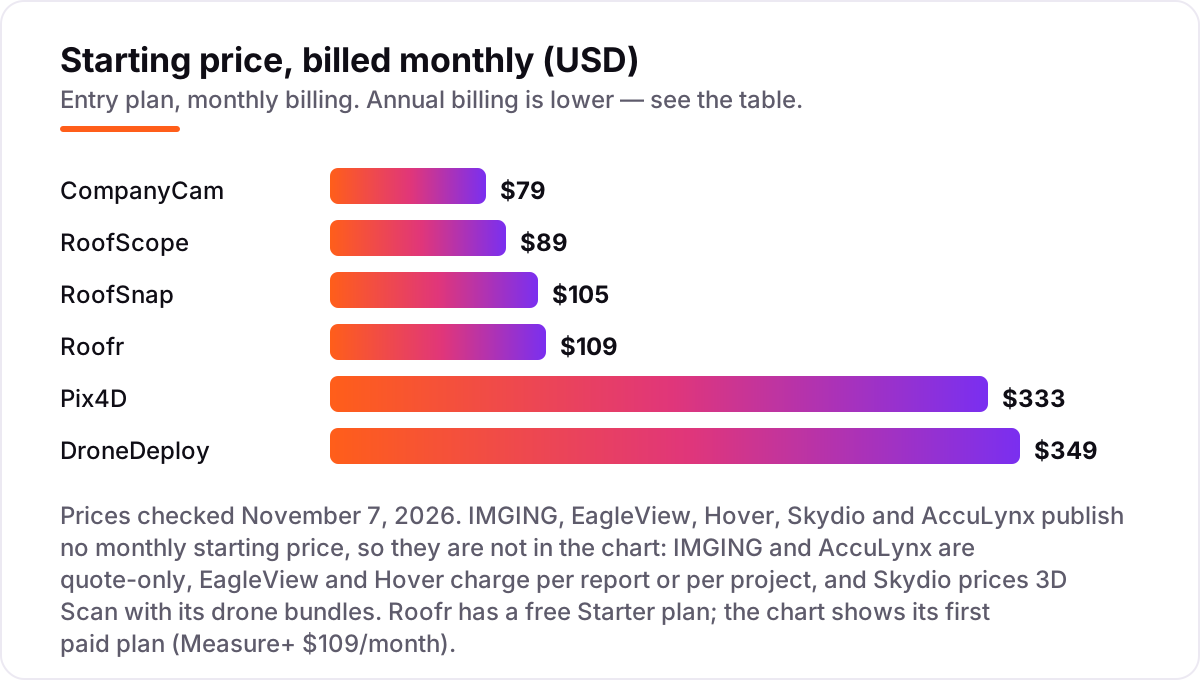
Take a roofing company that inspects 20 roofs a month with one estimator. On list prices, the subscription costs $79 a month on CompanyCam Core, $89 on RoofScope, $105 on RoofSnap, $109 on Roofr Measure+ and $349 on DroneDeploy Individual. Two of those numbers need adjusting before they are real: RoofSnap at $105 covers one user, so a second estimator doubles it, and Roofr Measure+ is only the subscription — the 20 measurement reports at $13 each add $260, taking it to $369 a month.
Over a year, that is $948 on CompanyCam Core, $1,068 on RoofScope before reports, $1,260 on RoofSnap for one user, $4,188 on DroneDeploy Individual and $4,428 on Roofr Measure+ with 20 reports a month. The per-report tools look different again: 20 EagleView Bid Perfect reports cost $360 a month with no subscription at all, while 20 Premium reports on small roofs cost $655. Hover Starter charges per scan instead: 20 roof scans at $29 to $69 each run $580 to $1,380 a month, and the $999-a-year Pro plan only discounts the per-scan price, it does not remove it.
Three costs sit outside every number above. First, the drone itself: a DJI Mavic 3 Enterprise class aircraft costs around $1,500 and up, and the FAA Part 107 certificate takes study time before you fly commercially. Second, the add-ons: ESX exports at $9 to $10 per report, rush delivery fees and extra seats at $29 to $34 a month each. Third, the per-job fees that never appear in a subscription chart: RoofSnap Full Snap reports run $35 to $55 each, and EagleView Premium reports run $32.75 to $87 by roof size. If you run the wider business on the same stack, see our guide to contractor management software for the operations side.
Annual billing cuts the bill on the subscription tools here: CompanyCam Core drops from $79 to $63 a month, Roofr Measure+ from $109 to $95, and RoofSnap from $105 to $78 a month for a two-to-four-user team. DroneDeploy publishes only annual prices, so $349 a month is already the annual-billing figure. One more cost to check before you commit: a second branch or crew is a second subscription on most tools here, while Roofr includes unlimited users on every plan — so a growing team pays the same $109 a month on Roofr Measure+ while per-user tools multiply.
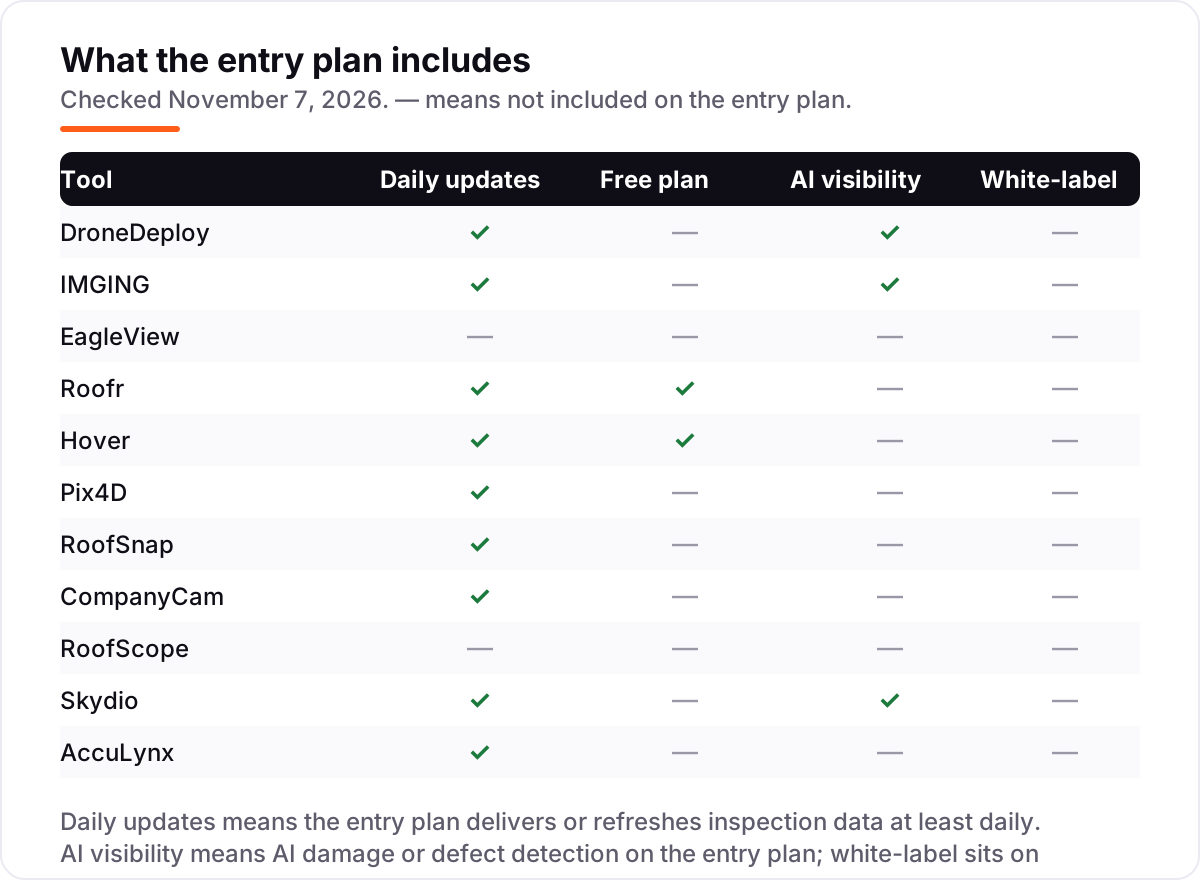
Know the difference: drone flights vs measurement reports
The confusion in this category is between flying and ordering. Drone flight platforms — DroneDeploy, IMGING, Pix4D and Skydio — give you software to fly your own drone and process what it captures. Measurement services — EagleView, RoofScope and Roofr reports — sell you the measurement itself: you enter an address and a report comes back. Both end in numbers you can estimate from, but only one of them needs a drone, a pilot and a Part 107 certificate.
There is a second, quieter confusion: a 3D model is not a measurement report. Hover and DroneDeploy produce beautiful models, but the report a carrier accepts — dimensions, pitch, area, waste factors, in a format Xactimate can import — is a separate product. EagleView Premium, RoofScope and Roofr with its ESX export produce that report; a raw 3D model does not, on its own, satisfy an adjuster.
A third distinction worth knowing is accuracy versus freshness. EagleView's aircraft imagery is measured against LiDAR benchmarks, but it may be months old; a drone flight is current to the day but only as accurate as the pilot, the overlap and the processing. For a pre-storm baseline, the archive wins. For storm damage last week, the drone wins. The right answer for most shops is both: archive reports for baselines, drone or phone capture for the current condition.
Quick comparison: tool type by need
| Buyer | Best pick | Why |
|---|---|---|
| Team that already flies drones | DroneDeploy | Full flight-to-model workflow, from $349/month |
| Insurance adjuster or carrier | IMGING | Purpose-built for claims, with AI damage detection, by quote |
| No drone, needs measurements fast | EagleView | Reports from $18 each, no hardware, no pilot |
| Residential roofer selling jobs | Roofr | Free to start, $13 reports into proposals, unlimited users |
| No drone, has a phone | Hover | Measured 3D model from photos, first 3 projects free |
| Needs survey-grade evidence | Pix4D | Survey-grade photogrammetry, PIX4Dmapper from $333/month |
| Solo roofer on a budget | RoofSnap | Pay-as-you-go reports from $13, subscription $105/user/month |
| Needs job-site photo proof | CompanyCam | Timestamped photos by project, from $79/month |
Mistakes to avoid
- Budgeting on the subscription and forgetting the per-job fee. EagleView, Hover, RoofSnap and Roofr all charge per report or per scan on top of the plan. At 20 jobs a month, the per-job fees are usually bigger than the subscription.
- Buying a drone platform when you only need measurements. If you inspect a few roofs a month, EagleView at $18 a report or Roofr's free plan is cheaper than a $4,188-a-year DroneDeploy license plus a $1,500 drone.
- Ignoring the Part 107 rule. Commercial drone flights in the US need an FAA Part 107 certificate. Flying without one risks fines and voids the insurance value of the inspection.
- Comparing monthly prices across different units. A $349-a-month DroneDeploy license, a $105-a-month RoofSnap seat and an $18 EagleView report are not comparable numbers. Convert everything to cost per inspection at your real volume first.
- Buying on the free plan, then finding the export costs extra. ESX files for Xactimate cost $9 to $10 per report on RoofScope and Roofr, and rush delivery is an add-on almost everywhere. Price the export before you commit.
How we chose
We checked each vendor's own pricing page on November 7, 2026 and recorded the starting price exactly as shown, including the annual-billing figure where the page lists one, and we ranked the tools by fit for the most common buyer — a US roofing contractor or adjuster who needs reliable roof data every week — not by brand size. Prices were verified from fresh search-index crawls of the vendors' own pricing pages dated November 2–7, 2026, plus independent October 2026 reads that agree on every figure used here. Five tools publish no monthly starting price — IMGING, EagleView, Hover, Skydio and AccuLynx — and we show their per-report, per-scan or quote pricing instead of inventing a monthly figure. Ratings appear only for the four tools whose G2 pages were verified this week: DroneDeploy, EagleView, Roofr and CompanyCam. The other seven carry no rating because their G2 or Capterra pages could not be verified fresh, and we would rather show no rating than a stale or estimated one. No vendor paid for a place in this list, and none of the links here are affiliate links.
What to do next
Start with the free plan or trial of your top pick and run one real week of roofs through it. Check that the measurements match a tape on a roof you know and that the report drops into your estimating tool without retyping. If the inspections are sorted but the jobs are not coming in, our local SEO service handles the visibility side — or compare providers in our guide to estimating software for contractors. Once your tools are in place, find out what's holding your rankings back.
Your stack only works if people find you
SerpAstra fixes what keeps your site off page one and makes it easy for AI assistants to recommend.
Get a free audit→Sources we checked (15)
- DroneDeploy pricing — dronedeploy.com/pricing (checked November 7, 2026)
- IMGING — lovelandinnovations.com (pricing not published, checked November 7, 2026)
- EagleView pricing — eagleview.com (checked November 7, 2026)
- Roofr pricing — roofr.com/pricing (checked November 7, 2026)
- Hover pricing — hover.to/pricing (checked November 7, 2026)
- Pix4D pricing — pix4d.com/pricing (checked November 7, 2026)
- RoofSnap pricing — roofsnap.com/pricing (checked November 7, 2026)
- CompanyCam pricing — companycam.com/pricing (checked November 7, 2026)
- RoofScope pricing — roofscope.com (checked November 7, 2026)
- Skydio 3D Scan — skydio.com (pricing not published, checked November 7, 2026)
- AccuLynx plan options — acculynx.com/plan-options (checked November 7, 2026)
- DroneDeploy reviews — g2.com/products/dronedeploy/reviews (checked November 7, 2026)
- EagleView reviews — g2.com/products/eagleview-eagleview/reviews (checked November 7, 2026)
- Roofr reviews — g2.com/products/roofr/reviews (checked November 7, 2026)
- CompanyCam reviews — g2.com/products/companycam/reviews (checked November 7, 2026)
Shamim
Founder of SerpAstra
A full-stack SEO and digital marketer who spends most days on Local SEO for dental practices, AI search visibility and lead generation.
Frequently asked questions
What is the best drone roof inspection software?
DroneDeploy is the best fit for most teams that already fly drones, at $349/month for the Individual plan. IMGING is the better pick for insurance inspections, and EagleView is the best option if you want measurement reports without buying a drone at all.
How much does drone roof inspection software cost?
Entry prices run from $0 to $349 a month, plus per-report or per-scan fees. Roofr starts free and its first paid plan is $109/month, RoofSnap is $105/user/month, and DroneDeploy is $349/month. EagleView charges $18 per report and Hover charges $29-$69 per roof scan.
Do I need a drone to inspect a roof?
No. EagleView, RoofScope and Roofr deliver measurements from aerial or satellite imagery with no drone involved, and Hover builds its 3D model from smartphone photos. A drone only pays off when you need current, close-range imagery or you inspect roofs every week.
What is the difference between DroneDeploy and EagleView?
DroneDeploy is a platform for flying your own drone and processing the imagery into maps and 3D models, from $349/month. EagleView is a measurement service: you order a report for $18 and up, and it arrives with dimensions, pitch and area. One is a tool you operate, the other is a report you buy.
Do I need an FAA Part 107 license to fly a drone for roof inspections?
Yes, in the United States, commercial drone flights require an FAA Part 107 remote pilot certificate. That covers any roof inspection you are paid for, including work for your own roofing company. Recreational rules do not apply to business flights, so budget for the exam and the certificate before you fly.
Can drone roof inspection software replace a physical roof inspection?
Not completely. Drone and aerial tools measure accurately and document visible damage, but they cannot feel soft decking, lift shingles or check attic ventilation. Use them for measurements, documentation and triage, then send a person onto the roof when the job needs a hands-on condition check.
Which tool is best for insurance roof inspections?
IMGING is the most purpose-built option: automated flight patterns, consistent high-resolution imagery and AI damage detection designed for claims. EagleView is the standard measurement report carriers accept, and AccuLynx ties those measurements into the restoration workflow with direct Xactimate integration.
Free SEO and AI visibility audit
Find out what is holding your rankings back
Send us your site. Within 2 business days you get a written audit, an AI visibility check and a short fix list ranked by impact. Free, with no contract attached.
Request my free audit→Related guides
 Local Business & Vertical Software10 Best Contractor Management Software in 2026, ComparedCompare the 10 best contractor management software platforms on price, compliance and global payments, with every price checked November 7, 2026.Read guide →
 Local Business & Vertical Software12 Best General Contractor Software in 2026, ComparedCompare the 12 best general contractor software tools on price, free plans, estimating and field features, with every price checked November 7, 2026.Read guide →
 Local Business & Vertical Software8 Best Estimating Software for Contractors in 2026, ComparedCompare the 8 best estimating software for contractors on price, takeoff, cost databases and free trials, with every price checked November 7, 2026.Read guide →