
7 Best Ecommerce Integration Software in 2026, Compared
Compare the 7 best ecommerce integration software on store, marketplace and retailer connections, task limits, EDI and real monthly cost, with prices checked.
 Shamim Mia, Founder, SerpAstraLast verified November 2, 20268 min read
We compare pricing pages, documentation and public reviews. We never accept payment for rankings.

Key takeaways
- Zapier is the easiest way to connect a store to the rest of the business, free for 100 tasks a month and $19.99 a month billed annually for 750 tasks.
- Make gives the most automation per dollar, 10,000 credits a month from $9 billed annually, and Pabbly Connect offers 10,000 tasks from $16 billed annually.
- n8n bills per workflow run rather than per step, and its self-hosted Community Edition is free, which suits technical teams with long workflows.
- Selling wholesale into retail chains needs EDI, not app automation: TrueCommerce and SPS Commerce carry tens of thousands of pre-built retailer connections, but neither publishes a price.
On this page
Quick comparison
| Tool | Best for | Starting price | Free plan |
|---|---|---|---|
| Zapier | Small stores that want to connect their shop to email, sheets, CRM and Slack without code | Free; $19.99/mo (annual) | Yes (free plan) |
| Make | Stores that need branching order workflows and high volume on a small budget | $9/mo (annual) | Yes (1,000 credits) |
| n8n | Technical teams that want long, custom store workflows billed per run or self-hosted for free | Free (self-hosted); $20/mo (annual) | Yes (self-hosted) |
| Pabbly Connect | Budget-conscious store owners who want high task volume with unlimited workflows | Free; $16/mo (annual) | Yes (100 tasks) |
| Boomi | Larger merchants that need APIs, data sync and EDI on one integration platform | $550/mo | No (30-day trial) |
| TrueCommerce | Small brands starting to sell wholesale to big retailers that need affordable EDI | $19.95/mo | No (demo only) |
| SPS Commerce | Suppliers selling into many retail chains that want EDI handled as a full service | Custom quote | No (demo only) |
Make one of these tools?
We re-check this list every quarter. Send a correction, request a review, or ask about a clearly labeled sponsored spot.
Request a listingThe best ecommerce integration software

Zapier
Best for: Small stores that want to connect their shop to email, sheets, CRM and Slack without code
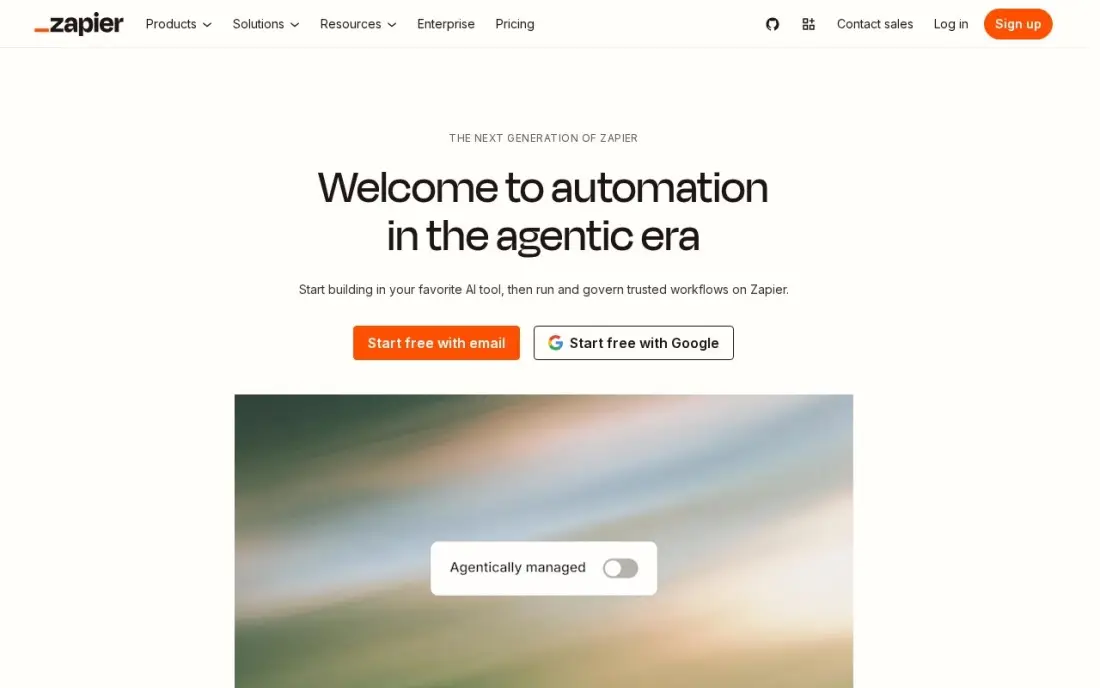
Zapier is the simplest way to make a store talk to everything else. A new order can add the customer to an email list, post to Slack, log a row in a spreadsheet and create a CRM contact, all set up in a point-and-click builder with thousands of apps available. The free plan covers 100 tasks a month, and Professional costs $19.99 a month billed annually, or $29.99 monthly, for 750 tasks.
The bill follows tasks, so a busy store burns through them fast: a three-step Zap running on 1,000 orders a month uses 3,000 tasks. Professional also covers one user; a team needs Team at $69 a month. Use it for light, reliable glue between apps.
What we like
- Connects thousands of apps, so the tools a business already uses can share data
- Multi-step Zaps, webhooks, filters and paths come with Professional
- AI by Zapier is included, so workflows can draft, summarise and route work
- 2-minute polling on Professional keeps automations close to real time
Watch out for
- The bill is set by task volume, not seats: a busy workflow can jump from $19.99 to $89 a month
- Professional covers only 1 user, so a team that builds Zaps together needs Team at $69 a month
- No free plan beyond 100 tasks a month, so real automation starts on a paid tier

Make
Best for: Stores that need branching order workflows and high volume on a small budget

Make is the value pick for store automation. Core costs $9 a month billed annually for 10,000 credits, against 750 tasks at Zapier's entry price, and its visual canvas handles branches, loops and error routes. That suits order workflows such as sending wholesale orders one way and retail orders another, or retrying a failed sync automatically.
Every module that runs uses a credit, so a ten-step scenario burns credits ten times faster than its run count suggests, and the canvas takes a day to learn. It connects more than 3,500 apps and includes AI tools. Choose Make when your workflows have logic, not just a trigger and an action.
What we like
- Cheapest volume here: 10,000 credits a month from $9/month billed annually, against 750 tasks at Zapier
- Visual canvas with branching, loops and error routes that simpler builders cannot do
- Make AI Agents and an AI toolkit are included, with 3,500+ apps connected
Watch out for
- The visual canvas has a real learning curve; branching, routers and error routes take a day to learn
- Every module that runs costs one credit, so a long scenario burns credits faster than the headline suggests
- Human-in-the-loop approval steps are Enterprise-only and were still in closed beta in mid-2026

n8n
Best for: Technical teams that want long, custom store workflows billed per run or self-hosted for free
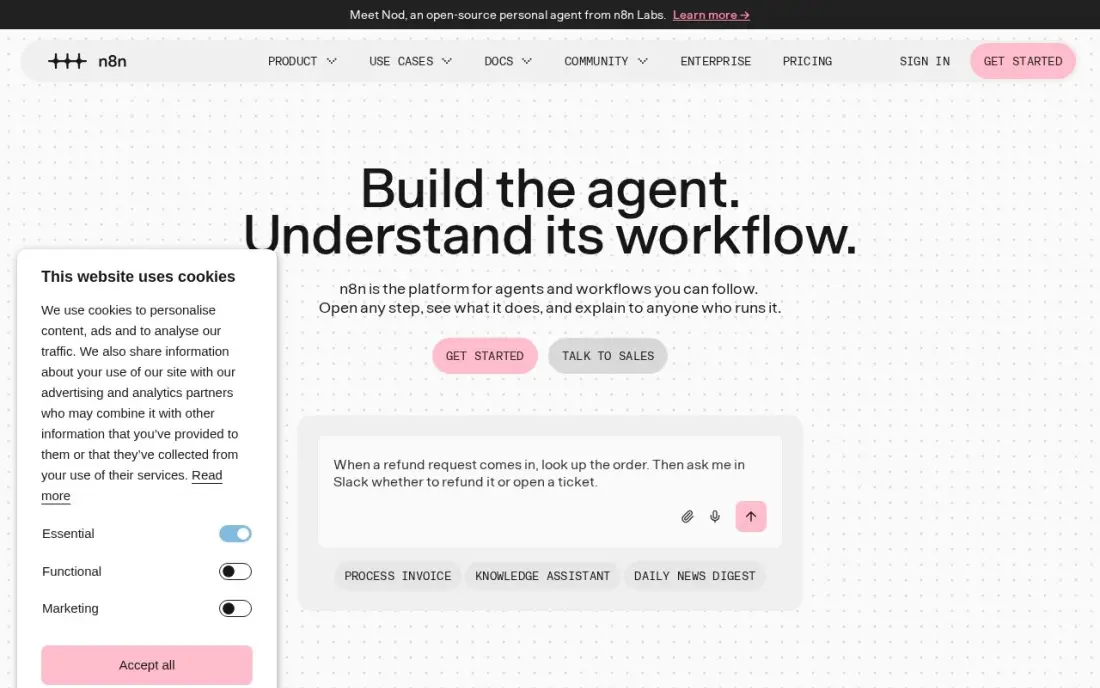
n8n suits a store with a developer. It bills per workflow run, not per step, so a twenty-step order sync costs the same as a two-step one, and the self-hosted Community Edition is free with unlimited executions. Code nodes and webhooks cover systems with no ready-made connector. The hosted Starter plan costs $20 a month billed annually, or $24 monthly, for 2,500 executions.
Starter caps active workflows at 5, and a flow that fires every minute uses the monthly runs in under two days. Self-hosting means you run the server. Choose n8n when the integrations are complex and someone technical owns them.
What we like
- Billed per workflow run, not per step, so a 20-step flow costs the same as a 2-step one
- Self-hosted Community Edition is free with unlimited executions, under a fair-code licence
- Native AI agent nodes and a large integration library, with code when the visual builder runs out
Watch out for
- Needs technical confidence: code nodes, webhooks and self-hosting are part of the appeal, not optional extras
- Starter caps at 5 active workflows and 5 concurrent executions, so busy teams outgrow it fast
- A flow that fires every minute eats the 2,500 monthly executions in under two days

Pabbly Connect
Best for: Budget-conscious store owners who want high task volume with unlimited workflows

Pabbly Connect is the budget pick for task-heavy stores. Standard gives 10,000 tasks a month for $16 billed annually, or $19 monthly, and only actions on external apps count, so triggers, filters and formatters are free. Every paid plan includes unlimited workflows and team members, and a one-time lifetime plan starts at $349 for owners who want to stop paying monthly.
The trade-offs are polish and depth. The interface feels dated, error handling has no fallback path, execution logs expire after 30 days on Standard, and the app library is smaller than the leaders'. For simple order-to-app workflows on a tight budget, the allowance is hard to beat.
What we like
- 10,000 tasks a month from $16/month billed annually, with triggers and internal steps free
- Unlimited workflows and team members on every paid plan, so growth does not add seats
- One-time lifetime plans from $349 for buyers who want to stop paying monthly
Watch out for
- Interface feels dated next to Zapier and Make, and error handling has no fallback path
- Execution logs expire after 30 days on Standard, so old failures cannot be audited later
- Smaller app library than the leaders, so niche tools may need webhooks instead of a native connector

Boomi
Best for: Larger merchants that need APIs, data sync and EDI on one integration platform

Boomi is a full integration platform rather than an automation tool. APIs, data integration, EDI and B2B management and AI agents sit in one low-code designer with more than 80 application connectors and pre-built transformations, which suits a merchant connecting a store, an ERP, a warehouse and retail partners. A 30-day free trial lets a team test it first.
Boomi publishes no EDI list price; a third-party figure of $550 a month exists, and costs climb with data volume and complex workflows. It is heavy for a small store. Choose Boomi when integration is a programme of several systems, not a few app connections.
What we like
- Full integration platform: EDI and B2B management sit beside APIs, data and AI agents
- Low-code interface with 80-plus application connectors and pre-built transformations
- 30-day free trial with no contract on the pay-as-you-go entry
- Strongest fit when EDI is one of several integration jobs, not the only one
Watch out for
- The $550 figure is third-party sourced; Boomi publishes no EDI list price and quotes by deployment
- Costs climb with data volume and complex workflows, per reviewers
- Overkill and overpriced for a business that only needs to exchange orders and invoices

TrueCommerce
Best for: Small brands starting to sell wholesale to big retailers that need affordable EDI
TrueCommerce is the low-cost route into EDI, the format large retailers use for purchase orders, invoices and shipping notices. Its web-based Transaction Manager turns those documents into plain screens, and more than 92,000 pre-built trading partner connections, including Amazon, Walmart, Target and Costco, make most new retailers a setup job rather than a build.
TrueCommerce publishes no price; directories list Basic at $19.95 a month, and the real quote depends on partners and volume. Reviewers say error messages are hard to trace and custom mappings often need support. Choose it when a retail buyer asks for EDI and the budget is small.
What we like
- Lowest starting price in this list at $19.95/month (third-party sourced)
- More than 92,000 pre-built trading partner connections, including Amazon, Walmart, Target and Costco
- Web-based Transaction Manager needs no installed software and covers purchase orders, invoices and ASNs
- Largest small-business reviewer segment on G2, with ease of use the most-cited strength
Watch out for
- The vendor publishes no price, so the $19.95 figure comes from directories and the real quote depends on partners and volume
- Reviewers say error messages are hard to trace and custom mappings often need support help
- Interface can feel click-heavy and slow with large transaction volumes

SPS Commerce
Best for: Suppliers selling into many retail chains that want EDI handled as a full service
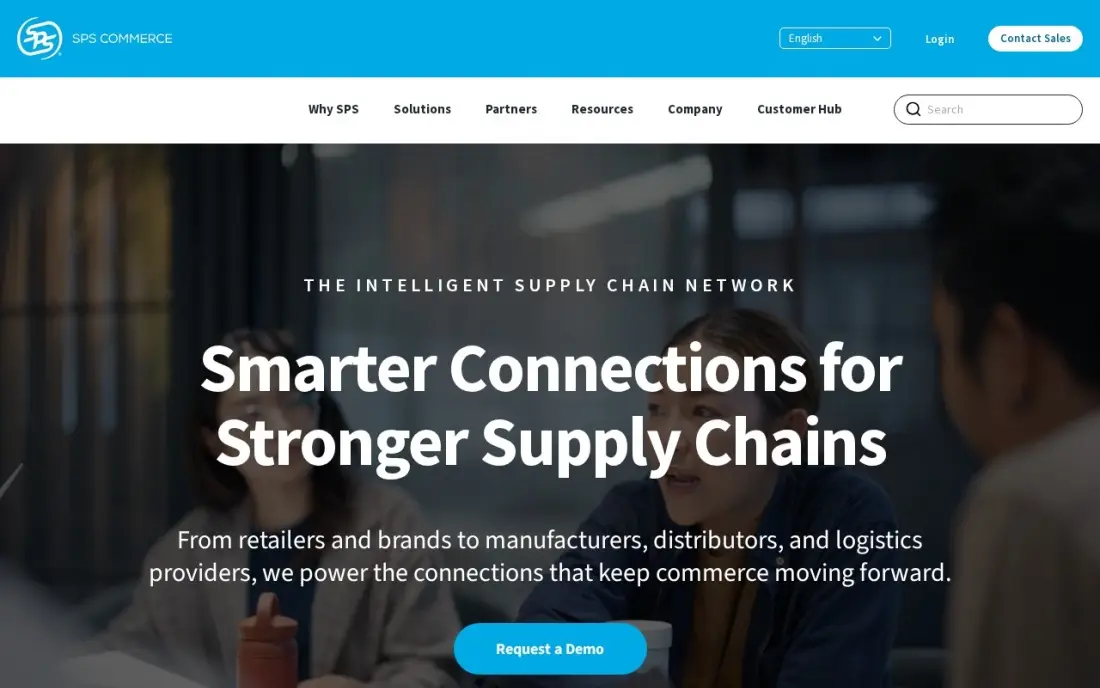
SPS Commerce is the full-service EDI option. Its network carries pre-built connections to more than 80,000 trading partners, and SPS handles mapping, testing and retailer compliance changes for you. Pre-built links to NetSuite, QuickBooks, Shopify and SAP Commerce keep retail orders flowing into the systems a brand already runs, and it has the most G2 reviews among the EDI tools here.
SPS publishes no price, directories list anything from $20 to $99 a month, and reviewers report setup fees of roughly $900 to $1,500 per retail connection. Contracts are described as rigid. Get every fee in writing before connecting your first retailer.
What we like
- Largest retail trading partner network here, with pre-built connections to more than 80,000 partners
- Full-service model: SPS handles mapping, testing and compliance changes for each retailer
- Pre-built links to NetSuite, QuickBooks, Shopify and SAP Commerce
- Highest review volume in this list, at 733 G2 reviews
Watch out for
- No published price, and directories disagree widely ($20/month on Capterra and GetApp, $99/month on SelectHub)
- Reviewers report costs climbing with partner count, plus setup fees of roughly $900-$1,500 per retail connection
- Contracts are described as rigid, with billing surprises reported by some users
The best ecommerce integration software moves orders, customers and stock between your store and every other system without anyone retyping them. We compared seven tools across two jobs: app automation platforms that connect a store to email, accounting, CRM and chat, and EDI and integration platforms that connect a brand to retailers and ERPs. Every price below comes from the vendor's own pricing page as checked in November 2026, and we say plainly where a vendor publishes no price.
How to choose the best ecommerce integration software
- List the systems first. Write down the store, marketplaces, accounting, shipping, email and any retailers, then check native connectors for each.
- Understand the meter. Tasks, credits, executions and partner connections are billed very differently; model a month of orders.
- Decide who will build it. No-code builders suit owners; code nodes and self-hosting suit developers.
- Plan for errors. Ask what happens when a sync fails: alerts, retries and logs matter more than the happy path.
- Separate EDI from app automation. Retailer purchase orders need an EDI provider, not a general automation tool.
- Keep stock in one place. Let one system own inventory and have integrations read from it.
Integrations save time behind the scenes; search brings in the orders to process. If your store needs more organic traffic, see our guide to SEO for ecommerce or our monthly SEO service.
Ecommerce integration pricing: what you will actually pay
Take a store with 1,000 orders a month running one three-step workflow per order: save to a sheet, add to the email list and post to Slack. On Zapier that is 3,000 tasks, which moves Professional from $19.99 to $49 a month billed annually. On Make, the same flow uses roughly 3,000 to 4,000 credits depending on how modules are counted, inside Core's 10,000 credits at $9 a month billed annually. On Pabbly Connect, only the three actions count, 3,000 tasks, well inside Standard's 10,000 at $16 a month billed annually. On n8n, it is 1,000 executions, inside Starter's 2,500 at $20 a month billed annually, or $0 self-hosted.
EDI is priced differently. TrueCommerce and SPS Commerce publish no prices; directories list TrueCommerce Basic at $19.95 a month and SPS at $20 to $99, and reviewers report SPS setup fees of roughly $900 to $1,500 per retailer. Boomi is quote-only, with a third-party figure of $550 a month. Ask for the cost per trading partner before signing.
Know the difference: app automation vs EDI
App automation tools such as Zapier, Make, n8n and Pabbly Connect watch for an event in one app, such as a new order, and act in others. They are quick to set up, cheap at small volume and ideal for connecting a store to email, spreadsheets, CRM and team chat.
EDI is a set of standard document formats that large retailers use for purchase orders, invoices and advance shipping notices, sent over secure networks with strict rules for each retailer. TrueCommerce and SPS Commerce maintain the retailer maps and compliance changes, and Boomi adds EDI to a wider integration platform. A brand selling only online rarely needs EDI; a brand that lands a big retail buyer usually needs it within weeks.
Quick comparison: tool type by need
| Buyer | Best pick | Why |
|---|---|---|
| Easiest no-code start | Zapier | Thousands of apps, free for 100 tasks, $19.99/month billed annually |
| Most automation per dollar | Make | 10,000 credits from $9/month billed annually |
| Technical teams | n8n | Billed per run, free self-hosted Community Edition |
| High task volume, low budget | Pabbly Connect | 10,000 tasks from $16/month billed annually |
| Multi-system integration | Boomi | APIs, data and EDI on one platform, priced by quote |
| First retail EDI | TrueCommerce | 92,000+ partner connections, priced by quote |
| Full-service retail EDI | SPS Commerce | 80,000+ partners with mapping handled for you |
Mistakes to avoid
- Building one giant workflow. Split integrations into small flows so one failure does not stop everything.
- Ignoring failed runs. Turn on error alerts and check logs weekly; silent failures lose orders.
- Syncing stock both ways from several tools. Two tools writing stock counts will overwrite each other.
- Underestimating task counts. Multiply steps by orders for your busiest month before choosing a plan.
- Agreeing to retailer EDI without a quote. Per-partner setup fees can outweigh the monthly fee.
How we chose
We checked each vendor's own pricing page in November 2026 and recorded the starting price exactly as shown, including the annual-billing figure where listed. Where a vendor publishes no price, we say so and label directory figures as third-party. We ranked tools for the most common buyer, a small or mid-size online store connecting its shop to the rest of the business, with EDI options for brands entering retail. Ratings come from G2 pages checked on the dates shown in the sources. No vendor paid for a place in this list, and none of the links here are affiliate links.
What to do next
Write down the three tasks your team retypes most each week, build the first one on Zapier's or Make's free plan, and run it for a month before automating the next. When the back office runs itself and you want more orders through it, book a free SEO call.
Frequently asked questions
What is the best ecommerce integration software?
For most small stores, Zapier is the easiest start, free for 100 tasks a month and $19.99 a month billed annually for 750 tasks. Make offers more volume for less, from $9 a month billed annually for 10,000 credits, and n8n suits technical teams. For retailer EDI, look at TrueCommerce or SPS Commerce.
What does ecommerce integration software do?
It moves data between your store and other systems automatically: orders to accounting and shipping, customers to email and CRM, stock levels between channels and purchase orders from retailers. The goal is to stop retyping data between apps.
Is Zapier or Make better for ecommerce?
Zapier is easier to learn and has the larger app library. Make is cheaper at volume, with 10,000 credits from $9 a month billed annually against 750 Zapier tasks at $19.99, and handles branching logic better. Many stores start on Zapier and move busy workflows to Make.
Do I need EDI to sell to retailers?
Most large retailers require EDI for purchase orders, invoices and advance shipping notices. TrueCommerce and SPS Commerce provide pre-built connections to tens of thousands of trading partners, and Boomi includes EDI inside a wider integration platform.
How much does ecommerce integration software cost?
Automation tools start low: Make from $9 a month, Pabbly Connect from $16 and Zapier from $19.99, all billed annually, and n8n from $20 billed annually or free self-hosted. EDI and enterprise platforms such as TrueCommerce, SPS Commerce and Boomi are quote-only.
Can integration software sync inventory between channels?
It can, but a dedicated inventory system usually does it more reliably. Use automation tools for orders, customers and notifications, and let an inventory system own stock counts across channels.
Sources we checked (13)
- Zapier — zapier.com/pricing (checked November 12, 2026)
- Zapier reviews on G2 (checked November 12, 2026)
- Make — www.make.com/en/pricing (checked November 2, 2026)
- Make reviews on G2 (checked November 2, 2026)
- n8n — n8n.io/pricing (checked November 2, 2026)
- n8n reviews on G2 (checked November 2, 2026)
- Pabbly Connect — www.pabbly.com/connect/pricing (checked November 2, 2026)
- Boomi — www.boomi.com (checked November 10, 2026)
- Boomi reviews on G2 (checked November 10, 2026)
- TrueCommerce — www.getapp.com/it-management-software/a/truecommerce-edi-solutions (checked November 10, 2026)
- TrueCommerce reviews on G2 (checked November 10, 2026)
- SPS Commerce — www.selecthub.com/edi-software/sps-commerce-fulfillment-vs-cleo-integration-cloud (checked November 10, 2026)
- SPS Commerce reviews on G2 (checked November 10, 2026)
Make one of these tools?
We re-check this list every quarter. Send a correction, request a review, or ask about a clearly labeled sponsored spot.
Request a listingShamim
Founder of SerpAstra
A full-stack SEO and digital marketer who spends most days on Local SEO for dental practices, AI search visibility and lead generation.
Free SEO and AI visibility audit
Find out what is holding your rankings back
Send us your site. Within 2 business days you get a written audit, an AI visibility check and a short fix list ranked by impact. Free, with no contract attached.
Request my free audit→Related buying guides
 Productivity & Office10 Best AI Automation Tools for Small Business in 2026, Compared10 best ai automation tools for small business compared on price, free plans and AI features, with real starting prices checked November 2, 2026.Read guide →
 Logistics, Supply Chain & Procurement10 Best EDI Software for Small Business in 2026, ComparedThe 10 best edi software for small business options compared on price, partner networks and ERP links, with every price checked November 10, 2026.Read guide →
 Ecommerce8 Best Ecommerce Inventory Management Software in 2026, ComparedCompare the 8 best ecommerce inventory management software on multichannel stock sync, order caps, free plans and real monthly cost, with prices checked.Read guide →