
8 Best Ecommerce Order Management Software in 2026, Compared
Compare the 8 best ecommerce order management software on multichannel order routing, shipping, order caps and real monthly cost, with every price checked.
 Shamim Mia, Founder, SerpAstraLast verified November 10, 20268 min read
We compare pricing pages, documentation and public reviews. We never accept payment for rankings.
Key takeaways
- ShipStation is the cheapest way to pull orders from every channel into one queue, from $14.99 a month for 50 shipments.
- Zoho Inventory manages orders, stock and dropshipping from $29 a month billed annually for 500 orders, with a free plan for 50.
- Cin7 Core and Finale Inventory suit multichannel sellers that need orders and stock in one system, from $349 a month and $63 a month billed annually.
- Oracle NetSuite is the full ERP option when orders, finance and inventory must share one database, but every deal is negotiated with no published price.
On this page
Quick comparison
| Tool | Best for | Starting price | Free plan |
|---|---|---|---|
| ShipStation | Online sellers that want orders from every store and marketplace in one shipping queue | $14.99/mo | No (30-day trial) |
| Zoho Inventory | Small online sellers that want sales orders, stock and dropshipping in one low-cost system | Free; $29/mo (annual) | Yes (50 orders) |
| Cin7 Core | Multichannel sellers that need orders from Shopify, Amazon and wholesale managed against one stock pool | $349/mo | No |
| Ordoro | Growing stores that want order routing, kitting, dropshipping and labels in one workflow | $499/mo | No (15-day trial) |
| Finale Inventory | High-volume ecommerce sellers that need order processing tied to warehouse picking | $63/mo (annual) | No (trial) |
| inFlow Inventory | Stores that also take wholesale orders and want B2B ordering beside retail orders | $99/mo (annual) | No (14-day trial) |
| Odoo Inventory | Growing businesses that want orders, stock and accounting in one modular system | Free (One App); $31.10/user/mo | Yes (1 app free) |
| Oracle NetSuite | Larger ecommerce businesses that want orders, inventory, finance and CRM in one cloud ERP | Custom quote | No (tour only) |
Make one of these tools?
We re-check this list every quarter. Send a correction, request a review, or ask about a clearly labeled sponsored spot.
Request a listingThe best ecommerce order management software

ShipStation
Best for: Online sellers that want orders from every store and marketplace in one shipping queue
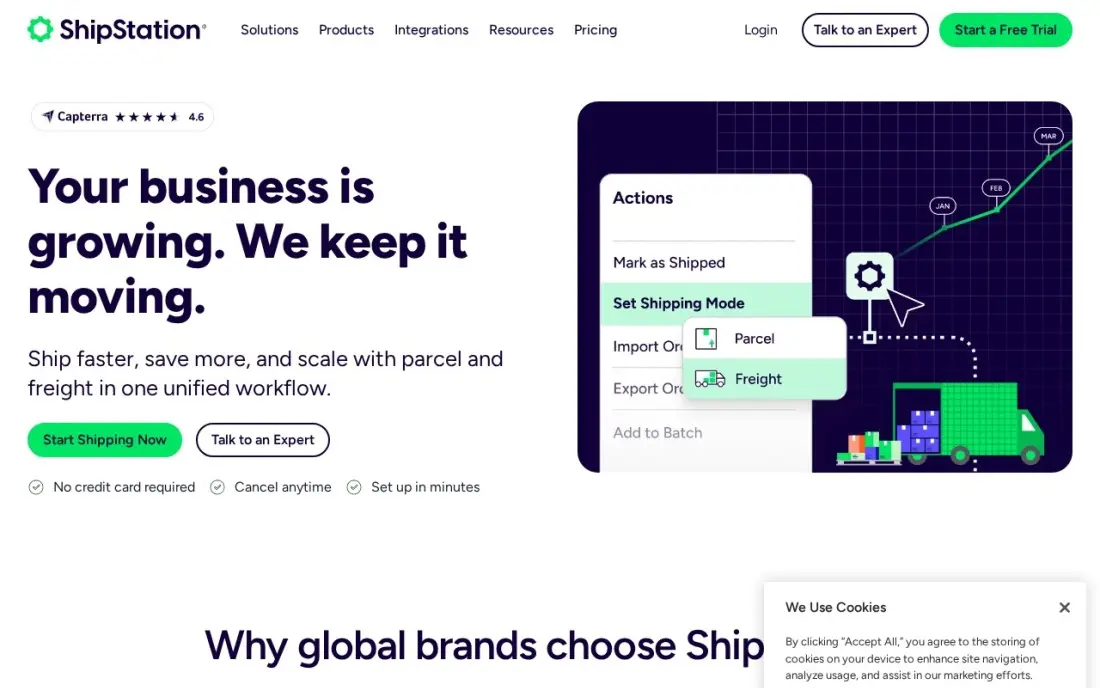
ShipStation is where many stores first get order management: it imports orders from more than 300 carts and marketplaces into one queue, applies automation rules such as choosing a carrier by weight or destination, prints branded labels in batches and sends tracking to customers. Starter costs $14.99 a month for 50 shipments, and stock levels sync back to each channel as orders ship.
Pricing is banded by shipments, so Starter costs $79.99 a month at 1,000 shipments, and the inventory and purchasing tools are lighter than a full order system. Choose ShipStation when getting orders out the door is the daily problem and your catalog is simple.
What we like
- Starter at $14.99/month covers 50 shipments with 300+ integrations across carts and marketplaces
- Automation rules, branded labels and discounted carrier rates cut the time each order takes to leave the shelf
- Stock levels sync back to every connected channel as orders ship, so listings do not oversell
Watch out for
- ShipStation is shipping-first: its inventory tools are lighter than the dedicated systems in this list
- The price rises with shipment volume — Starter is $79.99 a month at 1,000 shipments, not $14.99
- Older directories still show the retired $9.99 Starter tier and the old Bronze/Silver ladder; the current plans are Starter, Standard and Premium

Zoho Inventory
Best for: Small online sellers that want sales orders, stock and dropshipping in one low-cost system
Zoho Inventory handles the whole order path for a small store: sales orders from connected channels, stock allocation, packages, shipments, backorders and dropshipping, with pricing per organization rather than per user. The free plan covers 50 orders a month, and Standard costs $29 a month billed annually, or $39 monthly, for 500 orders, 3 users and 2 locations.
Every plan caps monthly orders, so a sale month can push you into the next tier, with Premium handling 3,000 orders at $79 a month, which is also where serial and batch tracking start. For a store under 500 orders a month that wants orders and stock together, it is the best value here.
What we like
- Free plan covers 50 orders a month with item tracking, barcoding and vendor management
- Per-organization pricing, not per-user: adding team members costs nothing extra on any plan
- Standard at $29/month billed annually covers 500 orders, 3 users and 2 locations with composite items and dropshipping
Watch out for
- Order caps force an upgrade at every growth step: 500 orders a month on Standard, 3,000 on Premium
- Serial and batch tracking, barcode generation and stock counting sit on Premium ($79/month) or above
- No free trial of the paid plans beyond the 14-day trial; the free plan is the only way to test long-term

Cin7 Core
Best for: Multichannel sellers that need orders from Shopify, Amazon and wholesale managed against one stock pool
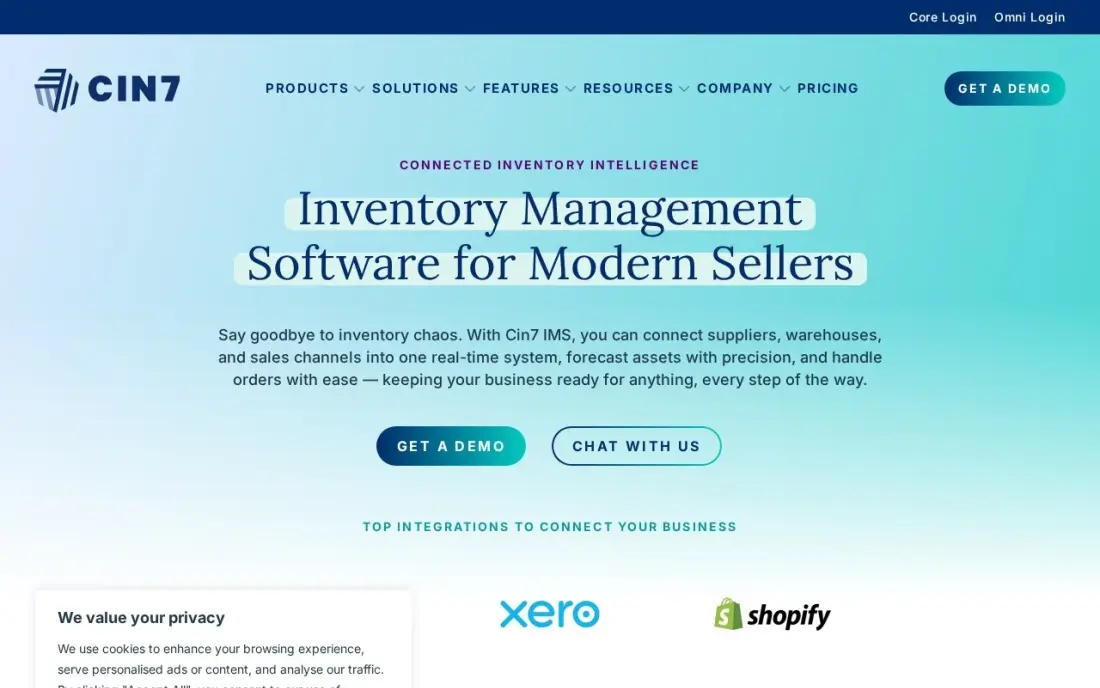
Cin7 Core manages orders from Shopify, Amazon and B2B channels against one stock pool, with unlimited inventory locations on every plan, so an order is allocated from the right warehouse and every channel sees the updated count. Pricing is published: Standard costs $349 a month, Pro $599 with production planning and Advanced $1,199.
Standard covers 5 users, 2 integrations and 6,000 sale orders a year, which is about 500 a month, and volume above that costs more. The B2B portal, POS and forecasting are add-ons. Choose Cin7 when multichannel order accuracy is the problem worth paying for.
What we like
- One published price list for a serious system: Standard $349, Pro $599 and Advanced $1,199 a month
- Unlimited inventory locations on every plan, with native Shopify and Amazon stock sync
- Pro adds material requirements planning for sellers who assemble or make what they sell
Watch out for
- Standard at $349/month covers only 5 users, 2 integrations and 6,000 sale orders a year; volume above that costs more
- ForesightAI forecasting, the B2B portal and POS are paid add-ons, not part of the base plans
- Cin7 Omni, the enterprise product, is quote-only, so larger sellers lose the published-price certainty

Ordoro
Best for: Growing stores that want order routing, kitting, dropshipping and labels in one workflow
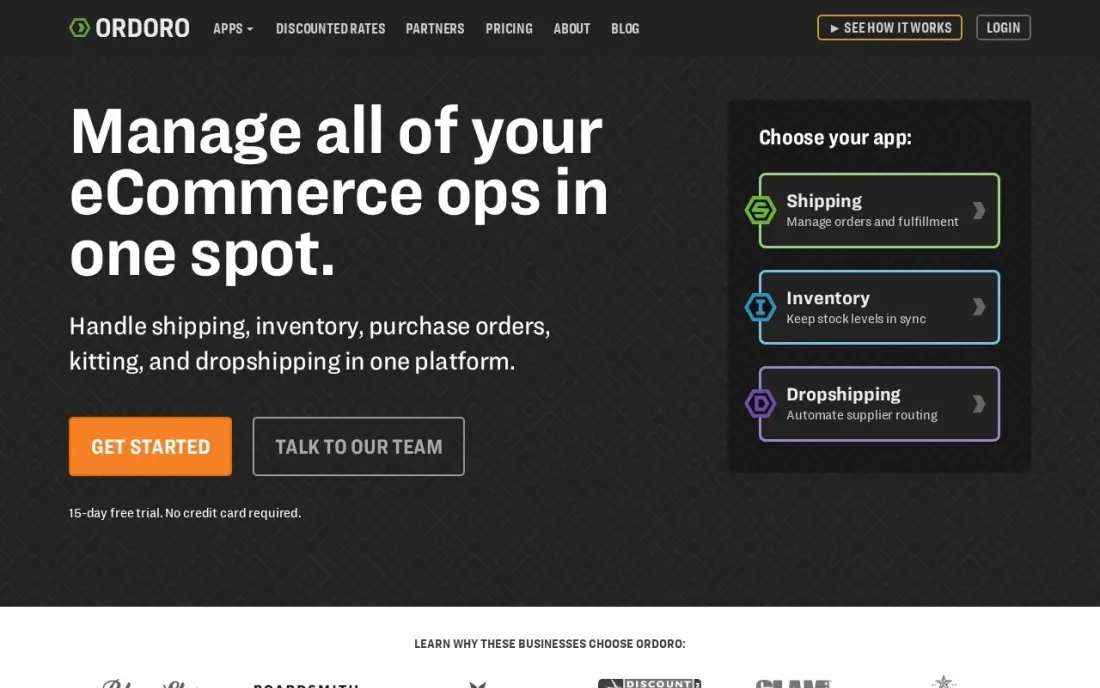
Ordoro combines order processing with inventory for stores shipping hundreds of orders a month. Pro costs $499 a month and bundles inventory, kitting, purchase orders and multi-warehouse tracking with discounted USPS rates, batch labels and automation rules, so orders can be routed and shipped from one screen. A 15-day free trial lets you run real orders first.
Express at $59 a month is shipping only, with no inventory management, and dropshipping automation is a separate $299 a month module. A store that routes some orders to suppliers and ships the rest itself needs Pro plus that module. Choose Ordoro when orders, stock and labels all leave from one desk.
What we like
- Pro bundles inventory, kitting, purchase orders and multi-warehouse tracking
- Discounted USPS rates and batch label printing in the same workflow
- Automation rules and shipping presets cut manual label work
Watch out for
- Inventory management only starts on Pro at $499/month; Express ($59) is shipping only
- Dropshipping automation is a separate $299/month module

Finale Inventory
Best for: High-volume ecommerce sellers that need order processing tied to warehouse picking
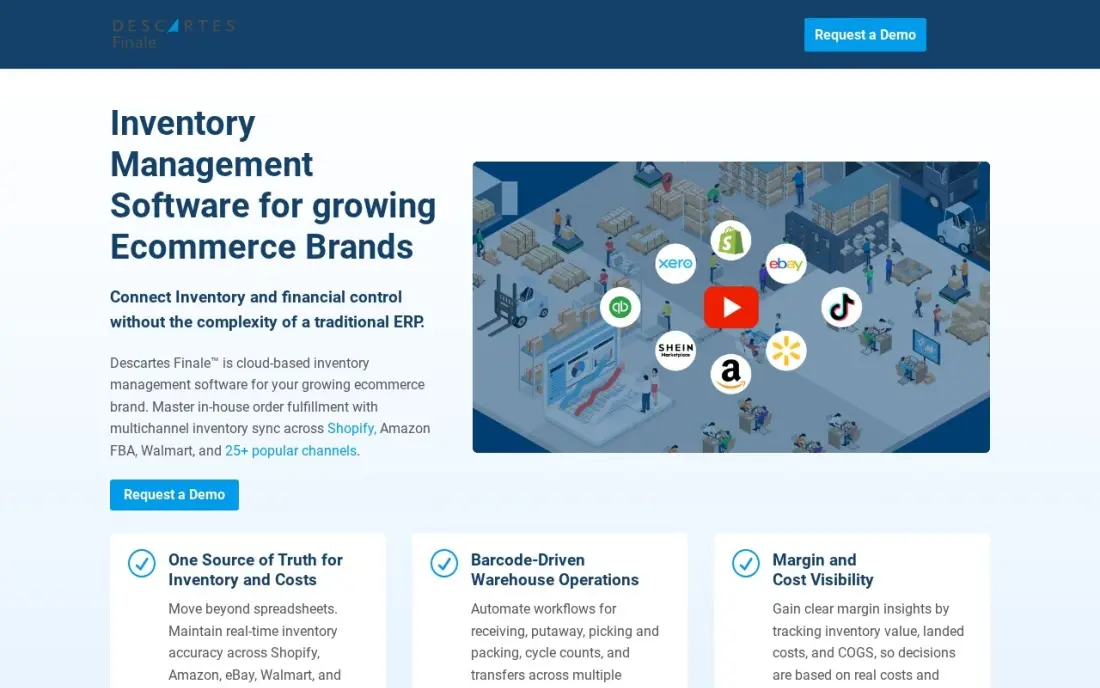
Finale Inventory links orders to the warehouse. Orders from several channels flow into one system, stock is reserved and picked with barcode scanning, and counts stay accurate across a busy stockroom. Starter costs $63 a month billed annually, or $75 monthly, and covers up to 100,000 products, which suits large catalogs on a modest budget.
Starter covers only two users, and the next tiers cost $166 and $291 a month billed annually, so a bigger warehouse team pays more. There is no free plan, only a trial. Choose Finale when order volume and picking accuracy are the bottleneck.
What we like
- Starter at $63/month billed annually covers up to 100,000 products
- Strong multichannel order and warehouse support for growing sellers
- Highest G2 score in this list at 4.8/5
Watch out for
- No free plan, only a trial, and the entry Starter plan covers just 2 users
- Higher tiers jump to $166 and $291 a month billed annually, so growth is pricey

inFlow Inventory
Best for: Stores that also take wholesale orders and want B2B ordering beside retail orders
inFlow Inventory suits a store that handles retail and wholesale orders side by side. Every plan includes unlimited products, sales orders and purchase orders, and the B2B Showroom add-on at $39 a month lets trade customers place orders through their own portal with their own prices. Lite costs $99 a month billed annually, or $129 monthly, for 2 team members and 1 location.
A third person or a second location means Core at $299 a month, and Core and above require a $499 onboarding package. Serial and lot tracking are $39 a month each below the top tier. Choose inFlow when wholesale orders are a real part of the business.
What we like
- Unlimited products, sales and purchase orders on every plan, with 2 team members and 1 location on Lite
- B2B Showroom add-on ($39/month) gives customers their own portal with per-customer products and prices
- G2 reviewers cite ease of use most, and in-house support is included on every plan
Watch out for
- Lite at $99/month billed annually covers only 2 team members and 1 location; a third person or second site means Core ($299/month)
- Serial and lot tracking are $39/month add-ons each below the top tier, and Core and above require a $499 one-time onboarding package
- Manufacturing (bills of materials, work orders) is a separate product line starting at $169/month billed annually

Odoo Inventory
Best for: Growing businesses that want orders, stock and accounting in one modular system
Odoo can run the whole order cycle once its apps are combined: Sales takes the order, Inventory reserves and picks the stock, and Accounting invoices it, all in one database. The Inventory app alone is free for unlimited users on One App Free, with multi-location stock, lots and serial numbers, barcode picking and reordering rules.
Order management needs Sales as well, and adding a second app moves every user to Standard at $31.10 a month for the first 12 months, then $38.90. Setup and configuration take real work. Choose Odoo when you want one system for orders and finance and can invest time in setting it up.
What we like
- One App Free gives the full Inventory app — multi-location stock, lots and serials, barcode picking — for unlimited users at $0
- Standard includes every Odoo app, so sales, purchasing and accounting share one stock figure with no sync step
- Reordering rules, landed costs and FEFO picking cover warehouse workflows the simpler trackers cannot
Watch out for
- The $31.10/user/month figure is a 12-month introductory rate; the list price is $38.90/user/month
- Every internal user is charged once a second app is installed, so costs scale with headcount, not stock
- Setup and customization take real work; reviewers note a steep learning curve on advanced settings

Oracle NetSuite
Best for: Larger ecommerce businesses that want orders, inventory, finance and CRM in one cloud ERP
NetSuite is the ERP route to order management. Orders, inventory, the general ledger, CRM and ecommerce run in one cloud system, so an order updates stock, revenue and the customer record at once, and SuiteSuccess templates shorten implementation for standard business models. It has more than 5,000 G2 reviews at 4.1 out of 5.
Oracle publishes no price list, so every deal is negotiated; third-party guides put small-business implementation at $25,000 to $50,000 and report renewal increases of 15 to 50 percent. Choose NetSuite when the business has outgrown separate order, inventory and accounting tools, and get a renewal cap in writing.
What we like
- True cloud ERP with CRM included in the base platform, no separate module fee
- One system for general ledger, inventory, orders, CRM and ecommerce
- SuiteSuccess templates shorten implementation for standard business models
- The most reviewed ERP here, with 5,256 G2 reviews at 4.1 out of 5
Watch out for
- Oracle publishes no price list, so every deal is negotiated and quotes vary widely
- Implementation typically runs $25,000 to $50,000 for a small business, per third-party guides
- Renewal increases of 15 to 50 percent a year are reported by third-party guides
The best ecommerce order management software pulls every order into one place, sends it to the right warehouse or supplier and keeps customers and sales channels updated until it is delivered. We compared eight tools, from shipping-first order queues to inventory systems and a full ERP, on multichannel routing, order caps and what a growing store actually pays. Every price below comes from the vendor's own pricing page as checked in November 2026.
How to choose the best ecommerce order management software
- Map where orders come from. List every store, marketplace and wholesale channel, and confirm a native connector for each.
- Decide where orders go. Your own shelves, several warehouses, a 3PL or dropship suppliers each need different routing features.
- Find the meter. Orders, shipments, users and locations are all used as pricing limits; check your busiest month against each.
- Check returns and backorders. These are where spreadsheets break first, so test them on a trial.
- Keep stock and orders in one system. Splitting them across tools causes overselling.
- Plan the accounting link. Orders should reach QuickBooks, Xero or your ERP without retyping.
Smooth fulfilment brings repeat buyers and better reviews, which help search visibility too. For the traffic side, see our guide to SEO for ecommerce or our monthly SEO service.
Ecommerce order management pricing: what you will actually pay
Take a store with 450 orders a month from Shopify and Amazon and three staff. Zoho Inventory Standard fits at $29 a month billed annually, $348 a year, covering 500 orders and 3 users. ShipStation's banded pricing sits between $14.99 for 50 shipments and $79.99 for 1,000, so check its band for 450. Finale Starter costs $63 a month billed annually, $756 a year, but covers two users, so a third pushes the store to a $166 tier.
Cin7 Core Standard costs $349 a month, $4,188 a year, and its 6,000 sale orders a year covers this store with little headroom. Ordoro Pro costs $499 a month, $5,988 a year, plus $299 a month if the store dropships. inFlow's 2-user Lite plan does not fit three staff, so this store would need Core at $299 a month plus the $499 onboarding. NetSuite is quote-only, with third-party guides putting implementation at $25,000 to $50,000.
Know the difference: order management vs shipping software
An order management system owns the order from the moment it is placed. It reserves stock, decides which location or supplier fulfils it, splits orders across warehouses, handles backorders and returns, and passes the result to accounting. Zoho Inventory, Cin7 Core, Finale, inFlow, Odoo and NetSuite work this way.
Shipping software takes over when the order is ready to leave. ShipStation and Ordoro import orders, rate-shop carriers, print labels and send tracking. For a store with one location and a simple catalog, shipping software may be all the order management it needs. Once orders route across warehouses, suppliers or wholesale accounts, a full order system earns its place.
Quick comparison: tool type by need
| Buyer | Best pick | Why |
|---|---|---|
| Shipping-first stores | ShipStation | Orders from 300+ channels in one queue, from $14.99/month |
| Small stores on a budget | Zoho Inventory | Orders, stock and dropshipping, $29/month billed annually |
| Multichannel sellers | Cin7 Core | One stock pool across channels, from $349/month |
| Orders plus labels plus kitting | Ordoro | Inventory and shipping on Pro at $499/month |
| High-volume warehouses | Finale Inventory | Barcode picking from $63/month billed annually |
| Retail plus wholesale | inFlow Inventory | B2B Showroom portal, Lite $99/month billed annually |
| Orders plus accounting | Odoo Inventory | One database for sales, stock and invoices |
| Full ERP | Oracle NetSuite | Orders, inventory, finance and CRM, priced by quote |
Mistakes to avoid
- Pricing an average month. Order caps bite in peak season; size the plan for your busiest month.
- Leaving returns manual. Unrecorded returns make stock counts wrong within weeks.
- Running orders in two systems. Pick one system of record and have every channel feed it.
- Skipping supplier tracking. Dropship orders need tracking pulled back automatically, or customers chase you.
- Ignoring onboarding fees. Ask every vendor about setup and implementation costs before comparing monthly prices.
How we chose
We checked each vendor's own pricing page in November 2026 and recorded the starting price exactly as shown, including the annual-billing figure where listed. We ranked tools for the most common buyer, a small or mid-size online store selling on two or more channels, weighing order routing, plan caps and the full monthly cost. Third-party figures for NetSuite are labelled as such. Ratings come from G2 pages checked on the dates shown in the sources. No vendor paid for a place in this list, and none of the links here are affiliate links.
What to do next
Pull your order count by channel for the last three months, note every place an order is retyped today, and trial the two tools whose caps fit your busiest month. When orders flow cleanly and you want more of them, book a free SEO call.
Frequently asked questions
What is the best ecommerce order management software?
For most small stores, Zoho Inventory is the best value, free for 50 orders a month and $29 a month billed annually for 500. ShipStation is the cheapest way to centralize orders for shipping from $14.99 a month, and Cin7 Core suits multichannel sellers from $349 a month.
What does an order management system do?
It collects orders from every sales channel into one place, allocates stock from the right location, routes each order to be picked, shipped or dropshipped, and updates customers and channels with tracking. Better systems also handle returns, backorders and wholesale orders.
Do I need order management software if I only sell on Shopify?
Usually not at first, because Shopify handles its own orders. You need a separate system once you add a marketplace, a second store, wholesale or a warehouse, when orders and stock start living in more than one place.
How much does ecommerce order management software cost?
On published prices, ShipStation starts at $14.99 a month, Zoho Inventory at $29 billed annually, Finale at $63 billed annually, inFlow at $99 billed annually, Cin7 Core at $349 and Ordoro Pro at $499 a month. NetSuite is quote-only.
What is the difference between order management and inventory management?
Order management follows each order from sale to delivery. Inventory management tracks how much stock you have and where. Most tools here do both, but ShipStation leans to orders and shipping, while Finale and Cin7 lean to stock.
Can order management software handle dropshipping?
Several can. Zoho Inventory includes dropshipping on Standard, and Ordoro offers dropshipping automation as a $299-a-month module. Check that the tool can send orders to suppliers automatically and pull tracking back.
Sources we checked (14)
- ShipStation — www.shipstation.com/pricing (checked November 10, 2026)
- ShipStation reviews on G2 (checked November 10, 2026)
- Zoho Inventory — www.zoho.com/us/inventory/pricing (checked November 10, 2026)
- Zoho Inventory reviews on G2 (checked November 10, 2026)
- Cin7 Core — www.cin7.com/pricing (checked November 10, 2026)
- Cin7 Core reviews on G2 (checked November 10, 2026)
- Ordoro — www.ordoro.com/pricing (checked November 10, 2026)
- Finale Inventory — www.finaleinventory.com/pricing (checked November 10, 2026)
- inFlow Inventory — www.inflowinventory.com/software-pricing (checked November 10, 2026)
- inFlow Inventory reviews on G2 (checked November 10, 2026)
- Odoo Inventory — www.odoo.com (checked November 10, 2026)
- Odoo Inventory reviews on G2 (checked November 10, 2026)
- Oracle NetSuite — www.netsuite.com/portal/products/pricing.shtml (checked November 12, 2026)
- Oracle NetSuite reviews on G2 (checked November 12, 2026)
Make one of these tools?
We re-check this list every quarter. Send a correction, request a review, or ask about a clearly labeled sponsored spot.
Request a listingShamim
Founder of SerpAstra
A full-stack SEO and digital marketer who spends most days on Local SEO for dental practices, AI search visibility and lead generation.
Free SEO and AI visibility audit
Find out what is holding your rankings back
Send us your site. Within 2 business days you get a written audit, an AI visibility check and a short fix list ranked by impact. Free, with no contract attached.
Request my free audit→Related buying guides
 Ecommerce8 Best Ecommerce Inventory Management Software in 2026, ComparedCompare the 8 best ecommerce inventory management software on multichannel stock sync, order caps, free plans and real monthly cost, with prices checked.Read guide →
 Logistics, Supply Chain & Procurement7 Best Shipping Companies for Small Business in 2026Compare the 7 best shipping company for small business options on price, free plans and carrier rates, with every price checked November 4, 2026.Read guide →
 Logistics, Supply Chain & Procurement10 Best Inventory Management Software Small Business in 2026, Compared10 best inventory management software small business picks compared with real 2026 prices, free plans and order limits, so you can choose by volume.Read guide →