
8 Best Ecommerce Platforms for Product Listings in 2026, Compared
Compare the 8 best ecommerce platforms for product listings: catalog tools, marketplace crosslisting and stock sync, with every price checked on vendor pages.
 Shamim Mia, Founder, SerpAstraLast verified November 4, 20268 min read
We compare pricing pages, documentation and public reviews. We never accept payment for rankings.

Key takeaways
- BigCommerce is the best store platform for large product listings: unlimited products, built-in filtering and variant handling on Core at $39 a month.
- Sellbrite is the best tool for pushing one catalog's listings to several marketplaces, with unlimited channels and SKUs and a free plan up to 30 orders a month.
- Resellers listing one-off items should use a crosslister: Vendoo includes auto-delist from $14.99 a month, List Perfectly covers 13 marketplaces from $29.
- Etsy and Shopify sit at either end: Etsy brings buyers to each $0.20 listing, Shopify gives you the most control over how listings look and rank.
On this page
Quick comparison
| Tool | Best for | Starting price | Free plan |
|---|---|---|---|
| BigCommerce | Stores with large catalogs and many variants that need strong listing and filtering tools | $39/mo | No (15-day trial) |
| Shopify | Brands that want full control over how listings look and sell across their store and social channels | $39/mo | No (trial) |
| Sellbrite | Sellers who want to publish one catalog's listings to Amazon, eBay, Etsy and more | $29/mo | Yes (30 orders) |
| Zoho Inventory | Sellers who want one master product record feeding every store and marketplace listing | $29/mo (annual) | Yes (50 orders) |
| Etsy | Makers and vintage sellers who want each listing in front of buyers already searching | Free; $0.20/listing | Yes (no monthly fee) |
| Vendoo | Resellers who list one-off items on many marketplaces and need auto-delist at a low price | $14.99/mo | No (14-day trial) |
| List Perfectly | High-volume resellers who want a catalog-first crosslister covering 13 marketplaces | $29/mo | No (money-back guarantee) |
| WooCommerce | WordPress sellers who want full control of listing data and no platform fee | Free | Yes (free plugin) |
Make one of these tools?
We re-check this list every quarter. Send a correction, request a review, or ask about a clearly labeled sponsored spot.
Request a listingThe best ecommerce platforms for product listings

BigCommerce
Best for: Stores with large catalogs and many variants that need strong listing and filtering tools
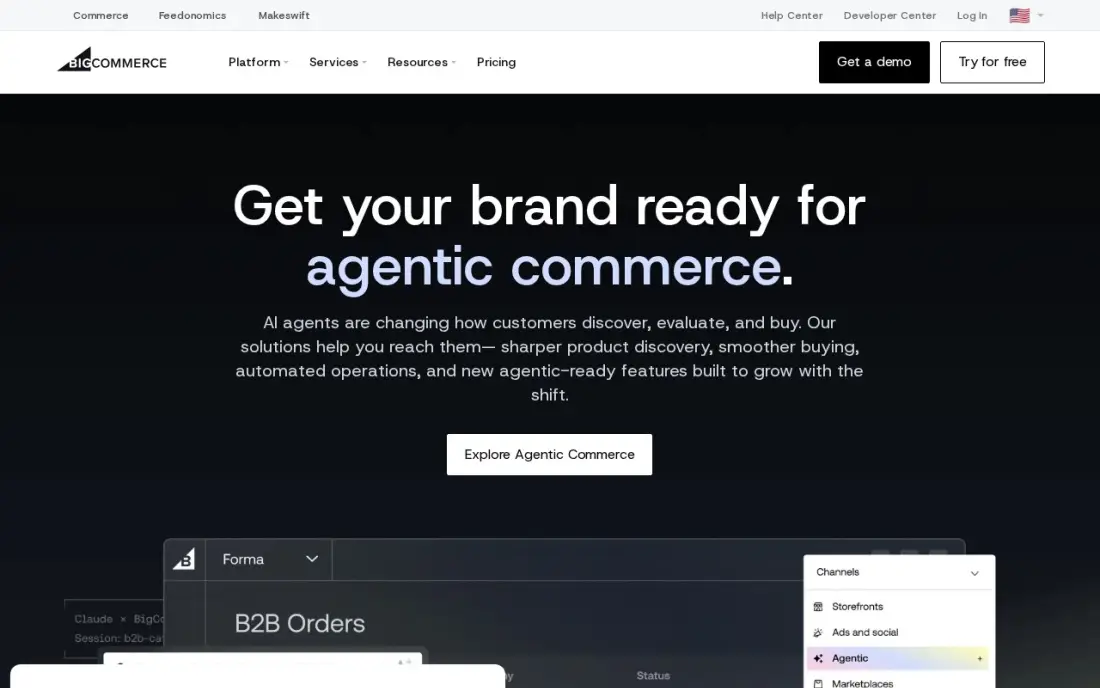
BigCommerce is built for big product catalogs. Core includes unlimited products, built-in product filtering and SEO controls, and handles items with many variants, so a store with thousands of listings stays searchable for shoppers. Unlimited staff accounts let several people work on listings at once. Core costs $39 a month, or $29 billed annually.
Core covers $30,000 in trailing 12-month sales before the store auto-upgrades, so a large catalog that sells well will move tiers. Abandoned cart recovery is not on Core. For pure catalog management on a hosted store, it is the strongest base here.
What we like
- Unlimited products, staff accounts and storage on every plan, with real-time shipping quotes
- Multi-currency selling and gift cards are included on Core, not held for a higher tier
- No platform fee on orders through approved embedded payment providers such as Stripe and PayPal
- Built-in SEO and product filtering for catalogs with many variants
Watch out for
- The plan auto-upgrades when trailing 12-month sales pass $30,000, so growth raises the bill
- A 2% fee applies on orders through payment gateways outside BigCommerce's approved list
- Abandoned cart recovery is not included on the entry Core plan

Shopify
Best for: Brands that want full control over how listings look and sell across their store and social channels

Shopify gives a brand the most control over its own listings: product pages, collections, variants and metadata are all editable, themes decide the layout, and the same listing feeds the store, social shops, AI chats and POS from one catalog. Apps add bulk editing, marketplace feeds and richer product data. Basic costs $39 a month, or $29 billed annually.
Bulk listing work leans on apps, which add monthly fees, and only the owner gets a staff account on Basic, so a team editing listings needs Grow at $105 a month. A 2% fee applies on third-party gateways.
What we like
- The largest app and theme ecosystem of any hosted ecommerce platform
- Unlimited products, hosting, SSL and checkout included, with AI-chat selling on the entry plan
- Shopify Payments charges 2.9% + 30c online with no extra platform fee
- POS for in-person sales at markets and pop-ups is included on Basic
Watch out for
- Apps and a paid theme push the real bill well above the $39 headline price
- A 2% fee applies on sales through a third-party payment gateway on Basic
- Only the store owner gets a staff account on Basic, so a small team must upgrade

Sellbrite
Best for: Sellers who want to publish one catalog's listings to Amazon, eBay, Etsy and more
Sellbrite turns one product catalog into listings on several marketplaces, using listing templates and a listings manager, then keeps stock and prices in sync. Every plan has unlimited SKUs, users and sales channels, and Pro plans sync every 15 minutes. Amazon FBA orders never count toward the plan's order limit.
It is priced by orders: free up to 30 a month, Pro 100 at $29 a month billed annually, Pro 500 at $79 and Pro 2K at $179, with automatic upgrades when you pass the cap. The free plan syncs only every 2 hours, which can oversell fast items.
What we like
- Unlimited SKUs, users and integrated sales channels on every plan
- A free plan covers up to 30 orders a month
- Pro plans sync inventory, prices and orders every 15 minutes
- Amazon FBA orders never count toward plan limits
Watch out for
- Order caps push you up a tier automatically: Pro 500 is $79 a month and Pro 2K $179, billed annually
- The free plan syncs only every 2 hours, slow enough to oversell a fast-moving item
- FBA inventory and multi-channel fulfillment cost $19 a month extra

Zoho Inventory
Best for: Sellers who want one master product record feeding every store and marketplace listing
Zoho Inventory keeps the master product record — item details, stock, barcodes and composite items — and feeds listings and orders across your sales channels from that one source. The free plan covers 50 orders a month, and paid plans charge per organization, so the whole team can maintain listings without per-seat fees.
Standard costs $29 a month billed annually, or $39 billed monthly, for 500 orders, three users and two locations. Order caps force upgrades as you grow, and serial and batch tracking wait for Premium at $79 a month. It manages data rather than storefront design.
What we like
- Free plan covers 50 orders a month with item tracking, barcoding and vendor management
- Per-organization pricing, not per-user: adding team members costs nothing extra on any plan
- Standard at $29/month billed annually covers 500 orders, 3 users and 2 locations with composite items and dropshipping
Watch out for
- Order caps force an upgrade at every growth step: 500 orders a month on Standard, 3,000 on Premium
- Serial and batch tracking, barcode generation and stock counting sit on Premium ($79/month) or above
- No free trial of the paid plans beyond the 14-day trial; the free plan is the only way to test long-term

Etsy
Best for: Makers and vintage sellers who want each listing in front of buyers already searching
Etsy is the platform where a listing itself does the selling: buyers search Etsy, and a well-written title, tags and photos put your item in front of them without ads. Each listing costs $0.20 and stays live for four months, with no monthly fee, so a seller can test many listings cheaply.
Selling is where the cost lands: a 6.5% transaction fee plus 3% + $0.25 processing, about 10% before Offsite Ads take 12–15% of the sales they drive. Listings follow Etsy's format, with no custom domain and no customer emails.
What we like
- Built-in buyers: Etsy search brings customers to each listing without ads or an audience of your own
- No monthly fee — a standard shop costs $0.20 per listing plus fees only when something sells
- Etsy Payments handles cards, PayPal, Apple Pay and Klarna in one checkout
Watch out for
- Fees stack to about 10% of a sale: 6.5% transaction plus 3% + $0.25 processing, before ads
- Offsite Ads take 12–15% of sales they drive, and shops cannot opt out once they pass $10,000 a year
- The shop is Etsy's, not yours — no custom domain, no email list, and rules can change overnight

Vendoo
Best for: Resellers who list one-off items on many marketplaces and need auto-delist at a low price

Vendoo is built for resellers: you create a listing once and post it to more than 10 marketplaces, including eBay, Poshmark, Mercari, Vinted, Whatnot and Grailed. Starter costs $14.99 a month, or $12.49 billed annually, with unlimited items, templates, importing and the mobile app, plus sale detection and auto-delist, which pulls a sold item from every other marketplace.
AI listing help, bulk actions and background removal wait for Growth at $29.99 a month, and connecting a Shopify store adds $9.99 a month. There is no free plan in the US, only a 14-day trial that needs a card.
What we like
- Unlimited items and all 10+ marketplaces on every plan, including Vinted, Whatnot and Grailed
- Sale detection and auto-delist are included from Starter at $14.99 a month
- iOS and Android mobile app with listing templates, importing and analytics on every plan
Watch out for
- No free plan in the US — only a 14-day trial that needs a card up front
- AI listing help and bulk actions wait for Growth at $29.99/month
- Connecting a Shopify store adds $9.99 a month, billed through Shopify

List Perfectly
Best for: High-volume resellers who want a catalog-first crosslister covering 13 marketplaces
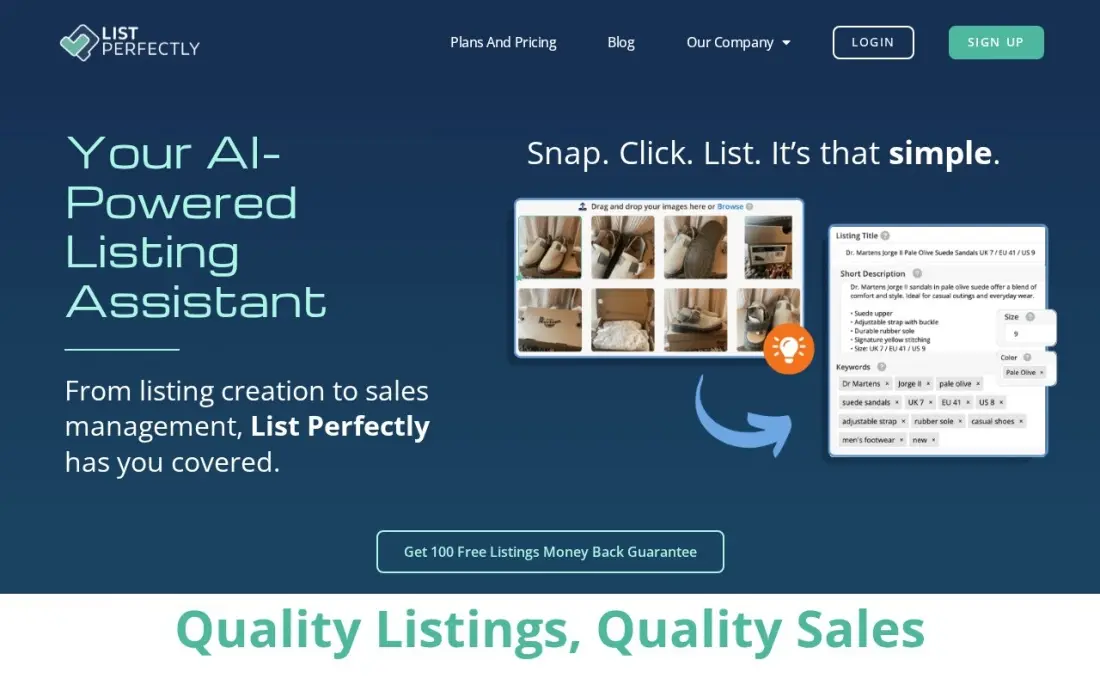
List Perfectly puts the catalog first: every item lives in your inventory, and marketplaces are destinations. Simple costs $29 a month for unlimited crosslisting to 13 marketplaces, including eBay, Etsy, Depop, Poshmark, Mercari, Vinted and Facebook, with an AI assistant that drafts 25 listings a month from photos.
Simple only carries title, description, price and photos across; brand, size, SKU and quantity need Business at $49 a month, and auto-delist waits for Pro Plus at $99 or more. There is no free plan or trial, only a money-back guarantee on your first 100 listings.
What we like
- Unlimited crosslisting on every plan to 13 marketplaces
- AI Listing Assistant generates full listings from photos, with 25 a month on Simple
- Catalog inventory system with templates, barcode scanning and bulk import on every plan
Watch out for
- No free plan and no trial — only a 100-listing money-back guarantee
- Auto-delist waits for Pro Plus at $99+/month
- Simple crosslists only title, description, price and photos; brand, size and SKU need Business at $49/month

WooCommerce
Best for: WordPress sellers who want full control of listing data and no platform fee
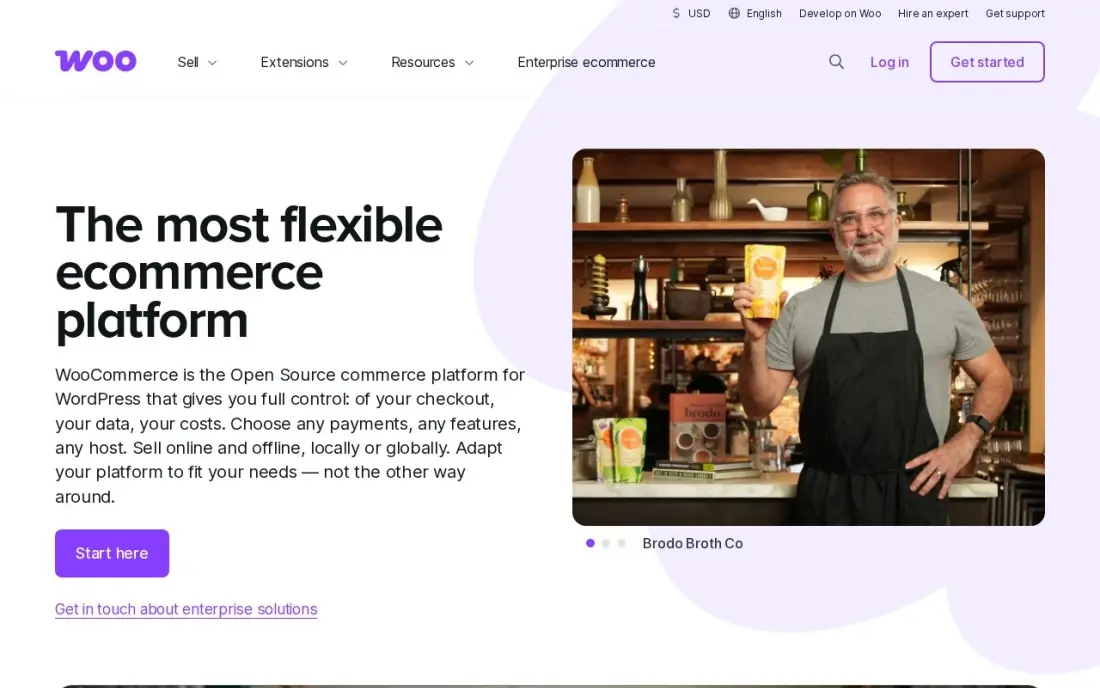
WooCommerce gives complete control over product listings: custom fields, attributes, variations and templates can all be shaped to your catalog, and extensions add bulk editing, CSV imports and marketplace feeds. The plugin is free and open source, takes no revenue share, and has more than 7 million installations behind it.
Large catalogs need good hosting — WooCommerce estimates $25 to $350 a month — and each extension costs $29 to $299 a year. Keeping feeds and imports working after updates is your job. It suits a team comfortable with WordPress and a catalog that needs custom data.
What we like
- The plugin itself is free and open source, with no licence fee and 0% revenue share
- More than 7 million active installations, so almost every ecommerce tool already integrates with it
- Full control over design, checkout and customer data, with no platform branding anywhere
- Subscriptions, bundles and memberships are available through extensions
Watch out for
- Hosting, security and updates are the owner's job, not the platform's
- The real cost is hosting at $25-$350 a month plus paid extensions at $29-$299 a year each
- No hosted support team to call when checkout breaks at midnight
The best ecommerce platforms for product listings make it easy to create good listings once, keep the data accurate and publish them wherever buyers search — your store, marketplaces or both. We compared eight platforms across four types: store platforms with strong catalog tools, a multi-channel listing tool, an inventory system, a marketplace and two reseller crosslisters. Every price below comes from the vendor's own pricing page as checked in November 2026.
How to choose the best ecommerce platforms for product listings
- Decide where listings need to appear. One store, several marketplaces or both. Each points to a different tool.
- Check variant handling. Sizes, colours and materials must stay attached to the right stock. Test a product with many options.
- Look at bulk tools. CSV import, bulk edit and templates save hours on large catalogs. Check which plan includes them.
- Confirm which fields carry across. Some crosslisters copy only title, price and photos on the entry plan; brand, size and SKU may need a higher tier.
- Protect against double sales. One-off items need auto-delist; stocked items need fast inventory sync.
- Think about search. Titles, descriptions, attributes and images decide whether a listing is found on Google and inside marketplaces.
Listings are the pages that earn search traffic in ecommerce. Our guide to SEO for ecommerce covers product page structure, and the free title tag checker and meta description checker help each listing show well in Google.
Product listing platforms pricing: what you will actually pay
Take a seller with 2,000 products selling on their own store and two marketplaces, around 300 orders a month. A BigCommerce store costs $39 a month or $29 billed annually on Core, but 300 orders a month will pass Core's $30,000 trailing-sales limit for most catalogs, so price the next tier. Shopify Basic costs the same $39 or $29, plus apps for bulk listing work.
To push those listings to marketplaces, Sellbrite Pro 500 costs $79 a month billed annually, $948 a year, covering up to 500 orders. Zoho Inventory Standard at $29 a month billed annually covers up to 500 orders as a master product record, with no per-user fees.
A reseller with one-off items pays differently. Vendoo Starter costs $14.99 a month or $12.49 billed annually, with auto-delist included, and List Perfectly costs $29 a month on Simple, $49 on Business for full field mapping. On Etsy, 2,000 listings cost $400 to list at $0.20 each, renewed every four months, before fees on sales.
Know the difference: multi-channel listing tool vs crosslister
A multi-channel listing tool such as Sellbrite is built for stocked products. You hold quantities of each SKU, the tool publishes the same listing to several marketplaces, and inventory sync lowers stock everywhere when one sells. Pricing is usually by monthly orders.
A crosslister such as Vendoo or List Perfectly is built for resellers of one-off items — clothing, collectibles, vintage. Each item exists once, so the key feature is auto-delist: when it sells on Poshmark, it disappears from eBay and Mercari. Crosslisters cover reseller marketplaces such as Vinted and Grailed that stock-based tools often skip, and they price by plan rather than by orders.
Quick comparison: tool type by need
| Buyer | Best pick | Why |
|---|---|---|
| Large catalogs on a store | BigCommerce | Unlimited products and built-in filtering, Core $39/month |
| Control over listing design | Shopify | One catalog for store, social and POS, Basic $39/month |
| One catalog to many marketplaces | Sellbrite | Unlimited channels, free up to 30 orders/month |
| Master product record | Zoho Inventory | Free for 50 orders, per-organization pricing |
| Listings that find buyers | Etsy | Built-in search traffic, $0.20 per listing |
| Resellers on a budget | Vendoo | Auto-delist from $14.99/month |
| High-volume resellers | List Perfectly | 13 marketplaces, AI listing help, from $29/month |
| Custom listing data | WooCommerce | Free plugin, custom fields and attributes |
Mistakes to avoid
- Copying manufacturer descriptions. Identical text across thousands of stores rarely ranks. Rewrite at least your best sellers.
- Leaving attribute fields empty. Filters and marketplace search depend on size, colour, brand and material. Fill every field.
- Running two masters for stock. If the store and a listing tool both edit quantities, they will conflict. Pick one source of truth.
- Choosing a crosslister without auto-delist. For one-off items, a missing auto-delist means double sales and cancellations.
- Using tiny or inconsistent photos. Listings with clear, consistent images convert better everywhere. Set a photo standard before you list.
How we chose
We checked each vendor's own pricing page in November 2026 and recorded the starting price exactly as shown, including annual-billing figures where the page lists one. We compared catalog tools, bulk editing, field mapping, marketplace coverage and stock protection, and ranked platforms by fit for the most common buyer: a seller with a growing catalog who wants listings on their own store and at least one marketplace. Ratings come from G2 pages where we checked them, on the dates shown in the sources. No vendor paid for a place in this list, and none of the links here are affiliate links.
What to do next
Export your current product list and check how many items have complete titles, descriptions, attributes and photos. Fix your top 50 first, then trial the listing tool that matches where you sell. When your listings are clean and you want more of them found in Google, book a free product page SEO review.
Frequently asked questions
What is the best ecommerce platform for product listings?
BigCommerce is the best store platform for large listings, with unlimited products and built-in filtering on Core at $39 a month or $29 billed annually. Sellbrite is best for publishing one catalog to several marketplaces, with a free plan up to 30 orders a month.
How can I list products on several marketplaces at once?
Use a multi-channel listing tool. Sellbrite lists a catalog on marketplaces and syncs stock, and resellers with one-off items can use crosslisters such as Vendoo, from $14.99 a month, or List Perfectly, from $29 a month.
What is auto-delist and why does it matter?
Auto-delist removes an item from every other marketplace when it sells on one. Without it, a one-off item can sell twice. Vendoo includes it from Starter at $14.99 a month; List Perfectly includes it on Pro Plus at $99 or more.
How much does it cost to list products on Etsy?
Each listing costs $0.20 and stays live for four months. When it sells, Etsy charges a 6.5% transaction fee plus 3% + $0.25 processing, about 10% of the sale before any Offsite Ads fee.
How do I write product listings that rank?
Put the words buyers search for in the title, write a detailed description with size, materials and use, add clear photos with descriptive file names, and fill every attribute field the platform offers.
Should I manage listings in my store or an inventory tool?
With one store, manage listings there. With several stores or marketplaces, keep a master record in a tool such as Zoho Inventory or Sellbrite so every listing draws from the same data and stock.
Sources we checked (11)
- BigCommerce — www.bigcommerce.com/pricing (checked November 12, 2026)
- Shopify — shopify.com/pricing (checked November 12, 2026)
- Shopify reviews on G2 (checked November 12, 2026)
- Sellbrite — www.sellbrite.com/pricing-pro (checked November 16, 2026)
- Zoho Inventory — www.zoho.com/us/inventory/pricing (checked November 10, 2026)
- Zoho Inventory reviews on G2 (checked November 10, 2026)
- Etsy — www.etsy.com/legal/fees (checked November 12, 2026)
- Vendoo — vendoo.co/pricing (checked November 4, 2026)
- List Perfectly — listperfectly.com/pricing (checked November 4, 2026)
- WooCommerce — woocommerce.com/pricing (checked November 12, 2026)
- WooCommerce reviews on G2 (checked November 12, 2026)
Make one of these tools?
We re-check this list every quarter. Send a correction, request a review, or ask about a clearly labeled sponsored spot.
Request a listingShamim
Founder of SerpAstra
A full-stack SEO and digital marketer who spends most days on Local SEO for dental practices, AI search visibility and lead generation.
Free SEO and AI visibility audit
Find out what is holding your rankings back
Send us your site. Within 2 business days you get a written audit, an AI visibility check and a short fix list ranked by impact. Free, with no contract attached.
Request my free audit→Related buying guides
 EcommerceBest Cross Posting Apps for Resellers (2026): 9 Apps Worth DownloadingCompare the 9 best cross posting app for resellers options on price, free plans, marketplaces and auto-delist, with every price checked November 4, 2026.Read guide →
 Ecommerce7 Best Ecommerce Platforms for SEO in 2026 (Pros, Cons and Pricing)The 7 best ecommerce platform for SEO picks compared on price, SEO controls and ease of use, with real 2026 prices checked on each vendor's pricing page.Read guide →
 Logistics, Supply Chain & Procurement10 Best Inventory Management Software Small Business in 2026, Compared10 best inventory management software small business picks compared with real 2026 prices, free plans and order limits, so you can choose by volume.Read guide →