
9 Best Electrical Estimating Software for Small Contractor in 2026, Compared
Compare the 9 best electrical estimating software for small contractor picks on price, takeoff tools and quoting, with prices checked November 7, 2026.
 Shamim Mia, Founder, SerpAstraLast verified November 7, 202613 min read
We compare pricing pages, documentation and public reviews. We never accept payment for rankings.

Key takeaways
- Jobber is the best fit for most small electrical shops at $29/month; Housecall Pro follows at $59/month for home-service work, and Bluebeam Revu Core at $330/user/year is the cheapest real takeoff tool.
- Plan-based commercial bidding needs a takeoff tool: STACK from $299/user/month or PlanSwift Essential at $2,000/year — neither is cheap, so only buy one when you bid from drawings weekly.
- The single most important buying factor is where the estimate starts: from a price book for service work, or from plan drawings for commercial bids — the two need different tools.
- Three platforms publish no price at all: simPRO, ServiceTitan and Procore are custom quote only, so budget for a sales cycle and implementation, not a signup.
On this page
Quick comparison
| Tool | Best for | Starting price | Free plan |
|---|---|---|---|
| Jobber | Solo electricians and small shops that want quoting, scheduling, invoicing and payments in one app | $29/mo | No (14-day trial) |
| Housecall Pro | Home-service electrical shops that want booking, dispatch, estimates and payments in one bill | $59/mo | No (14-day trial) |
| Fieldwire | Crews that need drawings, tasks and punch lists in the field, run from a phone | $39/user/mo | Yes (free Basic) |
| STACK | Small contractors bidding plan-based commercial work from drawing sets | $299/user/mo | Yes (free version) |
| PlanSwift | Estimators who want desktop takeoff with AI-assisted counting on Windows | $2,000/yr | No (14-day trial) |
| Bluebeam Revu | Small shops that want the cheapest professional on-screen takeoff from PDFs | $330/user/yr | No (14-day trial) |
| simPRO | Trade contractors that want estimating through invoicing in one system | Custom quote | No (demo) |
| ServiceTitan | Growing electrical shops that want the full residential business platform | Custom quote | No (demo) |
| Procore | Electrical contractors scaling into commercial construction with general contractors | Custom quote | No (demo) |
Make one of these tools?
We re-check this list every quarter. Send a correction, request a review, or ask about a clearly labeled sponsored spot.
Request a listingThe best electrical estimating software for small contractors

Jobber
Best for: Solo electricians and small shops that want quoting, scheduling, invoicing and payments in one app
Jobber is the small-shop default because it runs the whole job, not just the estimate. Core costs $29 a month billed annually for one user, and it covers professional quotes with templates and e-signatures, automated quote follow-ups, scheduling, invoicing with online payments, and a client hub where customers approve quotes and pay. The Home Depot integration pulls live product prices and local store availability into quotes, which saves real time on material pricing.
The honest boundary is scope. Jobber quotes beautifully but does no plan takeoff, so commercial bids from drawings still need STACK or PlanSwift alongside it. Core covers one user only, so a second person means Connect at $99 a month billed annually. For residential and light commercial shops doing service work and small projects, Jobber is the easiest yes on this list.
What we like
- Core at $29/month covers quoting, scheduling, invoicing and client management for a solo operator
- Quote follow-up automations chase unanswered bids for you
- Home Depot product pricing with local availability built into quoting
- Free trial needs no credit card, so you can test it with real quotes
Watch out for
- No plan takeoff: commercial bids from drawings need STACK or PlanSwift alongside it
- Core covers one user only — a second person means Connect at $99/month billed annually
- Card processing fees (2.9% + 30 cents online) sit on top of the subscription

Housecall Pro
Best for: Home-service electrical shops that want booking, dispatch, estimates and payments in one bill
Housecall Pro is built for home-service trades, and electrical is one of its core verticals. Basic costs $59 a month billed annually for one user and covers online booking, scheduling and dispatch, estimates and invoicing, card payments, a flat-rate price book, job costing and review management. The 14-day trial runs on the full MAX plan with no credit card, so you can test the top tier before you pay.
The estimating model is the thing to understand. Housecall Pro prices from a flat-rate price book, which is fast for service calls and panel upgrades and wrong for plan-based commercial bids. Essentials at $149 a month is the realistic tier for a crew, since it adds flat-rate pricing, GPS tracking and QuickBooks Online sync. Card processing fees sit on top of the subscription.
What we like
- Basic at $59/month includes online booking, scheduling, estimates, invoicing, payments and a price book
- Flat-rate pricing, GPS tracking and QuickBooks Online sync on Essentials
- No long-term contracts, and the 14-day trial runs on the full MAX plan
Watch out for
- Estimating is flat-rate price-book driven, not plan takeoff
- Basic holds one user — a crew starts on Essentials at $149/month
- Payment processing fees (from 2.59%) add up on every card job

Fieldwire
Best for: Crews that need drawings, tasks and punch lists in the field, run from a phone
Fieldwire is the odd one on this list because it does not estimate at all. It is jobsite management under Hilti ownership: drawings on every phone, tasks, punch lists, photos, checklists and daily reports. For a small electrical contractor it is the companion tool: the estimate gets built in Jobber or STACK, and the work gets run in Fieldwire. The free Basic plan covers 5 users, 3 projects and 100 sheets.
Pro costs $39 per user per month billed annually and adds reports and exports, sheet version compare, project templates and custom task statuses. The honest math is per user: a 10-person crew pays $390 a month, which is real money for field management. But crews adopt it because the mobile app works offline and the learning curve is hours, not weeks.
What we like
- A genuinely free Basic plan for small teams: 5 users, 3 projects, 100 sheets
- Pro at $39/user/month adds reports, sheet compare and project templates
- Backed by Hilti, with offline-capable mobile apps the crew actually opens
Watch out for
- It is field management, not estimating: no takeoff or bid pricing
- Per-user pricing scales fast — a 10-person crew pays $390 a month
- RFIs, submittals and budgets need Business Plus at $89/user/month

STACK
Best for: Small contractors bidding plan-based commercial work from drawing sets
STACK is the cloud takeoff and estimating platform most small commercial contractors land on when spreadsheets stop working. Takeoff and Estimate Premium starts at $299 per user per month billed annually, with quantity, labor and material takeoff, flexible estimates and proposals, and unlimited plans and projects. Prebuilt items and assemblies for each trade, plus the ability to build your own, make it faster than generic PDF markup for electrical work.
Two things soften the price. First, there is a free version of Takeoff and Estimate, so a small shop can start measuring plans without spending anything. Second, it is web-based and runs on any computer. The honest catch is the seat math: $299 per user per month means two estimators cost $7,176 a year, so it earns its keep only when you bid commercial work weekly.
What we like
- Purpose-built cloud takeoff with prebuilt trade items and assemblies
- Unlimited plans and projects on paid plans, with real-time team collaboration
- Free version lets a small shop start measuring plans without a purchase order
- AI Takeoffs included on Premium, not held for the top tier
Watch out for
- $299/user/month is the steepest entry on this list and per-user pricing multiplies fast
- Paid plans run on 12-month terms, so plan for the commitment
- Works best with a dedicated estimator, not a tech estimating between jobs

PlanSwift
Best for: Estimators who want desktop takeoff with AI-assisted counting on Windows
PlanSwift is the veteran desktop takeoff tool, and its 2026 story is AI. Essential costs $2,000 a year for one seat and includes Auto Count, Auto Scale and Auto Bookmark; Core costs $3,000 a year and adds Auto Takeoff, which builds a first-pass takeoff in minutes for the estimator to refine. For electrical work, that means device counts, conduit runs and fixture schedules pulled from plans far faster than manual clicking.
The commercial shape is simple: both plans are annual per seat and include software, updates, priority support and training, with a 14-day trial that takes no card. The honest fit question is workflow. PlanSwift is a desktop estimator's tool on Windows. If your estimating happens at a desk on plan sets, it fits; if it happens in a truck between jobs, you want cloud and mobile instead.
What we like
- Takeoff and estimating in one desktop tool for every trade, with trade assemblies
- Core adds Auto Takeoff, which builds a first-pass takeoff in minutes
- 14-day trial with no credit card and no auto-charge
- Additional seats are discounted ($1,500 per Essential seat)
Watch out for
- $2,000 a year for one seat is steep if you bid only a few jobs a month
- Annual plans only, no monthly option, and Windows only
- Full AI takeoff suite waits for Core at $3,000 a year

Bluebeam Revu
Best for: Small shops that want the cheapest professional on-screen takeoff from PDFs
Bluebeam Revu is the takeoff tool half the construction industry already knows, and Core at $330 per user per year is the price leader for professional measurement. Core includes specialty markup tools, perimeter, count, angle and volume measurements, drawing overlay and compare, Studio collaboration hosting, and CAD plugins. For an electrical contractor, that covers device counts, conduit measurements and plan markups at a tenth of STACK's annual cost.
Know which tier you are buying. Basics at $260 per user per year covers PDF markup but not the measurements, so it cannot do takeoffs. Complete at $440 adds Excel quantity links and batch automation. All plans are billed annually per user, and you can mix plans across the team. Revu runs on Windows, with web and mobile for field markup, and a 14-day free trial.
What we like
- Core at $330/user/year is the lowest annual cost for real takeoff tools
- Industry-standard PDF markup with measurement, counts and drawing compare
- Studio collaboration lets the whole team mark up together
- You can mix plan tiers across the team
Watch out for
- Windows desktop first, with web and mobile as companions
- The $260 Basics tier lacks takeoff measurements, so Core is the real entry
- AI drawing reviews wait for Max at $590/user/year (introductory price)

simPRO
Best for: Trade contractors that want estimating through invoicing in one system
simPRO is the trade-specific platform for contractors that want estimating through invoicing in one system. Quotes are built from catalog items and prebuilt assemblies, then flow into scheduling, dispatch, job costing, inventory and invoicing without rekeying. The mobile app lets technicians build good-better-best quotes in the field, with manager approval before the quote reaches the customer.
The price is the hurdle: simPRO publishes no prices, so budgeting starts with a demo and a custom quote, and reviewers report implementation fees and multi-year commitments. Expect a three-month implementation and a real onboarding project, not a signup. It fits growing commercial shops with several technicians; a solo electrician will find Jobber faster and far cheaper.
What we like
- Quotes flow into scheduling, job costing, stock and invoicing without rekeying
- Good-better-best quotes built in the field, with manager approval before sending
- Real-time inventory across stores and vans, the best in this class
- Built for trade contractors, not adapted from generic field service software
Watch out for
- No published price — budgeting starts with a demo and a custom quote
- Reviewers report implementation fees, multi-year commitments and steep price rises
- Expect a three-month implementation and a steep learning curve

ServiceTitan
Best for: Growing electrical shops that want the full residential business platform
ServiceTitan is the all-in-one platform for established residential trades, built for shops with office staff and several technicians. It covers call booking, dispatch, estimates and proposals, invoicing, payments, memberships, marketing and reporting in one system, with a price book and good-better-best proposals that help technicians sell bigger jobs. Its dispatch board and reporting are the strongest in this list.
The trade-off is the buying process. ServiceTitan publishes no prices: its pricing page lists Starter, Essentials and The Works with a Request Pricing button on each, and pricing runs per technician. Implementation takes months and costs thousands on top of the subscription. It is the right buy for a growing shop that can absorb the setup; it is too much platform for a one-truck operation.
What we like
- Strongest dispatch board and reporting in this list, built for multi-tech shops
- Price book and good-better-best proposals help technicians sell bigger jobs
- Deep marketing, membership and payroll features in one system
- Integrates with QuickBooks and a wide certified app marketplace
Watch out for
- No published prices — every package shows a Request Pricing button
- Implementation takes months and costs thousands on top of the subscription
- Annual contracts with little flexibility, and the lowest setup score here

Procore
Best for: Electrical contractors scaling into commercial construction with general contractors
Procore is construction management for electrical contractors scaling into commercial work. It centralizes drawings, RFIs, submittals, budgets, change orders, daily logs and financials, so the estimate, the bid and the build all live in one system with unlimited users. Its estimating lives in the preconstruction module, which connects bid management and takeoffs to the project budget.
The price follows your volume, not your headcount: Procore charges an upfront annual fee per product based on annual construction volume, and publishes no numbers. Expect an enterprise sales cycle and implementation project. For a small shop, Procore is a destination to grow into, not a starting point; buy it when commercial general contractors start requiring it on their projects.
What we like
- One system from estimate and bid to build, budget and closeout
- Unlimited users, storage and support on the annual licence
- The platform commercial general contractors already run, so it wins you work
- Strongest project financials in this list, with change orders and forecasting
Watch out for
- No published price — an annual fee per product, based on construction volume
- Enterprise sales cycle and implementation project, not a signup
- Estimating is a paid preconstruction module, not part of the core platform
The best electrical estimating software for small contractor shops does two jobs at once: it prices the work fast enough to win the bid, and it keeps the numbers honest enough that the job still makes money. We ranked the nine tools below by fit for the most common buyer — a US electrical shop with one to ten people — starting with the cheapest quoting apps and ending with the enterprise platforms, and every price was checked on the vendor's own pricing page on November 7, 2026.
How to choose the best electrical estimating software for small contractor
- Start from where the estimate comes from. Service calls and panel upgrades are priced from a flat-rate price book; commercial bids are measured from plan drawings. The two need different tools, and buying the wrong kind is the most expensive mistake in this list.
- Count your estimators, not just your techs. STACK and Fieldwire charge per user, so a second estimator doubles the bill. Jobber Core and Housecall Pro Basic cover one user each, and the next tier is where a growing crew lands.
- Check where the estimating happens. If it happens at a desk on plan sets, a desktop tool like PlanSwift fits. If it happens in a truck between jobs, you need cloud software and a mobile app your crew will actually open.
- Check what happens after the estimate. A quote that flows into scheduling, dispatch, invoicing and job costing saves a day a week of rekeying. A takeoff-only tool leaves that work to something else.
- Try it on a real bid before you pay. The free plans and 14-day trials here are long enough to price two genuine jobs. If the trial cannot price your most common job, the tool cannot either.
Estimating is one system in your stack, not the whole stack. If the shop also needs to be found online, our local SEO service covers the visibility side for trade businesses — and our guide to SEO for plumbers shows how the same playbook works for a sister trade. Before you publish new service pages, run your titles through the free local business schema generator — it builds the markup that helps Google show your services, hours and area.
Whatever you shortlist, try it with real numbers before you pay. Price two jobs you have already won — one service call, one bid — and compare the tool's price against what the job actually cost. That test tells you more than any review can. Check two things in the trial: that the price book or takeoff matches how you already price, and that the quote it produces is one you would send to a customer as-is.
Electrical estimating software for small contractors pricing: what you will actually pay
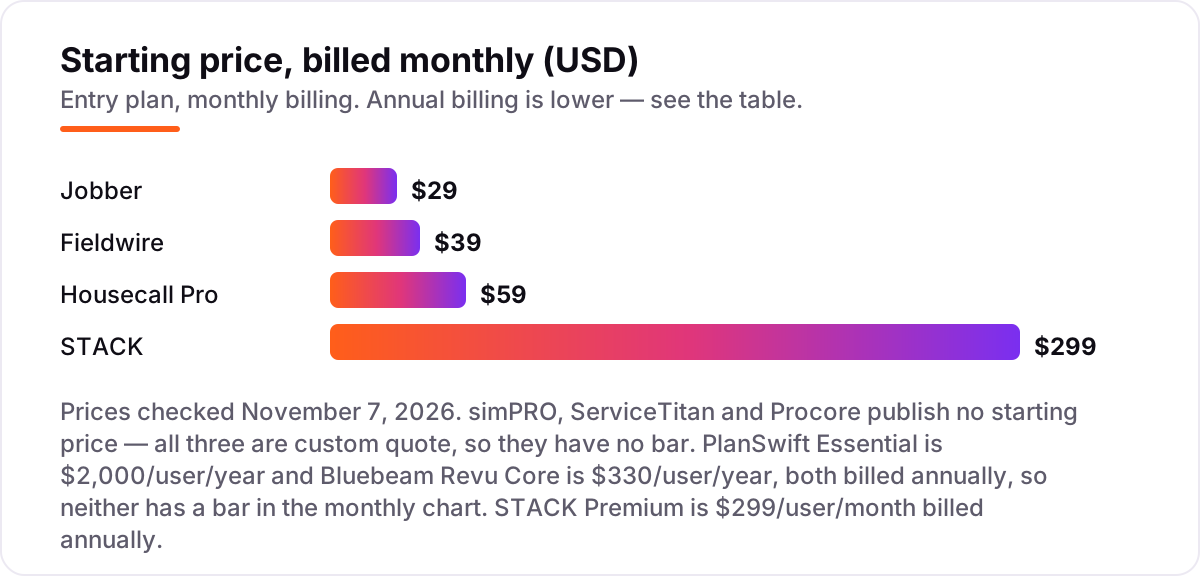
Take a three-person electrical shop — one estimator in the office, two techs in the field — bidding two commercial jobs a month and running service calls between them. On list prices, the quoting app costs $149 a month on Jobber Connect for a 2–5 person team, or $149 a month on Housecall Pro Essentials for up to 5 users. Fieldwire Pro for the three of them costs $117 a month at $39 per user. The takeoff seat costs $299 a month on STACK Premium, $2,000 a year on PlanSwift Essential, or $330 a year on Bluebeam Revu Core.
Over a year, that is $1,788 on Jobber Connect or Housecall Pro Essentials, $1,404 on Fieldwire Pro for three users, $3,588 on STACK Premium for one estimator, $2,000 on PlanSwift Essential, and $330 on Bluebeam Revu Core. The cheapest serious combination is Jobber Connect plus Bluebeam Revu Core at $2,118 a year — quoting and takeoff together for less than STACK alone at $3,588. The dearest combination, STACK plus Housecall Pro Essentials, runs $5,376 a year before add-ons.
Three costs sit outside every number above. First, the custom-quote platforms: simPRO, ServiceTitan and Procore publish no price, and reviewers report implementation fees of $5,000 or more plus multi-year contracts, so get a written quote before budgeting. Second, card processing on the invoices you send, which runs about 2.59–2.9% plus 30 cents per transaction. Third, the annual commitment: STACK, PlanSwift and Bluebeam Revu all bill annually, so the first year is paid up front. If invoicing is the bottleneck rather than estimating, see our guide to the best invoicing software for small business.
Know the difference: estimating software vs takeoff software vs field service software
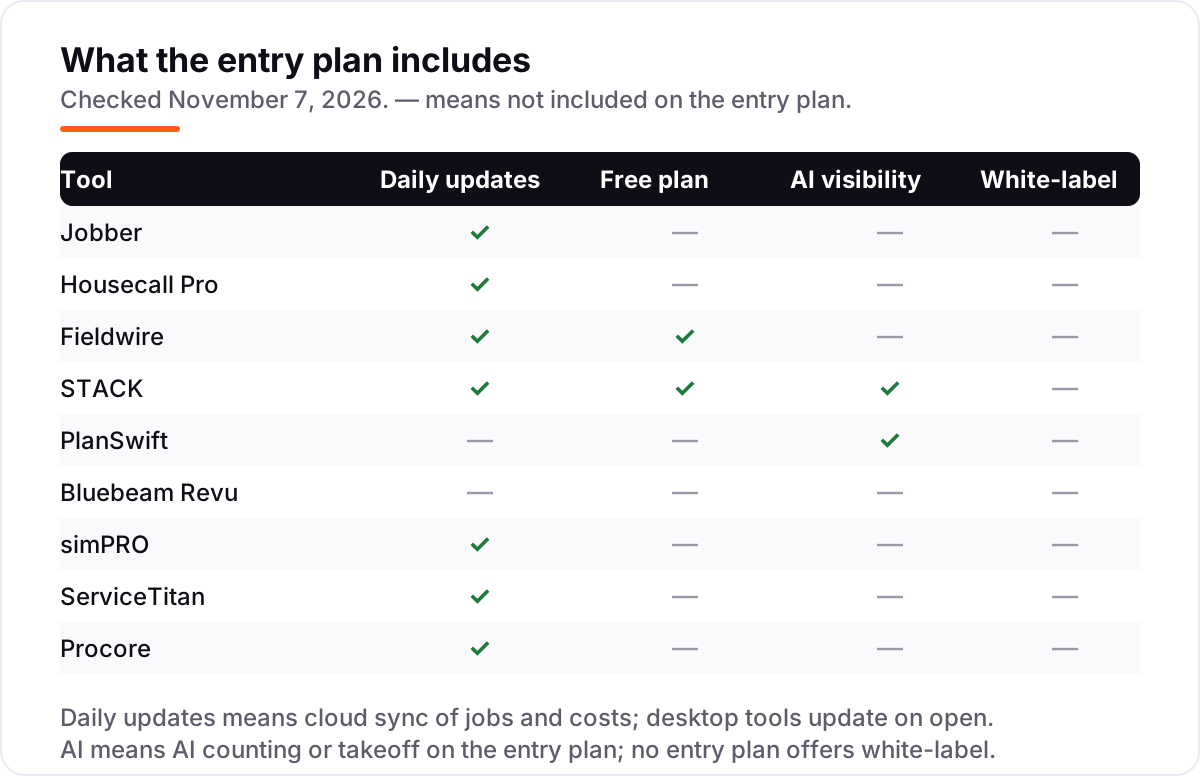
The confusion in this category is that three different jobs share the word "estimating". Estimating software prices the job: labor, materials, markup and the quote you send the customer. Takeoff software measures the job from drawings: how many devices, how many feet of conduit, how many fixtures. Field service software runs the job after it is won: scheduling, dispatch, invoicing and payments. Jobber and Housecall Pro are estimating and field service tools. STACK, PlanSwift and Bluebeam Revu are takeoff tools. Fieldwire is field service only, with no estimating at all.
There is a second, quieter confusion: a price book is not a takeoff. A price book lists flat rates for standard jobs — a panel upgrade, a service call, a ceiling fan — and it is the fastest way to price residential work. A takeoff counts quantities from a drawing set, and it is the only honest way to price a commercial bid. Shops that try to price commercial bids from a price book underbid the job; shops that try to price service calls from a takeoff waste an hour per quote.
A third distinction worth knowing is the platform trap. simPRO, ServiceTitan and Procore each do estimating, scheduling and invoicing in one system, which is genuinely valuable — but each one is a custom-quote platform with an implementation project. Buying one before you have the team to run it means paying enterprise prices for features a $29-a-month tool already covers.
Quick comparison: tool type by need
| Buyer | Best pick | Why |
|---|---|---|
| Solo electrician doing service work | Jobber | Quoting, scheduling and invoicing in one app, from $29/month |
| Home-service shop with a price book | Housecall Pro | Booking, dispatch and flat-rate pricing, from $59/month |
| Crew that needs drawings in the field | Fieldwire | Free Basic plan, Pro is $39/user/month |
| Commercial bidding from drawings | STACK | Cloud takeoff and estimating, from $299/user/month |
| Desk estimator on Windows | PlanSwift | AI-assisted takeoff, Essential is $2,000/year |
| Cheapest real takeoff | Bluebeam Revu | Core is $330/user/year with full measurement tools |
| Growing shop outgrowing the small tools | simPRO or ServiceTitan | Full platform, custom quote — get a written price first |
Mistakes to avoid
- Buying a takeoff tool for service work. STACK and PlanSwift are built for plan-based bids. If your week is service calls and panel upgrades, a price book in Jobber or Housecall Pro prices the job in minutes, and a takeoff tool wastes an hour per quote.
- Budgeting on the monthly figure when the plan is annual. STACK, PlanSwift and Bluebeam Revu bill annually, so the first year is paid up front: $3,588, $2,000 and $330 per seat. Compare tools on the annual total, not the monthly equivalent.
- Ignoring the per-user math. Fieldwire Pro at $39 a user and STACK at $299 a user look cheap for one person and expensive for ten. Price the tool at your real headcount, including the office, before you commit.
- Buying a custom-quote platform before you have the team to run it. simPRO, ServiceTitan and Procore all need demos, implementation and multi-year contracts. A shop under five people gets the same quoting job done on Jobber for $29 a month.
- Forgetting the costs outside the subscription. Card processing runs 2.59–2.9% plus 30 cents per transaction, and the enterprise platforms add implementation fees of $5,000 or more. Budget those before you sign, not after.
How we chose
We checked each vendor's own pricing page on November 7, 2026 and recorded the starting price exactly as shown, including the annual-billing figure where the page lists one. PlanSwift and Bluebeam Revu publish annual per-user prices only, so they have no bar in the monthly chart and the footnote names the annual figures. simPRO, ServiceTitan and Procore publish no starting price, so we list them as custom quote and do not estimate one. Ratings come from each tool's G2 page, checked the same day. Two prices carry a note: G2 still lists STACK Premium at $249 a user a month, but the vendor's own pricing page now lists $299, and the vendor page wins; PlanSwift's $2,000-a-year Essential price is now published on its pricing page, where earlier roundups could only say "see website". No vendor paid for a place in this list, and none of the links here are affiliate links.
What to do next
Start with the free plan or trial of your top pick and price two real jobs through it — one service call and one bid — before you commit to a year. Check that the quote it produces is one you would send to a customer as-is, and that the price matches what the job actually cost. If the shop is sorted but new customers are not finding you, our local SEO service handles the visibility side — or compare providers in our guide to marketing software for contractors. Once your tools are in place, find out what's holding your rankings back.
Your stack only works if people find you
SerpAstra fixes what keeps your site off page one and makes it easy for AI assistants to recommend.
Get a free audit→Sources we checked (18)
- Jobber pricing — getjobber.com/pricing (checked November 7, 2026)
- Housecall Pro pricing — housecallpro.com/pricing (checked November 7, 2026)
- Fieldwire pricing — fieldwire.com/pricing (checked November 7, 2026)
- STACK pricing — stackct.com/pricing (checked November 7, 2026)
- PlanSwift pricing — planswift.com/pricing (checked November 7, 2026)
- Bluebeam Revu pricing — bluebeam.com/pricing (checked November 7, 2026)
- simPRO pricing — simprogroup.com/pricing (checked November 7, 2026)
- ServiceTitan pricing — servicetitan.com/pricing (checked November 7, 2026)
- Procore pricing — procore.com/pricing (checked November 7, 2026)
- Jobber reviews on G2 (checked November 7, 2026)
- Housecall Pro reviews on G2 (checked November 7, 2026)
- Fieldwire reviews on G2 (checked November 7, 2026)
- STACK reviews on G2 (checked November 7, 2026)
- PlanSwift reviews on G2 (checked November 7, 2026)
- Bluebeam Revu reviews on G2 (checked November 7, 2026)
- simPRO reviews on G2 (checked November 7, 2026)
- ServiceTitan reviews on G2 (checked November 7, 2026)
- Procore reviews on G2 (checked November 7, 2026)
Shamim
Founder of SerpAstra
A full-stack SEO and digital marketer who spends most days on Local SEO for dental practices, AI search visibility and lead generation.
Frequently asked questions
What is the best electrical estimating software for a small contractor?
Jobber is the best fit for most small electrical shops: quoting, scheduling, invoicing and payments in one app from $29 a month. Housecall Pro at $59 a month suits home-service shops that want a price book. If you bid commercial work from drawings, add Bluebeam Revu Core at $330 a user a year for takeoff.
How much does electrical estimating software cost?
Entry prices run from $0 to $299 a user a month. Fieldwire Basic and the free version of STACK cost nothing, Jobber starts at $29 a month and Housecall Pro at $59. PlanSwift Essential is $2,000 a year a seat, and simPRO, ServiceTitan and Procore are custom quote only, so get a written quote before budgeting.
Is there free electrical estimating software for small contractors?
Yes, with limits. Fieldwire Basic is free for 5 users, 3 projects and 100 sheets, and STACK offers a free version of Takeoff and Estimate for one project a month. Neither is a full estimating system on its own, so most shops pair a free tool with a paid quoting app like Jobber.
What is the difference between estimating software and takeoff software?
Estimating software prices the job: labor, materials, markup and the quote you send. Takeoff software measures the job from drawings: counts, lengths and areas that feed the estimate. Jobber and Housecall Pro estimate from a price book; STACK, PlanSwift and Bluebeam Revu take off from plans.
Can I do electrical estimates in Jobber or Housecall Pro?
Yes, for service work and small installs. Both build quotes from a price book or templates, with e-signatures and follow-ups. Neither does plan takeoff, so a commercial bid from a drawing set still needs STACK, PlanSwift or Bluebeam Revu alongside it. Use the quoting app for service calls and the takeoff tool for bids.
Do I need a takeoff tool if I mostly do residential service work?
Usually not. Service calls, panel upgrades and small installs are priced faster from a flat-rate price book in Housecall Pro or Jobber than from a drawing. Buy a takeoff tool only when plan-based bids become a weekly job; until then, Bluebeam Revu Core at $330 a year is the cheapest way to start.
How do I switch estimating software later?
Yes, but plan the move between jobs, not mid-bid. Export your price book, item assemblies, customer list and open quotes from the old tool, then rebuild the price book in the new one and price two real jobs in both systems before going live. Takeoff tools export quantities to Excel, which most estimators keep as the bridge.
Free SEO and AI visibility audit
Find out what is holding your rankings back
Send us your site. Within 2 business days you get a written audit, an AI visibility check and a short fix list ranked by impact. Free, with no contract attached.
Request my free audit→Related guides
 Digital Marketing & Ads7 Best Marketing Software for Contractors in 2026, ComparedCompare the 7 best marketing software for contractors on price, reviews and trade-specific features, with every price checked November 5, 2026.Read guide →
 Local SEOSEO for plumbers: rank in the map pack and get more callsSEO for plumbers: win the map pack and get more calls with emergency pages, service pages patients trust, reviews, and calls that become booked jobs today.Read guide →
 Accounting, Tax & Finance11 Best Invoicing Software for Small Business in 2026, Compared11 best invoicing software for small business compared on price, free plans and payment fees. Prices checked on vendor pricing pages, November 2, 2026.Read guide →