
10 Best Email Drip Campaign Software in 2026, Compared
10 best email drip campaign software tools compared on price, automation depth and free plans. Real starting prices checked November 4, 2026.
 Shamim Mia, Founder, SerpAstraLast verified November 4, 202617 min read
We compare pricing pages, documentation and public reviews. We never accept payment for rankings.
Key takeaways
- ActiveCampaign is the best overall drip tool from $15/month billed annually; Klaviyo is the best for online stores from $20/month; Brevo is the cheapest paid entry at $9/month.
- The single most important buying factor is the automation limit on the entry plan: steps per flow, number of workflows and send caps vary far more than the headline price suggests.
- Free plans are real here — Kit covers up to 10,000 subscribers and Brevo sends 300 emails a day — but Brevo's $9 Starter plan has no automation at all; drip sequences start on Standard at $18/month.
- Every price below was gathered on November 4, 2026. All ten tools price by contacts or email volume, so check the price at your own list size before comparing.
On this page
Quick comparison
| Tool | Best for | Starting price | Free plan |
|---|---|---|---|
| ActiveCampaign | Small businesses and agencies that want the deepest drip automation builder with a CRM attached | $15/mo (annual) | No (14-day trial) |
| Klaviyo | Online stores that want purchase-behavior drip flows tied directly to their shop data | $20/mo | Yes (250 profiles) |
| Mailchimp | Small businesses that want a familiar all-rounder with a free plan and simple journeys | $13/mo | Yes (250 contacts) |
| Brevo | Budget-conscious senders who email a lot and want to pay for volume, not contacts | $8.08/mo (annual) | Yes (300/day) |
| HubSpot Marketing Hub | B2B teams that want drip emails driven by their CRM records and deal stages | $20/seat/mo | Yes (free plan) |
| Drip | Online stores that want one plan with every feature and unlimited sends | $39/mo | No (14-day trial) |
| Omnisend | Shopify and WooCommerce stores that want pre-built drip flows at the lowest ecommerce price | $16/mo | Yes (250 contacts) |
| Kit | Creators and newsletter writers who want sequences and tagging on a generous free plan | $33/mo (annual) | Yes (10,000 subs) |
| MailerLite | Small businesses that want a simple, cheap drip tool with no learning curve | $10.80/mo (annual) | Yes (250 subs) |
| GetResponse | Small businesses that want email, webinars and courses in one subscription | $15.58/mo (annual) | Yes (500 contacts) |
Make one of these tools?
We re-check this list every quarter. Send a correction, request a review, or ask about a clearly labeled sponsored spot.
Request a listingThe best email drip campaign software

ActiveCampaign
Best for: Small businesses and agencies that want the deepest drip automation builder with a CRM attached
ActiveCampaign is the automation benchmark in this list, and the Starter plan shows why: a visual builder where a drip sequence can branch on opens, clicks, purchases and deal stages, with goals and split testing. For a small business that lives on follow-up — welcome series, win-back flow, post-purchase check-in — that depth is the whole point, and no other tool here matches the branching logic at this price.
The catch is the 5-action cap on Starter automations: a real multi-email drip with conditions will hit that ceiling fast, and Plus at $49/month is the honest entry point for serious sequences. The price also climbs steeply with list size, and accounts created after November 2025 are billed for every contact, including unsubscribed ones. Buy it when automation depth is the job; buy MailerLite or Brevo for a simple sequence.
What we like
- The most flexible visual automation builder here — multi-step drip sequences with branching, goals and split testing
- Built-in CRM and lead scoring on Plus, so drip campaigns can trigger off deals and pipeline stages
- Predictive sending and conditional content on Pro, plus AI automation and campaign builders from Starter
Watch out for
- Starter caps each automation at 5 actions, so real drip sequences need Plus ($49/month) or above
- Accounts created after November 3, 2025 are billed for all contacts, including unsubscribed and bounced ones
- No free plan — only a 14-day trial — and the price climbs steeply with list size

Klaviyo
Best for: Online stores that want purchase-behavior drip flows tied directly to their shop data
Klaviyo is built for stores, and its drip flows show it. A welcome series can wait for a first purchase, an abandoned-cart flow can reference the exact products left behind, and a win-back flow can trigger on predicted churn risk — all from the shop data Klaviyo already holds. The free plan covers 250 active profiles, so a new store can run real flows before paying anything.
The billing is the thing to watch. There is no annual discount, so the $20 starting price is the price, and it climbs quickly: $60 at 2,500 profiles, $150 at 10,000. SMS is sold separately through Email+SMS bundles whose prices are not published. Buy Klaviyo when your revenue depends on purchase-triggered email; buy Omnisend when the same flows need to cost less.
What we like
- Flows trigger off real purchase behavior — browsed products, abandoned carts, repeat-purchase windows — not just opens and clicks
- Predictive analytics (predicted lifetime value, churn risk) included on the paid Email plan
- 350+ integrations and the deepest Shopify connection of any tool here, with revenue attribution per flow
Watch out for
- No annual discount — the price is monthly billing only, so there is no way to lower it by committing
- Costs rise fast with list size: $60 at 2,500 profiles and $150 at 10,000
- Email+SMS bundle pricing is not published, so SMS costs need a quote

Mailchimp
Best for: Small businesses that want a familiar all-rounder with a free plan and simple journeys
Mailchimp is the safe default in this list: the builder most people already know, the widest template library, and Customer Journeys that map a whole drip sequence on one canvas with triggers for signups, purchases and birthdays. The free plan covers 250 contacts and 500 sends a month, which is enough to test a welcome sequence on a real audience before spending anything.
The limits sit in the fine print. Essentials caps each automation flow at four steps, so a five-email onboarding drip needs Standard at $20/month. Mailchimp also bills for every contact in the audience, including unsubscribed ones, until you archive or delete them. And the AI writing and predictive segmentation that make the higher plans attractive are not on Essentials. It is the easiest first drip tool — just check the step cap before you build.
What we like
- The widest template library here and the easiest builder for a first drip sequence
- Customer Journeys map the whole sequence visually, with triggers for signups, purchases and birthdays
- Free plan covers 250 contacts, and the paid price scales in small steps as the list grows
Watch out for
- Essentials caps automation flows at 4 steps — real multi-email drips need Standard ($20/month)
- You pay for every contact, including unsubscribed ones, until you archive or delete them
- Generative AI writing and predictive segmentation are held for Standard and Premium

Brevo
Best for: Budget-conscious senders who email a lot and want to pay for volume, not contacts
Brevo flips the usual pricing model: you pay for email volume, not contacts. The free plan sends 300 emails a day to as many as 100,000 stored contacts, and the paid Starter plan is $9/month for 5,000 emails — the cheapest paid entry in this list. Starter also includes an AI content generator, advanced segmentation and transactional email, which is a lot of tool for nine dollars.
The catch matters for this list specifically: Starter has no automation. Drip sequences start on Standard at $18/month, so the real drip price is double the headline. Each paid tier also caps stored contacts — 500 on the entry tier — and removing the Brevo logo costs another $9/month on Starter. Buy Brevo for cheap high-volume sending, and budget Standard if sequences are the point.
What we like
- Cheapest paid entry here at $9/month, priced by email volume rather than list size
- Free plan sends 300 emails a day to up to 100,000 stored contacts — the most generous free tier by volume
- Starter includes an AI content generator, advanced segmentation and transactional email in the same plan
Watch out for
- Starter has no automation at all — drip sequences start on Standard ($18/month)
- Each paid tier caps stored contacts (500 on the entry tier), so a growing list pushes you to a higher-volume tier
- Removing the Brevo logo from emails costs $9/month extra on Starter

HubSpot Marketing Hub
Best for: B2B teams that want drip emails driven by their CRM records and deal stages
HubSpot is the only tool here where a drip sequence can start from a deal changing stage or a contact crossing a lifecycle threshold, because the email tool and the CRM are the same product. One Starter seat opens every Hub — Marketing, Sales, Service, Content and Data — and the free plan includes the CRM, forms and 2,000 email sends a month, so a small B2B team can run its first nurture sequence at no cost.
The pricing cliff is the honest warning. Starter is $20 per seat per month, but Professional is $890 a month plus a $3,000 one-time onboarding fee, and there is no tier in between. Marketing contacts are also billed separately in 1,000-contact blocks. Buy HubSpot when the CRM drives the email; buy ActiveCampaign when automation depth matters more than the CRM.
What we like
- Drip sequences trigger off anything in the CRM — lifecycle stage, deal value, form fills, page views
- One seat price opens every Hub (Marketing, Sales, Service, Content, Data) on the Starter Customer Platform
- Free plan includes the CRM, forms and 2,000 email sends a month, so a small team can start at $0
Watch out for
- The jump from Starter ($20/seat) to Professional ($890/month) is the steepest cliff in this list, plus a $3,000 onboarding fee
- You also pay per 1,000 marketing contacts on top of the seat price, so the bill grows two ways at once
- Full workflow automation and custom reporting sit on Professional, not Starter

Drip
Best for: Online stores that want one plan with every feature and unlimited sends
Drip sells one thing: the whole product, priced by people. At $39/month for up to 2,500 people you get the visual automation builder, revenue attribution, unlimited email sends and every integration — no Starter-versus-Pro guessing, no feature held back for a higher tier. The workflows are built around shopping behavior, so a sequence can follow a subscriber from first browse through abandoned cart to repeat purchase.
The trade-off is that there is no free plan and no annual discount, so $39 a month is the floor from day one. Drip also bills on the highest contact count reached during the billing period, so a one-off list import can raise that month's bill even if the list shrinks again. Buy it when you want every feature without tier-hopping; buy Omnisend when a free plan matters more.
What we like
- One plan, every feature: visual automation, revenue attribution, unlimited sends and all integrations at $39/month
- Workflows built around shopping behavior — browse, abandon, buy, repeat — with on-site behavior tracking
- No feature tiers to outgrow; the price only changes when the contact count does
Watch out for
- No free plan, only a 14-day trial — you pay from the first real list
- No annual billing option, so the $39 monthly price cannot be discounted by committing
- Bills on the highest contact count reached during the billing period, not the count at the end of it

Omnisend
Best for: Shopify and WooCommerce stores that want pre-built drip flows at the lowest ecommerce price
Omnisend is the fastest way to a working drip sequence in this list: welcome, abandoned-cart and post-purchase flows come pre-built, and the free plan includes every core feature — automation and segmentation included — for up to 250 contacts and 500 emails a month. Standard starts at $16/month for 500 contacts, which undercuts Klaviyo at every list size from 500 up.
The limits are worth knowing before you commit. Standard caps sends at twelve times your contact count, so a store that emails often will need Pro at $59/month. SMS is now a separate purchase for new subscribers, and billable contacts include non-subscribers such as checkout customers. Buy Omnisend for the cheapest working ecommerce flows; buy Klaviyo when predictive analytics justifies the higher price.
What we like
- Pre-built welcome, abandoned-cart and post-purchase flows you can switch on the same day
- Free plan includes every core feature — automation and segmentation included, not stripped out
- Cheaper than Klaviyo at every list size from 500 contacts up, with 24/7 live chat on every plan
Watch out for
- Standard caps sends at 12 times your contact count, so heavy senders need Pro ($59/month)
- SMS is now a separate purchase for new subscribers — no SMS credits bundled on Standard
- Billable contacts include non-subscribers such as checkout customers, which can push the tier up

Kit
Best for: Creators and newsletter writers who want sequences and tagging on a generous free plan
Kit, formerly ConvertKit, is built around one idea: a subscriber is a person with tags, not a row in a list. A drip sequence can branch on what a reader clicked, bought or downloaded, and the visual automation builder shows those branches clearly. The free Newsletter plan covers 10,000 subscribers with unlimited emails, forms and landing pages — the most generous free tier in this list.
The honest caveats: the free plan allows only one email sequence, so real drip work needs Creator, and Creator jumped from $29 to $39 a month in September 2025 — old $29 figures still circulate. Kit also bills on total subscribers, including unengaged ones, so pruning a cold list directly lowers the bill. Buy it for creator newsletters; buy MailerLite for the same job at a third of the price.
What we like
- The most generous free plan here: up to 10,000 subscribers with unlimited emails, forms and landing pages
- Tag-based subscriber model makes drip sequences follow what a reader actually did, not which list they joined
- Visual automations and sequences are unlimited on Creator, with a Creator Network for audience growth
Watch out for
- Prices jumped in September 2025 — Creator went from $29 to $39/month, and old $29 figures still circulate
- The free plan allows only one email sequence, so real drip campaigns need a paid plan
- Bills on total subscribers including unengaged ones, so a cold list costs the same as a warm one
MailerLite
Best for: Small businesses that want a simple, cheap drip tool with no learning curve
MailerLite is the simplest tool in this list, and the cheapest full drip tool after Brevo. Comfort costs $12/month for up to 500 subscribers and includes the automation builder, an AI writing assistant, landing pages and digital products — with the MailerLite logo removed. Only active subscribers count toward the tier, so unsubscribed and bounced contacts never raise the bill the way they do on Mailchimp.
The free plan is much smaller than it used to be: 250 subscribers and 2,500 emails a month after two cuts since 2025. Comfort also caps automations at 50 active with 100 steps each, and there is no built-in CRM, so drip triggers stay inside email behavior rather than sales data. Buy it when a straightforward sequence at a low price is the whole brief.
What we like
- The cheapest full drip tool here after Brevo — Comfort from $12/month with automation included
- Only active subscribers count toward the tier, so unsubscribed and bounced contacts never raise the bill
- Comfort removes the MailerLite logo, adds an AI writing assistant and includes landing pages and digital products
Watch out for
- Free plan shrank twice since 2025 — now just 250 subscribers and 2,500 emails a month
- Comfort caps automations at 50 active with 100 steps each; unlimited automations need Power ($25/month)
- No built-in CRM, so drip triggers stay inside email behavior rather than sales data

GetResponse
Best for: Small businesses that want email, webinars and courses in one subscription
GetResponse is the consolidation play in this list: email, landing pages, webinars and courses in one login, with unlimited monthly sends on every paid plan. Starter costs $19/month for 1,000 contacts and includes autoresponders, landing pages and an AI content generator, while Creator at $69/month adds webinars, a course builder for up to 500 students and premium newsletter subscriptions.
The catch is the one that matters most for drip campaigns: Starter includes only one custom automation workflow. A welcome series plus an abandoned-cart flow already exceeds it, so real drip work needs Marketer at $59/month. The same email address on two lists can also be counted twice. Buy GetResponse when webinars and courses justify the bundle; buy MailerLite when email alone is the job.
What we like
- Every paid plan includes unlimited monthly email sends — no send caps to watch
- Marketer adds unlimited workflows, sales funnels, abandoned-cart recovery and webinars up to 100 attendees
- Creator adds a course builder for up to 500 students and premium newsletter subscriptions for $10 more
Watch out for
- Starter includes only one custom automation workflow — real drip work needs Marketer ($59/month)
- The same email address on two lists can be counted and billed twice
- Annual plans are non-refundable if you cancel mid-term
What email drip campaign software actually does
The best email drip campaign software turns a signup into a sequence that sends itself. A new subscriber gets a welcome email on day one, a useful guide on day three and an offer on day seven — each one triggered by what that person did, not by someone remembering to press send. The software behind it is a trigger engine plus a timer: it watches for signups, purchases, abandoned carts and inactivity, then sends the next email in the sequence at the right moment.
People search for this category several ways — drip campaign software, drip email software and automated email sequences — and they all mean the same thing. The products differ in what triggers they watch and what else they bundle: some are pure email tools, some are ecommerce platforms with email attached, and some are CRMs where email is one channel among many. The price follows the bundle, not just the sending.
One number shows why the category exists: Campaign Monitor reports that automated emails generate 320% more revenue than non-automated emails. That gap is the whole case for drip software — the same list earns more when the emails arrive because of a trigger rather than because of a calendar.
Free options first
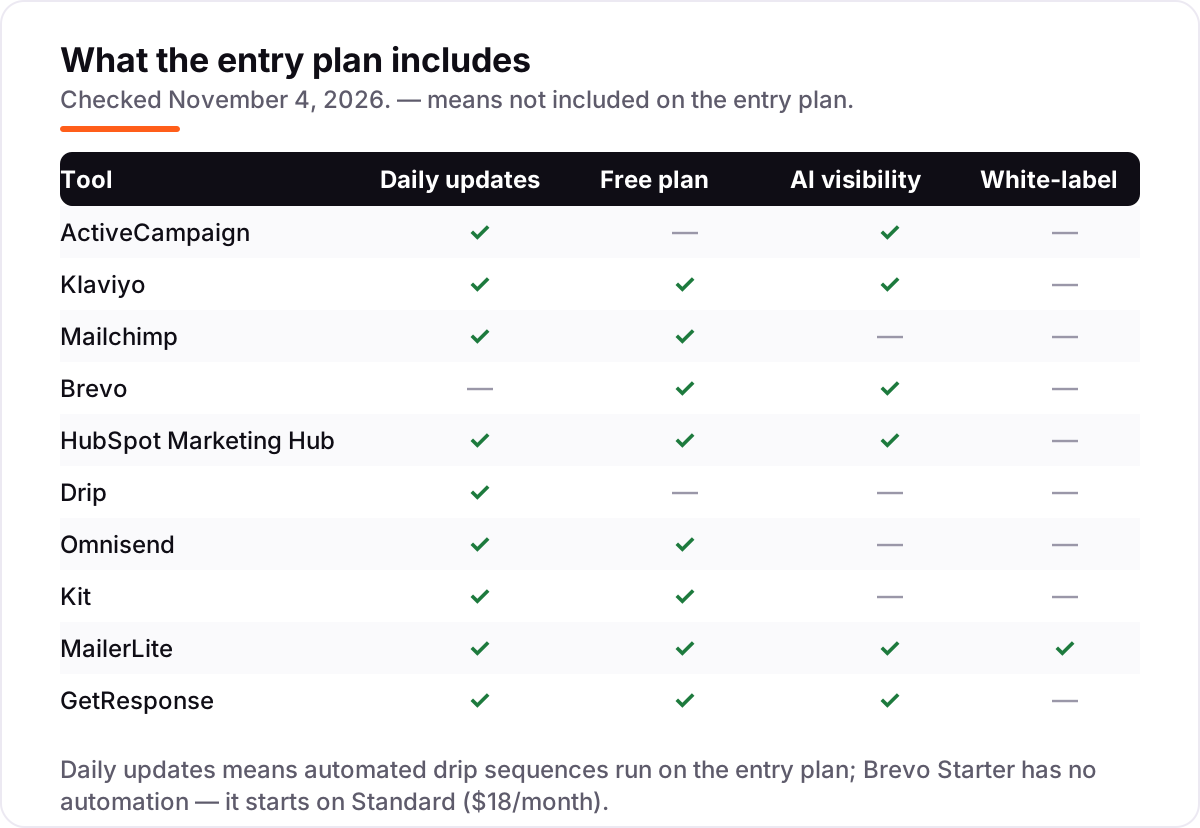
If your list is small, you may not need to pay at all. Kit's free plan covers up to 10,000 subscribers with unlimited emails, Brevo sends 300 emails a day free to up to 100,000 stored contacts, and GetResponse covers 500 contacts free. MailerLite, Omnisend and Klaviyo all run free plans at 250 subscribers or profiles, and HubSpot's free plan includes the CRM with 2,000 email sends a month.
The free tiers are honest products, but each has a ceiling that matters for drip work. Kit's free plan allows only one email sequence, so a welcome series plus a win-back flow already needs the paid plan. Brevo's free plan has limited automation, and its $9 Starter plan has none at all. MailerLite's free plan caps at three automations. For a single welcome sequence on a small list, start free; for anything with two or more sequences running, budget for a paid plan. Our guide to email marketing for local business covers the same free-tier trade-offs for a single-location business.
Dedicated automation tools vs all-in-one suites
The 10 tools in this list split into two camps. The dedicated automation tools — ActiveCampaign, Drip, Kit and MailerLite — do email and automation and little else. They are cheaper, faster to learn, and their pricing is easy to read: one number per list size. ActiveCampaign is the deepest of them, Drip the most ecommerce-shaped, Kit the most creator-shaped, MailerLite the simplest.
The suites — HubSpot, Klaviyo, Mailchimp, Brevo, Omnisend and GetResponse — bundle drip email with something else: a CRM, a shop platform, webinars, courses or transactional email. You pay more, or you pay in a more complicated way, but you replace a second subscription. The right camp depends on what you already pay for: if you own a CRM or a store platform, use its email; if you only need sequences, a dedicated tool costs less.
Ecommerce drip tools
For online stores, the drip tool is not really an email tool — it is a revenue tool. Klaviyo, Drip and Omnisend all trigger flows off shop behavior: a cart left behind, a product browsed twice, a second purchase that never came. Klaviyo adds predictive analytics on top, Drip adds revenue attribution on every plan, and Omnisend adds pre-built flows that work on day one.
The price difference between them is real but smaller than it looks. Omnisend Standard is $16/month for 500 contacts against Klaviyo's $20 for 500 profiles, and Drip is $39 for up to 2,500 people with unlimited sends. At 10,000 contacts the gap widens — Omnisend Standard at $132 a month against Klaviyo at $150 — but the deciding factor is usually the shop platform: Klaviyo's Shopify integration is the deepest, Omnisend's is nearly as deep for less money, and Drip works across Shopify, WooCommerce and Magento without a favorite.
Email drip campaign software pricing: what you will actually pay
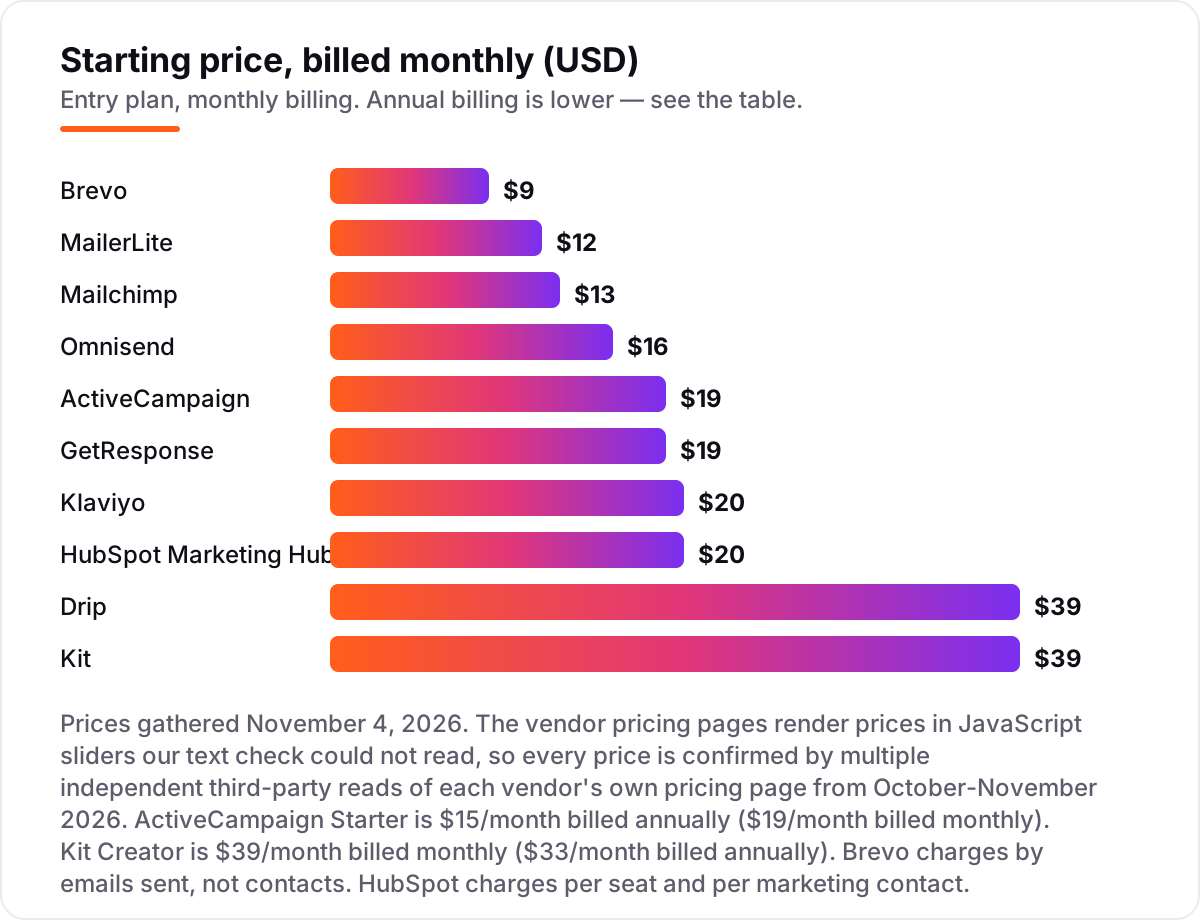
Take a small business with about 1,000 contacts running a welcome series plus one nurture flow for a year. The entry prices in this list are quoted at different list sizes, so read the tier next to each figure: ActiveCampaign Starter is $19 a month billed monthly, or $15 a month billed annually, for 1,000 contacts — $228 a year on monthly billing against $180 a year on annual billing, a $48 saving. GetResponse Starter is also $19 a month, or $15.58 a month billed annually, for 1,000 contacts — $228 a year against $186.96 a year. Kit Creator covers up to 1,000 subscribers at $39 a month billed monthly, or $33 a month billed annually — $468 a year against $396 a year, a $72 saving.
The cheaper entry prices are quoted at smaller tiers. MailerLite Comfort is $12 a month, or $10.80 a month billed annually, for up to 500 subscribers — $144 a year against $129.60 a year. Mailchimp Essentials is $13 a month for 500 contacts, or $156 a year, with no annual figure stated in this list. Omnisend Standard is $16 a month for 500 contacts, or $192 a year. Klaviyo Email is $20 a month for 500 profiles, or $240 a year, with no annual discount at all. Drip is $39 a month for up to 2,500 people, or $468 a year, also with no annual discount. HubSpot Starter is $20 a month per seat, or $240 a year per seat.
Two costs sit outside those numbers. First, the headline price often buys a capped version: Brevo Starter is $9 a month, or $8.08 a month billed annually — $108 a year against $96.96 — but it has no automation, so a real drip sequence needs Standard at $18 a month, or $216 a year. GetResponse Starter allows only one custom automation workflow, so a second sequence needs Marketer at $59 a month, and ActiveCampaign Starter caps each automation at five actions, so serious sequences need Plus at $49 a month. Second, the extras: HubSpot bills marketing contacts in 1,000-contact blocks on top of the seat price, Brevo charges $9 a month extra to remove its logo on Starter, and SMS is a separate purchase on Klaviyo and Omnisend. The cheapest entry price that actually runs a drip sequence is MailerLite at $12 a month, and the dearest entry prices are Drip and Kit at $39 — $144 a year against $468, a $324 gap that comes from what each plan includes, not from the list size.
Know the difference: drip sequences vs broadcast sends
The confusion in this category is between two kinds of email that share the same inbox. A drip sequence is triggered by one subscriber's behavior — a signup, a purchase, a cart left behind — and each email follows the last on that person's own clock, so two subscribers who joined a week apart are on different emails on the same day. A broadcast, or newsletter, is one email sent to a whole list at the same time on a schedule. Every tool in this list sends broadcasts, but the sequence-first tools are built around the drip: ActiveCampaign, Kit, MailerLite and Drip put the automation builder at the center of the product. The campaign-first tools — Mailchimp, Brevo and GetResponse — come from newsletter heritage, and their entry plans show it: Mailchimp Essentials caps flows at four steps, GetResponse Starter allows one custom workflow, and Brevo Starter has no automation at all.
There is a second, quieter confusion: ecommerce flows versus CRM workflows. Klaviyo, Drip and Omnisend trigger sequences off shop behavior — browsed products, abandoned carts, repeat purchases — while HubSpot triggers them off CRM records, such as a deal changing stage or a contact crossing a lifecycle threshold. A store that buys HubSpot for cart recovery, or a B2B team that buys Klaviyo for deal nurture, has bought the wrong trigger. Match the trigger to the tool first, and the price second.
A third distinction worth knowing is an autoresponder versus a drip sequence. An autoresponder is a single reply to a single event — one welcome email after a signup. A drip sequence is several emails with waits and conditions between them. A tool that advertises autoresponders may only send that one reply; check that the entry plan allows multi-step sequences with branches before you assume the welcome email is the start of a series rather than the whole of it.
Quick comparison: tool type by need
| Buyer | Best pick | Why |
|---|---|---|
| Small business, deepest automation | ActiveCampaign | Branching builder with CRM, from $15/month billed annually |
| Online store, purchase-triggered flows | Klaviyo | Predictive analytics and Shopify depth from $20/month |
| Cheapest paid sending | Brevo | $9/month for 5,000 emails — but drip needs Standard at $18 |
| CRM-led B2B nurture | HubSpot | Sequences trigger off CRM records, from $20/seat/month |
| Ecommerce value, pre-built flows | Omnisend | Welcome and cart flows ready on day one, from $16/month |
| Creator newsletters and sequences | Kit | Free plan to 10,000 subscribers; Creator from $39/month |
| Simplest cheap drip tool | MailerLite | Real automation from $12/month, billed only on active subscribers |
How to choose the best email drip campaign software
- Count your sequences, not just your subscribers. One welcome series fits almost any free plan; three sequences running at once needs a paid plan with enough workflows — GetResponse Starter allows only one.
- Check what the entry plan actually automates. Brevo Starter has no automation at all, Mailchimp Essentials caps flows at four steps, and ActiveCampaign Starter caps each automation at five actions. The headline price often buys a capped version.
- Match the trigger to the tool. Purchase behavior points to Klaviyo, Drip or Omnisend; CRM stages point to HubSpot or ActiveCampaign; reader behavior points to Kit.
- Price it at your list size, not the entry tier. Every tool here charges more as the list grows, and the growth curves differ wildly — Klaviyo goes from $20 to $150 between 500 and 10,000 profiles.
- Try the free plan with a real sequence. Build your welcome series on the free tier, send it to a real segment, and check the open and click rates before paying. Every tool in this list has a free plan or a free trial.
Before you write the emails in that sequence, run your subject lines through the free SERP snippet preview tool — it shows exactly how a title will look in Google, which is the same discipline a good subject line needs.
Mistakes to avoid
- Comparing headline prices without checking automation limits. A $9 plan with no automation is not cheaper than a $16 plan that runs your sequences.
- Paying for contacts you cannot email. Mailchimp and ActiveCampaign bill for unsubscribed contacts; MailerLite and Klaviyo do not count them the same way. Prune or archive before you compare.
- Building one giant sequence instead of several small ones. A welcome series, an onboarding series and a win-back flow are three triggers, not one 15-email chain.
- Trusting a directory price. Kit still shows $29 in many roundups; the live pricing page says $39 after the September 2025 increase. Always check the vendor's own page.
- Forgetting the trial ends. Set a reminder for the day the trial converts, and check the numbers against your own email platform's reports so you know what the tool should be showing.
How we chose
We gathered each vendor's starting price on November 4, 2026. The vendor pricing pages render their prices in JavaScript sliders that our text check could not read, so every price is confirmed by multiple independent third-party reads of each vendor's own pricing page from October–November 2026, and the sources list names the vendor page each figure came from. Ratings come from G2, with the review count shown. We ranked the tools by fit for the most common buyer — a small business setting up its first drip sequences — not by brand size. No vendor paid for a place in this list, and none of the links here are affiliate links.
What to do next
Start with the decision path above: count your sequences, check the entry plan's automation limits, and match the trigger to the tool. Then take the free plan or trial of your top pick and build your welcome series on a real segment. If the opens and clicks look right after a week, you have your tool. If the traffic to feed those sequences is the problem, our monthly SEO service brings the subscribers the sequences are built for. Once your tools are in place, find out what's holding your rankings back.
Your stack only works if people find you
SerpAstra fixes what keeps your site off page one and makes it easy for AI assistants to recommend.
Get a free audit→Sources we checked (21)
- ActiveCampaign pricing — activecampaign.com/pricing (checked November 4, 2026)
- ActiveCampaign on G2 — 4.4/5, 14,780 reviews (checked November 4, 2026)
- Klaviyo pricing — klaviyo.com/pricing (checked November 4, 2026)
- Klaviyo on G2 — 4.6/5, 1,360 reviews (checked November 4, 2026)
- Mailchimp pricing — mailchimp.com/pricing (checked November 4, 2026)
- Mailchimp on G2 — 4.3/5, 12,998 reviews (checked November 4, 2026)
- Brevo pricing — brevo.com/pricing (checked November 4, 2026)
- Brevo on G2 — 4.5/5, 2,776 reviews (checked November 4, 2026)
- HubSpot Marketing Hub pricing — hubspot.com/pricing/marketing (checked November 4, 2026)
- HubSpot Marketing Hub on G2 — 4.4/5, 16,050 reviews (checked November 4, 2026)
- Drip pricing — drip.com/pricing (checked November 4, 2026)
- Drip on G2 — 4.4/5, 482 reviews (checked November 4, 2026)
- Omnisend pricing — omnisend.com/pricing (checked November 4, 2026)
- Omnisend on G2 — 4.6/5, 1,269 reviews (checked November 4, 2026)
- Kit pricing — kit.com/pricing (checked November 4, 2026)
- Kit on G2 — 4.4/5, 236 reviews (checked November 4, 2026)
- MailerLite pricing — mailerlite.com/pricing (checked November 4, 2026)
- MailerLite on G2 — 4.6/5, 1,113 reviews (checked November 4, 2026)
- GetResponse pricing — getresponse.com/pricing (checked November 4, 2026)
- GetResponse on G2 — 4.3/5, 1,140 reviews (checked November 4, 2026)
- Campaign Monitor — automated emails generate 320% more revenue than non-automated emails (checked November 4, 2026)
Shamim
Founder of SerpAstra
A full-stack SEO and digital marketer who spends most days on Local SEO for dental practices, AI search visibility and lead generation.
Frequently asked questions
What is the best email drip campaign software in 2026?
ActiveCampaign is the best overall: the deepest automation builder with a CRM behind it, from $15/month billed annually. Klaviyo is the best for online stores, Brevo is the cheapest paid entry at $9/month, and Kit is the best for creators. The right pick depends on what triggers your sequences — purchases, CRM stages or reader behavior.
How much does email drip campaign software cost?
Entry prices in this list run from $9 to $39 a month: Brevo $9, MailerLite $12, Mailchimp $13, ActiveCampaign $15 billed annually, Omnisend $16, GetResponse $19, Klaviyo and HubSpot $20, Drip and Kit $39. Every tool prices by contacts or email volume, so the bill rises with your list — check the price at your own list size.
Is there a free email drip campaign software?
Yes, with limits. Kit's free plan covers up to 10,000 subscribers but allows only one sequence. Brevo sends 300 emails a day free, MailerLite and Omnisend cover 250 subscribers free, and GetResponse covers 500 contacts. Note that Brevo's $9 Starter plan has no automation — drip sequences start on Standard at $18/month.
What is the difference between a drip campaign and a newsletter?
A newsletter is a broadcast: one email sent to a whole list on a schedule. A drip campaign is a sequence triggered by behavior — a signup, a purchase, a cart left behind — where each email follows the last automatically. Newsletters keep an audience warm; drip campaigns move one subscriber through a journey step by step.
How many emails should a drip campaign have?
Three to seven emails covers most sequences: three for a welcome series, five for onboarding, up to seven for a sales nurture. Shorter is better when each email has one job — introduce, teach, prove, offer. If a sequence needs more than seven emails, it is usually two sequences joined together, and splitting them makes the triggers easier to follow.
Can I switch drip software without losing my sequences?
You can move the audience — every tool here exports contacts as a CSV — but the sequences themselves have to be rebuilt, because automation builders do not share a common format. Before switching, screenshot each flow and export any templates. Budget an afternoon to rebuild, and run the old and new sequences side by side until the new one is proven.
Free SEO and AI visibility audit
Find out what is holding your rankings back
Send us your site. Within 2 business days you get a written audit, an AI visibility check and a short fix list ranked by impact. Free, with no contract attached.
Request my free audit→Related guides
 MarketingEmail marketing for local businesses (that customers actually open)Email marketing for local businesses: build a list the right way, send emails customers open, and turn past customers into repeat bookings without spam.Read guide →
 MarketingMarketing automation for small businesses: what to automate (and what not to)Marketing automation for small businesses, explained: what to automate first, what to keep human, and the tools that save hours without losing customers.Read guide →
 Digital Marketing & Ads8 Best Marketing Automation Tools in 2026 (Free and Paid, Compared)Compare the 8 best marketing automation tools in 2026 on price, automation depth and free plans, with prices checked November 4, 2026 for small teams.Read guide →