
8 Best Email Marketing Platforms for 2026 (Pros, Cons and Pricing)
8 best email marketing platforms compared on real starting prices, free plans and automation. Brevo $9/month, Mailchimp $13. Checked Nov 4, 2026.
 Shamim Mia, Founder, SerpAstraLast verified November 4, 202615 min read
We compare pricing pages, documentation and public reviews. We never accept payment for rankings.

Key takeaways
- Brevo is the cheapest way in at $9/month for 5,000 emails, MailerLite is the easiest at $12/month, and Mailchimp is the best-connected at $13/month — those three cover most small businesses.
- Free plans are real: Brevo sends 300 emails a day with unlimited contacts, Kit covers up to 10,000 subscribers, and Mailchimp covers 250 contacts.
- The single most important buying factor is how the price scales with your list — Mailchimp charges for unsubscribed contacts, and ActiveCampaign jumps from $19 to $149 a month between 1,000 and 10,000 contacts.
- Prices below were confirmed against the vendors' pricing pages in late October 2026, except MailerLite, read directly on November 4, 2026, and ActiveCampaign, whose prices are third-party reported because it publishes none. Ratings are G2, checked November 4, 2026.
On this page
Quick comparison
| Tool | Best for | Starting price | Free plan |
|---|---|---|---|
| Mailchimp | Small businesses that want the biggest integration library and ecommerce automation in one familiar platform | $13/mo | Yes (250 contacts) |
| Brevo | Small businesses and ecommerce stores that want the cheapest paid plan and pricing by emails sent, not contacts | $9/mo | Yes (300/day) |
| MailerLite | Solo marketers and small teams that want a clean editor, honest pricing and the easiest tool to learn | $12/mo | Yes (250 subs) |
| Kit | Creators, bloggers and newsletter writers who sell digital products and grow an audience | $39/mo | Yes (10,000 subs) |
| Constant Contact | Small local businesses, nonprofits and event organizers that want guided templates and phone support | $12/mo | No (free trial) |
| GetResponse | Small businesses that want webinars, landing pages and sales funnels in the same subscription as email | $19/mo | Yes (500 contacts) |
| ActiveCampaign | Growing teams that live in automation and want a built-in CRM with their email | $19/mo | No (14-day trial) |
| HubSpot Marketing Hub | Teams that already run on HubSpot CRM and want email tied to contacts, deals and reporting | $20/mo per seat | Yes (basic email) |
Make one of these tools?
We re-check this list every quarter. Send a correction, request a review, or ask about a clearly labeled sponsored spot.
Request a listingThe best email marketing platforms

Mailchimp
Best for: Small businesses that want the biggest integration library and ecommerce automation in one familiar platform
Mailchimp is the name most small businesses start with, and the reason is breadth: the Essentials plan covers campaigns, a Customer Journey Builder for abandoned cart and win-back flows, landing pages and signup forms, and it connects to almost any store or site through one of the largest integration libraries in this list. For a shop running on Shopify or WooCommerce, that plug-and-play ecommerce automation is the real selling point.
The catch is the price curve. Essentials starts at $13 a month for 500 contacts, but it is $75 at 5,000 and $110 at 10,000, and unsubscribed contacts count toward the tier until you archive them. If your list grows fast, budget for the next band before you commit, and clean out dead contacts every quarter.
What we like
- Largest integration library in this list — connects to nearly any store, site or tool a small business uses
- Customer Journey Builder covers abandoned cart, win-back and post-purchase flows from Essentials up
- Sends up to 10 times your contact count a month, with 3 user seats and 3 audiences on Essentials
Watch out for
- Price climbs steeply with list size — Essentials is $75/month at 5,000 contacts and $110 at 10,000
- Unsubscribed and non-subscribed contacts count toward your billing tier until you archive or delete them
- Generative AI writing and design tools sit on Standard ($20/month), not Essentials

Brevo
Best for: Small businesses and ecommerce stores that want the cheapest paid plan and pricing by emails sent, not contacts
Brevo is the cheapest paid plan in this list, and its pricing model is the reason: you pay for the emails you send, not the contacts you store. Starter costs $9 a month for 5,000 emails, and the free plan sends 300 emails a day with unlimited contacts — the most generous free tier here. That makes Brevo the best fit for a business with a big list that mails rarely, or a store that wants email, SMS and WhatsApp in one account.
Watch the extras, though. Starter is single-user, emails carry Brevo branding unless you pay $12 a month to remove it, and unused emails expire at month end. If you need A/B testing, Standard at $18 a month is the step up. For most small senders, though, the $9 entry price is hard to beat.
What we like
- Cheapest paid entry in this list at $9/month, and you pay for emails sent — not for how many contacts you store
- Free plan sends 300 emails a day with unlimited contacts, the most generous free tier here
- Email, SMS, WhatsApp and a built-in CRM in one account, with an AI content generator on Starter
Watch out for
- Emails carry Brevo branding on Starter unless you pay $12/month for the logo-removal add-on
- Starter is single-user only — extra seats cost extra, and A/B testing needs Standard ($18/month)
- Unused monthly emails expire at the end of each month, so a quiet month does not bank credits
MailerLite
Best for: Solo marketers and small teams that want a clean editor, honest pricing and the easiest tool to learn
MailerLite is the easiest tool in this list to learn, and the G2 numbers back that up: 4.6 out of 5, the highest rating here, with reviewers praising the clean editor and the support team most. The Comfort plan costs $12 a month and includes the full feature set — dynamic emails, multivariate testing, smart sending and the AI writing assistant — rather than holding features for higher tiers.
Billing is fair, too: only active subscribers count, so unsubscribed and bounced contacts never push you into a higher band. The trade-offs are scope. There is no built-in CRM, the integration list is shorter than Mailchimp's, and advanced automation triggers need the $25 Power plan. For a solo marketer sending regular newsletters, it is the simplest buy here.
What we like
- Highest G2 rating in this list at 4.6/5, with reviewers praising ease of use and support most
- Comfort includes the AI writing assistant, dynamic emails, multivariate testing and smart sending for $12/month
- Bills only for active subscribers — unsubscribed and bounced contacts do not count toward your tier
Watch out for
- No built-in CRM and fewer native integrations than Mailchimp or HubSpot
- Advanced automation triggers and unlimited monthly emails need the Power plan ($25/month)
- Approval review for new accounts can delay the first send by a day or two

Kit
Best for: Creators, bloggers and newsletter writers who sell digital products and grow an audience
Kit, formerly ConvertKit, is built for creators rather than stores: tag-based subscriber management, a visual automation builder, landing pages and forms, and built-in commerce for digital products, paid newsletters and subscriptions. The free plan is the most generous in this list by headcount — up to 10,000 subscribers with unlimited sends — which makes it the obvious place to start a newsletter.
The catch is that the free plan has no automations or sequences, so a welcome series needs the Creator plan at $39 a month for up to 1,000 subscribers — the September 2025 reprice raised it from $25, so roundups still show the stale $25 or $29 figures. Prices then climb fast: $59 at 3,000 subscribers and $139 at 10,000. Choose Kit when the audience is the business; choose a cheaper sender when it is not.
What we like
- Free plan covers up to 10,000 subscribers with unlimited sends, landing pages and forms
- Tag-based subscriber management and visual automation builder fit how creators actually segment an audience
- Built-in commerce: sell digital products, paid newsletters and subscriptions with a 3.5% fee on Creator
Watch out for
- Free plan has no automations or sequences — a welcome series needs the $39/month Creator plan
- Price jumps hard with list size: Creator is $59/month at 3,000 subscribers and $139 at 10,000
- Email design options are plainer than Mailchimp or MailerLite, with less visual template variety

Constant Contact
Best for: Small local businesses, nonprofits and event organizers that want guided templates and phone support
Constant Contact is the most guided tool in this list, and that is its whole pitch. The setup walks a non-marketer through templates, list import and the first send, event marketing and social posting are built in, and real human support answers by phone as well as email and chat. For a local business, a nonprofit or an event organizer, that hand-holding is worth more than a clever automation builder.
The price is the honest downside. There is no free plan since June 2025, Lite starts at $12 a month for 500 contacts, and it jumps to $30 the moment you add contact 501 — the steepest first step here. Lite also keeps Constant Contact branding in your emails. Buy it for the guidance, not the price.
What we like
- Largest review base among the small-business tools here, with the most guided, beginner-friendly setup
- Strong event marketing and list-growth tools, including event registration and social posting
- Real human support by phone, email and chat, plus a 30-day money-back guarantee
Watch out for
- No free plan since June 2025 — only a free trial, so every user pays from day one
- Lite jumps from $12 to $30 a month the moment you add contact number 501, the steepest first step here
- Lite shows Constant Contact branding in your emails and allows only basic single-step automation

GetResponse
Best for: Small businesses that want webinars, landing pages and sales funnels in the same subscription as email
GetResponse is the only tool here that tries to be the whole marketing stack: email, autoresponders, landing pages, conversion funnels, courses and webinar hosting in one subscription. The Starter plan costs $19 a month for 1,000 contacts and includes unlimited monthly sends, three user seats, an AI email generator and unlimited landing pages — no send caps to watch.
That breadth is the selling point for a small business that runs webinars or sells a course alongside the newsletter. The limits are on the entry plan itself: the free plan is newsletters only after the trial, webinars and unlimited workflows need Marketer at $59 a month, and the template designs feel dated next to Mailchimp and MailerLite.
What we like
- Unlimited monthly email sends on every paid plan — no send caps to watch
- Starter includes 3 user seats, an AI email generator, unlimited landing pages and basic automation
- Only tool here with built-in webinars and conversion funnels from the mid-tier up
Watch out for
- Free plan is newsletters only after the trial — no automation, and every email carries a GetResponse badge
- Webinars and unlimited automation workflows need Marketer ($59/month), not Starter
- Template designs feel dated next to Mailchimp and MailerLite, per multiple G2 reviewers

ActiveCampaign
Best for: Growing teams that live in automation and want a built-in CRM with their email
ActiveCampaign is the automation specialist in this list. The Starter plan includes multi-step visual workflows, site tracking and a built-in CRM, so email and sales share one contact record. It has the largest G2 review base here — 14,838 reviews — and reviewers praise the automation depth most. If your marketing runs on sequences, tags and conditional paths, this is the tool built for that work.
The price needs careful reading. ActiveCampaign publishes no prices at all, so the $19 monthly and $15 annual-billing figures are third-party reported, not vendor-verified. The cost also scales hard with list size: Starter is $149 a month at 10,000 contacts, nearly ten times the entry price. And since November 2025, new accounts are billed for every contact, including unsubscribed ones. Pick it when automation is the job, not just sending.
What we like
- Deepest automation in this list: multi-step visual workflows, site tracking and conditional content
- Built-in CRM on every plan, so email and sales pipelines share one contact record
- Largest G2 review base here at 14,838 reviews, with automation praised most
Watch out for
- No free plan, and ActiveCampaign publishes no prices — the $19 monthly and $15 annual rates are third-party reported
- Price rises fast with list size: Starter is $149/month at 10,000 contacts, nearly 10 times the entry price
- New accounts are billed for every contact, including unsubscribed and bounced ones, since November 2025

HubSpot Marketing Hub
Best for: Teams that already run on HubSpot CRM and want email tied to contacts, deals and reporting
HubSpot Marketing Hub is email wired into a full CRM: every send ties to a contact record, deals and reporting, with landing pages, live chat and ad management in the same system. The free plan includes the CRM and basic email, so a small team can start without paying, and the Starter plan at $20 a month per seat removes branding and adds automation for 1,000 marketing contacts.
The honest warning is the price cliff. Professional costs $890 a month plus a $3,000 onboarding fee, and every extra 1,000 marketing contacts adds about $50 a month on Starter. HubSpot is the right buy when the CRM is the system of record; as a standalone email sender, it is the most expensive route here.
What we like
- Email, CRM, landing pages, live chat and ads in one system, with every send tied to a contact record
- Free plan includes the CRM and basic email, so small teams can start without paying
- Largest G2 review base in this list at 16,039 reviews, with ease of use praised most
Watch out for
- Starter-to-Professional is a 45x price cliff — $20/seat to $890/month — with a $3,000 onboarding fee
- Every extra 1,000 marketing contacts costs about $50/month on Starter, so large lists get expensive fast
- New-customer promo pricing ($7/seat) ends after the first term, so budget against the $20 list price
What an email marketing platform actually does
The best email marketing platforms do three jobs: they store your audience, they send campaigns and automated sequences, and they report what happened — opens, clicks and sales. You add contacts, build an email, send it to a segment, and the tool tells you who opened, who clicked and who bought. That is the whole job, and it is a job worth doing well: Litmus's State of Email 2025 survey puts the average return at $36 for every $1 spent on email marketing, with 35% of companies reporting more than $36 back per dollar.
The products differ in what they charge for and what else they bundle around the sending. Some price by contacts, some by emails sent, some by seats — and the same list can cost $9 a month on one platform and $75 on another. Some are simple senders with a good editor; others are all-in-one suites with a CRM, landing pages, SMS and webinars. The price follows the bundle and the billing unit, not just the sending.
This list is organised by what you actually need: the cheapest way in, the easiest tool to learn, the creator pick, the guided small-business pick, the all-in-one pick, the automation pick and the CRM pick. Every price below is the entry plan's starting price, with the billing basis named so you can compare like with like.
Free options first
If your list is new, you may not need to pay at all. Brevo sends 300 emails a day with unlimited contacts, Kit covers up to 10,000 subscribers with unlimited sends, Mailchimp covers 250 contacts and 500 sends a month, MailerLite covers 250 subscribers and 2,500 emails, GetResponse covers 500 contacts, and HubSpot's free plan includes basic email with the CRM. The free tiers are honest products, not demos — but each one holds something back.
The pattern is consistent: free plans cap the audience or the sends, and they strip out automation and branding removal. Kit's free plan has no sequences at all, GetResponse's free plan is newsletters only with a badge on every email, and Constant Contact and ActiveCampaign have no free plan — only a trial. For a single small list, start free and upgrade when the list grows past the limit. For anything that needs a welcome sequence or a branded send, skip the free tier: those features start on the paid plans.
Simple senders vs all-in-one suites
The 8 tools in this list split into two camps. The simple senders — MailerLite, Kit, Constant Contact and Brevo at its entry level — do one job well: they store contacts, send campaigns and run basic automations, and they stay out of your way. They are cheaper, faster to learn and the right size for a solo marketer or a small team that sends a newsletter and a few sequences.
The suites — Mailchimp, GetResponse, ActiveCampaign and HubSpot — bundle email with more: ecommerce automation, landing pages and funnels, a built-in CRM, SMS and webinars. You pay more, but you replace two or three subscriptions. The right camp depends on what you already pay for: if you own a CRM or a landing-page tool, buy a simple sender; if you need the whole stack in one login, a suite costs less than the tools separately.
Automation and AI: what the entry plan actually includes
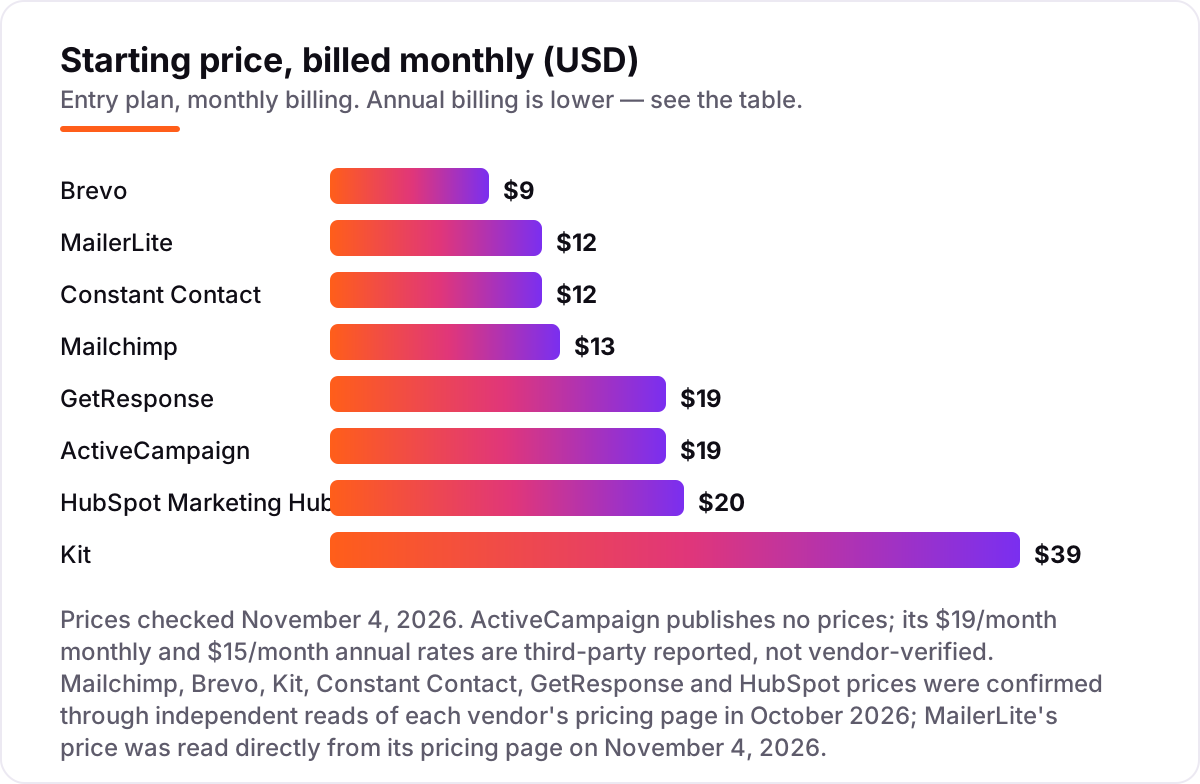
Automation is where the entry plans diverge most. ActiveCampaign and Kit put multi-step visual workflows on their entry paid plans, GetResponse includes one automation workflow on Starter, and Mailchimp Essentials covers flows up to 4 steps. Brevo and MailerLite include automation from the free tier up, while Constant Contact Lite allows only basic single-step automation — real sequences need Standard at $35 a month.
AI help is now a standard entry-plan feature on half this list: Brevo, MailerLite, GetResponse and ActiveCampaign all include an AI writing or content assistant on the entry plan. On the others it is limited or sits on a higher tier — Mailchimp gates its generative AI writing and design tools to Standard. Treat AI as a drafting aid, not a strategy: the assistant writes the first version, and you still decide what the email says and who it goes to.
Email marketing platforms pricing: what you will actually pay
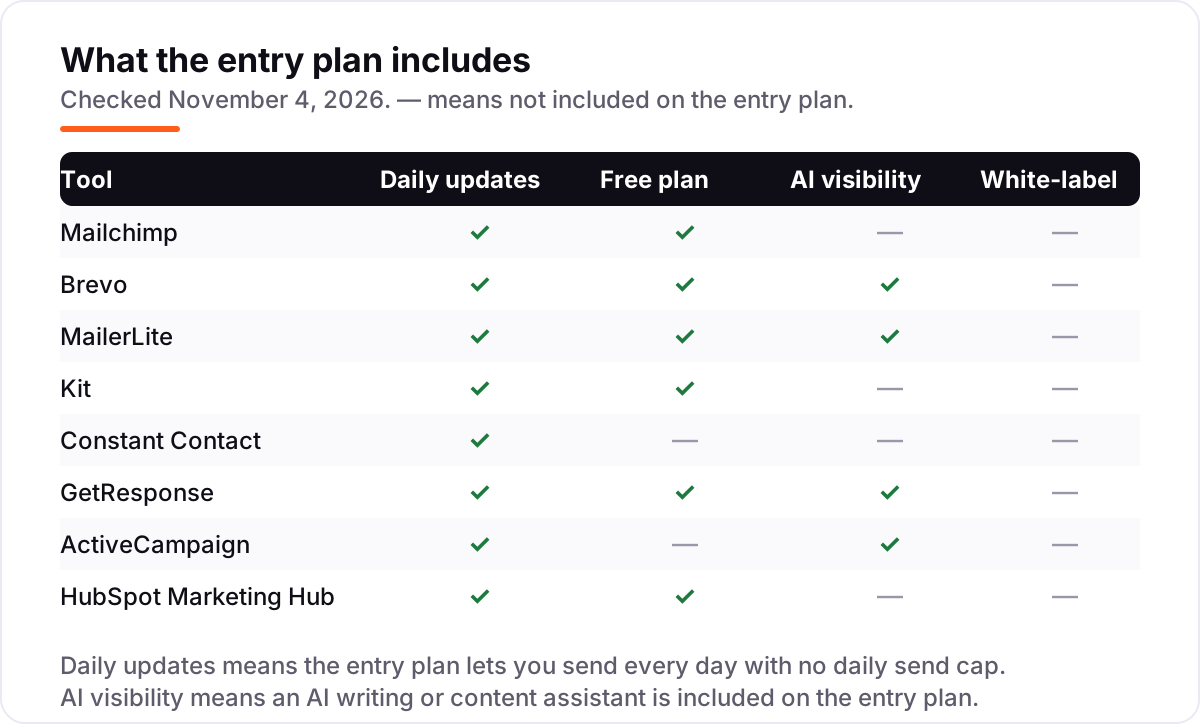
Take a small business with 1,000 contacts sending weekly. On monthly billing, Brevo Starter costs $9 a month, or $108 a year; MailerLite Comfort costs $12 a month, or $144 a year; GetResponse Starter costs $19 a month, or $228 a year; ActiveCampaign Starter costs $19 a month, or $228 a year; HubSpot Starter costs $20 a month per seat, or $240 a year; and Kit Creator costs $39 a month, or $468 a year. The same 1,000 contacts cost $108 a year at the cheap end and $468 at the dear end — before the two tools that jump at this size: Mailchimp Essentials is $26.50 a month at 1,000 contacts, or $318 a year, and Constant Contact Lite is $30 a month, or $360 a year, because it jumps from $12 the moment you add contact 501.
Annual billing cuts the bill where it exists: Brevo drops from $9 to $8.08 a month, or $96.96 a year; Kit drops from $39 to $33 a month, or $396 a year; GetResponse drops from $19 to $15.58 a month, or $186.96 a year; ActiveCampaign drops from $19 to $15 a month, or $180 a year. One warning on those annual figures: ActiveCampaign publishes no prices, so its $19 and $15 rates are third-party reported, not vendor-verified. And the billing unit matters as much as the number — Brevo charges for emails sent, so a 1,000-contact list mailed daily costs more than the same list mailed weekly, while MailerLite and Kit charge only for the subscribers you have.
Know the difference: simple senders vs all-in-one suites
The confusion in this category is between two kinds of tool that both call themselves an email marketing platform. A simple sender stores contacts, sends campaigns and runs basic automations — and does little else. MailerLite, Kit, Constant Contact and Brevo at its entry level are senders: they are cheaper, faster to learn and the right size for a solo marketer or a small team that sends a newsletter and a few sequences.
An all-in-one suite bundles email with a CRM, landing pages, SMS, funnels or webinars in the same subscription. Mailchimp, GetResponse, ActiveCampaign and HubSpot are suites: you pay more, but you replace two or three subscriptions. The right camp depends on what you already pay for — if you own a CRM or a landing-page tool, buy a simple sender; if you need the whole stack in one login, a suite costs less than the tools separately. A second distinction worth knowing is price by contacts versus price by sends: Mailchimp, MailerLite, Kit and Constant Contact charge by audience size, while Brevo charges by emails sent, so a big list mailed rarely is cheapest on Brevo and dearest on Mailchimp.
Quick comparison: tool type by need
| Buyer | Best pick | Why |
|---|---|---|
| Small business, cheapest start | Brevo | $9/month for 5,000 emails, priced by sends not contacts |
| Solo marketer, easiest to learn | MailerLite | $12/month, highest G2 rating here, full features on Comfort |
| Online store, most integrations | Mailchimp | $13/month, largest integration library, ecommerce flows |
| Creator or newsletter writer | Kit | Free to 10,000 subscribers, built-in product sales |
| Local business, needs guidance | Constant Contact | $12/month, guided setup, phone support, event tools |
| Webinars and funnels included | GetResponse | $19/month, unlimited sends, webinars from Marketer |
| Automation-first team | ActiveCampaign | $19/month (third-party reported), deepest workflows, built-in CRM |
| Already on HubSpot CRM | HubSpot Marketing Hub | $20/month per seat, email tied to contacts and deals |
How to choose the best email marketing platforms
- Count your contacts first, then check the price at that size. Under 500, the free plans and the cheapest paid plans cover you. Over 5,000, the billing unit decides — Brevo and GetResponse win on volume, Mailchimp and ActiveCampaign get expensive fast.
- Check what counts toward the bill. Some tools charge for unsubscribed contacts, some only for active subscribers, and Brevo charges for emails sent. A list with 30% inactive contacts costs far more on Mailchimp than on MailerLite.
- Decide sender or suite. If you already pay for a CRM or landing pages, buy a simple sender. If you need email, CRM, landing pages and SMS in one login, a suite is cheaper than the tools separately.
- Check the automation question. If you need welcome sequences, abandoned-cart emails or behavior-based follow-ups, make sure the plan you pick includes them — several tools charge extra for real automation.
- Try before you pay. Every tool in this list has a free plan or a free trial. Run your real list for two send cycles and compare the open and click rates before committing.
Before you send your first campaign, tag your links with the free UTM builder so you can see in analytics exactly which email drove each visit and sale.
Mistakes to avoid
- Comparing starting prices without checking the billing unit. $9 a month for 5,000 emails is not the same as $13 a month for 500 contacts, and a per-seat price multiplies with every team member.
- Ignoring what counts as a contact. Mailchimp and ActiveCampaign bill for unsubscribed contacts; MailerLite bills only active subscribers. A dirty list costs real money on the wrong platform.
- Paying for a suite when you only need newsletters. A $12 sender beats a $20-per-seat CRM platform you only use for campaigns.
- Trusting a directory price. Several directories still show Kit's old $25 or $29 Creator figures — the current price is $39 a month, or $33 billed annually, after the September 2025 reprice. Always check the vendor's own pricing page, and confirm whether the price shown is monthly or annual billing.
- Forgetting the trial ends. Set a reminder for the day the trial converts, and export your list and automations before you cancel anything — automations do not transfer between platforms.
How we chose
We confirmed each vendor's starting price against its own pricing page: MailerLite's price was read directly from its pricing page on November 4, 2026, and the other six prices were confirmed through independent reads of each vendor's pricing page in October 2026, with all sources agreeing on the figures shown. ActiveCampaign publishes no prices at all, so its $19 monthly and $15 annual-billing figures are third-party reported, not vendor-verified, and HubSpot's $20 figure is the list price — a new-customer promo from $7 a seat is temporary. Ratings come from G2, checked November 4, 2026, with review counts shown. We ranked the tools by fit for the most common buyer — a small business or solo marketer sending regular campaigns to a growing list — not by brand size. No vendor paid for a place in this list, and none of the links here are affiliate links.
What to do next
Start with the decision path above: count your contacts, check what counts toward the bill, and decide sender or suite. Then take the free plan or trial of your top pick and run your real list for two send cycles. If the emails land, the reports make sense and the price holds at your list size, you have your tool. If email is one part of a bigger growth plan, our monthly SEO service covers the search side too. Once your tools are in place, find out what's holding your rankings back.
Your stack only works if people find you
SerpAstra fixes what keeps your site off page one and makes it easy for AI assistants to recommend.
Get a free audit→Sources we checked (17)
- Mailchimp pricing — mailchimp.com/pricing (checked October 2026)
- Mailchimp on G2 — 4.3/5, 12,998 reviews (checked November 4, 2026)
- Brevo pricing — brevo.com/pricing (checked October 2026)
- Brevo on G2 — 4.5/5, 2,776 reviews (checked November 4, 2026)
- MailerLite pricing — mailerlite.com/pricing (checked November 4, 2026)
- MailerLite on G2 — 4.6/5, 1,115 reviews (checked November 4, 2026)
- Kit pricing — kit.com/pricing (checked November 4, 2026)
- Kit on G2 — 4.4/5, 236 reviews (checked November 4, 2026)
- Constant Contact pricing — constantcontact.com/pricing (checked October 2026)
- Constant Contact on G2 — 4.1/5, 7,625 reviews (checked November 4, 2026)
- GetResponse pricing — getresponse.com/pricing (checked October 2026)
- GetResponse on G2 — 4.3/5, 1,146 reviews (checked November 4, 2026)
- ActiveCampaign pricing — activecampaign.com/pricing (checked November 4, 2026; publishes no prices)
- ActiveCampaign on G2 — 4.4/5, 14,838 reviews (checked November 4, 2026)
- HubSpot Marketing Hub pricing — hubspot.com/pricing/marketing (checked October 2026)
- HubSpot Marketing Hub on G2 — 4.4/5, 16,039 reviews (checked November 4, 2026)
- Litmus — email marketing ROI, $36 per $1 spent (State of Email 2025)
Shamim
Founder of SerpAstra
A full-stack SEO and digital marketer who spends most days on Local SEO for dental practices, AI search visibility and lead generation.
Frequently asked questions
What is the best email marketing platform in 2026?
For most small businesses, Brevo at $9/month or MailerLite at $12/month — cheap, easy, and the free plans are genuinely usable. Mailchimp is the best-connected pick at $13/month if you run an online store. Creators should start with Kit, and teams that live in automation should look at ActiveCampaign.
How much does email marketing software cost?
Between $9 and $39 a month at the entry level: Brevo starts at $9, Mailchimp and Constant Contact at $12–$13, ActiveCampaign at $19, GetResponse at $19, HubSpot at $20 per seat and Kit at $39. The entry price is only the start, though — most tools charge more as your list grows, so check the price at 5,000 and 10,000 contacts before you commit.
Is there a free email marketing platform?
Yes, with limits. Brevo sends 300 emails a day with unlimited contacts, Kit covers up to 10,000 subscribers, Mailchimp 250 contacts, MailerLite 250 subscribers and GetResponse 500 contacts. Constant Contact and ActiveCampaign have no free plan, only a free trial. Free plans suit a new list; once you need automation or branding removal, a paid plan costs less than the time you lose working around the limits.
Which is cheaper, Mailchimp or Brevo?
Brevo, by a clear margin. Brevo Starter is $9 a month for 5,000 emails and its free plan allows unlimited contacts, while Mailchimp Essentials starts at $13 a month for 500 contacts and charges for unsubscribed contacts too. The gap widens as the list grows: at 5,000 contacts Mailchimp Essentials is $75 a month, while Brevo's price only rises with how much you send.
What should I check before paying for an email marketing platform?
Four things: what the price is based on — contacts, emails sent or seats — and what it costs at your list size in a year, whether the free plan covers what you need, whether automation and AI tools are on the entry plan or a higher tier, and whether unsubscribed contacts count toward your bill. All four vary widely across the tools in this list.
Can I switch email marketing platforms later?
Yes, and every tool in this list offers a free migration or import for contacts, templates and lists. The painful parts are rebuilding automations, which do not transfer, and re-warming your sending reputation on the new platform. Export your list and your automation maps before you cancel, and run both tools in parallel for one send cycle.
Do I need marketing automation or just newsletters?
If you send the same email to everyone on a schedule, newsletters are enough — MailerLite, Brevo or Constant Contact will do. Automation earns its keep when you need welcome sequences, abandoned-cart emails, win-back flows or behavior-based follow-ups. Kit and ActiveCampaign are built for that work; on Mailchimp and Brevo, serious automation starts on the mid-tier plans.
Free SEO and AI visibility audit
Find out what is holding your rankings back
Send us your site. Within 2 business days you get a written audit, an AI visibility check and a short fix list ranked by impact. Free, with no contract attached.
Request my free audit→Related guides
 MarketingEmail marketing for local businesses (that customers actually open)Email marketing for local businesses: build a list the right way, send emails customers open, and turn past customers into repeat bookings without spam.Read guide →
 MarketingMarketing automation for small businesses: what to automate (and what not to)Marketing automation for small businesses, explained: what to automate first, what to keep human, and the tools that save hours without losing customers.Read guide →
 ContentContent marketing for local businesses: a practical guideContent marketing for local businesses: which formats earn calls, a simple 90-day plan, how to write pages that rank and convert, and how to measure it.Read guide →