
9 Best Law Firm Accounting Software in 2026, Compared
Compare the 9 best law firm accounting software options on price, trust accounting and free plans, with every price checked November 8, 2026.
 Shamim Mia, Founder, SerpAstraLast verified November 8, 202614 min read
We compare pricing pages, documentation and public reviews. We never accept payment for rankings.

Key takeaways
- CosmoLex is the best fit for most small firms at $49/user/month, with trust accounting built in; Clio follows at $49/user/month with the largest user base, and MyCase at $50/user/month for case management plus billing.
- Trust accounting is the dividing line: CosmoLex and Clio include IOLTA-compliant trust ledgers at the entry price, while QuickBooks Online, Xero, Zoho Books, FreshBooks and Wave need a legal add-on for it.
- The single most important buying factor is the billing unit: the legal tools charge per user, so a five-person firm pays about $245 a month, while the general ledgers charge per firm and cost far less.
- Two tools have genuinely free plans — Wave Starter with no revenue cap and Zoho Books while annual revenue stays under $50,000 — but neither handles trust accounting.
On this page
Quick comparison
| Tool | Best for | Starting price | Free plan |
|---|---|---|---|
| CosmoLex | Small law firms that want practice management and trust accounting in one subscription, with no separate ledger to reconcile | $49/user/mo | No (10-day trial) |
| Clio | Small firms that want the best-known practice platform with trust accounting on the cheapest plan | $49/user/mo | No (7-day trial) |
| MyCase | Small firms that want case management, billing and client intake in one place with a low entry price | $50/user/mo | No (free trial) |
| PracticePanther | Solo attorneys and small firms that want an easy setup with billing, time tracking and a client portal | $49/user/mo | No (free trial) |
| QuickBooks Online | Small law firms whose accountant already works in QuickBooks and who bill through a general ledger | $38/mo | Yes (Free plan) |
| Xero | Small firms that want unlimited users on every plan and clean bank reconciliation without per-seat fees | $27/mo | No (30-day trial) |
| Zoho Books | Small firms that want a genuinely free ledger now and the cheapest paid upgrade when revenue passes $50,000 | $15/mo (annual) | Yes (free plan) |
| FreshBooks | Solo attorneys and small firms that bill clients for time and want invoicing to lead | $23/mo | No (30-day trial) |
| Wave | Solo attorneys who want real double-entry accounting free, with no invoice or revenue caps | Free; Pro $19/mo | Yes (free) |
Make one of these tools?
We re-check this list every quarter. Send a correction, request a review, or ask about a clearly labeled sponsored spot.
Request a listingThe best law firm accounting software

CosmoLex
Best for: Small law firms that want practice management and trust accounting in one subscription, with no separate ledger to reconcile
CosmoLex is the only tool here built around the ledger first: matters, billing, time tracking and trust accounting share one cloud system, so a trust deposit, a fee transfer and the resulting journal entries are one traceable record. Launch costs $49 per user a month on annual billing, or $59 month to month; Core costs $99 and adds more reporting and automation, and Pro costs $129.
The trade-off is the per-user math. Five seats on Launch cost $245 a month, or $2,940 a year, before payment-processing fees, and there is no free plan — only a 10-day trial. Some reviewers also report price increases at renewal. Buy CosmoLex when you want one system for matters and books; buy Clio when you want the biggest ecosystem, or QuickBooks Online when your accountant insists on it.
What we like
- Built-in trust accounting with three-way reconciliation on every plan, including Launch
- One subscription covers matters, billing, time tracking and the general ledger
- Accounting is included at the entry price, not sold as an add-on module
- Client portal and online payments included, so clients pay from the invoice
Watch out for
- Per-user pricing climbs fast: five users on Launch cost $245 a month on annual billing
- No free plan, only a 10-day trial, so evaluation time is short
- Some reviewers report price increases and billing problems after renewal

Clio
Best for: Small firms that want the best-known practice platform with trust accounting on the cheapest plan
Clio is the best-known legal practice platform, and its entry plan already covers what most small firms need: matters, calendaring, documents, time tracking, billing and online payments, with trust accounting that meets IOLTA rules included from the first seat. The entry plan costs $49 per user a month on annual billing, and the 7-day trial is long enough to run a real matter through it.
The catch is the ledger. In early 2026 Clio launched Clio Accounting, a built-in general ledger with bank feeds and reconciliation, but it is a paid add-on with no published price, so the true cost of a full set of books is higher than $49 a seat. Buy Clio when you want the standard platform with the deepest integration list; buy CosmoLex when the accounting must be native at the entry price.
What we like
- Trust accounting that meets IOLTA rules is included on every plan, including the entry plan
- The largest legal-software user base here, with 997 G2 reviews and the highest rating in this list
- Matters, calendar, documents, time and billing in one cloud system with a 7-day trial
- More than 200 integrations cover document automation, e-signature and payments
Watch out for
- Full general-ledger accounting (Clio Accounting) is a paid add-on on top of the Manage subscription
- AI features start on Core, not on the entry plan
- Higher tiers are quote-only, so the real price past the entry plan is not published

MyCase
Best for: Small firms that want case management, billing and client intake in one place with a low entry price
MyCase balances case management and billing in one subscription: contacts, calendars, documents, time tracking, invoices, online payments and a client portal, with no setup fee and no long-term contract. Basic costs $50 per user a month on annual billing, or $60 month to month; Pro costs $89 on annual billing and adds client intake, workflows and unlimited e-signature, and Advanced costs $109.
One warning before you buy: MyCase's own pages disagree on the entry price. The help center lists Basic at $50 a user a month on annual billing, while older vendor pages still show $39, so confirm the number on the checkout page. Buy MyCase when you want balanced case and billing tools; buy CosmoLex when the ledger itself is the priority.
What we like
- Case management, billing, online payments and client portal in a single subscription
- Basic covers the essentials for $50/user/month on annual billing, with no setup fee
- No setup fee and no long-term contract on any plan
- Client intake forms, workflows and unlimited eSignature arrive on Pro without a separate add-on
Watch out for
- MyCase's own pages disagree on the entry price: the help center lists Basic at $50/user/month billed annually, older pages list $39
- AI writing and intake automation wait for Pro at $89/user/month billed annually
- Trust accounting depth is thinner than CosmoLex, which was built around the ledger first

PracticePanther
Best for: Solo attorneys and small firms that want an easy setup with billing, time tracking and a client portal
PracticePanther is the easiest tool here to set up, with a 9.1 out of 10 ease-of-setup score on G2 and live training included, so a solo attorney can be billing within a day. Solo costs $49 per user a month on annual billing, or $59 month to month, and includes time tracking, billing, document templates, task workflows, trust account ledgers and a client portal.
The limits sit on the higher tiers. LEDES billing and intake wait for Business at $89 a user a month, and full trust and operating accounting with three-way reconciliation needs Business Pro at $114. Buy PracticePanther when ease of setup matters most; buy CosmoLex when trust accounting depth matters at the entry price.
What we like
- The easiest setup in this list, with a 9.1/10 ease-of-setup score on G2
- Solo includes document templates, task and event workflows, trust account ledgers and unlimited storage
- Native two-way texting and a client portal keep clients informed without extra tools
- Live training is included, so a solo attorney can get running without a consultant
Watch out for
- Full trust and operating accounting needs Business Pro at $114/user/month on annual billing
- Solo covers only basic billing; LEDES billing and intake wait for Business at $89/user/month
- Per-user pricing means a five-person firm pays $245 a month even on the Solo plan

QuickBooks Online
Best for: Small law firms whose accountant already works in QuickBooks and who bill through a general ledger
QuickBooks Online is the default choice: it is the accounting software most accountants already know, so finding help is easy, and it covers the whole job — invoicing, bills, bank feeds and reporting — in one subscription. Simple Start costs $38 a month for one user, and the price climbs with headcount rather than features: Essentials is $85 for three users, Plus is $140 for five, and Advanced is $340 for 25.
For a law firm the gap is trust accounting. QuickBooks Online has no IOLTA ledger of its own, so a firm needs a legal billing add-on on top of the subscription, which adds a second per-user cost. Buy QuickBooks Online when your accountant already lives in it and you will add the legal layer; buy CosmoLex or Clio when trust accounting must be in the same subscription.
What we like
- The software most US accountants already use, so finding help and switching accountants is easy
- Full double-entry accounting with invoicing, bills, bank feeds and reporting on every paid plan
- Intuit Intelligence AI features are included on Simple Start, not held for the top tier
- More than 800 integrations cover payroll, payments, inventory and legal billing add-ons
Watch out for
- No trust accounting of its own: IOLTA handling needs a legal add-on such as LeanLaw or TrustBooks
- Price rises most years — Essentials, Plus and Advanced all went up again for renewals from August 1, 2026
- Hard user caps force upgrades: a second user means Essentials at $85/month, and payroll is a paid add-on
Xero
Best for: Small firms that want unlimited users on every plan and clean bank reconciliation without per-seat fees
Xero's pitch is simple: one flat price per plan and as many users as you like. Early costs $27 a month and covers quotes, 20 invoices and 5 bills a month, with bank reconciliation and receipt capture included. Growing costs $59 a month, removes the invoice and bill caps, and adds automated reconciliation and dashboards; Established costs $97 and adds multi-currency, projects and expense claims.
The limits to watch are the ones on Early: most active firms outgrow 20 invoices a month quickly, so the real starting price is often Growing at $59. There is no annual billing option, so there is no discount for paying yearly, and trust accounting needs a legal add-on on top. Choose Xero when several people touch the books and you refuse to pay per seat.
What we like
- Unlimited users on every plan, including Early at $27/month — no per-seat fees at any tier
- Bank reconciliation and Hubdoc receipt capture included from the entry plan
- More than 1,000 app integrations, the widest marketplace in this list
- Single flat price per plan with no annual-billing maze — the monthly price is the price
Watch out for
- Early caps at 20 invoices and 5 bills a month — most active firms need Growing at $59/month
- No trust accounting: IOLTA handling needs a legal billing add-on on top of Xero
- No native US payroll; payroll comes through Gusto at $36/month plus $6 per person paid

Zoho Books
Best for: Small firms that want a genuinely free ledger now and the cheapest paid upgrade when revenue passes $50,000
Zoho Books is the value pick in this list because the free plan is a real ledger, not a demo: full double-entry accounting, invoicing and bank reconciliation at $0 while annual revenue stays under $50,000. Standard costs $20 a month for 3 users and 5,000 invoices a year, and Professional costs $50 and adds multi-currency, inventory and project billing.
The catches are the ceilings. The free plan stops at 1,000 invoices a year, extra users cost $3 a month each, and there is no payroll module on any Zoho Books plan — payroll is a separate Zoho product. Accountants also recommend it less often than QuickBooks Online or Xero. Choose Zoho Books when the budget matters most and you already live in the Zoho ecosystem, or when the free plan covers your first year.
What we like
- A real free plan: full double-entry accounting, invoicing and bank reconciliation at $0 while revenue stays under $50,000 a year
- Cheapest paid step up here — Standard is $20/month for 3 users and 5,000 invoices a year
- Deep Zoho ecosystem: CRM, Inventory, Expense and Payroll connect without third-party tools
- Client portal and payment reminders included, so clients can pay from the invoice itself
Watch out for
- Free plan stops at 1,000 invoices a year and only while annual revenue stays under $50,000
- No trust accounting: IOLTA handling needs a separate legal tool on top of Zoho Books
- Multi-currency and inventory wait for Professional at $50/month, and there is no payroll module on any plan

FreshBooks
Best for: Solo attorneys and small firms that bill clients for time and want invoicing to lead
FreshBooks is built for service businesses that bill for time: invoicing, estimates, expenses and time tracking sit at the front, and the accounting sits behind them. Lite costs $23 a month and covers 5 billable clients; Plus costs $43 for 50 clients and adds double-entry reports, bank reconciliation and free accountant access; Premium costs $70 and removes the client cap entirely.
The client cap is the thing that decides your bill. A sixth client moves you from Lite to Plus, and every extra team member costs $11 a month on top of the plan. There is no inventory tracking and no free plan, only a 30-day trial. Pick FreshBooks when invoicing and time billing are the job; pick QuickBooks Online or Xero when you sell products or need deeper accounting.
What we like
- The easiest invoicing in this list: clean invoices, estimates, recurring billing and payment reminders
- Time tracking and expense tracking built in, so billable hours flow straight onto invoices
- Plus adds double-entry reports, bank reconciliation and free accountant access for $43/month
- Rated 4.5/5 on G2 across 981 reviews, the highest score among the general ledgers here
Watch out for
- Lite covers only 5 billable clients — a sixth client forces Plus at $43/month
- No trust accounting: IOLTA handling needs a legal billing tool on top of FreshBooks
- Every extra team member costs $11/month on top of the plan price

Wave
Best for: Solo attorneys who want real double-entry accounting free, with no invoice or revenue caps
Wave is the only tool here whose free plan has no revenue cap and no invoice cap: Starter costs $0 and includes unlimited estimates, invoices, bills and bookkeeping records, with real double-entry accounting underneath. Pro costs $19 a month, or $190 a year, and adds automatic bank imports, receipt scanning, multi-user access and payment reminders.
The free plan's weakness is manual work. Starter has no automatic bank feed, so every transaction is typed in or uploaded by hand, and that gets old fast past fifty transactions a month. There is no inventory tracking and no multi-currency invoicing at any price, and Wave serves the US and Canada only. Start on Wave when the firm is small and the budget is $0; upgrade to Pro the month manual entry starts costing you evenings.
What we like
- The only genuinely free full ledger here: unlimited invoices, bills and bookkeeping records at $0 with no revenue cap
- Pro is a single $19/month upgrade that adds automatic bank imports, receipt scanning and unlimited users
- Payments and payroll are pay-as-you-go add-ons, so a firm that only invoices pays nothing at all
- Simple enough for an owner with no accounting background to run the books alone
Watch out for
- No trust accounting: IOLTA handling needs a separate legal tool on top of Wave
- Automatic bank imports, receipt scanning and extra users all need Pro at $19/month — Starter means manual entry
- No inventory tracking and no multi-currency invoicing at any price
The best law firm accounting software does two jobs at once: it keeps the firm's general books straight and it keeps client trust money in its own ledger, reconciled three ways, the way every state bar requires. We ranked the nine tools below by fit for the most common buyer — a small US law firm doing its own books — starting with the legal tools that include trust accounting and ending with the free general ledgers, and every price was checked on the vendor's own pricing page on November 8, 2026.
How to choose the best law firm accounting software
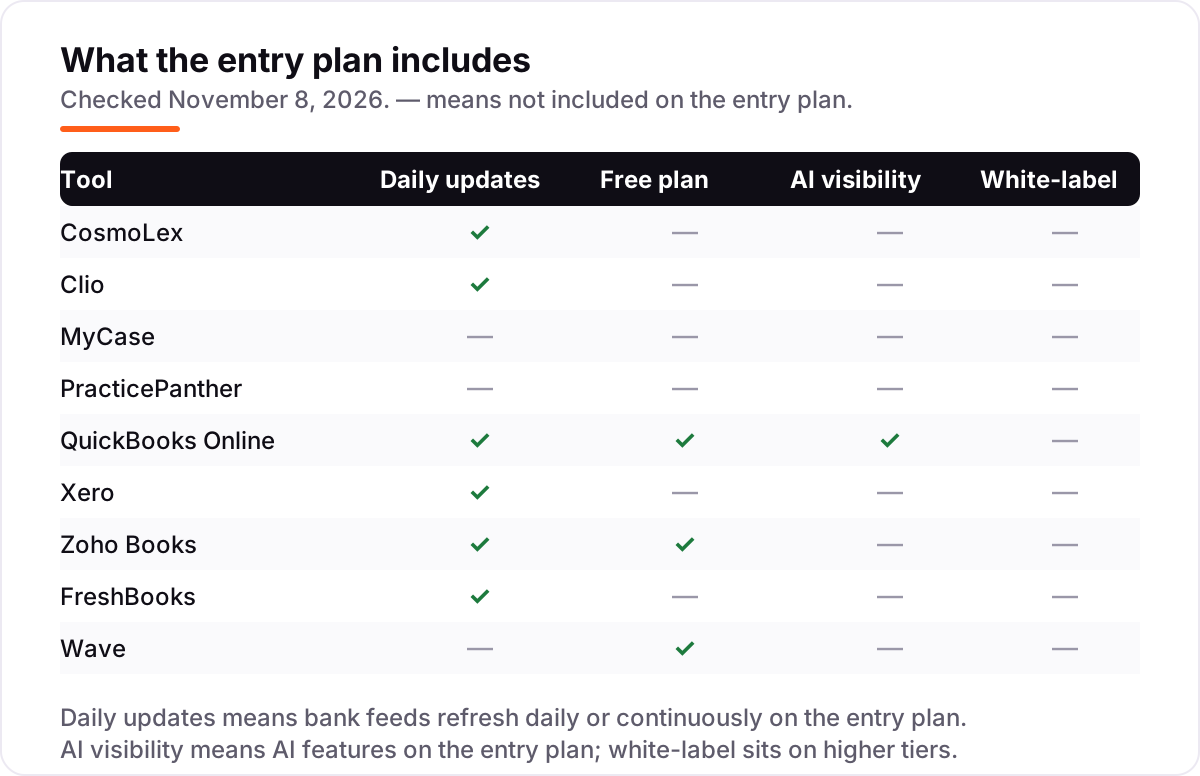
- Check trust accounting first. If the firm holds client money, the tool must keep a separate IOLTA trust ledger with three-way reconciliation. CosmoLex and Clio include it at the entry price; the general ledgers need a legal add-on.
- Count the billing unit. The legal tools charge per user — five seats cost about $245 a month — while the general ledgers charge per firm. Multiply the per-user price by every attorney, paralegal and bookkeeper who needs a login.
- Decide whether the ledger or the matter comes first. CosmoLex and Clio bundle matters and books; QuickBooks Online and Xero are stronger ledgers but need a legal layer for billing and trust work.
- Check the bank feed. Daily automatic bank imports save hours of manual entry; Wave Starter is the only tool here that makes you type transactions in by hand unless you pay for Pro.
- Think about who else touches the books. If your accountant already lives in QuickBooks Online, picking anything else means paying them to learn a new system — ask before you buy.
Accounting is one system in your firm, not the whole firm. If the practice also needs to be found online, our guide to legal marketing software covers the visibility side, and our local SEO service handles rankings for firms that want new clients from Google Maps. And before you publish new pages for the practice areas you sell, run your titles through the free SERP snippet preview tool — it shows exactly how the title and description will look in Google.
Whatever you shortlist, try it with real data before you pay. The free plans and trials in this list are long enough to run one genuine month — your matters, your trust account, your invoices — and that month tells you more than any review can. Check two things in the trial: that the trust ledger reconciles three ways without daily fixing, and that your accountant can get in for free. Every general ledger here gives your accountant access at no extra charge, so there is no reason to buy before they have looked at it.
Law firm accounting pricing: what you will actually pay
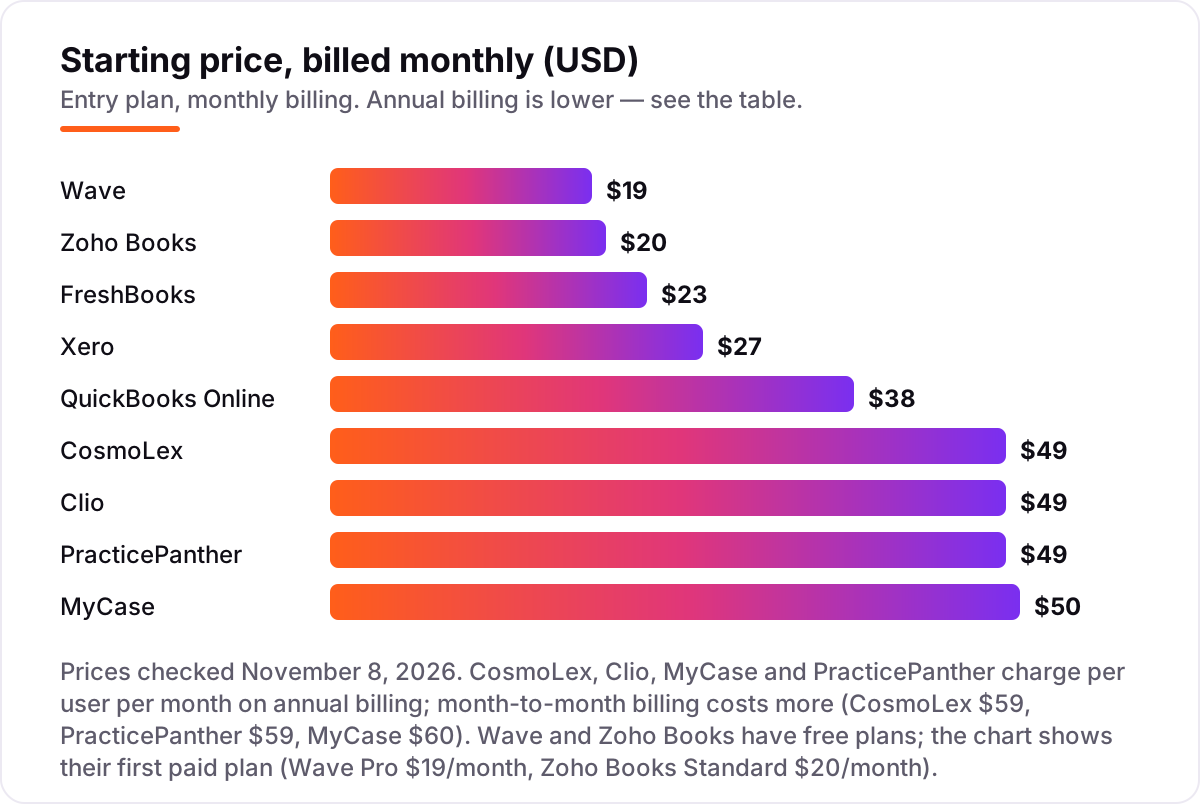
Take a five-person firm — two attorneys, two paralegals and one bookkeeper — that bills about 40 matters a month. On list prices, the subscription costs $0 a month on Wave Starter, $19 on Wave Pro, $20 on Zoho Books Standard, $23 on FreshBooks Lite, $27 on Xero Early, $38 on QuickBooks Online Simple Start, $245 on CosmoLex Launch, Clio or PracticePanther Solo, and $250 on MyCase Basic. Three of those numbers need adjusting before they are real: Zoho Books Standard covers 3 users, so two extra users at $3 each bring it to $26 a month; FreshBooks Lite covers one user, so four extra team members at $11 each bring it to $67; and QuickBooks Online Simple Start covers one user, so a five-person firm needs Plus at $140 a month.
Over a year, that is $190 on Wave Pro billed annually, $312 on Zoho Books Standard with two extra seats, $708 on Xero Growing, $804 on FreshBooks Plus with four extra seats, $1,680 on QuickBooks Online Plus, $2,940 on CosmoLex Launch, Clio or PracticePanther Solo, and $3,000 on MyCase Basic. The same five people and the same 40 matters cost $190 a year at the cheap end and $3,000 at the dear end — a $2,810 gap that comes entirely from per-user pricing and billing choices, not from features.
Three costs sit outside every number above. First, the introductory discounts — 50% off for three months on QuickBooks Online — end, so budget on the list price. Second, the legal add-ons: a firm on QuickBooks Online, Xero, Zoho Books, FreshBooks or Wave still needs a legal billing tool for trust accounting, which adds a second per-user subscription. Third, card processing on the invoices you send, which is charged per transaction rather than per month. If the firm wants the full practice picture rather than just the books, see our guide to case management software for law firms.
Annual billing cuts the bill on the legal tools: CosmoLex Launch drops from $59 to $49 a user a month, PracticePanther Solo from $59 to $49, and MyCase Basic from $60 to $50. Xero publishes no annual price, so the monthly figure is the whole story. One more cost to check before you commit: a second office is a second subscription on every tool in this list, so a firm with two locations pays double whatever the chart shows.
Know the difference: trust accounting vs general accounting
The confusion in this category is between two ledgers that look alike and are not. General accounting records the firm's own money — fees earned, rent, salaries, expenses — and produces the reports a tax return needs. Trust accounting records other people's money: client retainers and settlements held in a separate IOLTA account, which the firm may not spend until the work is done. Every US state bar requires the trust ledger to be reconciled three ways — bank balance, book balance and client balances — and a general ledger cannot do that job.
There is a second, quieter confusion: billing tools are not accounting software. A billing tool sends invoices and tracks time; it does not keep a double-entry ledger, produce a balance sheet, or give your accountant a tax-ready set of books. All nine tools in this list keep a real ledger, including the free ones, which is what the phrase "accounting software" means here. The difference is that only the four legal tools add the trust ledger on top.
A third distinction worth knowing is the add-on trap. A firm that buys QuickBooks Online for $38 a month and then adds a legal billing tool at $55 a user a month pays more than a firm that buys CosmoLex at $49 a user a month — and runs two systems that must stay in sync. Price the pair together, not the ledger alone, before you decide the general ledger is the cheap option.
Quick comparison: tool type by need
| Buyer | Best pick | Why |
|---|---|---|
| Small firm that wants one system | CosmoLex | Trust accounting built in, from $49/user/month |
| Firm that wants the standard platform | Clio | Largest user base, trust accounting on every plan, from $49/user/month |
| Solo attorney who wants easy setup | PracticePanther | Fastest setup, Solo is $49/user/month |
| Firm whose accountant uses QuickBooks | QuickBooks Online | The standard choice accountants know, from $38/month, plus a legal add-on |
| Team that hates per-seat pricing | Xero | Unlimited users on every plan, Early is $27/month |
| Solo on a $0 budget | Wave | Free Starter plan, unlimited invoices, Pro is $19/month when you want bank feeds |
Mistakes to avoid
- Budgeting on the per-firm price when the tool charges per user. A $49-a-month legal tool is $245 a month for five seats. Multiply before you compare it with a $38-a-month flat ledger.
- Buying a general ledger, then finding trust accounting costs extra. QuickBooks Online, Xero, Zoho Books, FreshBooks and Wave have no IOLTA ledger, so a firm that holds client money pays for a second subscription on top.
- Budgeting on the promo price. The 50% introductory discount on QuickBooks Online lasts three months. The list price is what you pay in month four, so compare tools on that number.
- Ignoring the cap that bites first. A tool can be cheap and still be the wrong buy: Xero Early at $27 is no bargain once you pass 20 invoices a month, and FreshBooks Lite at $23 is no bargain once you pass 5 clients.
- Forgetting the trust reconciliation. A trust ledger that does not reconcile three ways is a bar complaint waiting to happen. Test the reconciliation in the trial with real trust transactions, not demo data.
How we chose
We checked each vendor's own pricing page on November 8, 2026 and recorded the starting price exactly as shown, including the annual-billing figure where the page lists one, and we ranked the tools by fit for the most common buyer — a small US law firm that holds client funds — not by brand size. The vendor pages were verified through fresh search-index crawls dated November 8, 2026, because the pricing pages did not load directly from this machine. Two prices needed a note: MyCase's own pages disagree on the entry price, with the help center listing Basic at $50/user/month on annual billing and older pages listing $39, so we used the help center figure; and Clio's published $49/user/month is the annual-billing rate, with no separate month-to-month rate on the page. Tabs3 and PCLaw were left out because neither publishes a starting price on its own site. This list shows no rating for MyCase because the only G2 figure we found came from a page crawled eight days earlier, and we would rather show no rating than a stale one. No vendor paid for a place in this list, and none of the links here are affiliate links.
What to do next
Start with the free plan or trial of your top pick and run one real month of matters through it. Check that the trust ledger reconciles three ways and the reports match what your accountant expects before you commit to a year. If the books are sorted but new clients are not finding you, our monthly SEO service handles the visibility side — or compare providers in our guide to SEO companies for law firms. Once your tools are in place, find out what's holding your rankings back.
Your stack only works if people find you
SerpAstra fixes what keeps your site off page one and makes it easy for AI assistants to recommend.
Get a free audit→Sources we checked (14)
- CosmoLex pricing — cosmolex.com/pricing (checked November 8, 2026)
- Clio pricing — clio.com/pricing (checked November 8, 2026)
- MyCase Basic tier pricing — supportcenter.mycase.com (checked November 8, 2026)
- PracticePanther pricing — practicepanther.com/pricing (checked November 8, 2026)
- QuickBooks Online pricing — quickbooks.intuit.com/pricing (checked November 8, 2026)
- Xero pricing — xero.com/us/pricing-plans (checked November 8, 2026)
- Zoho Books pricing — zoho.com/us/books/pricing (checked November 8, 2026)
- FreshBooks pricing — freshbooks.com/pricing (checked November 8, 2026)
- Wave pricing — waveapps.com/pricing (checked November 8, 2026)
- G2 CosmoLex vs PracticePanther comparison (checked November 8, 2026)
- G2 Clio Manage vs PracticePanther comparison (checked November 8, 2026)
- G2 QuickBooks Online vs Xero comparison (checked November 8, 2026)
- G2 FreshBooks vs Zoho Books comparison (checked November 8, 2026)
- G2 Wave vs Zoho Books comparison (checked November 8, 2026)
Shamim
Founder of SerpAstra
A full-stack SEO and digital marketer who spends most days on Local SEO for dental practices, AI search visibility and lead generation.
Frequently asked questions
What is the best law firm accounting software?
CosmoLex is the best fit for most small firms: trust accounting, billing and matter management in one subscription from $49/user/month. Clio is the better pick when you want the largest user base and integration list, also from $49/user/month. QuickBooks Online is the best general ledger when your accountant already uses it.
How much does law firm accounting software cost?
Entry prices run from $0 to $50 a month. Wave and Zoho Books both have free plans, and the general ledgers cost $19–$38 a month. The legal tools charge per user, so a five-person firm pays about $245 a month on CosmoLex, Clio or PracticePanther at the entry tier.
Do law firms need trust accounting software?
Yes, if the firm holds client money. Bar rules in every US state require client funds to sit in a separate trust account with its own ledger and regular three-way reconciliation. CosmoLex and Clio include that ledger at the entry price; the general ledgers here do not, so they need a legal add-on.
Can a law firm just use QuickBooks Online?
Yes, for the general books — invoicing, bills, bank feeds and reporting — but not for trust accounting. QuickBooks Online has no IOLTA ledger, so a firm must add a legal billing tool on top of the subscription. That second subscription is a per-user cost, so price the pair together before you commit.
Is there free law firm accounting software?
There are free general ledgers, but no free legal accounting tool in this list. Wave Starter is free with unlimited invoices and no revenue cap, and Zoho Books is free while revenue stays under $50,000 a year. Neither handles trust accounting, so a firm that holds client funds still needs a paid legal tool.
Can I switch law firm accounting software later?
Yes, but plan the move for your year-end and never mid-matter. Export your chart of accounts, client and matter lists, open invoices, trust balances and transaction history from the old tool, then import them into the new one and reconcile both the operating and trust accounts before going live.
Does law firm accounting software include billing?
The legal tools do: CosmoLex, Clio, MyCase and PracticePanther all include time tracking, invoicing and online payments. The general ledgers also invoice, but they bill like any other business — no matter-based billing, no LEDES invoices and no trust transfers. If billing is the job, start with a legal tool.
Free SEO and AI visibility audit
Find out what is holding your rankings back
Send us your site. Within 2 business days you get a written audit, an AI visibility check and a short fix list ranked by impact. Free, with no contract attached.
Request my free audit→Related guides
 Local Business & Vertical Software8 Best Case Management Software for Law Firms in 2026, ComparedCompare the 8 best case management software for law firms on published prices, trust accounting and free trials, with prices checked November 7, 2026.Read guide →
 Local Business & Vertical Software8 Best Document Management Software for Law Firms in 2026, ComparedCompare the 8 best document management software for law firms on price, security and matter filing, with every price checked November 7, 2026.Read guide →
 Accounting, Tax & Finance7 Best Accounting Software for Small Businesses in 2026, ComparedCompare the 7 best accounting software for small businesses on price, free plans, bank feeds and AI features, with every price checked November 2, 2026.Read guide →