
7 Best Lease Guarantor Companies for Bad Credit in 2026
7 best lease guarantor companies for bad credit, compared on fees, approval odds and coverage, with real vendor fees checked November 2, 2026.
 Shamim Mia, Founder, SerpAstraLast verified November 2, 202612 min read
We compare pricing pages, documentation and public reviews. We never accept payment for rankings.

Key takeaways
- TheGuarantors leads for most renters: 40% to just over one month's rent, the widest landlord acceptance, and 4.7/5 on Trustpilot (394 reviews). Insurent follows at 70%–90% for U.S. renters, and PandaGuarantee at 3%–8% of annual rent.
- The single most important buying factor is approval odds plus the fee: a cheap guarantor you cannot get approved for, or one your landlord will not accept, costs you the apartment.
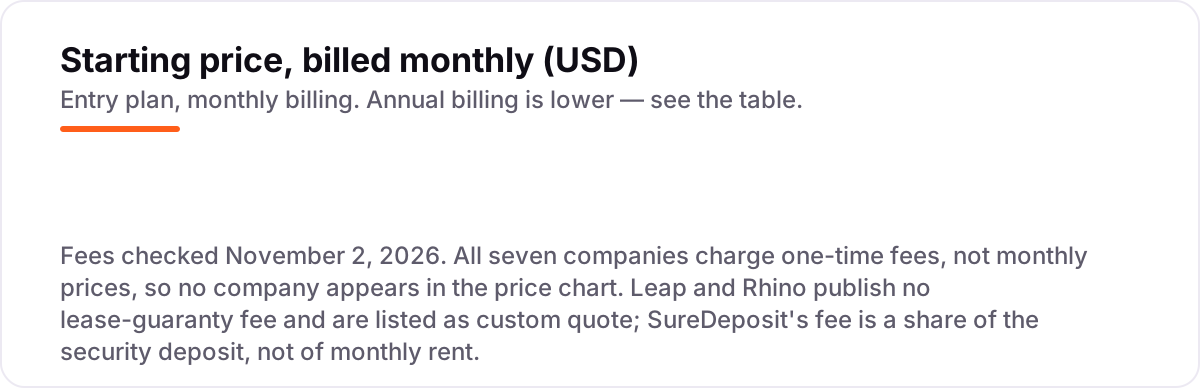
- Every fee here is a one-time payment, not a monthly subscription. Leap and Rhino publish no lease-guaranty fee, so both are listed as custom quote.
- No guarantor can promise approval, and the fee protects your landlord, not you. If you miss rent and the company pays, you still owe the company.
On this page
Quick comparison
| Tool | Best for | Starting price | Free plan |
|---|---|---|---|
| TheGuarantors | Renters with bad credit applying at large, professionally managed buildings who want the most widely accepted guarantor | 40%–100%+ of 1 mo. rent | No |
| Insurent | U.S. renters with steady income but a thin or damaged credit file who are applying at an Insurent-enrolled building | 70%–90% of 1 mo. rent | No |
| PandaGuarantee | Renters with low credit scores who need a low income threshold and a fast decision in New York City | 3%–8% of annual rent | No |
| Cosign | Renters with thin credit, no Social Security number or variable freelance income who want a soft credit check | 40%–110% of 1 mo. rent | No |
| Leap | Students and renters who have already been declined elsewhere, including applicants with FICO scores below 600 | Custom quote | No |
| Rhino | Renters at partner properties who want deposit replacement plus a guaranty, and are willing to pay a monthly premium | Custom quote | No |
| SureDeposit | Renters who can qualify on income and credit but cannot afford a full cash security deposit at a participating community | 17.5% of deposit | No |
Make one of these tools?
We re-check this list every quarter. Send a correction, request a review, or ask about a clearly labeled sponsored spot.
Request a listingThe best lease guarantor companies for bad credit

TheGuarantors
Best for: Renters with bad credit applying at large, professionally managed buildings who want the most widely accepted guarantor
TheGuarantors is the largest name in this list and the safest first try for most bad-credit renters. Its published guidance puts the one-year Rent Coverage fee at 40% to a bit more than one month's rent, with the exact figure set by your credit, income and the coverage your building requires. The application takes under five minutes, and the company's scale is the point: 9 of the 10 largest U.S. real estate companies partner with it.
The catch is that the low end of the range is for stronger profiles. A renter with bad credit should expect a quote toward the higher end, and the fee is non-refundable once the lease is signed. Confirm your building accepts TheGuarantors before you apply, and pay by ACH rather than card to avoid the 3% surcharge.
What we like
- Lowest published starting fee here: 40% of one month's rent for stronger profiles on a one-year lease
- Partners with 9 of the 10 largest U.S. real estate companies, so large managed buildings usually accept it
- More than 1.5 million renter applications processed, per the company's own site
- Optional Deposit Coverage can be bundled with Rent Coverage where the landlord allows it
Watch out for
- Fee is personalized and non-refundable, and higher-risk renters can pay more than a full month's rent
- Only works where the building accepts it, and card payments add a 3% surcharge

Insurent
Best for: U.S. renters with steady income but a thin or damaged credit file who are applying at an Insurent-enrolled building
Insurent is the oldest lease guaranty service in the U.S., operating since 2008, and its pricing is the most transparent of the big names. Its renter page states the average fee for U.S. renters at 70% to 90% of one month's rent for a one-year lease, and 98% to 110% for renters without U.S. credit history. The fee is per lease, not per person, so roommates can split it, and the guaranty is issued within 24 hours of approval.
The limits are coverage and income. Insurent only works at buildings that have pre-enrolled, so if your landlord is not a partner, this option is off the table. It also asks for income of at least 27.5 times the monthly rent, which is lower than the 40-times rule many landlords apply alone, but still a real bar for a bad-credit renter.
What we like
- Clear published fee bands: 70%–90% of one month's rent for U.S. renters, 98%–110% for non-U.S. renters
- Accepted at more than 775,000 units, per the company's own site, with qualification certificates in about 30 minutes
- Full refund of the fee if you do not get the apartment
Watch out for
- Only works at buildings already enrolled in the Insurent program, in 10 states plus Washington, D.C.
- Requires annual income of at least 27.5 times the monthly rent, or liquid assets of 50 times the rent

PandaGuarantee
Best for: Renters with low credit scores who need a low income threshold and a fast decision in New York City
PandaGuarantee is the budget challenger in this list, and it is built for the renter the big guarantors turn away. Its published fee is 3% to 8% of annual rent as a one-time payment, which works out to roughly 36% to 96% of one month's rent. The income bar is 20 times the monthly rent, the credit minimum is 500, and the company says approvals come back in minutes rather than days.
The trade-off is reach. PandaGuarantee launched its New York City product in March 2026, so it is mainly an option for NYC renters right now, and your building still has to accept it. If you rent in New York and your credit score is the problem, get a PandaGuarantee quote before paying a higher fee elsewhere.
What we like
- Low income threshold of 20 times the monthly rent, against Insurent's 27.5 times
- Credit minimum of 500, per the company's own comparison page, with approvals in minutes
- Surety bond backed by Crum & Forster, a carrier rated A+ by AM Best
Watch out for
- Newer and narrower than the big two: launched its New York City product in March 2026 and is mainly an NYC option
- Fee is risk-adjusted, so higher-risk renters land toward the 8% end of the range

Cosign
Best for: Renters with thin credit, no Social Security number or variable freelance income who want a soft credit check
Cosign is the most credit-friendly option in this list for renters whose file is thin rather than damaged. Its own blog puts the one-time fee at 40% to 110% of one month's rent, depending on the coverage amount you choose and your risk profile. Screening is free, the credit check is soft, and the company says applicants generally hear back the same day, often in under an hour.
Cosign was built for the cases landlords usually decline: no U.S. credit history, an ITIN instead of a Social Security number, freelance or variable income. The fee is discounted on renewal terms. The main limitation is acceptance, since it only works at participating communities, so ask your leasing office whether Cosign is already onboarded before you apply.
What we like
- Only a soft credit check, so applying does not affect your credit score
- Accepts non-citizens with an ITIN, students without income and self-employed renters
- Decisions generally in under an hour, with coverage of 3, 6, 9 or 12 times the monthly rent
Watch out for
- Fee varies by applicant and coverage level, so there is no single published price to budget against
- Only works at participating communities, and Cosign may need to onboard your building first

Leap
Best for: Students and renters who have already been declined elsewhere, including applicants with FICO scores below 600
Leap is the guarantor to try when other companies have already said no. Its Rent Guaranty co-signs your lease for a one-time premium, and the company has built its business on underwriting FICO scores below 600, a segment most guarantors avoid. It markets the product especially to students and applicants who have been declined, and the application takes a few minutes.
The honest drawback is price transparency: Leap publishes no fee percentage, so the only way to know what you will pay is to apply and read the quote. Third-party guides estimate 55% to 90% of one month's rent, but that is not a vendor figure, so we list Leap as custom quote. Get the written quote before you commit, and confirm your building is a Leap partner first.
What we like
- Explicitly underwrites applicants with FICO scores below 600, which most guarantors avoid
- Rent Guaranty is backed by an insurer rated A- (Excellent) by A.M. Best
- Separate Deposit Replacement product starts at about $5 a month instead of a large cash deposit
Watch out for
- Publishes no fee percentage, so you cannot compare its price until you apply and get a quote
- Only works at partner properties, and Leap confirms lease details with the building before issuing coverage

Rhino
Best for: Renters at partner properties who want deposit replacement plus a guaranty, and are willing to pay a monthly premium
Rhino, now combined with Jetty as Greenlight Rent, is the biggest name in deposit replacement, and it also offers a Renter Guarantee for renters who do not qualify on their own. Instead of one large upfront fee, you pay a monthly premium based on your lease and risk profile, which keeps move-in costs down. The combined platform covers more than 6 million rental units through large property operators.
Rhino is the weakest fit in this list for a bad-credit renter who needs to qualify, because deposit replacement is not the same as a lease guaranty, and some landlords will not accept it as one. Its Trustpilot score of 3.0 out of 5 is also the lowest here. Use Rhino when the deposit is the barrier; use a true guarantor above when approval itself is the barrier.
What we like
- Nationwide at partner properties, and now combined with Jetty after the February 2025 merger
- Monthly premium model lowers move-in costs instead of demanding a large one-time fee
- Covers more than 6 million rental units through its property partners
Watch out for
- Trustpilot score is 3.0/5 from 1,715 reviews, the lowest in this list, with many reviewers citing poor communication
- Primarily a deposit replacement product, so it may not satisfy a landlord who requires a full lease guaranty
- No published lease-guaranty price, and quotes give little cost breakdown, per renter reviews

SureDeposit
Best for: Renters who can qualify on income and credit but cannot afford a full cash security deposit at a participating community
SureDeposit is not a lease guarantor, and that distinction matters: it replaces the security deposit, it does not help you qualify for the lease. Instead of handing over a full cash deposit, you buy a surety bond for a one-time, non-refundable fee. The vendor's own example is a $175 bond on a $1,000 deposit, or 17.5% of the deposit, and the bond stays good for the life of your lease at a participating community.
For a bad-credit renter, SureDeposit only helps after approval, when the deposit itself is the problem. It does involve a credit review, and if the surety pays your landlord for rent or damage, you must reimburse it in full. Pair it with a guarantor above if you need both approval and a lower deposit, and check first that your community participates.
What we like
- Cheapest entry cost here: a $175 bond replaces a $1,000 deposit in the vendor's own example
- One payment covers the life of your lease at a participating community, with no monthly charges
- Bond is underwritten by American Bankers Insurance Company of Florida, an Assurant company
Watch out for
- Deposit coverage only: it does not help you qualify if your income or credit falls short
- Only available at participating communities, and the fee is non-refundable
- You still owe the surety in full if it pays a claim to your landlord
How to choose the best lease guarantor companies for bad credit
The best lease guarantor companies for bad credit are the ones that will both approve you and be accepted by your landlord. That is the whole test, and it comes before price: a cheap guarantor that declines you, or one your building will not take, costs you the apartment. Start by asking your leasing office which guarantors it accepts, then apply to the ones on that list.
- Approval odds first. Check the income bar and the credit floor before you pay anything. PandaGuarantee lists a 500 credit minimum and a 20-times income threshold; Insurent asks for 27.5 times the rent; Cosign uses only a soft credit check.
- Fee as a share of one month's rent. Every guarantor here quotes a one-time fee, not a monthly price. Compare the percentages, not the dollar figures, because the dollar figure scales with your rent.
- Landlord acceptance. Every company in this list works through partner buildings. Acceptance is not universal, and it is the most common reason a guarantor fails.
- Refund terms. Ask what happens if the lease falls through before move-in. Insurent refunds in full if you do not get the apartment; TheGuarantors and Leap generally do not refund once the lease is signed.
- What the fee covers. Rent coverage is the core product. Deposit coverage is often a separate product or an add-on, and a deposit bond alone does not help you qualify.
- Speed. If your application window is short, same-day decisions matter. Insurent issues qualification certificates in about 30 minutes, Cosign generally decides in under an hour, and PandaGuarantee says approvals come in minutes.
Apply to two guarantors when you can, not one. A decline from the first company tells you nothing about the second, because each one underwrites against its own income and credit limits, and the fee quotes can differ by hundreds of dollars on the same apartment. Have your documents ready before you start: recent pay stubs or bank statements, identification, and the lease details your building requires, including the coverage amount. Most applications are online and take only a few minutes, but the quote is what matters, and you should not pay anything until you have it in writing alongside the building's acceptance.
Lease guarantor companies for bad credit pricing: what you will actually pay
Take a $2,000-a-month apartment on a one-year lease. TheGuarantors would charge roughly $800 to just over $2,000, since its published range is 40% to a bit more than one month's rent. Insurent would charge $1,400 to $1,800 for a U.S. renter at 70% to 90%, or $1,960 to $2,200 for a renter without U.S. credit at 98% to 110%. PandaGuarantee would charge $720 to $1,920, because 3% to 8% of $24,000 in annual rent works out to those figures. Cosign would charge $800 to $2,200 at 40% to 110%.
Leap and Rhino publish no lease-guaranty fee, so there is no number to put in this example for them: you only learn the price when you apply and read the written quote. SureDeposit is different again, because it replaces the deposit rather than guaranteeing the lease. On a $2,000 deposit its 17.5% example rate works out to $350, paid once. Remember that none of these fees is rent: the money is gone once the lease is signed, it does not reduce what you owe each month, and you pay the fee again if you renew with a new guaranty.
Two costs catch renters off guard. The first is the renewal: a guaranty covers one lease term, so a renewal usually means a new fee, although Cosign says its renewal fees are discounted and Insurent says it may quote lower rates for renewals. The second is the lease length: Insurent states that a two-year guaranty costs about 85% more than a one-year guaranty, so a longer lease is not a longer version of the same price. Add the small extras too, such as TheGuarantors' 3% card surcharge, and pay by bank transfer where you can.
Know the difference: lease guarantor vs co-signer vs deposit alternatives
The biggest confusion in this category is the name on the paperwork. A co-signer is a person who signs your lease with you and is jointly responsible for the rent from day one, and can be pursued without the landlord first trying to collect from you. A lease guarantor company is a paid third party that only steps in after you default, and it never lives in the unit. Most of the companies in this list are guarantors, even when their marketing uses the word cosign.
Deposit alternatives are a third thing entirely. Rhino and SureDeposit replace the cash security deposit, which lowers your move-in cost, but they do not prove to a landlord that you can pay the rent each month. A landlord who requires a guarantor because your income or credit falls short will usually not accept a deposit bond in its place. Approval is also never guaranteed by any of these companies: each one underwrites you against its own income and credit limits, and a decline from one does not mean a decline from all of them, so a second application is often worth the time.
One more difference matters after you move in. If you stop paying rent and the guarantor pays your landlord, the debt does not disappear: you still owe the guarantor, and it can pursue you for the money, including through collections. The fee buys you approval, not forgiveness, and the guarantee protects the landlord, not you. That is true for every company in this list, from TheGuarantors to SureDeposit, so treat the fee as the price of getting the keys, and keep the rent itself affordable on your own income.
Quick comparison: tool type by need
| Buyer | Best pick | Why |
|---|---|---|
| Bad credit, large managed building | TheGuarantors | Widest acceptance and the lowest published starting fee at 40% of one month's rent |
| Steady income, enrolled building | Insurent | Clear 70%–90% fee bands and a full refund if you do not get the apartment |
| Low credit score, New York City | PandaGuarantee | 500 credit minimum, 20-times income bar and approvals in minutes |
| Thin credit or no Social Security number | Cosign | Soft credit check only, ITIN accepted and decisions in under an hour |
| Already declined elsewhere | Leap | Underwrites FICO scores below 600, but the fee is custom quote only |
| Deposit is the barrier, not approval | Rhino or SureDeposit | Deposit replacement for a monthly premium or a 17.5% one-time bond fee |
How we chose
We checked each vendor's own pages on November 2, 2026 and recorded the fee exactly as published: TheGuarantors at 40% to a bit more than one month's rent, Insurent at 70%–90% for U.S. renters, PandaGuarantee at 3%–8% of annual rent, Cosign at 40%–110% of one month's rent, and SureDeposit at $175 on a $1,000 deposit. Leap and Rhino publish no lease-guaranty fee, so both are listed as custom quote rather than estimated. The third-party fee estimates for Leap (55%–90% of one month's rent) are not vendor figures and are not used as prices in this guide. Ratings come from Trustpilot, and only for TheGuarantors and Rhino, where a Trustpilot page with a score and review count was verified today. We ranked the companies by fit for the most common buyer — a renter with bad credit who needs both approval and landlord acceptance — not by brand size. No vendor paid for a place in this list, and none of the links here are affiliate links.
SerpAstra researches these lists the same way it researches SEO tools: vendor pages, documentation and public reviews, checked on the date above. If you run a small business alongside your rental search, our guides to the best SEO platform for finance, the best SEO companies for small business and the best marketing platforms for small business SEO cover that side of your work, and our monthly SEO service covers getting found online. The free SERP snippet preview tool shows how any page will look in Google search results.
What to do next
Ask your leasing office which guarantors it accepts, then apply to two or three of them and compare the written quotes side by side. Check the fee as a percentage of one month's rent, the refund terms if the lease falls through, and whether deposit coverage is included or separate. Keep the quotes together in one place so the comparison is honest: the same rent, the same lease length and the same coverage, so the cheapest quote on paper is genuinely the cheapest for your apartment. Do not pay any fee until you have the quote and the building's acceptance in writing, and remember that no guarantor can promise approval. Once your tools are in place, find out what's holding your rankings back.
Your stack only works if people find you
SerpAstra fixes what keeps your site off page one and makes it easy for AI assistants to recommend.
Get a free audit→Sources we checked (10)
- TheGuarantors renter page — theguarantors.com/renter (checked November 2, 2026)
- TheGuarantors on Trustpilot — 4.7/5, 394 reviews (checked November 2, 2026)
- Insurent renter information — insurent.com/renters (checked November 2, 2026)
- PandaGuarantee best rent guarantor in NYC — fee, 20x income, 500 credit minimum (checked November 2, 2026)
- Cosign cosigner cost guide — 40%–110% of one month's rent (checked November 2, 2026)
- Leap — leapeasy.com (checked November 2, 2026)
- Rhino on Trustpilot — 3.0/5, 1,715 reviews (checked November 2, 2026)
- SureDeposit what is SureDeposit — $175 bond on a $1,000 deposit (checked November 2, 2026)
- ApartmentList lease guarantor guide — guarantor fees and the 40x/80x income rules (checked November 2, 2026)
- RentDataNow lease guarantor costs — TheGuarantors, Insurent and Leap fees (checked November 2, 2026)
Shamim
Founder of SerpAstra
A full-stack SEO and digital marketer who spends most days on Local SEO for dental practices, AI search visibility and lead generation.
Frequently asked questions
How much does a lease guarantor cost with bad credit?
Expect a one-time fee of roughly 40% to 110% of one month's rent, with bad credit pushing you toward the higher end. TheGuarantors publishes 40% to just over one month's rent, Insurent charges 70%–90% for U.S. renters, and PandaGuarantee charges 3%–8% of annual rent. Leap and Rhino publish no fee.
Can I get a lease guarantor with a low credit score?
Yes, but approval is never guaranteed. PandaGuarantee lists a credit minimum of 500, Leap underwrites FICO scores below 600, and Cosign uses only a soft credit check for thin files. Each company still sets its own income and risk limits, so apply to more than one and compare the written quotes.
What is the difference between a lease guarantor and a co-signer?
A co-signer signs the lease with you and is jointly responsible from day one. A guarantor company is a paid third party that promises to cover the landlord only if you default, and it never lives in the unit. Most companies in this list are guarantors, not co-signers, even when their marketing says cosign.
Will a lease guarantor accept me if my landlord does not?
No. A guarantor only works if your landlord or building accepts that specific company. TheGuarantors, Insurent, Leap, Cosign and Rhino all work through partner buildings. Ask your leasing office which guarantors it accepts before you apply or pay any fee.
Is the guarantor fee refundable?
Usually not once the lease is signed. TheGuarantors and Leap call their fees non-refundable, with exceptions if you are rejected or the lease falls through before move-in. Insurent refunds the fee in full if you do not get the apartment. Always get the refund terms in writing before paying.
Does a lease guarantor replace the security deposit?
No, not on its own. A guarantor covers the landlord if you stop paying rent; the deposit is separate. Some guarantors bundle deposit coverage, and separate products like Rhino and SureDeposit replace the deposit itself. Check whether your building wants both, and budget for each fee separately.
What should I check before paying a guarantor?
Four things: that your landlord accepts that exact company, the fee in writing as a percentage of one month's rent, the refund terms if the lease falls through, and what the guarantee covers. Never pay before you have the written quote and the building's written acceptance.
Free SEO and AI visibility audit
Find out what is holding your rankings back
Send us your site. Within 2 business days you get a written audit, an AI visibility check and a short fix list ranked by impact. Free, with no contract attached.
Request my free audit→Related guides
 SEO & AI Search8 Best SEO Platforms for Finance in 2026 (Pros, Cons and Pricing)8 best SEO platform for finance options compared on price, YMYL content tools, branch tracking and AI visibility. All prices checked November 1, 2026.Read guide →
 SEO & AI Search8 Best SEO Companies for Small Business in 20268 best SEO companies for small business compared on price, contracts and AI visibility, with prices checked on each agency's own site on November 1, 2026.Read guide →
 SEO & AI Search12 Best Marketing Platforms for Small Business SEO in 2026, ComparedThe 12 best marketing platforms for small business SEO, compared on real prices, SEO tools and AI visibility. Every price checked November 1, 2026.Read guide →