
10 Best Local Advertising Platforms for 2026 (Pros, Cons and Pricing)
Compare the 10 best local advertising platforms for 2026: real minimum budgets, pay-per-click and pay-per-lead pricing, and which one fits your business.
 Shamim Mia, Founder, SerpAstraLast verified November 4, 202614 min read
We compare pricing pages, documentation and public reviews. We never accept payment for rankings.

Key takeaways
- Google Ads leads for search intent with no minimum spend, Meta Ads is the cheapest start at $1 a day, and Yelp Ads is the only one with a published monthly floor at $150 a month.
- The single most important buying factor is intent: search and lead ads catch people already looking, while social and neighbourhood ads create demand among people who are not.
- Nine of the ten platforms sell by auction with no monthly subscription — your cost is the budget you set, not a price on a page.
- TikTok has the highest floor at $50 a day per campaign, so it is the last platform to test, not the first.
On this page
Quick comparison
| Tool | Best for | Starting price | Free plan |
|---|---|---|---|
| Google Ads | Local service businesses that want to catch people searching for exactly what they sell | No minimum | No (pay per click) |
| Google Local Services Ads | Home-service trades that want phone calls from nearby customers and will answer fast | Pay per lead | No (pay per lead) |
| Meta Ads | Local shops, salons and restaurants that want cheap reach in the feeds their customers scroll daily | From $1/day | No (pay per ad) |
| Microsoft Advertising | Local businesses that already run Google Ads and want the same searchers for less per click | No minimum | No (pay per click) |
| Yelp Ads | Restaurants, dentists and home services in cities where customers check Yelp before they call | $150/mo | No (ads paid) |
| Nextdoor Ads | Neighbourhood businesses — cleaners, landscapers, pet care — that live or die by local word of mouth | No minimum | No (ads paid) |
| TikTok Ads | Local retailers and beauty brands with short video that can stop a scroll | From $50/day | No (pay per ad) |
| LinkedIn Ads | B2B local firms — lawyers, accountants, IT support — that sell to job titles, not neighbourhoods | From $10/day | No (pay per ad) |
| Amazon Ads | Local shops that sell products on Amazon and want to win the buy box search | From $1/day | No (pay per ad) |
| Pinterest Ads | Home decor, craft, food and wedding businesses whose customers plan purchases on Pinterest | No minimum | No (ads paid) |
Make one of these tools?
We re-check this list every quarter. Send a correction, request a review, or ask about a clearly labeled sponsored spot.
Request a listingThe best local advertising platform

Google Ads
Best for: Local service businesses that want to catch people searching for exactly what they sell
Google Ads is the first platform most local businesses should test, because it catches people the moment they search for a service nearby. A dentist, plumber or florist can show an ad above the organic results for searches like 'emergency plumber near me'. There is no minimum spend: you set a daily budget, pay only when someone clicks, and Google caps the monthly charge at the daily budget times 30.4.
The catch is the click price. In competitive trades one click can cost several dollars, and a small budget can vanish in days if targeting is loose. Smart Bidding and Performance Max automate much of the work, but they need conversion tracking and a fast landing page to learn from. Start with a tight radius, exact-match keywords, and a daily budget you can hold for two weeks.
What we like
- No minimum spend: you set any daily budget and pay only when someone clicks
- Catches the highest-intent local traffic — people searching for your service right now
- Smart Bidding and Performance Max automate bidding and placements with Google AI
- Location, call and map extensions put your phone number and address in the ad
Watch out for
- Clicks in competitive trades are expensive, and a small budget can disappear in days
- The interface is deep and easy to misconfigure, so beginners often pay for irrelevant clicks
- Google can spend up to twice the daily budget on a busy day, which surprises new advertisers
Google Local Services Ads
Best for: Home-service trades that want phone calls from nearby customers and will answer fast
Local Services Ads are the only pay-per-lead option in this list, and for eligible trades they are the closest thing to buying customers rather than clicks. Your ad appears above regular search ads with a Google Verified badge, and you pay only when a customer calls, messages or books. There is no monthly subscription and no published lead price: the auction sets it, and it varies by trade, location and lead type.
The model only works if someone answers the phone. A missed call over 20 seconds in business hours still counts as a lead, so a trade with no one on the phones pays for calls it never takes. It covers only certain categories and areas, so check yours before planning around it. If you qualify and answer fast, it is the most direct local buy here.
What we like
- You pay per valid lead — a call, message or booking — never per click or impression
- Ads sit above regular search ads with a Google Verified badge that builds trust
- Invalid or low-quality leads are not charged, and bad leads can be disputed for credit
- Your Google Business Profile reviews show in the ad, so good reviews do the selling
Watch out for
- Only certain service categories and US areas are eligible, so many businesses cannot use it
- You pay for every valid lead, including calls that do not turn into jobs
- Google is moving Local Services Ads into Performance Max campaigns, so the setup is changing

Meta Ads
Best for: Local shops, salons and restaurants that want cheap reach in the feeds their customers scroll daily
Meta Ads is the cheapest way into local advertising, and the best fit for businesses whose customers decide by scrolling rather than searching. One buy covers Facebook and Instagram, with radius targeting down to a single neighbourhood, and the minimum daily budget is $1 for impression-charged ad sets in the US. Lead ads collect names and phone numbers inside the app, so a salon can gather bookings without a landing page.
The $1 floor is a technicality, not a test: at that level an ad set barely delivers, and a conversion campaign needs about 50 results a week to leave the learning phase. Budget $10 to $20 a day per ad set for a real test. Meta is demand creation, not demand capture — it works best when the offer is visual and the radius is tight.
What we like
- The lowest floor here: $1 a day minimum daily budget for impression-charged ad sets in the US
- One buy covers Facebook and Instagram, with radius targeting down to a single neighbourhood
- Advantage+ AI automates targeting and creative testing for small advertisers
- Lead ads collect names and phone numbers without sending people off the app
Watch out for
- The $1 a day floor buys almost nothing; a real test needs $10 to $20 a day per ad set
- Conversion campaigns need about 50 results a week to leave the learning phase, which costs real money
- Ad account bans and support delays are a common complaint in G2 reviews
Microsoft Advertising
Best for: Local businesses that already run Google Ads and want the same searchers for less per click
Microsoft Advertising is the second search engine most local businesses ignore, and that is exactly why it is worth testing. It serves ads across Bing, Yahoo, DuckDuckGo, MSN and Outlook, reaching an older and more affluent search audience that Google never shows you. There is no minimum spend and no sign-up fee, and a Google Ads campaign imports in a few clicks, so the extra work is minutes rather than hours.
The trade-off is volume. Bing's search share is a fraction of Google's, so Microsoft Advertising cannot carry a campaign on its own — it is a supplement, not a replacement. Clicks typically cost less than the same keyword on Google, which makes it a good second buy once Google is working. Test it with your best-performing Google campaign and compare the cost per lead, not the cost per click.
What we like
- No minimum spend and no sign-up fee — you control the daily budget and the bids
- Reaches Bing, Yahoo, DuckDuckGo, MSN and Outlook searchers that Google never shows you
- Clicks typically cost less than the same keyword on Google Ads
- Google Ads campaigns import in a few clicks, so setup takes minutes, not hours
Watch out for
- Search volume is far smaller than Google, so it cannot carry a campaign on its own
- The interface and reporting feel a step behind Google Ads
- Only 13 G2 reviews, so there is little public feedback to check

Yelp Ads
Best for: Restaurants, dentists and home services in cities where customers check Yelp before they call
Yelp Ads buys placement where local customers are already comparing businesses and reading reviews — a strong position for restaurants, dentists and home services in busy cities. It is the only platform here with a published monthly floor: self-serve ads start at $150 a month, about $5 a day on average, with no term contract. Your review stars show in the ad, so reputation becomes the creative.
The warning signs are real. Yelp Advertising scores 2.6 out of 5 on G2, the lowest in this list, with reviewers unhappy about billing and value. Rep-sold programs carry 3, 6 or 12-month terms, so the flexible price is self-serve only — do not sign a rep contract for the headline rate. Yelp works when your page has strong reviews; without them, the ad sends clicks to a page that argues against you.
What we like
- The only platform here with a published monthly floor: from $150 a month self-serve
- Ads appear where customers are already comparing local businesses and reading reviews
- Your own review stars show in the ad, so a strong reputation becomes the creative
- Self-serve has no term contract — pause or cancel at any time with no penalty
Watch out for
- The lowest G2 score in this list at 2.6 out of 5, with reviewers unhappy about billing and value
- Rep-sold programs carry 3, 6 or 12-month terms, so the flexible price is self-serve only
- Your ad can appear on competitors' pages, and theirs can appear on yours

Nextdoor Ads
Best for: Neighbourhood businesses — cleaners, landscapers, pet care — that live or die by local word of mouth
Nextdoor Ads puts your business in the feed of verified neighbours in the exact ZIP codes you serve — the most neighbourhood-specific buy in this list. Self-serve Ads Manager has no minimum spend, and Nextdoor suggests $3, $5 or $10 a day. A free Business Page and free Business Posts reach neighbours before you spend anything, and a neighbour's recommendation carries more trust than any big-platform ad.
The limits are reach and evidence. A neighbourhood feed is small by design, so Nextdoor cannot scale like Meta or Google, and there is no published cost per click or per lead — you only learn your price by testing. With only 6 G2 reviews, public feedback is thin. Use it for word-of-mouth services — cleaning, landscaping, pet care — and judge it on booked jobs, not clicks.
What we like
- No minimum spend on self-serve Ads Manager — set any daily budget and test cheaply
- Ads reach verified neighbours in the exact ZIP codes you serve, up to a 30-mile radius
- Recommendations from neighbours carry more trust than any ad format on bigger platforms
- A free Business Page and free Business Posts reach neighbours before you spend anything
Watch out for
- Only 6 G2 reviews at 3.3 out of 5, so public feedback is very thin
- Reach is limited to the neighbourhoods you target, so it cannot scale like Meta or Google
- No published cost per click or per lead — you only learn your price by testing

TikTok Ads
Best for: Local retailers and beauty brands with short video that can stop a scroll
TikTok Ads is the video-first option here, and it suits local retailers and beauty brands that can make short vertical video people actually watch. Clicks are cheap — typically $0.30 to $1.50 — and CPMs run $4 to $10 in 2026 benchmarks, so the reach per dollar beats almost every other platform here. Spark Ads turn your best organic posts into ads, and Smart+ AI automates targeting.
The floor is the problem. A campaign needs at least $50 a day and each ad group $20 a day, so a two-week test costs far more than on Meta or Google. The audience is browsing for fun, not looking for a plumber, so local intent is weak. Test TikTok only after search and Meta work, and only if you can make real video — still images and stock clips underperform badly.
What we like
- Short vertical video reaches younger local customers that search ads never touch
- Clicks are cheap — typically $0.30 to $1.50 — and CPMs run $4 to $10 in 2026 benchmarks
- Spark Ads turn your best organic posts into ads without rebuilding the creative
- Smart+ AI automates targeting and creative combinations for small teams
Watch out for
- The highest floor here: $50 a day per campaign and $20 a day per ad group, so a test is not cheap
- Needs real video creative — still images and stock clips underperform badly
- Local intent is weaker than search: people are browsing for fun, not looking for a plumber

LinkedIn Ads
Best for: B2B local firms — lawyers, accountants, IT support — that sell to job titles, not neighbourhoods
LinkedIn Ads is the only platform here that sells to job titles instead of neighbourhoods, which makes it the pick for B2B local firms — lawyers, accountants, IT support — whose buyers are defined by what they do, not where they live. Targeting runs on job title, company, seniority and industry, and Lead Gen Forms collect details inside LinkedIn, so no landing page is needed. Accelerate AI can build a campaign from your website.
The cost is the catch. Clicks typically run $5 to $15, so the $10-a-day minimum buys one or two clicks, and a real test needs $3,000 to $5,000 a month. That prices out most small budgets, and G2 reviewers repeatedly flag the high cost and clunky learning curve. Use it only when one client is worth thousands — then one lead can pay for the test.
What we like
- The only platform that targets by job title, company, seniority and industry
- Lead Gen Forms collect contact details inside LinkedIn, so no landing page is needed
- High-quality B2B leads: G2 reviewers praise the precise targeting above all else
- Accelerate AI builds campaigns and creative from your website in a few clicks
Watch out for
- The most expensive clicks here: typically $5 to $15 a click, so $10 a day buys one or two clicks
- A real test needs $3,000 to $5,000 a month, which prices out most small local budgets
- G2 reviewers repeatedly flag the high cost and a clunky learning curve

Amazon Ads
Best for: Local shops that sell products on Amazon and want to win the buy box search
Amazon Ads is the marketplace buy in this list, and it only makes sense for local shops that already sell products on Amazon. Sponsored Products put your listing at the top of Amazon search results, in front of shoppers ready to buy — which is why clicks here convert better than social traffic. The minimum daily budget is $1, the joint-lowest floor here, and Amazon recommends $10 a day to start.
The catch is the gate. You need a Professional seller account and buy box eligibility before Sponsored Products will run, and a service business with no listings gets nothing from it at all. Competition is fierce on popular products, and costs climb hard in Q4. If you sell on Amazon, start with your best seller on automatic targeting and watch advertising cost of sales, not clicks.
What we like
- A $1 a day minimum daily budget — the joint-lowest floor in this list
- Shoppers on Amazon are ready to buy, so clicks convert better than social traffic
- Sponsored Products need no Brand Registry, just a Professional seller account
- AI creative tools generate ad images and video from your existing listings
Watch out for
- Only useful if you sell on Amazon — it does nothing for a service business with no listings
- Needs a Professional seller account and buy box eligibility before Sponsored Products will run
- Clicks are cheap but competition is fierce, and costs climb hard in Q4

Pinterest Ads
Best for: Home decor, craft, food and wedding businesses whose customers plan purchases on Pinterest
Pinterest Ads reaches shoppers while they are planning a purchase, a different moment from other social platforms. People save ideas for a kitchen, a wedding or a recipe weeks before they buy, so an ad for home decor or food lands mid-decision rather than mid-scroll. There is no platform minimum, and clicks typically cost $0.10 to $1.50, among the cheapest in this list.
The cheap floor is misleading. A useful test still needs $10 to $50 a day, and a conversion campaign needs daily spend of at least 4 to 5 times your target cost per acquisition, or the algorithm starves. Pinterest suits visual, plannable purchases far better than urgent services — nobody searches it for an emergency plumber. If your customers plan before they buy, test it; if they decide in a crisis, spend on search instead.
What we like
- No platform minimum — you set your own daily budget, and a test can start at $10 a day
- Clicks typically cost $0.10 to $1.50, among the cheapest in this list
- Shoppers plan purchases here, so ads reach people mid-decision, not mid-scroll
- Performance+ AI automates targeting and bidding for small advertisers
Watch out for
- No platform minimum sounds cheap, but a useful test still needs $10 to $50 a day
- Conversion campaigns need daily spend of at least 4 to 5 times your target cost per acquisition
- The G2 rating covers Pinterest as a platform, not the ads product specifically
The best local advertising platform for a small business is the one that puts your ad in front of nearby customers at the moment they are ready to buy — and charges you only when they act. This list ranks ten platforms by fit for the most common buyer, a local owner spending their own money, and every price below was checked on November 4, 2026.
How to choose the best local advertising platform
- Start with intent, not reach. Search and lead ads catch people already looking for what you sell; social and neighbourhood ads create demand among people who were not looking. Intent wins for services, reach wins for shops.
- Check the floor before the features. TikTok needs $50 a day per campaign and LinkedIn $10 a day, while Google Ads has no minimum at all — a platform you cannot afford to test is not an option, however good it looks.
- Match the platform to the decision. Urgent needs belong on search, visual purchases belong on Meta and Pinterest, and word-of-mouth services belong on Nextdoor and Yelp.
- Count the creative cost. TikTok and Pinterest need real video and images; Google and LinkedIn need strong copy and a fast landing page. The platform is only as good as the creative you can actually make.
- Plan for the learning phase. Every platform here needs a week or two of data before it optimises, so budget for a test you can hold, not a burst you abandon after three days.
Choosing an ad platform is only half the job. If your business also needs to show up when people search without clicking an ad, our guide to local SEO tools covers the organic side, and our local SEO service handles it for you. And before you send paid traffic anywhere, build tracked links with the free UTM builder so you know which platform actually produced each call.
Whatever you shortlist, test one platform at a time with a budget you can hold for two weeks. The test tells you two things no review can: what a click costs in your town, and whether those clicks turn into calls. If either number is wrong, the platform is wrong for you — no matter how well it ranks in this list.
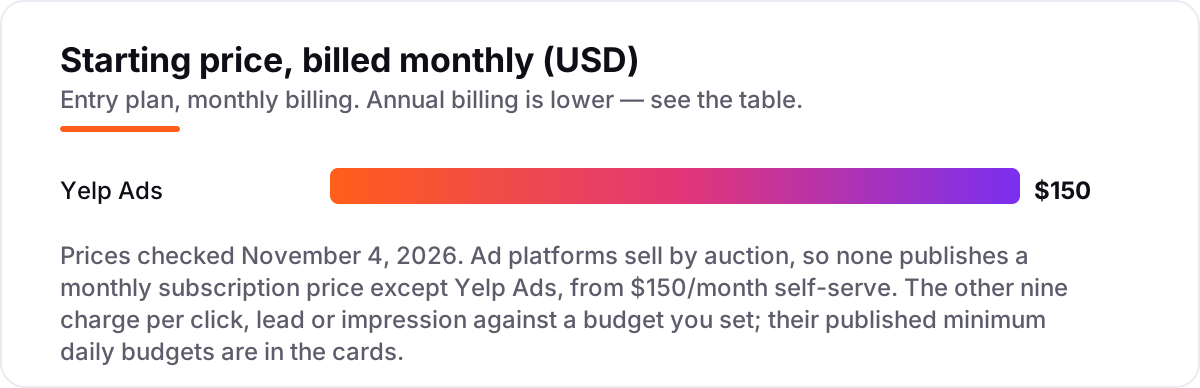
Best local advertising platform pricing: what you will actually pay
Take a $300 monthly test budget and spend it on one platform at a time. On Google Ads, $10 a day caps at $304 a month, because Google caps the monthly charge at the daily budget times 30.4 — so a $300 test buys a full month of search ads at $10 a day. On Meta Ads, the same $10 a day runs one ad set at the low end of a real test, and $5 a day is the floor for click-charged ad sets. On Yelp Ads, $150 of the $300 is the monthly floor, leaving $150 of click budget above it.
The floors change the maths completely. TikTok's $50-a-day campaign floor means a $300 test budget lasts six days there, and LinkedIn's $10-a-day floor buys one or two clicks a day at typical $5 to $15 click prices. Nextdoor is the opposite: at its suggested $3 a day, $300 runs for months of neighbourhood reach, and Amazon's $1-a-day floor means the budget is never the constraint — the product listing is. Microsoft Advertising has no minimum spend at all, so a $300 test can run at $5 a day for two months.
Three costs sit outside every number above. First, the creative: a TikTok test needs real video, and a Meta test needs several images, while a search test needs a fast landing page. Second, the management: if someone runs the account for you, expect a fee on top of the ad spend. Third, the learning phase: the first week mostly buys data, so judge a platform after two weeks of steady spend, not after three days. If you want the organic side working alongside the ads, our guide to Google Ads vs Local Services Ads compares the two Google options in detail.
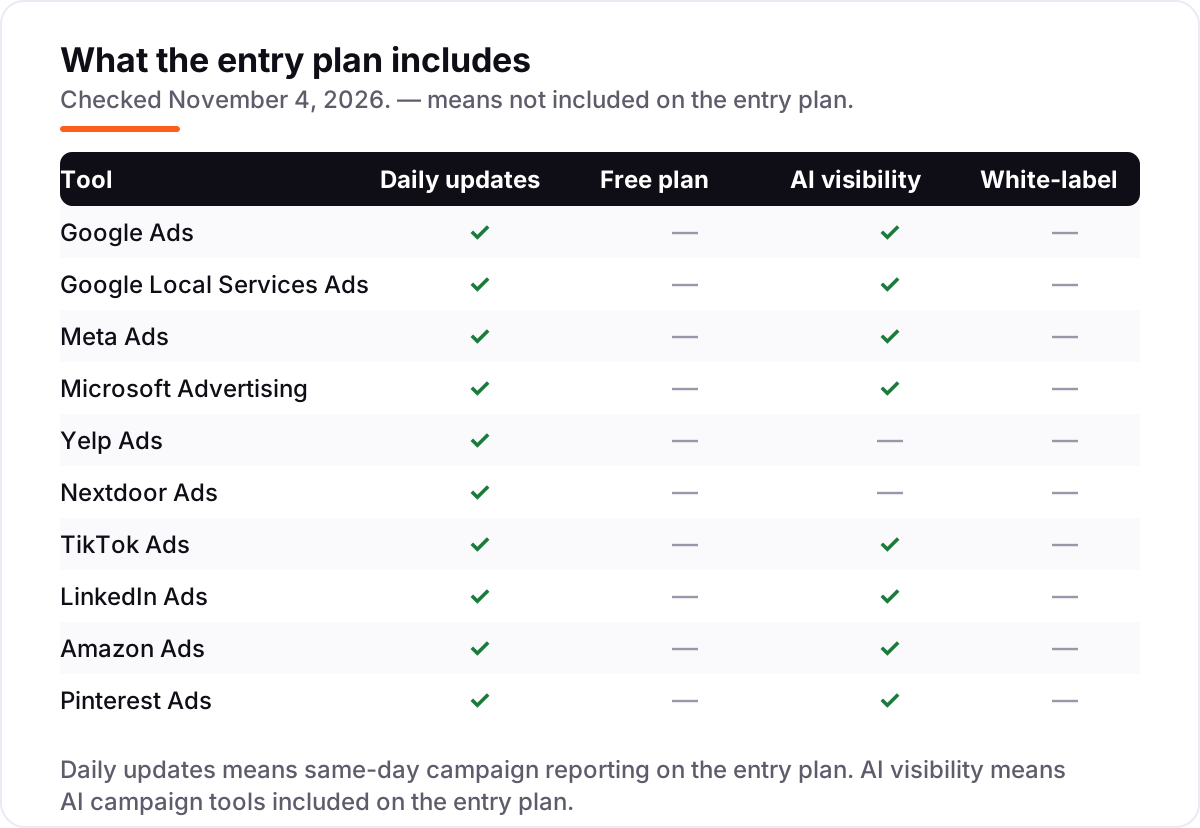
Know the difference: pay per click vs pay per lead
The biggest confusion in this category is between two ways of paying that sound similar but bill very differently. Pay per click — Google Ads, Microsoft Advertising, Meta Ads, Yelp Ads and most of this list — charges you every time someone clicks, whether or not they call, book or buy. You buy traffic, and turning that traffic into customers is your job: the landing page, the phone answering, the follow-up.
Pay per lead — only Google Local Services Ads in this list — charges you only when a customer contacts you through the ad: a call, a message, a voicemail or a booking. You buy conversations, not traffic, and Google does not charge for leads it decides are invalid or low quality. The catch is that a lead is not a customer: you still have to answer, quote and close, and a missed call over 20 seconds in business hours still counts as a lead.
There is a third model hiding inside the others: pay per impression. Meta, TikTok and Pinterest ad sets charged on impressions bill for views, not clicks, which suits awareness campaigns but makes the cost per customer harder to see. The practical rule is simple. If you can close a phone call, pay per lead. If you can close a landing page, pay per click. If you only want to be seen, pay per impression — and measure it separately from the other two.
Quick comparison: tool type by need
| Buyer | Best pick | Why |
|---|---|---|
| Local service catching searchers | Google Ads | No minimum spend, pay per click, the biggest pool of local search intent |
| Trade that wants phone calls | Google Local Services Ads | Pay per valid lead with a Google Verified badge, no monthly fee |
| Shop or salon on a small budget | Meta Ads | From $1 a day, one buy covers Facebook and Instagram |
| Business already running Google Ads | Microsoft Advertising | The same searchers for less per click, no minimum spend |
| Business with strong Yelp reviews | Yelp Ads | From $150 a month, ads where customers already compare and decide |
| Neighbourhood word-of-mouth service | Nextdoor Ads | No minimum spend, verified neighbours in the ZIP codes you serve |
| Retailer with short video | TikTok Ads | Cheapest clicks here, but a $50 a day campaign floor |
| B2B firm selling to job titles | LinkedIn Ads | Job-title targeting no other platform offers, from $10 a day |
| Shop selling products on Amazon | Amazon Ads | From $1 a day, in front of shoppers who are ready to buy |
| Visual, plannable purchases | Pinterest Ads | No platform minimum, clicks from $0.10 to $1.50 |
Mistakes to avoid
- Spreading $300 across five platforms. A test budget split five ways buys no platform enough data to learn. Spend the whole test on one platform, judge it, then move on.
- Budgeting on the floor instead of the test. A $1-a-day Meta floor or a $50-a-day TikTok floor is not a test budget — it is the smallest amount the platform will accept. Budget for the learning phase, not the minimum.
- Buying clicks when you need calls. If nobody answers the phone, pay-per-click traffic is wasted. Fix the phone answering first, or buy pay-per-lead instead.
- Judging a platform after three days. Every platform here needs a week or two of steady spend before it optimises. A three-day test measures noise, not performance.
- Forgetting the creative and the landing page. The platform is only as good as the ad and the page it sends people to. A weak landing page turns cheap clicks into expensive silence.
How we chose
We checked each vendor's own advertising pages on November 4, 2026 and recorded the starting price exactly as the vendor states it. Nine of the ten platforms publish no monthly subscription price at all: they sell by auction, so the card states the published minimum daily budget or the fact that there is none, and the only monthly figure in this list — Yelp Ads at $150 a month — is the figure Yelp publishes for self-serve accounts. The benchmark click and impression ranges quoted for TikTok and Pinterest are third-party 2026 benchmarks, not vendor prices, and are labelled as such. Ratings come from G2 review pages; where a G2 page could not be opened directly, we used G2's own search results for the same page, and Google Local Services Ads has no G2 listing, so it carries no rating. No vendor paid for a place in this list, and none of the links here are affiliate links.
What to do next
Start with one platform and one offer: Google Ads if your customers search, Meta Ads if they scroll, Local Services Ads if you are an eligible trade that answers the phone. Run it for two weeks at a steady daily budget, track every call with tracked links, and judge it on booked jobs — not on clicks. If the numbers work, add the second platform; if they do not, fix the landing page and the offer before you blame the channel. If ads are sorted but new customers still are not finding you, our monthly SEO service handles the organic side. Once your tools are in place, find out what's holding your rankings back.
Your stack only works if people find you
SerpAstra fixes what keeps your site off page one and makes it easy for AI assistants to recommend.
Get a free audit→Sources we checked (19)
- Google Ads pricing — ads.google.com (checked November 4, 2026)
- Google Local Services Ads — ads.google.com (checked November 4, 2026)
- Meta Ads — facebook.com/business (checked November 4, 2026)
- Microsoft Advertising — ads.microsoft.com (checked November 4, 2026)
- Yelp Ads — business.yelp.com (checked November 4, 2026)
- Nextdoor Ads — business.nextdoor.com (checked November 4, 2026)
- TikTok Ads Manager — ads.tiktok.com (checked November 4, 2026)
- LinkedIn Ads — business.linkedin.com (checked November 4, 2026)
- Amazon Ads — advertising.amazon.com (checked November 4, 2026)
- Pinterest Ads — business.pinterest.com (checked November 4, 2026)
- Google Ads reviews on G2 — g2.com (checked November 4, 2026)
- Facebook for Business reviews on G2 — g2.com (checked November 4, 2026)
- Microsoft Advertising reviews on G2 — g2.com (checked November 4, 2026)
- Yelp Advertising reviews on G2 — g2.com (checked November 4, 2026)
- Nextdoor Business reviews on G2 — g2.com (checked November 4, 2026)
- TikTok Ads reviews on G2 — g2.com (checked November 4, 2026)
- LinkedIn Marketing Solutions reviews on G2 — g2.com (checked November 4, 2026)
- Amazon Sponsored Ads reviews on G2 — g2.com (checked November 4, 2026)
- Pinterest reviews on G2 — g2.com (checked November 4, 2026)
Shamim
Founder of SerpAstra
A full-stack SEO and digital marketer who spends most days on Local SEO for dental practices, AI search visibility and lead generation.
Frequently asked questions
What is the best local advertising platform?
Google Ads is the best fit for most local businesses: it catches people searching for your service right now, with no minimum spend. Add Meta Ads when your customers decide by scrolling, and Local Services Ads when you are an eligible trade that answers the phone fast. The right mix depends on whether your customers search, scroll or ask neighbours first.
How much does local advertising cost?
There is no monthly subscription on nine of the ten platforms here — you set the budget and pay per click, lead or impression. Floors run from $1 a day on Meta and Amazon to $50 a day on TikTok, and Yelp Ads starts at $150 a month. A useful first test is $300 to $500 a month on one platform, not $50 spread across five.
Is there a free local advertising platform?
No. Every account in this list is free to open, but every ad costs money — there is no free advertising plan on any of them. The free options are the organic side: a Google Business Profile, a free Nextdoor Business Page, and free posts on Meta and Pinterest. Use those first, then pay to put the best of them in front of more nearby people.
Google Ads vs Local Services Ads: which is better for a local business?
Local Services Ads wins when you qualify and answer the phone fast, because you pay per lead instead of per click and the Google Verified badge builds trust. Google Ads wins for everyone else: it covers every category and area, and you control the keywords and the budget. Many trades run both — Local Services Ads for calls, Google Ads for everything the lead ads cannot cover.
What is the minimum budget to start advertising locally?
The technical minimum is $1 a day on Meta Ads and Amazon Ads, and there is no minimum at all on Google Ads, Microsoft Advertising, Nextdoor or Pinterest. The practical minimum is higher: $10 to $20 a day per ad set on Meta, $10 a day on LinkedIn, and $50 a day per campaign on TikTok. Below those levels the platforms cannot gather enough data to optimise.
Can I run local ads with $100 a month?
Yes, on the cheap floors: $100 a month is about $3 a day, which clears Nextdoor's suggested $3 a day and Yelp's $5 a day is just above it. It buys almost nothing on TikTok, where the floor alone is $50 a day, and very little on LinkedIn. Spend the $100 on one platform with a tight radius and one offer, and judge it on calls and bookings, not clicks.
Free SEO and AI visibility audit
Find out what is holding your rankings back
Send us your site. Within 2 business days you get a written audit, an AI visibility check and a short fix list ranked by impact. Free, with no contract attached.
Request my free audit→Related guides
 SEO & AI SearchBest Local SEO Tools for 2026: 11 Picks Ranked by What You Need11 best local SEO tools with real prices checked November 1, 2026 — from $14/month trackers to quote-only enterprise platforms, sorted by what you need.Read guide →
 MarketingGoogle Ads vs Local Services Ads: which wins local jobs?Google Ads vs Local Services Ads: pay per click or pay per lead, placement, verification, and cost compared, so you can pick the one that wins local jobs.Read guide →
 SEO & AI Search12 Best Marketing Platforms for Small Business SEO in 2026, ComparedThe 12 best marketing platforms for small business SEO, compared on real prices, SEO tools and AI visibility. Every price checked November 1, 2026.Read guide →