
7 Best Local Listing Management Software in 2026, Compared
7 best local listing management software tools compared on price, directory coverage and sync speed. Prices checked on vendor pricing pages, November 1, 2026.
 Shamim Mia, Founder, SerpAstraLast verified November 1, 202614 min read
We compare pricing pages, documentation and public reviews. We never accept payment for rankings.

Key takeaways
- BrightLocal is the best all-rounder for most small businesses: listing sync from $54/month on Manage, plus rank tracking, audits and white-label reports.
- Moz Local is the cheapest way to sync listings to 90+ directories: $20/month per location on Lite, or $199/year billed annually.
- Whitespark's Local Platform manages Google Business Profiles for $1/month per location, but directory sync is a separate one-time service.
- The single most important buying factor is what counts as a listing sync: some tools push updates to 200+ publishers in real time, others only manage your Google profile.
- Every price below was checked on the vendor's own pricing page on November 1, 2026, except Moz Local (see How we chose) and Birdeye, which publishes no price.
On this page
Quick comparison
| Tool | Best for | Starting price | Free plan |
|---|---|---|---|
| BrightLocal | Small businesses and agencies managing 1–10 locations who want listings, rank tracking and audits in one subscription | $41/mo | No (14-day trial) |
| Moz Local | Single-location businesses in the US, UK or Canada that want listings synced to 90+ directories for about $20/month | $20/mo per location | No |
| Synup | Agencies and multi-location brands that want every feature on every plan, with an AI agent doing the listing work | $49/mo | No (14-day trial) |
| Whitespark | Local SEOs and small businesses that manage Google Business Profiles and buy citation work only when needed | $1/mo per location | No (free tools) |
| Yext | Multi-location brands and franchises that need listings pushed to 200+ publishers in real time | $199/yr per location | No |
| Semrush Local | Teams already paying for Semrush who want listing management inside the SEO suite they use | $60/mo per location | No (7-day trial) |
| Birdeye | Multi-location brands that want listings, reviews, messaging and social in one platform and buy by quote | Custom quote | No (30-day trial) |
Make one of these tools?
We re-check this list every quarter. Send a correction, request a review, or ask about a clearly labeled sponsored spot.
Request a listingThe best local listing management software

BrightLocal
Best for: Small businesses and agencies managing 1–10 locations who want listings, rank tracking and audits in one subscription
BrightLocal is the best all-rounder in this list because listing management is one part of a wider local SEO toolkit. The Manage plan at $54 a month for one location adds Active Sync listing management and Google Business Profile post scheduling to rank tracking, citation tracking and audits, and Grow at $65 adds review monitoring and requests. For a small agency, that is one subscription, not three.
The catch is the entry plan. Track at $41 a month has no listing sync at all, so a buyer who only needs listings pays $54, not $41, and citation building costs $2–$3.20 per citation extra. Prices rise with location bands: two to five locations on Manage costs $76 a month. Buy BrightLocal when you want listings plus rankings and audits together; buy Moz Local when listings alone will do.
What we like
- Listing sync (Active Sync) from the $54/month Manage plan, with Google Business Profile post scheduling included
- Local Search Grid shows map-pack rankings block by block, plus GBP and citation audits on every plan
- White-label client reports and a 14-day free trial with no credit card required
Watch out for
- The $41/month Track plan has no listing management — sync starts on Manage at $54/month
- Citation building is pay-as-you-go at $2–$3.20 per citation on top of the subscription

Moz Local
Best for: Single-location businesses in the US, UK or Canada that want listings synced to 90+ directories for about $20/month
Moz Local does one job and charges one flat price for it: $20 a month per location on Lite, or $199 a year billed annually. That buys distribution to more than 90 directories in the US, UK and Canada, plus Local Grid map-pack tracking, review monitoring and Data Health analytics. There is no cheaper way to get a single location listed consistently.
The limits are the flip side of the simplicity. Moz Local only works in the US, UK and Canada, and every location costs the same $20 — ten locations cost $200 a month with no volume break until Enterprise at 50 locations. Review replies need Preferred at $30 a month. Pick Moz Local for one to ten locations; beyond that, BrightLocal's location bands or Synup's Premium plan cost less per location.
What we like
- Syncs name, address, phone and hours to 90+ directories from the $20/month Lite plan
- Local Grid map-pack tracking and review monitoring included on every plan
- Listings stay live after cancellation, unlike rented-listing models
Watch out for
- No free trial, and the price is the same for every location — no volume discount until Enterprise at 50+ locations
- Review replies start on Preferred at $30/month per location; Listings AI costs $14/month extra on Lite

Synup
Best for: Agencies and multi-location brands that want every feature on every plan, with an AI agent doing the listing work
Synup rebuilt its pricing around a simple idea: every plan includes every feature, and only the location count changes the price. Solo costs $49 a month for one location and includes listings distribution, review monitoring and responses, social publishing, a Local Rank Grid and AI discovery scoring across ChatGPT, Gemini and Perplexity. The Sydekick agent watches for listing drift and fixes it.
The pricing jumps are steep. Solo covers one location, and the next step is Premium at $299 a month for up to ten locations, so a two-location business pays six times the Solo price. White-labeling also starts on Premium, and agent work draws on a monthly credit allowance of 20,000 on Solo. Synup fits agencies that manage several clients and want one platform per client, not a single shop with one address.
What we like
- Every plan includes every feature — listings, reviews, social posting, rank grid and AI discovery — only capacity changes
- Sydekick AI agent detects listing drift and fixes it without a person opening the record
- White-labeling from Premium ($299/month), with monthly billing and no annual contract required
Watch out for
- Solo covers 1 location only, so the next band jumps to $299/month for up to 10 locations
- Agent work runs on monthly credits (20,000 on Solo), so heavy months can need extra credit blocks

Whitespark
Best for: Local SEOs and small businesses that manage Google Business Profiles and buy citation work only when needed
Whitespark is not one platform but a shelf of separate tools, and that is the point. The Local Platform costs $1 a month per location and manages Google Business Profiles: bulk edits across locations, alerts when Google or a third party changes a profile, and the option to reject unwanted updates. If you need citations found or built, the Local Citation Finder and the one-time Listings Service are separate purchases.
The modular model is both the strength and the trap. A single-location business that only needs its Google profile managed pays almost nothing, but a business that also wants rank tracking and review generation buys three tools and the bill passes $90 a month. Whitespark fits local SEOs who know exactly which job they need done; it frustrates buyers who want one login for everything.
What we like
- Local Platform manages Google Business Profiles for $1/month per location, with bulk edits and alerts on unwanted changes
- Every tool is sold separately, so you pay for the citation finder or rank tracker only when you need it
- One-time Listings Service ($20–$999) builds and cleans up citations without a subscription
Watch out for
- Local Platform manages Google profiles only — it does not sync listings across a directory network by itself
- Buying the separate tools adds up: Local Rank Tracker runs $14–$200/month and Reputation Builder $79/month per location

Yext
Best for: Multi-location brands and franchises that need listings pushed to 200+ publishers in real time
Yext is the enterprise standard for listing management because it does not rely on data aggregators. Direct API integrations with more than 200 publishers push a change live in hours, and the Knowledge Graph behind it keeps every location's details consistent. The Complete plan at $499 a year adds PowerListings+ and analytics, and Premium at $999 adds review monitoring and Yext Pages for location content.
The headline price is misleading. Emerging at $199 a year covers smaller directories only — no Google, Facebook or Apple — so the real entry point for most businesses is Essential at $449 a year. All plans are annual-only, and listings can revert when the subscription ends, which is the rented-listing model Moz Local avoids. Yext fits brands with many locations and global coverage; a single shop gets the same result cheaper elsewhere.
What we like
- Direct API integrations with 200+ publishers, so changes go live in hours rather than weeks
- PowerListings+ publishes products, services, calendars and staff bios to listings from Complete up
- Analytics and a free training session included on every PowerListings plan
Watch out for
- The $199/year Emerging plan skips Google, Facebook and Apple — the plan with Google costs $449/year
- Annual-only billing with 12-month terms, and listings can revert when the subscription ends

Semrush Local
Best for: Teams already paying for Semrush who want listing management inside the SEO suite they use
Semrush Local makes sense only if you already pay for Semrush. The Local Pro plan at $60 a month per location adds Listing Management to the suite: distribution to more than 70 directories in the US, duplicate detection and suppression. It sits beside the Map Rank Tracker geo-grid and the GBP AI Agent, so listings, reviews and maps share one dashboard and one login.
The pricing is the problem. Listing Management is not on the $30 Base plan at all, so the real starting price is $60 a month per location — and that is on top of a Semrush base plan from $139.95 a month. Ten locations on Pro costs $600 a month before the base plan. Buy Semrush Local as an add-on to a subscription you already have, never as a first listing tool.
What we like
- Listing Management distributes business details to 70+ directories in the US and 40+ elsewhere, with duplicate detection
- Map Rank Tracker shows Google Maps rankings as a geo-grid heatmap, with 1,225 credits on Pro
- GBP AI Agent automates posts, photo uploads and review replies from the Base plan
Watch out for
- Listing Management is only on Pro at $60/month per location — the $30 Base plan has no listing sync
- Per-location pricing stacks fast: 10 locations on Pro costs $600/month before the Semrush base plan

Birdeye
Best for: Multi-location brands that want listings, reviews, messaging and social in one platform and buy by quote
Birdeye is the biggest platform in this list, and the hardest to price. Listings, reviews, messaging, social and surveys run in one place, with AI agents that draft review replies, generate review requests and score listing health. It monitors more than 200 review sites. Multi-location brands use it as the single system for customer experience, not just for listings.
The quote-only pricing is the real barrier. Birdeye's pricing page shows no figures — only a form asking for your location count — and third-party reports put entry plans near $299 a month per location on annual contracts. Contracts auto-renew unless you give 90 days' written notice. Birdeye fits brands with many locations and a review problem; a single-location business should not need a sales call to manage listings.
What we like
- Listings, reviews, messaging, social and surveys in one platform, with AI agents for review responses
- Monitors 200+ review sites, with AI-generated replies and sentiment analysis
- Highest G2 score in this list at 4.7/5 from more than 4,200 reviews
Watch out for
- No published price — the pricing page is a quote form, and buyer reports put entry plans near $299/month per location
- Annual contracts that auto-renew unless you give 90 days’ written notice, with an 8% renewal fee reported by buyers
What the best local listing management software actually does
The best local listing management software keeps your business name, address, phone number and hours identical everywhere customers look — Google, Apple Maps, Bing, Facebook and the directories behind them. You enter the details once, and the tool pushes them out, watches for changes made by Google or third parties, and flags duplicates. This list covers seven tools that do that job in 2026, sorted by fit for the most common buyer: a single-location small business or a small agency managing a handful of clients.
The job matters because listings and reviews feed each other. Birdeye's State of Online Reviews 2026 report found Google accounted for 79.4% of reviews per location in 2025, so a wrong address or phone number on Google costs real calls, not just a tidy record. A listing tool does not replace local SEO work, but it stops the slow damage of inconsistent details across dozens of sites.
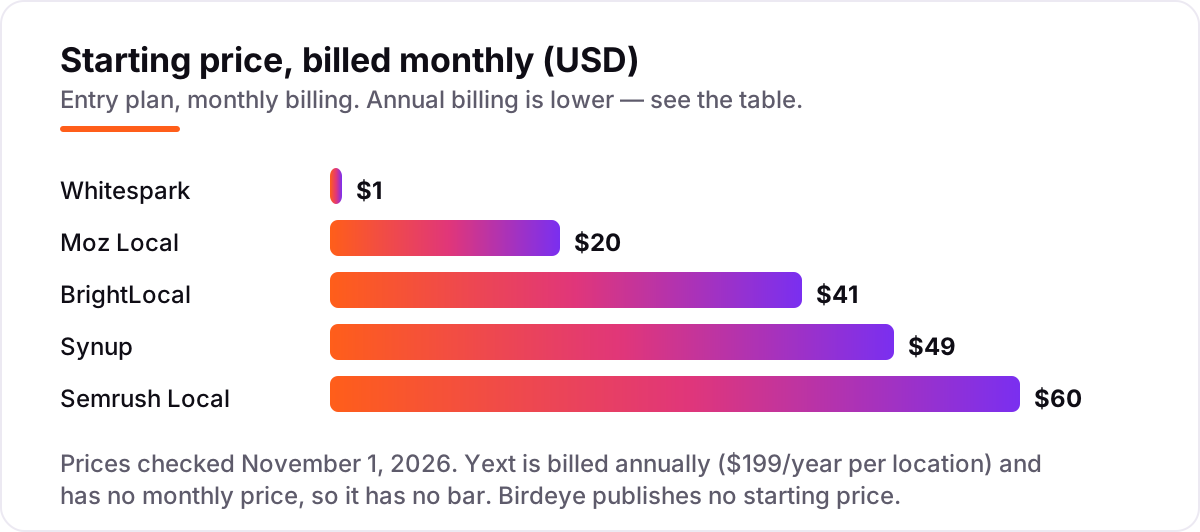
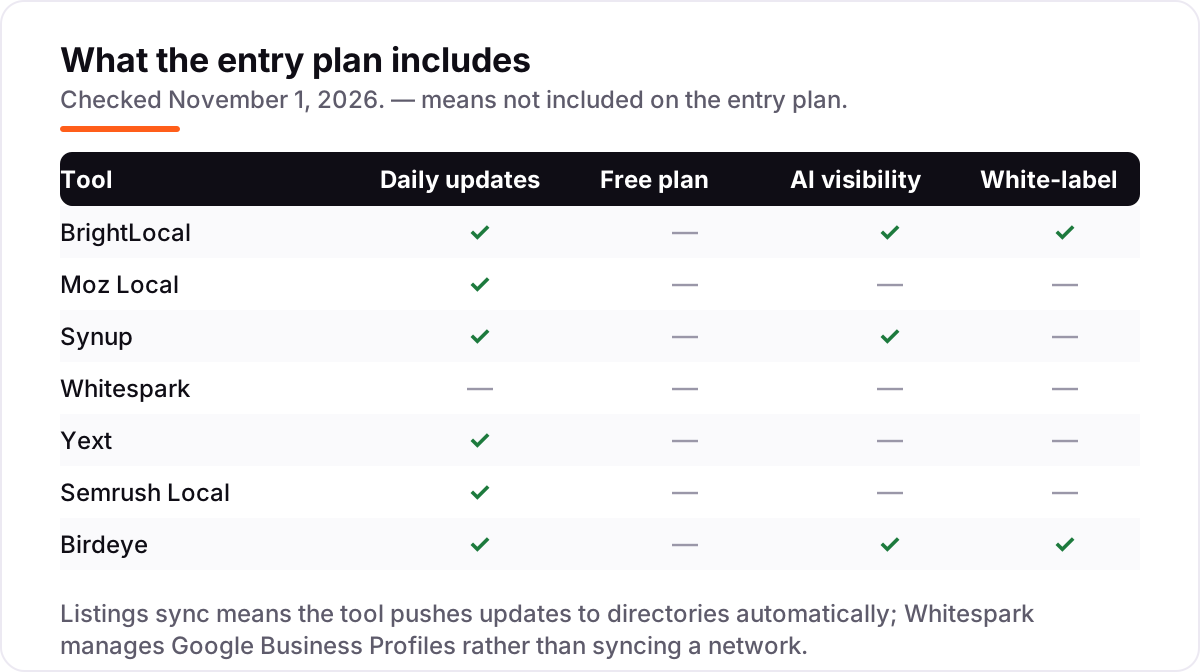
The seven tools split into three groups: cheap and focused options for one location, dedicated listing platforms for agencies and multi-location brands, and all-in-one suites where listings are one module among many. The price chart and the comparison table below show the starting price for each; the cards carry the catch behind each headline number.
Free and cheap options first
If you manage one location and your budget is tight, start at the bottom of the price list, not the top. Whitespark's Local Platform manages Google Business Profiles for $1 a month per location, which is the cheapest entry in this list by a wide margin — but it manages Google profiles only, so directory sync is a separate one-time purchase. Moz Local Lite at $20 a month per location is the cheapest true listing sync: 90+ directories, Local Grid tracking and review monitoring, with no sales call and no free trial.
Google Business Profile itself is free, and it is the one listing you cannot skip — every tool in this list manages it, none of them replaces it. What the paid tools add is everything around it: the other directories, duplicate suppression, change alerts and reporting. For a single shop, Moz Local Lite is usually enough. For a business that also wants rank tracking and audits, BrightLocal's Manage plan at $54 a month is the next step up, and it is still cheaper than buying tracking and listings separately.
Dedicated listing tools vs all-in-one suites
The seven tools in this list split into two camps. The dedicated tools — Moz Local, Yext, Synup and BrightLocal — exist to keep listings accurate. They push updates, suppress duplicates and report on listing health, and they stay out of the way. They are usually cheaper per location and faster to learn, and their pricing is the most transparent in this list.
The suites — Semrush Local and Birdeye — bundle listings with reviews, messaging, social and analytics. You pay more, and in Birdeye's case you cannot even see the price before a sales call, but you replace two or three subscriptions. The right camp depends on what you already pay for: if you own Semrush, its Local Pro add-on is the easy choice; if you only need listings synced, a dedicated tool costs less. Whitespark sits outside both camps — a shelf of separate tools you buy one at a time, which is the cheapest route when you know exactly which job you need done.
Multi-location and agency tools
Once you pass ten locations, the buying question changes from price per location to price per portfolio. Moz Local charges the same $20 for every location, so ten locations cost $200 a month and fifty cost $1,000 — there is no volume break until Enterprise. BrightLocal prices by location bands instead, so the per-location cost falls as you add sites: two to five locations on Manage costs $76 a month, and six to ten costs $109. Synup sells capacity bands too: $299 a month covers up to ten locations with every feature included and white-labeling switched on.
Yext and Birdeye are built for this scale and price for it. Yext's direct integrations with 200+ publishers matter most when a wrong phone number would spread to hundreds of listings overnight, and Birdeye's single dashboard for listings, reviews and messaging matters when a regional team runs fifty stores. Both want annual contracts, and both are poor value for a single shop. If you run local SEO for clients, the white-label question decides between them: BrightLocal includes white-label reports on every plan, Synup from Premium, and Birdeye for agency accounts — Moz Local and Yext do not offer it on their entry plans.
Listing sync vs citation building: know the difference
The biggest buyer confusion in this category is the gap between syncing listings and building citations. Listing sync is ongoing: the tool holds your correct details and pushes them to directories continuously, fixing drift and rejecting bad changes as they appear. Citation building is a one-time job: submitting your business to a list of directories, or cleaning up entries that are wrong today. A business usually needs both once, then only sync afterwards.
That is why the cheapest plans can mislead. BrightLocal's Track plan includes a Citation Tracker that finds problems, but fixing them costs $2 to $3.20 per citation on top of the subscription. Whitespark's Local Citation Finder finds citation opportunities from $33 a month, and its Listings Service builds or cleans them up for a one-time fee of $20 to $999. Yext and Moz Local include the sync in the subscription price; neither sells citation building separately. Before you compare prices, decide which of the two jobs you are buying — sync, cleanup, or both — and check whether the plan you picked includes it. Our guide to what local SEO actually covers explains where listings sit in the wider local search picture.
Quick comparison: tool type by need
| Buyer | Best pick | Why |
|---|---|---|
| Single location, tightest budget | Whitespark | $1/month per location for Google Business Profile management |
| Single location, full listing sync | Moz Local | 90+ directories for $20/month per location, no sales call |
| Small business or agency, best value | BrightLocal | Listings plus rank tracking, audits and white-label reports from $54/month |
| Agency managing several clients | Synup | Every feature on every plan, white-labeling from $299/month for 10 locations |
| Multi-location brand, widest reach | Yext | 200+ direct publisher integrations, real-time sync, from $199/year |
| Already paying for Semrush | Semrush Local | Listing Management plus maps and reviews inside the suite, $60/month per location |
| Multi-location brand, reviews first | Birdeye | Listings, reviews, messaging and social in one platform, quote only |
How to choose: a short decision path
- Count your locations first. One location: Moz Local or Whitespark. Two to ten: BrightLocal or Synup. Over ten: price the portfolio, not the location — BrightLocal bands, Synup Premium and Yext all beat flat per-location pricing at that size.
- Check what the entry plan actually syncs. BrightLocal Track has no listing sync, Semrush Local Base has none either, and Yext Emerging skips Google. The cheapest plan is only cheap if it includes the job you are buying.
- Decide sync or cleanup. If your listings are already a mess, budget for a one-time cleanup — Whitespark's Listings Service or BrightLocal's Citation Builder — before you pay for a sync subscription.
- Test your own data. Run the free NAP consistency checker on your business first, so you know how many directories already disagree about your name, address and phone number before you pay a tool to fix them.
- Try before you pay. Every tool here except Moz Local and Yext offers a free trial of 7 to 30 days. Run your real locations for a week and check whether the changes actually appear on Google and Apple Maps — that is the test that matters, not the dashboard. Our guide to how to track your Google ranking shows what to measure while the trial runs.
Mistakes to avoid
- Comparing monthly prices without checking the billing unit. Yext is annual-only, Moz Local charges per location with no volume discount, and BrightLocal prices by location bands — three tools, three different maths, and the cheapest headline rarely wins.
- Buying a plan that does not include listing sync. BrightLocal Track and Semrush Local Base both look cheap and neither syncs listings. Read the plan features, not the price.
- Ignoring what happens when you cancel. Yext listings can revert when the subscription ends; Moz Local listings stay live. For a business that may switch tools, that difference is worth more than a few dollars a month.
- Trusting a directory price. G2 still shows BrightLocal Track at $39 and Synup Solo at $39; both vendors now charge more. Always check the vendor's own pricing page — the sources at the bottom of this guide link to every page we checked.
- Paying for a suite when you only need listings. Semrush Local Pro at $60 a month per location, on top of a Semrush base plan, is hard to justify for listing sync alone. A dedicated tool at $20–$54 a month does the same job.
How we chose
We checked each vendor's own pricing page on November 1, 2026 and recorded the starting price exactly as shown, including the annual-billing figure where the page lists one. Two exceptions need stating plainly. Moz Local's price was not verified on moz.com itself, because moz.com was unreachable from our network on the check date; the figures used are Moz's own, as published on its G2 profile (Lite $16/month billed annually, Preferred $24, Elite $33), and they match every independent check we ran. Birdeye publishes no price at all — its pricing page is a quote form — so we list it as a custom quote and give only buyer-reported figures, clearly labeled as such. Ratings come from G2 pages opened on November 1, 2026, except Whitespark, which has no G2 product page — its G2 listing returns a 404 and the review page rate-limited us, so we show no rating for it rather than an estimate. We ranked the tools by fit for the most common buyer — a single-location small business or a small agency — not by brand size. No vendor paid for a place in this list, and none of the links here are affiliate links.
What to do next
Start with the decision path above: count your locations, check what the entry plan syncs, and test your own listings with the free NAP checker before you spend anything. Then take the free trial of your top pick and watch whether your changes actually appear on Google and Apple Maps within a week. If the numbers move and the reports make sense, you have your tool. If you'd rather have this set up and read for you, request a free SEO + AI visibility audit and get a ranked fix list in 2 business days.
Rather not run the tools yourself?
Tools show you the data. SerpAstra turns it into higher rankings, more map-pack calls and citations in AI answers.
Get a free SEO + AI visibility audit→Sources we checked (14)
- BrightLocal pricing — help.brightlocal.com (checked November 1, 2026)
- BrightLocal on G2 — 4.6/5, 230 reviews (checked November 1, 2026)
- Moz Local pricing — moz.com/products/local (figures as published by Moz on G2, checked November 1, 2026)
- Moz Local on G2 — 4.2/5, 476 reviews (checked November 1, 2026)
- Synup pricing — synup.com/pricing (checked November 1, 2026)
- Synup on G2 — 4.6/5, 335 reviews (checked November 1, 2026)
- Whitespark pricing — whitespark.ca/pricing (checked November 1, 2026)
- Yext PowerListings plans — yext.com (checked November 1, 2026)
- Yext on G2 — 4.4/5, 1,124 reviews (checked November 1, 2026)
- Semrush Local pricing — semrush.com/pricing/local (checked November 1, 2026)
- Semrush on G2 — 4.4/5, 4,304 reviews (checked November 1, 2026)
- Birdeye pricing — birdeye.com/pricing (checked November 1, 2026; no prices published)
- Birdeye on G2 — 4.7/5, 4,296 reviews (checked November 1, 2026)
- Birdeye, State of Online Reviews 2026 — Google accounted for 79.4% of reviews per location in 2025
Shamim
Founder of SerpAstra
A full-stack SEO and digital marketer who spends most days on Local SEO for dental practices, AI search visibility and lead generation.
Frequently asked questions
What is the best local listing management software in 2026?
BrightLocal is the best all-rounder for most small businesses: listing sync from $54/month on Manage, plus rank tracking, audits and white-label reports. Moz Local is the cheapest pure listing sync at $20/month per location. Brands with many locations should look at Yext or Birdeye instead.
How much does local listing management software cost?
From $1 to $60 a month per location at the published entry level. Whitespark's Local Platform is $1/month per location, Moz Local Lite is $20, BrightLocal Manage is $54 and Semrush Local Pro is $60. Yext starts at $199 a year per location, and Birdeye publishes no price.
Is there a free local listing management software?
No fully free tool in this list manages listings across directories. Google Business Profile itself is free, and Whitespark offers free tools such as its Review Checker, but syncing listings to dozens of directories needs a paid plan. BrightLocal, Synup and Semrush Local offer free trials of 7 to 14 days.
What is the difference between listing management and citation building?
Listing management keeps your details synced and corrected on an ongoing basis — change the hours once and every directory updates. Citation building is a one-time job: submitting your business to directories or cleaning up wrong entries. BrightLocal charges for citation building per citation, and Whitespark sells it as a one-time service.
Do my listings stay live if I cancel Yext or Moz Local?
It depends on the model. Moz Local listings stay live after cancellation because it distributes through data aggregators. Yext uses direct API connections, so listings can revert when the subscription ends — that is the rented-listing trade-off for its real-time sync. Check the exit terms before you sign an annual contract.
How many directories should listing software cover?
Coverage matters less than which directories are included. Google, Apple Maps, Bing, Facebook and Yelp plus the main data aggregators cover almost all local searches. Moz Local lists 90+ directories, Yext 200+ publishers and Semrush Local 70+ in the US — the difference is depth, not whether customers will find you.
Can I manage listings for multiple locations in one account?
Yes, every tool in this list supports multiple locations, but all of them charge per location. Moz Local charges the same $20 for each location, BrightLocal prices by location bands so the per-location cost falls as you add sites, and Synup sells capacity bands of 1, 10, 25 or 50 locations.
Free SEO and AI visibility audit
Find out what is holding your rankings back
Send us your site. Within 2 business days you get a written audit, an AI visibility check and a short fix list ranked by impact. Free, with no contract attached.
Request my free audit→Related guides
 StrategyHow to track your Google ranking (and what the numbers actually mean)Track your Google ranking the right way: Search Console, free checkers and rank trackers explained, and what average position and CTR really mean today.Read guide →
 AI SearchHow to get your brand cited in ChatGPT and AI searchA practical guide to earning citations in ChatGPT, Perplexity and Google AI Overviews: crawler access, Bing indexing, answer-first pages and brand signals.Read guide →
 Local SEOWhat is local SEO? A beginner's guide for small businessesWhat is local SEO? A clear beginner’s guide: how the map pack works, the five pillars, what it costs, and the first steps any small business can take.Read guide →