
7 Best Marketing Intelligence Software in 2026, Compared
Compare the 7 best marketing intelligence software tools on price, traffic data, intent signals and AI tracking, with every price checked November 5, 2026.
 Shamim Mia, Founder, SerpAstraLast verified November 5, 202612 min read
We compare pricing pages, documentation and public reviews. We never accept payment for rankings.

Key takeaways
- Semrush is the best all-rounder at $139.95/month; Similarweb follows at $199/month for traffic estimates, and Ahrefs is the cheapest deep data at $29/month.
- HubSpot Marketing Hub is the cheapest paid entry at $20/seat a month, with a real free tier — but its intelligence is your own data, not your competitors'.
- The single most important buying factor is the data source: modelled traffic estimates, your own first-party data and third-party intent signals answer different questions.
- Bombora and 6sense publish no prices — buyer-reported medians run about $25,000 and $62,000 a year, so they are enterprise buys, not team tools.
On this page
Quick comparison
| Tool | Best for | Starting price | Free plan |
|---|---|---|---|
| Semrush | Marketing teams that want competitor traffic, keyword and ad intelligence in one platform | $139.95/mo | Yes (free account) |
| Similarweb | Teams that need estimated traffic and audience data for any website, not just search | $199/mo | No (7-day trial) |
| Ahrefs | SEO-led teams that want the deepest backlink and keyword data at the lowest entry price | $29/mo | Yes (free for site owners) |
| Sprout Social | Social teams that need listening, reporting and inbox in one place and can pay per seat | $99/seat/mo | No (30-day trial) |
| HubSpot Marketing Hub | Small teams that want their own campaign data and the CRM in one place before buying specialist tools | $20/seat/mo | Yes (free tier) |
| Bombora | B2B teams that already run a CRM or ABM platform and need raw intent signals to feed it | Custom quote | No |
| 6sense | Enterprise B2B teams with a mature ABM program who want predictive AI to rank target accounts | Custom quote | Yes (free plan) |
Make one of these tools?
We re-check this list every quarter. Send a correction, request a review, or ask about a clearly labeled sponsored spot.
Request a listingThe best marketing intelligence software

Semrush
Best for: Marketing teams that want competitor traffic, keyword and ad intelligence in one platform
Semrush is the broadest tool in this list: one login covers keyword research, site audits, rank tracking, backlink analysis and the two kinds of intelligence buyers usually want — Traffic Analytics for competitor visits and channels, and Advertising Research for rival ad copy and spend estimates. The SEO plan costs $139.95 a month, or $117.33 a month billed annually, and it covers 5 projects and 500 tracked keywords.
The catch is scope. The SEO plan tracks AI Overviews citations but not prompt-level AI visibility, and traffic figures are modelled estimates rather than measured data. Guru at $249.95 a month and Business at $499.95 add the deeper limits and white-label reporting. Buy Semrush when one platform should answer most competitor questions; buy Similarweb when traffic estimates are the whole job.
What we like
- Traffic Analytics estimates visits, channels and engagement for any website, not just your own
- Advertising Research shows competitors' ad copy, spend estimates and display creatives
- One subscription covers keyword research, site audits, rank tracking and backlink analysis
- Free account lets you try 10 tracked keywords before paying
Watch out for
- The SEO plan covers AI Overviews citations only — prompt-level AI tracking needs a higher tier or add-on
- Traffic figures are modelled estimates, and Similarweb's audience data runs deeper
- The price jumps fast: Guru is $249.95/month and Business is $499.95/month

Similarweb
Best for: Teams that need estimated traffic and audience data for any website, not just search
Similarweb answers the question Semrush only estimates: how much traffic does a competitor actually get, and where does it come from? The Competitive Intelligence plan costs $199 a month, or $125 a month billed annually, and it shows website performance, traffic and engagement, audience demographics and a marketing channels overview for any site, with alerts when a rival's traffic spikes.
The limits are the seat and the history. The entry plan covers one user and three months of data, and ad intelligence waits for the $542-a-month billed-annually tier. Traffic figures are modelled estimates, not measured visits. Buy Similarweb when traffic and audience data drive the decision; buy Ahrefs when search data is enough and the budget is small.
What we like
- The only tool here that estimates traffic, engagement and audience demographics for 100 million-plus websites
- Marketing Channels Overview shows where competitors get traffic — search, social, display, email or direct
- Competitor alerts flag traffic spikes and new campaigns without manual checking
Watch out for
- Entry plan is a single seat with only 3 months of history; teams pay far more
- Traffic figures are modelled estimates, not measured data, and Similarweb notes variance can reach 30%
- Ad intelligence needs the $542/month billed-annually tier, not the entry plan

Ahrefs
Best for: SEO-led teams that want the deepest backlink and keyword data at the lowest entry price
Ahrefs is the cheapest way into serious competitor data. Starter costs $29 a month with no annual billing option, and it includes Site Explorer, Keywords Explorer, Site Audit and Rank Tracker for one user and 100 tracked keywords. Its backlink index is the deepest in this list, and Ahrefs says it refreshes every 15 minutes, which makes it the sharpest tool here for link and content-gap work.
The trade-off is what it cannot see. Ahrefs estimates search traffic only, so it tells you nothing about a rival's total visits, social or display traffic. There is no free trial — the free route is verifying a site you own — and a second seat costs extra. Buy Ahrefs when search is the battleground and the budget is tight; buy Semrush when you also need traffic and ad data.
What we like
- Backlink index is the deepest in this list, and Ahrefs says it refreshes every 15 minutes
- Keywords Explorer covers 10 search engines, including YouTube and Amazon, not just Google
- Site Audit crawls and flags technical issues with clear fix guidance
- Starter at $29/month is the cheapest paid entry in this list
Watch out for
- No traffic estimates for competitors — Ahrefs estimates search traffic only, not total visits
- Starter covers 1 user and 100 tracked keywords; a second seat costs extra
- No free trial — the only way in free is verifying a site you own

Sprout Social
Best for: Social teams that need listening, reporting and inbox in one place and can pay per seat
Sprout Social is the social side of marketing intelligence: listening, reporting and the inbox in one place. Essentials costs $99 a seat a month, or $79 billed annually, and it covers 5 social profiles with publishing, scheduling and standard reports. Listening tracks brand keywords and locations across networks with sentiment scoring, and the Smart Inbox merges comments, mentions, reviews and direct messages into one queue.
The catch is that the intelligence costs extra. Listening and Premium Analytics are paid add-ons on Standard and up, and Essentials is publishing-only — the inbox starts on Standard at $199 a seat a month. Every extra seat multiplies the bill. Buy Sprout Social when social signals and customer care matter as much as publishing; buy a cheaper scheduler when they do not.
What we like
- Social listening tracks brand keywords and locations across networks, with sentiment scoring
- Smart Inbox merges comments, mentions, reviews and DMs into one queue with routing
- Reporting covers profile, post and paid performance, with Salesforce reporting on higher tiers
- 30-day free trial with no credit card, the longest trial here
Watch out for
- Listening and Premium Analytics are paid add-ons on Standard and up, not included in the entry price
- Every extra seat multiplies the bill — three people on Standard cost $597 a month billed annually
- Essentials is publishing-only; the inbox starts on Standard at $199/seat a month

HubSpot Marketing Hub
Best for: Small teams that want their own campaign data and the CRM in one place before buying specialist tools
HubSpot Marketing Hub is the odd one out here: its intelligence is your own data, not your competitors'. Starter costs $20 a seat a month and includes 1,000 marketing contacts, email marketing, landing pages, forms, live chat and ad management, all tied to the same contact record as the free CRM. That single record is the point — every campaign, form and ad reports against the same contacts, so nothing needs stitching together.
The bill climbs with contacts, not seats: every extra 1,000 marketing contacts adds about $50 a month on Starter, and Professional jumps to $890 a month plus a $3,000 onboarding fee. Real AI and predictive reporting wait for the higher tiers. Buy HubSpot when first-party data and the CRM come first; buy Semrush or Similarweb when competitor data is the job.
What we like
- Free tier includes the CRM, forms, live chat and 2,000 email sends a month with HubSpot branding
- Every campaign, form and ad connects to the same contact record, so reporting needs no stitching
- Starter removes branding and adds email automation, landing pages and ad management for $20 a seat
- More than 1,500 apps in the marketplace, the largest integration library here
Watch out for
- Costs climb with contacts: every extra 1,000 marketing contacts adds about $50 a month on Starter
- The jump to Professional is steep — $890 a month plus a $3,000 one-time onboarding fee
- Real AI and predictive reporting wait for Professional and Enterprise, not Starter

Bombora
Best for: B2B teams that already run a CRM or ABM platform and need raw intent signals to feed it
Bombora sells one thing: intent signals. Company Surge watches research behaviour across a co-op of more than 5,000 B2B publisher sites, covering 25,300-plus topics, and flags when an account's research on a topic jumps above its baseline. There is no published price — Vendr's median contract is about $25,000 a year — and pricing runs per annual contract by the topics tracked and the volume consumed.
The signal is account-level only: Bombora names the company researching, never the person, and surge data refreshes weekly rather than daily. It also needs somewhere to go — a CRM or ABM platform that can act on the surges. Buy Bombora when you already run that stack and need raw intent to feed it; buy 6sense when you want the orchestration built in.
What we like
- Company Surge tracks research across a 5,000-plus publisher co-op covering 25,300-plus intent topics
- Signals are account-level and consent-based, from direct publisher relationships rather than bidstream data
- Feeds straight into CRMs and ABM platforms, so intent data lands where sales already works
Watch out for
- No published price — Vendr's median contract is about $25,000 a year, and onboarding can add $5,000 or more
- Account-level only: it names the company researching, never the person
- Surge data refreshes weekly, so fast-moving buying signals can be days old

6sense
Best for: Enterprise B2B teams with a mature ABM program who want predictive AI to rank target accounts
6sense is the full platform Bombora feeds: predictive AI scores accounts by buying stage, blends first-party signals with third-party intent, technographics and firmographics, and turns the ranked list into advertising, email and sales plays. Paid bundles are custom-quoted — Vendr's median contract is about $62,000 a year — but there is a real free plan with 50 data credits a month, company and people search, sales alerts and a Chrome extension.
The cost is not only money. Reviewers report a real learning curve, about three months to implement, and the platform needs dedicated RevOps time to run well; data credits do not roll over between periods. Buy 6sense when the ABM program is mature and the pipeline justifies it; buy Bombora when you only need the intent feed.
What we like
- Predictive AI scores accounts by buying stage, so sales focuses on the accounts most likely to buy
- Intent data blends first-party signals with third-party intent, technographics and firmographics in one view
- Free plan includes 50 data credits a month, company and people search, sales alerts and a Chrome extension
- Named a Leader in Forrester's Q1 2026 Wave for Revenue Marketing Platforms
Watch out for
- No published price — Vendr's median contract is about $62,000 a year, and some buyers report six-figure quotes
- Data credits do not roll over between periods, so unused credits are lost
- Reviewers note a real learning curve and that the platform needs dedicated RevOps time to run well
The best marketing intelligence software tells you what your competitors and your buyers are doing before they tell you themselves: which pages drive their traffic, which ads they run, which accounts are researching your category right now. We ranked the seven tools below by fit for the most common buyer — a marketing team that needs competitor and buyer data it can act on — and every price was checked on the vendor's own pricing page on November 5, 2026.
How to choose the best marketing intelligence software
- Name the data source first. Modelled traffic estimates (Similarweb), your own first-party data (HubSpot Marketing Hub) and third-party intent signals (Bombora, 6sense) answer different questions — pick the source before you pick the tool.
- Count seats before you count features. Sprout Social and HubSpot Marketing Hub charge per seat, so a three-person team pays three times the headline price; Semrush, Similarweb and Ahrefs charge per account.
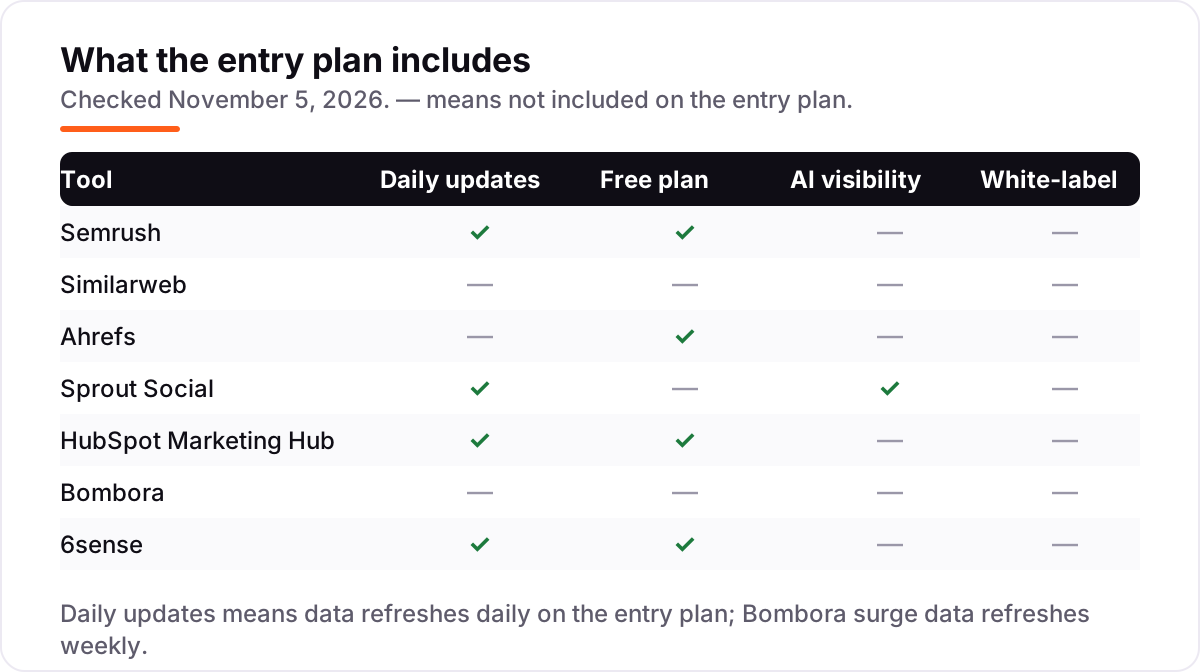
- Check what the entry plan actually includes. Sprout Social's listening is a paid add-on, Similarweb's ad intelligence needs the top self-serve tier, and Semrush's entry plan covers AI Overviews citations only.
- Decide whether you need named accounts or named people. Bombora and 6sense name the company researching, never the person — if your sales team needs contacts, budget for an enrichment tool too.
- Check the history window. Similarweb's entry plan keeps three months of data; a longer baseline costs more, and switching tools later means rebuilding that history from scratch.
Marketing intelligence is one half of the visibility job — the other half is your own site showing up when buyers search. Our AI search optimization service covers that side, and before you spend on ads, tag every link with the free UTM builder tool so the campaign data in these tools is actually trustworthy.
Whatever you shortlist, trial it against a competitor you already know well. Run one genuine week — your rivals, your keywords, your accounts — and check two things: that the numbers match what you already know from your own analytics, and that the reports answer a question your team actually asks. Every tool here offers a free plan or a trial long enough for that test, so there is no reason to buy before the data has proved itself.
Marketing intelligence software pricing: what you will actually pay
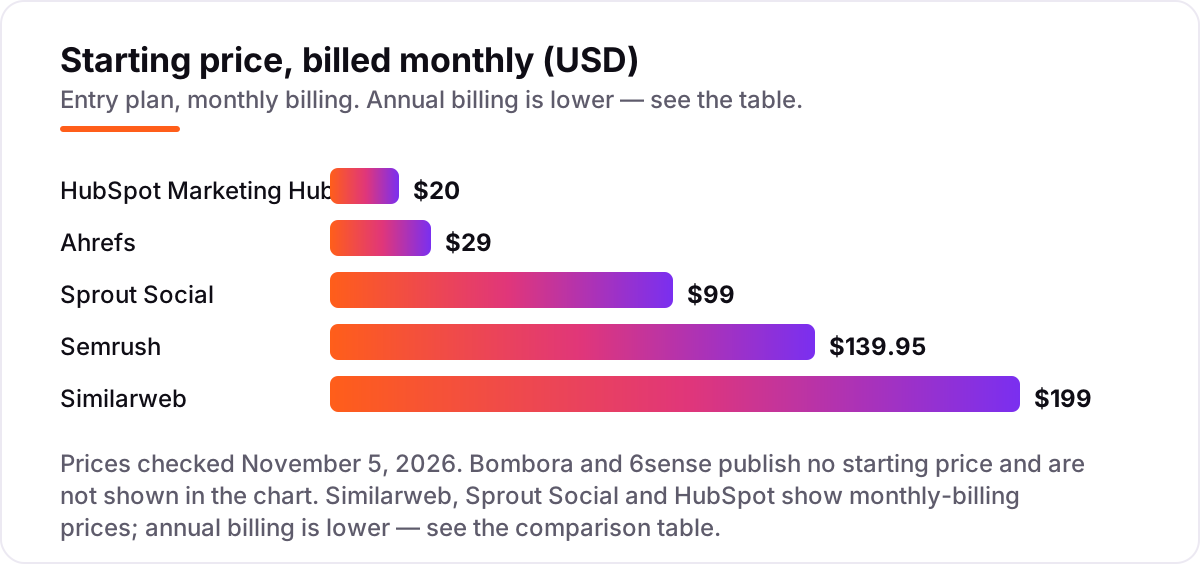
Take a three-person marketing team that wants competitor traffic, keyword and social data for a year. On list prices, Ahrefs Starter is $29 a month for one seat, or $348 a year; Semrush SEO is $139.95 a month, or $1,407.96 a year billed annually; Similarweb Competitive Intelligence is $199 a month, or $1,500 a year billed annually; Sprout Social Essentials for three seats is $297 a month, or $2,844 a year billed annually; and HubSpot Marketing Hub Starter for three seats is $60 a month, or $720 a year, at 1,000 contacts.
A practical stack for that team is Semrush on annual billing ($1,408 a year) plus Sprout Social Essentials for three seats on annual billing ($2,844 a year) plus HubSpot Starter for three seats ($720 a year) — $4,972 a year for competitor traffic and keywords, social listening and reporting, and first-party campaign data in one CRM. Swap Semrush for Ahrefs and the stack drops to $3,912 a year, but you lose traffic estimates and ad intelligence.
Annual billing is the cheapest lever in this list. Semrush drops from $1,679.40 a year on monthly billing to $1,407.96 billed annually, Similarweb from $2,388 to $1,500, and Sprout Social Essentials for three seats from $3,564 to $2,844. The catch is the commitment: annual plans are paid up front and usually do not refund the unused months if you cancel early, so buy monthly for the first month or two and switch to annual only once the tool has proved itself on real work.
Two costs sit outside every number above. First, the add-ons: Sprout Social's listening and Premium Analytics are quoted separately, and Similarweb's ad intelligence needs the $542-a-month tier. Second, the enterprise tier: Bombora and 6sense publish no prices, and buyer-reported medians from Vendr run about $25,000 and $62,000 a year — those are not vendor list prices, but they are the realistic budget for either tool. If you sell to consumers rather than B2B accounts, skip both and spend the money on the self-serve stack instead.
Know the difference: marketing intelligence vs marketing analytics
The confusion in this category is between outside data and inside data. Marketing intelligence is external: what competitors do and what buyers research before they reach you — traffic estimates, ad spend, intent signals. Marketing analytics is internal: what happens on your own site, campaigns and CRM — visits, conversions, pipeline. Semrush, Similarweb, Bombora and 6sense are mostly intelligence; HubSpot Marketing Hub is mostly analytics; Sprout Social sits in the middle, reporting on your own social accounts while listening to the wider conversation.
There is a second, quieter confusion: modelled data versus measured data. Similarweb's traffic figures and Semrush's Traffic Analytics are estimates built from panels and public signals — useful for direction, wrong in detail. Your own analytics are measured, and that is why the two disagree. If a tool's estimate contradicts your own measured numbers for a site you own, trust your own data and treat the estimate as a rough ranking, not a fact.
A third distinction worth knowing is account-level versus contact-level intent. Bombora and 6sense tell you a company is researching a topic; neither tells you which person at that company is doing the reading. That is enough to prioritize accounts and time outreach, but it is not a lead list — budget for enrichment or expect sales to do the detective work.
One more check before you buy: ask who owns the data. Similarweb and Semrush estimate other companies' traffic, so their figures can shift when the model changes; HubSpot and Sprout Social report on data you already own. Modelled data gets better over time, but it is never yours to export in full.
Quick comparison: tool type by need
| Buyer | Best pick | Why |
|---|---|---|
| Team that wants everything in one login | Semrush | Traffic, keywords, ads and AI Overviews tracking from $139.95/month |
| Team that needs traffic estimates for any site | Similarweb | Visits, channels and audiences for 100 million-plus websites, from $199/month |
| SEO-led team on a tight budget | Ahrefs | Deepest backlink and keyword data, from $29/month |
| Social team that needs listening and inbox | Sprout Social | Listening, Smart Inbox and reporting from $99/seat/month |
| Small team that wants CRM and reporting together | HubSpot Marketing Hub | First-party campaign data inside the CRM, from $20/seat/month |
| B2B team that needs intent signals to feed sales | Bombora | Company Surge intent data from a 5,000-site co-op, custom-quoted |
| Enterprise ABM team that needs predictive scoring | 6sense | AI-ranked accounts with a free plan, paid bundles custom-quoted |
Mistakes to avoid
- Paying for modelled traffic and expecting measured data. Similarweb and Semrush estimate competitor traffic; the figures are directionally right and wrong in detail. Never quote them as fact in a board deck.
- Budgeting on the per-seat price without multiplying by seats. Sprout Social and HubSpot Marketing Hub charge per seat, so three people on Sprout Standard cost $597 a month billed annually, not $199.
- Buying intent data before the workflow exists to use it. Bombora and 6sense signals are worthless if nobody acts on the surges — set up the CRM routing and the sales plays first.
- Comparing monthly and annual prices as if they were the same. Similarweb's entry plan is $199 a month billed monthly but $125 billed annually — a $888-a-year gap on the same plan.
- Treating a free account as the full product. Semrush's free account covers 10 keywords and 6sense's free plan covers 50 credits; the real work — full traffic data, intent feeds, white-label reports — sits on paid plans.
How we chose
We checked each vendor's own pricing page on November 5, 2026 and recorded the starting price exactly as shown, including the annual-billing figure where the page lists one, and we ranked the tools by fit for the most common buyer — a marketing team that needs competitor and buyer data it can act on — not by brand size. Bombora and 6sense publish no prices, so we show no starting price for them; the contract medians quoted for those two are buyer-reported figures from Vendr, not vendor list prices. Ratings come from each tool's G2 page, checked the same day. No vendor paid for a place in this list, and none of the links here are affiliate links.
What to do next
Start with the free plan or trial of your top pick and test it against a competitor you already know well. Check that the traffic estimates, keyword data or intent signals match what your own analytics already tell you before you commit to a year. If the intelligence is sorted but new customers are not finding you, our monthly SEO service handles the visibility side — or compare providers in our guide to SEO companies for small business. Once your tools are in place, find out what's holding your rankings back.
Your stack only works if people find you
SerpAstra fixes what keeps your site off page one and makes it easy for AI assistants to recommend.
Get a free audit→Sources we checked (14)
- Semrush pricing — semrush.com/pricing/ (checked November 5, 2026)
- Similarweb pricing — similarweb.com/packages/web/ (checked November 5, 2026)
- Ahrefs pricing — ahrefs.com/pricing/ (checked November 5, 2026)
- Sprout Social pricing — sproutsocial.com/pricing (checked November 5, 2026)
- HubSpot Marketing Hub pricing — hubspot.com/pricing/marketing (checked November 5, 2026)
- Bombora pricing — bombora.com/pricing (checked November 5, 2026)
- 6sense pricing — 6sense.com/pricing/ (checked November 5, 2026)
- Semrush reviews — g2.com/products/semrush/reviews (checked November 5, 2026)
- Similarweb reviews — g2.com/products/similarweb/reviews (checked November 5, 2026)
- Ahrefs reviews — g2.com/products/ahrefs/reviews (checked November 5, 2026)
- Sprout Social reviews — g2.com/products/sprout-social/reviews (checked November 5, 2026)
- HubSpot Marketing Hub reviews — g2.com/products/hubspot-marketing-hub/reviews (checked November 5, 2026)
- Bombora Company Surge reviews — g2.com/products/bombora-company-surge/reviews (checked November 5, 2026)
- 6sense Revenue Marketing reviews — g2.com/products/6sense-revenue-marketing/reviews (checked November 5, 2026)
Shamim
Founder of SerpAstra
A full-stack SEO and digital marketer who spends most days on Local SEO for dental practices, AI search visibility and lead generation.
Frequently asked questions
What is the best marketing intelligence software?
Semrush is the best all-rounder: competitor traffic, keywords, ads and AI Overviews tracking in one login from $139.95/month. Similarweb is better when traffic estimates are the whole job, and Ahrefs wins on price at $29/month when search data is enough. B2B teams that need intent data should look at Bombora or 6sense instead.
How much does marketing intelligence software cost?
Self-serve tools run $20 to $199 a month: HubSpot Marketing Hub from $20/seat, Ahrefs from $29, Sprout Social from $99/seat, Semrush from $139.95 and Similarweb from $199. Bombora and 6sense publish no prices; buyer-reported medians from Vendr run about $25,000 and $62,000 a year, so they are enterprise buys.
What is the difference between marketing intelligence and marketing analytics?
Intelligence is external data about competitors, markets and buyers — traffic estimates, ad spend and intent signals. Analytics is your own first-party data — your site, your campaigns, your CRM. Semrush and Similarweb are mostly intelligence; HubSpot is mostly analytics. Most teams need both, which is why the two categories keep getting bundled.
Is there free marketing intelligence software?
Yes, with limits. Semrush has a free account with 10 tracked keywords, HubSpot's free tier covers the CRM and basic marketing, and 6sense has a free plan with 50 data credits a month. Similarweb offers free tools for basic lookups. None of the free options includes full competitor traffic or intent data — those sit on paid plans.
Do I need intent data, or is traffic data enough?
Traffic data tells you what competitors do; intent data tells you which accounts are researching your category right now. A team selling to consumers rarely needs intent data. A B2B team with a sales force and a CRM does — but only if someone acts on the signals. Buying Bombora or 6sense without a workflow to use the surges wastes the subscription.
Can I switch marketing intelligence tools later?
Yes, but expect to lose history. Export your tracked keywords, competitor lists and saved reports before cancelling, and start the new tool's tracking at least a month before the old subscription ends. Traffic estimates and intent baselines rebuild from scratch, so a clean switch means running both tools side by side for one billing cycle.
Free SEO and AI visibility audit
Find out what is holding your rankings back
Send us your site. Within 2 business days you get a written audit, an AI visibility check and a short fix list ranked by impact. Free, with no contract attached.
Request my free audit→Related guides
 SEO & AI Search7 Best Competitor Ad Tracking Platforms in 2026, Compared7 best competitor ad tracking platforms compared on price, coverage and alerts, with real starting prices, free plans and the best pick for each buyer.Read guide →
 SEO & AI Search9 Best AI Visibility Competitor Analysis Tools in 2026, Compared9 best ai visibility competitor analysis tools compared with real prices, prompt limits and rival-tracking features. Prices checked November 1, 2026.Read guide →
 Digital Marketing & Ads8 Best All-In-One Marketing Platforms in 2026, ComparedCompare the 8 best all-in-one marketing platforms on price, free plans and automation, with every price verified in November 2026 and sorted by buyer.Read guide →