
12 Best Marketing Platforms for Ecommerce in 2026, Compared
Compare the 12 best marketing platform for ecommerce picks on price, free plans, email and SMS, with every live price verified November 5, 2026.
 Shamim Mia, Founder, SerpAstraLast verified November 5, 202615 min read
We compare pricing pages, documentation and public reviews. We never accept payment for rankings.

Key takeaways
- Klaviyo is the best fit for most online stores at $20/month; Omnisend follows at $16/month with email, SMS and push in one plan, and Brevo is the cheapest paid start at $9/month.
- Sender has the biggest free plan here — 2,500 subscribers and 15,000 emails a month at $0 — while Klaviyo, Omnisend, Mailchimp, Brevo, HubSpot and MailerLite all offer free tiers too.
- The single most important buying factor is the meter: some tools charge by contacts, some by emails sent, and some by orders — and the meter decides what you actually pay, not the headline price.
- SMS is billed on top of almost every plan here, so a store that texts its list should price the messages, not just the subscription.
On this page
Quick comparison
| Tool | Best for | Starting price | Free plan |
|---|---|---|---|
| Klaviyo | Online stores that want the ecommerce-native email and SMS platform with the deepest Shopify integration | $20/mo | Yes (free plan) |
| Omnisend | Shopify and WooCommerce stores that want email, SMS and push in one ecommerce-first plan | $16/mo | Yes (free plan) |
| Mailchimp | Small stores that want the biggest template library and the widest integration ecosystem | $13/mo | Yes (free plan) |
| Brevo | Stores with big lists that send infrequently and want to pay for emails, not contacts | $9/mo | Yes (free plan) |
| HubSpot Marketing Hub | Growing stores that want email, CRM, landing pages and ads in one system with a free tier | $20/mo/seat | Yes (free plan) |
| ActiveCampaign | Stores that want CRM-driven automation and sales pipelines alongside email | $19/mo | No (14-day trial) |
| Drip | Direct-to-consumer brands that want one price, every feature, and revenue per email | $39/mo | No (14-day trial) |
| GetResponse | Stores that want webinars, landing pages and ecommerce automation in one cheaper plan | $19/mo | Yes (limited free) |
| MailerLite | New stores that want a full toolset — automations, landing pages, websites — at the lowest paid price | $12/mo | Yes (free plan) |
| AWeber | Small stores and creators that want simple email with paid-subscription tools built in | $15/mo | No (14-day trial) |
| Sender | New stores that want the biggest free plan in this list and a $9 paid step up | $9/mo | Yes (free plan) |
| Constant Contact | Small stores that want phone support, event tools and simple email without learning a new system | $12/mo | No (30-day trial) |
Make one of these tools?
We re-check this list every quarter. Send a correction, request a review, or ask about a clearly labeled sponsored spot.
Request a listingThe best marketing platform for ecommerce

Klaviyo
Best for: Online stores that want the ecommerce-native email and SMS platform with the deepest Shopify integration
Klaviyo is the default recommendation for an online store for a reason: it was built for ecommerce, and its Shopify integration syncs orders, browsing and purchase data in close to real time. The Email plan starts at $20 a month for up to 500 active profiles and includes 5,000 sends a month, flows, segments, an AI subject-line generator and revenue attribution. The free plan covers 250 profiles and 500 sends a month, which is enough to launch a new store.
The catch is the price curve. The same plan costs $60 a month at 2,500 profiles, $100 at 5,000 and $150 at 10,000. SMS and add-ons are billed on top. Buy Klaviyo when the store lives on automated flows and the list is growing; buy Omnisend or Brevo when the budget matters more than the deepest segmentation.
What we like
- The strongest Shopify integration here: orders, browsing and purchase data sync in close to real time
- Predictive analytics (lifetime value, churn risk) and deep segmentation included on the Email plan
- Pre-built ecommerce flows for abandoned carts, welcome series, win-backs and post-purchase
- 350+ integrations cover the major store platforms, helpdesks and ad channels
Watch out for
- The bill climbs fast with list size: $60/month at 2,500 profiles and $150 at 10,000
- No annual billing discount on self-serve plans, so the monthly price is the price
- The learning curve is real once you move past templates into advanced flows and segments

Omnisend
Best for: Shopify and WooCommerce stores that want email, SMS and push in one ecommerce-first plan
Omnisend is the closest rival to Klaviyo for a Shopify or WooCommerce store, and it undercuts Klaviyo on price at every list size. Standard lists at $16 a month for 500 contacts and includes 6,000 emails a month, unlimited web push, forms, automation and a product recommender; the page shows $11.20 a month for the first three months under a 30% promotion. The free plan covers 250 contacts and 500 emails a month, and support is 24/7 live chat and email on every tier, including free.
The trade-offs are smaller. SMS is billed per message on top of the plan, and advanced reporting waits for the Pro plan. Pick Omnisend when you want email, SMS and push in one plan without Klaviyo's price curve; pick Klaviyo when predictive analytics and the deepest Shopify data matter most.
What we like
- Built for ecommerce from the ground up: pre-built flows for carts, browse abandonment and win-backs
- Email, SMS and web push in one plan, with 24/7 live chat and email support on every tier
- Free migration from Klaviyo or Mailchimp, done for you in about 5 days
- Unlimited monthly emails on Pro, and the free plan already includes automation
Watch out for
- The $11.20/month shown on the page is a 30% first-3-months promotion; the list price is $16/month
- SMS is billed per message on top of the plan, so heavy texting adds up quickly
- Advanced reporting and the account expert wait for higher tiers or $400/month spend

Mailchimp
Best for: Small stores that want the biggest template library and the widest integration ecosystem
Mailchimp is the safe default: the biggest template library, the widest integration list, and an interface a non-marketer can learn in an afternoon. Essentials costs $13 a month for 500 contacts and includes 5,000 sends a month, A/B testing and basic automation; Standard costs $20 and adds multi-step automation and advanced segmentation. The free plan covers 250 contacts and 500 sends a month, which suits a brand-new list.
The billing trap is the contact counting. Subscribed, unsubscribed and non-subscribed contacts all count toward your tier until you archive them, so a list with years of dead addresses costs real money — and the price climbs with every band: $45 a month at 2,500 contacts, $75 at 5,000. Buy Mailchimp for breadth and ease; buy Brevo or Sender when the list is large and the budget is tight.
What we like
- The biggest template and integration ecosystem in this list — it connects to almost everything
- Easy to set up and easy to use, with the highest ease-of-setup scores among the big names
- Built-in CRM, landing pages and social posting make it a genuine all-in-one for small stores
- Free plan is genuinely free for a brand-new list under 250 contacts
Watch out for
- The free plan stops at 250 contacts and 500 sends a month, so most stores outgrow it fast
- Pricing counts unsubscribed and non-subscribed contacts until you archive them
- Multi-step automation and advanced segmentation wait for Standard at $20/month

Brevo
Best for: Stores with big lists that send infrequently and want to pay for emails, not contacts
Brevo is the budget pick because it prices by emails sent, not contacts stored — the opposite of Mailchimp and Klaviyo. Starter costs $9 a month for 5,000 emails, and the free plan stores up to 100,000 contacts while sending 300 emails a day at $0. That makes Brevo much cheaper for a store with a large list that emails once or twice a week.
The catch is the contact cap inside each volume tier: the $9 tier stores only 500 contacts, so a 1,200-contact list needs the $17 tier instead. Branding removal is a $12-a-month add-on on Starter, and pop-ups wait for Professional at $499 a month. Buy Brevo when the list is big and the sending is light; buy Omnisend when pop-ups and pre-built ecommerce flows matter more.
What we like
- Cheapest paid start here at $9/month, and the price follows emails sent, not contacts stored
- Free plan stores up to 100,000 contacts and sends 300 emails a day at $0
- Email, SMS, WhatsApp, web push and CRM in one account from the entry plan
- Standard adds automation, A/B testing and send-time optimization for $18/month
Watch out for
- Starter stores only 500 contacts at the $9 tier — a bigger list means a higher volume tier
- Removing Brevo branding costs $12/month extra on Starter
- Pop-ups need the Professional plan at $499/month, and phone support is not included below it

HubSpot Marketing Hub
Best for: Growing stores that want email, CRM, landing pages and ads in one system with a free tier
HubSpot Marketing Hub is the only true all-in-one in this list: the CRM, email, landing pages, ads, live chat and reporting all live in one login, and the free plan is genuinely useful with 2,000 sends a month. Starter costs $20 a month per seat and includes 1,000 marketing contacts, 500 HubSpot Credits, email automation and landing pages. The Shopify app syncs buyers as non-marketing contacts by default, so connecting the store does not raise the bill.
The cliff is the story. Professional costs $890 a month plus a $3,000 one-time onboarding fee, and every extra 1,000 marketing contacts past the first costs about $50 a month — so a 5,000-contact list runs about $220 a month on Starter. Buy HubSpot when the CRM is the center of the stack; buy Klaviyo or ActiveCampaign when email alone is the job.
What we like
- The only true all-in-one here: CRM, email, landing pages, ads, chat and reporting in one login
- Free plan is genuinely useful — 2,000 sends a month with the CRM included
- Shopify data sync sets buyers as non-marketing contacts by default, so syncing the store costs nothing extra
- 14,917 G2 reviews at 4.4/5, the largest review base in this list
Watch out for
- The jump from Starter to Professional is steep: $20/seat to $890/month plus a $3,000 onboarding fee
- Marketing contacts cost extra past 1,000: about $50/month per additional 1,000 contacts
- The $7/seat annual promo is for new customers only and ends — budget on the $20 list price

ActiveCampaign
Best for: Stores that want CRM-driven automation and sales pipelines alongside email
ActiveCampaign is the automation pick. Its workflow builder goes deeper than anything else here — conditional logic, goals, split testing and site tracking — and the built-in CRM ties campaigns to orders and revenue instead of treating email as a separate channel. Starter costs $19 a month for 1,000 contacts, or $15 a month billed annually, and includes 10,000 sends a month plus the CRM and ecommerce integrations.
The limits are the seat and the trial. Starter includes one seat and caps at two, so a three-person team is pushed toward Pro, and there is no free plan — only a 14-day trial. SMS and WhatsApp are paid add-ons. Buy ActiveCampaign when automation depth and CRM matter more than a free tier; buy HubSpot when the CRM needs to be the whole system, not just part of it.
What we like
- The deepest automation builder here: conditional logic, goals and split testing on every plan
- Built-in CRM and ecommerce integrations tie campaigns to orders and revenue
- 14,699 G2 reviews at 4.4/5, with automation the most praised feature by a wide margin
- Plus adds landing pages and the Stripe and booking integrations for $59/month
Watch out for
- No free plan — only a 14-day trial — so there is no way to run a small list for $0
- Starter includes 1 seat and caps at 2, so a team of three is pushed toward Pro
- SMS and WhatsApp are paid add-ons, not part of the plan price

Drip
Best for: Direct-to-consumer brands that want one price, every feature, and revenue per email
Drip sells one plan and nothing else: $39 a month for up to 2,500 active people, with unlimited email sends and every feature included at every list size. There are no tiers to compare and no upgrade hiding the workflow builder, the dynamic segments or the revenue dashboards. Every email and every workflow shows its revenue per recipient, so a store can see exactly which send paid for itself.
The simplicity has a floor. There is no free plan, only a 14-day trial, and the smallest list still costs $39 a month — more than Klaviyo, Omnisend or Brevo charge at the same size. Workflows cap at 50 on the entry band. Buy Drip when you want one honest price and revenue attribution; buy Omnisend when you want the same ecommerce focus for about half the money.
What we like
- One plan with every feature included — no tier gates hiding the automation you need
- Revenue attribution per email and per workflow, so every send shows its dollars
- Visual workflow builder with ready-made playbooks for welcome, cart and win-back
- Bills only on active people who can actually receive your emails, not your whole database
Watch out for
- No free plan and no cheap entry: the smallest list still costs $39/month
- No annual billing discount is published, so the monthly price is the price
- Workflows cap at 50 on the entry band, and SMS is billed on top of the plan

GetResponse
Best for: Stores that want webinars, landing pages and ecommerce automation in one cheaper plan
GetResponse is the value pick for a store that also runs webinars: Starter costs $19 a month for 1,000 contacts, or $15.58 a month billed annually, and includes unlimited monthly email sends, autoresponders, landing pages, forms and pop-ups, plus three seats. Marketer costs $59 a month and adds unlimited automation workflows, abandoned cart recovery, promo codes and revenue reports — the ecommerce features that matter.
The catch is the single workflow on Starter. One custom automation is enough for a welcome series, but a store running cart recovery, win-backs and post-purchase flows needs Marketer. The free version stops at 500 contacts and sends newsletters only. Buy GetResponse when webinars and unlimited sends matter; buy ActiveCampaign when automation depth is the priority.
What we like
- Unlimited monthly email sends on every plan, including Starter at $19/month
- Ecommerce automation on Marketer: abandoned cart recovery, promo codes and revenue reports
- Webinars, landing pages, forms and pop-ups included — no separate webinar tool to buy
- Three seats included on Starter, so a small team shares one plan
Watch out for
- Starter allows only one automation workflow — unlimited workflows start on Marketer at $59/month
- The free version stops at 500 contacts, sends newsletters only and carries a GetResponse badge
- Annual plans are non-refundable, so the 18% saving locks you in for a year
MailerLite
Best for: New stores that want a full toolset — automations, landing pages, websites — at the lowest paid price
MailerLite is the low-cost all-rounder. Comfort starts at $12 a month and covers automations, landing pages, a website builder, digital product sales and paid newsletters in one account — more breadth than any other tool at this price. The free plan covers 250 subscribers and 2,500 emails a month and still includes full automation, three email editors and A/B testing, which most rivals reserve for paid plans.
The free plan shrank in June 2026, from 500 subscribers to 250, so most growing lists start paying sooner than older guides suggest. New accounts also go through an approval check before sending, which can slow down day one. Buy MailerLite when the budget is tight and the store needs websites and forms as well as email; buy Brevo when the list is large and sending is light.
What we like
- The cheapest full-featured paid plan here after Brevo: Comfort from $12/month
- Full automation, three email editors and A/B testing even on the free plan
- Landing pages, a website builder and digital product sales in the same account
- Paid newsletters are built in, so creators can sell subscriptions without another tool
Watch out for
- The free plan dropped to 250 subscribers in June 2026, so most growing lists pay sooner
- New accounts go through an approval check before sending, which can slow down day one
- Comfort caps monthly sends at 10x your subscriber tier and automations at 50

AWeber
Best for: Small stores and creators that want simple email with paid-subscription tools built in
AWeber is the simple pick with one unusual strength: Lite costs $15 a month for 500 subscribers and already includes three team seats, where most rivals include one and charge for the rest. It also has native paid-subscription tooling, so a store or creator can sell a newsletter without bolting on another platform. Landing pages, web push and signup forms are included, and the Shopify and WooCommerce integrations have been around for years.
The price ladder is the problem. Lite rises to $25 a month at 1,000 subscribers and $60 at 5,000, which is steeper than GetResponse or ActiveCampaign at the same sizes, and there has been no free plan since 2025. Buy AWeber when three seats and paid subscriptions matter; buy GetResponse when the same money should buy deeper automation.
What we like
- Lite includes 3 team seats at $15/month — most rivals charge extra for a second seat
- Native paid-subscription tooling, so you can sell a newsletter without another platform
- Landing pages, web push and signup forms included on the entry plan
- Long track record with ecommerce integrations for Shopify and WooCommerce
Watch out for
- No free plan since 2025 — only a 14-day trial, so a small list pays from day one
- Lite rises steeply with list size: $25/month at 1,000 subscribers and $60 at 5,000
- Automation and ecommerce features are shallower than Klaviyo, Omnisend or ActiveCampaign

Sender
Best for: New stores that want the biggest free plan in this list and a $9 paid step up
Sender wins on the free plan alone: 2,500 subscribers and 15,000 emails a month at $0, with automation, pop-ups, signup forms and landing pages included — five times the subscriber cap of MailerLite's free plan and ten times Mailchimp's. Standard costs $9 a month for 500 subscribers and 6,000 emails, with no branding, three users and unlimited landing pages. Every new account also gets a 14-day trial of the Professional plan.
The trade-off is scale and ecosystem. Sender is a smaller company, so the integration library and third-party help content are thinner than Mailchimp's or Klaviyo's, and bigger lists are priced only in the calculator on its site. Buy Sender when the store is new and the free plan covers the first year; buy MailerLite when the store needs a website builder as well as email.
What we like
- The biggest free plan here: 2,500 subscribers and 15,000 emails a month at $0, with automation included
- Standard is $9/month for 500 subscribers — the joint-cheapest paid plan in this list
- Pop-ups, signup forms and landing pages included even on the free plan
- Transactional email shares the same account, so order emails need no second service
Watch out for
- Smaller company, so the integration library and third-party help content are thinner
- Free emails carry Sender branding, and removing it means paying for Standard
- Bigger lists are priced only in the calculator on Sender's site — no published ladder

Constant Contact
Best for: Small stores that want phone support, event tools and simple email without learning a new system
Constant Contact is the simple-and-supported pick. Lite costs $12 a month for up to 500 contacts, or $10.20 a month billed annually, and includes the email editor, AI writing assistance, social posting, 300+ integrations and a welcome-series automation. The 30-day free trial (100 sends) is the longest here and needs no credit card, and support is live phone and chat with marketing experts plus 1:1 onboarding — the most hand-holding in this list.
There has been no free plan since June 2025, so the trial is the only free look, and Lite covers one user with only a welcome-series automation — real automation starts on Standard at $35 a month. Pricing also scales on contacts and sends at once. Buy Constant Contact when human help and event tools matter; buy MailerLite or Sender when a free plan matters more.
What we like
- The longest free trial here at 30 days (100 sends), with no credit card required
- Live phone and chat support with marketing experts, plus 1:1 onboarding with a human
- Event hosting with product sales and payments built into the same account
- Social posting to Facebook, Instagram and LinkedIn included on the Lite plan
Watch out for
- No free plan since June 2025 — the 30-day trial is the only free look
- Lite covers one user and only a welcome-series automation; real automation starts at Standard $35/month
- Pricing scales on two dials at once — contacts and sends — so the bill can surprise you
The best marketing platform for ecommerce is the one that turns your store's own data — orders, browsing, abandoned carts — into emails and texts that bring shoppers back. We ranked the 12 tools below by fit for the most common buyer, a small online store on Shopify or WooCommerce, starting with the ecommerce-native platforms and ending with the general email tools that also serve stores well. Every price was checked on the vendor's own pricing page on November 5, 2026.
How to choose the best marketing platform for ecommerce
- Find the meter first. Klaviyo and Mailchimp charge by contacts, Brevo charges by emails sent, and Drip charges by active people. The meter decides what you actually pay as the list grows, not the headline price.
- Check the store integration. Klaviyo, Omnisend and HubSpot sync orders and browsing in close to real time; a generic email tool that only imports a CSV will not trigger a cart email when it matters.
- Count the free plan's real limits. Sender covers 2,500 subscribers free, Klaviyo 250 profiles, Mailchimp 250 contacts. A free plan that ends at 250 contacts is a trial with a different name.
- Price SMS separately. Email is the subscription; texts are billed per message on almost every plan here, from about $0.007 per SMS on Omnisend. A store that texts weekly can double its bill on messages alone.
- Look past the entry price to the second tier. The plan you actually need is often the second one: Mailchimp Standard for automation, GetResponse Marketer for unlimited workflows, HubSpot Professional for real reporting.
If the store also needs to be found in the first place, our guide to SEO for ecommerce covers the visibility side, and the best ecommerce marketing companies guide covers hiring that work out. Before you write the first campaign, build your tracking links with the free UTM builder tool so every email's revenue shows up in your analytics.
Whatever you shortlist, try it with your real store data before you pay. The free plans and trials in this list are long enough to connect the store, send one genuine campaign and run one abandoned-cart flow — and that week tells you more than any review can. Check two things in the trial: that the store sync pulls orders through without manual fixing, and that the revenue report matches what your store actually earned.
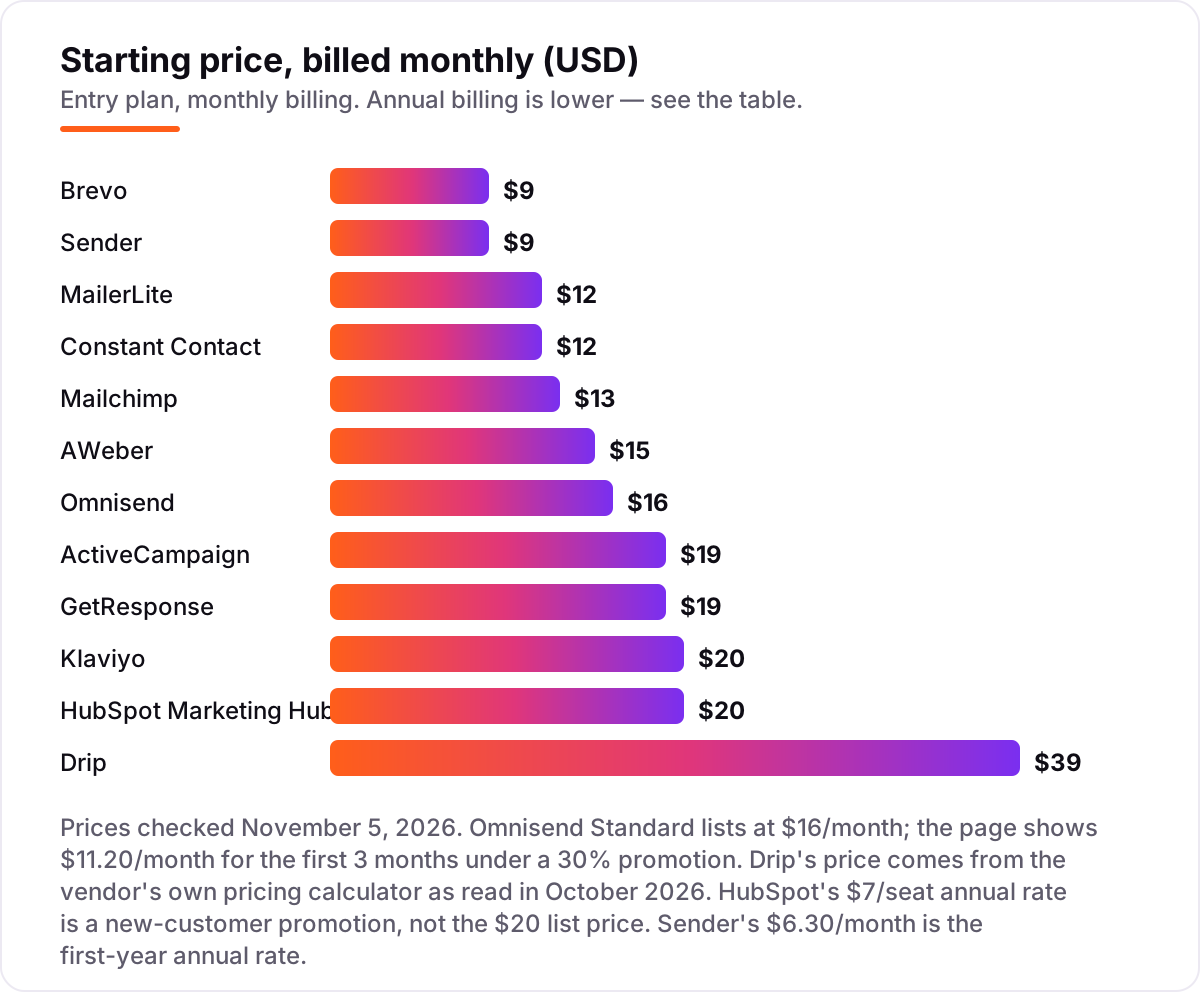
Marketing platforms for ecommerce pricing: what you will actually pay
Take a store with 500 contacts that emails weekly. On list prices, the subscription costs $9 a month on Brevo Starter or Sender Standard, $12 on MailerLite Comfort or Constant Contact Lite, $13 on Mailchimp Essentials, $15 on AWeber Lite, $16 on Omnisend Standard, $19 on GetResponse Starter or ActiveCampaign Starter, $20 on Klaviyo Email or HubSpot Marketing Hub Starter, and $39 on Drip. Two of those numbers need adjusting before they are real: Brevo's $9 tier stores only 500 contacts, so a list a little larger needs the next volume tier, and HubSpot's $20 is per seat, so a second seat doubles it.
Over a year, that is $75.60 on Sender Standard billed annually in the first year, $84 on HubSpot Starter at the new-customer promo rate, $96.96 on Brevo Starter, $122.40 on Constant Contact Lite, $129.60 on MailerLite Comfort, $150 on AWeber Lite, $180 on ActiveCampaign Starter, $186.96 on GetResponse Starter, and $468 on Drip. Klaviyo, Mailchimp and Omnisend publish no annual discount, so their monthly figures are the whole story. The same 500 contacts and the same weekly email cost $75.60 a year at the cheap end and $468 at the dear end — a $392 gap that comes entirely from billing choices and meters, not from features.
Three costs sit outside every number above. First, SMS: Omnisend charges from $0.007 per message and Klaviyo's SMS is a separate credit purchase, so a store sending 2,000 texts a month adds roughly $14–$30 to the bill. Second, the list itself: every tool here raises the price as contacts grow, and Klaviyo's $20 becomes $60 at 2,500 profiles and $150 at 10,000. Third, the second tier: the automation most stores actually need — Mailchimp Standard, GetResponse Marketer, HubSpot Professional — costs two to forty-five times the entry price. If you would rather hire the marketing out than run the tools, see our guide to the best ecommerce marketing companies.
Annual billing cuts the bill on most tools here: GetResponse Starter drops from $228 to $186.96 a year, ActiveCampaign Starter from $228 to $180, AWeber Lite from $180 to $150, and Constant Contact Lite from $144 to $122.40. The exceptions matter too: Klaviyo, Mailchimp and Drip publish no annual discount at all, and Omnisend's only saving is paying three months upfront for 30% off. One more cost to check before you commit: a second store is a second subscription on every tool in this list, so price the second storefront before you commit to a tool for the first.
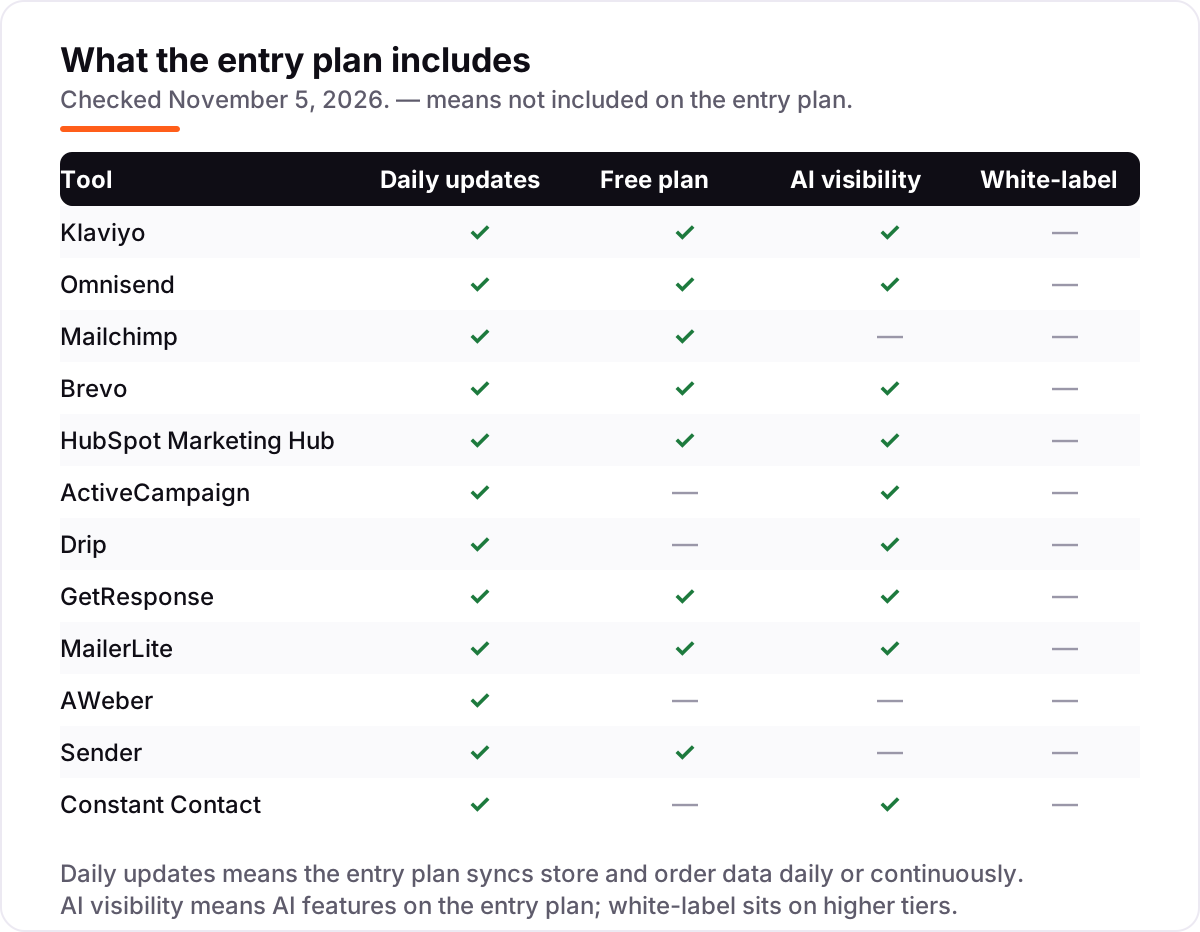
Know the difference: a marketing platform is not your store platform
The confusion in this category is between the store and the megaphone. Shopify, WooCommerce and BigCommerce are store platforms: they hold your products, take the payment and record the order. A marketing platform is the tool that brings the shopper back — the emails, texts, pop-ups and automations built on top of the order data. The two connect, but neither replaces the other, and buying a second store platform when you needed a marketing tool is the most expensive mistake in this list.
There is a second, quieter confusion: email tools are not marketing platforms. An email tool sends campaigns; a marketing platform also runs SMS, pop-ups, landing pages, a CRM and revenue reporting in the same account. All twelve tools in this list cover more than email, but the depth varies: Klaviyo and HubSpot are genuine platforms, while MailerLite and Sender are email-led tools with platform features bolted on. Match the depth to the job — a store sending one newsletter a week does not need a CRM, and a store running five flows a day does.
A third distinction worth knowing is contacts versus sends. Klaviyo, Mailchimp and AWeber charge by how many contacts you store, so a dead list costs money. Brevo and Sender charge by how many emails you send, so a big list that rarely hears from you stays cheap. Drip charges by active people who can actually receive your emails. The right meter depends on your list: big and quiet favors Brevo, small and chatty favors Klaviyo.
Quick comparison: tool type by need
| Buyer | Best pick | Why |
|---|---|---|
| Most online stores | Klaviyo | Deepest Shopify integration and ecommerce flows, from $20/month |
| Best value for Shopify/WooCommerce | Omnisend | Email, SMS and push in one plan, from $16/month |
| Big list, light sending | Brevo | Priced by emails sent, not contacts, from $9/month |
| Biggest free plan | Sender | 2,500 subscribers and 15,000 emails a month free |
| All-in-one with CRM | HubSpot Marketing Hub | CRM plus marketing in one system, from $20/seat/month |
| Deepest automation | ActiveCampaign | Workflow builder plus CRM, from $19/month |
| One price, every feature | Drip | Single plan at $39/month with revenue attribution |
| Cheapest full toolset | MailerLite | Websites, forms and automation from $12/month |
Mistakes to avoid
- Budgeting on the promo price. Omnisend's $11.20 and HubSpot's $7/seat are first-months or new-customer promotions. The list price is what you pay when the promotion ends, so compare tools on that number.
- Buying on the contact count you have today. Every tool here reprices as the list grows. Klaviyo's $20 becomes $60 at 2,500 profiles; price the list you expect in a year, not the list you have now.
- Forgetting SMS in the budget. The subscription is only the email price. A store texting its list weekly adds $14–$30 a month in message credits on most plans here.
- Picking a tool that cannot see your orders. A marketing platform that only imports CSVs cannot trigger a cart email in real time. Check the store integration syncs orders before you buy, not after.
- Paying for the second tier on day one. Start on the entry plan and upgrade when a limit actually bites — a workflow cap, a seat cap, a send cap — not because the sales page says the higher plan is better.
How we chose
We checked each vendor's own pricing page on November 5, 2026 and recorded the starting price exactly as shown, including the annual-billing figure where the page lists one, and we ranked the tools by fit for the most common buyer — a small online store on Shopify or WooCommerce — not by brand size. Drip's $39 comes from the vendor's own pricing calculator as read in October 2026, and Sender's $6.30 annual figure is the first-year rate shown on its pricing page. Ratings come from G2 pages checked the same day; Drip, MailerLite, AWeber and Sender carry no rating here because we could not verify a current G2 score and count for them, and we would rather show no rating than a stale or estimated one. No vendor paid for a place in this list, and none of the links here are affiliate links.
What to do next
Start with the free plan or trial of your top pick, connect your real store, and send one genuine campaign plus one abandoned-cart flow. Check that the store sync pulls orders through and the revenue report matches what the store actually earned before you commit to a year. If the tools are sorted but new customers are not finding the store, our monthly SEO service handles the visibility side — or compare email-first options in our guide to email marketing platforms for ecommerce. Once your tools are in place, find out what's holding your rankings back.
Your stack only works if people find you
SerpAstra fixes what keeps your site off page one and makes it easy for AI assistants to recommend.
Get a free audit→Sources we checked (20)
- Klaviyo pricing — klaviyo.com/pricing (checked November 5, 2026)
- Omnisend pricing — omnisend.com/pricing (checked November 5, 2026)
- Mailchimp pricing — mailchimp.com/pricing (checked November 5, 2026)
- Brevo pricing — brevo.com/pricing (checked November 5, 2026)
- HubSpot Marketing Hub pricing — hubspot.com/pricing/marketing (checked November 5, 2026)
- ActiveCampaign pricing — activecampaign.com/pricing (checked November 5, 2026)
- Drip pricing — drip.com/pricing (checked November 5, 2026)
- GetResponse pricing — getresponse.com/pricing (checked November 5, 2026)
- MailerLite pricing — mailerlite.com/pricing (checked November 5, 2026)
- AWeber pricing — aweber.com/pricing (checked November 5, 2026)
- Sender pricing — sender.net/pricing (checked November 5, 2026)
- Constant Contact pricing — constantcontact.com/pricing (checked November 5, 2026)
- Klaviyo G2 reviews — g2.com/products/klaviyo/reviews (checked November 5, 2026)
- Mailchimp G2 reviews — g2.com/products/mailchimp/reviews (checked November 5, 2026)
- HubSpot Marketing Hub G2 reviews — g2.com/products/hubspot-marketing-hub/reviews (checked November 5, 2026)
- Brevo G2 reviews — g2.com/products/sendinblue/reviews (checked November 5, 2026)
- ActiveCampaign G2 reviews — g2.com/products/activecampaign/reviews (checked November 5, 2026)
- Omnisend G2 reviews — g2.com/products/omnisend/reviews (checked November 5, 2026)
- GetResponse G2 reviews — g2.com/products/getresponse/reviews (checked November 5, 2026)
- Constant Contact G2 reviews — g2.com/products/constant-contact/reviews (checked November 5, 2026)
Shamim
Founder of SerpAstra
A full-stack SEO and digital marketer who spends most days on Local SEO for dental practices, AI search visibility and lead generation.
Frequently asked questions
What is the best marketing platform for ecommerce?
Klaviyo is the best fit for most online stores: the deepest Shopify integration, predictive analytics and pre-built ecommerce flows, from $20/month with a free plan to 250 profiles. Omnisend is the better value pick at $16/month, and Brevo is the cheapest paid start at $9/month.
How much does a marketing platform for ecommerce cost?
Entry prices run from $0 to $39 a month. Sender, Brevo, Klaviyo, Omnisend, Mailchimp, HubSpot and MailerLite all have free plans, and the first paid plans cost $9–$20 a month. A 500-contact store typically pays $108–$468 a year for the subscription, before SMS credits and add-ons.
Is Klaviyo or Omnisend better for a Shopify store?
Klaviyo wins on depth: stronger segmentation, predictive analytics and the closest Shopify data sync, from $20/month. Omnisend wins on price and breadth: email, SMS and web push in one plan from $16/month, with 24/7 support on every tier. Most small stores will not miss Klaviyo's extra depth.
Do I need a separate SMS tool?
Usually not. Klaviyo, Omnisend, Brevo, Drip and GetResponse all sell SMS in the same account, but the messages are billed per text on top of the plan — often from $0.007 to $0.01 per message. Price your monthly text volume before choosing, since heavy texting can double the bill.
What is the difference between a marketing platform and Shopify?
Shopify is the store: it holds your products, checkout and orders. A marketing platform is the megaphone: it sends the emails and texts, runs the pop-ups and automations, and brings shoppers back. The two connect — Klaviyo, Omnisend and HubSpot all sync with Shopify — but neither replaces the other.
Can I switch marketing platforms later?
Yes, and stores do it often. Export your contacts, segments, templates and automation rules from the old tool, import the list into the new one, and rebuild the two or three flows that earn the most revenue first. Switch at a quiet time of year and keep the old account live until the first campaigns have sent cleanly.
Free SEO and AI visibility audit
Find out what is holding your rankings back
Send us your site. Within 2 business days you get a written audit, an AI visibility check and a short fix list ranked by impact. Free, with no contract attached.
Request my free audit→Related guides
 Digital Marketing & Ads12 Best Email Marketing Platforms for Ecommerce in 2026, Compared12 best email marketing platforms for ecommerce compared on real starting prices, free plans and store automation. Klaviyo $20/month, Brevo $9.Read guide →
 Digital Marketing & Ads11 Best Ecommerce Marketing Companies in 202611 best ecommerce marketing companies compared on services, pricing and fit for online stores, with every price checked on November 4, 2026.Read guide →
 StrategySEO for ecommerce: product and category pages that rankSEO for ecommerce: product and category pages that rank, with the structure, schema and internal links that turn search traffic into paying customers.Read guide →