
8 Best Multi-Channel Ecommerce Platforms in 2026, Compared
Compare the 8 best multi-channel ecommerce platforms for selling on marketplaces, social and several stores, with inventory sync and prices checked in 2026.
 Shamim Mia, Founder, SerpAstraLast verified November 1, 20268 min read
We compare pricing pages, documentation and public reviews. We never accept payment for rankings.

Key takeaways
- Shopify is the best multi-channel ecommerce platform for most brands: one catalog and stock pool across the store, social, AI chats and in-person sales, from $39 a month.
- Sellbrite is the cheapest way to add marketplaces to an existing store, with unlimited channels on every plan and a free tier up to 30 orders a month.
- Zoho Inventory suits sellers who want stock control above every channel, with a free plan for 50 orders and per-organization pricing rather than per user.
- Running multiple stores is a different problem from multiple channels: decide whether you need separate brands, countries or just more places to list the same products.
On this page
Quick comparison
| Tool | Best for | Starting price | Free plan |
|---|---|---|---|
| Shopify | Brands that want one catalog and stock pool across their store, social, marketplaces and in-person sales | $39/mo | No (trial) |
| BigCommerce | Growing brands that want marketplace and social channels plus multi-currency selling built into the platform | $39/mo | No (15-day trial) |
| Sellbrite | Online sellers that want to list one catalog on Amazon, eBay, Etsy and other marketplaces from a single dashboard | $29/mo | Yes (30 orders) |
| Zoho Inventory | Multi-channel sellers that want inventory control above every store and marketplace, priced per organization | $29/mo (annual) | Yes (50 orders) |
| Square for Retail | Small shops selling in person and online that want one free system for both channels | $0 (free plan) | Yes (free plan) |
| Lightspeed Retail | Retailers with several physical stores and a website that share stock across locations | $89/mo (annual) | No (trial) |
| WooCommerce | WordPress sellers that want multi-channel connectors without a platform fee | Free | Yes (free plugin) |
| Adobe Commerce | Large businesses running several brands, regions or B2B and B2C stores from one installation | Custom quote | No (demo only) |
Make one of these tools?
We re-check this list every quarter. Send a correction, request a review, or ask about a clearly labeled sponsored spot.
Request a listingThe best multi-channel ecommerce platforms

Shopify
Best for: Brands that want one catalog and stock pool across their store, social, marketplaces and in-person sales

Shopify is the strongest all-round hub for multi-channel selling. The store, Instagram and TikTok, AI chats and in-person sales through POS all draw on one catalog and one stock count, so a sale anywhere updates inventory everywhere. Its app store adds marketplace connectors, and POS is included on Basic at $39 a month, or $29 billed annually.
Each extra Shopify store is billed as its own plan, so separate brands or country stores multiply the subscription. Only the owner gets a staff account on Basic, and a 2% fee applies on third-party gateways. For one brand on many channels, it is the simplest setup here.
What we like
- The largest app and theme ecosystem of any hosted ecommerce platform
- Unlimited products, hosting, SSL and checkout included, with AI-chat selling on the entry plan
- Shopify Payments charges 2.9% + 30c online with no extra platform fee
- POS for in-person sales at markets and pop-ups is included on Basic
Watch out for
- Apps and a paid theme push the real bill well above the $39 headline price
- A 2% fee applies on sales through a third-party payment gateway on Basic
- Only the store owner gets a staff account on Basic, so a small team must upgrade

BigCommerce
Best for: Growing brands that want marketplace and social channels plus multi-currency selling built into the platform
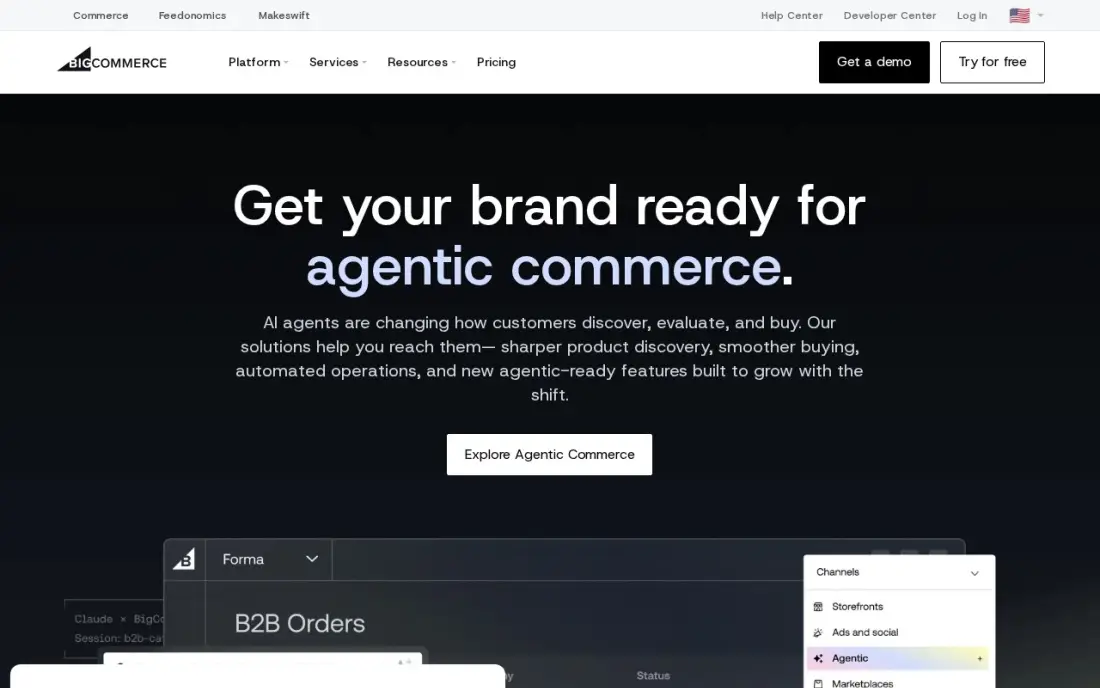
BigCommerce puts more channel features in the base platform than most rivals: multi-currency selling, unlimited products and staff accounts, and real-time shipping quotes on Core, with channel connections managed from the admin. BigCommerce also offers multi-storefront selling for brands that run several sites from one backend — check which plan includes it.
Core costs $39 a month, or $29 billed annually, but covers only $30,000 in trailing 12-month sales, and sales across every channel count toward that, so a busy multi-channel brand climbs tiers fast. A 2% fee applies on gateways outside the approved list.
What we like
- Unlimited products, staff accounts and storage on every plan, with real-time shipping quotes
- Multi-currency selling and gift cards are included on Core, not held for a higher tier
- No platform fee on orders through approved embedded payment providers such as Stripe and PayPal
- Built-in SEO and product filtering for catalogs with many variants
Watch out for
- The plan auto-upgrades when trailing 12-month sales pass $30,000, so growth raises the bill
- A 2% fee applies on orders through payment gateways outside BigCommerce's approved list
- Abandoned cart recovery is not included on the entry Core plan

Sellbrite
Best for: Online sellers that want to list one catalog on Amazon, eBay, Etsy and other marketplaces from a single dashboard
Sellbrite does one job: it lists your products on marketplaces and keeps stock and prices in sync across them. Every plan, including the free one, allows unlimited SKUs, users and integrated sales channels, and Amazon FBA orders never count toward the order limit. Pro plans sync inventory, prices and orders every 15 minutes.
Pricing is by order volume. Free covers up to 30 orders a month, Pro 100 costs $29 a month billed annually, Pro 500 $79 and Pro 2K $179, and going over the cap moves you up automatically. The free plan syncs only every 2 hours, slow enough to oversell a fast item.
What we like
- Unlimited SKUs, users and integrated sales channels on every plan
- A free plan covers up to 30 orders a month
- Pro plans sync inventory, prices and orders every 15 minutes
- Amazon FBA orders never count toward plan limits
Watch out for
- Order caps push you up a tier automatically: Pro 500 is $79 a month and Pro 2K $179, billed annually
- The free plan syncs only every 2 hours, slow enough to oversell a fast-moving item
- FBA inventory and multi-channel fulfillment cost $19 a month extra

Zoho Inventory
Best for: Multi-channel sellers that want inventory control above every store and marketplace, priced per organization
Zoho Inventory sits above the sales channels rather than being one: it holds the stock, then feeds the online store and marketplaces from that single count. The free plan covers 50 orders a month with item tracking and barcoding, and paid plans charge per organization rather than per user, so adding staff costs nothing.
Standard costs $29 a month billed annually, or $39 billed monthly, and covers 500 orders, three users and two locations, with dropshipping and composite items. Order caps force upgrades as volume grows, and serial and batch tracking wait for Premium at $79 a month.
What we like
- Free plan covers 50 orders a month with item tracking, barcoding and vendor management
- Per-organization pricing, not per-user: adding team members costs nothing extra on any plan
- Standard at $29/month billed annually covers 500 orders, 3 users and 2 locations with composite items and dropshipping
Watch out for
- Order caps force an upgrade at every growth step: 500 orders a month on Standard, 3,000 on Premium
- Serial and batch tracking, barcode generation and stock counting sit on Premium ($79/month) or above
- No free trial of the paid plans beyond the 14-day trial; the free plan is the only way to test long-term

Square for Retail
Best for: Small shops selling in person and online that want one free system for both channels

Square for Retail is the cheapest way for a shop to run two channels from one stock count. The free plan covers in-person sales, an online store, basic stock tracking and low-stock alerts, so a sale on the counter updates the website straight away. Billing is month to month with no cancellation fees.
Plus at $49 a month per location adds purchase orders, vendor management and cost-of-goods reports, and transfers between stores need Premium at $149 a month per location. Marketplace selling is limited compared with a dedicated tool, so pair it with Sellbrite if Amazon or eBay matter.
What we like
- Free plan covers sales, basic inventory, low-stock alerts and an online store at $0 before card fees
- Plus at $49/month per location adds purchase orders, vendor management, cost-of-goods reports and barcode label printing
- Month-to-month billing with no cancellation fees, and card rates fall slightly on Plus and Premium
Watch out for
- Real inventory management — purchase orders, vendors, cost reporting — starts on Plus ($49/month per location), not the free plan
- Payment processing is locked to Square, so the per-transaction fee is non-negotiable
- Transfer orders between stores need Premium ($149/month per location)

Lightspeed Retail
Best for: Retailers with several physical stores and a website that share stock across locations

Lightspeed Retail is the multi-store retailer's choice: stock transfers between locations, multi-variant products, bundles and large CSV imports, with POS, payments, purchase orders and a basic online store in one system. Basic costs $89 a month billed annually, or $109 billed monthly, for one register and one location.
The bill grows with every till and shop. Extra registers are $59 a month each, forecasting and API access wait for Plus at $289 a month, and processing runs through Lightspeed Payments at 2.6% + 10c. The web store is basic, so online-first brands should start elsewhere.
What we like
- Basic covers POS, payments, core inventory, purchase orders and a basic online store from $89/month billed annually
- Core ($149/month) adds loyalty, advanced reporting, accounting integrations and a mobile scanner app
- Handles multi-variant products, bundles, stock transfers and up to 10,000-item CSV imports
Watch out for
- Basic at $89/month billed annually covers 1 register and 1 location; extra registers are $59/month each
- Card processing runs through Lightspeed Payments at 2.6% + 10c on every plan, with no cheaper processor option on the page
- The features serious stockrooms need — forecasting, custom reporting, API access — sit on Plus ($289/month)

WooCommerce
Best for: WordPress sellers that want multi-channel connectors without a platform fee
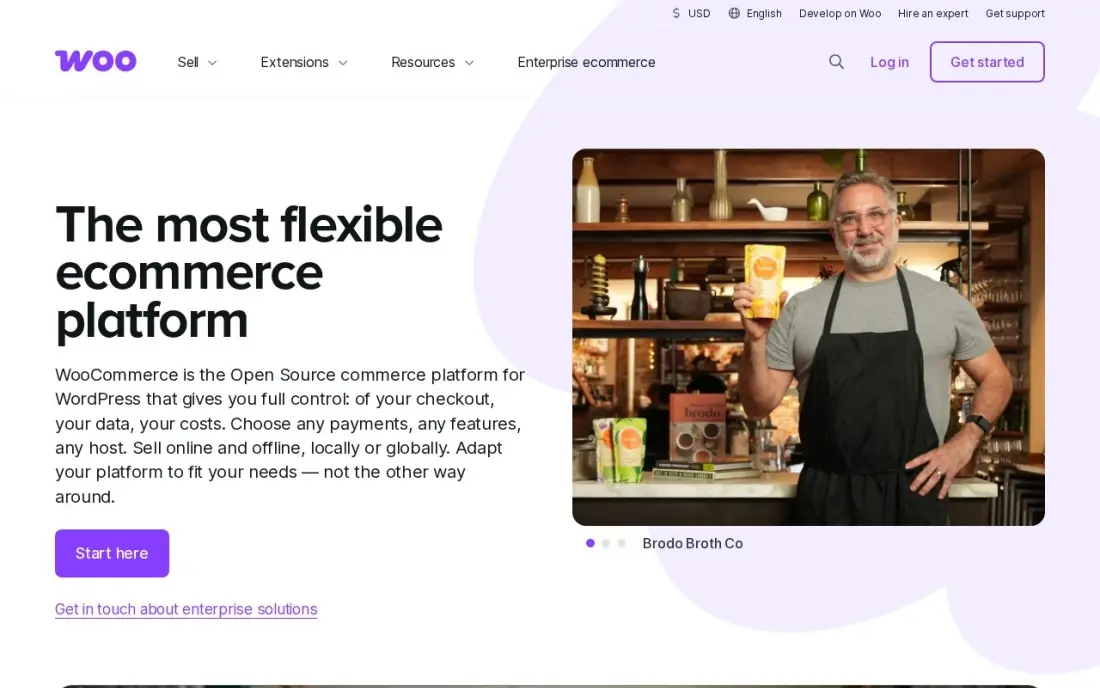
WooCommerce can act as a multi-channel hub for a WordPress business: extensions connect it to marketplaces, social shops and Google, and the plugin itself is free with no share of revenue. With more than 7 million installations, connectors exist for most channels and inventory tools.
Every connector is another extension at $29 to $299 a year, hosting runs $25 to $350 a month on WooCommerce's estimate, and keeping several sync plugins working after updates is the owner's job. It suits a technical team; others will find Shopify or Sellbrite less work.
What we like
- The plugin itself is free and open source, with no licence fee and 0% revenue share
- More than 7 million active installations, so almost every ecommerce tool already integrates with it
- Full control over design, checkout and customer data, with no platform branding anywhere
- Subscriptions, bundles and memberships are available through extensions
Watch out for
- Hosting, security and updates are the owner's job, not the platform's
- The real cost is hosting at $25-$350 a month plus paid extensions at $29-$299 a year each
- No hosted support team to call when checkout breaks at midnight

Adobe Commerce
Best for: Large businesses running several brands, regions or B2B and B2C stores from one installation
Adobe Commerce suits the multiple-stores problem at scale: separate brands, country sites and B2B and B2C storefronts can run from one installation with shared catalogs and personalized pricing. It handles very large catalogs and high traffic, and gives full control of URLs and structured data for each store.
It is enterprise software with an enterprise bill. Adobe publishes no list price, third-party estimates put licences well into five figures a year, and changes need developers. Choose it only when several stores with different prices, catalogs and rules genuinely need one shared backend.
What we like
- Deep customization: custom product types, pricing logic, checkout flows and B2B workflows like quotes and approvals
- Handles very large catalogs and high traffic, with company accounts, shared catalogs and personalized pricing built in
- Full control of URLs, metadata and schema, with no platform-imposed structure
Watch out for
- No published price — you need a sales consultation, and third-party estimates put licences well into five figures a year before hosting and development
- Needs developers for setup and ongoing maintenance; routine changes are slower and more expensive than on a hosted platform
The best multi-channel ecommerce platform keeps one catalog and one stock count in step across your own store, marketplaces, social shops and physical locations, so you never sell the same last item twice. We compared eight platforms — channel hubs, a marketplace listing tool, an inventory system, POS systems and enterprise multi-store software — and every price below comes from the vendor's own pricing page as checked in November 2026. This guide also covers the related question of running multiple stores.
How to choose the best multi-channel ecommerce platform
- Decide where stock lives. Pick one system as the master stock count — the store platform, an inventory tool or the POS — and make every other channel read from it.
- Check sync speed. A sync every 2 hours is fine for slow items and dangerous for fast ones. Find the interval on the plan you will buy, not the top tier.
- Count orders across all channels. Order-capped plans count every channel's orders, and sales thresholds count every channel's revenue.
- List your channels honestly. Amazon, eBay, Etsy, TikTok, Instagram, Google and a physical shop each need a connector. Confirm each one exists and what it costs.
- Separate channels from stores. Selling one brand in many places is multi-channel; running separate brands or country sites is multi-store, and the pricing works differently.
- Plan returns across channels. A return from one marketplace must go back into the stock every other channel sees.
Every extra channel creates another copy of your product pages, and duplicate content can split search visibility. Our guide to SEO for ecommerce explains how to keep your own store as the version Google ranks, and our SEO audit finds duplicate and thin product pages.
Multi-channel ecommerce platforms pricing: what you will actually pay
Take a seller with a Shopify store doing 400 orders a month in total across the store, Amazon and eBay. Shopify Basic costs $39 a month billed monthly or $29 billed annually, $468 or $348 a year. Adding Sellbrite for the marketplaces at that volume means Pro 500 at $79 a month billed annually, $948 a year, plus $19 a month if FBA inventory is involved.
If the seller instead runs stock from Zoho Inventory, Standard at $29 a month billed annually, or $348 a year, covers up to 500 orders and three users, and adding staff costs nothing because pricing is per organization. Pass 500 orders and the next tier applies.
A shop selling in person and online can start at $0 on Square for Retail's free plan, with Plus at $49 a month per location, $588 a year, for purchase orders and supplier management. Running several shops on Lightspeed Retail starts at $89 a month billed annually for one register and one location, with each extra register at $59 a month.
Know the difference: multi-channel vs multi-store
Multi-channel means one business selling the same products in many places: its website, Amazon, eBay, Etsy, Instagram, TikTok and a shop counter. The hard problems are stock sync, listing formats for each channel and keeping prices consistent, and tools such as Sellbrite, Zoho Inventory and Shopify's channel connectors solve them.
Multi-store means running more than one storefront: separate brands, separate country sites with their own currency and language, or a B2B site beside a consumer one. The hard problems there are shared catalogs, different prices per store and admin overhead. Each extra Shopify store is a separate plan, while Adobe Commerce and BigCommerce's multi-storefront feature run several storefronts from one backend.
Quick comparison: tool type by need
| Buyer | Best pick | Why |
|---|---|---|
| Most multi-channel brands | Shopify | One stock pool across web, social, AI chats and POS, from $39/month |
| Built-in channel features | BigCommerce | Multi-currency and multi-storefront options, Core $39/month |
| Adding marketplaces | Sellbrite | Unlimited channels, free up to 30 orders/month |
| Stock control above channels | Zoho Inventory | Free for 50 orders, per-organization pricing |
| Shop plus website on a budget | Square for Retail | Free plan with POS and online store |
| Several physical stores | Lightspeed Retail | Stock transfers between locations, $89/month billed annually |
| WordPress sellers | WooCommerce | Free plugin, channel connectors as extensions |
| Several brands from one backend | Adobe Commerce | Multiple storefronts and shared catalogs, by quote |
Mistakes to avoid
- Running two masters for stock. If the store and an inventory tool both think they own stock, they will overwrite each other. Choose one source of truth.
- Buying the free tier for a fast seller. A 2-hour sync on a product that sells every few minutes guarantees oversells and marketplace penalties.
- Copying the same description everywhere. Identical text on every marketplace competes with your own store in search. Write a distinct description for your site.
- Forgetting marketplace fees in pricing. A price that works on your store may lose money after marketplace commission. Set prices per channel.
- Opening a second store when a second channel would do. A separate store doubles admin. Only split when brands, currencies or customers genuinely differ.
How we chose
We checked each vendor's own pricing page in November 2026 and recorded the starting price exactly as shown, including annual-billing figures where the page lists one. We compared where each tool keeps stock, how fast it syncs, which channels it covers and how its price grows with orders or sales, and ranked them by fit for the most common buyer: a brand with its own store adding marketplaces and social channels. Adobe Commerce publishes no price, so we list it as custom quote. Ratings come from G2 pages where we checked them, on the dates shown in the sources. No vendor paid for a place in this list, and none of the links here are affiliate links.
What to do next
List every channel you sell on today and the one you want next, then note where your stock count lives. Start a free plan on Sellbrite or Zoho Inventory and connect one marketplace for a month before adding the rest. If more channels mean your own store is losing search traffic, book a free review.
Frequently asked questions
What is the best multi-channel ecommerce platform?
Shopify is the best fit for most brands, with one catalog and stock pool across the store, social, AI chats and POS from $39 a month or $29 billed annually. Sellbrite is the cheapest way to add marketplaces, with a free plan up to 30 orders a month.
How do I sell on Amazon, eBay and my own store at the same time?
Use a listing and sync tool such as Sellbrite, or an inventory system such as Zoho Inventory, so one stock count feeds every channel. Without a sync tool, the same item will sell twice when stock runs low.
What is the best ecommerce platform for multiple stores?
For several physical shops, Lightspeed Retail handles stock transfers between locations. For several online brands or country sites, Adobe Commerce runs multiple storefronts from one installation, and BigCommerce offers multi-storefront selling. Each extra Shopify store is billed as its own plan.
How much does multi-channel selling software cost?
Sellbrite starts free for 30 orders a month, with Pro 100 at $29 a month billed annually. Zoho Inventory is free for 50 orders, with Standard at $29 a month billed annually. Shopify Basic and BigCommerce Core cost $39 a month, or $29 billed annually.
How often should inventory sync between channels?
As often as possible for fast-moving items. Sellbrite's paid plans sync every 15 minutes and its free plan every 2 hours. Platforms with one built-in stock pool, such as Shopify, update every connected channel as each sale happens.
What is the difference between multi-channel and omnichannel?
Multi-channel means selling in several places. Omnichannel means those places share one customer record, one stock pool and consistent pricing, so a customer can buy online and return in store.
Sources we checked (14)
- Shopify — shopify.com/pricing (checked November 12, 2026)
- Shopify reviews on G2 (checked November 12, 2026)
- BigCommerce — www.bigcommerce.com/pricing (checked November 12, 2026)
- Sellbrite — www.sellbrite.com/pricing-pro (checked November 16, 2026)
- Zoho Inventory — www.zoho.com/us/inventory/pricing (checked November 10, 2026)
- Zoho Inventory reviews on G2 (checked November 10, 2026)
- Square for Retail — squareup.com (checked November 10, 2026)
- Square for Retail reviews on G2 (checked November 10, 2026)
- Lightspeed Retail — www.lightspeedhq.com/pricing (checked November 10, 2026)
- Lightspeed Retail reviews on G2 (checked November 10, 2026)
- WooCommerce — woocommerce.com/pricing (checked November 12, 2026)
- WooCommerce reviews on G2 (checked November 12, 2026)
- Adobe Commerce — business.adobe.com/products/magento/magento-commerce.html (checked November 1, 2026)
- Adobe Commerce reviews on G2 (checked November 1, 2026)
Make one of these tools?
We re-check this list every quarter. Send a correction, request a review, or ask about a clearly labeled sponsored spot.
Request a listingShamim
Founder of SerpAstra
A full-stack SEO and digital marketer who spends most days on Local SEO for dental practices, AI search visibility and lead generation.
Free SEO and AI visibility audit
Find out what is holding your rankings back
Send us your site. Within 2 business days you get a written audit, an AI visibility check and a short fix list ranked by impact. Free, with no contract attached.
Request my free audit→Related buying guides
 EcommerceBest Cross Posting Apps for Resellers (2026): 9 Apps Worth DownloadingCompare the 9 best cross posting app for resellers options on price, free plans, marketplaces and auto-delist, with every price checked November 4, 2026.Read guide →
 Logistics, Supply Chain & Procurement10 Best Inventory Management Software Small Business in 2026, Compared10 best inventory management software small business picks compared with real 2026 prices, free plans and order limits, so you can choose by volume.Read guide →
 Retail, Restaurants & Hospitality7 Best Retail Software for Small Business in 2026, ComparedCompare the 7 best retail software for small business options on price, inventory and hardware, with every price checked on November 10, 2026.Read guide →