
12 Best Newspaper Platforms for 2026 (Pros, Cons and Pricing)
Compare the 12 best newspaper platform options for local publishers on price, free plans and paywalls, with every price checked November 12, 2026.
 Shamim Mia, Founder, SerpAstraLast verified November 12, 202614 min read
We compare pricing pages, documentation and public reviews. We never accept payment for rankings.

Key takeaways
- WordPress leads for most small papers at $0 for the software, with Ghost from $18 a month and Substack free with a 10% cut of paid subscriptions.
- The single most important buying factor is the revenue model: a flat monthly fee beats a percentage cut once paid subscriptions pass a few hundred dollars a month.
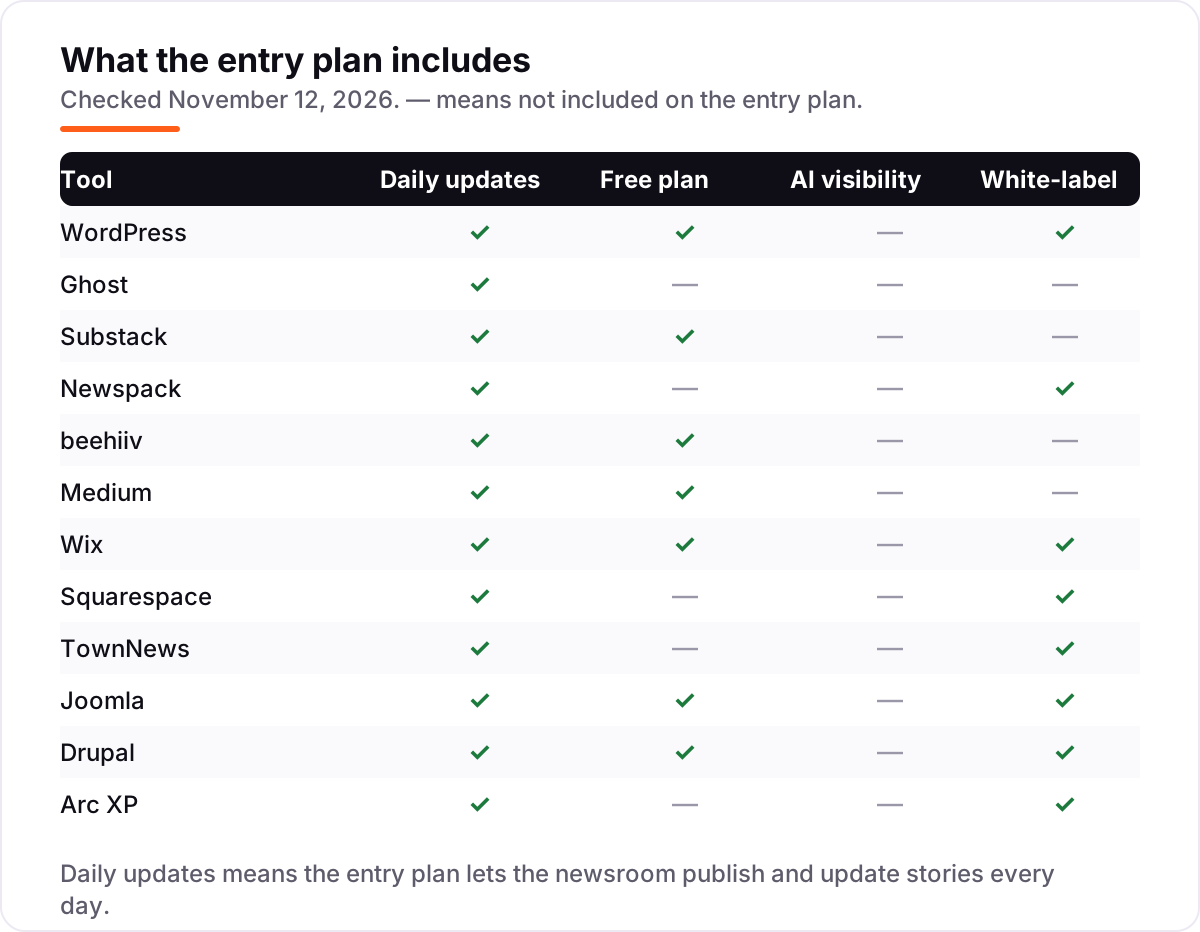
- Five of the 12 tools cost $0 to start — WordPress, Substack, Medium, Joomla and Drupal — but hosting, paywall plugins and card processing still cost money.
- Every price below was checked on the vendor's own pricing page on November 12, 2026. Ratings are G2, with review counts shown.
On this page
Quick comparison
| Tool | Best for | Starting price | Free plan |
|---|---|---|---|
| WordPress | Small newspapers that want full ownership and the biggest plugin and theme choice | Free; Personal $9/mo | Yes (free software) |
| Ghost | Independent papers that want a fast site, newsletters and memberships in one place | $18/mo | No (14-day trial) |
| Substack | Solo writers and small papers that want paid subscriptions with zero upfront cost | Free; 10% of paid subs | Yes (free plan) |
| Newspack | Established local news outlets that want hosting, paywall and support bundled | $750/mo | No (paid only) |
| beehiiv | Newsletter-first papers that want growth tools and a 0% revenue cut | Free; Lite $59/mo | Yes (free plan) |
| Medium | New writers and columnists who want built-in discovery | Free; Member $5/mo | Yes (free plan) |
| Wix | Small papers that want a drag-and-drop site up fast with no code | $24/mo | Yes (free plan) |
| Squarespace | Design-led papers that want a polished site with no maintenance | $25/mo | No (14-day trial) |
| TownNews | Local US news groups and TV stations that want a purpose-built newsroom system | Custom quote | No (demo only) |
| Joomla | Multilingual community papers that want more built in than WordPress | Free | Yes (free software) |
| Drupal | Large or complex papers with structured content and strict access rules | Free | Yes (free software) |
| Arc XP | Large national publishers that need one system for print, web and apps | Custom quote | No (demo only) |
Make one of these tools?
We re-check this list every quarter. Send a correction, request a review, or ask about a clearly labeled sponsored spot.
Request a listingThe best newspaper platform

WordPress
Best for: Small newspapers that want full ownership and the biggest plugin and theme choice
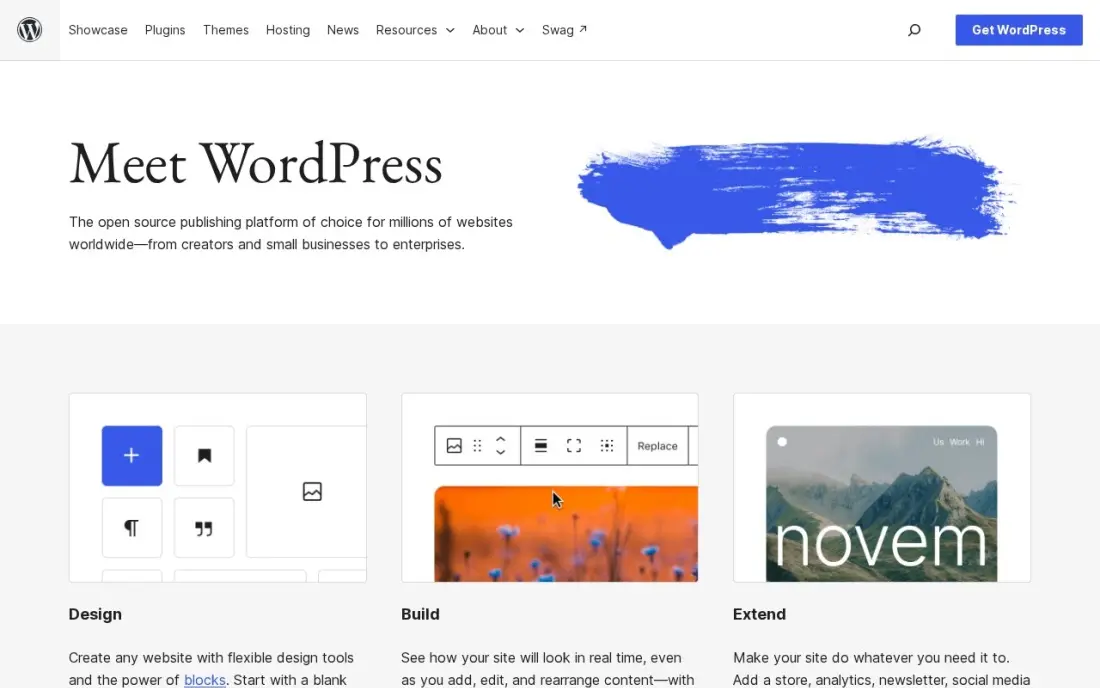
WordPress is the default answer for a small newspaper, and the reason is simple: the software costs $0, and nothing else in this list matches its ecosystem. News themes, paywall plugins such as Leaky Paywall and MemberPress, newsletter tools, classifieds and events all exist already, so a weekly paper can add subscriptions. The site is yours — export it and move hosts any time.
The catch is that free software is not a free newspaper. Hosting runs a few dollars a month, a good news theme costs money, and security, updates and backups fall on you or your host. WordPress.com's hosted Personal plan is $9 a month billed monthly, or $4 billed annually, if you would rather not manage a server. Pick WordPress when you want control and the widest choice; pick Ghost when you want the paywall built in.
What we like
- Free software with no licence fee at any size
- The largest theme and plugin ecosystem, including news themes and paywall plugins
- Full data ownership — export the whole site and move it any time
- Scales from a one-person weekly to a metro daily
Watch out for
- Hosting, security, updates and backups are your job, not the vendor's
- Selling subscriptions needs a paywall or newsletter plugin on top
- Design quality depends on the theme — cheap themes look cheap

Ghost
Best for: Independent papers that want a fast site, newsletters and memberships in one place
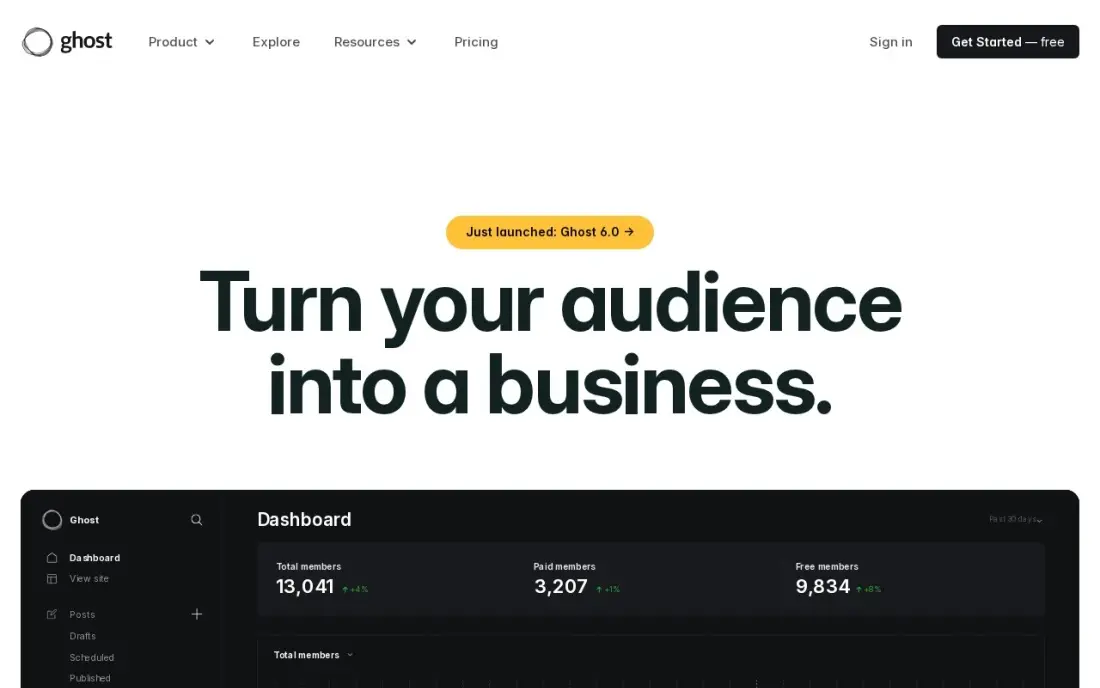
Ghost is the cleanest publishing tool in this list: a fast website, an email newsletter and paid memberships in one product, with no plugins to install and no page builder to fight. Ghost takes 0% of subscription revenue, so every dollar a reader pays stays with the paper apart from Stripe's card fees. Starter is $18 a month billed monthly, or $15 billed annually, for up to 1,000 members.
Read the plan limits before you buy. Starter cannot sell paid subscriptions at all — that needs Publisher, from $35 a month billed monthly or $29 billed annually — and Starter allows one staff user and official themes only. Prices also rise as the member count grows. Pick Ghost when the paper is a newsletter-led publication; pick WordPress when you need a bigger team and a wider plugin shelf.
What we like
- Takes 0% of subscription revenue on every plan
- Newsletters, memberships and the site in one product — no plugins needed
- A fast, clean editor built for publishing, not for page building
- Free to self-host if you run your own server
Watch out for
- Starter cannot sell paid subscriptions — that needs Publisher from $35/month billed monthly ($29/month billed annually)
- The price rises with member count, not just with features
- One staff user and official themes only on Starter

Substack
Best for: Solo writers and small papers that want paid subscriptions with zero upfront cost
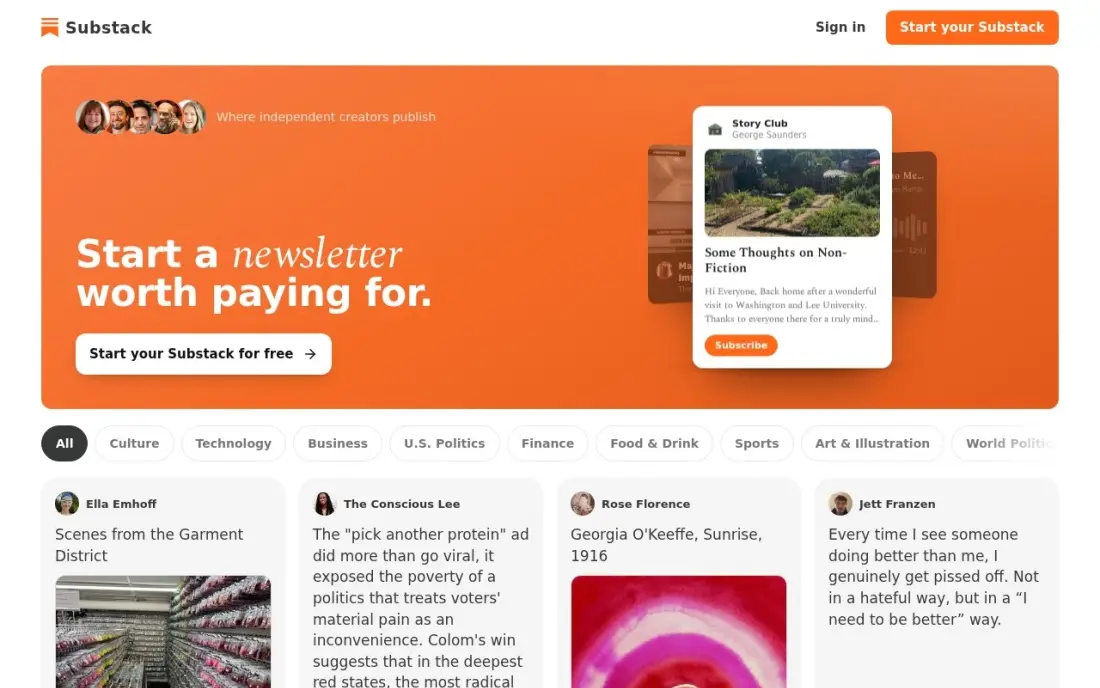
Substack is the fastest way for a writer or a tiny paper to start charging readers: publishing, sending, podcast and video hosting are free at any list size, and turning on paid subscriptions is a switch, not a project. Readers pay through your own Stripe account, and Substack takes 10% of each payment plus Stripe's fees of about 2.9% plus $0.30. There is no monthly bill.
The 10% is the whole business model, and it never falls. A paper earning $5,000 a month from paid subscriptions hands Substack $500 of it, every month, forever — at that point Ghost's flat $29 or beehiiv's $49 costs far less. There is also no real website builder and no subscriber list you fully own. Pick Substack to start earning this week; move when the 10% costs more than a flat fee.
What we like
- $0 to start, with no subscriber cap and no send limit
- Paid subscriptions are a switch, not a project
- Built-in recommendations bring new readers to the publication
- A custom domain is available for a one-time $50
Watch out for
- The 10% cut never falls — no tier lowers it as you grow
- Your publication lives inside Substack's branding and discovery rules
- It is a newsletter first — there is no real website builder

Newspack
Best for: Established local news outlets that want hosting, paywall and support bundled
Newspack is WordPress packaged for news by Automattic: hosting with 200 GB of storage, free migration, a staging site, advertising tools, newsletter tools and a metered paywall with tiered subscriptions, all on one monthly bill, plus a designated technical account manager. Pricing follows revenue — $750 a month for publications under $300,000 a year, $1,500 up to $600,000 and $2,500 up to $1 million.
The floor is the problem for a small paper: $9,000 a year before a single subscription is sold, and the price rises as the paper earns more. The platform also restricts you to an approved plugin list, so you cannot extend it the way plain WordPress allows. Pick Newspack when the outlet is established and wants support bundled; a startup weekly gets the same WordPress base for $0 plus hosting.
What we like
- WordPress pre-configured for news — ads, newsletter and a metered paywall included
- Hosting, migration, a staging site and a dedicated account manager bundled
- Backed by the Google News Initiative, the Knight Foundation and the Lenfest Institute
- No pageview limits stated on the pricing page
Watch out for
- The $750/month floor is $9,000 a year before the paper earns a dollar
- The price rises with revenue — $1,500, then $2,500 a month
- A restricted plugin list — you cannot extend the platform freely

beehiiv
Best for: Newsletter-first papers that want growth tools and a 0% revenue cut
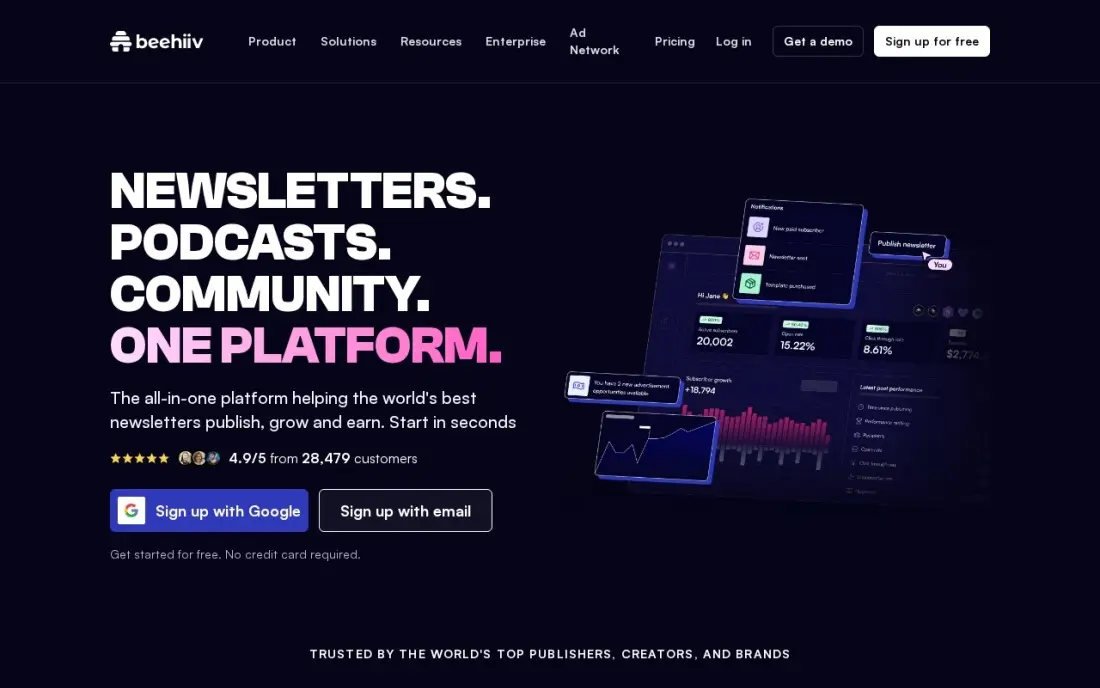
beehiiv is built for publishers whose product is the newsletter: a website, unlimited sends on every plan, and from Lite a referral program, an ad network and paid subscriptions with a 0% beehiiv cut. The free plan covers up to 2,500 subscribers, and Lite starts at $59 a month billed monthly, or $49 billed annually, for up to 1,000 subscribers. Only Stripe's card fees come off subscription revenue.
The price follows the list, not the features. Lite climbs to $139 a month at 10,000 subscribers and $469 at 100,000, so a growing paper should price the list it will have next year, not the one it has today. The free plan also blocks paid subscriptions and the ad network. Pick beehiiv when email is the paper; pick WordPress or Ghost when the website comes first.
What we like
- Free plan covers 2,500 subscribers with unlimited sends
- Lite takes 0% of paid subscription revenue
- An ad network and a referral program are built in from Lite
- Priced by subscribers, not by sends
Watch out for
- The paid price climbs with list size — $139/month at 10,000 subscribers on Lite
- The free plan blocks paid subscriptions and the ad network
- No print workflow — it is email-first, not a full newspaper CMS

Medium is the easiest way to get a story in front of strangers: publishing is free, the editor is clean, and the recommendation feed and human-curated Boost do the distribution work a new paper cannot do alone. Publications let several writers share one masthead, and the Partner Program pays from how long paying members read. A membership costs $5 a month or $50 a year and unlocks the Partner Program and a custom domain.
The trade is ownership. There is no subscriber list to export, no paywall you control, and earnings depend on a payout formula Medium has changed several times. A paper that lives only on Medium is renting its audience. Pick Medium for a column or a new voice finding readers; build the paper itself on WordPress or Ghost, where the list belongs to you.
What we like
- Free to publish with a clean editor and a built-in audience
- Publications group writers under one masthead
- The Partner Program pays from member reading time
- No hosting, security or maintenance work at all
Watch out for
- You do not own the audience — there is no subscriber list to export
- A custom domain and the Partner Program need the $5/month membership
- Earnings depend on Medium's changing payout formula

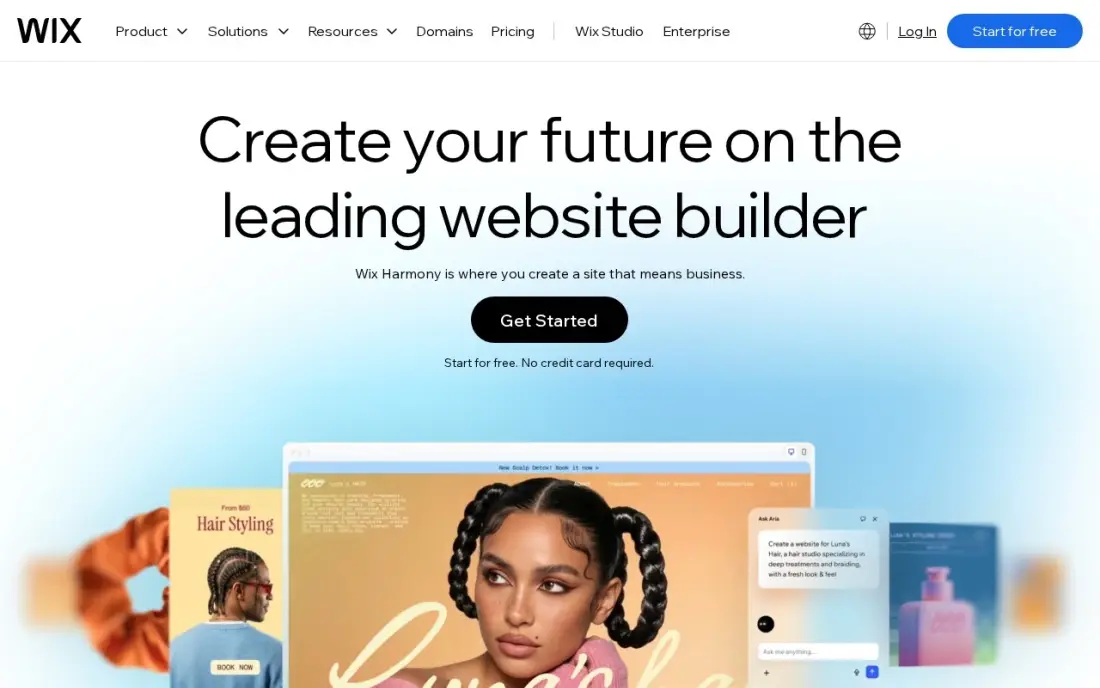
Wix is the fastest route to a working news site: pick a template, drag the layout into shape and publish, with no code and no server to manage. The free plan works for a trial run, and Light at $24 a month billed monthly, or $17 billed annually, removes Wix ads and connects a custom domain. A blog, SEO tools and member areas come with the site.
Light cannot take payments, so a paper that sells subscriptions needs Core at $36 a month billed monthly, or $29 billed annually — and the monthly-billing figures come from Wix's own blog and checkout, not its plans page, which shows annual prices only. Wix also has no real newsroom workflow for editions and approvals. Pick Wix for speed; pick WordPress when the newsroom outgrows a page builder.
What we like
- The fastest setup here — drag-and-drop, no code
- Light removes Wix ads and connects a custom domain
- Blog, SEO tools and member areas are built in
- A 14-day money-back guarantee on premium plans
Watch out for
- Light cannot take payments — selling subscriptions needs Core at $36/month billed monthly ($29/month billed annually)
- Monthly billing costs about 40% more than annual billing
- Newsroom workflows such as editions and role-based approval are not its strength

Squarespace
Best for: Design-led papers that want a polished site with no maintenance
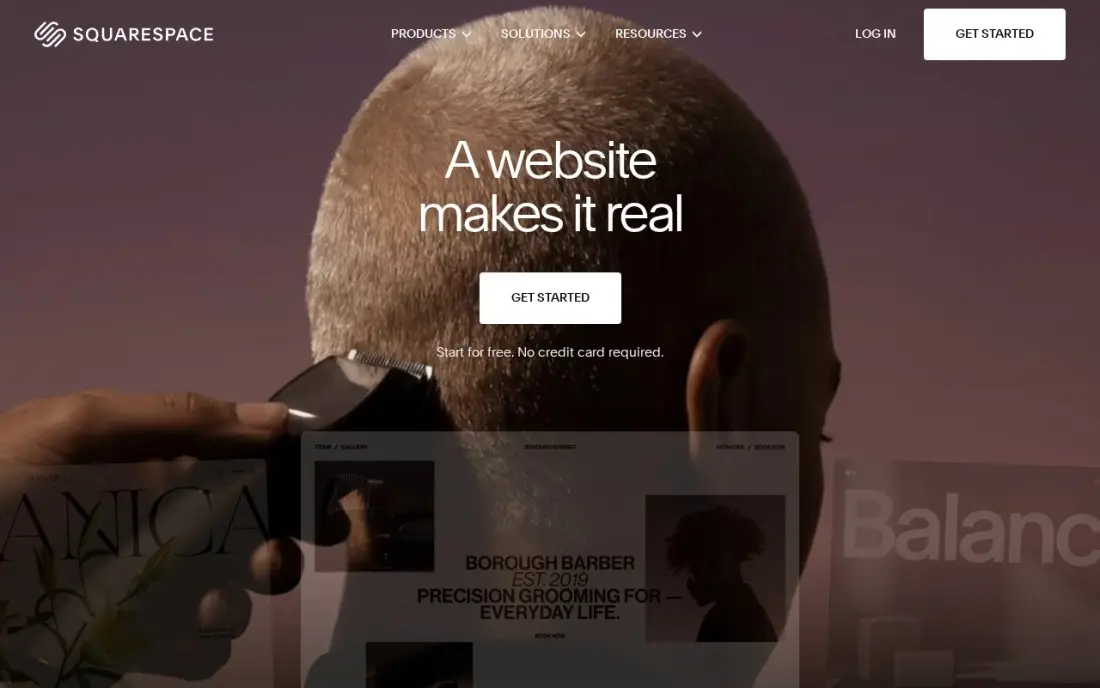
Squarespace makes the best-looking paper in this list with the least work: pick a template, drop in the stories, and the site looks designed. Basic is $25 a month billed monthly, or $19 billed annually, and covers hosting, SSL, analytics, blogging, newsletters and member areas, with a free custom domain for the first year on annual plans. The 14-day trial needs no credit card.
There is no free plan, so the meter runs from day one, and Basic takes 2% of store sales and 7% of digital content and memberships on top of card processing. A real paywall needs a workaround, and exports leave out store and portfolio pages. Pick Squarespace when the paper's look matters most; pick Ghost when subscriptions are the business.
What we like
- The best-looking templates here, with no design work needed
- Hosting, SSL, analytics and a free domain for a year on annual plans
- Blogging, newsletters and member areas in one editor
- A 14-day trial that needs no credit card
Watch out for
- No free plan — you pay from day one
- Basic charges 2% on store sales and 7% on digital content and memberships
- Paywall and newsroom workflows need workarounds

TownNews
Best for: Local US news groups and TV stations that want a purpose-built newsroom system
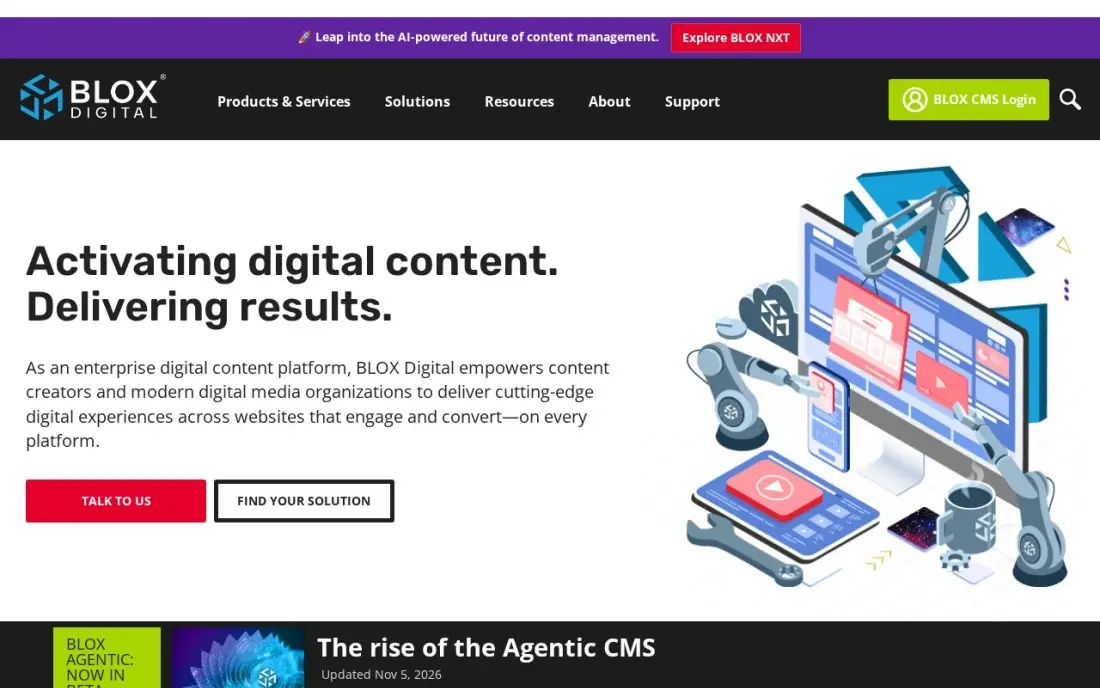
TownNews owns the local news niche in the United States. Its BLOX platform serves more than 2,000 local news organizations — newspapers, TV stations and digital-only local outlets — with tools tuned for community publishing: local advertising, events, obituaries and broadcast integration. It is hosted, so the newsroom never touches a server, and its relationship with Lee Enterprises gives it deep roots in American local media.
Pricing is by custom quote, and that is the first thing to settle: there is no published price, implementation takes months and real internal resources, and the platform assumes you have product and engineering staff. Total costs run into five figures a year once implementation and support are included. Pick TownNews when you run local news at group scale; a single weekly paper will find WordPress or Newspack cheaper.
What we like
- Serves more than 2,000 local news organizations across all 50 US states
- Newsroom tools built in — obituaries, events, local ads and broadcast integration
- Deep roots in US community publishing through Lee Enterprises
- Hosted, so there is no server work for the newsroom
Watch out for
- No published price — the budget is clear only after a sales call
- Implementation takes months and real internal resources
- Quote-based pricing can run into five figures a year

Joomla
Best for: Multilingual community papers that want more built in than WordPress
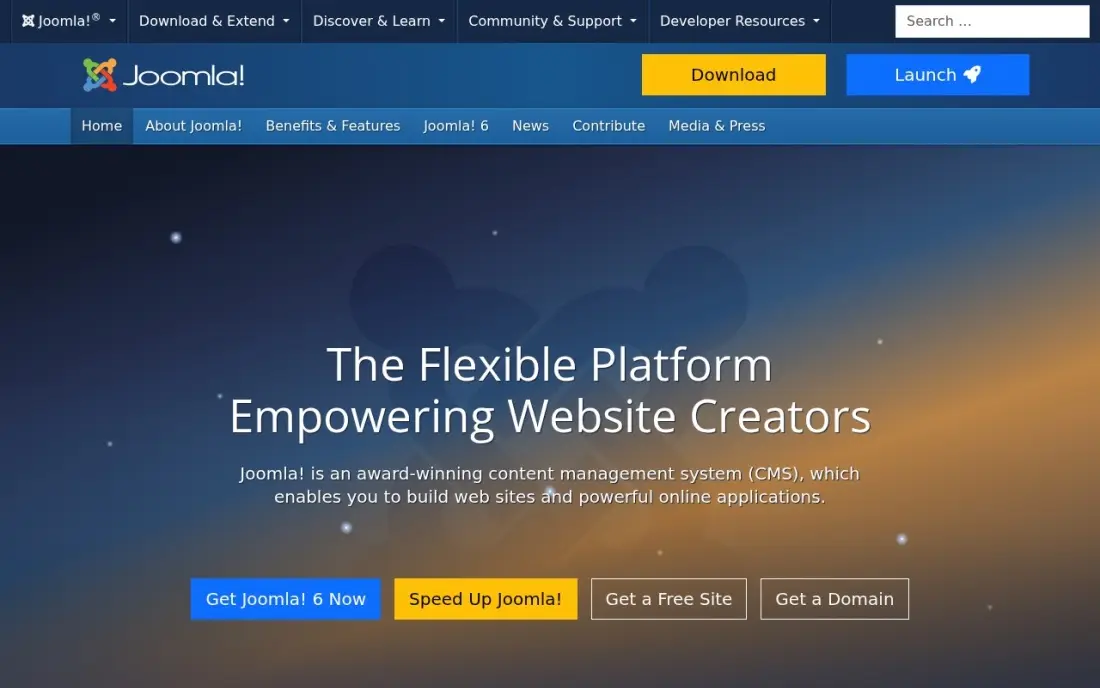
Joomla sits between WordPress and Drupal: more built in than WordPress, easier to learn than Drupal. It is free, open-source software under the GPL, with no licence fee at any size. Multilingual content and access control come with the core, not a plugin, which matters for a community paper publishing in two languages or running member-only sections. Thousands of extensions add paywalls, events and classifieds.
The trade is ecosystem size. Joomla's theme and extension market is far smaller than WordPress's, so a specific news feature may need a paid extension or custom work. It also needs more learning than a hosted builder, and security and updates are yours. Pick Joomla for a multilingual community paper; pick WordPress when you want the widest plugin shelf.
What we like
- Free, GPL software with no licence fee at any size
- Multilingual content and access control built in — no plugin needed
- Thousands of extensions for paywalls, events and classifieds
- Runs on the same cheap hosting as WordPress
Watch out for
- A smaller theme and extension market than WordPress
- A steeper learning curve than a hosted builder
- The most useful extensions carry their own licence fees

Drupal
Best for: Large or complex papers with structured content and strict access rules
Drupal is the heavy-duty free CMS in this list, and it earns its place on depth: content types, Views and APIs let a paper model sections, editions, beats and archives as structured data, with access control fine enough for a large newsroom. There are no licensing fees, ever, and it powers large publishers and government sites with a strong security record. Publishing to web, app and print from one desk is a real option.
Depth costs skill. Drupal has the steepest learning curve here and needs a developer for setup and upkeep; there is no hosted version with a published price, so you arrange hosting yourself. For a one-person weekly it is overkill. Pick Drupal when the paper is large or complex enough to need its modelling; pick WordPress when a theme and a few plugins will do.
What we like
- Free, open source, with no licensing fees ever
- The deepest content modelling and access control in this list
- Powers large publishers and government sites
- A strong security record and API-first publishing
Watch out for
- The steepest learning curve in this list — it needs a developer
- No hosted version with a price — you arrange hosting yourself
- Overkill for a one-person weekly

Arc XP
Best for: Large national publishers that need one system for print, web and apps
Arc XP is the enterprise tier of this list: a cloud platform built by The Washington Post that puts a CMS, digital asset management, video, subscription tools and a low-code front end in one system, hosted on AWS. It publishes to web, app and print from one desk and serves large media organizations. For a national publisher with dozens of contributors, that single system is the point.
The price is the barrier: Arc XP publishes no rate card, and industry estimates put annual fees from $50,000 to more than $3,000,000, with a median near $400,000 to $500,000 a year. Implementation is a major project, and leaving is hard — content exports are rate-limited. Pick Arc XP only at national scale; every smaller paper in this list costs less in a year than Arc XP costs in a month.
What we like
- Built by The Washington Post for large newsrooms
- CMS, digital asset management, video, subscriptions and front-end in one system
- Multichannel publishing to web, app and print from one desk
- Cloud-hosted on AWS with managed infrastructure
Watch out for
- No published price — estimates run $50,000 to $3,000,000+ a year
- Implementation is a major project with professional services
- Heavy vendor lock-in — content exports are rate-limited
The best newspaper platform for a small paper is the one that fits how it earns money — and the 12 tools below are ranked by fit for the most common buyer, a small US local paper with one site, a handful of staff and a few hundred paying readers, with every price checked on the vendor's own pricing page on November 12, 2026.
How to choose the best newspaper platform
- Start with the revenue model. A flat fee (Ghost $18 a month, beehiiv Lite $59) beats a percentage cut (Substack 10%) once paid subscriptions pass a few hundred dollars a month — work out the crossover before you pick.
- Check what the paywall costs. WordPress needs a paywall plugin, Ghost Starter cannot sell subscriptions at all, and beehiiv's free plan blocks them. The paywall is often a second price, not part of the headline.
- Check who owns the subscriber list. WordPress, Ghost and beehiiv let you export it; Medium and Substack keep the audience inside their system. A list you cannot export is not yours.
- Check the pricing unit. Ghost and beehiiv price by members or subscribers, Newspack by revenue, WordPress by nothing at all. Price the audience you will have next year, not the one you have today.
- Check the newsroom workflow. Editions, roles and approval steps matter once more than two people write. WordPress, Newspack, TownNews and Arc XP have them; Wix and Squarespace do not.
- Think about print. If the paper still prints, ask how stories reach the page. Most tools here are digital-only; Arc XP and TownNews are built for print as well as web.
A platform publishes the paper, but it does not bring readers to it on its own. If the paper is not showing up when people nearby search for local news, our local SEO service covers that side. And before the paper asks readers to share stories, the free SERP snippet preview tool shows how each headline will look in search results.
Whatever you shortlist, try it with real stories before you pay. The trials in this list run 14 to 30 days, which is long enough to publish an edition, send a newsletter and take a real subscription payment. Check two things in the trial: that the paywall actually stops non-subscribers, and that the subscriber list exports cleanly — those are the two things that are painful to fix after launch.
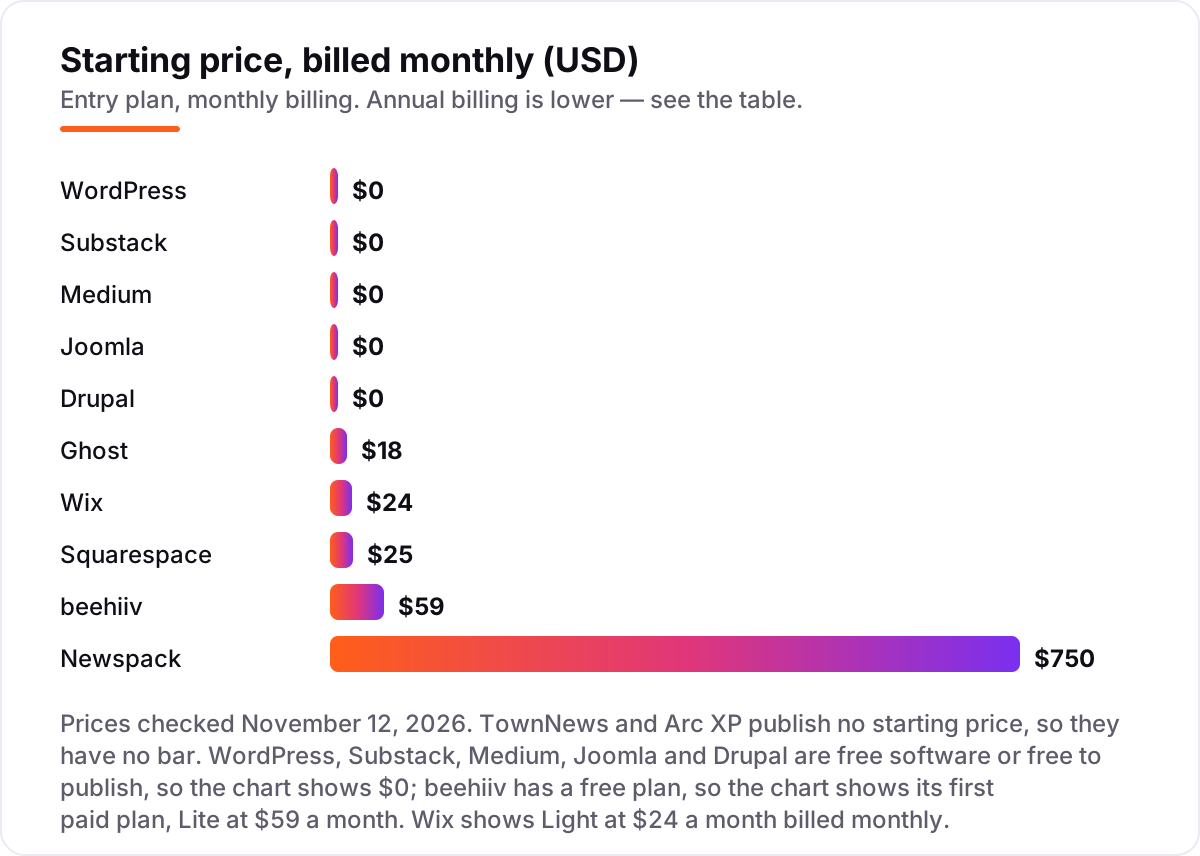
Newspaper platform pricing: what you will actually pay
Take a small weekly paper with one site, three staff and 50 paying readers at $10 a month — $500 a month of subscription revenue. On list prices, the software costs $0 on WordPress (plus a few dollars a month for hosting), $0 on Substack, $0 on Medium, $0 on Joomla and Drupal, $18 a month on Ghost Starter, $24 on Wix Light, $25 on Squarespace Basic, $59 on beehiiv Lite and $750 on Newspack. TownNews and Arc XP have no published price to quote.
Over a year on monthly billing, that is $0 on the free tools, $216 on Ghost Starter, $288 on Wix Light, $300 on Squarespace Basic, $708 on beehiiv Lite and $9,000 on Newspack. Annual billing cuts most of these: Ghost Starter drops to $180 a year, Wix Light to $204, Squarespace Basic to $228 and beehiiv Lite to $588.
Three costs sit outside every number above. First, the revenue cut: on $500 a month of subscriptions, Substack takes $50, and Stripe takes about $29.50 (2.9% plus $0.30 per payment), so the paper keeps about $420.50 of the $500. Second, the paywall: WordPress needs a paywall plugin, and Ghost needs Publisher at $35 a month billed monthly before it can sell subscriptions at all. Third, hosting and email: self-hosted WordPress, Joomla and Drupal need hosting and an email sender, a few dollars a month that the hosted tools include.
Know the difference: a flat fee, a percentage cut and a custom quote
The confusion in this category is the pricing model, not the feature list. A flat fee charges the same every month no matter how much the paper earns: Ghost Starter at $18, beehiiv Lite at $59, Newspack at $750. A percentage cut charges nothing upfront and takes a share of every payment: Substack's 10% of paid subscriptions. A custom quote means the vendor does not publish a price at all: TownNews and Arc XP will only quote after a sales call, and the total runs into five or six figures a year once implementation is included.
The model matters most as the paper grows. At $500 a month of subscription revenue, Substack's 10% costs $50 a month — more than Ghost Starter at $18 and close to beehiiv Lite at $59. At $5,000 a month, Substack costs $500 while Ghost Publisher costs $35 and beehiiv Lite costs $59 at the same list size. The free start is the cheapest way to begin and the most expensive way to stay. Work out the crossover — the monthly revenue where the percentage cut passes the flat fee — and pick the model that fits the revenue you expect in a year, not the revenue you have today.
There is a second, quieter confusion: free software is not a free paper. WordPress, Joomla and Drupal cost $0 for the software, but hosting, a domain, a paywall plugin and email sending all cost money, and your time maintaining the site is the largest cost of all. Budget on the software plus hosting plus the paywall plus card processing, not on the $0 headline.
Quick comparison: tool type by need
| Buyer | Best pick | Why |
|---|---|---|
| Small paper that wants full ownership | WordPress | Free software, widest plugin choice, G2 4.4/5 |
| Independent paper built on newsletters | Ghost | Site, email and memberships in one, 0% revenue cut |
| Solo writer who wants to charge readers now | Substack | Free to publish, 10% only when readers pay |
| Established local outlet that wants support | Newspack | Hosting, paywall and an account manager from $750/month |
| Newsletter-first paper that wants to grow | beehiiv | Free to 2,500 subscribers, 0% cut from Lite at $59/month |
| Local news group or TV station | TownNews | Purpose-built for US local news, custom quote |
Mistakes to avoid
- Budgeting on the subscription alone. Card processing runs about $29.50 a month on $500 of subscriptions, and Substack's 10% adds $50 more. The subscription is the smallest part of the bill once readers start paying.
- Comparing monthly prices without checking billing. The annual price is usually 15–20% lower — Ghost Starter drops from $18 to $15 a month, Wix Light from $24 to $17 — and a few tools have no annual option at all.
- Ignoring the revenue model. A percentage cut is the cheapest way to start and the most expensive way to stay: at $5,000 a month of subscriptions, Substack costs $500 while Ghost Publisher costs $35.
- Buying a platform that cannot sell subscriptions. Ghost Starter and beehiiv's free plan both block paid subscriptions. Check the paywall is on the plan you are actually buying, not on the plan above it.
- Renting your audience. A paper that lives only on Medium or Substack cannot export its subscriber list. If the platform changes its rules, the audience goes with it.
How we chose
We checked each vendor's own pricing page on November 12, 2026 and recorded the starting price exactly as shown, including the annual-billing figure where the page lists one, and we ranked the tools by fit for the most common buyer — a small US local paper with one site, a handful of staff and a few hundred paying readers — not by brand size. Four prices needed extra care. WordPress.com's headline prices are first-year offers: Personal is $4 a month billed annually for the first year and renews higher, and the $9 monthly figure is the month-to-month price. Wix's plans page shows annual prices only, so the $24 Light and $36 Core monthly figures come from Wix's own blog and checkout, as noted in the Wix card. Substack publishes no price table — its help pages state free publishing plus a 10% cut of paid subscriptions, which is the price we record. TownNews and Arc XP publish no price at all, so both are listed as custom quote and carry no figure anywhere in this post. Ratings come from fresh search-index copies of the exact G2 pages, crawled within the last two days: WordPress.org 4.4 from 9,546 reviews, Ghost 4.0 from 40, Wix 4.2 from 1,889 and Squarespace 4.4 from 1,136. The other eight tools show no rating because their G2 or Capterra pages were not verified today. No vendor paid for a place in this list, and none of the links here are affiliate links.
What to do next
Start with the free plan or trial of your top pick and run one real edition through it. Check that the paywall stops non-subscribers, that the newsletter goes out on time and that the subscriber list exports cleanly. If the paper is sorted but new readers are not finding it, our monthly SEO service handles the visibility side — or compare providers in our guide to SEO companies for small business. Once your tools are in place, find out what's holding your rankings back.
Frequently asked questions
What is the best newspaper platform?
WordPress is the best fit for most small papers: the software is free, the plugin and theme choice is the widest, and you own your data. Ghost is the best pick when newsletters and memberships are the business, at $18 a month. Substack is the best way to start charging readers with $0 upfront.
How much does a newspaper platform cost?
Most small papers pay $0 to $59 a month for the software. WordPress, Substack, Medium, Joomla and Drupal cost $0 to start, Ghost is $18 a month and beehiiv Lite is $59. Newspack starts at $750 a month, and TownNews and Arc XP price by custom quote.
Is there a free newspaper platform?
Yes. WordPress, Joomla and Drupal are free open-source software, and Substack and Medium are free to publish on. The software is free, but hosting, a domain, paywall plugins and card processing still cost money, so budget a few dollars a month even on a $0 platform.
What is the difference between WordPress.org and WordPress.com?
WordPress.org is the free software you install on your own hosting, with full control over themes, plugins and data. WordPress.com is Automattic's hosted version: the free plan carries ads, and Personal is $9 a month billed monthly or $4 billed annually, with hosting and maintenance included.
Can I sell subscriptions on a free platform?
Yes, but the cost model differs. Substack is free and takes 10% of paid subscriptions. WordPress is free software and needs a paywall plugin, which may cost extra. Ghost Starter cannot sell paid subscriptions at all — that needs Publisher from $35 a month billed monthly.
How do I move my newspaper to a new platform?
Export your stories, images, subscriber list and member data first, then import them into the new platform and test the site before going live. Keep the old site running until the new one is proven, because a mid-week switch is how archives and subscriber logins get lost.
What should a small local paper check before paying for a newspaper platform?
Check how the price grows with your audience, whether the paywall is included or an extra plugin, and who owns the subscriber list. Then run the trial with real stories: publish an edition, take a real subscription payment, and confirm the paywall and the newsletter both work.
Sources we checked (16)
- WordPress.com pricing — wordpress.com/pricing (checked November 12, 2026)
- WordPress.org on G2 — 4.4/5, 9,546 reviews (checked November 12, 2026)
- Ghost pricing — ghost.org/pricing (checked November 12, 2026)
- Ghost on G2 — 4.0/5, 40 reviews (checked November 12, 2026)
- Substack pricing — substack.com/pricing (checked November 12, 2026)
- Newspack pricing — newspack.com/pricing (checked November 12, 2026)
- beehiiv pricing — beehiiv.com/pricing (checked November 12, 2026)
- Medium plans — medium.com/plans (checked November 12, 2026)
- Wix plans — wix.com/plans (checked November 12, 2026)
- Wix on G2 — 4.2/5, 1,889 reviews (checked November 12, 2026)
- Squarespace pricing — squarespace.com/pricing (checked November 12, 2026)
- Squarespace on G2 — 4.4/5, 1,136 reviews (checked November 12, 2026)
- TownNews — townnews.com (checked November 12, 2026)
- Joomla — joomla.org (checked November 12, 2026)
- Drupal — drupal.org (checked November 12, 2026)
- Arc XP — arcxp.com (checked November 12, 2026)
Make one of these tools?
We re-check this list every quarter. Send a correction, request a review, or ask about a clearly labeled sponsored spot.
Request a listingShamim
Founder of SerpAstra
A full-stack SEO and digital marketer who spends most days on Local SEO for dental practices, AI search visibility and lead generation.
Free SEO and AI visibility audit
Find out what is holding your rankings back
Send us your site. Within 2 business days you get a written audit, an AI visibility check and a short fix list ranked by impact. Free, with no contract attached.
Request my free audit→Related buying guides
 SEO & AI Search VisibilityBest CMS for SEO in 2026: 8 Options Ranked and Reviewed8 best CMS for SEO compared with real 2026 prices, free plans and SEO controls. WordPress, Webflow, Shopify and more, ranked by fit for a small business site.Read guide →
 Website Builders & Hosting12 Best Blogging Platforms for SEO in 2026 (Pros, Cons and Pricing)Compare the best blogging platform for SEO for your budget: 12 platforms ranked on price, SEO controls and ownership, from free WordPress to Ghost and Webflow.Read guide →
 Marketing9 Best Newsletter Platforms for 2026 (Pros, Cons and Pricing)Compare the 9 best newsletter platforms on price, free plans, automation and monetization, with every starting price checked November 6, 2026.Read guide →