
8 Best Omnichannel Advertising Tools in 2026 (Free and Paid, Compared)
Compare the 8 best omnichannel advertising tools on price, channels and automation, with every price checked November 5, 2026 — from free to enterprise DSPs.
 Shamim Mia, Founder, SerpAstraLast verified November 5, 202613 min read
We compare pricing pages, documentation and public reviews. We never accept payment for rankings.

Key takeaways
- AdRoll is the only free entry here — its Ads plan costs $0 plus media — while AdEspresso, Birch and Madgicx all start at $45–$49 a month and Optmyzr starts at $299.
- StackAdapt, Smartly and Criteo publish no starting price at all: StackAdapt has no minimum spend, Smartly and Criteo are quoted per customer after a demo or sales call.
- Price follows ad spend, not seats, on most of these tools — Birch, Madgicx and Optmyzr all raise the bill as your managed spend grows, so the entry price is only the price at the lowest spend tier.
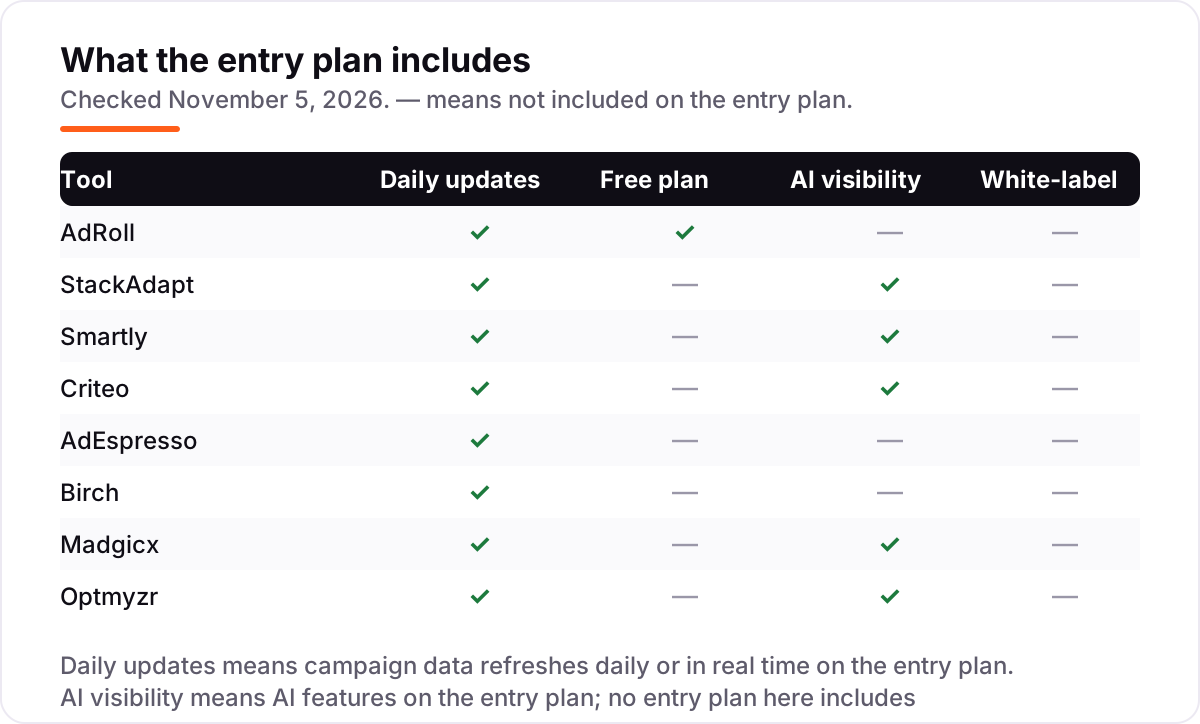
- The automation tier matters more than the headline price: Birch's $49 Essential plan has no automated rules at all, and those arrive only on Pro at $99 a month.
On this page
Quick comparison
| Tool | Best for | Starting price | Free plan |
|---|---|---|---|
| AdRoll | Ecommerce brands and small teams that want retargeting, display, video, social and connected TV ads from one free-to-start platform | Free | Yes (free plan) |
| StackAdapt | Agencies and brands buying programmatic display, native, video, CTV, audio, DOOH and in-game inventory from one self-serve DSP | Custom quote | No |
| Smartly | Enterprise brands running creative production and media buying across a dozen social and programmatic channels | Custom quote | No |
| Criteo | Ecommerce brands and retailers that want AI-driven retargeting and commerce audiences across the open web, social, video and CTV | Custom quote | No |
| AdEspresso | Small businesses and freelancers running Facebook and Instagram ads who want fast split testing and simple automation | $49/mo | No (14-day trial) |
| Birch | Performance marketers who want transparent, auditable automation rules across Meta, Google, TikTok and Snapchat | $49/mo | No (14-day trial) |
| Madgicx | Ecommerce brands running Meta ads who want AI audits, audience insights and creative analytics in one dashboard | $45/mo | No (7-day trial) |
| Optmyzr | PPC teams managing many Google, Microsoft, Meta, Amazon and LinkedIn accounts who want rule-based automation and reporting | $299/mo | No (14-day trial) |
Make one of these tools?
We re-check this list every quarter. Send a correction, request a review, or ask about a clearly labeled sponsored spot.
Request a listingThe best omnichannel advertising tools

AdRoll
Best for: Ecommerce brands and small teams that want retargeting, display, video, social and connected TV ads from one free-to-start platform
AdRoll is the easiest way into omnichannel advertising because there is no subscription to pay before your first campaign. The free Ads plan covers retargeting and brand-awareness campaigns across display, video, native and connected TV, and you pay only for the media you run. Social ads across Facebook, Instagram, TikTok and Pinterest come as an add-on, as does cross-channel attribution, so the free plan stays genuinely usable.
The trade-offs sit in the add-ons and the top tier. Attribution that ties channels and journeys to revenue costs extra, and the Advanced Package, which bundles the full platform with ad credits, needs a year-long commitment. Managed services also need qualifying ad spend. Buy AdRoll to start free and scale into social and attribution later; buy StackAdapt when programmatic inventory is the job from day one.
What we like
- No subscription to start: the Ads plan is free and you pay only for the media you run
- Retargeting, display, video, native and connected TV ads plus social ads across Facebook, Instagram, TikTok and Pinterest in one platform
- Cross-channel attribution add-on shows which channels and journeys actually drive conversions and revenue
- Deep ecommerce integrations with Shopify, WooCommerce, Wix and BigCommerce, plus Klaviyo audiences
Watch out for
- Social ads and cross-channel attribution are paid add-ons, not part of the free Ads plan
- The full Advanced Package needs a year-long commitment, and managed services need qualifying ad spend
- Deeper custom reporting is a common reviewer request, more than support or ease of use

StackAdapt
Best for: Agencies and brands buying programmatic display, native, video, CTV, audio, DOOH and in-game inventory from one self-serve DSP
StackAdapt is the most complete programmatic answer in this list: one self-serve platform that buys native, display, video, connected TV, audio, digital out-of-home and in-game inventory, with predictive bidding and bid shading doing the optimization work. There is no minimum spend and no separate platform fee — the cost sits inside the CPM — and the vendor's guidance is that most teams hit their stride around $5,000 a month of spend.
The catches are access and transparency. Self-serve access needs an application and approval, there is no free trial, and no price is published, so the first real number comes from a sales conversation. Reporting draws the most complaints, with custom breakdowns needing manual export. Pick StackAdapt for programmatic breadth; pick AdRoll to start today with no approval gate.
What we like
- Seven channels in one self-serve DSP: native, display, video, CTV, audio, DOOH and in-game inventory
- No minimum spend to get started, and no separate platform fee — costs sit inside the CPM
- Reviewers rate its support among the best in programmatic, with hands-on account teams
- Built-in Creative Studio and AI assistant Ivy help with planning, reporting and creative
Watch out for
- Self-serve access is subject to an application and approval process, not instant signup
- No published price and no free trial, so you cannot test the platform before talking to sales
- Reporting can feel limited for highly custom, multi-dimensional breakdowns without manual export

Smartly
Best for: Enterprise brands running creative production and media buying across a dozen social and programmatic channels
Smartly is the enterprise end of this list: one platform that builds the creative and buys the media across twelve channels, from Meta, TikTok, Pinterest and Snapchat to Amazon DSP, The Trade Desk and Yahoo DSP. Templates fed by product catalogs turn one feed into ads in every size and format, and cross-channel budget automation moves spend toward the best-performing channel without manual rebalancing.
Everything about Smartly is sized for large advertisers. There is no published price, no self-serve tier and no trial — every engagement starts with a sales discovery call — and reported contracts run into five and six figures a year. Buy Smartly when creative scale justifies an enterprise contract; buy AdEspresso or Birch when a published monthly price matters more.
What we like
- Creative production and media buying in one platform, with templates fed by product catalogs that scale ads across channels
- Cross-channel budget automation shifts spend to the best-performing channel without manual reallocation
- Twelve native channel connections, from Meta and TikTok to Amazon DSP and The Trade Desk
- Support reviewers rate highly, including long onboarding help for agencies
Watch out for
- No published prices and no self-serve tier — every engagement starts with a sales discovery call
- Contracts are sized for large budgets; reported deals run into five and six figures a year
- New platform features can take a while to appear in Smartly, and template editing draws complaints

Criteo
Best for: Ecommerce brands and retailers that want AI-driven retargeting and commerce audiences across the open web, social, video and CTV
Criteo's edge is its commerce data: audiences built from real shopping behavior across a large network of retailers and brands, used to predict what shoppers will buy next and to serve them dynamic product ads. Retargeting, prospecting and dynamic creative optimization run in one platform across the open web, social, video and connected TV, and you pay per click or impression rather than a subscription.
The price of that data is opacity. There are no tiered plans and no published price — every cost is negotiated and tied to campaign spend — and the machine learning needs volume, so a few hundred dollars a month buys little optimization. Creative customization and placement-level reporting also draw complaints. Choose Criteo when retargeting is the job; choose AdRoll for a free start with broader control.
What we like
- Commerce dataset built from real shopping behavior powers predictive audiences and dynamic product ads
- Retargeting, prospecting and dynamic creative optimization in one platform across web, social, video and CTV
- Pay per click or per thousand impressions, so cost follows delivery rather than a fixed subscription
- Managed onboarding and account contacts that reviewers describe as knowledgeable
Watch out for
- No published price and no tiered plans — every cost is negotiated and tied to campaign spend
- Small budgets struggle: the machine learning needs enough volume to optimize, so tiny campaigns underperform
- Creative customization and placement-level reporting are thinner than buyers expect

AdEspresso
Best for: Small businesses and freelancers running Facebook and Instagram ads who want fast split testing and simple automation
AdEspresso, owned by Hootsuite, is the simplest tool in this list for a small advertiser: one place to create Facebook and Instagram campaigns, split test them, and let automatic optimization shift budget toward the winners. Every plan includes unlimited ad accounts, so one $49 subscription covers all clients, and inspector breakdowns explain which variation won and why.
The limits are scope and scale. Starter caps ad spend at $1,000 a month, so a growing account moves to Plus at $99, and campaign creation covers Facebook and Instagram only — Google appears in analytics, not the builder. It also carries the lowest G2 score here (3.6/5), with support responsiveness the recurring complaint. Pick AdEspresso for simple social campaigns; pick Birch or Madgicx for automation across more channels.
What we like
- Unlimited ad accounts on every plan, so one subscription covers all your clients
- Split testing and automatic optimization built in, with inspector breakdowns that explain what changed
- The easiest setup in this list for a first-time advertiser, with onboarding help on Plus
- Campaign approval workflows and multi-page bulk creation arrive on Plus at $99/month
Watch out for
- Starter caps ad spend at $1,000 a month — growing advertisers move to Plus quickly
- Campaign creation covers Facebook and Instagram only; Google support is analytics, not creation
- The lowest G2 score in this list (3.6/5), with support responsiveness a recurring complaint

Birch
Best for: Performance marketers who want transparent, auditable automation rules across Meta, Google, TikTok and Snapchat
Birch, formerly Revealbot, is the rules engine of this list: you write if-this-then-that rules — pause an ad set past a cost threshold, scale the budget when return holds — and Birch checks them roughly every 15 minutes across Meta, Google, TikTok and Snapchat. Unlike black-box automation, every action is logged and auditable, and bulk creation and post boosting speed up bulk launches.
The catch is the tier split that trips up first-time buyers. Essential at $49 covers workspaces, reports and boosting, but automated rules — the feature most buyers come for — need Pro at $99, and both prices apply only up to $10,000 a month of connected spend. Buy Birch when you want rules you can read; buy Madgicx when you would rather an AI told you what to do.
What we like
- Rules you write and can audit, checking roughly every 15 minutes across Meta, Google, TikTok and Snapchat
- No per-seat or per-rule charges — price scales only with connected ad spend
- Bulk creation and post boosting speed up launching many ads from one place
- 14-day trial with full access to every feature, no credit card required
Watch out for
- Automated rules are Pro-only at $99/month — Essential at $49 is reporting and boosting without rules
- Price rises with connected ad spend, and overage fees apply if a tier's spend limit is passed
- Smallest review base in this list (19 G2 reviews), and some features lag behind platform changes
Madgicx
Best for: Ecommerce brands running Meta ads who want AI audits, audience insights and creative analytics in one dashboard
Madgicx is the AI-first pick for Meta advertisers: one Pro plan that bundles an AI Marketer which audits your account and tells you what to fix next, an AI Audience Studio, creative analytics by visual element, and automation rules, all in one dashboard. There are no feature tiers — the price moves only with your monthly Meta ad spend, starting at $45 under $1,000 of spend.
The trade-offs are focus and the spend ladder. The engine is built for Meta, so Google and TikTok get reporting rather than the same automation depth, and the price climbs steeply, reaching $329 a month at $20,000–$30,000 of monthly Meta spend. Tracking Pro costs another $49 a month per account, and the trial lasts only 7 days. Pick Madgicx for Meta-led ecommerce; pick Optmyzr when search and multi-platform PPC dominate.
What we like
- AI Marketer audits the account and tells you exactly what to fix next, instead of leaving you with raw charts
- Creative analytics break performance down by visual element, so you learn which ad elements actually work
- One plan with every feature included — the price moves only with your Meta ad spend
- Server-side tracking add-on (Tracking Pro) improves Meta attribution as cookies fade
Watch out for
- Meta-first: Google and TikTok reporting exist, but the optimization engine is built for Meta
- Price climbs steeply with spend, reaching $329/month at $20,000–$30,000 of monthly Meta spend
- Tracking Pro costs another $49/month per account, and the 7-day trial is short

Optmyzr
Best for: PPC teams managing many Google, Microsoft, Meta, Amazon and LinkedIn accounts who want rule-based automation and reporting
Optmyzr is the PPC workhorse of this list: a rule engine that automates bid changes, budget pacing, account hygiene and reporting across Google, Microsoft, Meta, Amazon and LinkedIn, with real-time data refresh and portfolio dashboards that replace spreadsheet reporting for agencies. Essentials starts at $299 a month billed monthly at $25,000 a month of managed spend, or $209 billed annually, and every plan includes the rule engine, audits and AI performance summaries.
The cost model is the thing to budget for. Price scales with managed spend and account count, and passing a plan's spend limit triggers overage charges that can push you into the next tier. White-labeled reports and full shopping-feed management wait for Premium. Buy Optmyzr for many PPC accounts and automation you control; buy StackAdapt when programmatic display and CTV are the bigger spend.
What we like
- Rule engine automates bid, budget and hygiene tasks across Google, Microsoft, Meta, Amazon and LinkedIn
- Real-time data refresh and cross-platform portfolio dashboards replace spreadsheet reporting
- Highest G2 score here alongside StackAdapt (4.7/5), with support reviewers call knowledgeable
- AI-generated performance summaries and MCP connections to ChatGPT and Claude
Watch out for
- Price scales with managed ad spend, and passing a plan's spend limit triggers overage charges
- The $299 entry tier covers up to $25,000/month spend — larger accounts pay more before any discount
- White-labeled reports and full shopping-feed management wait for Premium
The best omnichannel advertising tools let you plan, launch and measure campaigns across display, social, video and connected TV from one place, instead of logging into five separate ad managers and stitching the reports together by hand. We ranked the eight tools below by fit for the most common buyer — a marketer who wants one system across channels without an enterprise contract — starting with the free entry point and ending with the PPC automation workhorse, and every price was checked on the vendor's own site on November 5, 2026.
How to choose the best omnichannel advertising tools
- Count your channels first. AdRoll and StackAdapt cover the open web plus social and TV; AdEspresso and Madgicx are strongest on social, and Optmyzr is strongest on search and shopping. The tool that covers your two biggest channels well beats one that covers eight thinly.
- Check whether the price follows your spend. Birch, Madgicx and Optmyzr all raise the bill as managed ad spend grows, so compare tools at your actual spend level, not at the entry tier.
- Ask what the entry tier leaves out. Birch's $49 Essential plan has no automated rules, AdRoll's free plan has no social ads or attribution, and Smartly has no self-serve tier at all — the feature you came for may sit one tier up.
- Decide how much automation you want to audit. Birch and Optmyzr run rules you write and can read; Madgicx and Smartly lean on AI that decides more on its own. Pick the style your team will actually trust.
- Test the reporting before you commit. Cross-channel reporting is the promise of this whole category, and it is also where tools disappoint most — run one real campaign through the trial and check the report answers your questions.
Omnichannel advertising is one system in your stack, not the whole stack. If the business also needs to be found in search, our guide to marketing platforms for small business SEO covers the visibility side. And before you launch campaigns anywhere, build clean tracking links with the free UTM builder — it keeps every channel's traffic labeled so the cross-channel report means something.
Whatever you shortlist, try it with real spend before you sign. The trials in this list run 7 to 14 days, which is long enough to launch one genuine campaign across two channels, and that campaign tells you more than any review can. Check two things in the trial: that the report shows both channels side by side without a spreadsheet, and that the automation does what it claims when you are not watching.
Omnichannel advertising pricing: what you will actually pay
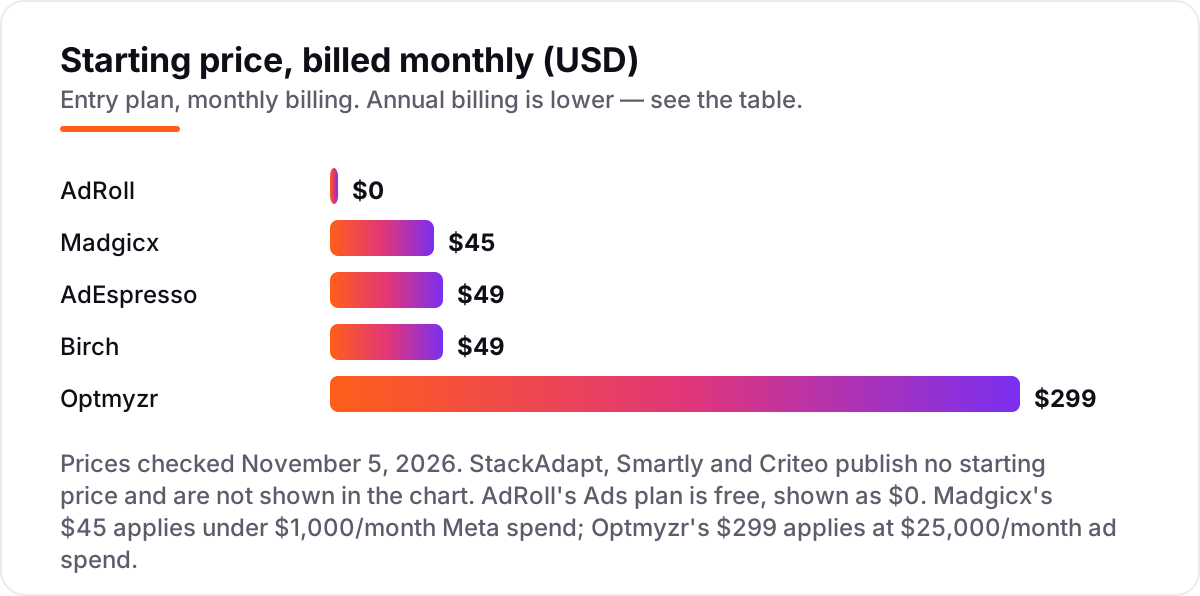
Take a small ecommerce brand spending $2,000 a month on ads — $1,500 on Meta and $500 on Google. On list prices, the subscription costs $0 on AdRoll's free Ads plan, $49 on AdEspresso Starter, $49 on Birch Essential, $99 on Madgicx Pro at the $1,000–$2,500 Meta spend band, and $299 on Optmyzr Essentials. StackAdapt has no minimum spend and no published price, so its cost is whatever CPMs the campaigns clear, and Smartly and Criteo are quoted per customer.
Two of those numbers need adjusting before they are real. First, Birch Essential at $49 has no automated rules, so a buyer who wants rules pays Pro at $99 a month. Second, Madgicx Pro at $99 in this example is the second spend band, not the $45 entry price, which applies only under $1,000 of monthly Meta spend — and Tracking Pro attribution adds $49 a month per account if you want server-side tracking.
Over a year, that is $0 on AdRoll plus media, $588 on AdEspresso Starter or Birch Essential, $1,188 on Birch Pro or Madgicx Pro at this spend level, and $3,588 on Optmyzr Essentials billed monthly, or $2,508 billed annually. The same $2,000 of ad spend costs $588 a year at the cheap end and $3,588 at the dear end for software alone — before a dollar of media. If the brand also runs search campaigns at scale, the automation side deserves a closer look in our guide to ad management software.
Annual billing cuts the bill on the priced tools here: Birch Essential drops from $588 to $540 a year, Madgicx Pro from $540 to $384 at the entry band, and Optmyzr Essentials from $3,588 to $2,508. AdRoll has no subscription to discount, and the three quote-only tools have no annual figure to compare. One more cost to check before you commit: a second brand is usually a second bill — Birch prices by connected ad spend across all accounts, but Madgicx charges per account for Tracking Pro, and agency plans on most tools here are priced per client or per account.
Know the difference: omnichannel advertising tools vs single-channel ad managers
The confusion in this category is between a tool that runs many channels and a tool that runs one channel very well. A single-channel ad manager — Meta Ads Manager, Google Ads, TikTok Ads Manager — is free, deep and purpose-built, and it will always get new features first. An omnichannel tool trades some of that depth for one workflow: one budget view, one report, one set of rules across channels. If you advertise on exactly one channel, the native manager plus a reporting spreadsheet usually beats paying for an omnichannel platform.
There is a second, quieter confusion: a demand-side platform is not the same as an omnichannel suite. A DSP like StackAdapt buys inventory programmatically across the open web, connected TV, audio and digital out-of-home through real-time auctions. An omnichannel suite may include a DSP, but it also covers social campaign management, creative production, automation rules and cross-channel reporting. StackAdapt is the only pure DSP in this list; the other seven are suites, managers or automation layers that sit on top of the channels.
A third distinction worth knowing is automation you write versus automation that decides. Birch and Optmyzr run rules you define — pause this, scale that, alert me when — and every action is logged for review. Madgicx and Smartly lean on AI models that audit, recommend and shift budgets on their own, which saves time but asks for more trust. Neither style is better in general; the right one is the one your team will actually check, because unaudited automation is how budgets quietly drift.
Quick comparison: tool type by need
| Buyer | Best pick | Why |
|---|---|---|
| Starting free, any budget | AdRoll | Free Ads plan, pay only for media, retargeting plus display, video and CTV |
| Programmatic across seven channels | StackAdapt | Self-serve DSP, no minimum spend, no separate platform fee |
| Enterprise creative + media in one contract | Smartly | Catalog-fed creative at scale and cross-channel budget automation |
| Ecommerce retargeting on shopping behavior | Criteo | Commerce dataset and dynamic product ads, priced per click or impression |
| Small social advertiser on a budget | AdEspresso | Unlimited ad accounts and fast split testing from $49/month |
| Rules you can read and audit | Birch | Transparent automation rules across Meta, Google, TikTok and Snapchat |
| Meta-led ecommerce with AI help | Madgicx | AI audits, audiences and creative analytics from $45/month |
| PPC teams with many accounts | Optmyzr | Rule engine and portfolio reporting across five ad platforms |
Mistakes to avoid
- Budgeting on the entry tier. Birch, Madgicx and Optmyzr all price by ad spend, so the entry price is only the price at the lowest spend band. Price the tool at your actual monthly spend, including overage charges.
- Buying on the free plan, then finding the feature costs extra. AdRoll's free plan has no social ads or attribution, and Birch's $49 plan has no automated rules. Check that the feature you came for is in the tier you are buying.
- Ignoring the approval gate. StackAdapt's self-serve access needs an application and approval, and Smartly and Criteo start with a sales call. If you need to launch this week, a tool with instant signup wins.
- Paying for channels you do not run. A seven-channel DSP is wasted on a brand that only runs Meta and Google. Match the tool to the channels you actually buy, not the ones on the brochure.
- Trusting automation you never audit. Rules and AI both make mistakes — a paused winner, a budget shifted to a weak channel. Check the automation log weekly, especially in the first month.
How we chose
We checked each vendor's own site on November 5, 2026 and recorded the starting price exactly as shown, and we ranked the tools by fit for the most common buyer — a marketer who wants one system across channels without an enterprise contract — not by brand size. Three tools publish no starting price at all: StackAdapt has no minimum spend and quotes by campaign, Smartly quotes per customer after a demo, and Criteo prices per click or impression with no subscription figure, so all three are listed as custom quote. Two prices need a spend-band note: Madgicx's pricing page shows the price for each Meta spend band, and the $45 entry applies to accounts under $1,000 a month of Meta spend, per Madgicx's own site; Optmyzr's pricing page sets prices by managed ad spend, and the $299 monthly figure is the $25,000-a-month tier. Ratings come from each tool's G2 page, opened November 5, 2026. No vendor paid for a place in this list, and none of the links here are affiliate links.
What to do next
Start with the free plan or trial of your top pick and run one real campaign across two channels through it. Check that the report shows both channels side by side and that the automation behaves while you are not watching before you commit to a year. If the ads are sorted but new customers are not finding you in search, our monthly SEO service handles the visibility side — or compare platforms in our guide to advertising platforms. Once your tools are in place, find out what's holding your rankings back.
Your stack only works if people find you
SerpAstra fixes what keeps your site off page one and makes it easy for AI assistants to recommend.
Get a free audit→Sources we checked (17)
- AdRoll pricing — adroll.com/pricing (checked November 5, 2026)
- StackAdapt plans and packages — stackadapt.com/plans-and-packages (checked November 5, 2026)
- Smartly — smartly.io (no published prices; demo and quote only, checked November 5, 2026)
- Criteo — criteo.com (no published subscription price; CPC/CPM-based, checked November 5, 2026)
- AdEspresso pricing — adespresso.com/pricing (checked November 5, 2026)
- Birch pricing — bir.ch/pricing (checked November 5, 2026)
- Madgicx pricing — madgicx.com/pricing (checked November 5, 2026)
- Madgicx vs Smartly.io alternatives — madgicx.com (entry price $45/month, checked November 5, 2026)
- Optmyzr pricing — optmyzr.com/pricing (checked November 5, 2026)
- AdRoll reviews — g2.com/products/adroll/reviews (checked November 5, 2026)
- StackAdapt reviews — g2.com/products/stackadapt/reviews (checked November 5, 2026)
- Smartly reviews — g2.com/products/smartly/reviews (checked November 5, 2026)
- Criteo reviews — g2.com/products/criteo/reviews (checked November 5, 2026)
- AdEspresso reviews — g2.com/products/adespresso/reviews (checked November 5, 2026)
- Birch reviews — g2.com/products/revealbot/reviews (checked November 5, 2026)
- Madgicx reviews — g2.com/products/madgicx/reviews (checked November 5, 2026)
- Optmyzr reviews — g2.com/products/optmyzr/reviews (checked November 5, 2026)
Shamim
Founder of SerpAstra
A full-stack SEO and digital marketer who spends most days on Local SEO for dental practices, AI search visibility and lead generation.
Frequently asked questions
What is the best omnichannel advertising tool?
AdRoll is the best starting point for most advertisers because its Ads plan is free and covers retargeting, display, video, native and connected TV. StackAdapt is the better pick for programmatic buying across seven channels, and Smartly suits enterprise teams that want creative production and media buying in one contract.
How much do omnichannel advertising tools cost?
Entry prices run from $0 to $299 a month. AdRoll is free plus media, AdEspresso, Birch and Madgicx start at $45–$49 a month, and Optmyzr starts at $299. StackAdapt, Smartly and Criteo publish no price and are quoted per customer, and most tools here raise the bill as your ad spend grows.
Is there a free omnichannel advertising tool?
Yes — AdRoll's Ads plan is free, and you pay only for the media you run, with social ads and cross-channel attribution as paid add-ons. Every other tool here is paid or quote-only, though Birch, AdEspresso and Optmyzr offer 14-day trials and Madgicx offers a 7-day trial.
What is the difference between an omnichannel advertising tool and a DSP?
A DSP like StackAdapt buys inventory programmatically across the open web, CTV and audio through real-time auctions. An omnichannel advertising tool is the wider category: it may include a DSP, but also covers social campaign management, creative production, automation rules and reporting across both walled gardens and the open web.
Do I still need the native ad managers if I use one of these tools?
Sometimes, yes. Tools like Birch and Optmyzr work through the platforms' APIs, so edge cases and brand-new features often appear in the native manager first. Smartly users report the same lag for new TikTok features. Keep the native managers for troubleshooting and for features your tool has not synced yet.
Can I switch omnichannel advertising tools later?
Yes, but plan the move around your campaigns, not mid-flight. Export your audiences, creative assets, rules and reports first, then rebuild the automation in the new tool and run both in parallel for a week or two. Switching also resets the learning on AI-driven tools, so expect a short performance dip after the move.
Free SEO and AI visibility audit
Find out what is holding your rankings back
Send us your site. Within 2 business days you get a written audit, an AI visibility check and a short fix list ranked by impact. Free, with no contract attached.
Request my free audit→Related guides
 Digital Marketing & AdsBest Ad Management Software for 2026: 12 Options Compared by Use Case12 best ad management software options compared by use case, with real starting prices — free native tools to $299-a-month automation. Checked Nov 4, 2026.Read guide →
 Digital Marketing & AdsBest Advertising Platforms (2026): 12 Options Ranked for Every BudgetCompare the 12 best advertising platforms on minimum budgets, pricing and reach, with every minimum checked November 4, 2026, and sorted by use case.Read guide →
 Digital Marketing & Ads7 Best Advertising Platforms for Small Businesses in 2026, Compared7 best advertising platforms for small businesses compared on minimum budgets, cost per click and who each one fits — minimums checked on each vendor's page.Read guide →