
7 Best Open Source Ecommerce Platforms in 2026, Compared
Compare the 7 best open source ecommerce platforms on licence, hosting cost, paid editions and developer effort, with every price checked on vendor pages.
 Shamim Mia, Founder, SerpAstraLast verified November 1, 20269 min read
We compare pricing pages, documentation and public reviews. We never accept payment for rankings.

Key takeaways
- WooCommerce is the easiest open source store for most small businesses: the plugin is free with 0% revenue share, and the real cost is hosting at $25 to $350 a month.
- PrestaShop and Magento Open Source are the free, full-featured classics for catalog-heavy and international stores, but both need technical help to run well.
- Medusa and Saleor are the developer-first, headless options; Medusa Cloud starts at $29 a month with no GMV fee, while Saleor Cloud starts at $1,599 a month.
- Shopware and Sylius are free at the core with paid editions for growing merchants: Shopware Rise from €600 a month and Sylius Plus from €800 a year.
On this page
Quick comparison
| Tool | Best for | Starting price | Free plan |
|---|---|---|---|
| WooCommerce | Small businesses on WordPress that want a free open source store they fully control | Free | Yes (free plugin) |
| Magento Open Source | Mid-size stores with developers that need large catalogs and deep customization for free | Free | Yes (free download) |
| PrestaShop | European and international sellers that want a free, full-featured store with multilingual selling built in | Free (Classic) | Yes (free download) |
| Shopware | Growing European merchants that want a free open source core with a paid upgrade path | Free; Rise from €600/mo | Yes (Community Edition) |
| Sylius | Symfony development teams building custom B2B or marketplace stores | Free; Plus from €800/yr | Yes (MIT) |
| Medusa | Developer teams building a headless store in JavaScript who want optional managed hosting | Free; Cloud from $29/mo | Yes (self-hosted) |
| Saleor | Funded brands building a headless GraphQL store that want managed cloud or self-hosting | Free; Cloud $1,599/mo | Yes (self-hosted) |
Make one of these tools?
We re-check this list every quarter. Send a correction, request a review, or ask about a clearly labeled sponsored spot.
Request a listingThe best open source ecommerce platforms

WooCommerce
Best for: Small businesses on WordPress that want a free open source store they fully control
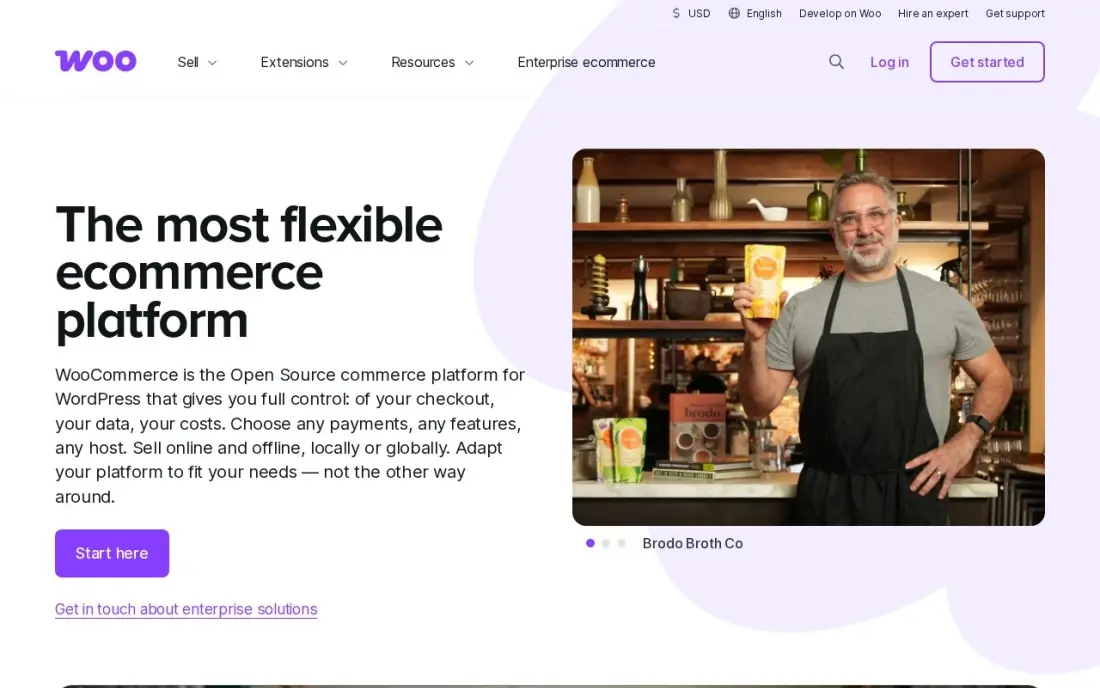
WooCommerce is the open source store most small businesses should try first. The plugin is free, takes no share of revenue and runs on more than 7 million WordPress sites, so themes, payment gateways, shipping tools and developers are easy to find. Because it sits inside WordPress, product pages and blog content live on one site, which helps stores that sell through search.
Free covers the software, not the running costs. WooCommerce's own estimate puts hosting at $25 to $350 a month, and extensions for subscriptions, bookings or advanced shipping cost $29 to $299 a year each. You also own updates, backups and security, with no support line to call. For a small catalog on a good managed host, it remains the cheapest way to own your store.
What we like
- The plugin itself is free and open source, with no licence fee and 0% revenue share
- More than 7 million active installations, so almost every payment, shipping and marketing tool integrates with it
- Full control over design, checkout and customer data, with no platform branding anywhere
- Subscriptions, bundles and memberships are available through extensions
Watch out for
- Hosting, security and updates are the owner's job, not the platform's
- The real cost is hosting at $25-$350 a month plus paid extensions at $29-$299 a year each
- No hosted support team to call when checkout breaks at midnight

Magento Open Source
Best for: Mid-size stores with developers that need large catalogs and deep customization for free
Magento Open Source is the free edition of the platform behind Adobe Commerce, and it remains one of the most capable open source stores for large catalogs. Adobe describes it as a free ecommerce platform, and the Extension Marketplace lists thousands of third-party extensions and templates, so most features a mid-size store needs already exist as an add-on. Product types, pricing rules and checkout can all be customised in code.
That power comes with weight. You need PHP developers for setup, upgrades and security patches, and hosting has to be sized for a heavy application. Adobe steers B2B commerce features and managed services to the paid Adobe Commerce. Choose Open Source when you have a developer team and a catalog that simpler platforms struggle with.
What we like
- Free to download, with thousands of third-party extensions and templates in the Extension Marketplace
- Built for large catalogs and custom product, pricing and checkout logic
- Community support through the Magento Association, forums, knowledge base and Slack channels
Watch out for
- Needs PHP developers for setup, upgrades and security patches
- B2B features and managed hosting are part of the paid Adobe Commerce, not Open Source
- Hosting must be sized for a heavy application, which raises running costs

PrestaShop
Best for: European and international sellers that want a free, full-featured store with multilingual selling built in

PrestaShop is a long-running open source store with a strong base in Europe. The Classic edition is free to download, charges no subscription and takes no commission on sales, and it ships with multilingual and multi-currency selling plus solid catalog and SEO controls. More than 4,000 modules and themes in the Addons Marketplace cover payments, shipping and marketing for most countries.
As with WooCommerce, you run the infrastructure and pay for the modules a production store needs, which often adds up past the free download. Support is community-led unless you pay. If you would rather not manage a server, PrestaShop's hosted plan starts at €24 a month excluding tax, which keeps the same software with less upkeep.
What we like
- Free open-source software with no subscription fees and no commission on sales — you own the store and the data
- Strong native SEO and catalog tools, with multilingual and multi-currency selling built in for international stores
- More than 4,000 modules and themes in the Addons Marketplace for extending the store
Watch out for
- You handle hosting, security, updates and performance yourself, or pay an expert — support is community-led unless you buy a plan
- Advanced modules and themes are paid, so a production store often costs more than the free download suggests

Shopware
Best for: Growing European merchants that want a free open source core with a paid upgrade path
Shopware is a German platform with an open source core, and its Community Edition carries no platform licence fee. You can self-host it, or move to Shopware's PaaS or SaaS options later without changing platform. It suits mid-size merchants, especially in Europe, that want a modern admin and storefront without starting on an enterprise contract.
Free has a ceiling. Under Shopware's fair-usage policy, linked shops with more than €1 million GMV over 365 days need a paid plan to keep access to the Shopware Account and extension store. Rise starts from €600 a month excluding VAT with the first 30 days free, and Evolve from €2,400 a month, both priced by GMV. Budget for hosting and an agency either way.
What we like
- Community Edition is free with access to the open source core
- Self-hosted, PaaS and SaaS options from the same vendor
- Rise includes the first 30 days free
Watch out for
- Linked shops above €1 million GMV over 365 days need a paid plan to keep Shopware Account and store access
- Paid editions are priced by GMV, from €600 a month for Rise and €2,400 for Evolve
- Hosting, implementation and maintenance cost extra on the Community Edition

Sylius
Best for: Symfony development teams building custom B2B or marketplace stores
Sylius is an open source framework for teams that would rather build a store than configure one. It is written on Symfony, and Sylius Standard is free under the MIT licence, which lets an agency or in-house team change anything. That makes it a strong base for B2B portals, marketplaces and unusual checkout flows that do not fit a template platform.
The free edition comes with community support and no response guarantee. Sylius Plus, on a commercial licence, starts from €800 a year and adds a B2B suite, marketplace suite, advanced multi-store, returns management and multi-source inventory with SLA-backed support. The full package is priced on GMV, and you can buy single modules instead. It suits developer teams, not owners who want a ready store.
What we like
- Sylius Standard is free under the permissive MIT licence
- Sylius Plus adds a B2B suite, marketplace suite, advanced multi-store and returns management
- Plus modules can be bought individually instead of as one package
Watch out for
- Community support on the free edition has no response guarantee
- Built for developers; there is no simple self-serve setup for non-technical owners
- Full Plus pricing is based on GMV and quoted, beyond the €800-a-year start

Medusa
Best for: Developer teams building a headless store in JavaScript who want optional managed hosting
Medusa is the open source commerce engine for JavaScript teams. It runs headless, so developers build the storefront in their own framework and connect it to Medusa's backend for products, carts, orders and regions. The code is on GitHub to self-host for free, and the managed Medusa Cloud adds hosting, previews and deploys from GitHub with no platform fee on sales.
Cloud plans start at $29 a month for Develop, $99 for Launch and $299 for Scale, all with unlimited orders and products and a 0% GMV fee. Usage above each plan's allowance, such as compute hours, data transfer and emails, is metered. Medusa says there is no lock-in, so a team can start on Cloud and move to its own servers later.
What we like
- 0% platform GMV fee and unlimited orders and products on every Cloud plan
- Cloud plans from $29 a month, with Launch at $99 and Scale at $299
- No lock-in: data can be exported to run Medusa on your own infrastructure
Watch out for
- Headless by design, so you build or buy the storefront
- Cloud usage beyond plan allowances is metered, from compute hours to emails
- SSO, audit logs and an uptime SLA wait for the Enterprise plan

Saleor
Best for: Funded brands building a headless GraphQL store that want managed cloud or self-hosting
Saleor is a headless, GraphQL-first commerce platform for brands with a development team or agency. The software is open source, so you can self-host it for free, and Saleor says you can move between its managed Cloud and your own servers. Free Sandboxes let developers build and test a store, but they are for non-commercial use only.
Saleor Cloud is priced for funded brands. Select costs $1,599 a month for up to $200,000 in monthly GMV, with 0.8% on orders above that, and Volume costs $3,999 a month for up to $1,000,000, with 0.4% above. An optional $6,000 Accelerator covers the pre-launch period. Self-hosting avoids those fees but puts infrastructure on your team.
What we like
- Open source, with the option to move between Saleor Cloud and self-hosting
- Free Sandboxes for building and testing before launch
- Volume plan covers up to $1,000,000 monthly GMV for $3,999 a month
Watch out for
- Saleor Cloud starts at $1,599 a month, far above other managed options here
- GMV above the plan limit is charged at 0.8% on Select and 0.4% on Volume
- Free Sandboxes are for non-commercial use only
The best open source ecommerce platform gives you a store you own outright: no licence fee, no revenue share and full access to the code, at the cost of running it yourself. We compared seven platforms on licence, real hosting cost, paid editions, developer effort and who each one suits, from WordPress plugins to headless engines, and every price below comes from the vendor's own page as checked in November 2026.
How to choose the best open source ecommerce platform
- Be honest about developer time. WooCommerce and PrestaShop can be run by a confident owner on a managed host; Magento Open Source, Sylius, Medusa and Saleor need a developer from day one.
- Price hosting, not the licence. The download is free, so compare hosting, paid extensions and maintenance, which WooCommerce alone estimates at $25 to $350 a month for hosting.
- Decide between a ready store and headless. WooCommerce, PrestaShop, Magento Open Source and Shopware come with a storefront; Medusa and Saleor are headless, so you build the front end.
- Check the licence and the upgrade path. Sylius Standard is MIT-licensed, Shopware's Community Edition has a fair-usage limit at €1 million GMV, and several vendors sell a paid edition on top of the free core.
- Look at the extension ecosystem. WooCommerce's 7 million installs and PrestaShop's 4,000-plus modules mean most features already exist; on newer platforms you may build them.
- Plan for SEO from the start. Full control of URLs, metadata and schema is a strength of open source, but only if someone sets it up.
An open source store gives you control of every URL and template, which is where SEO is won or lost. Before launch or a replatform, a technical SEO audit catches crawl and redirect problems, and our guide to the best ecommerce platform for SEO compares how each platform handles them.
Open source ecommerce platform pricing: what you will actually pay
The licence is free on every platform here, so the bill is hosting, extensions and people. A small WooCommerce store on a $25-a-month host pays $300 a year before extensions; on a $350-a-month host it pays $4,200. PrestaShop's hosted plan, which removes server work, costs €24 a month excluding tax, or €288 a year. Magento Open Source has no hosted option from Adobe, so price a developer-managed server and support retainer.
The managed and paid editions show monthly prices only. Medusa Cloud costs $29 a month on Develop, $348 a year, or $99 a month on Launch, $1,188 a year, with no GMV fee. Shopware Rise starts from €600 a month excluding VAT, €7,200 a year, and Evolve from €2,400 a month. Sylius Plus starts from €800 a year. Saleor Cloud Select costs $1,599 a month, $19,188 a year, for up to $200,000 in monthly GMV.
Developer time usually outweighs all of these. A headless build on Medusa or Saleor means paying for a custom storefront, so get a build quote before comparing cloud fees.
Know the difference: monolithic vs headless open source
A monolithic platform ships the admin, the database and the storefront as one application. WooCommerce, PrestaShop, Magento Open Source and Shopware work this way: install them, pick a theme and you have a working store. Extensions add features to the same application, which is faster to launch but ties the design to the platform's theme system.
A headless platform ships only the commerce backend and exposes it through an API. Medusa and Saleor work this way. Developers build the storefront in their own framework and can serve the same catalog to a website, an app and a kiosk. That gives full control over speed and design, but nothing appears on screen until someone builds the front end.
Quick comparison: tool type by need
| Buyer | Best pick | Why |
|---|---|---|
| Small businesses on WordPress | WooCommerce | Free plugin, 0% revenue share, largest ecosystem |
| Large catalogs with developers | Magento Open Source | Free, deeply customisable, thousands of extensions |
| International sellers | PrestaShop | Free Classic edition with multilingual and multi-currency selling |
| Growing European merchants | Shopware | Free Community Edition, Rise from €600/month |
| Symfony teams building B2B | Sylius | MIT-licensed core, Plus from €800/year |
| JavaScript teams going headless | Medusa | Free to self-host, Cloud from $29/month with no GMV fee |
| Funded headless brands | Saleor | GraphQL API, Cloud Select $1,599/month |
Mistakes to avoid
- Treating free as zero cost. Hosting, extensions, security and updates are real monthly costs, and they are yours on every self-hosted platform.
- Choosing headless without a front-end budget. Medusa and Saleor need a storefront built and maintained, which is often the largest line in the project.
- Skipping updates. Unpatched open source stores are a common target, so schedule core and extension updates every month.
- Installing extensions for everything. Each plugin or module adds load time and upgrade risk; use as few as the store needs.
- Replatforming without redirects. Moving to a new platform changes URLs, and missing 301 redirects can wipe out years of search traffic.
How we chose
We read each vendor's own pricing or product page in November 2026 and recorded the licence and prices exactly as shown, including GMV limits and fair-usage terms. Where a page did not state a licence, we did not name one. WooCommerce and PrestaShop facts come from vendor pages checked earlier in November 2026. We ranked platforms by fit for a typical small or mid-size merchant and by how much developer work each needs. Ratings come from G2 pages checked on the dates shown in the sources, and we left them out where we had no verified score. No vendor paid for a place in this list, and none of the links here are affiliate links.
What to do next
Install your top two choices on a test server or free sandbox, load twenty real products and run a test order end to end, timing every step. Then price a year of hosting and maintenance for each. If you are moving an existing store, protect your rankings first. Book a free migration SEO check.
Frequently asked questions
What is the best open source ecommerce platform?
WooCommerce is the best open source ecommerce platform for most small businesses because the plugin is free, takes no revenue share and has the largest ecosystem. Magento Open Source and PrestaShop suit larger catalogs, and Medusa or Saleor suit developer teams building a headless store.
Is open source ecommerce really free?
The software is free, but running a store is not. WooCommerce estimates hosting at $25 to $350 a month, extensions and modules cost extra, and you pay for developer time to update and secure the store. Managed options such as Medusa Cloud from $29 a month remove some of that work.
Which open source ecommerce platform is easiest for beginners?
WooCommerce, because it runs inside WordPress and installs like any plugin on a managed host. PrestaShop is next. Magento Open Source, Sylius, Medusa and Saleor all expect a developer to set them up.
What is the difference between Magento Open Source and Adobe Commerce?
Magento Open Source is the free, self-hosted edition. Adobe Commerce is the paid version, with no published price, and Adobe positions it for B2B commerce features and managed services that the free edition does not include.
Is a headless open source platform better than WooCommerce?
Only if you have developers. Medusa and Saleor give full control over the storefront and suit custom experiences, but you build the front end yourself. WooCommerce gives you a working store with themes on day one.
Can I move from Shopify to an open source platform?
Yes. Products, customers and orders can be exported and imported into WooCommerce, PrestaShop or Magento Open Source, often with a migration extension. Plan 301 redirects for every product and category URL so you keep search rankings.
Sources we checked (9)
- WooCommerce — woocommerce.com/pricing (checked November 12, 2026)
- WooCommerce reviews on G2 (checked November 12, 2026)
- Magento Open Source — business.adobe.com/products/magento/open-source (checked November 16, 2026)
- PrestaShop — prestashop.com/start (checked November 1, 2026)
- PrestaShop reviews on G2 (checked November 1, 2026)
- Shopware — www.shopware.com/pricing (checked November 16, 2026)
- Sylius — sylius.com/?p=22774 (checked November 16, 2026)
- Medusa — medusajs.com/pricing (checked November 16, 2026)
- Saleor — saleor.io/pricing (checked November 16, 2026)
Make one of these tools?
We re-check this list every quarter. Send a correction, request a review, or ask about a clearly labeled sponsored spot.
Request a listingShamim
Founder of SerpAstra
A full-stack SEO and digital marketer who spends most days on Local SEO for dental practices, AI search visibility and lead generation.
Free SEO and AI visibility audit
Find out what is holding your rankings back
Send us your site. Within 2 business days you get a written audit, an AI visibility check and a short fix list ranked by impact. Free, with no contract attached.
Request my free audit→Related buying guides
 Ecommerce8 Best Ecommerce Platforms for Developers in 2026, ComparedCompare the 8 best ecommerce platforms for developers on APIs, open source, hosting and real monthly cost, with every price checked on vendor pages in 2026.Read guide →
 Ecommerce9 Best Composable Commerce Platforms in 2026, ComparedCompare the 9 best composable commerce platforms for commerce engines, headless content and editing on APIs, free plans and cost, checked on vendor sites.Read guide →
 Ecommerce7 Best Customizable Ecommerce Platforms in 2026, ComparedCompare the 7 best customizable ecommerce platforms on code access, hosting, fees and real monthly cost, from open source to hosted, with prices checked.Read guide →