
Best Optometry EHR Software for 2026: 12 Options Compared by Use Case
Compare the 12 best optometry ehr software options for 2026 on price, charting, optical POS and billing, with every price checked November 8, 2026.
 Shamim Mia, Founder, SerpAstraLast verified November 8, 202613 min read
We compare pricing pages, documentation and public reviews. We never accept payment for rankings.

Key takeaways
- RevolutionEHR leads for most independent practices at $319/month, Eyefinity Encompass follows at $340/month for VSP-network practices, and iTRUST is the budget pick at $99/month billed annually.
- Most tools here charge per provider, per location or per user — and that billing unit, not the headline price, decides what a two-doctor practice actually pays.
- The single most important buying factor is vision-plan billing: if the practice files VSP or EyeMed claims daily, the EHR must handle those claims natively.
- Two tools publish no starting price at all — Uprise and MyVisionExpress are custom quote — so budget them only after a written quote.
On this page
Quick comparison
| Tool | Best for | Starting price | Free plan |
|---|---|---|---|
| RevolutionEHR | Independent optometry practices that want one cloud system for exams, optical and billing | $319/mo | No (demo) |
| Eyefinity Encompass | Practices in the VSP network that want EHR, practice management and patient engagement in one bundle | $340/mo | No (no trial) |
| Crystal PM | Multi-location practices that want cloud or in-office hosting and tight exam-to-optical flow | $365/mo | No (demo) |
| iTRUST | Small and mid-sized practices that want a low-cost cloud EHR with AI help and no long contract | $99/mo (annual) | No (free trial) |
| EyeCloud Pro | Single-location practices that want a simple per-location price with optical POS included | $259/mo | No (free trial) |
| MaximEyes | Multi-location and ophthalmology practices that want deep customization and device integration | $325/mo | No (free trial) |
| Compulink Eyecare Advantage | Specialty practices that want one database for EHR, billing, optical POS and an online store | $149/user/mo | No (no trial) |
| Barti | Practices that want AI charting and billing automation in a modern, cloud-only EHR | $360/mo | No (demo) |
| DrChrono | Tech-comfortable practices that want iPad-first charting and a flexible API | $199/provider/mo | No (free trial) |
| OpticMate | Optical stores and small practices that want patient records, inventory and appointments in one system | $179/mo | No (free trial) |
| Uprise | Practices that want a VisionWeb-backed cloud EHR with strong recall and patient education | Custom quote | No (demo) |
| MyVisionExpress | Eye-care practices that want SightView's integrated EHR, practice management and surgery-center tools | Custom quote | No (demo) |
Make one of these tools?
We re-check this list every quarter. Send a correction, request a review, or ask about a clearly labeled sponsored spot.
Request a listingThe best optometry ehr software

RevolutionEHR
Best for: Independent optometry practices that want one cloud system for exams, optical and billing
RevolutionEHR is the default choice in this list because it was built for optometry from the start, not adapted from a general medical EHR. Exams, optical dispensing, claims and patient communication all live in one cloud system, so a prescription written in the exam room flows to the dispensary without retyping. The published price starts at $319 a month for an exam-only or optical-only location, while the full Core plan costs $455 a month.
The extras are what sell it: an AI scribe that drafts exam notes, device integration that pulls readings straight into the chart, and SmartFlow ordering to lens suppliers. The trade-offs are a one-time setup fee plus a conversion fee for existing records, and charting that some reviewers find click-heavy. Pick RevolutionEHR when the practice wants the most complete optometry-native system and will pay for it.
What we like
- Built only for optometry, with exam charting, optical dispensing and vision-plan billing in one place
- AI scribe and device integration through RevIntegrator cut charting time
- SmartFlow sends lens and glasses orders straight to suppliers
- Cloud-based, so charts are available from any location or device
Watch out for
- The $319 starting point covers an exam-only or optical-only location, not the full Core plan at $455/month
- A one-time setup fee and a database-conversion fee apply on top of the subscription
- Some reviewers call the charting click-heavy, with a learning curve for new staff

Eyefinity Encompass
Best for: Practices in the VSP network that want EHR, practice management and patient engagement in one bundle
Eyefinity Encompass is the bundle pick: practice management, EHR, patient engagement and analytics in one subscription, starting at $340 a month for one location and one doctor in the first year of a one-year contract. Its strongest card is the VSP connection — eligibility checks, vision-plan claims and ordering run through the same system, which matters a lot when most of the appointment book is VSP patients.
The Enhanced plan at $758 a month adds the capability bundles most practices end up wanting, so the real price is often higher than the entry figure. Onboarding fees apply per doctor, and the practice must use EncompassPay for card processing. Choose Eyefinity when the practice lives inside the VSP network; choose RevolutionEHR when it wants a vendor-neutral system.
What we like
- One bundle for practice management, EHR, patient engagement and analytics
- Deep VSP integration, including vision-plan claims and eligibility checks
- AI-assisted exam charting with customizable templates and smart fields
- Enhanced plan at $758/month adds the most popular capability bundles
Watch out for
- Essential covers one location and one doctor for the first year of a one-year contract
- Each doctor pays a one-time onboarding fee, plus a one-time AMA royalty fee per account
- EncompassPay is required, so card processing is tied to the platform

Crystal PM
Best for: Multi-location practices that want cloud or in-office hosting and tight exam-to-optical flow
Crystal PM earns its place on the exam-to-optical handoff. A prescription written during the exam appears in the dispensary automatically, which removes the transcription errors that cost optical sales. The EHR is ONC-certified, with templates for comprehensive exams, contact lens fittings, dry eye and vision therapy, and the practice can host it in the cloud or in the office.
The weakness is pricing transparency: the vendor does not publish a list price, and the $365 a month figure here comes from third-party directories, with the cloud version at about $475. Training and onboarding typically add $500 to $3,000 one time. Pick Crystal PM when optical flow is the priority and the practice wants a deployment choice.
What we like
- Prescription data flows straight from the exam to the dispensary, with no retyping
- ONC-certified EHR with templates for comprehensive exams, contact lens fittings and dry eye
- Cloud or in-office hosting, so the practice picks its own deployment
- More than 8,000 independent optometry providers use the platform
Watch out for
- No public list price on the vendor site — the $365 figure comes from third-party directories
- Cloud hosting costs more than the in-office version, at about $475/month per the same directories
- Some reviewers report occasional performance crashes under heavy use

iTRUST
Best for: Small and mid-sized practices that want a low-cost cloud EHR with AI help and no long contract
iTRUST is the budget pick by a clear margin. The EHR costs $99 a month when billed annually, or $139 month to month, with no long-term contract — roughly a third of what the established platforms charge. For $189 a month billed annually, the EHR plus billing bundle adds claims, billing and point of sale, which is the configuration most practices actually need.
The low price does not mean a thin product: an AI scribe, an AI receptionist and an AI doctor assistant are built in, and two-way texting costs $24 a month extra. The catch is the module math — the EHR alone does not include billing. Pick iTRUST when the budget is tight and the practice wants modern AI tools without a big contract.
What we like
- Lowest entry price here: EHR from $99/month billed yearly, with no long-term contract
- EHR plus billing bundle at $189/month billed yearly covers claims and point of sale
- AI scribe, AI receptionist and AI doctor assistant are built in, not bolted on
- Two-way texting, WhatsApp and a phone system are available as low-cost add-ons
Watch out for
- The $99 rate is the yearly-billed price; monthly billing is $139 for the EHR alone
- Billing, claims and point of sale are a separate $99 module, or $189 bundled with the EHR
- Add-ons such as two-way texting and the AI receptionist cost extra per month

EyeCloud Pro
Best for: Single-location practices that want a simple per-location price with optical POS included
EyeCloud Pro is the simplest price in this list to understand: plans start at $259 a month per location, and the vendor publishes that figure on its own pricing page. The system is a cloud EHR and practice management platform built only for optometry, with customizable exam templates, image annotation, trackable tonometry and e-prescribing, plus optical POS and frame inventory.
The setup fee is the part to budget for: $1,000 per location, one time, covering data migration and onboarding. Some reviewers also report rising costs and features added without being asked, so read each invoice. Pick EyeCloud Pro when the practice has one location and wants a flat per-office price.
What we like
- Published per-location pricing, starting at $259/month, with no per-doctor math
- HIPAA-compliant cloud EHR with image annotation, diagnosis codes and e-prescribing
- Optical POS, frame inventory and lab integration with VisionWeb in the same system
- Built by optometrists, with exam templates that mirror how clinics actually chart
Watch out for
- A one-time $1,000 setup fee applies per location, on top of the subscription
- Some reviewers report rising costs and features added without being asked
- Pricing is per location, so a second office doubles the subscription

MaximEyes
Best for: Multi-location and ophthalmology practices that want deep customization and device integration
MaximEyes is the customization pick. It is an ONC-certified EHR and practice management system from First Insight, built for optometry and ophthalmology together, so surgical co-management and referrals work inside the same record. Charting, workflows and reporting are highly configurable, and the system covers scheduling, billing, optical point of sale and patient flow.
The trade-off is that the vendor does not publish a price list, so the $325 a month figure here comes from third-party directories and the real quote depends on the practice. Implementation is quoted separately. Pick MaximEyes when the practice is large, multi-location or shares patients with ophthalmology.
What we like
- ONC-certified EHR built for both optometry and ophthalmology, so co-management is native
- Highly customizable charting, workflows and reporting for complex practices
- Optical point of sale and patient flow management in the same system
- Long-established vendor, in eye care since 1994
Watch out for
- The $325 figure comes from third-party directories; the vendor does not publish a price list
- Implementation and training are quoted per practice and add to the first-year cost
- Reviewers note slow loading times in busy clinic hours

Compulink Eyecare Advantage
Best for: Specialty practices that want one database for EHR, billing, optical POS and an online store
Compulink Eyecare Advantage is the all-in-one specialty pick: one database for the EHR, practice management, billing, optical POS and even an online optical store. The EHR is specialty-specific, with optometry templates, chief complaints and ICD-10 coding built in, and the optical side handles lens catalogs, lab orders and cost reporting automatically.
The $149 per user a month figure comes from third-party directories, and the vendor quotes each practice individually. Implementation and data migration are the big first-year costs, typically $2,000 to $10,000 and $1,500 to $12,000 respectively. Pick Compulink when the practice wants one system for the clinic and the retail floor.
What we like
- Specialty-specific EHR with optometry templates, chief complaints and ICD-10 coding built in
- Optical inventory and point of sale with automatic lens catalog updates and lab orders
- Telehealth, e-prescribing, patient portal and online bill pay in one database
- AI-driven patient flow monitoring and an optical e-commerce store are available
Watch out for
- The $149 figure comes from third-party directories; the vendor does not publish a price list
- Implementation typically runs $2,000-$10,000 and data migration $1,500-$12,000, per directories
- The breadth of modules means a longer setup than a single-purpose EHR

Barti
Best for: Practices that want AI charting and billing automation in a modern, cloud-only EHR
Barti is the AI-first pick in this list. It is a modern cloud EHR and practice management system that puts an AI scribe and billing automation at the center of the workflow, rather than selling them as add-ons. Four plans — Core, Pro, Premium and Copilot — scale with practice size, and prices start at $360 a month according to the vendor's own FAQ.
The pitch is consolidation: charting, billing, scheduling and optical in one login, replacing five or more disconnected tools. The catch is that an exact price needs a discovery call, and the integration list is shorter than the established platforms. Pick Barti when the practice wants the newest automation and will trade breadth of integrations for it.
What we like
- AI scribe and automation are central, not an add-on, across charting and billing
- Four plans — Core, Pro, Premium and Copilot — scale with practice size
- Replaces five or more disconnected tools with one login, per the vendor
- HIPAA compliant with role-based access controls and a business associate agreement on every plan
Watch out for
- Prices start at $360/month and scale with practice size, so larger practices pay materially more
- A discovery call is required to get an exact price for the practice
- Newer platform, so the integration list is shorter than the established vendors

DrChrono
Best for: Tech-comfortable practices that want iPad-first charting and a flexible API
DrChrono is the mobile-first pick. It is a cloud EHR built around iPad charting, so the doctor documents the exam at the chair rather than at a desk afterwards, and the same system covers scheduling, telehealth, billing and revenue cycle management. Customizable templates include optometry configurations, and an open API connects the EHR to other tools.
The $199 per provider a month figure is a third-party estimate: the vendor now sells Foundation, Growth and Premium plans by quote, and only usage fees are published. Extended lab integration costs $30 per provider a month extra on the lower tiers. Pick DrChrono when the practice charts on iPads and values mobility over optometry-only depth.
What we like
- Mobile-first design with iPad charting that works across the clinic, not just at a desk
- Customizable exam templates with optometry configurations
- Integrated scheduling, telehealth, billing and revenue cycle management
- Open API connects the EHR to other tools the practice already uses
Watch out for
- The $199 figure is a third-party estimate; the vendor now sells Foundation, Growth and Premium by quote
- Extended lab integration costs $30/provider/month extra on the lower tiers
- Some reviewers report limited customization and slow customer support

OpticMate
Best for: Optical stores and small practices that want patient records, inventory and appointments in one system
OpticMate is the small-practice pick: an all-in-one optometry and optical store platform that centralizes patient management, inventory control, appointment scheduling and automated client communication. It is built for optical retail as much as for the exam room, with frame and lens inventory at the center, and it costs $179 a month according to third-party directories.
The limits are clinical depth and integrations: patient records support is thinner than the dedicated EHRs here, and the vendor is smaller, so the integration list is short. The free trial is the right way to test it. Pick OpticMate when the business is mainly an optical store with an exam lane, not a medical-heavy clinic.
What we like
- One system for patient management, inventory, appointments and automated messages
- Optical retail focus, with frame and lens inventory built for dispensaries
- Simple flat monthly price with a free trial to test the workflow
- Cloud-based, so the front desk and the exam room share the same record
Watch out for
- The $179 figure comes from third-party directories; the vendor does not publish a price list
- Patient records support is limited compared with the clinical EHRs in this list
- Smaller vendor, so third-party integrations are fewer than the big platforms

Uprise
Best for: Practices that want a VisionWeb-backed cloud EHR with strong recall and patient education
Uprise is VisionWeb's cloud EHR and practice management system, built only for optometry. Essentials covers the EHR, e-prescribing, secure messaging and unlimited training and support, while Pro adds frame catalogs, patient recall and reminders, patient education and CodeSAFE verification. EDGEPro analytics and revenue cycle management are available as add-ons.
The price is the problem for a comparison list: Uprise publishes no starting price and sells both plans by custom quote, so there is no number to rank it on. Older directories still show $79 per user a month, but that figure is stale and we do not use it. Ask for a written quote that separates the subscription from implementation and training.
What we like
- Cloud EHR and practice management built only for optometry, from VisionWeb
- Essentials covers EHR, e-prescribing, secure messaging and unlimited training
- Pro adds frame catalogs, patient recall, patient education and CodeSAFE verification
- EDGEPro analytics and revenue cycle management are available as add-ons
Watch out for
- No published starting price — Uprise sells Essentials and Pro by custom quote
- The $79/user/month figure in older directories is stale and is not used here
- Add-ons such as revenue cycle management are quoted separately

MyVisionExpress
Best for: Eye-care practices that want SightView's integrated EHR, practice management and surgery-center tools
MyVisionExpress is part of SightView's integrated EHR and practice management suite for eye care. It covers general optometry and ophthalmology with specialty templates and custom workflows, and it bundles practice management, EHR, inventory management, revenue cycle management and a patient portal, with ambulatory surgery center tools for practices that co-manage surgery.
Like Uprise, it publishes no starting price: the subscription is customized to practice size, physician count and modules, so the only honest figure is a written quote. The interface is older than the cloud-native tools in this list, which shows in daily use. Pick MyVisionExpress when the practice already runs SightView tools or needs surgery-center support.
What we like
- Part of SightView's integrated EHR and practice management suite for eye care
- Covers general optometry and ophthalmology, with specialty templates and custom workflows
- Practice management, EHR, inventory, revenue cycle and patient portal in one system
- Ambulatory surgery center tools are included for practices that co-manage surgery
Watch out for
- No published starting price — MyVisionExpress is sold by custom quote
- Pricing depends on practice size, physician count and modules, so quotes vary widely
- Older interface than the cloud-native tools in this list
The best optometry ehr software does three jobs at once: it charts the exam, runs the optical dispensary and files the vision-plan claim, all without making staff retype the same prescription three times. We ranked the 12 tools below by fit for the most common buyer — a US independent optometry practice with one or two doctors — and every price was checked on November 8, 2026.
How to choose the best optometry ehr software
- Start with vision-plan billing. If most of the appointment book is VSP or EyeMed, the EHR must file those claims natively — RevolutionEHR, Eyefinity and Crystal PM do, while generic EHRs need workarounds.
- Work out the billing unit before comparing prices. Some tools charge per provider, some per location and some per user, so a $149/user tool can cost more than a $340/location tool for a busy practice.
- Check the optical handoff. The prescription should flow from the exam to the dispensary automatically; Crystal PM and RevolutionEHR do this best, and it is where optical sales are won or lost.
- Ask what the entry price leaves out. Billing, claims, e-prescribing and patient messaging are often separate modules — iTRUST charges $99 for the EHR alone and $189 bundled with billing.
- Count the first-year costs, not just the monthly price. Setup fees, data conversion, onboarding and card processing are billed separately on almost every tool here.
The list below is sorted by fit, not by price, so the cheapest tool is not first. If the practice also needs to be found online, our local SEO service covers the visibility side, and the free SERP snippet preview tool shows how the practice's pages will look in Google before they are published.
Whatever the shortlist, demo each tool with a real exam workflow before signing: chart a comprehensive exam, dispense a pair of glasses, file a vision-plan claim and run the recall list. That hour tells you more than any review can, and it exposes the billing-unit math that decides the real price.
Optometry EHR pricing: what you will actually pay
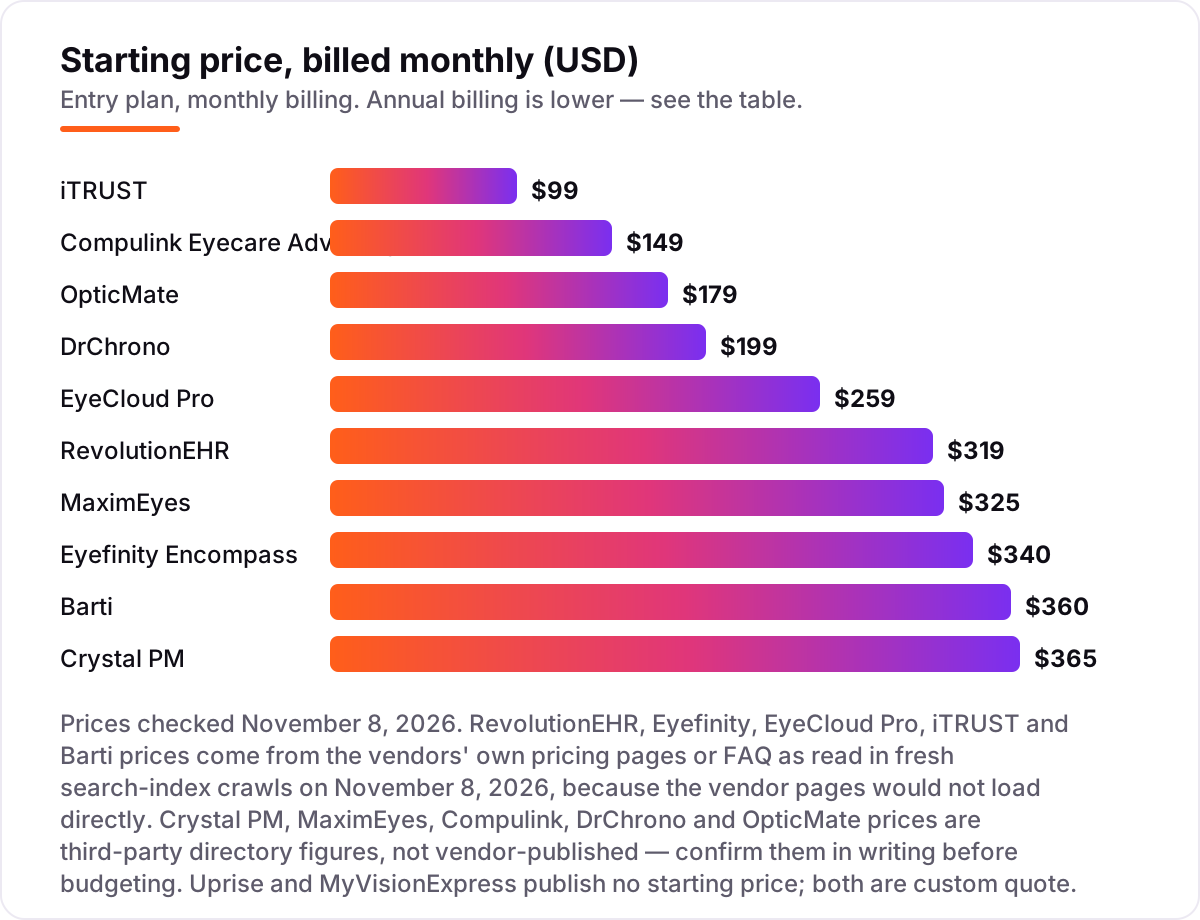
Take a single-doctor, single-location practice and compare the monthly subscription alone. On list prices, the bill is $99 a month on iTRUST billed annually, $149 on Compulink per user, $179 on OpticMate, $199 on DrChrono per provider, $259 on EyeCloud Pro per location, $319 on RevolutionEHR for an exam-only location, $325 on MaximEyes, $340 on Eyefinity Essential, $360 on Barti and $365 on Crystal PM in-office. The full RevolutionEHR Core plan is $455 a month, and the iTRUST EHR plus billing bundle is $189 a month billed annually.
Over a year, that is $1,188 on iTRUST, $1,788 on Compulink for one user, $2,148 on OpticMate, $2,388 on DrChrono for one provider, $3,108 on EyeCloud Pro, $3,828 on RevolutionEHR exam-only, $3,900 on MaximEyes, $4,080 on Eyefinity Essential, $4,320 on Barti and $4,380 on Crystal PM in-office. The gap between the cheapest and the dearest is $3,192 a year for the same one-doctor practice — and it comes from the billing unit and the modules included, not from the feature list alone.
Three costs sit outside every number above. First, setup: EyeCloud Pro charges $1,000 per location, RevolutionEHR charges a setup fee plus a database-conversion fee, and Eyefinity charges an onboarding fee per doctor plus an AMA royalty fee. Second, the billing module: iTRUST's $99 is the EHR alone, and the bundle is $189. Third, card processing: Eyefinity requires EncompassPay, and most other tools charge processing on top of the subscription. A second location doubles the per-location tools — EyeCloud Pro and Eyefinity — while a second doctor raises the per-provider and per-user tools instead.
Know the difference: per-provider, per-location and per-user pricing
The biggest confusion in this category is the billing unit, because the same dollar figure means different things on different tools. Per-provider pricing, used by DrChrono at $199 and Compulink at $149 per user, scales with the number of doctors and staff who log in. Per-location pricing, used by EyeCloud Pro at $259 and Eyefinity at $340, stays flat no matter how many doctors work in that office — but a second office doubles it. Per-practice pricing, used by RevolutionEHR's $319 exam-only starting point and Barti's $360, is closest to a flat fee for the whole practice.
The practical test is simple: count doctors, count locations, count users, then multiply. A two-doctor, one-location practice pays $398 a month on DrChrono, $259 on EyeCloud Pro and $340 on Eyefinity Essential — so the tool with the higher headline price is the cheaper buy. A one-doctor, two-location practice pays the opposite way round: $518 on EyeCloud Pro against $199 on DrChrono. Always get the quote in writing with the billing unit named, and ask whether front-desk staff count as users.
There is a second distinction worth knowing: an EHR is not the same as practice management software. The EHR is the clinical record — exam charting, prescriptions, diagnosis codes and e-prescribing. Practice management is the office side — scheduling, billing, claims and inventory. Most tools in this list bundle both, but the entry price sometimes covers only one half, as with iTRUST's $99 EHR-only plan.
Quick comparison: tool type by need
| Buyer | Best pick | Why |
|---|---|---|
| Most independent practices | RevolutionEHR | Optometry-native EHR, optical and billing in one cloud system, from $319/month |
| VSP-network practices | Eyefinity Encompass | Deep VSP integration and a full bundle, from $340/month |
| Tightest budget | iTRUST | Full cloud EHR from $99/month billed annually, with AI tools included |
| Optical-first practices | Crystal PM | Tightest exam-to-dispensary flow, from about $365/month |
| Single location, simple price | EyeCloud Pro | Flat $259/month per location, optical POS included |
| AI-led charting | Barti | AI scribe and billing automation at the center, from $360/month |
Mistakes to avoid
- Comparing headline prices across different billing units. A $149/user tool costs more than a $340/location tool once three staff log in, and a $259/location tool doubles with a second office.
- Budgeting on the EHR-only price. iTRUST's $99 covers the EHR alone; billing is a separate module, and the bundle is $189. Check what the entry price actually includes before comparing.
- Forgetting setup and conversion fees. EyeCloud Pro charges $1,000 per location, RevolutionEHR charges setup plus conversion, and Eyefinity charges onboarding per doctor — none of it is in the monthly price.
- Buying a generic EHR for vision-plan billing. DrChrono is a strong general EHR, but vision-plan claims need configuration or a billing add-on, while RevolutionEHR, Eyefinity and Crystal PM handle them natively.
- Skipping the demo with a real exam. Chart a full exam, dispense glasses and file a claim in the demo. A tool that looks cheap on paper can cost hours a week in clicks.
How we chose
We checked each vendor's own pricing page on November 8, 2026 and recorded the starting price exactly as shown, including the annual-billing figure where the page lists one. Five prices — Crystal PM, MaximEyes, Compulink, DrChrono and OpticMate — are not published by their vendors, so we used third-party directory figures for them and say so on each card; confirm those in writing before budgeting. Uprise and MyVisionExpress publish no starting price at all, so we list them as custom quote rather than guessing. Ratings come only from G2 or Capterra pages read on November 8, 2026; tools without a verified rating show none. No vendor paid for a place in this list, and none of the links here are affiliate links. Note that browser reads of the vendor pages failed on November 8, 2026, so vendor-published prices were verified from fresh search-index crawls of the vendors' own pages dated within the last day.
What to do next
Shortlist two or three tools from the table above and book a demo of each with the same exam workflow: chart, dispense, claim, recall. Ask every vendor for a written quote that names the billing unit, the setup fee, the conversion fee and the card-processing terms, then compare the first-year total, not the monthly headline. If the EHR is sorted but new patients are not finding the practice, our local SEO service handles the visibility side — or compare providers in our guide to SEO companies for small business. Once your tools are in place, find out what's holding your rankings back.
Your stack only works if people find you
SerpAstra fixes what keeps your site off page one and makes it easy for AI assistants to recommend.
Get a free audit→Sources we checked (18)
- RevolutionEHR pricing — revolutionehr.com/pricing (checked November 8, 2026)
- Eyefinity Encompass pricing — eyefinity.com/pricing (checked November 8, 2026)
- Crystal PM pricing — crystalpm.com/pricing (checked November 8, 2026)
- iTRUST pricing — itrust.io (checked November 8, 2026)
- EyeCloud Pro pricing — eyecloudpro.com/pricing (checked November 8, 2026)
- MaximEyes pricing — first-insight.com/maximeyes (checked November 8, 2026)
- Compulink Eyecare Advantage pricing — compulinkadvantage.com (checked November 8, 2026)
- Barti pricing — barti.com (checked November 8, 2026)
- DrChrono pricing — drchrono.com/pricing (checked November 8, 2026)
- OpticMate pricing — opticmate.net (checked November 8, 2026)
- Uprise pricing — visionweb.com/uprise (checked November 8, 2026)
- MyVisionExpress pricing — sightview.com/my-vision-express (checked November 8, 2026)
- RevolutionEHR reviews — g2.com/products/revolutionehr/reviews (checked November 8, 2026)
- Eyefinity Encompass reviews — g2.com/products/eyefinity-encompass/reviews (checked November 8, 2026)
- Crystal PM reviews — g2.com/products/crystal-practice-management/reviews (checked November 8, 2026)
- iTRUST reviews — g2.com/products/itrust-optical-and-optometry-cloud-ehr-with-automated-practice-management-software/reviews (checked November 8, 2026)
- EyeCloud Pro reviews — capterra.com/p/1021874/Eye-Cloud-Pro (checked November 8, 2026)
- Compulink Advantage reviews — g2.com/products/compulink-advantage/reviews (checked November 8, 2026)
Shamim
Founder of SerpAstra
A full-stack SEO and digital marketer who spends most days on Local SEO for dental practices, AI search visibility and lead generation.
Frequently asked questions
What is the best optometry EHR software?
RevolutionEHR is the best fit for most independent practices: optometry-native charting, optical dispensing and vision-plan billing from $319/month. Eyefinity Encompass is the better pick inside the VSP network, and iTRUST is the best budget option at $99/month billed annually for a small practice.
How much does optometry EHR software cost per month?
Entry prices in this list run from $99 to $365 a month, plus two custom-quote tools. A single-doctor practice typically pays $1,188 to $4,380 a year for the subscription alone, before setup fees, onboarding and card processing, which are billed separately.
Is there a free optometry EHR?
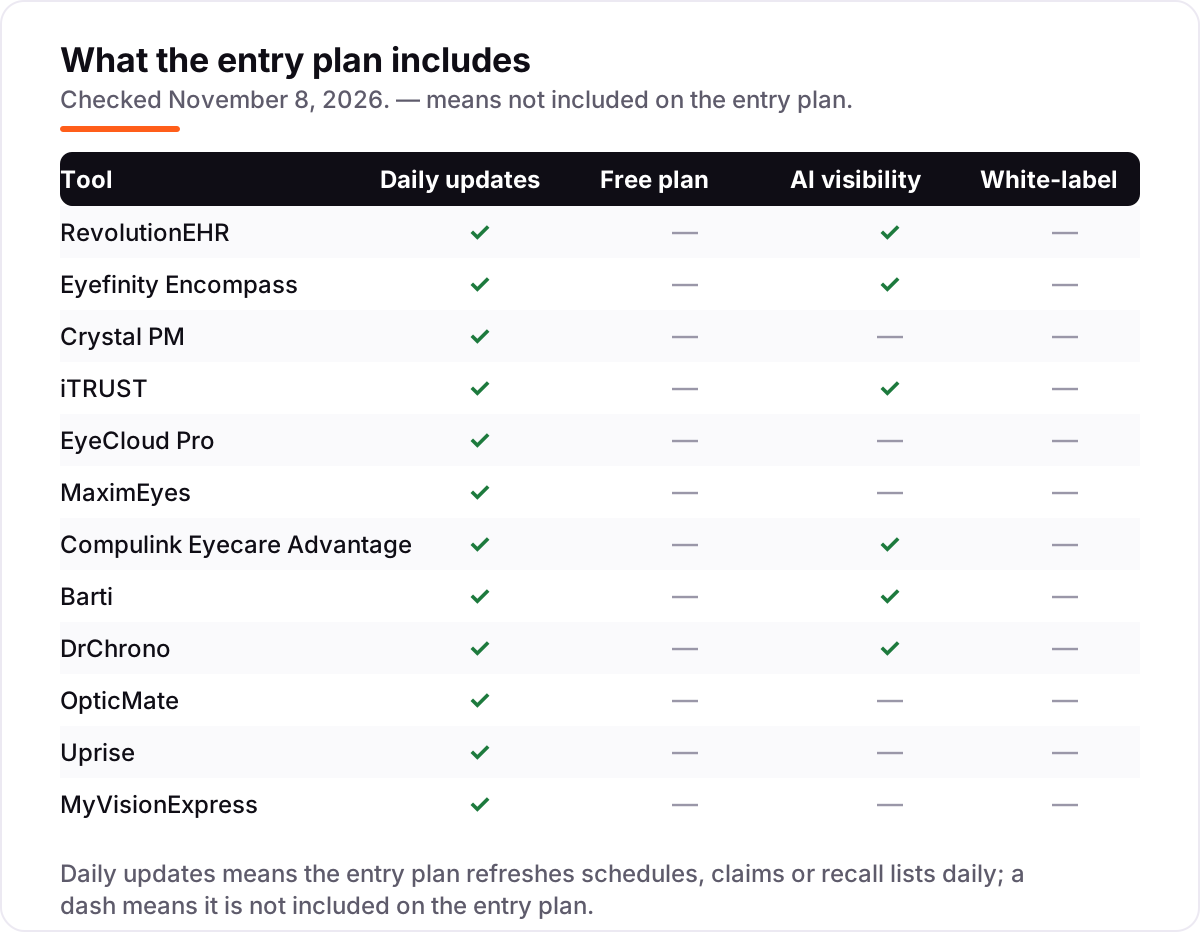
No tool in this list offers a free plan. iTRUST, EyeCloud Pro, MaximEyes, DrChrono and OpticMate offer free trials, and RevolutionEHR, Eyefinity, Crystal PM, Barti, Uprise and MyVisionExpress offer demos. Demos are shorter than trials, so ask what each demo actually covers. Budget from the entry price, not from a trial.
What is the difference between an optometry EHR and practice management software?
An EHR is the clinical record: exam charting, prescriptions, diagnosis codes and e-prescribing. Practice management is the office side: scheduling, billing, claims and inventory. Most tools here bundle both, but the EHR-only price can mislead — check whether billing is included.
Do optometry EHRs handle vision-plan billing?
Yes, the optometry-native tools do. RevolutionEHR, Eyefinity and Crystal PM all handle vision-plan claims, including VSP and EyeMed, alongside medical insurance. Generic EHRs such as DrChrono need configuration or a billing add-on to do the same job. Check coverage for your own plans during the demo.
Can I switch optometry EHR software later?
Yes, but plan the move carefully. Export patient records, exam history, prescriptions and open claims from the old system, then pay for data conversion — RevolutionEHR charges a conversion fee, and EyeCloud Pro charges $1,000 per location for setup. Switch at a quiet period, never mid-week.
Free SEO and AI visibility audit
Find out what is holding your rankings back
Send us your site. Within 2 business days you get a written audit, an AI visibility check and a short fix list ranked by impact. Free, with no contract attached.
Request my free audit→Related guides
 Local Business & Vertical Software10 Best EMR Software for Optometrists in 2026, ComparedCompare the 10 best emr software for optometrists on price, exam workflows, VSP billing and optical POS — three publish prices, the rest are quotes.Read guide →
 Local Business & Vertical Software12 Best EHR Software for Chiropractors in 2026, ComparedCompare the 12 best ehr software for chiropractors on price, SOAP notes, billing and AI features, with every price checked November 7, 2026.Read guide →
 Local Business & Vertical Software8 Best Dental Practice Management Software in 2026, ComparedCompare the 8 best dental practice management software options on price, cloud vs server, and AI features, with every price checked November 7, 2026.Read guide →