
10 Best Optometry Software in 2026: Pricing, Features and Pros & Cons
Compare the 10 best optometry software options for 2026 on price, EHR, optical POS and scheduling, with every price checked November 8, 2026.
 Shamim Mia, Founder, SerpAstraLast verified November 8, 202614 min read
We compare pricing pages, documentation and public reviews. We never accept payment for rankings.

Key takeaways
- RevolutionEHR leads for most independent practices at $319/month, Eyefinity Encompass follows at $340/month for VSP-heavy schedules, and LiquidEHR is the budget pick at $199/month with the highest user rating here.
- Only five of the ten tools publish a starting price — the other five are sold on custom quotes, so always get the quote in writing, itemized by doctor, location and module.
- The single most important buying factor is whether the software covers your whole workflow — exam charting, optical POS and vision-plan billing — or leaves one of the three to a separate system.
- Onboarding, setup and data conversion are billed on top of nearly every subscription here, and a 60- to 90-day implementation is normal for the larger platforms.
On this page
Quick comparison
| Tool | Best for | Starting price | Free plan |
|---|---|---|---|
| RevolutionEHR | Independent OD practices that want one cloud platform for exams, billing and patient engagement | $319/mo | No (demo) |
| Eyefinity Encompass | Practices where VSP vision plans dominate the schedule | $340/mo | No (demo) |
| LiquidEHR | Solo ODs and small practices that want a simple optometry EHR with no contract | $199/mo | No (free trial) |
| Eye Cloud Pro | Single-location practices that want a cloud platform built only for optometry, priced per location | $200/mo | No (demo) |
| Crystal PM | Practices that want the EHR molded to their workflow, cloud or on-premise | $365/mo | No (demo) |
| MaximEyes | Large eye care groups that also run optical retail | Custom quote | No (demo) |
| Compulink Advantage | Practices that want single-screen charting built for eye care | Custom quote | No (demo) |
| Uprise | Growing practices already on VisionWeb that want EHR and practice management from the same vendor | Custom quote | No (demo) |
| OfficeMate | Established practices that run on-premise and want Eyefinity's practice management without moving to the cloud | Custom quote | No (demo) |
| My Vision Express | Multi-location optical retail groups that need one system for EHR, practice management and optical POS | Custom quote | No (demo) |
Make one of these tools?
We re-check this list every quarter. Send a correction, request a review, or ask about a clearly labeled sponsored spot.
Request a listingThe best optometry software

RevolutionEHR
Best for: Independent OD practices that want one cloud platform for exams, billing and patient engagement
RevolutionEHR is the closest thing this category has to a default choice: a cloud EHR and practice management platform built only for optometry, with exam documentation, scheduling, billing, optical workflows and patient communication in one login. Pricing is per doctor rather than per user, so the whole staff shares one subscription: exam-only or optical-only locations start at $319 a month, Core is $455, Advanced starts at $660 and Premium at $830.
The standouts are the optometry-first charting and the AI Scribe, which drafts exam notes during the encounter at no extra cost. The catches are the one-time setup and database-conversion fees, and the $319 rate covers only part of a practice — a full practice pays Core or more. Buy RevolutionEHR when you want one cloud system for the office; buy LiquidEHR when the budget is the deciding factor.
What we like
- Exam documentation built around the OD workflow, not adapted from general medicine
- Month-to-month billing with no long-term contract
- AI Scribe captures exam notes during the encounter at no extra cost
- Vendor reports a 97% customer retention rate
Watch out for
- One-time setup fee and database-conversion fee apply on top of the subscription
- The $319 rate covers exam-only or optical-only locations — a full practice pays Core $455/month or more
- Add-on modules raise the total above the published tier prices

Eyefinity Encompass
Best for: Practices where VSP vision plans dominate the schedule
Eyefinity Encompass is the VSP-native option: the platform behind Eyefinity EHR, built by the company that runs the VSP vision-plan network. Essential costs $340 a month for one location and one doctor in the first year of a one-year contract, and Enhanced is $758 a month. Both bundle practice management, EHR with an iPad exam app, patient portal, online scheduling and analytics in one cloud login.
The reason to pick it is the vision-plan workflow: eligibility and authorizations up to seven days ahead of the visit, with bulk checks across the schedule. The catches are the fine print — the $340 rate needs EncompassPay, and a one-time onboarding fee per doctor plus an AMA royalty fee sit on top. Choose Eyefinity Encompass when VSP patients fill your book; choose RevolutionEHR when they do not.
What we like
- VSP eligibility and authorizations up to seven days ahead of the visit, with bulk checks
- Practice management, EHR, engagement and analytics under one login
- SOC 2 Type 2 certified and EHNAC accredited
- Vendor reports 20 million exams processed a year across 9,300 locations
Watch out for
- The $340 rate covers one location and one doctor for the first year of a one-year contract and requires EncompassPay
- One-time onboarding fee per doctor plus an AMA royalty fee on top of the subscription
- No free trial, and onboarding typically takes about 90 days

LiquidEHR
Best for: Solo ODs and small practices that want a simple optometry EHR with no contract
LiquidEHR is the budget pick with the least fine print: two plans, flat prices, free setup and no contract. In-Office costs $199 a month for a server setup, Cloud costs $299 a month, and both cover unlimited doctors and workstations with every module included. It is also the best-rated tool here at 4.8 out of 5 on Capterra, with customer service rated 4.9 out of 5.
The trade-off is scope rather than price. The integration catalog is the smallest in this list, the optical POS is thinner than MaximEyes or Compulink, and the interface looks dated next to the cloud-first tools. Pick LiquidEHR when a solo or small practice wants honest flat pricing and a vendor you can reach by phone; pick RevolutionEHR when you need deeper integrations.
What we like
- Transparent flat pricing with free setup and no contract
- Highest user rating here: 4.8/5 on Capterra, with customer service at 4.9/5
- Unlimited doctors and workstations on both plans
- Small vendor with direct phone access to technicians
Watch out for
- Smallest integration catalog in this list
- Optical POS is thinner than MaximEyes or Compulink
- Interface looks dated next to the cloud-first tools

Eye Cloud Pro
Best for: Single-location practices that want a cloud platform built only for optometry, priced per location
Eye Cloud Pro is a cloud platform built exclusively for optometry, combining EHR, optical POS, billing, inventory, scheduling and payments in one system. Pricing is per location rather than per user: Eye Cloud Doctor costs $200 a month per location, the full Eye Cloud Pro plan is $330, and a one-time $1,000 setup fee applies per location. That flat per-location model suits a single-location practice that wants one predictable bill.
The warning signs are in the reviews. Customers report added charges for features they never requested, a $200 monthly penalty for not using the built-in payment processing, and $150 a month for read-only access after cancelling. Get the full fee list in writing before you sign. Choose Eye Cloud Pro for simple per-location pricing; choose LiquidEHR for cleaner billing.
What we like
- EHR, optical POS, billing, inventory and scheduling in one cloud system, built only for optometry
- Priced per location, so a single-location practice pays one flat rate
- Frame inventory, lab integration and contact-lens ordering included on the Pro plan
- Designed by optometrists, with exam workflows that match how an OD office actually runs
Watch out for
- One-time $1,000 setup fee per location on top of the subscription
- Reviewers report extra charges for features they did not ask for, including a $200/month penalty for not using the built-in payment processing
- Read-only access after cancelling still costs $150/month, per reviewer reports

Crystal PM
Best for: Practices that want the EHR molded to their workflow, cloud or on-premise
Crystal PM is the customization pick: a practice management and EHR platform that molds exam templates, billing rules and workflows to how one office actually works. It runs cloud-hosted or on-premise, in three tiers — Essentials, Plus and Pro — and the vendor reports 8,000-plus independent providers on the platform. G2's vendor-supplied pricing lists In-Office at $365 a month and Cloud at $475.
The catches are the age and the effort. The interface uses an older desktop design language, and setup is a project that needs someone on your side to shape it. Confirm the price in writing first, since the vendor's own page asks you to contact the company. Pick Crystal PM when your workflow is unusual and you want it mirrored; pick RevolutionEHR when you want a standard workflow that works out of the box.
What we like
- Deep customization of exam templates and billing rules
- Choice of cloud-hosted or on-premise deployment
- Same-day human support from an optometry-focused team
- More than 8,000 independent providers on the platform, per the vendor
Watch out for
- The $365 figure comes from G2's vendor-supplied pricing page, not from crystalpm.com, so confirm it in writing before budgeting
- Older desktop design language
- Setup is a project, not a plug-in

MaximEyes is the heavyweight in this list, built for eye care groups that run clinical care and optical retail together. One interface covers EHR, practice management, optical POS and image management, with more than 270 integrations for OCT, autorefractors and visual fields, plus EVAA AI helpers for overflow calls, note drafting and billing checks. Pricing is by quote only, with no published list price.
That breadth is also the drawback. The interface is dense and takes real training, and a solo OD pays enterprise prices for capacity they will never use. MaximEyes carries no G2 star rating here because G2 shows no overall score for it yet. Choose MaximEyes when the practice is a multi-location group with a serious retail arm; choose RevolutionEHR or Crystal PM when it is a single independent office.
What we like
- EHR, practice management, optical POS and image management in one interface
- More than 270 integrations covering OCT, autorefractors and visual fields
- EVAA AI helpers for overflow calls, note drafting and billing checks
Watch out for
- Enterprise-grade complexity and pricing for a solo OD
- Dense interface takes training
- No published price and no G2 star rating yet

Compulink Advantage
Best for: Practices that want single-screen charting built for eye care
Compulink Advantage is built around OneTab, a single-page charting layout that holds the full exam on one screen instead of spreading it across tabs. It pairs that with optical POS, inventory, lab orders and job costing, plus more than 150 equipment interfaces for the diagnostic devices an eye care practice actually owns. Pricing is by quote only, with no published list price.
The customization is the catch as well as the selling point: someone on your team has to do the shaping, and the learning curve is real. Some interfaces also show their age. Pick Compulink Advantage when fast single-screen charting is the priority and you have someone to configure it; pick RevolutionEHR when you want the exam flow ready on day one.
What we like
- OneTab single-page charting layout for the full exam
- More than 150 equipment interfaces
- Optical POS, inventory, lab orders and job costing included
Watch out for
- Customization learning curve — someone has to do the shaping
- No public pricing
- Some interfaces show their age

Uprise
Best for: Growing practices already on VisionWeb that want EHR and practice management from the same vendor
Uprise is VisionWeb's cloud EHR and practice management system for optometry, sold in two tiers: Essentials covers practice management and EHR with e-prescribing and secure messaging, while Pro adds frame catalogs, patient recall and reminders, CodeSAFE verification, EDGEPro analytics and optional revenue cycle management. Unlimited training and support are included, per the vendor, and pricing is custom for both tiers.
The honest gap is evidence: there is no G2 or Capterra rating for the EHR product, and third-party sites quote a $79 per user monthly starting price that the vendor's own custom-plan model does not support, so we do not use that figure. Choose Uprise when the practice already orders and claims through VisionWeb; choose RevolutionEHR when you want a priced, reviewed alternative.
What we like
- Cloud EHR and practice management built for optometry by VisionWeb
- Two tiers, Essentials and Pro, so a practice can start simple and add recall, analytics and revenue cycle later
- Unlimited training and support included, per the vendor
- Ties into VisionWeb ordering and claims, which many ODs already use
Watch out for
- No published price — the quote is the only way to know the cost
- No G2 or Capterra rating for the EHR product, so there is no public review score to check
- Third-party sites quote a $79 per user monthly starting price, but the vendor sells custom plans, so we do not use that figure

OfficeMate
Best for: Established practices that run on-premise and want Eyefinity's practice management without moving to the cloud
OfficeMate is Eyefinity's on-premise practice management system, paired with the ExamWRITER EHR, and it has run established eye care offices since long before the cloud options existed. It covers scheduling, patient records, billing and reporting in one system, with electronic remittance advice and general ledger integration, and it is ONC-ATCB 2014 certified. Pricing is by quote only.
The trade-off is ownership: the practice owns the server, the backups and the updates, and the interface shows its age next to the cloud tools. Reviewers also report occasional crashes. Pick OfficeMate when the practice is happy on-premise and the staff already knows it; pick Eyefinity Encompass when the same vendor's cloud platform is acceptable.
What we like
- Practice management paired with ExamWRITER EHR, from the VSP-affiliated Eyefinity family
- Scheduling, patient records, billing and reporting in one on-premise system
- ONC-ATCB 2014 certified, with electronic remittance advice and general ledger integration
- The system many established practices already run, so staff training is often already done
Watch out for
- On-premise only, so the practice owns the server, the backups and the updates
- No published price, and the interface shows its age next to the cloud tools
- Occasional crashes reported by reviewers, and support fixes can be slow

My Vision Express
Best for: Multi-location optical retail groups that need one system for EHR, practice management and optical POS
My Vision Express, from Sightview, combines practice management, EHR and optical point-of-sale in one system built for eye care groups that sell as much as they examine. Its Quick Order POS handles orders, prescriptions and payments on one screen, and inventory covers frames, contact lenses, spectacle lenses and lens treatments across locations. Third-party guides put its user base above 15,000 eye care professionals.
The price is the problem: nothing is published, and third-party estimates run around $15,000 a year for a 10-user practice, with $5,000 to $20,000 in onboarding and a 60- to 90-day implementation. Reviewers also complain about slow performance and support. Choose My Vision Express for multi-location optical retail; choose MaximEyes for a similar brief with a published integration story.
What we like
- Practice management, EHR and optical point-of-sale in a single system
- Used by more than 15,000 eye care professionals, per third-party guides
- Quick Order POS handles orders, prescriptions and payments on one screen
- Inventory covers frames, contact lenses, spectacle lenses and lens treatments across locations
Watch out for
- No public pricing — quote only, with third-party estimates around $15,000 a year for a 10-user practice
- Dated interface, with recurring reviewer complaints about slow performance and support
- Implementation typically takes 60 to 90 days, per third-party guides
The best optometry software does three jobs at once: it charts the exam, runs the front desk and sells the glasses, without making the doctor retype the same visit in three systems. We ranked the ten tools below by fit for the most common buyer — an independent OD practice with one location — starting with the cloud platforms most practices buy first and ending with the enterprise systems built for groups, and every price was checked on November 8, 2026.
How to choose the best optometry software
- Check the three jobs first. The software should cover exam charting, practice management and optical POS. If one is missing, the practice pays for a second system and reconciles the two by hand.
- Follow the vision plans. If VSP patients fill the book, Eyefinity Encompass checks eligibility up to seven days ahead; if they do not, that feature is worth nothing and RevolutionEHR fits better.
- Price it per doctor and per location. RevolutionEHR charges per doctor, Eye Cloud Pro per location, and Eyefinity Encompass per location and doctor. The same practice can cost $2,388 or $5,700 a year depending on which unit the vendor counts.
- Ask what the quote leaves out. Onboarding, setup and data conversion are billed on top of nearly every subscription here, and the larger platforms take 60 to 90 days to implement.
- Test the exam, not the demo script. Run one complete routine exam, one contact lens order and one denied claim in the trial before you sign — that hour tells you more than any sales call.
The exam workflow is the part buyers get wrong most often, so compare the charting experience directly: our guide to the best EMR software for optometrists covers the same tools from the charting angle. And before you publish new pages for the services you sell, run your titles through the free SERP snippet preview tool — it shows exactly how the title and description will look in Google.
Whatever you shortlist, try it with real data before you pay. The demos and trials in this list are long enough to run one genuine week — your exams, your schedule, your frame inventory — and that week tells you more than any review can. Check two things in the trial: that the exam charting matches how your doctors actually document, and that the optical POS follows the prescription without retyping. Every tool here is built for eye care, so the differences are in the workflow, not the category.
Optometry software pricing: what you will actually pay
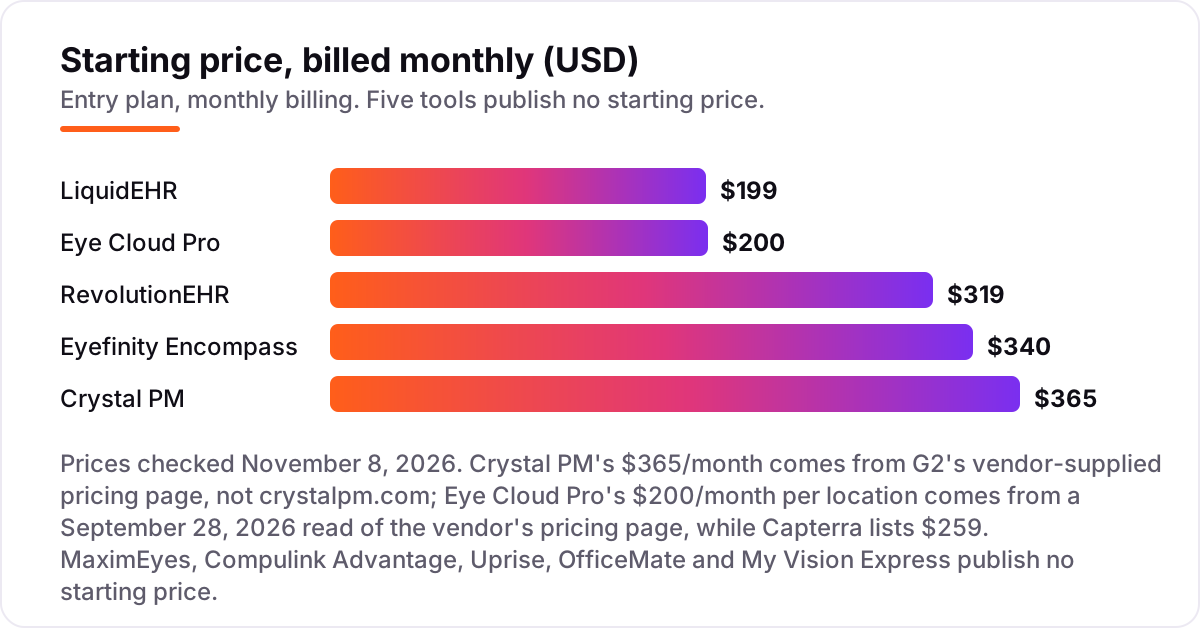
Take a single-location, one-doctor practice paying monthly for a year. On list prices, the subscription costs $2,388 a year on LiquidEHR In-Office, $2,400 on Eye Cloud Pro Doctor, $3,828 on RevolutionEHR exam-only, $4,080 on Eyefinity Encompass Essential and $4,380 on Crystal PM In-Office. Two of those numbers need adjusting before they are real: Eye Cloud Pro adds a one-time $1,000 setup fee per location, bringing its first year to $3,400, and RevolutionEHR's $319 rate covers exam-only or optical-only locations, so a full practice pays Core at $455 a month, or $5,460 a year.
The cloud plans cost more again. LiquidEHR Cloud is $299 a month, or $3,588 a year; Eye Cloud Pro's full plan is $330 a month per location, or $3,960 a year before the setup fee; and Crystal PM Cloud is $475 a month, or $5,700 a year. The same one-doctor practice therefore pays between $2,388 and $5,700 a year for the subscription alone, depending on the tier and the deployment — and the five custom-quote tools need a written quote before any number exists at all.
Three costs sit outside every number above. First, onboarding and data conversion: RevolutionEHR charges a one-time setup and conversion fee, Eyefinity Encompass charges onboarding per doctor plus an AMA royalty fee, and My Vision Express onboarding runs $5,000 to $20,000 by third-party estimates. Second, the payment-processing tie-ins — Eye Cloud Pro reviewers report a $200 monthly penalty for not using its built-in processing. Third, the second location: Eye Cloud Pro and Eyefinity Encompass price per location, so a two-location practice pays double. If the practice also needs the visibility side covered, the comparison is similar — see our guide to dental practice management software, which faces the same per-location pricing pattern.
Know the difference: optometry software vs a general medical EHR
The confusion in this category is between software built for eye care and software built for medicine in general. A general medical EHR — the kind built for primary care or a multi-specialty clinic — charts visits, orders labs and handles medical billing well, but it has no optical POS, no frame inventory, no contact-lens ordering and no vision-plan eligibility checks. An optometry practice that buys one ends up bolting an optical system onto the side and reconciling the two by hand.
Optometry software, by contrast, is built around the eye exam and the optical sale as one workflow: the refraction flows into the prescription, the prescription flows into the frame and lens order, and the order flows into vision-plan billing. All ten tools in this list work that way, including the custom-quote ones. The difference between them is scope, not category: LiquidEHR and Eye Cloud Pro cover the whole job for a single location, while MaximEyes and My Vision Express add the multi-location retail machinery a group needs.
There is a second, quieter distinction: EHR, practice management and optical POS are three jobs, and some products only do two of them. Uprise and OfficeMate lean toward practice management with an EHR attached, while MaximEyes and My Vision Express lead with the retail side. Before you buy, name the job you are actually replacing — if it is the exam, test the charting; if it is the dispensary, test the POS.
Quick comparison: tool type by need
| Buyer | Best pick | Why |
|---|---|---|
| Solo OD on a budget | LiquidEHR | $199/month, free setup, no contract, highest rating here |
| Most independent practices | RevolutionEHR | Optometry-first charting with AI Scribe, from $319/month |
| VSP-heavy schedule | Eyefinity Encompass | Eligibility checks up to 7 days ahead, from $340/month |
| Single location, one flat rate | Eye Cloud Pro | $200/month per location, EHR plus optical POS |
| Needs deep customization | Crystal PM | Cloud or on-premise, exam templates molded to your workflow, from $365/month |
| Large group with optical retail | MaximEyes | EHR, POS and image management in one system, priced by quote |
Mistakes to avoid
- Budgeting on the exam-only rate. RevolutionEHR's $319 covers exam-only or optical-only locations; a full practice pays Core at $455 a month. Price the tier you will actually use, not the cheapest line on the page.
- Buying an EHR without optical POS. If the practice sells glasses, the sale has to live in the same system as the exam. A charting-only tool means a second system for the dispensary and manual reconciliation every day.
- Skipping the vision-plan check. VSP eligibility is the feature that decides Eyefinity Encompass for many practices. If your book is mostly VSP, test the eligibility workflow in the demo — do not assume it works.
- Ignoring onboarding and conversion fees. Setup, onboarding and database conversion are billed on top of nearly every subscription here, and My Vision Express onboarding alone runs $5,000 to $20,000 by third-party estimates.
- Signing before testing the exam workflow. A demo script hides the slow parts. Run one complete routine exam, one contact lens order and one denied claim in the trial, and time each one.
How we chose
We checked each vendor's own pricing page on November 8, 2026 and recorded the starting price exactly as shown — or recorded a custom quote where the vendor publishes no price. Two prices carry a disclosure: Crystal PM's $365 a month comes from G2's vendor-supplied pricing page rather than crystalpm.com, which asks you to contact the company, and Eye Cloud Pro's $200 a month per location comes from a September 28, 2026 read of the vendor's pricing page, while Capterra lists $259. We did not use the $79 per user monthly figure third-party sites quote for Uprise, because the vendor sells custom Essentials and Pro plans. The live page reader was unavailable on November 8, so prices were verified through fresh search-index copies of the vendors' own pricing pages, crawled within the last day, plus a vendor-verified check from November 7 for RevolutionEHR, LiquidEHR and Eyefinity Encompass. Ratings come from G2 and Capterra pages checked the same way; MaximEyes carries no rating because G2 shows no overall star rating for it, and Uprise carries none because no G2 or Capterra listing exists for the EHR product — the G2 listing named Uprise is a different product. We ranked the tools by fit for the most common buyer — an independent OD practice — not by brand size. No vendor paid for a place in this list, and none of the links here are affiliate links.
What to do next
Start with demos of your top three picks and run the same test in each: one complete routine exam, one contact lens order, one VSP eligibility check and one denied claim. Ask for the quote in writing, itemized by doctor, location, module, onboarding and data conversion, before you compare prices. If the software is sorted but new patients are not finding the practice, our local SEO service handles the visibility side — or compare providers in our guide to medical SEO companies. Once your tools are in place, find out what's holding your rankings back.
Your stack only works if people find you
SerpAstra fixes what keeps your site off page one and makes it easy for AI assistants to recommend.
Get a free audit→Sources we checked (20)
- RevolutionEHR pricing — revolutionehr.com/pricing (checked November 8, 2026)
- Eyefinity Encompass pricing — eyefinity.com/pricing (checked November 8, 2026)
- LiquidEHR pricing — liquidehr.com/pricing (checked November 8, 2026)
- Eye Cloud Pro pricing — eyecloudpro.com/pricing (checked September 28, 2026 via ToolRadar read of the vendor page)
- Crystal PM pricing — crystalpm.com/pricing (checked November 8, 2026)
- MaximEyes — first-insight.com/maximeyes (checked November 8, 2026)
- Compulink Advantage — compulinkadvantage.com (checked November 8, 2026)
- Uprise — startyouruprise.com (checked November 8, 2026)
- OfficeMate — eyefinity.com (checked November 8, 2026)
- My Vision Express — sightview.com/my-vision-express (checked November 8, 2026)
- RevolutionEHR reviews — G2 (checked November 8, 2026)
- Eyefinity Encompass reviews — G2 (checked November 8, 2026)
- LiquidEHR reviews — Capterra (checked November 8, 2026)
- Eye Cloud Pro reviews — Capterra (checked November 8, 2026)
- Crystal PM reviews and pricing — G2 (checked November 8, 2026)
- Compulink Advantage reviews — G2 (checked November 8, 2026)
- OfficeMate reviews — G2 (checked November 8, 2026)
- My Vision Express (Sightview Optometry) reviews — G2 (checked November 8, 2026)
- Eye Cloud Pro pricing plans — ToolRadar read of eyecloudpro.com/pricing (September 28, 2026)
- Uprise EHR pricing — SoftwareFinder (custom plans, checked September 25, 2026 from the vendor's website)
Shamim
Founder of SerpAstra
A full-stack SEO and digital marketer who spends most days on Local SEO for dental practices, AI search visibility and lead generation.
Frequently asked questions
What is the best optometry software?
RevolutionEHR is the best fit for most independent practices: optometry-first charting, AI Scribe and month-to-month billing from $319/month. Eyefinity Encompass is the better pick when VSP patients dominate the schedule, from $340/month. LiquidEHR is the best budget option at $199/month with the highest user rating here.
How much does optometry software cost?
Published starting prices run from $199 to $365 a month for a single location or doctor. LiquidEHR starts at $199, Eye Cloud Pro at $200 per location, RevolutionEHR at $319, Eyefinity Encompass at $340 and Crystal PM at $365. Five tools publish no price, and onboarding, setup and data conversion are billed on top.
Is there free optometry software?
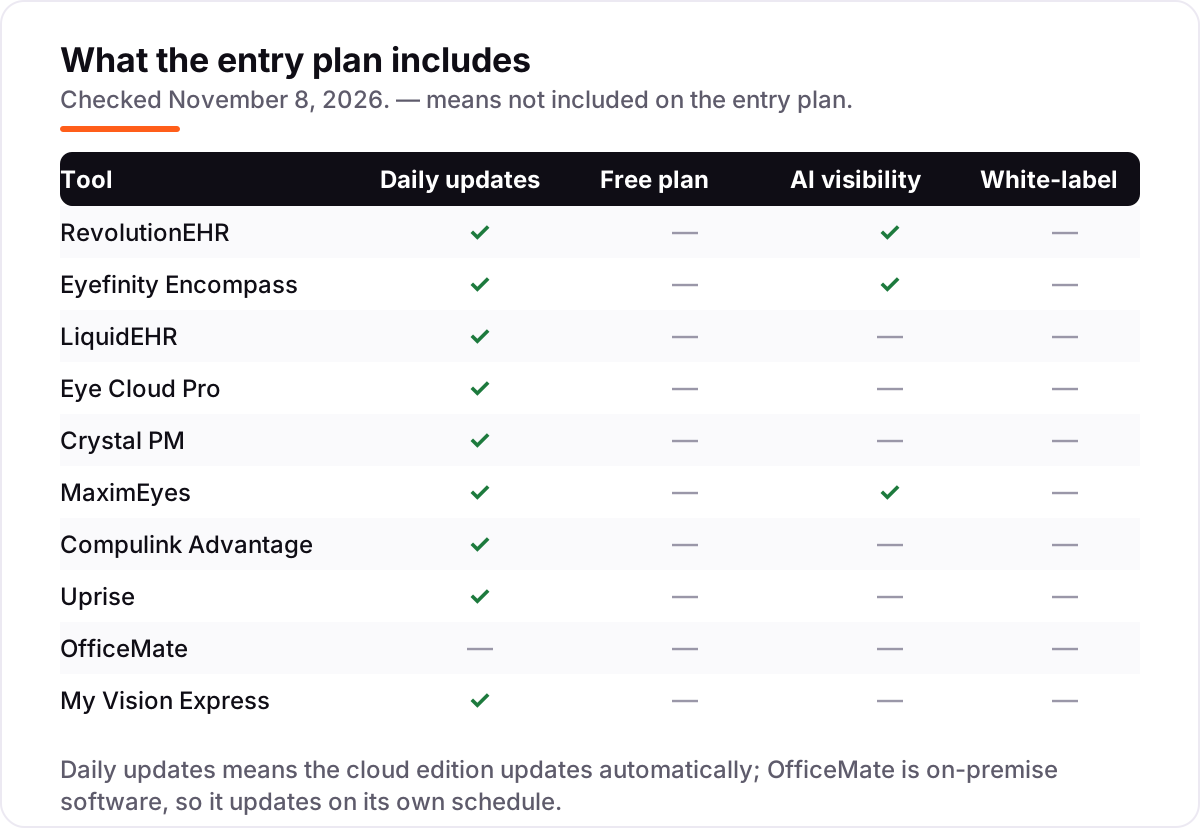
No tool in this list has a free plan. LiquidEHR offers a free trial, and every other tool offers a demo instead. Some vendors offer free trials through their sales teams, but none publish a free tier, so budget for a paid subscription from day one and use the trial or demo to test the exam workflow.
What is the difference between optometry software and a general medical EHR?
Optometry software is built around the eye exam, optical retail and vision-plan billing, while a general medical EHR is built around primary care or specialty medicine. The optometry-specific tools here include optical POS, frame inventory, VSP eligibility checks and exam templates that a general EHR does not have.
Do I need optical POS in my optometry software?
Yes, if the practice sells glasses or contact lenses. Optical POS handles frame inventory, lens orders, lab tracking and payments in the same system as the exam, so the sale follows the prescription without retyping. Without it, the front desk runs a second system and reconciles the two by hand.
Can I switch optometry software later?
Yes, but plan the move between busy seasons. Export patient records, exam history, open orders and the frame inventory from the old system, then import them and reconcile the schedule before going live. Most vendors charge a one-time database-conversion fee, and implementations typically take 60 to 90 days.
Does optometry software handle VSP billing?
The optometry-specific tools do. Eyefinity Encompass checks VSP eligibility and authorizations up to seven days ahead of the visit, and RevolutionEHR, Crystal PM and the other eye care platforms include vision-plan billing. A general medical EHR usually needs an add-on or a separate clearinghouse for vision plans.
Free SEO and AI visibility audit
Find out what is holding your rankings back
Send us your site. Within 2 business days you get a written audit, an AI visibility check and a short fix list ranked by impact. Free, with no contract attached.
Request my free audit→Related guides
 Local Business & Vertical Software10 Best EMR Software for Optometrists in 2026, ComparedCompare the 10 best emr software for optometrists on price, exam workflows, VSP billing and optical POS — three publish prices, the rest are quotes.Read guide →
 Local Business & Vertical Software8 Best Dental Practice Management Software in 2026, ComparedCompare the 8 best dental practice management software options on price, cloud vs server, and AI features, with every price checked November 7, 2026.Read guide →
 SEO & AI Search9 Best Medical SEO Companies (2026): Who to Hire and What It Costs9 best medical SEO companies compared on price, specialty and AI visibility, with real starting prices where published and custom-quote warnings where not.Read guide →