
6 Best OTT Platforms to Launch a Streaming Service in 2026
Compare the 6 best OTT platforms for launching your own subscription streaming service, from Uscreen and Muvi to Brightcove and Mux, with prices checked.
 Shamim Mia, Founder, SerpAstraLast verified November 2, 20269 min read
We compare pricing pages, documentation and public reviews. We never accept payment for rankings.
Key takeaways
- Uscreen is the best OTT platform for creators and small media brands: Starter costs $49 a month for up to 100 subscribers, and Growth costs $199 a month or $149 billed annually.
- Branded TV apps are where OTT gets expensive: Uscreen includes Roku, Apple TV, Android TV, Fire TV and Samsung apps only on its Custom plan.
- Muvi suits businesses that want a white-label streaming service with a published price, from $399 a month on Standard.
- Dacast is the budget pick for live-first broadcasters at $39 a month billed annually; Brightcove and Mux serve media companies and engineering teams.
On this page
Quick comparison
| Tool | Best for | Starting price | Free plan |
|---|---|---|---|
| Uscreen | Creators and small media brands launching a subscription video service with apps | From $49/mo | Trial |
| Muvi | Businesses that want a fully white-labeled streaming website or app at a published monthly price | From $399/mo | Trial |
| Dacast | Live-first broadcasters and event organizers that want a paywall at a low price | $39/mo (annual) | No (14-day trial) |
| Brightcove | Media companies and large enterprises running OTT at broadcast scale | Custom quote | No (free trial) |
| Mux | Engineering teams building their own OTT app on video APIs | Usage-based | Yes (free tier) |
| Kajabi | Creators who want video memberships, courses and email in one subscription without a separate OTT build | $179/mo | No (14-day trial) |
Make one of these tools?
We re-check this list every quarter. Send a correction, request a review, or ask about a clearly labeled sponsored spot.
Request a listingThe best OTT platforms

Uscreen
Best for: Creators and small media brands launching a subscription video service with apps
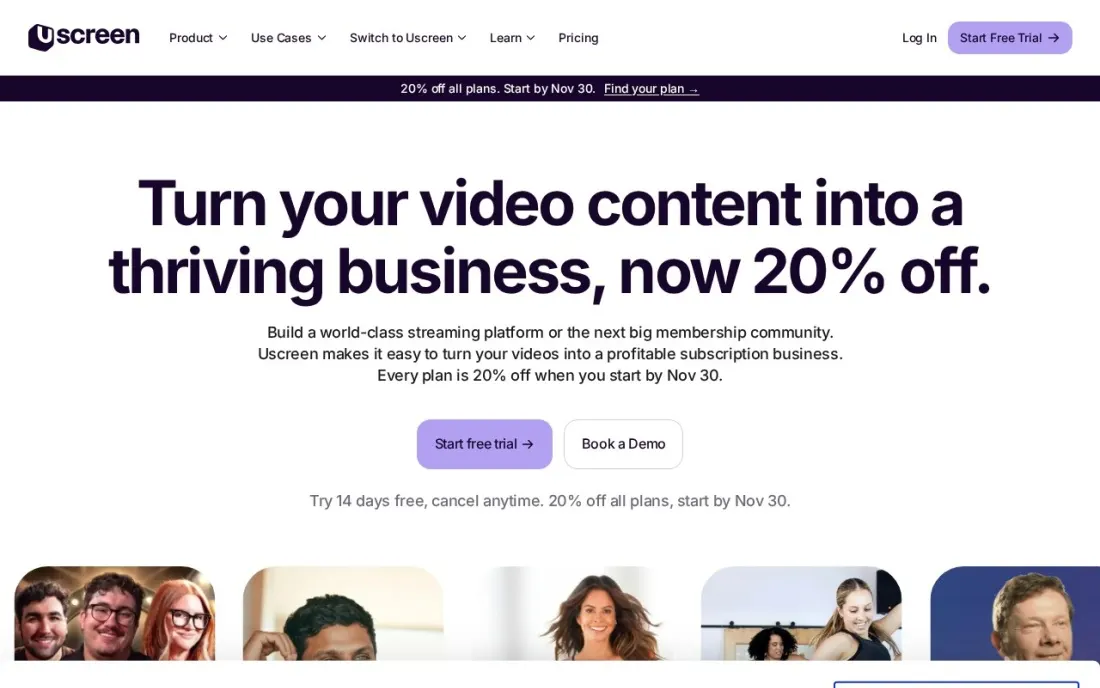
Uscreen is built for creators and niche media brands that want their own subscription streaming service: a branded storefront, subscriptions and one-time sales, a video catalog, community features and native live streaming. Starter costs $49 a month on monthly billing with up to 100 subscribers and 20 hours of storage; Growth removes the subscriber cap at $199 a month, or $149 billed annually.
The fees grow with your audience: Growth adds $1.99 per subscriber and 5% on one-time sales, and App Essentials, with branded iOS and Android apps, costs $499 a month, or $449 billed annually, plus $0.99 per subscriber. Roku, Apple TV, Fire TV, Android TV and Samsung apps come only on the quote-only Custom plan.
What we like
- Subscriptions, one-time sales, a storefront and native live streaming in one platform
- Unlimited bandwidth on every plan
- Branded iOS and Android apps on App Essentials, and TV apps on Custom
- Rated 4.8 out of 5 from 128 reviews on Capterra
Watch out for
- Per-subscriber fees on Growth ($1.99) and App Essentials ($0.99), plus 5% on one-time sales
- Starter is capped at 100 subscribers and 20 hours of video storage
- TV apps for Roku, Apple TV, Fire TV and others require the quote-only Custom plan

Muvi
Best for: Businesses that want a fully white-labeled streaming website or app at a published monthly price
Muvi sells a white-label OTT platform for companies that want a streaming service under their own brand rather than inside a creator marketplace. Capterra lists Standard at $399 a month with a completely white-labeled website or app, Professional at $1,499 a month, and Enterprise at $3,900 a month, with the Ultimate tier quoted separately. A free trial is available.
The price ladder is steep, so check which features you need before choosing a tier: recommendation features and premium options sit above Standard. Capterra reviewers rate Muvi 4.4 out of 5 from 41 reviews. It suits a business, broadcaster or faith network with a sizable library and a budget for a branded service.
What we like
- Fully white-labeled streaming website or app on the entry plan
- Published monthly prices for Standard, Professional and Enterprise
- Rated 4.4 out of 5 from 41 reviews on Capterra
Watch out for
- A large jump from Standard at $399 to Professional at $1,499 a month
- The top Ultimate tier is quote-only
- More platform than a solo creator with a small library needs

Dacast
Best for: Live-first broadcasters and event organizers that want a paywall at a low price
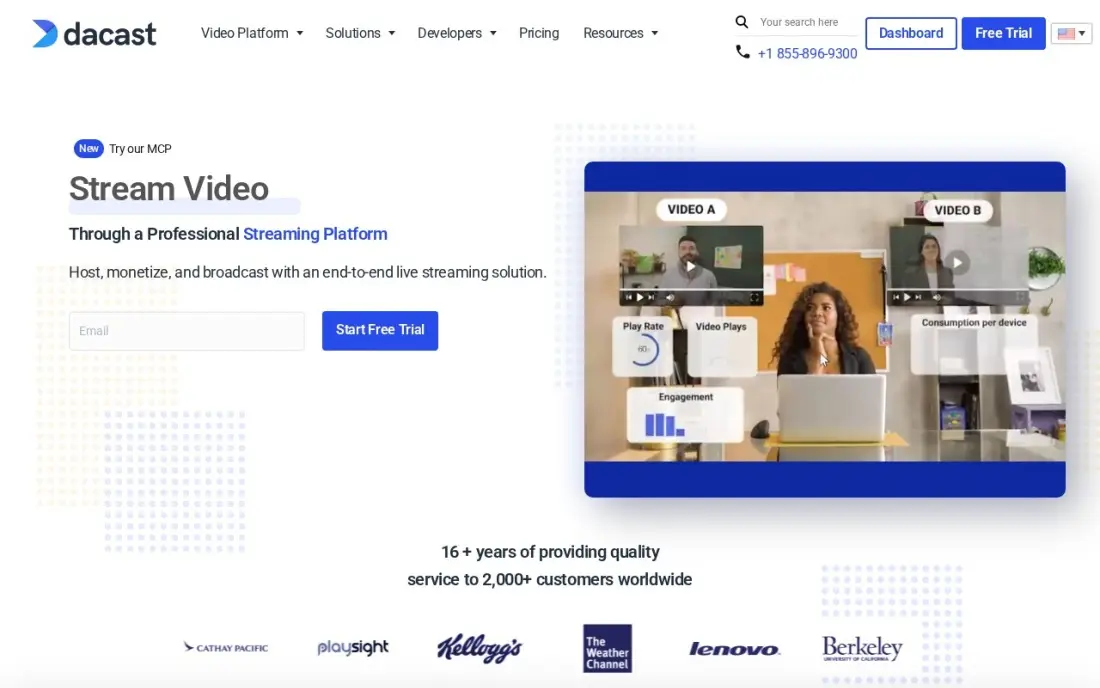
Dacast covers live streaming and on-demand video with a paywall for pay-per-view and subscriptions, a fully white-label player on every plan and real-time analytics that show concurrent viewers and geography during an event. Starter costs $39 a month billed annually and includes 2.4 TB of bandwidth a year and 500 GB of storage.
Starter is annual-only, so $468 is paid up front, and G2 reviewers report auto-renewal charges without a reminder, so set your own calendar note. The dashboard feels dated next to newer tools. For churches, schools, sports leagues and event producers that stream live first, it is the lowest-cost way to charge for access.
What we like
- Live streaming, VOD hosting, paywall and analytics in one plan from $39/month billed annually
- Fully white-label player on every plan, with monetization through pay-per-view and subscriptions
- Real-time analytics cover concurrent viewers, geography and engagement during live events
Watch out for
- Starter is billed annually only — $468 up front — with no month-to-month option
- G2 reviewers report auto-renewal charges with no reminder, and mixed support experiences
- The dashboard and API feel dated next to Wistia and Vimeo, per G2 reviewers

Brightcove
Best for: Media companies and large enterprises running OTT at broadcast scale
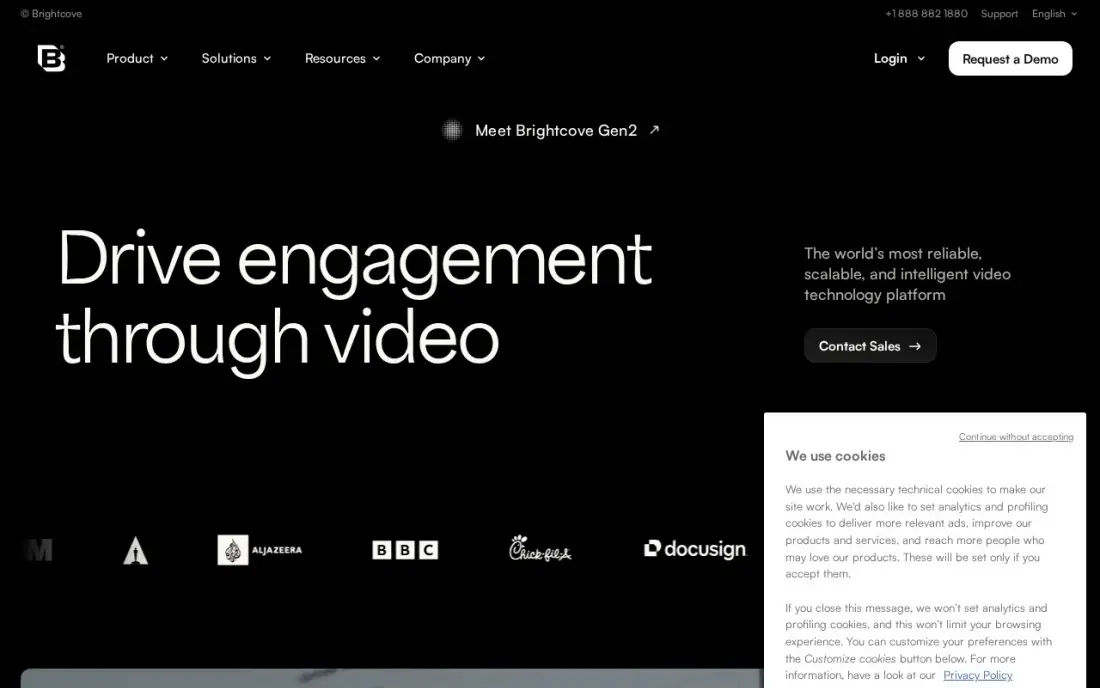
Brightcove is the enterprise OTT option: live, on-demand and OTT delivery with advertising, subscription and pay-per-view monetization, DRM, global CDN delivery and broadcast-grade audience analytics. It is built for media companies and large organizations that stream to big audiences and need ad revenue as well as subscriptions.
There is no published price; every plan is a custom quote, and buyers report contracts of $20,000 or more a year. G2 reviewers report a three-month average implementation. A free trial is available, but Brightcove is the wrong shape for a creator or small business, who will get to market faster and cheaper on Uscreen or Dacast.
What we like
- Broadcast-grade analytics with audience insights across live, on-demand and OTT delivery
- Monetization built in — advertising, subscriptions and pay-per-view — with DRM and global CDN delivery
- Integrations with marketing automation and CMS platforms, plus dedicated support on enterprise plans
Watch out for
- No published pricing — every deal is a custom quote, and buyers report $20,000-plus annual contracts
- Implementation averages three months on G2, with a 28-month average payback period
- Overkill and overpriced for a small team that only needs hosting and basic analytics

Mux is for teams that want to build the streaming service themselves. Its APIs handle encoding, storage and delivery, and Mux Data tracks playback quality — buffering, errors and startup time — for every viewer and device. You design the app, the paywall and the catalog; Mux handles the video plumbing underneath.
There is no flat price. Delivery is billed from $0.0008 per minute watched, and the first 100,000 delivery minutes each month are free, so a small library costs almost nothing until viewing grows. Deeper monitoring through Mux Data is listed by third-party sources at $499 a month. You need developers, so it suits startups and product teams, not creators.
What we like
- Mux Data tracks playback quality in real time — buffering, errors and startup time per viewer and device
- API-first: encoding, storage and delivery are all programmable, with the first 100,000 delivery minutes free each month
- Per-second billing means small libraries cost almost nothing until viewing grows
Watch out for
- No flat starting price — costs scale with minutes watched, so a popular video raises the bill
- Built for developers; non-technical teams will need engineering help to set it up
- Mux Data's paid monitoring starts at $499/month on the Media plan, per third-party pricing data

Kajabi
Best for: Creators who want video memberships, courses and email in one subscription without a separate OTT build
Kajabi is not a pure OTT platform, but many creators who would consider one use it to sell video memberships alongside courses, coaching and email marketing. It takes no revenue share on sales through Kajabi Payments, only card processing of 2.9% plus $0.30, which matters once a membership has hundreds of subscribers.
Basic costs $179 a month, or $143 billed annually, and caps at 5 products and 2,500 contacts, counting courses, memberships and podcasts together. There is no free plan, only a 14-day trial and a 30-day money-back guarantee. Choose it when video is one product among several; choose Uscreen when streaming is the business.
What we like
- The only all-in-one here: website, courses, memberships, email, funnels, community and podcast hosting on one bill
- Takes no revenue share on sales through Kajabi Payments — only card processing of 2.9% + $0.30 on Basic
- Unlimited marketing emails, landing pages and funnels on every plan, including Basic
- Every plan carries a 14-day free trial and a 30-day money-back guarantee
Watch out for
- The highest entry price here at $179 a month, with no free plan and no cheap tier since Kickstarter was removed
- Basic caps at 5 products and 2,500 contacts, and counts courses, coaching offers, downloads and podcasts together
- Basic keeps Kajabi branding on pages and has no AI credits; those need Growth at $249 a month
The best OTT platforms give you everything to run your own streaming service: a branded website and apps, video delivery that does not buffer, and payments for subscriptions, rentals or pay-per-view. We compared six platforms, from creator-friendly subscription tools to enterprise media platforms and developer APIs, and every price below comes from the vendor's own pricing page or, where we note it, the Capterra listing, as checked in November 2026.
How to choose the best OTT platforms
- Decide how you will charge. Subscriptions, one-time rentals, pay-per-view and ads need different features; most small services start with a monthly subscription.
- Count the apps you need. A website alone is cheap; branded mobile apps and TV apps for Roku, Apple TV and Fire TV are what push the price up.
- Read the revenue fees. Per-subscriber charges and percentages of sales grow with your audience, so model them at your target subscriber count.
- Check live streaming. Live events and premieres keep subscribers engaged, but some plans include only an hour or two of live streaming.
- Look at bandwidth and storage. Unlimited bandwidth matters for a popular library; capped storage limits how much content you can publish.
- Plan who will run it. A creator needs a hosted platform; a media company with engineers can build on APIs such as Mux.
A streaming service still needs viewers to find it. Our video SEO guide explains how to get video content into search results, and our monthly SEO service can grow traffic to your storefront.
Which OTT platform fits your situation
A creator testing a paid video channel with a small audience. Start on Uscreen Starter at $49 a month, which covers up to 100 subscribers and 20 hours of video storage with unlimited bandwidth. When you pass 100 subscribers, Growth at $149 a month billed annually removes the cap, but model the $1.99 per-subscriber fee and the 5% on one-time sales before you move up.
A coach or educator whose video sits beside courses and email. Kajabi fits better than a pure OTT platform. Basic at $143 a month billed annually puts memberships, courses, email and funnels on one bill and takes no revenue share on sales through Kajabi Payments, only card processing. Watch the Basic limits of 5 products and 2,500 contacts, which count courses, memberships and podcasts together.
A church, school, sports league or event producer that streams live first. Dacast is the lowest-cost way to charge for access, with live streaming, VOD hosting, a paywall and a white-label player from $39 a month billed annually. Starter is annual-only, so $468 is paid up front, and G2 reviewers report auto-renewal charges without a reminder, so put the renewal date in your calendar.
A business or faith network with a sizable library that wants its own brand. Muvi gives a fully white-labeled website or app on Standard at $399 a month, as listed on Capterra. Check which features you need before you sign, because the next step, Professional, costs $1,499 a month.
A media company or a team with its own developers. Brightcove suits large audiences that need advertising, subscriptions, pay-per-view, DRM and global CDN delivery, but expect a custom quote, reported contracts of $20,000 or more a year and about three months of implementation. If you have engineers and want full control, Mux handles encoding, storage and delivery from $0.0008 per minute watched, with the first 100,000 delivery minutes free each month, while you build the app and paywall yourself.
OTT platforms pricing: what you will actually pay
Take a creator launching a subscription service with 500 subscribers. On Uscreen Growth at $149 a month billed annually, the subscription costs $1,788 a year, and the $1.99 per-subscriber fee adds about $995 a month, or $11,940 a year, at 500 subscribers. Adding branded mobile apps on App Essentials at $449 a month billed annually lowers the per-subscriber fee to $0.99, or about $495 a month at 500 subscribers.
For a business that wants a white-label service, Muvi Standard costs $399 a month, or $4,788 a year, and Professional costs $1,499 a month, or $17,988 a year. A live-first broadcaster on Dacast Starter pays $39 a month billed annually, or $468 up front.
At the top end, Brightcove is a custom quote, with buyers reporting $20,000 or more a year, and Mux bills delivery from $0.0008 per minute watched after the first 100,000 free minutes a month, plus your own development costs.
Know the difference: hosted OTT platform vs video API
A hosted OTT platform such as Uscreen, Muvi or Dacast gives you a finished service: storefront, video player, payments, subscriber accounts and, on higher plans, apps. You upload content, set prices and launch in days or weeks. The trade-off is that you work within the platform's design and fee structure.
A video API such as Mux gives you the building blocks — encoding, storage, delivery and playback analytics — and your developers build the rest. You control every part of the experience and avoid per-subscriber platform fees, but you pay in engineering time and ongoing maintenance. Most creators and small media brands should start hosted; companies with in-house developers and a distinct product idea may prefer to build.
Quick comparison: tool type by need
| Buyer | Best pick | Why |
|---|---|---|
| Creators and niche media | Uscreen | Subscriptions, live and apps, from $49/month |
| White-label business service | Muvi | Branded website or app from $399/month |
| Live-first broadcasters | Dacast | Paywall and live streaming from $39/month billed annually |
| Large media companies | Brightcove | Ads, subscriptions and DRM at scale, custom quote |
| Engineering teams | Mux | Video APIs, first 100,000 delivery minutes free |
| Creators selling more than video | Kajabi | Memberships, courses and email, no revenue share |
Mistakes to avoid
- Launching TV apps before you have an audience. Apps cost the most; prove demand on the web and mobile first.
- Ignoring per-subscriber fees. A low plan price with a per-subscriber charge can cost more than a higher flat plan at scale.
- Publishing without a content schedule. Subscribers cancel when the library stops growing; plan regular releases before launch.
- Forgetting rights and licensing. Only stream content you own or have licensed for streaming in every region you sell to.
- Skipping the free trial. Test playback on real devices and connections before you migrate a library.
Related comparisons: OTT Advertising Platforms
How we chose
We checked each vendor's own pricing page in November 2026 and recorded the starting price exactly as shown, including the annual-billing figure where the page lists one. For Muvi, whose public pricing we could not confirm on its own site, we used the Capterra listing read on November 16, 2026. We ranked the platforms by fit for the most common buyer, a creator or small media brand launching a subscription service, and noted where enterprise and developer options fit better. Ratings come from G2 and Capterra pages checked on the dates shown in the sources. No vendor paid for a place in this list, and none of the links here are affiliate links.
What to do next
Pick the platform that matches how you will charge, start a free trial and publish five videos behind a paywall to test checkout and playback on a phone and a TV. When the service is ready for viewers, book a free call about getting it found in search.
Frequently asked questions
What is the best OTT platform?
For creators and small media brands, Uscreen is the best OTT platform here, from $49 a month for up to 100 subscribers and $149 a month billed annually on Growth. Muvi suits businesses wanting a white-label service from $399 a month, and Brightcove suits large media companies on a custom quote.
How much does it cost to launch an OTT platform?
On published prices, Dacast starts at $39 a month billed annually, Uscreen at $49 a month, and Muvi at $399 a month. Branded mobile apps on Uscreen cost $449 a month billed annually, TV apps need its quote-only Custom plan, and Brightcove contracts are reported at $20,000 or more a year.
What is an OTT platform?
OTT, or over-the-top, means video delivered over the internet straight to viewers instead of through cable or satellite. An OTT platform gives you the website, apps, video delivery and payments to run your own streaming service, as Netflix does at a much larger scale.
Can I put my streaming service on Roku and Apple TV?
Yes, with the right plan. Uscreen includes Roku, Apple TV, Android TV, Fire TV and Samsung apps on its Custom plan, and enterprise platforms such as Brightcove deliver to TV devices. Teams on Mux build their own TV apps.
Do OTT platforms take a cut of subscription revenue?
Some do. Uscreen charges $1.99 per subscriber on Growth and $0.99 on App Essentials, plus 5% on one-time sales. Kajabi takes no revenue share on sales through Kajabi Payments beyond card processing.
Is OTT the same as OTT advertising?
No. OTT platforms help you run your own streaming service; OTT advertising platforms sell ad space on other companies' streaming services. If you want to advertise on streaming TV, see our guide to OTT advertising platforms.
Sources we checked (12)
- Uscreen — www.uscreen.tv/pricing (checked November 16, 2026)
- Uscreen reviews on Capterra (checked November 16, 2026)
- Muvi — www.capterra.com/p/162335/Muvi (checked November 16, 2026)
- Muvi reviews on Capterra (checked November 16, 2026)
- Dacast — www.dacast.com/pricing (checked November 2, 2026)
- Dacast reviews on G2 (checked November 2, 2026)
- Brightcove — www.brightcove.com (checked November 2, 2026)
- Brightcove reviews on G2 (checked November 2, 2026)
- Mux — mux.com/pricing (checked November 2, 2026)
- Mux reviews on G2 (checked November 2, 2026)
- Kajabi — kajabi.com/pricing (checked November 12, 2026)
- Kajabi reviews on G2 (checked November 12, 2026)
Make one of these tools?
We re-check this list every quarter. Send a correction, request a review, or ask about a clearly labeled sponsored spot.
Request a listingShamim
Founder of SerpAstra
A full-stack digital marketer and SEO strategist covering technical and local SEO, AI search visibility, paid ads and lead generation for local businesses, e-commerce brands and SaaS teams.
Free SEO and AI visibility audit
Find out what is holding your rankings back
Send us your site. Within 2 business days you get a written audit, an AI visibility check and a short fix list ranked by impact. Free, with no contract attached.
Request my free audit→Related buying guides
 Marketing10 Best OTT Advertising Platforms for 2026 (Pros, Cons and Pricing)Compare the 10 best ott advertising platforms for 2026 on entry cost, inventory and measurement, with every price verified on November 5, 2026.Read guide →
 Marketing8 Best Membership Website Software in 2026, ComparedCompare the 8 best membership website software on monthly price, transaction fees, courses, community and member limits, with prices checked on vendor pages.Read guide →
 Video Editing & Streaming8 Best Private Video Hosting Platforms in 2026, ComparedCompare the 8 best private video hosting platforms on password protection, white-label players, paywalls, bandwidth and real cost, prices from vendor pages.Read guide →