
10 Best OTT Advertising Platforms for 2026 (Pros, Cons and Pricing)
Compare the 10 best ott advertising platforms for 2026 on entry cost, inventory and measurement, with every price verified on November 5, 2026.
 Shamim Mia, Founder, SerpAstraLast verified November 5, 202613 min read
We compare pricing pages, documentation and public reviews. We never accept payment for rankings.

Key takeaways
- Vibe.co is the cheapest way in at $50 a day with no contract; Roku and Disney start at $500 a campaign, and tvScientific, Tatari and StackAdapt publish no minimum at all.
- Four of the ten platforms publish no starting price — MNTN, Amazon DSP, DV360 and The Trade Desk quote every engagement, so budget for a sales conversation, not a rate card.
- The real cost is media plus creative: Vibe builds your ad free with AI, MNTN bundles production into spend, and Roku turns social assets into TV spots free through Spaceback.
- Walled gardens sell their own inventory only — Roku, Disney and Amazon — while DSPs like The Trade Desk, DV360 and StackAdapt buy across the open internet.
On this page
Quick comparison
| Tool | Best for | Starting price | Free plan |
|---|---|---|---|
| Vibe.co | Small budgets running their first streaming TV test | $50/day | No (free signup) |
| Roku Ads Manager | DTC brands that want direct access to Roku's streaming households | $500/campaign | No (free signup) |
| Disney Campaign Manager | Brands that want direct access to Hulu, Disney+ and ESPN inventory | $500/campaign | No (free signup) |
| tvScientific | Performance marketers who want to pay per outcome, not per impression | No minimum | No |
| Tatari | Brands that need linear TV and streaming bought and measured together | No minimum | No |
| StackAdapt | Agencies and brands running CTV alongside other programmatic channels | No minimum | No (free signup) |
| MNTN | DTC brands running performance-driven TV with creative bundled in | Custom quote | No |
| Amazon DSP | Brands that sell on Amazon and want shopping data behind their TV ads | Custom quote | No |
| Google Display & Video 360 | Enterprise teams inside Google Marketing Platform that need YouTube in the buy | Custom quote | No |
| The Trade Desk | Agencies and large brands buying open-internet CTV at scale | Custom quote | No |
Make one of these tools?
We re-check this list every quarter. Send a correction, request a review, or ask about a clearly labeled sponsored spot.
Request a listingThe best OTT advertising platforms

Vibe.co is the lowest-friction way into streaming TV ads. You set a daily budget from $50, upload a 15- or 30-second video, and go live the same day across more than 500 premium streaming channels, including Hulu, Paramount+ and Peacock. There is no contract, no platform fee and no annual commitment, and CPMs typically run $15–$35. Vibe became part of Walmart Connect when Walmart acquired it in August 2026.
The platform suits performance marketers who already buy search and social: CRM audiences, retargeting, and measurement in Northbeam and Triple Whale. A free AI creative tool builds a commercial from your website URL in seconds, which removes the biggest blocker for brands without TV creative. Pick Vibe when you want the cheapest honest test of streaming TV before committing to a bigger platform.
What we like
- Lowest entry point here: $50 a day with no contract and no platform fee
- Same-day launch across 500+ premium streaming channels, including Hulu and Paramount+
- Free AI creative tool builds a commercial from your website URL
- Native integrations with Northbeam and Triple Whale for purchase-level measurement
Watch out for
- US market only — international campaigns are not supported
- No YouTube TV inventory, so that audience needs a separate buy
- Reporting is thinner than the enterprise DSPs, with limited API access

Roku Ads Manager
Best for: DTC brands that want direct access to Roku's streaming households
Roku Ads Manager is the self-serve route into Roku's living rooms: The Roku Channel, the Roku Audience Network and third-party streaming inventory from services such as Netflix, Peacock and Max. Campaigns can start at $500, there are no revenue requirements, and you pay as the campaign delivers rather than upfront. Roku prices on a dynamic CPM, so costs move with audience demand and you can set a maximum bid as a guardrail.
The practical edge is creative: Roku's partnership with Spaceback turns existing social assets into TV spots free of charge, so a brand without a commercial can still launch. The trade-off is scope — this is a Roku-centered buy, not a cross-platform DSP, and measurement leans on post-view attribution. Choose Roku when your audience lives on Roku devices and you want a $500 test, not an enterprise contract.
What we like
- Direct access to Roku's streaming households plus The Roku Channel
- Campaigns can start at $500 with no revenue requirements and no upfront payment
- Free creative help turns social assets into TV spots through the Spaceback partnership
- Pay as the campaign delivers, and pause or extend it at any time
Watch out for
- Inventory is centered on Roku, so cross-platform reach needs another buy
- Dynamic CPM pricing means costs vary by demand and you cannot lock a rate
- Measurement leans on post-view attribution rather than incrementality testing

Disney Campaign Manager
Best for: Brands that want direct access to Hulu, Disney+ and ESPN inventory
Disney Campaign Manager is Disney's self-serve portal for streaming TV ads across Hulu, Disney+ and ESPN. Signup is free, campaigns start at $500, and there are no subscription, setup or installation fees — billing starts only after the ad starts running. Targeting runs on Disney's first-party audience data, which is the reason to buy here rather than through an open exchange: you reach Disney's streaming households directly, in brand-safe premium inventory.
The limit is the walled garden: you buy Disney inventory only, so a campaign that also needs Roku, Peacock or the open web needs a second platform. The tooling is also simpler than a full DSP, with fewer cross-channel controls. Pick Disney Campaign Manager when Hulu or Disney+ viewers are the audience you actually want, and a $500 campaign is the test you want to run.
What we like
- Direct access to Hulu, Disney+ and ESPN inventory from one portal
- Campaigns start at $500 with free signup and no subscription or setup fees
- Disney's first-party audience data for targeting across its streaming services
- Billing starts only after the ad starts running
Watch out for
- Inventory is limited to Disney's own streaming services
- Self-serve tools are simpler than a full DSP, with less cross-channel control
- No linear TV buying — streaming only, unlike the convergent platforms

tvScientific
Best for: Performance marketers who want to pay per outcome, not per impression
tvScientific is the performance marketer's OTT platform: buy streaming TV on CPM or CPA, and let its AI shift spend in real time toward the placements that drive outcomes. There is no minimum spend for self-serve campaigns, and the Guaranteed Outcomes program lets qualified advertisers set a cost per outcome — an install, a purchase, a site visit — and pay only when that result happens. The vendor says it reaches 95% of ad-supported video-on-demand audiences.
Pinterest now owns tvScientific, and its interest graph feeds the platform's targeting — a useful edge for brands already marketing on Pinterest. The catch is access: outcome-based pricing needs sales qualification, and self-serve signup runs through a Get Started form rather than instant activation. Choose tvScientific when you want TV held to a direct-response standard and you can define the outcome first.
What we like
- No minimum spend for self-serve campaigns, with CPM or CPA buying
- Guaranteed Outcomes program lets you pay only when a defined result happens
- Pinterest's interest graph now feeds its targeting after the acquisition
- Reaches 95% of ad-supported video-on-demand audiences, per the vendor
Watch out for
- Outcome-based pricing needs sales qualification — it is not open self-serve
- Smaller brand recognition than the big DSPs, with fewer public case studies
- Access is requested through a Get Started or demo form rather than instant signup

Tatari
Best for: Brands that need linear TV and streaming bought and measured together
Tatari is the only platform here that buys linear TV and streaming together: broadcast and cable plus streaming and online video, planned and measured in one place. Self-serve programmatic buying carries no minimum, and the platform runs on direct publisher deals with NBCU, Disney, Netflix and Amazon rather than open-exchange scraps. Its patented outcome attribution and incrementality testing tie TV exposure to business results instead of impressions alone.
The AI Planning Engine recommends a media mix before a dollar is spent, drawing on years of performance data across billions in managed spend. The trade-off is that managed campaigns are quoted rather than published, and linear buying adds planning complexity a streaming-only buyer never faces. Pick Tatari when your plan spans both kinds of TV and you want one measurement story for both.
What we like
- Buys linear TV and streaming together — the only convergent platform here
- No minimum for self-serve programmatic buying, per Tatari's own comparison pages
- Patented outcome attribution with incrementality testing built in
- Direct publisher access to NBCU, Disney, Netflix and Amazon inventory
Watch out for
- Managed service and prospecting carry higher minimums — confirm terms before planning a budget
- Linear TV buying adds complexity a streaming-only buyer does not need
- Pricing for managed campaigns is quoted, not published

StackAdapt
Best for: Agencies and brands running CTV alongside other programmatic channels
StackAdapt is the multichannel DSP for teams that run CTV alongside everything else: native, display, video, audio, digital out-of-home and in-game inventory from one campaign editor. There is no minimum spend to get started, the Basic tier is self-serve by credit card, and fees sit inside the CPM rather than arriving as a separate platform bill. The vendor's own guidance is that most teams hit their stride around $5,000 a month.
The built-in Creative Studio adapts creative without a separate tool, and the AI assistant Ivy helps with campaign planning and reporting. The friction is onboarding: self-serve access is subject to an application and approval process, so launch is not instant the way it is on Vibe. Choose StackAdapt when CTV is one channel in a wider programmatic plan and you want one dashboard for all of it.
What we like
- No minimum spend to get started, with credit-card self-serve on the Basic tier
- Seven channels in one platform: CTV, display, native, video, audio, DOOH and in-game
- Built-in Creative Studio adapts creative without a separate tool
- AI assistant Ivy helps with campaign planning and reporting
Watch out for
- Self-serve access is subject to an application and approval process
- Fees are baked into the CPM rather than broken out as a separate platform fee
- Most teams only see the best results around $5,000 a month, per StackAdapt's own guidance

MNTN built the performance TV category: streaming commercials bought and measured like digital, with Verified Visits attribution that matches site visits to exposed households and holdout tests that measure true incrementality. Campaigns can go live in under an hour across more than 150 premium networks, and Creative-as-a-Subscription bundles professional video production into the media spend — the fix for brands without a commercial.
QuickFrame AI builds a TV-ready ad from your website at no extra cost, which is why so many first-time TV advertisers start here. The filter is budget: the homepage calculator starts at $5,000 a month, and the platform fee is bundled into media rather than broken out. Pick MNTN when you want TV judged on conversions and you have the budget to feed its optimization.
What we like
- Performance TV built for conversions, with Verified Visits attribution and holdout incrementality tests
- Creative-as-a-Subscription bundles professional video production into the media spend
- Campaigns can go live in under an hour across 150+ premium networks
- QuickFrame AI builds a TV-ready ad from your website at no extra cost
Watch out for
- Homepage budget calculator starts at $5,000 a month, which prices out small testers
- Platform fee is bundled into media rather than broken out transparently
- Reviewers note the lack of period-over-period reporting comparisons

Amazon DSP
Best for: Brands that sell on Amazon and want shopping data behind their TV ads
Amazon DSP buys display, video and audio ads across Prime Video, Twitch, Fire TV and thousands of third-party sites, with Amazon's shopping and streaming data behind the targeting. Self-service has carried no Amazon-imposed minimum since November 2025, so any advertiser can open it through the Amazon Ads console. Shoppable and interactive formats connect the ad straight to the product page, and Amazon Marketing Cloud ties exposure to purchases.
The reality check is scale: guides consistently put the practical self-service starting point at $10,000–$15,000 a month for enough data to optimize, and Amazon's own managed service typically needs around $50,000 a month. Reviewers also flag support dependency and a slow interface. Choose Amazon DSP when you sell on Amazon and want purchase data, not just reach, behind your TV ads.
What we like
- Prime Video, Twitch and Fire TV inventory plus Amazon's shopping data for targeting
- Self-service has no Amazon-imposed minimum since November 2025
- Amazon Marketing Cloud measurement ties ad exposure to purchases
- Interactive and shoppable formats connect the ad to the product page
Watch out for
- Managed service typically needs around $50,000 a month, per third-party reporting
- In practice most guides put the realistic self-service starting point at $10,000–$15,000 a month
- Support dependency is a common reviewer complaint, with slow platform performance noted

Google Display & Video 360
Best for: Enterprise teams inside Google Marketing Platform that need YouTube in the buy
Google Display & Video 360 is the DSP for teams inside Google Marketing Platform. It is the only DSP that buys YouTube programmatically — including YouTube Select and TrueView — next to display, video, audio and CTV from more than 90 exchanges, with Floodlight measurement and a single frequency cap across YouTube and the open web. Integration with Campaign Manager 360 and Analytics 360 keeps planning, buying and measurement in one stack.
The cost is opacity: Google publishes no rate, and the platform fee is a percentage of media cost set per contract, so two buyers can pay different fees for the same inventory. Access runs through a Google sales relationship or a certified partner, and the learning curve is steep. Pick DV360 when YouTube is a material line in the plan and the Google stack is home.
What we like
- The only DSP that buys YouTube programmatically, including YouTube Select
- Access to 90+ exchanges with Google's audience signals and Floodlight measurement
- Native integration with Campaign Manager 360, Analytics 360 and Search Ads 360
- Single frequency cap across YouTube and open-web video in one buy
Watch out for
- Pricing is a percentage of media cost set per contract — Google publishes no rate
- Access runs through a Google sales relationship or certified partner, not direct signup
- Steep learning curve, with reporting that is hard to share between team members

The Trade Desk
Best for: Agencies and large brands buying open-internet CTV at scale
The Trade Desk is the leading independent DSP, built for agencies and large brands buying open-internet CTV, audio, display, native and video from one platform. Its case rests on transparency: log-level data and granular spend controls let buyers audit delivery themselves, and the Walmart Connect partnership adds retail purchase data to targeting. Kokai AI and Koa optimize bids and suggest targeting adjustments as campaigns run.
The price of that power is opacity on cost: no published pricing, with fees negotiated per account under NDA, and a platform built for traders rather than beginners. Media buyers rate its price performance below cheaper self-serve DSPs, per Digiday's 2026 buyer scorecard. Choose The Trade Desk when scale, control and independent measurement matter more than the lowest entry cost.
What we like
- Leading independent DSP with the broadest open-internet CTV and audio inventory
- Log-level data and granular spend controls for buyers who audit delivery themselves
- Kokai AI and Koa optimize bids and suggest targeting adjustments
- Walmart Connect partnership adds retail purchase data to targeting
Watch out for
- No published pricing — fees are negotiated per account under NDA
- Built for teams with trading expertise; beginners face a steep learning curve
- Media buyers rate its price performance below cheaper self-serve DSPs, per Digiday's 2026 buyer scorecard
The best ott advertising platforms put your ad on the biggest screen in the house — the TV in the living room — bought with the targeting and measurement of digital ads. Over-the-top (OTT) ads stream over the internet to smart TVs, Roku boxes, Fire TV sticks and game consoles, skipping cable subscriptions entirely. The ten platforms below cover every way in: self-serve tools from $50 a day, publisher portals from $500 a campaign, and enterprise DSPs that quote every engagement. Every price was checked on the vendor's own site on November 5, 2026.
How to choose the best ott advertising platforms
- Start with the minimum, not the feature list. Vibe starts at $50 a day, Roku and Disney at $500 a campaign, and tvScientific, Tatari and StackAdapt publish no minimum at all. The platform whose floor fits your test budget is the shortlist; the rest is detail.
- Match the inventory to your audience. Roku sells Roku households, Disney sells Disney streaming households, and Amazon sells shoppers. If your buyer is everywhere, you need an open DSP such as The Trade Desk, DV360 or StackAdapt, not a walled garden.
- Decide how you will prove it worked. Performance platforms — Vibe, MNTN, tvScientific, Tatari — tie exposure to visits, installs or purchases. Walled gardens report reach and post-view results. If your boss wants incrementality, demand holdout testing before you sign.
- Check who makes the creative. Vibe builds your ad free with AI, MNTN bundles production into spend, and Roku turns social assets into TV spots free through Spaceback. Every other platform here expects you to arrive with a finished 15- or 30-second spot.
- Ask what the fee covers. On self-serve platforms the fee is the media itself, often with no platform fee at all. On enterprise DSPs the fee is a percentage of media set per contract and never published — ask for it in writing before you scale.
One more check before you spend: your TV ad sends viewers to a landing page, and that page's title and description decide whether they stay. Run them through the free SERP snippet preview tool before launch — it shows exactly how the page will look in Google. For the wider measurement picture, our guide to CTV advertising measurement companies covers the independent tools that verify what platforms claim.
OTT advertising platforms pricing: what you will actually pay
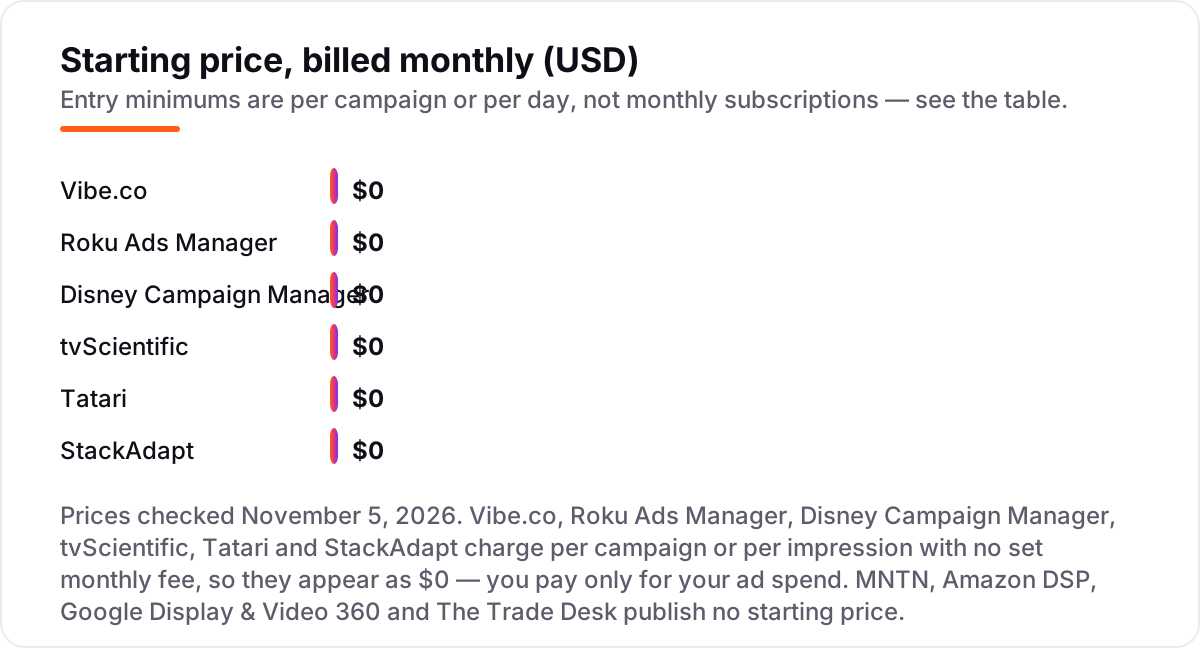
Take a brand with $3,000 to test streaming TV for one month. On Vibe, the $50 daily minimum means $1,500 of that month is the floor — 30 days at $50 — which buys roughly 43,000 to 100,000 impressions at $15–$35 CPM. On Roku or Disney, the $500 campaign minimum leaves $2,500 for media at a dynamic CPM, and billing starts only when ads run. On tvScientific, Tatari or StackAdapt there is no minimum at all, so the full $3,000 is media, subject to whatever CPM the auction sets.
That same $3,000 does not reach the enterprise tier. MNTN's homepage calculator starts at $5,000 a month, Amazon's managed service typically needs around $50,000 a month (a third-party reported figure, not an Amazon-published rate), and DV360 and The Trade Desk quote every engagement. Amazon self-service has no Amazon-imposed minimum, but guides consistently put the practical starting point at $10,000–$15,000 a month for enough data to optimize.
Three costs sit outside every number above. First, creative: free on Vibe's AI tool, bundled into MNTN's spend, and free through Roku's Spaceback partnership — everywhere else, budget for production separately. Second, measurement: holdout incrementality tests need enough volume to read, which is why a $500 campaign tells you less than a four-week test. Third, the fee layer: enterprise DSP fees are a percentage of media set per contract, so the CPM you see is never the whole cost.
Know the difference: OTT, CTV and linear TV
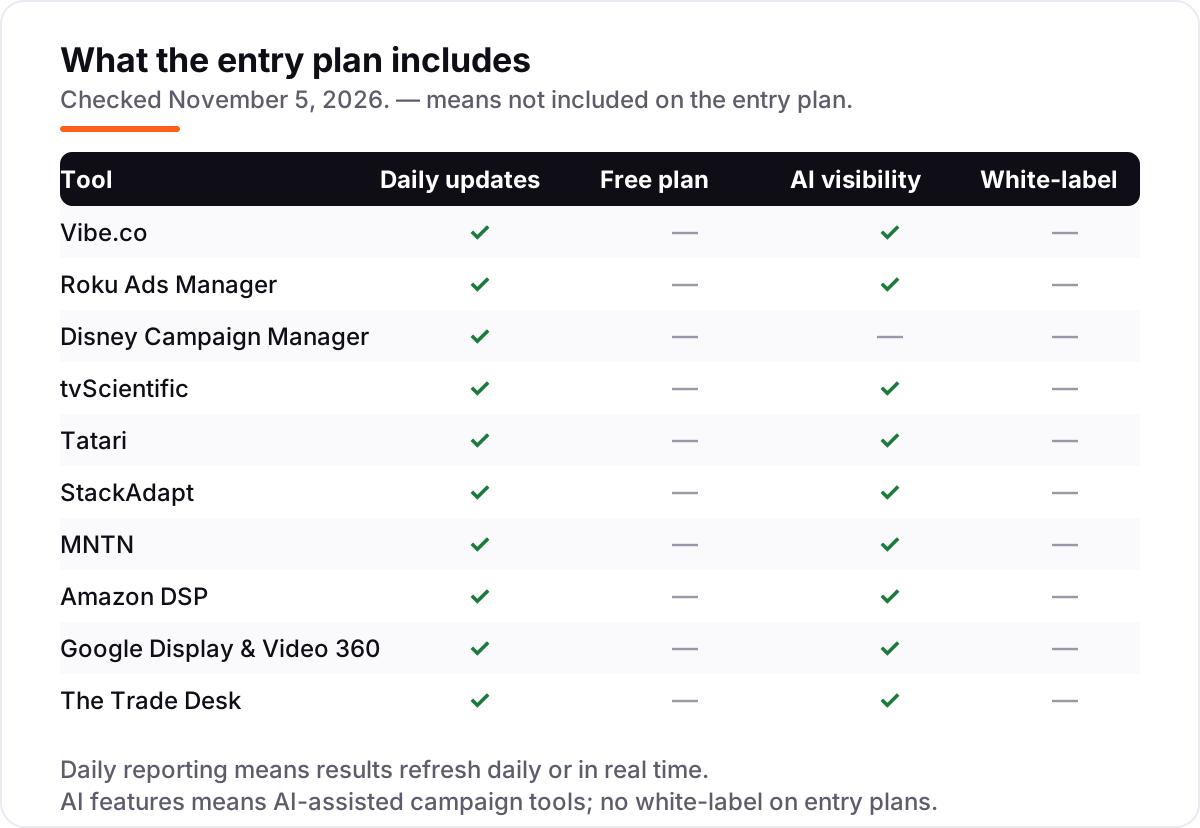
Buyers use three terms for what looks like one thing. OTT (over-the-top) is how the ad arrives — streamed over the internet, bypassing cable. CTV (connected TV) is what it arrives on — a smart TV, a Roku or Fire TV device, a game console. Linear TV is the old schedule: broadcast and cable watched live at a set time. Most platforms here sell CTV inventory delivered over the top; only Tatari adds linear to the same plan.
There is a second split that matters more for your budget: walled gardens versus open DSPs versus performance platforms. Walled gardens — Roku, Disney, Amazon — sell their own inventory only, with their own audience data. Open DSPs — The Trade Desk, DV360, StackAdapt — buy across exchanges and publishers, with your data layered on top. Performance platforms — Vibe, MNTN, tvScientific, Tatari — package buying with outcome measurement, and judge themselves on visits and sales rather than reach.
A third distinction is who runs the campaign. Self-serve platforms let you build, launch and optimize directly — Vibe same-day, Roku and Disney from a portal, StackAdapt after an application. Managed and enterprise platforms — Amazon's managed service, DV360 through a partner, The Trade Desk for most large accounts — put a team or a contract between you and the buy. Self-serve is cheaper to test; managed is how large budgets get handled.
Quick comparison: tool type by need
| Buyer | Best pick | Why |
|---|---|---|
| First OTT test on a small budget | Vibe.co | $50 a day, no contract, same-day launch across 500+ channels |
| Roku-only audience | Roku Ads Manager | Direct Roku inventory from $500 a campaign, pay as it delivers |
| Hulu and Disney+ audience | Disney Campaign Manager | Disney streaming inventory from $500 a campaign, free signup |
| Pay only for results | tvScientific | No minimum spend, CPM or CPA with a Guaranteed Outcomes program |
| Linear plus streaming together | Tatari | Convergent TV in one plan, no self-serve minimum |
| CTV plus display, native and audio | StackAdapt | Seven channels in one DSP, no minimum spend |
Mistakes to avoid
- Budgeting on the minimum. A $500 campaign proves the platform works, not that the channel works. Plan a four-week test with enough impressions to read, or the result is noise.
- Buying reach you cannot measure. Impressions are the easiest number a platform can give you and the least useful. Insist on visit, install or purchase attribution — and a holdout test — before you scale.
- Forgetting the creative. A finished 15- or 30-second spot is a precondition on most platforms here. If you do not have one, start where creative is free or bundled: Vibe, MNTN or Roku.
- Treating a walled garden as a DSP. Roku, Disney and Amazon sell their own inventory. If your audience is everywhere, a single walled garden buy is a sample, not a strategy.
- Signing a managed contract before a self-serve test. Managed minimums run $10,000 a month and up. Run the self-serve version first, learn the CPMs and the audience, then negotiate from data.
How we chose
We checked each vendor's own pricing page, help center or product page on November 5, 2026, and recorded the entry cost exactly as published: a daily minimum, a campaign minimum, no minimum, or no published price at all. Ratings come only from G2 pages opened on November 5, 2026 — Vibe at 4.8 from 181 reviews, MNTN at 4.8 from 61, StackAdapt at 4.7 from 924, Amazon DSP at 4.2 from 18, and The Trade Desk at 4.4 from 195. Tatari, tvScientific, Roku Ads Manager, Disney Campaign Manager and Google Display & Video 360 show no rating because we could not verify a G2 listing for them, and we would rather show no rating than a stale one.
Two figures in this list are not vendor-published prices and are labeled as such in the cards. Amazon's managed-service figure of around $50,000 a month and its practical self-service range of $10,000–$15,000 a month come from third-party reporting of Amazon's terms, not from Amazon's own pricing page. MNTN's $5,000 a month is the starting point of its homepage budget calculator, not a published minimum — MNTN's own site advertises no minimums. No vendor paid for a place in this list, and none of the links here are affiliate links.
What to do next
Start with the cheapest test that fits your audience: Vibe at $50 a day, or Roku or Disney at $500 a campaign. Run it for four weeks, measure visits or purchases against a holdout group, and scale only the audience and creative that beat the holdout. If the test works but the channel needs to grow beyond one publisher, move to StackAdapt for multichannel reach or The Trade Desk for open-internet scale — and get the fee in writing first. If streaming TV is one part of a wider visibility plan, our monthly SEO service covers the search side while TV covers the screen. Once your tools are in place, find out what's holding your rankings back.
Your stack only works if people find you
SerpAstra fixes what keeps your site off page one and makes it easy for AI assistants to recommend.
Get a free audit→Sources we checked (15)
- Vibe.co advertising costs — help.vibe.co (checked November 5, 2026)
- Roku Ads Manager getting started — help.ads.roku.com (checked November 5, 2026)
- Disney Campaign Manager getting started — disneycampaignmanager.com (checked November 5, 2026)
- tvScientific vs Tatari comparison — tvscientific.com (checked November 5, 2026)
- Tatari vs StackAdapt comparison — tatari.tv (checked November 5, 2026)
- StackAdapt plans and packages — stackadapt.com (checked November 5, 2026)
- MNTN homepage — mntn.com (checked November 5, 2026)
- Amazon DSP — advertising.amazon.com (checked November 5, 2026)
- Display & Video 360 — marketingplatform.google.com (checked November 5, 2026)
- The Trade Desk — thetradedesk.com (checked November 5, 2026)
- Vibe reviews — G2 (checked November 5, 2026)
- MNTN Performance TV reviews — G2 (checked November 5, 2026)
- StackAdapt reviews — G2 (checked November 5, 2026)
- Amazon DSP reviews — G2 (checked November 5, 2026)
- The Trade Desk reviews — G2 (checked November 5, 2026)
Shamim
Founder of SerpAstra
A full-stack SEO and digital marketer who spends most days on Local SEO for dental practices, AI search visibility and lead generation.
Frequently asked questions
What is the best OTT advertising platform?
Vibe.co is the best starting point for most buyers: $50 a day, no contract, same-day launch across 500+ premium channels, and a free AI creative tool. Brands with larger budgets should look at MNTN for performance TV or The Trade Desk for open-internet scale. The right pick depends on your budget floor and whether you need one publisher or the whole internet.
How much does OTT advertising cost?
Entry points run from $50 a day on Vibe.co and $500 a campaign on Roku and Disney, to no minimum on tvScientific, Tatari and StackAdapt. Enterprise platforms quote every engagement, with MNTN's calculator starting at $5,000 a month and Amazon's managed service typically around $50,000. A realistic first test, including creative, runs $1,500–$5,000.
What is the difference between OTT and CTV advertising?
OTT is how the ad arrives — streamed over the internet, bypassing cable. CTV is what it arrives on — a smart TV, a streaming stick or a console. In practice the terms overlap: nearly every platform here sells CTV inventory delivered over the top. Linear TV, the scheduled broadcast and cable watched live, is a separate buy that only Tatari bundles into the same plan.
Do OTT platforms have minimum spends?
Some do and some do not. Vibe.co requires $50 a day, Roku and Disney require $500 a campaign, and MNTN's calculator starts at $5,000 a month. tvScientific, Tatari and StackAdapt publish no minimum for self-serve buying, and Amazon's self-service has no Amazon-imposed minimum. Managed and enterprise tiers always carry higher minimums, so check which tier a quoted figure belongs to.
Can small businesses advertise on OTT?
Yes — this is the biggest change in TV advertising in a decade. A small business can launch on Vibe.co at $50 a day, or on Roku or Disney at $500 a campaign, with creative built free by Vibe's AI tool or Roku's Spaceback partnership. The realistic floor for a readable test is about $1,500 over four weeks, not a single $500 campaign.
How do you measure OTT ad performance?
The honest answer is holdout testing: compare purchases or visits from households that saw the ad against a randomly withheld group that did not. Vibe, MNTN, tvScientific and Tatari all offer outcome attribution or incrementality tests. Reach and post-view numbers alone prove little, so ask any platform how it runs holdouts before you judge a campaign on its dashboard.
Do I need a TV commercial to advertise on OTT?
You need a 15- or 30-second video, but not necessarily a produced commercial. Vibe's AI tool builds one from your website free, MNTN bundles production into its media spend, and Roku turns social assets into TV spots free through Spaceback. Every other platform here expects a finished spot, so budget for production unless you start on one of those three.
Free SEO and AI visibility audit
Find out what is holding your rankings back
Send us your site. Within 2 business days you get a written audit, an AI visibility check and a short fix list ranked by impact. Free, with no contract attached.
Request my free audit→Related guides
 Digital Marketing & Ads12 Best CTV Advertising Platforms for 2026 (Pros, Cons and Pricing)Compare the 12 best CTV advertising platforms on price, minimum budgets, targeting and measurement — every figure checked live on November 4, 2026.Read guide →
 Digital Marketing & Ads7 Best Advertising Platforms for Small Businesses in 2026, Compared7 best advertising platforms for small businesses compared on minimum budgets, cost per click and who each one fits — minimums checked on each vendor's page.Read guide →
 Digital Marketing & Ads10 Best Digital Advertising Platforms in 2026, ComparedCompare the 10 best digital advertising platforms on price, minimum budgets, targeting and AI tools — every figure checked November 4, 2026.Read guide →