
7 Best Patient Engagement Platforms in 2026, Compared
Compare the 7 best patient engagement platforms on reminders, recall, two-way texting, online booking, intake and cost, with prices checked on vendor pages.
 Shamim Mia, Founder, SerpAstraLast verified November 4, 20268 min read
We compare pricing pages, documentation and public reviews. We never accept payment for rankings.

Key takeaways
- Weave is the only platform here with a published starting price for a full suite — $199 a month for phones, texting, reminders, scheduling, reviews and payments — plus a $750 setup fee.
- NexHealth and Solutionreach are the strongest picks for practices that want reminders, forms and recall synced to the practice system; Luma Health is built for health systems and specialty groups.
- Tebra suits independent practices that want a website, online booking and reviews tied to a native EHR, from $49 a month per non-physician provider and $99 per physician.
- Podium and Birdeye are general local-business messaging and review tools, not healthcare-built platforms, so confirm HIPAA terms in writing before patient information goes in.
On this page
Quick comparison
| Tool | Best for | Starting price | Free plan |
|---|---|---|---|
| Weave | Dental and medical practices that want phones, texting, reminders and payments in one system | $199/mo | No |
| NexHealth | Practices that want booking, reminders, forms and payments synced live with the practice system | ~$350/mo (third-party) | No |
| Luma Health | Health systems and specialty groups that need referrals, scheduling, intake and reminders at scale | Custom quote | No |
| Solutionreach | Practices whose main goal is filling the schedule through reminders and patient recall | Custom quote | No (free trial) |
| Tebra (PatientPop) | Independent practices that want a website, online booking, reviews and reminders tied to their EHR | $49/mo per provider | No (demo) |
| Podium | Multi-provider clinics that want texts, calls, webchat, reviews and payments in one shared inbox | $399/mo | No (demo only) |
| Birdeye | Multi-location practices that want reviews, messaging and listings managed centrally | $299/mo per location (third-party) | No (demo only) |
Make one of these tools?
We re-check this list every quarter. Send a correction, request a review, or ask about a clearly labeled sponsored spot.
Request a listingThe best patient engagement platforms

Weave
Best for: Dental and medical practices that want phones, texting, reminders and payments in one system
Weave puts the whole front-desk conversation in one place: phone system, two-way texting, appointment reminders, scheduling, review requests and payments. When a patient calls or texts, staff see the context in the same screen, which is what a patient engagement platform is supposed to do. Weave publishes a starting price of $199 a month and bills month to month with no early termination fees.
That figure is not the whole first bill. Expect a $750 setup fee and $200 for uploading your initial digital forms, and the Pro and Elite tiers are priced by quote. It is rated 4.6 out of 5 on G2 from 540 reviews, the largest review base among the healthcare-built tools here.
What we like
- Phones, two-way texting, reminders, scheduling, reviews and payments in one system
- When a patient calls or texts, staff see the conversation context on the same screen
- Highest review count here: 4.6 out of 5 from 540 G2 reviews
- Month-to-month billing with no early termination fees
Watch out for
- No free plan or trial — the only way to see it before buying is a demo
- Expect a $750 setup fee and $200 for initial digital form uploads on top of the monthly price
- Pro and Elite tier prices are not published, so the full cost needs a quote

NexHealth
Best for: Practices that want booking, reminders, forms and payments synced live with the practice system
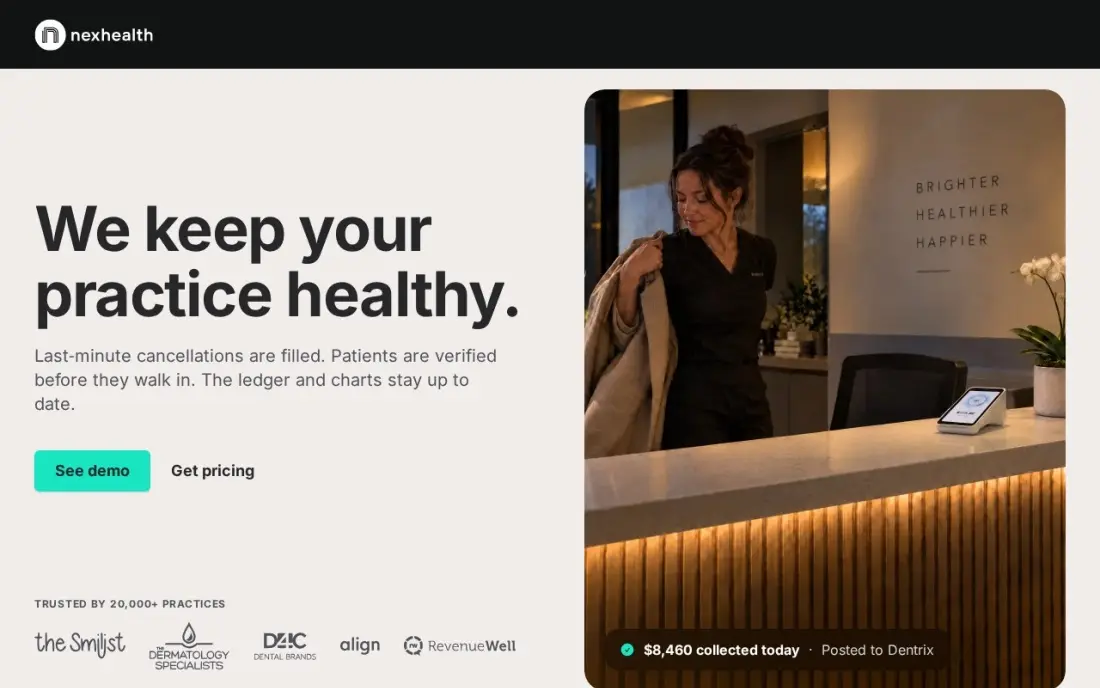
NexHealth's strength is the connection. Its Synchronizer reads and writes the practice's schedule, chart and ledger in real time across 15 health record systems, so an online booking, a text confirmation, a digital form and a payment all update the same record. Insurance eligibility checks can run automatically before each appointment, which saves the front desk a round of calls.
NexHealth prices by quote. Capterra and pricing guides put the start at $350 a month, and implementation typically adds $500 to $3,000, plus integration fees. There is no free trial. Reviewers rate it 4.8 out of 5 on G2 from 138 reviews, the highest score here.
What we like
- Highest rating here: 4.8 out of 5 from 138 G2 reviews
- Synchronizer reads and writes schedule, chart and ledger in real time across 15 health record systems
- Eligibility checks run automatically ahead of appointments or on demand
- An online booking, a text confirmation, a digital form and a payment all update the same patient record
Watch out for
- The $350 figure comes from Capterra and pricing guides; NexHealth itself prices by quote
- Implementation typically adds $500 to $3,000 one-time, plus integration fees
- No free trial, so the only way to test it is a demo

Luma Health
Best for: Health systems and specialty groups that need referrals, scheduling, intake and reminders at scale
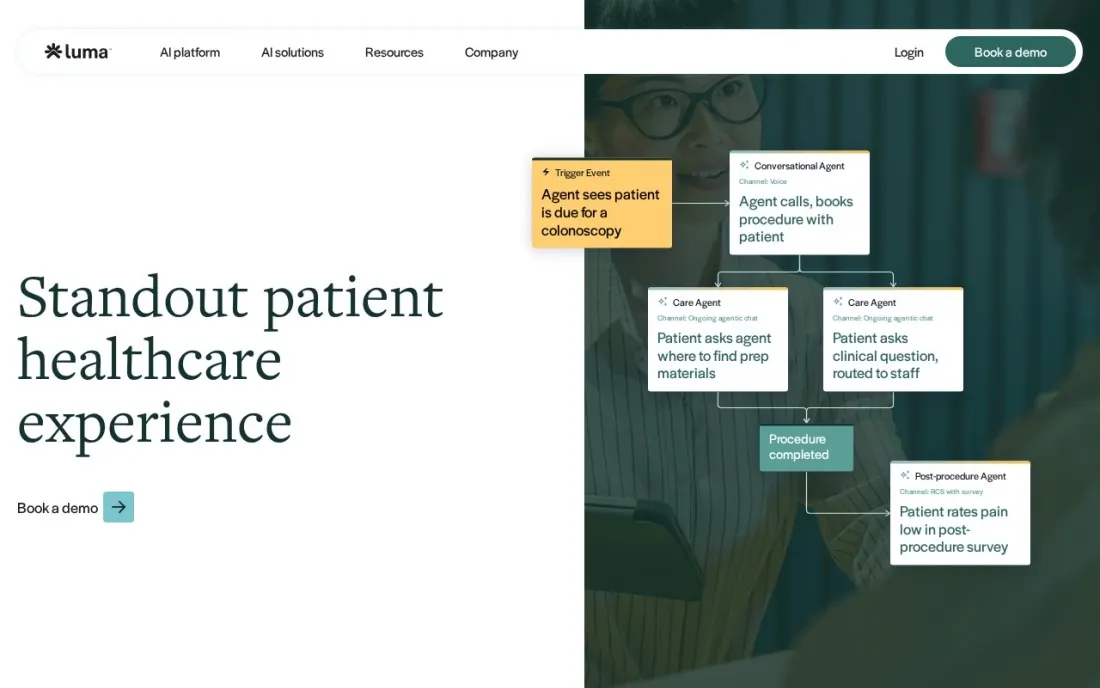
Luma Health calls its product a Patient Success Platform, and it is built for organisations with complex access problems: health systems, specialty groups, regional and rural care and primary care networks. It handles referrals with automated outreach, rules-based scheduling tied to the EHR, a waitlist that offers freed-up slots, mobile intake forms, eligibility checks and reminders and recalls in more than 30 languages.
Its integration list is the reason larger groups shortlist it: Epic, Oracle Health, MEDITECH, eClinicalWorks and athenahealth are all named. Luma publishes no pricing, so every figure comes through a demo. For a single-provider office it is more platform than needed; for a multi-site group with referral backlogs, it fits.
What we like
- Covers the full journey: referrals, scheduling, waitlist, intake forms, eligibility, payments reminders and recalls
- Integrates with Epic, Oracle Health, MEDITECH, eClinicalWorks and athenahealth, among others
- Reminders and recalls in more than 30 languages, plus broadcast messaging for closures and care-gap campaigns
- HIPAA compliant, SOC 2 Type II attested and HITRUST CSF r2 certified, per Luma's platform page
Watch out for
- No published pricing — every price comes through a demo
- Built for health systems and specialty groups, so a single small practice may pay for scale it does not use
- The platform is broad, so expect a real implementation project rather than a same-week switch

Solutionreach
Best for: Practices whose main goal is filling the schedule through reminders and patient recall
Solutionreach is the recall specialist. It connects to more than 400 practice management and EHR systems and runs the messages that keep a schedule full: appointment reminders, recall and reactivation campaigns for lapsed patients, two-way texting, online scheduling and digital intake. It signs a Business Associate Agreement as part of its terms.
It publishes no starting price, and third-party directories list figures anywhere from $199 to $400 a month. Add-ons push the bill up: extra SMS costs $50 to $250 a month and the AI receptionist is a paid add-on. A free trial is available, so test recall results on your own patient list first.
What we like
- Connects with 400+ practice management and EHR systems, so reminders, recalls and intake sync without retyping
- Acts as your HIPAA business associate, with a Business Associate Agreement in its terms
- Automated recall and reactivation campaigns target lapsed patients, plus two-way texting, online scheduling and digital intake
Watch out for
- No published starting price, so budgeting starts with a sales conversation rather than a number on the page
- Third-party directories disagree on the entry price, listing figures from $199 to $400 a month
- Add-ons stack up: extra SMS runs $50–$250 a month and the AI receptionist is a paid add-on

Tebra (PatientPop)
Best for: Independent practices that want a website, online booking, reviews and reminders tied to their EHR
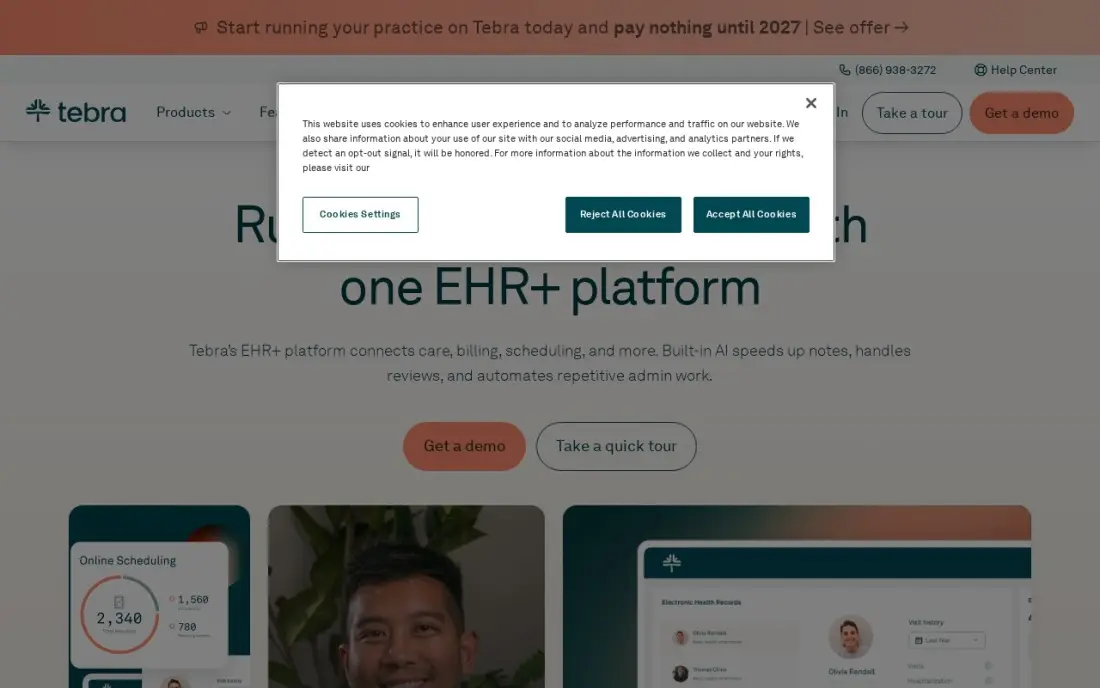
Tebra, formerly PatientPop, combines patient engagement with practice growth. The Patient Experience and Marketing bundle includes a practice website with SEO, online scheduling, reputation management with AI review replies, automated reminders and listings on more than 80 directories, and because the EHR is Tebra's own, bookings and reminders update the same record.
It costs $49 a month per non-physician provider and $99 a month per physician, so a practice with three physicians pays $297 a month. The bundle runs on a 12 to 24 month contract and is a closed system: the website and booking live inside Tebra, not your existing stack.
What we like
- Built for healthcare from the ground up: custom practice website with SEO, online scheduling, reputation management and 80+ directory listings
- HIPAA compliant with a Business Associate Agreement available, and the EHR is native rather than integrated
- AI-powered review replies and automated reminders run without staff touching them
Watch out for
- Pricing is per provider, so a practice with several physicians pays the per-provider rate for each one
- The marketing bundle is a 12 to 24 month contract, not month-to-month
- It is a closed system — the website, scheduling and reputation tools live inside Tebra, not your existing stack

Podium
Best for: Multi-provider clinics that want texts, calls, webchat, reviews and payments in one shared inbox

Podium is a general local-business messaging platform rather than a healthcare-built one, but its model suits a busy clinic front desk: texts, calls, webchat and review requests land in one shared inbox, and patients can pay a balance by text at 2.9% plus $0.30. Core costs $399 a month and Pro $599, with unlimited contacts and team members on Core.
Extra fees sit on top: $5 a month per US location for carriers, $5 per extra phone number and $30 per phone seat. Because Podium is not a healthcare-specific tool, ask for its HIPAA terms and a Business Associate Agreement in writing before you send appointment details through it.
What we like
- One shared inbox for texts, calls, webchat and reviews, with AI review responses on the entry plan
- Unlimited contacts, texts and team members on Core, with 250 bulk message credits a month
- Payments by text at 2.9% plus $0.30, so the review tool also takes the money
- Ease of use is the most-mentioned G2 strength, with 358 mentions across 2,109 reviews
Watch out for
- The most expensive entry here at $399 a month, with every plan sold through a sales call
- A $5 monthly carrier fee per US location, $5 per extra phone number and $30 per phone seat sit on top of the plan
- The AI Employee add-on has no published price, and the AI is capped at 1,500 message segments a month

Birdeye
Best for: Multi-location practices that want reviews, messaging and listings managed centrally

Birdeye is the multi-location option: reviews, messaging, surveys, listings, social and payments managed in one dashboard across every site. For a dental or physio group with several locations, centralised review management and patient surveys are the parts that matter most, and it is rated 4.7 out of 5 on G2 from 4,205 reviews.
Birdeye publishes no prices. Third-party reports put Starter at $299 a month per location billed annually, falling to about $199 to $249 at ten or more locations, on annual contracts that auto-renew. Like Podium it is not healthcare-built, so confirm HIPAA terms before using it for anything beyond reviews.
What we like
- The broadest suite here: reviews, messaging, social, surveys, listings and payments in one login
- Largest review sample in this list at 4.7 out of 5 from 4,205 G2 reviews
- Centralized review management across locations, with automation and strong reporting
- Per-location rates fall to about $199 to $249 a month at ten or more locations
Watch out for
- Publishes no prices at all, so the $299 figure is third-party reported and every quote needs confirming in writing
- Annual contracts with auto-renewal, and third-party reports describe a renewal increase of about 8%
- AI review replies cost $50 to $100 a location a month extra, on top of the subscription
The best patient engagement platform keeps patients informed, booked and returning without your front desk making every call by hand. We compared seven platforms across healthcare-built suites, recall specialists and general messaging tools used by clinics, and every price below was checked on the vendor's own pages in November 2026 — with third-party figures labelled where a vendor publishes none.
How to choose the best patient engagement platform
- Start with your practice system. Engagement only saves time if bookings, forms and confirmations write back to your EHR or practice management software; check the exact integration, not just the logo.
- Decide what problem you are solving. No-shows call for reminders and confirmations, an empty schedule calls for recall campaigns, and phone overload calls for two-way texting and online booking.
- Ask for the Business Associate Agreement. Any tool that sends appointment details is handling health information; healthcare-built platforms state HIPAA terms, general ones may not.
- Count locations and providers. Tebra prices per provider, Birdeye per location and Weave per practice, so the cheapest tool for one office may be the dearest for five.
- Price the extras. Setup fees, form uploads, extra SMS, phone seats and AI add-ons appear on several of the bills here.
- Check the contract term. Weave bills month to month, while Tebra's bundle runs 12 to 24 months and Birdeye's contracts auto-renew annually.
Engagement keeps the patients you have; search brings new ones. If your practice wants more patients finding it on Google Maps, our local SEO service covers that, and our guide to the best medical SEO companies compares agencies that focus on healthcare.
Patient engagement platform pricing: what you will actually pay
Take a single-location practice with two physicians and one hygienist or nurse practitioner. Weave starts at $199 a month, or $2,388 a year, plus a $750 setup fee and $200 for initial form uploads — $3,338 in the first year. Tebra's Patient Experience and Marketing bundle costs $99 a month for each physician and $49 for the non-physician provider, $247 a month or $2,964 a year, on a 12 to 24 month contract. Podium Core costs $399 a month, $4,788 a year, before the $5 per-location carrier fee and $30 per phone seat.
NexHealth, Solutionreach, Luma Health and Birdeye are quote-only. Third-party figures put NexHealth at around $350 a month, $4,200 a year, plus $500 to $3,000 in implementation, and Solutionreach anywhere from $199 to $400 a month. Treat those as a reason to ask for a written quote, not as a budget, and compare first-year totals including setup rather than monthly headlines.
Know the difference: healthcare-built platforms vs general messaging tools
Healthcare-built platforms — Weave, NexHealth, Solutionreach, Tebra and Luma Health — are designed around the appointment. They read the schedule from your practice system, send reminders and recalls based on it, collect intake forms that land in the chart, and are built with health data in mind — though you should still get the BAA in writing. That deep link is what removes double entry for the front desk.
General messaging and review tools such as Podium and Birdeye are built for any local business. They are strong at shared inboxes, review generation and payments by text, and they cover several locations well, but they do not run recall from your clinical schedule in the same way. Clinics often use them for reviews and general enquiries, with appointment communication left to a healthcare-built platform.
Quick comparison: tool type by need
| Buyer | Best pick | Why |
|---|---|---|
| Dental and medical practices | Weave | Phones, texting, reminders and payments from $199/month |
| Practices wanting live sync | NexHealth | Real-time read and write to schedule, chart and ledger |
| Health systems and specialty groups | Luma Health | Referrals, scheduling, intake and 30+ language reminders, quote-only |
| Practices focused on recall | Solutionreach | Recall and reactivation across 400+ practice systems |
| Independent practices growing online | Tebra (PatientPop) | Website, booking, reviews and reminders tied to a native EHR |
| Busy multi-provider clinics | Podium | Shared inbox for texts, calls, webchat and reviews, from $399/month |
| Multi-location groups | Birdeye | Central reviews, surveys and listings across sites |
Mistakes to avoid
- Buying before checking the integration. A platform that cannot write back to your practice system turns automation into double entry.
- Skipping the BAA. Sending appointment details through a tool without a Business Associate Agreement is a compliance risk, whatever the marketing says.
- Comparing monthly prices only. Setup fees, form uploads and implementation can add hundreds or thousands of dollars in the first year.
- Sending too many messages. Patients mute practices that text too often; set reminder timing and frequency deliberately and measure confirmations.
- Ignoring recall. Reminders reduce no-shows, but recall of overdue patients is usually where the extra revenue sits.
Related comparisons: Sales Engagement Platforms
How we chose
We checked each vendor's own pricing or product page in November 2026 and recorded starting prices exactly as shown. Where a vendor publishes no price, we list it as a custom quote and label third-party figures as estimates. We scored platforms on practice-system integration, reminders and recall, two-way messaging, intake and payments, HIPAA position and total first-year cost. Ratings come from G2 pages on the dates shown in the sources. No vendor paid for a place in this list, and none of the links here are affiliate links.
What to do next
Pull your no-show rate and your list of patients overdue for a visit, then ask two shortlisted vendors to show exactly how their platform would reach those patients inside your practice system. Choose the one that moves both numbers with the least staff effort. If you also want more new patients finding the practice, book a free local visibility check.
Frequently asked questions
What is the best patient engagement platform?
For most dental and medical practices, Weave is the best all-round pick, with phones, texting, reminders and payments from $199 a month. NexHealth is best for real-time sync with the practice system, Solutionreach for recall, and Luma Health for health systems and specialty groups.
What does a patient engagement platform do?
It handles the communication around a visit: online booking, appointment reminders, two-way texting, digital intake forms, recall of overdue patients, review requests and often payments. The best platforms sync with the practice management or EHR system so staff do not retype anything.
How much do patient engagement platforms cost?
Weave publishes $199 a month plus a $750 setup fee, Tebra costs $49 per non-physician provider and $99 per physician a month, and Podium Core costs $399 a month. NexHealth, Solutionreach, Luma Health and Birdeye are quote-only; third-party figures for NexHealth start around $350 a month.
Do patient engagement platforms need to be HIPAA compliant?
Yes, if they handle protected health information such as appointment details. Healthcare-built tools such as Solutionreach, Tebra and Luma Health state HIPAA compliance; for general tools such as Podium and Birdeye, get a signed Business Associate Agreement before use.
What is the difference between patient engagement and patient scheduling software?
Scheduling software books the appointment. A patient engagement platform covers everything around it — reminders, confirmations, forms, recall, reviews and payments — and usually includes online booking as one feature.
Which patient engagement platform is best for a small practice?
A small practice usually gets the most from Weave for its published price and month-to-month billing, or Tebra if it also wants a website and online booking tied to an EHR. Luma Health is built for larger organisations.
What is the best patient engagement platform for hospitals and health systems?
Luma Health is the platform here built for health systems and specialty groups. It covers referrals, scheduling, waitlists, intake forms, eligibility, payment reminders and recalls, integrates with Epic, Oracle Health, MEDITECH, eClinicalWorks and athenahealth, and sends reminders in more than 30 languages. It is HIPAA compliant, SOC 2 Type II attested and HITRUST CSF r2 certified, and pricing is by quote.
Sources we checked (11)
- Weave — www.getweave.com/pricing (checked November 7, 2026)
- Weave reviews on G2 (checked November 7, 2026)
- NexHealth — www.nexhealth.com (checked November 7, 2026)
- NexHealth reviews on G2 (checked November 7, 2026)
- Luma Health — go.lumahealth.io/patient-success-platform (checked November 16, 2026)
- Solutionreach — www.getapp.com/all-software/a/solutionreach (checked November 4, 2026)
- Tebra (PatientPop) — www.tebra.com (checked November 4, 2026)
- Podium — www.podium.com/pricing (checked November 12, 2026)
- Podium reviews on G2 (checked November 12, 2026)
- Birdeye — birdeye.com/pricing (checked November 12, 2026)
- Birdeye reviews on G2 (checked November 12, 2026)
Make one of these tools?
We re-check this list every quarter. Send a correction, request a review, or ask about a clearly labeled sponsored spot.
Request a listingShamim
Founder of SerpAstra
A full-stack digital marketer and SEO strategist covering technical and local SEO, AI search visibility, paid ads and lead generation for local businesses, e-commerce brands and SaaS teams.
Free SEO and AI visibility audit
Find out what is holding your rankings back
Send us your site. Within 2 business days you get a written audit, an AI visibility check and a short fix list ranked by impact. Free, with no contract attached.
Request my free audit→Related buying guides
 Productivity & Office10 Best Appointment Reminder Software in 2026, ComparedCompare the 10 best appointment reminder software options on price, reminders, free plans and no-show tools, with prices checked November 10, 2026.Read guide →
 Healthcare9 Best Medical Appointment Scheduling Software in 2026, ComparedCompare the 9 best medical appointment scheduling software options on price, HIPAA readiness, reminders and free plans, with prices checked November 8, 2026.Read guide →
 Healthcare8 Best Automation Tools for Marketing in Healthcare in 2026, ComparedThe 8 best automation tools for marketing in healthcare, compared on price, HIPAA readiness and patient-journey automation. Prices checked November 4, 2026.Read guide →