
8 Best Real Estate Crowdfunding Platforms in 2026, Compared
Compare the 8 best real estate crowdfunding platforms on minimum investment, fees, accreditation and liquidity, with every figure checked November 8, 2026.
 Shamim Mia, Founder, SerpAstraLast verified November 8, 202613 min read
We compare pricing pages, documentation and public reviews. We never accept payment for rankings.

Key takeaways
- Fundrise is the best fit for most first-time investors at a $10 minimum, Groundfloor is the best short-term debt pick at $10 with no investor fees, and Arrived is the best way to pick a specific rental home at $100.
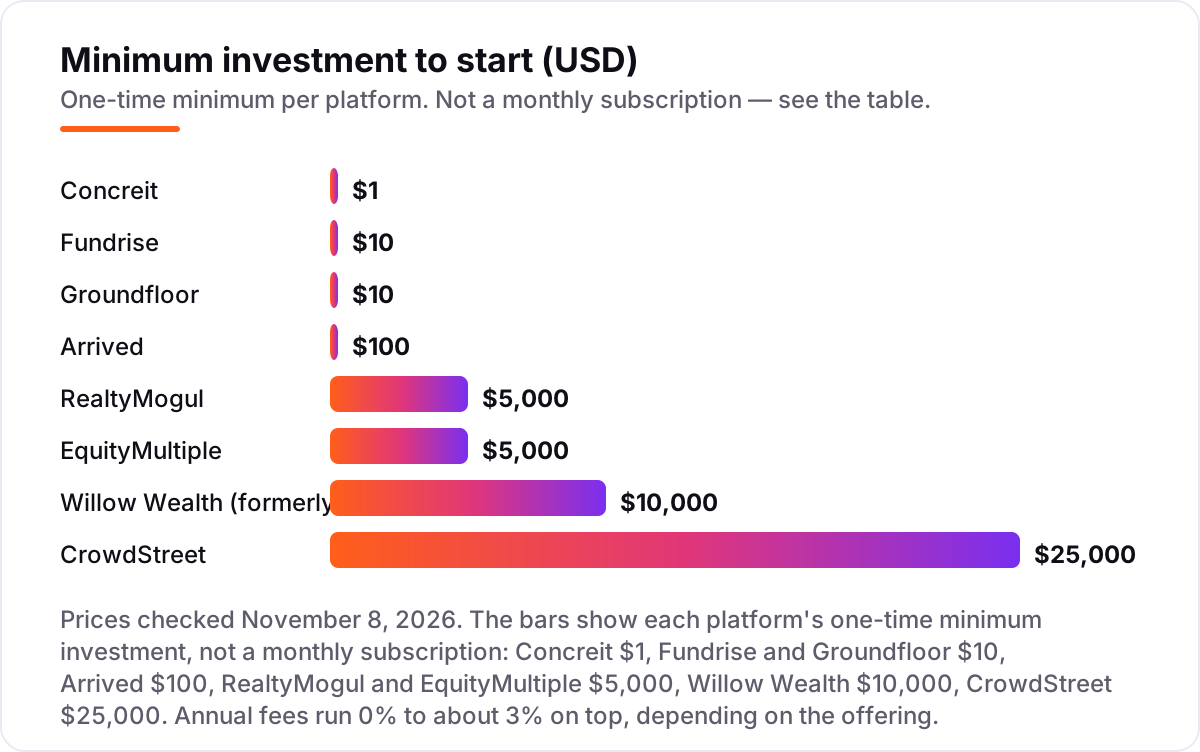
- These are investments, not subscriptions: the chart shows one-time minimums from $1 to $25,000, and annual fees run from 0% to about 3% on top, depending on the offering.
- Accreditation splits the list in half: Fundrise, Groundfloor, Arrived and Concreit take any US investor, while EquityMultiple, Willow Wealth and CrowdStreet are mostly accredited-only.
- Nothing here is liquid. Holds run from 6 months on Groundfloor loans to 3–10 years on CrowdStreet deals, and RealtyMogul's REIT redemptions are suspended.
On this page
Quick comparison
| Tool | Best for | Starting price | Free plan |
|---|---|---|---|
| Fundrise | First-time investors who want the lowest barrier into diversified real estate funds with no accreditation needed | $10 minimum | No |
| Groundfloor | Investors who want short-term real estate debt with no investor fees and money back in months, not years | $10 minimum | No |
| Arrived | Investors who want to pick the exact rental house they own a slice of, from $100 | $100 minimum | No |
| Concreit | Beginners who want to test real estate investing with a single dollar and weekly payouts | $1 minimum | No |
| RealtyMogul | Investors who want commercial real estate REITs and individual deals from one established platform | $5,000 minimum | No |
| EquityMultiple | Accredited investors who want commercial deals plus short-term notes paying 6-7.4% APY | $5,000 minimum | No |
| Willow Wealth (formerly Yieldstreet) | Accredited investors who want one platform spanning real estate, private credit, art and private equity | $10,000 minimum | No |
| CrowdStreet | Accredited investors who want to hand-pick individual commercial deals and can commit $25,000 per deal | $25,000 minimum | No |
Make one of these tools?
We re-check this list every quarter. Send a correction, request a review, or ask about a clearly labeled sponsored spot.
Request a listingThe best real estate crowdfunding platforms

Fundrise
Best for: First-time investors who want the lowest barrier into diversified real estate funds with no accreditation needed
Fundrise is the easiest starting point in this list. A $10 minimum buys into diversified funds holding dozens of properties across apartments, industrial buildings and single-family rentals, and no accreditation is needed for the core real estate funds. Fees are published and flat: 0.15% advisory plus 0.85% management, about 1% a year in total. An IRA account needs $1,000 to open, and the $125 annual IRA custody fee makes small IRA balances uneconomic.
The trade-off is control. You buy shares of Fundrise funds, never a specific building, and the managers choose every property. Money is locked up for years by design: redemptions run quarterly, and pulling out early costs 1-3%. Buy Fundrise when you want the cheapest, simplest way into private real estate; buy Arrived when picking the exact house matters more to you.
What we like
- The lowest minimum among diversified fund platforms at $10, open to non-accredited investors
- A flat, published fee of about 1% a year: 0.15% advisory plus 0.85% management
- Diversified funds spread money across dozens of properties and several property types
- Quarterly redemption windows give a defined, if slow, way to request an exit
Watch out for
- You buy into funds, not individual properties, so you never pick a specific building
- Money is locked up for years; early redemptions carry penalties of 1-3%
- The Innovation Fund (VCX) is now a listed stock, not a platform fund, so the venture option is gone from the platform

Groundfloor
Best for: Investors who want short-term real estate debt with no investor fees and money back in months, not years
Groundfloor works differently from every fund on this list: you lend money to developers, and you earn the interest the borrower pays. Individual loans start at $10, the account minimum is $100, and there are no investor fees at all — borrowers pay a 2-4.5% origination fee. Loans run 6-18 months. Fixed-rate Notes pay 5.0% APR for one month, 6.0% for three months and 8.0% for the 12-month Signature Note.
The risk is the borrower: your return is capped at the loan rate, and a default can cost principal. The company's FY2025 filing shows most pre-2025 loans still on its books were more than 90 days past due, and auditors have repeated a going-concern doubt in every annual report since fiscal 2017. Spread small amounts across many loans and keep any Groundfloor position small.
What we like
- Zero investor fees on individual loans and Notes; borrowers pay the 2-4.5% origination fee
- A $10 minimum per loan lets a small account spread across many loans
- Short terms of 6-18 months mean money comes back far sooner than on equity platforms
- Fixed-rate Notes pay 5.0% to 8.0% APR depending on term, published on the Notes page
Watch out for
- You are a lender, not an owner, so returns are capped at the loan rate with no upside
- Default risk is real: most pre-2025 loans still on the books were past due in the FY2025 filing
- Auditors have repeated a going-concern doubt in every annual report since fiscal 2017

Arrived
Best for: Investors who want to pick the exact rental house they own a slice of, from $100
Arrived sells shares of individual rental homes: you browse houses, pick the ones you like, and buy in at $100 a share, $10 per share. Offerings are open to accredited and non-accredited investors under Regulation A+, and the platform reports $493 million invested and $125 million distributed across 613 properties as of November 2026. A monthly secondary market offers a possible exit after six months, for a fee.
The fees sit inside each property. A 3.5% sourcing fee is built into the offering price, brokerage and offering costs add up to 3% more, asset management runs 0.6% of the purchase price a year, and property management takes up to 8% of rent. Dividend yields on single-family rentals averaged 3.9% in 2025. Buy Arrived when choosing the house matters; buy Fundrise when you would rather have the manager choose.
What we like
- The only platform here where you choose the individual rental home, from $100 a share
- Open to accredited and non-accredited investors under Regulation A+
- A monthly secondary market offers a possible exit after a 6-month hold, for a fee
- Highest Trustpilot score in this list at 4.4 out of 5 from 226 reviews
Watch out for
- A 3.5% sourcing fee is built into each home's price, so you pay above market value on entry
- Dividend yields on single-family rentals averaged 3.9% in 2025, well below the debt platforms
- A federal class action filed in mid-2026 alleges inflated return projections and hidden fees

Concreit
Best for: Beginners who want to test real estate investing with a single dollar and weekly payouts
Concreit is the cheapest way to try real estate investing: $1 buys a share of its Cash Flow fund, a pooled fund of short-term real estate loans, and dividends arrive weekly. The fund pays a 6.30% annualized distribution on a $1.00 share price, per its October 2026 SEC filing, through a mobile app. There is no property selection and no appreciation upside — this is fixed-income exposure, not ownership.
The catch is the small-account fee. Balances under $5,000 pay $5 a month, which is $60 a year, more than the payout on a $1,000 balance. Above $5,000 the fee switches to 1% a year, which is reasonable. Redemptions are monthly requests, not guarantees, and exiting in year one costs 2%. Concreit works as a $1 test drive, not as a place to park a small balance.
What we like
- The lowest minimum anywhere at $1, open to non-accredited investors
- Weekly dividend payouts, the most frequent schedule in this list
- A 6.30% annualized payout on a $1.00 share price, per its October 2026 SEC filing
- Mobile-first app with a live payout tracker and automatic reinvestment
Watch out for
- A $5 monthly fee on balances under $5,000 wipes out the yield on any small account
- A pooled debt fund with no property selection and no appreciation upside
- Redemptions are requests, not guarantees, and exiting in year one costs 2%

RealtyMogul
Best for: Investors who want commercial real estate REITs and individual deals from one established platform
RealtyMogul is the oldest commercial platform here, founded in 2012, and its pitch is access to the deals institutions buy: apartments, offices and industrial property through two non-traded REITs and individual private placements. The REITs start at $5,000 and are open to non-accredited investors; private placements run $25,000-$35,000 and need accreditation. Joining is free and the platform charges sponsors, not investors, to list — the fees sit inside the REITs instead.
Read the current status before you put money in. Both REITs stopped taking new subscriptions on July 11, 2025, and both boards suspended share repurchases on April 21, 2026, so existing investors cannot exit and new investors cannot enter the REITs at all. The Income REIT's net asset value has fallen 37.8% since 2022. What is actually open today is the private-placement shelf for accredited investors.
What we like
- Two non-traded REITs open to non-accredited investors under Regulation A
- Private placements from $25,000 for accredited investors who want single deals
- Acquired by The Wideman Company in November 2025, and the platform still operates
- Quarterly distributions on the Income REIT, currently running about 1.5% of NAV a year
Watch out for
- Both REITs are paused to new investors since July 11, 2025, and redemptions were suspended April 21, 2026
- The Income REIT's net asset value has fallen 37.8% since 2022, per 2026 reviews
- Fee layers stack: up to 3% offering costs, 1-1.25% management, and a 2% disposition fee

EquityMultiple
Best for: Accredited investors who want commercial deals plus short-term notes paying 6-7.4% APY
EquityMultiple pairs two very different products. Alpine Notes are short-term, fixed-rate notes paying 6.0% APY for three months, 7.0-7.05% for six and 7.35-7.40% for nine, with no investor fees — the $5,000 minimum genuinely applies here. The other side is commercial real estate: debt, preferred equity and equity deals, plus pooled funds, where minimums run $10,000-$30,000 in practice and fees run 0.5-1.5% a year plus a $30-$70 administrative fee per investment.
Two things changed recently. The platform is accredited-only, so most readers cannot use it at all. And on August 1, 2026, Larson Capital Management took over day-to-day operations under license from Equity Multiple, Inc., with new Larson offerings carrying Larson's own fees — typically 2% of net asset value, a 1.5% acquisition fee and 20% of profits above a preferred return. Older reviews describe a different operator.
What we like
- Alpine Notes pay 6.0% APY for 3 months, 7.0-7.05% for 6 months and 7.35-7.40% for 9 months, with no investor fees
- Commercial debt, preferred equity and equity deals, plus pooled funds
- Self-certified accreditation at signup, with no documentary evidence typically required
- The Ascent Income Fund reported a 9.08% historical distributed net yield as of June 2025
Watch out for
- Accredited investors only; there is no path for retail investors
- The advertised $5,000 minimum covers Alpine Notes only; most deals need $10,000-$30,000
- Larson Capital Management took over day-to-day operations on August 1, 2026, so the platform is not what older reviews describe

Willow Wealth (formerly Yieldstreet)
Best for: Accredited investors who want one platform spanning real estate, private credit, art and private equity
Willow Wealth is the new name of Yieldstreet, per a January 2026 SEC filing, after the rebrand was announced in October 2025. Its menu is the broadest here — real estate, private credit, private equity, art and more — in deal funds mostly from $10,000 and a managed Willow 360 portfolio from $25,000. New primary offerings are accredited-only, backed by an SEC-registered adviser and a FINRA-registered broker-dealer.
CNBC's August 2025 review of 30 Yieldstreet real estate deals found 4 written down to zero, 23 on a watchlist and only 3 still active, all of which had stopped paying out. The Alternative Income Fund's quarterly repurchase was suspended in April 2026. Fees also stack: a 1-4% placement fee, 1-3% a year in management, and up to 20% of profits on some deals. This is the platform to research hardest before committing.
What we like
- The broadest menu here: real estate, private credit, private equity, art and more
- Deal funds from about $10,000, with a managed Willow 360 portfolio from $25,000
- An SEC-registered adviser and a FINRA-registered broker-dealer sit behind the platform
- Short Term Notes from $500 offer a lower entry point into private credit
Watch out for
- Rebranded from Yieldstreet to Willow Wealth in October 2025, and public performance history was largely removed
- CNBC's August 2025 review of 30 real estate deals found 4 written to zero and 23 on a watchlist
- Fees stack across layers: 1-4% placement, 1-3% a year management, and up to 20% of profits on some deals

CrowdStreet
Best for: Accredited investors who want to hand-pick individual commercial deals and can commit $25,000 per deal
CrowdStreet is a marketplace where accredited investors pick individual commercial deals — apartments, industrial parks, hotels — and commit $25,000 or more to the one they choose. There is no direct platform fee to investors on marketplace deals; sponsors pay to list, and sponsor fees of 2-5% sit inside each deal. CrowdStreet Funds offer a more diversified route, and its Form CRS puts typical fund offerings from $5,000.
The minimum is one problem; the history is the second. Proper diversification means five or more deals: $125,000 at the standard minimum. In 2022, Nightingale Properties offerings on CrowdStreet became a fraud case: the sponsor's CEO pleaded guilty in February 2025 to wire fraud involving roughly $54 million raised from CrowdStreet investors. Holds run 3-7 years. Only investors who can diligence a sponsor themselves should use the marketplace.
What we like
- Pick individual commercial deals: apartments, industrial, hotels and more
- No direct platform fee to investors on marketplace deals; sponsors pay to list
- CrowdStreet Capital is a FINRA-registered broker-dealer and SIPC member since 2023
- Funds and managed portfolios sit alongside the marketplace for investors who want diversification
Watch out for
- Accredited investors only, with a $25,000 minimum that makes diversification expensive
- The 2022 Nightingale fraud case saw about $54 million raised from CrowdStreet investors
- No early exit: holds run 3-7 years, and CrowdStreet warns some deals can extend past 10 years
The best real estate crowdfunding platforms let an ordinary investor buy a slice of property online — a rental house, an apartment building, a short-term loan to a house flipper — without a mortgage or a tenant to manage. This list covers eight of them, from a $1 minimum to $25,000 a deal, and every minimum and fee below was checked on November 8, 2026. Treat this as a comparison of platforms, not investment advice: every one of these investments is illiquid, and several have frozen withdrawals in the last two years.
How to choose the best real estate crowdfunding platforms
- Start with accreditation. Fundrise, Groundfloor, Arrived and Concreit take any US investor; EquityMultiple, Willow Wealth and CrowdStreet are accredited-only, and RealtyMogul's private placements are too. If you are not accredited, half this list is closed to you before price matters.
- Match the minimum to the real cost. A $1 or $10 start is a test drive, not a portfolio. Concreit's $5 monthly fee on balances under $5,000 costs more than the yield on a $1,000 balance, and Groundfloor's $10 loans only diversify once you hold ten or more.
- Ask who picks the property. Fundrise and Concreit are funds: the manager chooses. Arrived and CrowdStreet let you pick the exact house or deal, which means the due diligence is yours, not theirs.
- Check the exit before the entry. Groundfloor loans repay in 6-18 months; CrowdStreet deals lock money up for 3-10 years. RealtyMogul's REIT redemptions are suspended, so a platform can be open for new deals and closed for exits at the same time.
- Add up every fee layer. The headline rate is rarely the whole cost: Arrived's sourcing fee, RealtyMogul's offering costs and Willow Wealth's placement fee all sit on top of the annual management fee.
Choosing a platform is only half the job if you also own property directly. Our guide to accounting software for real estate investors covers the bookkeeping side, and our local SEO service helps real estate businesses get found by local buyers. Before you publish a page about any investment you make, run the title through the free SERP snippet preview tool to see exactly how it will look in Google.
Whatever you shortlist, read the offering documents before you invest — not just the marketing page. Every platform here files with the SEC, and the fees, the hold period and the redemption rules live in those documents. Start with an amount you can afford to lock up for the full hold period, spread it across more than one platform if you can, and check the platform's current status: two platforms on this list have paused redemptions or new subscriptions in 2025-2026, and the status can change between reviews.
Real estate crowdfunding pricing: what you will actually pay
Take $25,000 — the smallest amount that can enter every platform on this list — and hold it for one year. On Fundrise the annual cost is about $250 at 1%. On Groundfloor, spread across individual loans, the investor fee is $0. On Concreit it is $250 at 1%. On RealtyMogul's Income REIT it is $250 at 1%, or $312.50 on the Apartment Growth REIT at 1.25%. On EquityMultiple it is $125-$375 in management fees plus a $30-$70 administrative fee. On Arrived, a single-family home costs about $875 in sourcing fees up front plus about $150 a year in asset management. On Willow Wealth, placement takes $250-$1,000 once and management takes $250-$750 a year.
CrowdStreet is the outlier: no direct platform fee on marketplace deals, but sponsor fees of 2-5% sit inside each deal, which is $500-$1,250 a year on $25,000 before any performance fee. Two numbers in this example are not in the chart at all. First, Concreit's $5 monthly fee only applies under $5,000, so it does not touch a $25,000 balance. Second, RealtyMogul's REITs are paused to new investors, so that $250 figure is what an existing holder pays, not a price a new investor can buy today.
The lesson is that the minimum is the wrong number to compare. The cost that matters is the annual drag on the amount you actually invest, plus the one-time fees taken before your money starts earning. On $25,000 for one year, that drag runs from $0 on Groundfloor loans to roughly $1,750 on Willow Wealth at the top of its ranges — and the spread widens every year the money stays locked up.
Know the difference: funds vs individual deals
The biggest confusion in this category is between buying a fund and buying a deal. A fund — Fundrise, Concreit, a REIT on RealtyMogul — pools your money with other investors and a manager picks the properties. You get diversification and professional management, and you give up the choice of what you own. An individual deal — a house on Arrived, a loan on Groundfloor, a project on CrowdStreet — lets you pick the exact property, which means you also carry the risk of that one property.
There is a second distinction worth knowing: debt versus equity. Groundfloor loans and Concreit's fund are debt: you lend money and earn interest, with returns capped at the loan rate and no share in appreciation. Fundrise funds, Arrived shares and CrowdStreet deals are mostly equity: you own a slice of the property, so you share the upside when values rise and the loss when they fall. Debt pays first when things go wrong; equity pays more when things go right.
A third distinction is who the fees go to. On Groundfloor and CrowdStreet's marketplace, the borrower or sponsor pays the platform, so the investor fee can be zero — but the cost is still there, priced into the loan rate or the deal. On Fundrise, Arrived and Concreit, the investor pays directly, which at least makes the cost visible. Neither model is free; one is just easier to see.
Quick comparison: tool type by need
| Buyer | Best pick | Why |
|---|---|---|
| First-time investor, $10 to start | Fundrise | Diversified funds, about 1% a year, no accreditation needed |
| Short-term cash, 6-18 months | Groundfloor | Real estate loans from $10, no investor fees |
| Wants to pick the exact house | Arrived | Shares of individual rental homes from $100 |
| Testing with $1 | Concreit | Lowest minimum anywhere, weekly payouts, but mind the $5 monthly fee under $5,000 |
| Commercial REITs | RealtyMogul | REITs from $5,000 — but paused to new investors, so check status first |
| Accredited, wants notes and deals | EquityMultiple | Alpine Notes pay 6-7.4% APY from $5,000 |
| Accredited, wants many asset classes | Willow Wealth | Real estate, credit, art and private equity from $10,000 |
| Accredited, wants to pick deals | CrowdStreet | Individual commercial deals from $25,000, no direct platform fee |
Mistakes to avoid
- Comparing minimums instead of annual cost. A $1 minimum with a $5 monthly fee costs more than a $100 minimum with a 1% fee. Compare the yearly drag on the amount you will actually invest.
- Assuming you can get out. Every platform here is illiquid by design. RealtyMogul's REIT redemptions are suspended and Willow Wealth's fund repurchase was suspended in April 2026 — check the exit terms before the entry terms.
- Treating a fund like a savings account. Concreit's weekly payouts and Groundfloor's fixed-rate Notes feel like cash, but neither is FDIC insured and neither guarantees redemptions.
- Buying one deal and calling it diversification. One CrowdStreet deal is one building in one city. Proper diversification on a $25,000-minimum platform needs $125,000 across five deals.
- Skipping the offering documents. The marketing page shows the minimum and the target return. The fees, the hold period, the redemption rules and the risk factors live in the SEC filings — read them before you invest.
How we chose
We checked each platform's minimum investment and fee structure on November 8, 2026. The vendors' own pages could not be opened directly from this machine — direct requests were refused and the page reader failed — so minimums were verified from fresh search-index crawls of the vendors' own pages, FAQs and SEC filings, cross-checked against independent reviews dated October and November 2026, and disclosed here rather than presented as a direct page read. CrowdStreet's $25,000 is the marketplace standard for individual deals; its own Form CRS puts typical fund offerings from $5,000. EquityMultiple's $5,000 covers Alpine Notes only; most of its deals need $10,000-$30,000. Ratings are Trustpilot scores from fresh crawls dated November 7-8, 2026, not G2 or Capterra, because these platforms have no G2 or Capterra listings; Concreit has no Trustpilot profile, so it carries no rating. No vendor paid for a place in this list, and none of the links here are affiliate links. This post is a platform comparison, not investment advice.
What to do next
Start with the platform that matches your accreditation status and the amount you can afford to lock up for the full hold period. Open an account, read the offering documents for the first investment you consider, and start small — a $10 or $100 test tells you how the platform reports, pays and communicates before you commit real money. If you run a real estate business and need more clients while your investments compound, our monthly SEO service handles the visibility side — or compare providers in our guide to accounting software for real estate developers. Once your tools are in place, find out what's holding your rankings back.
Your stack only works if people find you
SerpAstra fixes what keeps your site off page one and makes it easy for AI assistants to recommend.
Get a free audit→Sources we checked (15)
- Fundrise — fundrise.com (minimum and fees checked November 8, 2026)
- Groundfloor — groundfloor.com (minimum and fees checked November 8, 2026)
- Arrived — arrived.com (minimum and fees checked November 8, 2026)
- Concreit — concreit.com (minimum and fees checked November 8, 2026)
- RealtyMogul — realtymogul.com (minimum and fees checked November 8, 2026)
- EquityMultiple — equitymultiple.com (minimum and fees checked November 8, 2026)
- Willow Wealth — willowwealth.com (minimum and fees checked November 8, 2026)
- CrowdStreet — crowdstreet.com (minimum and fees checked November 8, 2026)
- Fundrise Trustpilot reviews — trustpilot.com/review/fundrise.com (checked November 8, 2026)
- Groundfloor Trustpilot reviews — trustpilot.com/review/groundfloor.com (checked November 8, 2026)
- Arrived Trustpilot reviews — trustpilot.com/review/arrived.com (checked November 8, 2026)
- RealtyMogul Trustpilot reviews — trustpilot.com/review/realtymogul.com (checked November 8, 2026)
- EquityMultiple Trustpilot reviews — trustpilot.com/review/www.equitymultiple.com (checked November 8, 2026)
- Willow Wealth Trustpilot reviews — trustpilot.com/review/willowwealth.com (checked November 8, 2026)
- CrowdStreet Trustpilot reviews — trustpilot.com/review/www.crowdstreet.com (checked November 8, 2026)
Shamim
Founder of SerpAstra
A full-stack SEO and digital marketer who spends most days on Local SEO for dental practices, AI search visibility and lead generation.
Frequently asked questions
What is the best real estate crowdfunding platform?
Fundrise is the best fit for most first-time investors: a $10 minimum, diversified funds, about 1% a year in fees and no accreditation needed. Groundfloor is better for short-term debt at $10 with no investor fees, and Arrived is better when you want to pick the exact rental home. The right pick depends on your minimum, your timeline and whether you are accredited.
How much money do I need to start real estate crowdfunding?
From $1 to $25,000, depending on the platform. Concreit starts at $1, Fundrise and Groundfloor at $10, Arrived at $100, RealtyMogul and EquityMultiple at $5,000, Willow Wealth at $10,000 and CrowdStreet at $25,000 per deal. A $1 or $10 start is a test drive, not a portfolio: the fees and the lack of diversification make tiny balances uneconomic.
Do I need to be an accredited investor?
Not for half this list. Fundrise, Groundfloor, Arrived and Concreit accept non-accredited investors under Regulation A, though non-accredited buyers are usually capped at 10% of the greater of their income or net worth per offering. EquityMultiple, Willow Wealth and CrowdStreet are accredited-only, and RealtyMogul's private placements are too. Accredited means $200,000 in annual income or $1 million in net worth, excluding your home.
Are real estate crowdfunding platforms safe?
They are regulated but not safe in the way a bank account is. Offerings are SEC-registered or exempt, and several platforms run FINRA-registered broker-dealers, but the investments are illiquid, unlisted and can lose principal. CrowdStreet's Nightingale fraud case and RealtyMogul's suspended redemptions both happened on regulated platforms. Never invest money you may need soon.
How do I get my money back from a crowdfunding platform?
Slowly, and sometimes not at all. Groundfloor loans repay in 6-18 months as borrowers pay back. Fundrise and Arrived offer quarterly or monthly redemption windows, with penalties and fees. CrowdStreet, EquityMultiple and RealtyMogul deals lock money up for 3-10 years with no early exit. RealtyMogul's REIT redemptions are currently suspended entirely, so check the exit terms before you invest.
What fees will I pay on a real estate crowdfunding platform?
It depends on the platform. Groundfloor charges investors nothing on loans and Notes. Fundrise charges about 1% a year. Concreit charges 1% a year, or $5 a month under $5,000. Arrived builds a 3.5% sourcing fee into each property price. EquityMultiple, Willow Wealth and CrowdStreet add sponsor and deal fees of 2-5% or more, so read the offering documents before committing.
Free SEO and AI visibility audit
Find out what is holding your rankings back
Send us your site. Within 2 business days you get a written audit, an AI visibility check and a short fix list ranked by impact. Free, with no contract attached.
Request my free audit→Related guides
 Local Business & Vertical Software7 Best Accounting Software for Real Estate Investors in 2026, ComparedCompare the 7 best accounting software for real estate investors on price, free plans and Schedule E reports, with prices checked November 7, 2026.Read guide →
 Local Business & Vertical Software7 Best Accounting Software for Real Estate Developers in 2026, ComparedCompare the 7 best accounting software for real estate developers on job costing, multi-entity reporting and price, with every price checked November 7, 2026.Read guide →
 Local Business & Vertical Software10 Best Accounting Software for Real Estate Flippers in 2026, ComparedCompare the 10 best accounting software for real estate flippers on price, free plans and per-flip cost tracking, with prices checked November 7, 2026.Read guide →