
9 Best Real Estate Investment Companies in 2026
Compare the 9 best real estate investment companies on minimums, fees and who can invest, with every minimum and fee checked November 8, 2026.
 Shamim Mia, Founder, SerpAstraLast verified November 8, 202614 min read
We compare pricing pages, documentation and public reviews. We never accept payment for rankings.

Key takeaways
- Concreit starts at $1 and Fundrise at $10, but the cheapest fee is Groundfloor at $0 — the minimum and the fee are two different costs, and the low-minimum picks are not always the cheap ones.
- Five of the nine need accredited status: EquityMultiple, Yieldstreet, AcreTrader and CrowdStreet take only accredited investors, and RealtyMogul's $5,000 REIT tier is paused for new money.
- The real cost is the fee stack, not the headline rate: on $10,000, the first-year cost runs from $0 on Groundfloor to $500-$700 on Yieldstreet once placement and sourcing fees are counted.
- Every pick here is illiquid — holds run from 6 months on Groundfloor loans to 5-10 years on farms and commercial deals, and most have no resale market at all.
On this page
Quick comparison
| Tool | Best for | Starting price | Free plan |
|---|---|---|---|
| Concreit | First-time investors who want to try real estate with the smallest possible amount and weekly payouts | $1 | No |
| Fundrise | Hands-off investors who want a diversified fund they never have to pick deals for | $10 | No |
| Groundfloor | Hands-on investors who want short-term real estate debt with no investor fees | $10 | No |
| Arrived | Investors who want to own a slice of one specific rental house and collect its rent | $100 | No |
| RealtyMogul | Investors who want commercial deals and REITs from one of the oldest platforms in the space | $5,000 | No |
| EquityMultiple | Accredited investors who want short-term notes or a choice of individual commercial deals | $5,000 | No |
| Yieldstreet | Accredited investors who want private markets beyond real estate, including art and private credit | $10,000 | No |
| AcreTrader | Accredited investors who want farmland specifically, for rent income plus land appreciation | $15,000 | No |
| CrowdStreet | Accredited investors with serious capital who want to pick individual commercial deals | $25,000 | No |
Make one of these tools?
We re-check this list every quarter. Send a correction, request a review, or ask about a clearly labeled sponsored spot.
Request a listingThe best real estate investment companies

Concreit
Best for: First-time investors who want to try real estate with the smallest possible amount and weekly payouts
Concreit is the cheapest way in: $1 buys a share in its Cash Flow fund, a pooled portfolio of short-term loans on single-family homes. The fund lends, collects interest and pays dividends weekly, at a 6.30% annualized payout rate from its October 2026 pricing supplement. The fee is 1% of net asset value a year above $5,000; below that, $5 a month.
The trade is simplicity for upside: this is debt, so you earn interest and never share in a property's appreciation, and the fund holds only about 20 to 25 loan participations. Leaving within a year costs 2% of the withdrawal, and redemptions come from a monthly queue the manager can suspend. Start on Concreit to learn the ropes with dollars, not thousands — then move to Fundrise or Groundfloor for diversification or deal choice.
What we like
- The lowest entry point anywhere: $1 to start, with no accreditation requirement
- Weekly dividend payouts, the most frequent schedule in this list
- A single pooled fund, so no deal-by-deal picking or research is needed
- SEC-registered Regulation A fund with monthly pricing supplements filed publicly
Watch out for
- Debt-only exposure: no property appreciation, only interest income
- A $5 monthly fee on balances under $5,000 eats small accounts — $60 a year on a $100 balance
- Leaving within a year costs 2% of the withdrawal, and redemptions can be paused if cash runs short

Fundrise
Best for: Hands-off investors who want a diversified fund they never have to pick deals for
Fundrise is the default diversified pick: $10 opens a Starter plan that spreads your money across its real estate funds — rental communities, apartments, warehouses and loans — with no deal picking. The published fee is about 1% a year: a 0.15% advisory fee plus a 0.85% management fee inside the funds. Auto-invest starts at $10, so small monthly deposits build a position on their own.
Two numbers deserve a second look. First, the all-in cost tops 1%: the Flagship fund's total annual expenses are 1.78%, per its May 2026 prospectus. Second, your money is not on tap — redemptions run quarterly, are capped at 5% of shares, and can be prorated. Direct shares in a single fund need $1,000, not $10. Buy Fundrise for a managed portfolio you can leave alone for five years or more.
What we like
- The lowest minimum of any diversified fund here: $10 to start, open to non-accredited investors
- A flat, published fee: 0.15% advisory plus 0.85% management, about 1% a year
- Diversified across rental communities, apartments, warehouses and real estate loans
- Auto-invest from $10, so a small monthly habit builds a position over time
Watch out for
- Money is locked up: redemptions are quarterly, capped, and can be prorated or suspended
- Total fund costs run above the headline 1% — the Flagship fund's total annual expenses are 1.78%
- Direct fund shares bought outside a plan need a $1,000 minimum, not $10

Groundfloor
Best for: Hands-on investors who want short-term real estate debt with no investor fees
Groundfloor makes you the lender: your money funds short-term loans to developers who renovate and flip houses, and you earn the interest. Loans start at $10, so $100 spreads across ten, and investors pay no fees at all on loans or Notes — borrowers pay origination instead. Fixed-rate Notes pay 5% for one month, 6% for three and 8% for twelve.
The catch is default risk, and it is not small: 73.4% of Groundfloor's loans were more than 90 days past due at December 31, 2025, per its annual report, and older loans can sit in default for years. The Notes are the safer corner, with a 100% on-time payment record since 2018 claimed by Groundfloor. Pick Groundfloor for short terms and zero fees — and only lend money you can wait years to see again.
What we like
- No investor fees at all on individual loans and Notes — borrowers pay the origination fees
- The lowest per-deal minimum here: $10 per loan, so $100 spreads across ten loans
- Short terms of 6 to 18 months, far quicker than the 5-to-7-year holds elsewhere
- Fixed-rate Notes pay 5% to 8% for terms of 1 to 12 months
Watch out for
- You are the lender, not an owner: returns are capped and there is no appreciation upside
- A large share of older loans is in default — 73.4% of loans were over 90 days past due at December 31, 2025
- IRA holders now pay Forge Trust custodial fees, which did not apply before July 1, 2026

Arrived
Best for: Investors who want to own a slice of one specific rental house and collect its rent
Arrived sells shares in one named house at a time: you see the address, photos, rent and projected return before you buy, and $100 is enough to start. The platform handles tenants, repairs and rent collection, and pays your share of the rent as dividends. It is open to non-accredited investors under Regulation A, and a secondary market opened in November 2025 gives shares a resale route.
The fee stack is the heaviest of the low-minimum picks: a one-time sourcing fee of up to 3.5% baked into the share price, property management at 8% of gross rent, and asset management of about 0.6% a year. Dividends averaged 3.9% in 2025 — below money-market yields. Buy Arrived to own a piece of one specific house, not a blind pool, if you can accept a 5-to-7-year hold.
What we like
- Buy shares in one named house, not a blind pool — you see the address, photos and rent before you invest
- Open to non-accredited investors under Regulation A, with a $100 minimum
- A secondary market launched in November 2025 gives shares a resale route
- Pooled funds are also available for investors who prefer diversification
Watch out for
- Fees stack up: a one-time sourcing fee of up to 3.5% plus 8% of gross rent for property management
- Dividends have run about 3.9% a year — below money-market yields in 2025
- The secondary market only trades in one-week windows each month and needs a matching buyer

RealtyMogul
Best for: Investors who want commercial deals and REITs from one of the oldest platforms in the space
RealtyMogul is one of the oldest platforms in this list, founded in 2012, and it pairs two businesses: private placements from outside sponsors, and its own Income REIT and Apartment Growth REIT. Joining and browsing are free — sponsors pay the platform, not you — and the REITs' asset management fee runs 1.00% to 1.25% of net asset value a year.
Read the status before the price: both REITs stopped taking new money on July 11, 2025, and suspended share repurchases on April 21, 2026, so the $5,000 REIT minimum is a stated rule, not an open door today. What is open is private placements, typically $25,000 to $35,000 for accredited investors. Consider RealtyMogul for its deal flow and history — but only if you qualify for placements and can hold for years.
What we like
- One of the oldest platforms here, founded in 2012, with over $1.2 billion invested by members
- Free to join and browse; the platform charges sponsors, not investors, for access
- Commercial deals, 1031 Exchange properties and two REITs under one roof
- Private placements are open today, with one equity offering open at a $35,000 minimum
Watch out for
- Both REITs are paused for new investors since July 11, 2025, and repurchases were suspended April 21, 2026
- Private placements need $25,000 to $35,000 and accredited status, so the $5,000 tier is not open today
- Fee layers stack: up to 3% offering costs on top of the 1.00-1.25% annual management fee

EquityMultiple
Best for: Accredited investors who want short-term notes or a choice of individual commercial deals
EquityMultiple sells private commercial real estate to accredited investors: individual debt, preferred-equity and equity deals, pooled funds, and Alpine Notes — short-term notes paying 6.00% for three months, 7.00% to 7.05% for six, and 7.35% for nine, with no investor fees on the notes. The platform is free to join and browse, and fees apply only once you invest.
The advertised $5,000 minimum is true only for Alpine Notes: most individual deals need $10,000 to $30,000, and the standard offering minimum is $25,000 per the platform's FAQ. Equity deals carry a 0.5% to 1.5% annual management fee plus a $30 to $70 admin fee per investment, and holds run five to seven years. Pick EquityMultiple for the notes if you are accredited and want a fixed, short-term return.
What we like
- Alpine Notes pay a fixed rate — 6.00% for 3 months, up to 7.35% for 9 months — with no investor fees
- Debt, preferred equity and common equity deals, plus pooled funds, in one place
- No fee to register or browse; fees apply only once you invest
- More than 64,000 accredited investors on the platform as of September 2026
Watch out for
- Accredited investors only — most retail investors cannot use it at all
- The advertised $5,000 minimum applies to Alpine Notes; most deals need $10,000 to $30,000
- Management fees of 0.5% to 1.5% stack with a $30 to $70 admin fee per investment

Yieldstreet
Best for: Accredited investors who want private markets beyond real estate, including art and private credit
Yieldstreet — rebranded as Willow Wealth in late 2025 — has the widest menu in this list: real estate, private credit, art, legal finance and funds from outside managers such as Carlyle, Goldman Sachs and StepStone. Most deals start at about $10,000, and the Alternative Income Fund is open to non-accredited investors at the same $10,000 minimum, with a 1.0% annual management fee.
Fees layer up fast: a placement fee of up to about 4% on some offerings, plus fund fees of 1% to 3% a year, and incentive fees on some deals. The track record also carries a warning: a CNBC review of 30 Yieldstreet real estate deals found 4 written down to zero and 23 on a watchlist. Use Yieldstreet for breadth across private markets — and read each offering's documents, because every deal prices differently.
What we like
- The widest menu here: real estate, private credit, art, legal finance and outside managers' funds
- The Alternative Income Fund is open to non-accredited investors at a $10,000 minimum
- Now also sells Carlyle, Goldman Sachs and StepStone funds, added December 2025
- Rebranded as Willow Wealth in late 2025, with the Yieldstreet name kept for its funds
Watch out for
- Most offerings need accredited status and $10,000, with the managed portfolio at $25,000
- Fees layer up: a placement fee of up to about 4% plus 1% to 3% annual fund fees
- A CNBC review of 30 real estate deals found 4 written to zero and 23 on a watchlist

AcreTrader
Best for: Accredited investors who want farmland specifically, for rent income plus land appreciation
AcreTrader is the farmland specialist: it sells fractional shares in single farms — each farm in its own LLC — to accredited investors, with rent income plus land appreciation over a 5-to-10-year hold. Current listings start at $15,000 per farm, and the annual administration fee is 0.75% of the farm's value, the cheapest percentage fee among the accredited-only picks here.
The platform vets hard: it accepts less than 5% of the parcels it reviews, and it has filed Form D for 173 farm companies totalling over $344 million. The limits are the usual ones for farmland — accredited only, no secondary market, and distributions arrive once a year in December. Buy AcreTrader when you specifically want farmland in the portfolio, not as a first step into real estate.
What we like
- The only farmland specialist here, with 173 farm companies filed and over $344 million raised
- A low 0.75% annual administration fee, the cheapest percentage fee among the accredited-only picks
- Less than 5% of reviewed parcels are accepted, so listings are tightly vetted
- A pooled farmland fund is available for investors who want diversification
Watch out for
- Accredited investors only, and each farm is a separate 5-to-10-year hold with no resale market
- The per-farm minimum is $15,000 on current listings, not the $10,000 some roundups quote
- Distributions come once a year, in December, so there is no monthly or quarterly income

CrowdStreet
Best for: Accredited investors with serious capital who want to pick individual commercial deals
CrowdStreet is a marketplace where commercial sponsors list individual deals — an apartment complex, an industrial park, a hotel conversion — and accredited investors pick which ones to fund. Most deals need $25,000, some up to $100,000, and CrowdStreet charges investors no direct platform fee on marketplace deals; sponsors pay to list, and sponsor fees of 2% to 5% sit inside each deal.
The scale is real: over $4 billion facilitated across 800-plus deals, with vetting that approves only about 2% to 5% of sponsor applicants, and CrowdStreet Capital has been a FINRA-registered broker-dealer since 2023. The risks are just as real: no secondary market, holds of 3 to 7 years that sponsors can extend, and a 2022 fraud case that cost investors about $54 million. Use CrowdStreet only with capital you can lock away and lose.
What we like
- The largest deal marketplace here, with over $4 billion facilitated across 800-plus deals
- No direct platform fee to investors on marketplace deals — sponsors pay to list
- CrowdStreet Capital is a FINRA-registered broker-dealer and SIPC member since 2023
- Vetting is strict: only about 2% to 5% of sponsor applicants are approved
Watch out for
- The highest minimum here: $25,000 per deal, so five deals for diversification means $125,000
- No secondary market — holds run 3 to 7 years, and sponsors can extend them further
- Sponsor fees of 2% to 5% sit on top of the deal, and a 2022 fraud case cost investors about $54 million
The best real estate investment companies let you buy into property without buying a house: a fund, a loan or a slice of one rental home, from $1 to $25,000 to start. We ranked the nine below by fit for the most common buyer — an everyday investor who wants real estate exposure without landlord work — starting with the lowest minimums and ending with the accredited-only marketplaces, and every minimum and fee was checked against the platform's own site or SEC filing on November 8, 2026.
How to choose the best real estate investment companies
- Start with the minimum, then read the fee. A $1 minimum means nothing if a $5 monthly fee eats the balance, and a $25,000 minimum means nothing if sponsor fees take another 5%. Add the one-time fees to the annual fee before you compare.
- Check whether you are allowed in. Concreit, Fundrise, Groundfloor and Arrived take non-accredited investors; EquityMultiple, AcreTrader and CrowdStreet do not, and most Yieldstreet offerings do not either. Accredited means $200,000 of individual income or $1 million of net worth excluding your home.
- Ask how you get out before you ask what you earn. Every pick here is illiquid to some degree. Fundrise redeems quarterly, Arrived trades one week a month, and CrowdStreet and AcreTrader have no resale market at all.
- Decide fund, marketplace or single property. A fund diversifies for you, a marketplace lets you pick each deal, and a single-property share lives or dies on one house or one farm. Beginners should start with a fund.
- Treat every return figure as a target, not a promise. Target IRRs, payout rates and distribution yields are the sponsor's estimates. Groundfloor's loan book and Yieldstreet's written-down deals show what happens when the estimates miss.
If you invest through an LLC, the bookkeeping matters as much as the platform — see our guide to the best accounting software for real estate investors. And before you publish pages about the properties or services you sell, run your titles through the free SERP snippet preview tool — it shows exactly how the title and description will look in Google.
Whatever you shortlist, read the offering documents before you send money. The minimum and the headline fee are on the homepage; the sourcing fees, disposition fees, redemption limits and suspension rights live in the circular or prospectus, and they are the terms that decide what you actually get back. Check two things in particular: whether redemptions can be paused, and what happens to your money if the platform itself runs into trouble.
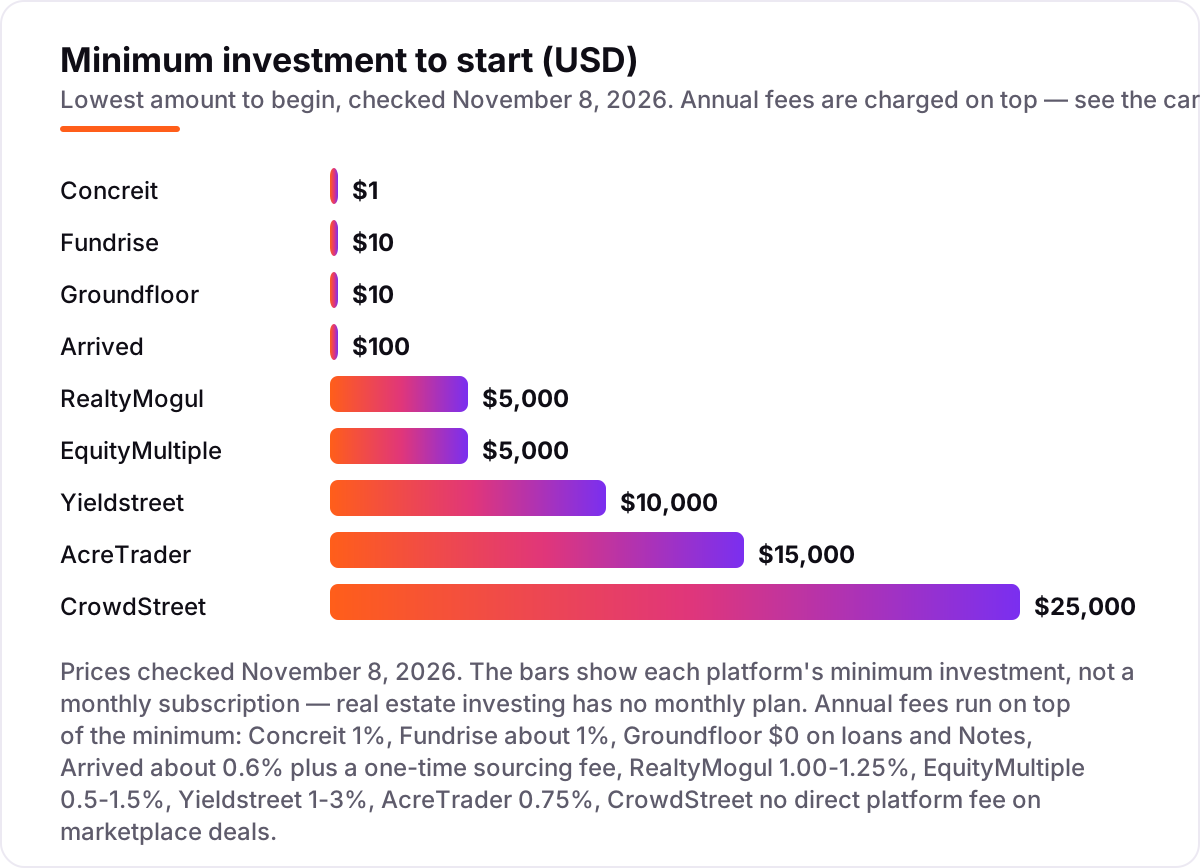
Real estate investment pricing: what you will actually pay
Take $10,000 — the amount eight of the nine picks will accept. The annual fee on that sum is $0 on Groundfloor, $75 on AcreTrader at 0.75%, $100 on Concreit at 1% and on Fundrise at its headline 1% (or $178 on the Flagship fund at its 1.78% total expenses), $50 to $150 on EquityMultiple plus a $30 to $70 admin fee, $100 to $125 on RealtyMogul, $60 on Arrived, and $100 to $300 on Yieldstreet. CrowdStreet needs $25,000, so it sits outside this example; on that sum its sponsor fees run $500 to $1,250.
Then add the one-time costs, which is where the gap opens up. Arrived adds up to $350 in sourcing fees, RealtyMogul up to $300 in offering costs, Yieldstreet up to $400 in placement fees, AcreTrader about $200 in closing costs, and EquityMultiple $30 to $70 in admin fees. All in, the first year on $10,000 costs $0 on Groundfloor, $100 on Concreit, $100 to $178 on Fundrise, $80 to $220 on EquityMultiple, about $275 on AcreTrader, $400 to $425 on RealtyMogul, $410 on Arrived, and $500 to $700 on Yieldstreet.
Three costs sit outside every number above. First, property management on Arrived takes 8% of gross rent before dividends are paid, so the dividend you see is already net of it. Second, exit costs: Concreit charges 2% if you leave within a year, and Arrived charges an estimated 6% to 7% disposition fee when the property sells. Third, tax paperwork: most of these pay out through K-1 forms that arrive late and complicate your return, so budget for an accountant. If you run a brokerage rather than investing yourself, the best commercial real estate companies covers the other side of the market.
Annual fees are charged on the amount invested, not on a subscription, so doubling your investment doubles the fee. A $50,000 position costs about $500 a year on Fundrise or Concreit, $375 on AcreTrader, and $500 to $1,500 on Yieldstreet — before any one-time fees. One more cost to check before you commit: an IRA is a second account on most platforms, with its own minimum ($1,000 on Fundrise) and, on Groundfloor, custodial fees that started July 1, 2026.
Know the difference: a fund, a marketplace and a single property
The confusion in this category is between three different things sold under one label. A fund — Fundrise, Concreit, Yieldstreet's Alternative Income Fund — pools your money with other investors' and a manager picks the assets. You get diversification and one fee schedule, and you give up choosing what you own. A marketplace — CrowdStreet, EquityMultiple's deals, RealtyMogul's placements — lists individual deals from sponsors and lets you pick each one. You get choice and deal-level detail, and you carry the research burden and the concentration risk of each pick.
The third shape is a single property — Arrived's houses, AcreTrader's farms — where you buy a slice of one named asset. Your return depends on that one house or farm, not on a portfolio, so the address, the tenant and the local market matter more than the platform's brand. All three shapes are illiquid, all three charge fees inside the investment rather than as a subscription, and none of them is a savings account: the money can fall in value and the exit can close.
There is a second, quieter confusion: lending versus owning. Groundfloor and Concreit's Cash Flow fund make you a lender — you earn interest, your upside is capped, and your risk is the borrower defaulting. Fundrise, Arrived, AcreTrader and the equity deals make you an owner — you share the rent and the appreciation, and you share the losses when values fall. Debt pays first and earns less; equity earns more and loses first. Know which side of that line you are on before you compare two platforms' rates.
Quick comparison: tool type by need
| Buyer | Best pick | Why |
|---|---|---|
| Lowest minimum of all | Concreit | $1 to start, weekly dividends, no accreditation needed |
| Hands-off diversified fund | Fundrise | Managed portfolio from $10, about 1% a year |
| Zero investor fees | Groundfloor | No fees on loans or Notes, $10 per loan, 6-to-18-month terms |
| Own a slice of one house | Arrived | Named rental homes from $100, secondary market since November 2025 |
| Oldest platform, commercial deals | RealtyMogul | REITs from $5,000 — currently paused; placements from $25,000 open |
| Accredited, fixed short-term notes | EquityMultiple | Alpine Notes from $5,000 at 6.00% to 7.35%, no investor fees |
| Widest private-market menu | Yieldstreet | Real estate, credit, art and outside funds from $10,000 |
| Farmland specifically | AcreTrader | Single farms from $15,000 at 0.75% a year |
| Big-ticket individual deals | CrowdStreet | Commercial deals from $25,000, no direct platform fee |
Mistakes to avoid
- Budgeting on the minimum. The minimum is the door, not the cost. A $1 Concreit account costs $5 a month under $5,000, and a $10,000 Yieldstreet investment can cost $500 to $700 in year one once placement fees are counted.
- Assuming you can sell. RealtyMogul suspended REIT repurchases in April 2026, Groundfloor's older loans can stay in default for years, and CrowdStreet and AcreTrader have no resale market at all. Treat every dollar here as locked for the full hold.
- Ignoring the accreditation wall. Five of the nine picks are accredited-only or mostly so. Check the $200,000 income or $1 million net-worth test before you fall for a deal you cannot legally buy.
- Comparing headline rates as if they were equal. A 6.30% payout, a 7.35% note rate and an 18% target IRR are different kinds of numbers — a payout, a fixed rate and a projection. Groundfloor's past-due loans show how far projections can miss.
- Putting everything in one deal. On CrowdStreet, five deals for real diversification means $125,000. If you cannot spread across at least five positions, a fund such as Fundrise or Concreit is the safer shape.
How we chose
We verified each platform's minimum investment and fee schedule from its own site and SEC filings, using fresh copies crawled November 6–8, 2026, and recorded the minimum and the fees exactly as published. Real estate platforms publish minimums and fees on homepages, FAQs and offering documents rather than on a single pricing page, so where a figure comes from an offering circular or a filing — Concreit's payout rate, Groundfloor's past-due loan share, RealtyMogul's REIT pause — we say so in the card. Minimums are the platform's lowest published entry point; where the advertised minimum covers only one product, such as EquityMultiple's Alpine Notes, the card says which product it covers. This list carries no review ratings because we could not verify a current score from the review pages on November 8, 2026, and we would rather show no rating than an unverified one. Two familiar names are missing on purpose: DiversyFund's $500 Growth REIT is closed to new investors and winding down, and Landa has taken no new investments since spring 2025. No vendor paid for a place in this list, and none of the links here are affiliate links.
What to do next
Start with the cheapest test that fits you: $1 on Concreit, $10 on Fundrise or a Groundfloor loan, $100 on Arrived — and read the offering circular before you add a second dollar. Check that you can live with the hold period and the redemption rules, and that the fees leave a return worth having after tax. If you are accredited and want the bigger deals, compare two marketplaces side by side on the same $25,000 before you commit it to one. If the investing side is sorted but new customers are not finding your business, our monthly SEO service handles the visibility side — or compare providers in our guide to SEO companies for small business. Once your tools are in place, find out what's holding your rankings back.
Your stack only works if people find you
SerpAstra fixes what keeps your site off page one and makes it easy for AI assistants to recommend.
Get a free audit→Sources we checked (10)
- Concreit — concreit.com (checked November 8, 2026)
- Fundrise — fundrise.com (checked November 8, 2026)
- Groundfloor — groundfloor.com (checked November 8, 2026)
- Arrived — arrived.com (checked November 8, 2026)
- RealtyMogul — realtymogul.com (checked November 8, 2026)
- EquityMultiple — equitymultiple.com (checked November 8, 2026)
- Yieldstreet — yieldstreet.com (checked November 8, 2026)
- AcreTrader — acretrader.com (checked November 8, 2026)
- CrowdStreet — crowdstreet.com (checked November 8, 2026)
- Best Real Estate Crowdfunding Platforms, Plus The Ones That Froze Withdrawals — thecollegeinvestor.com (October 2026)
Shamim
Founder of SerpAstra
A full-stack SEO and digital marketer who spends most days on Local SEO for dental practices, AI search visibility and lead generation.
Frequently asked questions
What is the best real estate investment company?
Fundrise is the best fit for most investors: a diversified fund from $10, at about 1% a year, open to non-accredited investors. Concreit is the cheapest way to start, at $1. Groundfloor has the cheapest fees, at $0 on loans and Notes. Accredited investors with more capital should look at EquityMultiple's Alpine Notes or CrowdStreet's deal marketplace.
How much money do you need to start investing in real estate?
As little as $1 on Concreit, $10 on Fundrise or per Groundfloor loan, and $100 on Arrived. The accredited-only platforms need far more: $5,000 for EquityMultiple's Alpine Notes, $10,000 on Yieldstreet, $15,000 per AcreTrader farm and $25,000 per CrowdStreet deal. Budget for the fees on top of the minimum, not just the minimum itself.
Do you need to be an accredited investor?
Not for the first four picks: Concreit, Fundrise, Groundfloor and Arrived are open to non-accredited investors. EquityMultiple, AcreTrader and CrowdStreet take accredited investors only, and most Yieldstreet offerings do too, though its Alternative Income Fund is open to everyone. RealtyMogul's REITs accepted non-accredited investors but are paused for new money.
What fees do real estate investment companies charge?
Annual management fees run from $0 on Groundfloor loans and Notes to 0.75% on AcreTrader, about 1% on Fundrise and Concreit, and 1% to 3% on Yieldstreet funds. One-time fees matter more: Arrived charges up to 3.5% sourcing, Yieldstreet up to about 4% placement, and CrowdStreet deals carry 2% to 5% in sponsor fees.
Can you sell a real estate investment when you need the money?
Usually not, or only slowly. Fundrise redemptions run quarterly and can be prorated, Arrived's secondary market trades one week a month, and Concreit's redemptions come from a monthly queue. CrowdStreet, AcreTrader and most EquityMultiple deals have no resale market at all, so expect to hold for 5 to 10 years.
Are real estate investment companies safe?
They are regulated — these are SEC-registered or SEC-qualified offerings, not unregistered schemes — but they are not safe in the sense of guaranteed returns. Loans default, as Groundfloor's 73.4% past-due figure shows, deals get written down, and your money is illiquid. Only invest money you can afford to lose and to lock away for years.
Fund or marketplace — which is better for a beginner?
A fund is the better start. Fundrise or Concreit picks the assets and diversifies for you, so one bad loan or property cannot sink the whole position. A marketplace such as CrowdStreet or EquityMultiple asks you to judge each sponsor and deal yourself, which needs experience — and $25,000 per deal makes diversification expensive.
Free SEO and AI visibility audit
Find out what is holding your rankings back
Send us your site. Within 2 business days you get a written audit, an AI visibility check and a short fix list ranked by impact. Free, with no contract attached.
Request my free audit→Related guides
 Local Business & Vertical Software7 Best Accounting Software for Real Estate Investors in 2026, ComparedCompare the 7 best accounting software for real estate investors on price, free plans and Schedule E reports, with prices checked November 7, 2026.Read guide →
 Local Business & Vertical Software10 Best Bookkeeping Software for Real Estate Investors in 2026, ComparedCompare the 10 best bookkeeping software for real estate investors on price, free plans and Schedule E reports, with every price checked November 7, 2026.Read guide →
 Local Business & Vertical Software9 Best Commercial Real Estate Companies in 2026Compare the 9 best commercial real estate companies on tenant-rep volume, coverage and conflicts, with fees quoted per deal and facts checked November 7, 2026.Read guide →