
11 Best Software for Electrical Contractors in 2026, Compared
Compare the 11 best software for electrical contractors on price, dispatch, estimating and invoicing, with every price checked November 8, 2026.
 Shamim Mia, Founder, SerpAstraLast verified November 8, 202614 min read
We compare pricing pages, documentation and public reviews. We never accept payment for rankings.

Key takeaways
- Jobber is the best fit for most small electrical shops at $49/month; Housecall Pro follows at $79/month, Kickserv is the budget pick at $75/month for five users, and ServiceTitan is the enterprise pick on a custom quote.
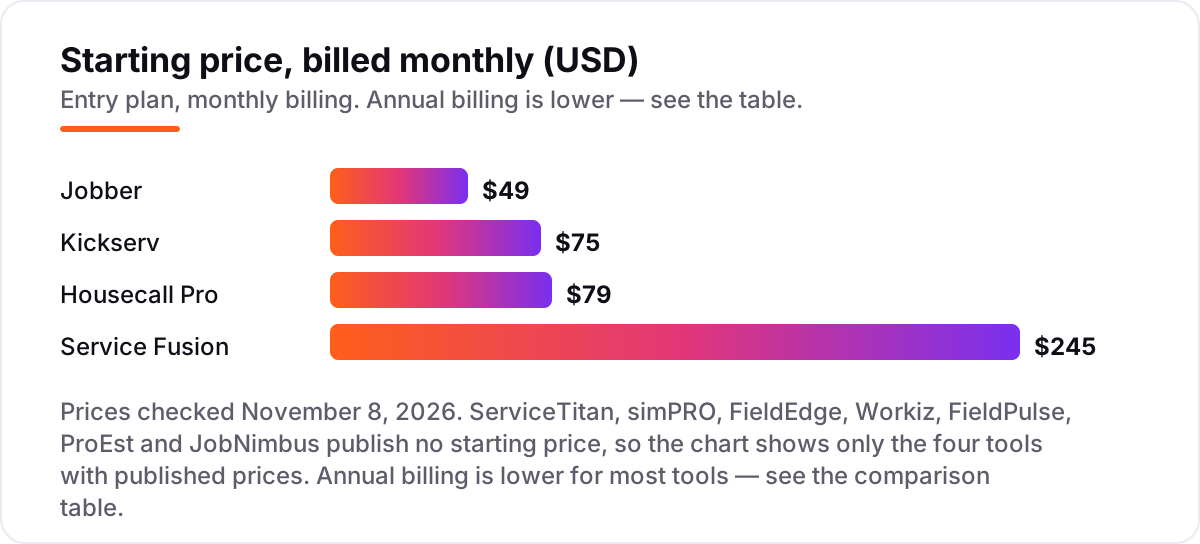
- Only four of the eleven tools publish a starting price at all — Jobber, Housecall Pro, Service Fusion and Kickserv — and the other seven need a sales quote, so get every figure in writing before you compare.
- The single most important buying factor is how the price grows with your crew: per-user plans multiply with every hire, while flat plans like Service Fusion stay at $245 a month no matter how many techs log in.
- Estimating and field service are different jobs: ProEst prices the work, the other ten run it, so buy a dedicated estimating tool only when quoting is your bottleneck.
On this page
Quick comparison
| Tool | Best for | Starting price | Free plan |
|---|---|---|---|
| Jobber | Solo electricians and small crews that want clear published pricing and a fast setup | $49/mo | No (14-day trial) |
| ServiceTitan | Multi-truck electrical contractors doing $3M+ a year that need deep dispatch and reporting | Custom quote | No (demo only) |
| Housecall Pro | Small residential electrical shops that want booking, a price book and financing in one app | $79/mo | No (14-day trial) |
| simPRO | Electrical contractors running quoted commercial projects and service maintenance together | Custom quote | No (demo only) |
| FieldEdge | US residential electrical shops already on QuickBooks that want a flat-rate price book | Custom quote | No (demo only) |
| Service Fusion | Larger electrical crews that want one flat price no matter how many techs log in | $245/mo | No (demo only) |
| Workiz | Call-driven electrical shops that want phone, texting and dispatch in one place | Custom quote | No (7-day trial) |
| FieldPulse | Electrical contractors that want strong scheduling and dispatch with field-seat pricing | Custom quote | No (free trial) |
| Kickserv | Small electrical crews on a budget that want the cheapest full-featured plan | $75/mo | No (30-day trial) |
| ProEst | Electrical contractors that need serious estimating and takeoff before they need dispatch | Custom quote | No (demo only) |
| JobNimbus | Electrical contractors that sell larger jobs and want a sales CRM first | Custom quote | No (14-day trial) |
Make one of these tools?
We re-check this list every quarter. Send a correction, request a review, or ask about a clearly labeled sponsored spot.
Request a listingThe best software for electrical contractors

Jobber
Best for: Solo electricians and small crews that want clear published pricing and a fast setup
Jobber is the straightforward pick for a small electrical shop: the price is on the website, the setup takes days rather than months, and one person can run quoting, scheduling and invoicing from the same screen. Core costs $49 a month for one user, or $29 a month billed annually, and covers the essentials — quotes, invoices, scheduling, a client hub and online booking.
The catch is the step up. Connect costs $139 a month and adds the pieces a growing shop actually needs: automated reminders, QuickBooks Online sync and time tracking, while Grow at $199 a month adds job costing and two-way texting. Buy Jobber when you want the price in writing before the demo; buy Housecall Pro when a price book and financing matter more than the cheapest entry point.
What we like
- Published prices with no sales call needed: Core is $49/month, or $29/month billed annually
- Extra users cost $29/month each, so the bill grows one seat at a time, not in jumps
- Connect adds QuickBooks Online sync, automated reminders and time tracking at $139/month
- 14-day free trial of Grow with no credit card required
Watch out for
- Core has no two-way texting, automated reminders or QuickBooks sync — those start on Connect at $139/month
- Per-user pricing climbs with every hire: a five-person crew needs Grow at $299/month
- Card payments cost 2.9% + 30 cents on top of the subscription

ServiceTitan
Best for: Multi-truck electrical contractors doing $3M+ a year that need deep dispatch and reporting
ServiceTitan is the platform big residential electrical contractors run on: dispatch, estimates, invoicing, payments, memberships and reporting in one system, with a pricebook your techs quote from in the field. It is built for volume — a shop with ten or more trucks gets capacity planning, call booking and marketing tools that the smaller tools in this list simply do not offer.
The price is the problem for everyone else. There is no published rate: third-party reports put it around $245 to $500 per technician a month, plus a reported $5,000 to $50,000 implementation fee and a 12-month minimum contract. Buy ServiceTitan when the business is big enough to staff the rollout; a shop under five trucks will pay enterprise money for depth it cannot use yet.
What we like
- The deepest dispatch, capacity planning and financial reporting in this list
- Pricebook, memberships and marketing tools built for high-volume residential work
- Three bundles (Starter, Essentials, The Works) scale from a growing shop to a large operation
- The most widely used platform in the category, so hiring techs who already know it is easier
Watch out for
- No published price — every figure comes from a sales quote, and third parties report about $245-$500 per technician a month
- Implementation is reported at $5,000-$50,000, with onboarding taking 60-120 days
- Annual price increases are a common reviewer complaint, with no public benchmark to push back against

Housecall Pro
Best for: Small residential electrical shops that want booking, a price book and financing in one app
Housecall Pro is the residential pick: Basic costs $79 a month, or $59 billed annually, and already includes the two things an electrical shop quotes with every day — a price book and job costing — plus online booking, estimates, invoicing and consumer financing. A customer who needs a $4,000 panel upgrade can finance it from the same invoice you send.
The limits show up as you grow. QuickBooks Online sync, routes and flat-rate pricing wait for Essentials at $189 a month, and the add-ons that larger shops need — CSR AI, vehicle GPS, payroll, VoIP — carry no published prices at all. Buy Housecall Pro for residential service work; buy Jobber when the accounting sync matters from day one.
What we like
- Price book and job costing included on Basic at $79/month, not held for a higher tier
- Consumer financing built in, so customers can pay large electrical jobs over time
- Online booking and review management included from the entry plan
- 14-day free trial of the MAX plan with no credit card required
Watch out for
- QuickBooks Online sync, routes and flat-rate pricing wait for Essentials at $189/month
- CSR AI, GPS tracking, payroll and VoIP are paid add-ons with no published prices
- MAX is sold through a demo, so the top tier has no self-serve checkout

simPRO
Best for: Electrical contractors running quoted commercial projects and service maintenance together
simPRO is the commercial end of this list: it runs quoted, multi-stage electrical projects and day-to-day service maintenance in the same system, with job costing, work-in-progress reporting and asset management built in. Pre-builds and assemblies let estimators price repeat work from standard parts and labour, with live supplier catalogs behind them.
It is quote-priced, so budget for a sales process and a reported $3,000 to $10,000-plus implementation before you see a number. The mobile app draws the most reviewer complaints, which matters when techs live on their phones. Buy simPRO when commercial projects and maintenance contracts are half the business; a pure residential shop will find it heavy.
What we like
- Job costing and work-in-progress reporting tie quoted costs to what was actually billed
- Pre-builds and assemblies speed up estimating, with live supplier catalogs
- Gantt-style scheduling suits multi-stage commercial projects, not just single visits
- Asset management and maintenance contracts included for recurring commercial work
Watch out for
- No published pricing — the price comes from a sales quote, and implementation is reported at $3,000-$10,000+
- Reviewers call the mobile app clunky compared with the desktop product
- The depth that suits commercial work is more than a small residential shop needs

FieldEdge
Best for: US residential electrical shops already on QuickBooks that want a flat-rate price book
FieldEdge has sold to HVAC, plumbing and electrical contractors since 1980, and it still assumes that buyer: a US shop already on QuickBooks that wants a flat-rate price book and service agreement tracking. The price book carries 30,000-plus repairs, and the QuickBooks sync — Desktop and Online — runs deeper than any other tool here.
There is no published price, and the three tiers — Select, Premier and Elite — all sit behind a quote request, so the first number you see comes from a salesperson. Support quality is also the most common reviewer complaint. Buy FieldEdge when QuickBooks is already the system of record; look elsewhere if the books live anywhere else.
What we like
- Flat-rate price book with 30,000+ repairs across HVAC, plumbing and electrical work
- The deepest QuickBooks Desktop and Online sync in this list
- Service agreement tracking built in for maintenance-plan customers
- Three tiers scale from basic dispatch to proposal and marketing tools
Watch out for
- No published pricing — three tiers (Select, Premier, Elite) all sit behind a quote request
- Support quality is the most common reviewer complaint across G2, Capterra and Trustpilot
- Integrations outside QuickBooks are limited, so non-QuickBooks shops get less value

Service Fusion
Best for: Larger electrical crews that want one flat price no matter how many techs log in
Service Fusion prices the way a growing electrical contractor wishes the rest of the list did: one flat monthly fee per company, with unlimited users on every tier. Starter costs $245 a month, or $208 billed annually, and covers scheduling, dispatch, estimates, invoicing and QuickBooks sync for the whole crew — five techs or twenty-five, the number never changes.
The trade-off is the floor. There is no free trial, so the first $245 goes out before you know whether the dispatch board fits how your office works, and GPS fleet tracking and the ServiceCall.ai phone add-on carry no published prices. Buy Service Fusion when headcount is the cost driver; a one-truck shop pays for seats it will never fill.
What we like
- Unlimited users on every tier — adding a tech or an office worker never raises the base price
- Flat published pricing: Starter $245/month, Plus $382, Pro $627, with 15% off billed annually
- QuickBooks sync included on Starter, not held for a higher tier
- No per-seat math: a 25-tech crew pays the same $245/month as a 5-tech crew
Watch out for
- No free trial — evaluation runs through a sales demo, so you commit at least $245/month first
- GPS fleet tracking and ServiceCall.ai are paid add-ons with no published prices
- Reviewers call it expensive for small startups: the cheapest plan is $245/month

Workiz
Best for: Call-driven electrical shops that want phone, texting and dispatch in one place
Workiz is built for shops that live on the phone: the call tracking, recording and two-way texting sit inside the platform rather than bolted on, and the dispatch board turns a ringing phone into a booked job without a second system. Three tiers — Standard, Pro and the top tier — each cover the first five users, with Genius AI scheduling and lead tools on Pro.
The catch is the price, or rather the absence of one. Workiz publishes no base price, and third parties report roughly $225 to $325 a month for five users, with the phone system and AI answering adding about $100 to $200 more. Get the quote in writing before the trial ends, and price the phone add-ons in the same conversation.
What we like
- Built-in phone system with call tracking and recording — the phone is part of the platform, not an add-on integration
- Genius AI scheduling and lead tools on Pro, plus automations on every paid tier
- Strong dispatch board with online booking and two-way texting
- 7-day free trial with no credit card required
Watch out for
- No published base price — every plan sits behind a quote request
- The phone system and AI answering are paid add-ons, about $100-$200/month by third-party reports
- Extra users past the first five cost about $55-$65/month each

FieldPulse
Best for: Electrical contractors that want strong scheduling and dispatch with field-seat pricing
FieldPulse is a scheduling-first platform with one pricing idea worth stealing: office seats and field seats cost different amounts, so a tech who only needs to see jobs and clock in does not pay the full back-office rate. Dispatch, work orders, estimates and invoicing all run from the same board, and Dynamic Proposals let a tech show a customer good, better and best options on site.
Like most of the mid-market here, it publishes no price. Third-party reports put the per-user rates around $65 to $115 a month, and the proposal and fleet-tracking features that make it attractive are paid add-ons. Buy FieldPulse for dispatch discipline at scale; a small shop will get the same jobs done cheaper on Jobber or Kickserv.
What we like
- Separate office and field seat types, so techs who only view jobs cost less than full office seats
- Dynamic Proposals present good/better/best options to the customer on site
- Strong scheduling and dispatch with a mobile app built for techs in the field
- QuickBooks sync and project management included on the Professional tier
Watch out for
- No published pricing — every tier sits behind a quote request
- Dynamic Proposals and GPS fleet tracking are paid add-ons, not included in the base plans
- Third-party reports put per-user rates around $65-$115/month, so a growing crew should budget high

Kickserv
Best for: Small electrical crews on a budget that want the cheapest full-featured plan
Kickserv is the budget pick that is still a complete system: Start costs $75 a month, or $60 billed annually, and covers five users with CRM, estimates, scheduling, invoicing, payments and QuickBooks Online sync. For a five-person electrical crew it undercuts every per-user tool here by more than $100 a month, and the 30-day trial is the longest in this list.
The savings have edges. There is no two-way texting on any plan, QuickBooks Desktop sync costs $50 a month extra on Run and above, and the mobile app ratings trail the category with no offline mode. Buy Kickserv when the budget is the constraint and the office does the texting; buy Jobber when the techs need to text customers from the van.
What we like
- The cheapest full-featured plan here for a five-person crew: Start is $75/month, or $60 billed annually
- QuickBooks Online sync included on Start, with time and expense tracking too
- 30-day free trial on every plan with no credit card required
- Flat pricing by team size — no per-user charges beyond the included users
Watch out for
- No two-way texting on any plan — reminders go out by email and one-way text only
- QuickBooks Desktop sync is a $50/month add-on on the Run plan and above
- Mobile app ratings trail the category, and there is no offline mode

ProEst
Best for: Electrical contractors that need serious estimating and takeoff before they need dispatch
ProEst does one job and does it properly: estimating. Digital takeoff, a built-in cost database, assemblies and templates turn a set of plans into a consistent, defensible quote, and the numbers flow into QuickBooks or Sage without retyping. For an electrical contractor bidding commercial work, the quote is the product — and ProEst treats it that way.
It does nothing else. There is no scheduling, no dispatch and no invoicing, so ProEst always pairs with a second tool for field work, and the price comes from a sales quote with no published starting point. Buy ProEst when estimating wins or loses the job; skip it when the work is mostly residential service calls priced from a flat-rate book.
What we like
- Detailed estimating with digital takeoff and a built-in cost database for electrical work
- Assemblies and templates keep quotes consistent across estimators
- Integrates with QuickBooks and Sage, so estimates flow into accounting without retyping
- Cloud-based, so estimators in the office and the field work on the same numbers
Watch out for
- Estimating only — there is no scheduling, dispatch or invoicing, so field work needs a second tool
- No published pricing — the price comes from a sales quote
- Built for construction estimating, so a pure service shop pays for depth it will not use

JobNimbus
Best for: Electrical contractors that sell larger jobs and want a sales CRM first
JobNimbus is a sales CRM that happens to do field service, and that order matters: visual boards and automations track every estimate from the first call to the signed job, with supplier integrations, e-signatures, financing and payments in the same record. For an electrical contractor selling panel upgrades and rewires, the sale is a process, not a single visit — and JobNimbus manages the process.
The price is the weak point. Four tiers by user cap all sit behind a quote request, and third-party reports describe an account price plus per-user fees by role, so a quote for a small crew can land higher than the headline suggests. Buy JobNimbus when selling bigger jobs is the bottleneck; buy a dispatch-first tool when the diary is the problem.
What we like
- Visual sales boards and automations track every estimate from first call to signed job
- Supplier integrations and e-signatures included on every tier
- Estimates, invoices, financing and payments in one CRM record
- 14-day free trial with no credit card required
Watch out for
- No published pricing — four tiers by user cap all sit behind a quote request
- Per-user fees by role stack on top of the account price, by third-party reports
- Built for roofing first, so some workflows and integrations assume a roofing job
The best software for electrical contractors covers the whole job — the quote, the schedule, the invoice and the payment — without making the office retype anything. We ranked the 11 tools below by fit for the most common buyer, a small electrical shop with one to ten techs, and every price was checked on November 8, 2026.
How to choose the best software for electrical contractors
- Count how the price grows. Per-user plans like Jobber multiply with every hire; flat plans like Service Fusion stay at $245 a month no matter how many techs log in.
- Check the price book first. An electrical shop quotes from a book, not from scratch — Housecall Pro includes one on Basic, while Jobber keeps detailed quoting on Grow.
- Match the tool to the work. Residential service calls need booking and dispatch; commercial projects need estimating, job costing and maintenance contracts, which is simPRO territory.
- Ask what is an add-on. GPS tracking, phone systems, AI answering and payroll are paid extras on most tools here, and most of them carry no published price.
- Test the mobile app in the van. Techs live on their phones, so run the trial on a real job — a dispatch board that only works well on a desktop will not survive a week in the field.
Choosing software is one system in the stack, not the whole stack. If the business also needs to be found online, our local SEO service covers the visibility side for trade businesses. And before you publish new pages for the services you sell, run your titles through the free local business schema generator — it builds the structured data that helps Google show your business properly.
Whatever you shortlist, try it with real jobs before you pay. The trials in this list run 7 to 30 days, which is long enough to run one genuine week — your quotes, your schedule, your invoices — and that week tells you more than any review can. Check two things in the trial: that a tech can quote and invoice from the van without calling the office, and that the books reconcile without daily fixing.
Software for electrical contractors pricing: what you will actually pay
Take a five-person crew: one person in the office and four techs in vans. On list prices, the subscription costs $75 a month on Kickserv Start, $189 on Housecall Pro Essentials, $245 on Service Fusion Starter and $299 on Jobber Grow. Two of those numbers need adjusting before they are real: Housecall Pro Essentials covers five users, so the crew fits exactly, while Jobber Grow at $299 is the five-user band — a sixth person costs another $29 a month on Jobber and nothing on Service Fusion or Kickserv.
Over a year, that is $900 on Kickserv Start billed monthly, or $720 billed annually; $2,268 on Housecall Pro Essentials billed monthly, or $1,788 billed annually; $2,940 on Service Fusion Starter billed monthly, or $2,496 billed annually; and $3,588 on Jobber Grow billed monthly, or $2,748 billed annually. The same five people cost $720 a year at the cheap end and $2,748 at the dear end — a $2,028 gap that comes entirely from the pricing model, not from features.
Three costs sit outside every number above. First, the quote-only tools: ServiceTitan is reported at about $245 to $500 per technician a month, which would put the same five-person crew at $1,225 to $2,500 a month before a reported $5,000 to $50,000 implementation fee — those are third-party reports, not ServiceTitan prices, and the only firm number is the one on your own quote. Second, the add-ons: phone systems, AI answering, GPS tracking and payroll are paid extras on most tools here, and most carry no published price. Third, card processing on the invoices you send, which runs about 2.9% plus 30 cents a transaction on Jobber and similar rates elsewhere.
Annual billing cuts the bill on the tools that publish prices: Kickserv drops from $900 to $720 a year, Housecall Pro Essentials from $2,268 to $1,788, Service Fusion Starter from $2,940 to $2,496, and Jobber Grow from $3,588 to $2,748. One more cost to check before you commit: a second trade is a second subscription on every tool in this list, so an electrical shop that also runs a plumbing division pays twice whatever the chart shows. If estimating is the bottleneck rather than dispatch, see our guide to the best electrical estimating software for small contractors.
Know the difference: field service software vs estimating software
The confusion in this category is between running the job and pricing the job. Field service software — ten of the eleven tools here — handles scheduling, dispatch, invoicing and payments: it takes a booked job and gets it done and paid. Estimating software prices the job before it exists: takeoff, cost databases and assemblies that turn a set of plans into a quote. ProEst is the only pure estimating tool in this list, and it does no scheduling or dispatch at all.
There is a second, quieter confusion: a price book is not estimating software. A price book lists flat rates for standard jobs — a panel swap, a socket install — and techs quote from it in the field. Estimating software builds a price from quantities, labour rates and materials for work that has never been done before, usually a commercial bid. Residential shops live on the price book; commercial bidders live on the estimating tool.
A third distinction worth knowing is CRM versus dispatch. JobNimbus leads with the sale — boards and automations that track an estimate from first call to signed job — while tools like FieldPulse and Workiz lead with the diary. If the bottleneck is winning bigger jobs, buy the CRM; if the bottleneck is getting techs to the right house on time, buy the dispatch tool.
Quick comparison: tool type by need
| Buyer | Best pick | Why |
|---|---|---|
| Solo electrician or small crew | Jobber | Clear pricing from $49/month, fast setup, no sales call needed |
| Multi-truck operation | ServiceTitan | Deepest dispatch and reporting, priced per technician by quote |
| Residential service work | Housecall Pro | Price book and job costing from $79/month, financing built in |
| Commercial projects | simPRO | Estimating, job costing and maintenance contracts in one system |
| Shop already on QuickBooks | FieldEdge | Flat-rate price book with the deepest QuickBooks sync |
| Big crew, flat budget | Service Fusion | Unlimited users for $245/month, no per-seat math |
| Small crew on a budget | Kickserv | Full system for five users at $75/month, 30-day trial |
Mistakes to avoid
- Comparing the headline price instead of the crew price. A $49 plan for one user is not a $49 plan for five people. Price the whole crew — office plus techs — before you shortlist anything.
- Buying on the trial, then finding the phone system costs extra. Workiz, Housecall Pro and FieldPulse all sell phone, GPS or AI features as add-ons with no published price. Get those numbers in writing during the trial, not after it.
- Ignoring the pricing model that bites first. Per-user plans look cheap for a solo operator and expensive at ten techs; flat plans look expensive for a solo operator and cheap at twenty. The model matters more than the starting price.
- Picking an estimating tool for a dispatch problem. ProEst prices jobs brilliantly and runs none of them. If the diary is the mess, buy dispatch software, not a better quote.
- Skipping the van test. A dispatch board that works on a desktop and fails on a phone will not survive a week in the field. Run the trial on real jobs, from the van, before you commit to a year.
How we chose
We checked each vendor's own pricing page on November 8, 2026 and recorded the starting price exactly as shown, or recorded "custom quote" where the vendor publishes no price. Seven of the eleven tools publish no starting price, so we did not invent one: the reported figures for ServiceTitan, Workiz and FieldPulse in this post come from named third-party reports, not from the vendors, and are labelled as such. Direct curl access to the vendor pages was unavailable from this machine, so prices were verified against fresh search-index copies of the vendors' own pricing pages, corroborated by multiple independent October 2026 reads that agree on every figure. Ratings come only from G2 or Capterra pages with a fresh crawl: seven tools carry a rating, and five do not — simPRO, FieldEdge, FieldPulse, ProEst and JobNimbus — because their review counts conflicted across crawls or were too small to trust, and we would rather show no rating than a stale or estimated one. No vendor paid for a place in this list, and none of the links here are affiliate links.
What to do next
Start with the trial of your top pick and run one real week of jobs through it. Check that a tech can quote and invoice from the van without calling the office, and that the books reconcile at the end of the week. If the trial fits, ask for the annual price in writing — including every add-on you will actually use — before you sign. If the books are sorted but new customers are not finding you, our monthly SEO service handles the visibility side — or compare providers in our guide to contractor management software. Once your tools are in place, find out what's holding your rankings back.
Your stack only works if people find you
SerpAstra fixes what keeps your site off page one and makes it easy for AI assistants to recommend.
Get a free audit→Sources we checked (20)
- ServiceTitan pricing — servicetitan.com/pricing (no published prices; custom quote, checked November 8, 2026)
- Jobber pricing — getjobber.com/pricing (checked November 8, 2026)
- Housecall Pro pricing — housecallpro.com/pricing (checked November 8, 2026)
- simPRO — simprogroup.com (no published pricing page; custom quote, checked November 8, 2026)
- FieldEdge pricing — fieldedge.com/pricing (no published prices; custom quote, checked November 8, 2026)
- Service Fusion pricing — servicefusion.com/pricing (checked November 8, 2026)
- Workiz pricing — workiz.com/pricing-plans (no published base price; custom quote, checked November 8, 2026)
- FieldPulse pricing — fieldpulse.com/pricing (no published prices; custom quote, checked November 8, 2026)
- Kickserv pricing — kickserv.com/pricing (checked November 8, 2026)
- ProEst — proest.com (no published pricing page; custom quote, checked November 8, 2026)
- JobNimbus pricing — jobnimbus.com/pricing (no published prices; custom quote, checked November 8, 2026)
- Jobber on G2 — g2.com/sellers/jobber (4.6/5, 533 reviews, checked November 8, 2026)
- ServiceTitan on G2 — g2.com/compare/kickserv-vs-servicetitan (4.4/5, 375 reviews, checked November 8, 2026)
- Housecall Pro on G2 — g2.com/compare/housecall-pro-vs-service-fusion (4.3/5, 205 reviews, checked November 8, 2026)
- Service Fusion on G2 — g2.com/compare/jobber-vs-service-fusion (4.1/5, 124 reviews, checked November 8, 2026)
- Workiz on G2 — g2.com/products/workiz/reviews (4.5/5, 247 reviews, checked November 8, 2026)
- Kickserv on G2 — g2.com/products/kickserv/reviews (4.5/5, 183 reviews, checked November 8, 2026)
- ServiceTitan reported pricing — projul.com (third-party report, not a vendor price)
- Workiz reported pricing — skillmammoth.com (third-party report, not a vendor price)
- FieldPulse reported pricing — fsmadvisor.com (third-party report, not a vendor price)
Shamim
Founder of SerpAstra
A full-stack SEO and digital marketer who spends most days on Local SEO for dental practices, AI search visibility and lead generation.
Frequently asked questions
What is the best software for electrical contractors?
Jobber is the best fit for most small electrical shops: clear pricing from $49/month, a fast setup and the essentials covered. ServiceTitan is the better pick for multi-truck operations that need deep dispatch and reporting, and Housecall Pro suits residential shops that want a price book and financing.
How much does software for electrical contractors cost?
Published prices run from $49/month for Jobber Core to $245/month for Service Fusion Starter, with Kickserv at $75/month for five users. Seven of the eleven tools publish no price at all, so a five-person crew should budget $900-$3,600 a year for the subscription alone, before add-ons and card fees.
Is there free software for electrical contractors?
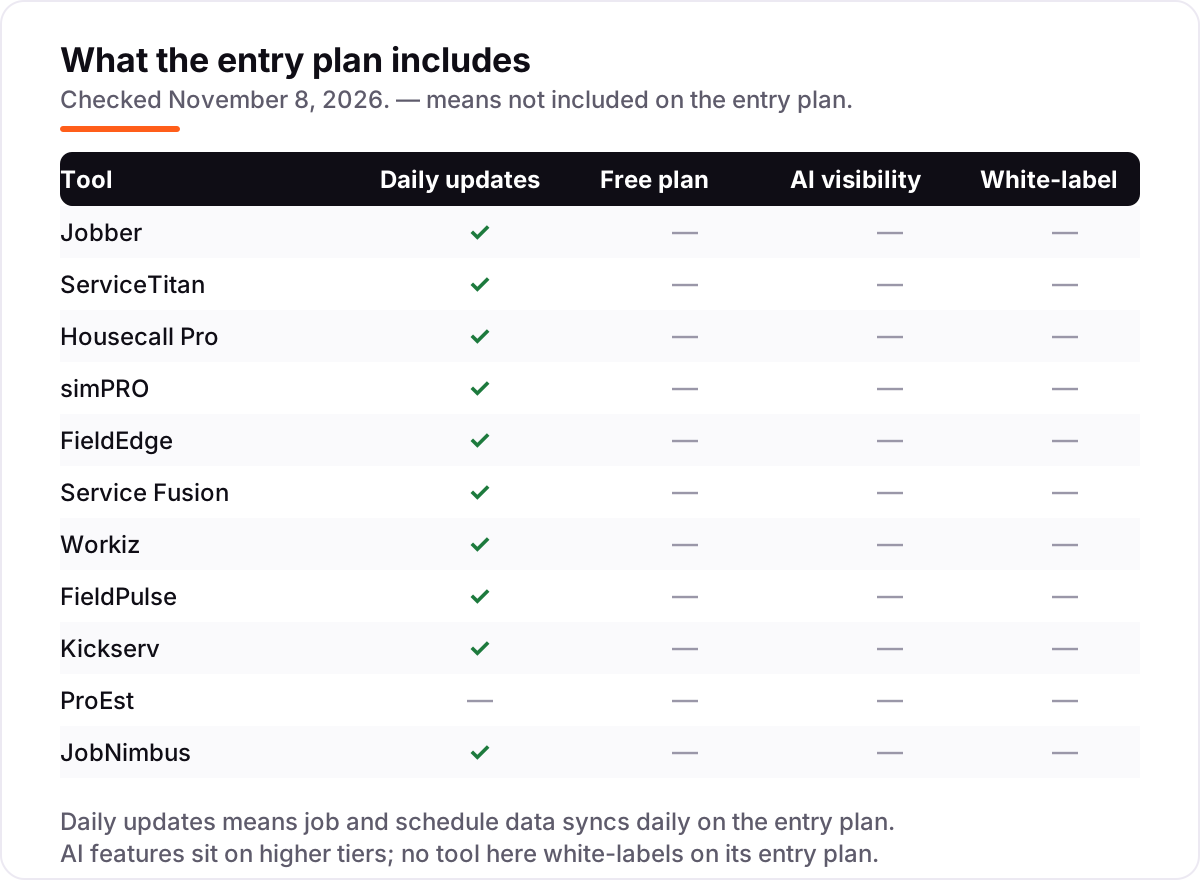
No tool in this list has a free plan. The cheapest way in is a trial: Workiz offers 7 days, Jobber and Housecall Pro 14 days, and Kickserv 30 days. The cheapest paid plan is Jobber Core at $49/month for one user, or Kickserv Start at $75/month for five users.
What is the difference between field service software and estimating software?
Field service software runs the job: scheduling, dispatch, invoicing and payments. Estimating software prices the job: takeoff, cost databases and assemblies that turn plans into a quote. Ten tools here are field service; ProEst is the only pure estimating tool, and it pairs with a second tool for field work.
Do I need a separate estimating tool if I buy Jobber or ServiceTitan?
Usually not. Jobber, ServiceTitan, Housecall Pro and simPRO all include quoting and price books that cover residential and light commercial work. A separate estimating tool like ProEst only pays off when you bid large commercial jobs from plans, where takeoff and assemblies decide whether the quote wins.
Can I switch electrical contractor software later?
Yes, but plan the move for a quiet month. Export customers, open jobs, price book items and unpaid invoices from the old tool, then import them and reconcile the books before going live. Switching mid-season means running two systems while techs are in the field, which is where jobs get lost.
Does electrical contractor software include a price book?
Most of it does, but not on every plan. Housecall Pro includes a price book on Basic, ServiceTitan and FieldEdge build their pricing around flat-rate books, and Jobber keeps detailed quoting on Grow. Check the plan, not just the product: a price book on the top tier is not the same as one on the entry plan.
Free SEO and AI visibility audit
Find out what is holding your rankings back
Send us your site. Within 2 business days you get a written audit, an AI visibility check and a short fix list ranked by impact. Free, with no contract attached.
Request my free audit→Related guides
 Local Business & Vertical Software9 Best Electrical Estimating Software for Small Contractor in 2026, ComparedCompare the 9 best electrical estimating software for small contractor picks on price, takeoff tools and quoting, with prices checked November 7, 2026.Read guide →
 Local Business & Vertical Software12 Best Accounting Software for Electrical Contractors in 2026, ComparedCompare the 12 best accounting software for electrical contractors on price, job costing, free plans and QuickBooks sync, with prices checked November 7, 2026.Read guide →
 Local Business & Vertical Software10 Best Contractor Management Software in 2026, ComparedCompare the 10 best contractor management software platforms on price, compliance and global payments, with every price checked November 7, 2026.Read guide →