
10 Best Software for Real Estate Management in 2026, Compared
Compare the 10 best software for real estate management options on price, free plans and per-unit minimums, with every price checked November 8, 2026.
 Shamim Mia, Founder, SerpAstraLast verified November 8, 202614 min read
We compare pricing pages, documentation and public reviews. We never accept payment for rankings.

Key takeaways
- Buildium is the best fit for most management companies at $62/month; AppFolio follows at $1.49/unit/month for portfolios of 50 units or more, and RentRedi costs $12/month billed annually with unlimited units.
- Four tools in this list are genuinely free for landlords — Innago, Avail, TurboTenant and Stessa — so a small portfolio has no reason to pay until a specific paid feature earns it.
- The single most important buying factor is the monthly minimum: a $1 or $2.50 per-unit rate means little when the floor is $100 or $199 a month.
- Per-unit pricing favors large portfolios and punishes small ones; flat-rate tools favor small portfolios and stay flat as units are added.
On this page
Quick comparison
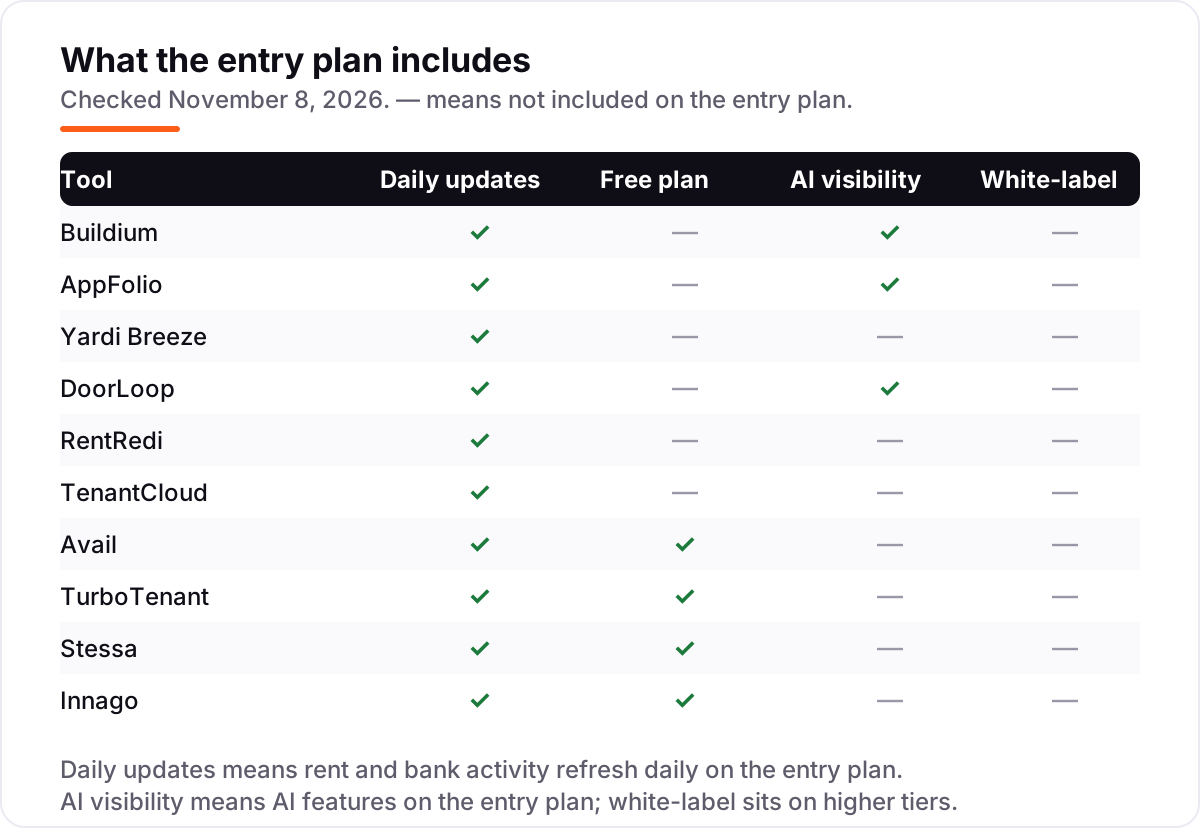
| Tool | Best for | Starting price | Free plan |
|---|---|---|---|
| Buildium | Small to mid-size management companies that want full accounting, leasing and maintenance in one system | $62/mo | No (14-day trial) |
| AppFolio | Management companies with 50 or more units that want deep automation and AI across a large portfolio | $1.49/unit/mo | No (demo only) |
| Yardi Breeze | Residential portfolios scaling past 100 units that want the Yardi name without Yardi complexity | $1/unit/mo | No (demo only) |
| DoorLoop | Growing landlords and managers who want modern software with AI help on tenant calls and maintenance | $2.50/unit/mo | No (24-hour trial) |
| RentRedi | Self-managing landlords who want one flat rate for unlimited units with no per-unit math | $12/mo (annual) | No (30-day money-back) |
| TenantCloud | DIY landlords who want one low flat fee with unlimited properties and no per-unit pricing | $15/mo (annual) | No (14-day trial) |
| Avail | DIY landlords who want a complete free app with listing reach through the Realtor.com network | Free; Plus $9/unit | Yes (free) |
| TurboTenant | Landlords who want free rental management with the widest listing reach | Free; Essentials $149/yr | Yes (free) |
| Stessa | Rental investors who care about accounting and tax reporting first | Free; Manage $12/mo | Yes (free) |
| Innago | Landlords who want one free system with no paywalls, tiers or upgrade prompts | Free | Yes (free) |
Make one of these tools?
We re-check this list every quarter. Send a correction, request a review, or ask about a clearly labeled sponsored spot.
Request a listingThe best software for real estate management

Buildium
Best for: Small to mid-size management companies that want full accounting, leasing and maintenance in one system
Buildium is the closest thing to a default pick for a management company. The Essential plan starts at $62 a month for up to 20 units and covers the whole cycle: accounting, leasing, maintenance, owner portals and resident communication, with bank reconciliation included. Growth at $192 and Premium at $400 add reporting automation, an open API and priority support.
The fee schedule needs a careful read before you sign. On Essential, incoming EFT rent payments cost $2.35 each, eSignatures cost $5 per document, and setting up a business bank account costs $99. Essential also stops at 40 units, so a portfolio past that point moves to Growth. Buy Buildium when the books matter as much as the doors; buy RentRedi or Innago when the portfolio is small and the budget is near zero.
What we like
- Full general-ledger accounting, leasing, maintenance and owner portals on every plan
- Essential covers up to 40 units, so small portfolios get the whole platform from $62/month
- Bank reconciliation and two-way email and SMS threads with residents included
- 14-day free trial with no credit card required
Watch out for
- Essential stops at 40 units, so a growing portfolio moves to Growth at $192/month
- Incoming EFT rent payments cost $2.35 each and eSignatures cost $5 per document on Essential
- Bank account setup costs $99 per account on Essential

AppFolio
Best for: Management companies with 50 or more units that want deep automation and AI across a large portfolio
AppFolio is the platform for portfolios that have outgrown flat-rate tools. Core starts at $1.49 per unit a month with a 50-unit minimum, and every plan includes the Realm-X AI assistant, Messages, accounting, leasing, maintenance and online payments. Plus at $3.20 and Max at $5.00 per unit add leasing CRM, deeper automation and advanced reporting for larger operations.
The catch is that the headline rate is not the bill. AppFolio does not publish its minimum monthly spend, and third-party reports put the floor near $280 to $298 a month, so a 50-unit portfolio pays far more than $1.49 times 50. Buy AppFolio when the portfolio is past 150 units and automation saves real staff hours; below 50 units, it is not sold to you at all.
What we like
- Realm-X AI assistant is included from Core, not held for the top tier
- The largest review base in this list, with 1,035 G2 reviews at 4.6 out of 5
- Plus and Max add leasing CRM, advanced automation and deeper reporting
- Built for scale: per-unit pricing gets cheaper per door as the portfolio grows
Watch out for
- Core needs at least 50 units, so small landlords and managers cannot buy it at all
- The minimum monthly spend is not published, so the real floor only appears in a sales quote
- Plus and Max step up to $3.20 and $5.00 per unit a month

Yardi Breeze
Best for: Residential portfolios scaling past 100 units that want the Yardi name without Yardi complexity
Yardi Breeze is the small-portfolio entry point into the Yardi ecosystem, and its pricing is refreshingly direct for this category. Residential Breeze costs $1 per unit a month with a $100 monthly minimum on an annual agreement, with no charge for setup, training, support or converting data from your old software. It covers online payments, lease tracking, maintenance, marketing and accounting with real financial depth.
The minimum is the whole story for a small portfolio. At 20 units the $1 rate would be $20, but the $100 floor applies, so the effective price is $5 a unit until you cross 100 doors. Breeze Premier at $2 a unit with a $400 minimum adds utility billing and expanded reporting. Buy Yardi Breeze when the portfolio is heading past 100 units and you want Yardi's accounting behind it.
What we like
- Published per-unit pricing with no onboarding, training or support fees
- Full property accounting, owner reporting and maintenance workflows from the entry plan
- No unit minimum, only a monthly minimum, so the price is easy to model
- Backed by Yardi, which has sold property software since 1984
Watch out for
- The $100 monthly minimum is the real price below 100 units, so a 20-unit portfolio pays $5 a unit
- Breeze Premier doubles the floor to a $400 monthly minimum
- Screening, renters insurance and online lease execution cost extra

DoorLoop
Best for: Growing landlords and managers who want modern software with AI help on tenant calls and maintenance
DoorLoop rebuilt its pricing in 2026 around three per-unit tiers that each include the complete platform. DoorLoop One costs $2.50 per unit a month with a $199 monthly minimum on annual billing, Connect adds a 24/7 AI receptionist at $4.00 a unit with a $299 minimum, and Multiply adds maintenance and lease-renewal agents at $5.00 a unit with a $399 minimum. Every plan includes unlimited users, API access and the AI assistant.
The minimum changes who this is for. At 10 units the $199 floor works out to nearly $20 a unit, so DoorLoop One only makes sense from about 80 units up. The trial is effectively a demo at 24 hours. Buy DoorLoop when the portfolio is growing fast and AI help on calls and maintenance is worth a premium.
What we like
- Every plan includes the full platform, with unlimited users and API access
- Highest G2 score in this list at 4.8 out of 5 across 255 reviews
- Connect adds a 24/7 AI receptionist that answers tenant calls and messages
- Clean modern interface with an AI assistant for tenant communication
Watch out for
- The $199 monthly minimum prices out small landlords, even though the per-unit rate looks low
- Connect and Multiply raise the floor to $299 and $399 a month
- The old flat-rate Starter plan is gone, so older $69/month quotes no longer apply

RentRedi
Best for: Self-managing landlords who want one flat rate for unlimited units with no per-unit math
RentRedi is the best value in this list for a self-managing landlord. The pricing is one flat rate: $12 a month on the annual plan, $20 a month on a 6-month term, or $29.95 month to month, with every feature included on every term and no per-unit fees. Unlimited properties, tenants and team members are covered, and the app handles rent collection with autopay, screening, listings, maintenance and accounting.
The flat rate is what makes it cheap at scale and dear at one door. A 50-unit portfolio costs the same $144 a year as a 2-unit one, which no per-unit tool in this list can match. The trade-offs are the lack of a free plan or trial, tenant-paid screening reports, and a mobile-first design that suits landlords who run the business from their phone.
What we like
- One flat rate for unlimited properties, tenants and team members on every billing term
- Every feature is included on every term, with no tiers or upgrade decisions
- Built-in accounting with Schedule E reporting and online lease signing
- Mobile-first design, with tenants getting their own app for payments and maintenance
Watch out for
- No free plan and no free trial, only a 30-day money-back guarantee
- Monthly billing costs $29.95, so the $12 rate needs the annual plan
- Tenant screening reports cost extra, at $39.99 or $49.99 with income verification

TenantCloud
Best for: DIY landlords who want one low flat fee with unlimited properties and no per-unit pricing
TenantCloud is built for independent landlords who want a real management platform without per-unit pricing anxiety. Starter costs $15 a month billed annually for up to 10 active leases, Growth is $29.17 for 30 leases, and Pro is $50 for 60, with unlimited properties included on every plan. Rent collection, applications, screening, leases and maintenance all run through one login.
The lease cap is the number to watch, not the unit count. A landlord with scattered single-family homes can hold many properties on Starter as long as active leases stay under 10, but a busy portfolio with fast turnover hits the cap quickly. Tenants pay the ACH fees on lower plans, and card payments cost 3.5% plus 30 cents. Pick TenantCloud when a low flat fee and unlimited properties matter more than a free plan.
What we like
- Low flat rate with unlimited properties on every plan
- Plans are priced by active leases, not units, so scattered-site landlords are not punished
- Rent collection, applications, screening, leases and maintenance in one login
- Month-to-month billing is available for landlords who do not want an annual commitment
Watch out for
- Starter caps at 10 active leases, so a busy portfolio needs Growth at $29.17/month
- No permanent free tier, only a 14-day trial
- Tenants pay per-transfer ACH fees of $1.95 on Starter, falling to $1.50 on Pro

Avail
Best for: DIY landlords who want a complete free app with listing reach through the Realtor.com network
Avail is landlord software built by Realtor.com, and its free Unlimited plan covers unlimited units with listing syndication to Realtor.com, Apartments.com and other rental sites, applications and TransUnion screening, state-specific lawyer-reviewed leases with e-signatures, online rent collection, maintenance tracking and basic accounting. Unlimited Plus at $9 per unit a month adds FastPay next-day payouts and waived ACH fees.
The free plan earns its keep from payment fees and upgrades. Tenants pay $2.50 per bank transfer on the free plan, and card payments carry a 3.5% fee on either plan. The per-unit Plus pricing also means a 10-unit portfolio pays about $90 a month for the upgrade, where a flat-rate tool would cost far less. Start on Avail free when listings and leases matter most; upgrade only for faster payouts.
What we like
- Free Unlimited plan covers unlimited units, with no unit cap
- Listing syndication to Realtor.com, Apartments.com and other rental sites
- State-specific lawyer-reviewed leases with e-signatures on the free plan
- Unlimited Plus waives tenant ACH fees and adds FastPay next-day payouts
Watch out for
- Unlimited Plus costs $9 per unit a month, so it gets expensive fast as units are added
- Tenants pay $2.50 per bank-transfer rent payment on the free plan
- Accounting is basic, with no depreciation or serious tax reporting

TurboTenant
Best for: Landlords who want free rental management with the widest listing reach
TurboTenant's free plan is the widest net in this list: listings syndicated to Realtor.com, Apartments.com, Redfin and more than 20 other sites, online applications, TransUnion screening, online rent payments, maintenance requests, document storage and expense tracking, all at $0 with no unit limit. Essentials at $149 a year adds unlimited lease creation and e-signatures, and Pro at $199 adds income verification and full accounting.
The limits are the paid features, not the free ones. State-specific leases and digital signing need Essentials or a per-document purchase, the free plan links one bank account, and there is no month-to-month billing on paid plans — the monthly figure on the pricing page is the annual price divided by 12. Pick TurboTenant when filling vacancies fast matters most and the budget is zero.
What we like
- Free plan has no unit limit and no trial period
- Listings syndicated to Realtor.com, Apartments.com, Redfin and 20-plus sites
- Online applications, TransUnion screening and online rent payments included free
- Essentials adds unlimited lease creation and e-signatures for $149 a year
Watch out for
- Full accounting waits for Pro at $199 a year, and the free plan links one bank account
- Paid plans are billed once a year, with no month-to-month option
- Screening and payment fees fall on tenants unless the landlord absorbs them

Stessa
Best for: Rental investors who care about accounting and tax reporting first
Stessa started as an investor's accounting tool and it still shows: the free Essentials plan includes unlimited properties, automatic bank feeds, basic financial reports, online rent collection, vacancy marketing and tenant screening. For a landlord whose biggest pain is tax season, the Schedule E report and the accountant tax package on paid plans are the headline features.
Manage at $12 a month billed annually adds the Schedule E report, unlimited lease agreements, legal forms and accelerated rent payments; Pro at $28 adds advanced reporting, unlimited receipt scanning and project expense tracking. The free tier is genuinely free, but the three things a serious landlord needs most — Schedule E, more than 5 receipt scans a month and project tracking — are all paywalled.
What we like
- Free Essentials plan includes unlimited properties and automatic bank feeds
- Basic financial reports, online rent collection and tenant screening at $0
- Manage adds the Schedule E report, unlimited lease templates and 60-plus legal forms
- Flat pricing on every tier, so the bill is the same at 3 units or 30
Watch out for
- The Schedule E report waits for Manage at $12 a month billed annually
- Free plan caps receipt scans at 5 a month and charges $15 per state lease template
- No project expense tracking below Pro at $28 a month billed annually

Innago
Best for: Landlords who want one free system with no paywalls, tiers or upgrade prompts
Innago is the only product in this list with no paid plan at all: free for landlords at any unit count, with no feature paywalls and no upgrade prompts gating features. Rent collection, tenant screening, digital lease signing, maintenance requests, document storage and financial tracking are all included. The company earns from small tenant-paid fees instead: $2 per bank rent payment, 2.99% for card payments and per-applicant screening fees.
Free is a business model, not charity, and the trade is visible in the app: prompts around payment processing and partner products appear throughout. There is also no premium tier to grow into, so a landlord who later wants advanced reporting or priority support will outgrow it. Start on Innago when the portfolio is small and every dollar of software cost is a dollar too much.
What we like
- The only tool here with no paid plan at all, free at any unit count
- Rent collection, screening, leases, maintenance and basic accounting all included
- Highest-rated ease of use in the category, at 4.8 out of 5 across 717 G2 reviews
- No unit caps and no feature paywalls on the free product
Watch out for
- Tenants pay the payment fees by default: $2 per bank transfer and 2.99% on cards
- Applicants pay $30 to $35 for screening reports
- No paid tier means no premium support or advanced reporting to upgrade into
The best software for real estate management does four jobs in one place: it collects rent, tracks leases, handles maintenance requests and keeps the books straight, without making the owner or manager learn accounting. We ranked the ten tools below by fit for the most common buyer — a manager or landlord running a residential portfolio — starting with the full management platforms and ending with the free landlord tools, and every price was checked on the vendor's own pricing page on November 8, 2026.
How to choose the best software for real estate management
- Count your units first. AppFolio will not sell Core below 50 units, Buildium Essential stops at 40, and TenantCloud Starter caps at 10 active leases. The limit you hit first is your real starting price.
- Work out the minimum, not the per-unit rate. Yardi Breeze at $1 a unit sounds cheap until the $100 monthly minimum applies, and DoorLoop at $2.50 a unit costs $199 a month at the floor. A small portfolio pays the minimum.
- Check who pays the payment fees. Innago, Avail and TurboTenant are free for landlords because tenants pay the ACH and card fees. If you absorb those fees, the free plan is no longer free.
- Decide whether you need real accounting. Buildium, AppFolio and Yardi Breeze keep a full general ledger; the free landlord tools track income and expenses but will not satisfy an accountant at year-end.
- Think about who else touches the books. If your accountant already lives in Buildium or AppFolio, picking anything else means paying them to learn a new system — ask before you buy.
Real estate software is one system in your stack, not the whole stack. If the management business also needs to be found online, our local SEO service covers the visibility side, and a clean listing on Google starts with correct business details — check yours with the free local business schema generator. And before you publish new pages for the properties you manage, run your titles through the free SERP snippet preview tool — it shows exactly how the title and description will look in Google.
Whatever you shortlist, try it with real data before you pay. The free plans and trials in this list are long enough to run one genuine month — your tenants, your rent roll, your maintenance requests — and that month tells you more than any review can. Check two things in the trial: that rent collection reconciles without daily fixing, and that your owner statements match what your owners expect. Every tool here lets you export your data, so there is no reason to buy before you have run a real month through it.
Software for real estate management pricing: what you will actually pay
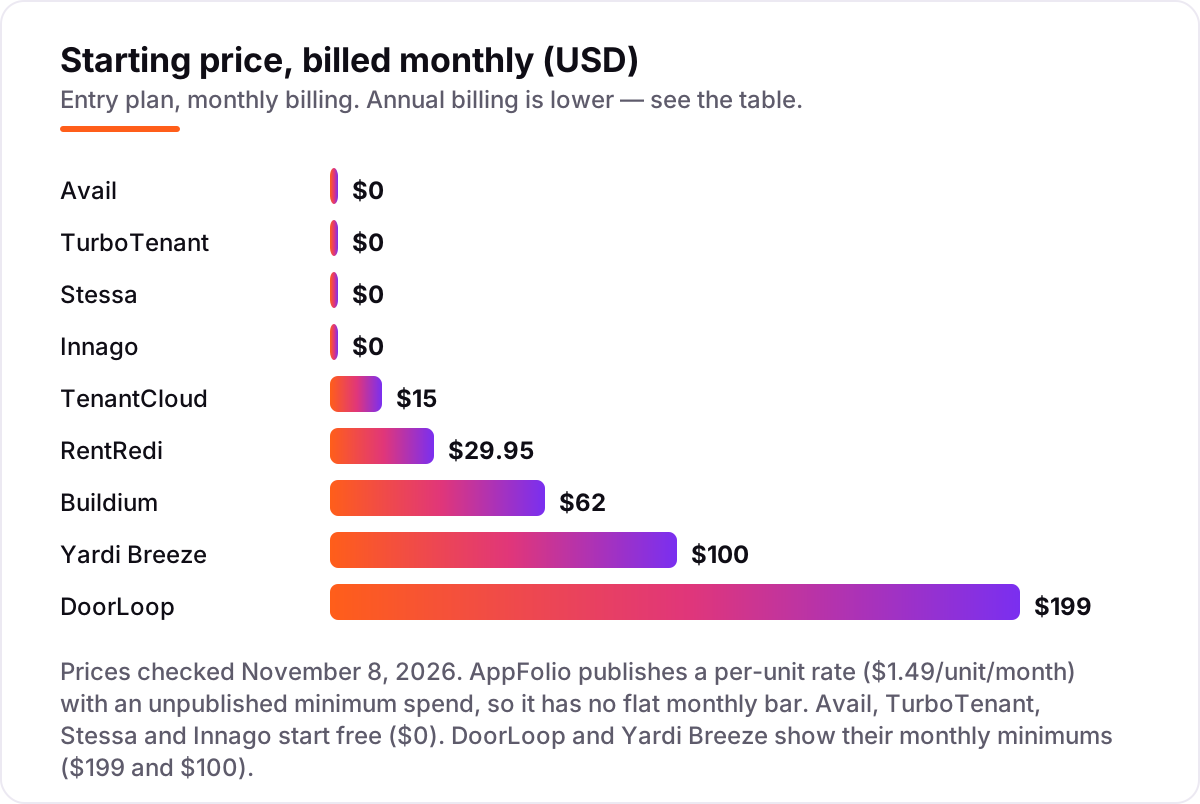
Take a 20-unit residential portfolio. On list prices, the subscription costs $0 a month on Innago, Avail, TurboTenant and Stessa, $12 on RentRedi billed annually, $15 on TenantCloud Starter billed annually, $62 on Buildium Essential, $100 on Yardi Breeze and $199 on DoorLoop One. AppFolio is not sold at this size: Core needs 50 units, so a 20-unit portfolio cannot buy it at any price.
Two of those numbers need adjusting before they are real. First, RentRedi at $12 a month needs the annual plan paid up front at $144 a year; month to month it costs $29.95. Second, Yardi Breeze and DoorLoop are minimums, not per-unit bills: 20 units at $1 a unit would be $20 on Yardi Breeze, but the $100 floor applies, and 20 units at $2.50 would be $50 on DoorLoop, but the $199 floor applies.
Over a year, that is $0 on the four free tools, $144 on RentRedi billed annually, $180 on TenantCloud Starter billed annually, $744 on Buildium Essential, $1,200 on Yardi Breeze and $2,388 on DoorLoop One. The same 20 units cost $0 a year at the free end and $2,388 at the dear end — a gap that comes entirely from monthly minimums and billing choices, not from features. At 100 units the picture flips: Yardi Breeze costs $100 a month, Buildium needs Growth at $252, and DoorLoop One costs $250, so the per-unit tools finally pay their headline rate. If the portfolio also needs the books kept for investors, see our guide to the best accounting software for real estate investors.
Three costs sit outside every number above. First, tenant screening: applicants usually pay $30 to $55 per report, but some landlords absorb it. Second, payment fees: tenants pay $2 to $2.50 per bank transfer on the free plans, and card payments cost around 3% to 3.5%. Third, add-ons: eSignatures cost $5 per document on Buildium Essential, state lease templates cost $15 each on Stessa Essentials, and screening, renters insurance and lease execution cost extra on Yardi Breeze. If leases are signed online, our guide to the best e-signature software for real estate covers that side of the stack.
Know the difference: flat-rate pricing vs per-unit pricing with minimums
The confusion in this category is between a rate and a bill. A per-unit rate like $1 or $2.50 a unit sounds cheap, but every per-unit tool in this list also carries a monthly minimum, and the minimum is the bill for any portfolio below the crossover point. Yardi Breeze costs $100 a month whether you manage 20 units or 100, and DoorLoop One costs $199 whether you manage 10 units or 80. The crossover is simple arithmetic: divide the minimum by the rate. Yardi Breeze breaks even at 100 units, DoorLoop One at about 80.
Flat-rate tools work the other way. RentRedi costs $12 a month billed annually whether you manage 2 units or 50, TenantCloud Starter costs $15 whether you hold 3 properties or 30, and Innago costs $0 at any size. The flat rate is the whole bill, and the only thing that changes it is the billing term or the lease cap.
There is a second, quieter confusion: rent collection apps are not management software. A rent app takes payments and tracks who paid; it does not keep a ledger, manage maintenance or produce owner statements. All ten tools in this list cover the full cycle from listing to ledger, including the free ones, which is what the phrase "real estate management software" means here. If a tool only collects rent, it belongs in a different list.
Quick comparison: tool type by need
| Buyer | Best pick | Why |
|---|---|---|
| Management company, under 40 units | Buildium | Full accounting and leasing from $62/month, Essential covers up to 40 units |
| Large portfolio, 50 units and up | AppFolio | Per-unit pricing from $1.49/unit/month, with AI included from Core |
| Portfolio heading past 100 units | Yardi Breeze | $1/unit/month with a $100 minimum, backed by Yardi |
| Growing portfolio that wants AI help | DoorLoop | Full platform from $2.50/unit/month, $199 minimum, AI receptionist on Connect |
| Self-managing landlord, flat rate | RentRedi | $12/month billed annually, unlimited units, no per-unit fees |
| Landlord who wants it free | Innago | Completely free at any unit count, no paid plan at all |
Mistakes to avoid
- Budgeting on the per-unit rate. A $1 or $2.50 rate means nothing below the crossover: Yardi Breeze costs $100 a month and DoorLoop $199 a month at the floor, whatever the rate card says.
- Buying AppFolio below 50 units. Core is not sold below 50 units, and the minimum spend is unpublished, so a small portfolio cannot buy it at any price — get the quote first, then compare.
- Ignoring who pays the payment fees. Free plans are free for the landlord because tenants pay $2 to $2.50 per bank transfer. If you absorb those fees to keep tenants happy, budget for them.
- Paying for the annual plan before the trial month. RentRedi's $12 rate needs a year paid up front, and TurboTenant's paid plans are annual-only. Run a real month on the free plan or trial first.
- Forgetting the second portfolio. If you manage two separate owner portfolios, check whether the tool prices per portfolio or per account — Stessa charges per portfolio on Pro, and several tools charge per business.
How we chose
We checked each vendor's own pricing page on November 8, 2026 and recorded the starting price exactly as shown, including the monthly minimum where the page lists one, and we ranked the tools by fit for the most common buyer — a manager or landlord running a residential portfolio — not by brand size. Two prices need a note. DoorLoop rebuilt its pricing in 2026 around per-unit plans, so older roundups still quote the retired $69/month Starter plan; the $199/month minimum above is the current DoorLoop One floor. AppFolio publishes its per-unit rates but not its minimum spend, so we show the $1.49/unit rate and do not assert a monthly floor that only appears in a sales quote. Stessa carries no rating in this list because its G2 page holds only a handful of reviews, and we would rather show no rating than a thin one. No vendor paid for a place in this list, and none of the links here are affiliate links.
What to do next
Start with the free plan or trial of your top pick and run one real month of rent through it. Check that rent collection reconciles, the owner statements match what your owners expect, and maintenance requests flow to the right person before you commit to a year. If the operations are sorted but new owners are not finding you, our local SEO service handles the visibility side — or compare providers in our guide to SEO companies for small business. Once your tools are in place, find out what's holding your rankings back.
Your stack only works if people find you
SerpAstra fixes what keeps your site off page one and makes it easy for AI assistants to recommend.
Get a free audit→Sources we checked (19)
- Buildium pricing — buildium.com/pricing (checked November 8, 2026)
- AppFolio pricing — appfolio.com/pricing (checked November 8, 2026)
- Yardi Breeze pricing — yardibreeze.com/pricing (checked November 8, 2026)
- DoorLoop pricing — doorloop.com/pricing (checked November 8, 2026)
- RentRedi pricing — rentredi.com/pricing (checked November 8, 2026)
- TenantCloud pricing — tenantcloud.com/pricing (checked November 8, 2026)
- Avail pricing — avail.com/pricing (checked November 8, 2026)
- TurboTenant pricing — turbotenant.com/pricing (checked November 8, 2026)
- Stessa pricing — stessa.com/pricing (checked November 8, 2026)
- Innago pricing — innago.com/pricing (checked November 8, 2026)
- Buildium on G2 — g2.com/products/buildium/reviews (checked November 8, 2026)
- AppFolio on G2 — g2.com/products/appfolio-property-manager/reviews (checked November 8, 2026)
- Yardi Breeze on G2 — g2.com/products/yardi-breeze/reviews (checked November 8, 2026)
- DoorLoop on G2 — g2.com/products/doorloop/reviews (checked November 8, 2026)
- RentRedi on G2 — g2.com/products/rentredi/reviews (checked November 8, 2026)
- TenantCloud on G2 — g2.com/products/tenantcloud/reviews (checked November 8, 2026)
- Avail on G2 — g2.com/products/avail-by-realtor-com/reviews (checked November 8, 2026)
- TurboTenant on G2 — g2.com/products/turbotenant/reviews (checked November 8, 2026)
- Innago on G2 — g2.com/products/innago/reviews (checked November 8, 2026)
Shamim
Founder of SerpAstra
A full-stack SEO and digital marketer who spends most days on Local SEO for dental practices, AI search visibility and lead generation.
Frequently asked questions
What is the best software for real estate management?
Buildium is the best fit for most management companies: full accounting, leasing and maintenance from $62/month. AppFolio is the better pick past 50 units, at $1.49/unit/month. For a self-managing landlord, RentRedi at $12/month billed annually or Innago free are the best starting points.
How much does real estate management software cost?
Entry prices run from $0 to $199 a month. Innago, Avail, TurboTenant and Stessa are free, RentRedi costs $12 a month billed annually, TenantCloud $15, and Buildium $62. Per-unit tools look cheap but carry minimums: Yardi Breeze costs $100 a month and DoorLoop $199 a month at the floor.
Is there free software for real estate management?
Yes. Innago is completely free with no paid plan, and Avail, TurboTenant and Stessa all offer free plans with unlimited properties. The free plans earn money from tenant-paid payment fees or paid upgrades, so check who pays the ACH and card fees before you commit.
What is the difference between flat-rate and per-unit pricing?
Flat-rate tools charge one price no matter how many units you manage, so RentRedi costs the same at 2 units or 50. Per-unit tools charge per door, but every one in this list also has a monthly minimum, so a small portfolio pays the floor, not the per-unit rate. Count doors first, then compare.
Do I need property management software or a property manager?
Software runs the tasks; a manager does them for you. A property manager typically charges 8 to 10% of monthly rent, while software costs $0 to $199 a month. Software suits owners who will spend a few hours a week on the portfolio; a manager suits owners who will not.
Can I switch real estate management software later?
Yes, but plan the move between tenants or at year-end. Export your tenant list, open leases, payment history and maintenance records from the old tool, then import them into the new one and reconcile the rent roll before going live. Switching mid-lease means running two systems through the move.
Does real estate management software include tenant screening?
Most tools here include screening, but the cost varies. Avail, TurboTenant and Innago include screening requests on their free plans, with applicants paying $30 to $55 per report. RentRedi charges $39.99 or $49.99 with income verification, also tenant-paid. Always confirm who pays before you advertise a vacancy.
Free SEO and AI visibility audit
Find out what is holding your rankings back
Send us your site. Within 2 business days you get a written audit, an AI visibility check and a short fix list ranked by impact. Free, with no contract attached.
Request my free audit→Related guides
 Local Business & Vertical Software7 Best Accounting Software for Real Estate Investors in 2026, ComparedCompare the 7 best accounting software for real estate investors on price, free plans and Schedule E reports, with prices checked November 7, 2026.Read guide →
 Local Business & Vertical Software9 Best Accounting Software for Real Estate Agents in 2026, ComparedCompare the 9 best accounting software for real estate agents on price, commission tracking and Schedule E reporting, with prices checked November 7, 2026.Read guide →
 Local Business & Vertical Software10 Best E-Signature Software for Real Estate in 2026, ComparedCompare the 10 best e-signature software for real estate on price, free plans, forms and broker review, with every price checked November 7, 2026.Read guide →