
11 Best Software for Running a Small Business in 2026, Compared
Compare the 11 best software for running a small business on price, free plans and what each tool actually covers, with every price checked November 4, 2026.
 Shamim Mia, Founder, SerpAstraLast verified November 4, 202614 min read
We compare pricing pages, documentation and public reviews. We never accept payment for rankings.

Key takeaways
- QuickBooks Online is the best fit for most small businesses at $38/month; HubSpot's CRM is free to start, and Zoho One bundles 15+ apps from $11/user/month.
- Four tools here start at $0 — HubSpot, Square, Monday.com and Canva — but the free plan is only a bargain if the limits fit how you actually work.
- The single most important buying factor is the limit that forces your next upgrade: user caps, seat minimums and client caps decide what you actually pay, not the headline price.
- Per-seat pricing multiplies fast: five people on Asana Starter cost $67.45/month billed monthly, while Xero covers unlimited users for $27/month.
On this page
Quick comparison
| Tool | Best for | Starting price | Free plan |
|---|---|---|---|
| QuickBooks Online | Small businesses that want the accounting software most US accountants already know, with room to grow into payroll and inventory | $38/mo | Yes (Free plan) |
| HubSpot | Small businesses that want a free CRM first and will only pay for sales and marketing tools when they need them | $20/mo per seat | Yes (free CRM) |
| Zoho One | Small businesses that want CRM, accounting, projects, email and help desk on one invoice instead of five subscriptions | $11/mo per user | No (30-day trial) |
| Xero | Small teams that want unlimited users on every plan and clean bank reconciliation without per-seat fees | $27/mo | No (30-day trial) |
| Shopify | Small businesses selling products online that want a full store, checkout and POS in one subscription | $39/mo | No (3-day trial) |
| Square | Shops, restaurants and appointment businesses that take payments in person and want the till, website and bookings in one place | Free; Plus $49/mo | Yes (free) |
| FreshBooks | Freelancers and service businesses that bill clients for time and projects and want invoicing to lead | $23/mo | No (30-day trial) |
| Monday.com | Small teams that want one board for every job, deadline and owner, with automations when they are ready | $12/mo per user | Yes (free plan) |
| Asana | Small teams that run projects on timelines and want AI help with the routine work | $13.49/mo per user | Yes (Personal) |
| Google Workspace | Small businesses that want business email, Docs, Drive and Meet under their own domain | $8.40/mo per user | No (14-day trial) |
| Canva | Owners who make their own social posts, flyers and menus and want brand kits and one-click resizing | $18/mo | Yes (free) |
Make one of these tools?
We re-check this list every quarter. Send a correction, request a review, or ask about a clearly labeled sponsored spot.
Request a listingThe best software for running a small business

QuickBooks Online
Best for: Small businesses that want the accounting software most US accountants already know, with room to grow into payroll and inventory
QuickBooks Online is the default accounting choice for a small business because it covers the whole money job in one place: invoicing, bills, bank feeds, expenses and the reports a tax return needs. Simple Start costs $38 a month for one user, and the price climbs with headcount rather than features: Essentials is $85 for three users, Plus is $140 for five, and Advanced is $340 for 25.
The trade-off is the price history and the caps. Intuit raised Essentials, Plus and Advanced for renewals from August 1, 2026, and a second user forces the jump to Essentials. Payroll is a separate add-on on every plan. Buy QuickBooks Online when you want the standard choice your accountant already knows; buy Xero when per-seat pricing is the deal-breaker.
What we like
- The accounting software most US accountants already use, so finding help and switching accountants is easy
- Full double-entry accounting with invoicing, bills, bank feeds and reporting on every paid plan
- Intuit Intelligence AI features are included on Simple Start, not held for the top tier
- More than 800 integrations cover payroll, payments, inventory and industry tools
Watch out for
- Price rises most years — Essentials, Plus and Advanced all went up again for renewals from August 1, 2026
- Hard user caps force upgrades: a second user means Essentials at $85/month, and payroll is a paid add-on
- No free plan beyond the limited QuickBooks Free tier (1 user, 2 invoices a month, no accountant access)

HubSpot
Best for: Small businesses that want a free CRM first and will only pay for sales and marketing tools when they need them
HubSpot is the only tool here that lets a business run its customer list for free with no time limit: contacts, deals, pipelines, live chat and meeting scheduling cost $0 for up to 1,000 contacts and 2 users. When you outgrow that, Starter costs $20 a month per seat and removes HubSpot branding while adding automation, AI agents, payments and more calling minutes.
The catch is that HubSpot is a family of products, not one product. Marketing Hub, Sales Hub, Service Hub and Content Hub are each billed separately, so a business that buys into all of them pays several subscriptions at once. Start on the free CRM when you need a customer list; buy Starter when the branding and limits start costing you deals.
What we like
- A genuinely free CRM with contacts, deals, pipelines, live chat and meeting scheduling at $0
- One database for contacts, deals, tickets and marketing, so nothing is retyped between tools
- Starter at $20/month per seat removes HubSpot branding and adds automation, AI agents and payments
- Free Academy courses and a large community make it the easiest CRM here to learn
Watch out for
- Starter is priced per seat, so a five-person team pays $100/month before adding any other HubSpot product
- Each HubSpot product (Marketing, Sales, Service, Content) is a separate paid subscription, and the bill grows fast
- The free plan caps at 1,000 contacts and 2 users, and carries HubSpot branding on emails and forms

Zoho One
Best for: Small businesses that want CRM, accounting, projects, email and help desk on one invoice instead of five subscriptions
Zoho One is the bundle play: one subscription that covers the CRM, the books, the help desk, email, projects and marketing, instead of five separate bills. Essentials costs $11 per user a month billed monthly, or $9 billed annually, and includes 15+ apps led by Bigin CRM, Books, Desk, Mail and Projects. Standard adds the full Zoho CRM and 50+ apps.
The pricing needs reading before you buy. Standard's $37 rate only applies if you licence every employee on payroll; licensing only the people who need it costs $90 per user a month. Essentials is the honest starting point for a small team, but it swaps the full CRM for Bigin. Pick Zoho One when you want one invoice for the whole stack and will use at least three of its apps.
What we like
- Essentials bundles 15+ apps — Bigin CRM, Books, Desk, Mail, Projects, Campaigns — from $9/user/month billed annually
- One licence, one login and one invoice replace five separate subscriptions and their renewals
- Zia AI is built into the suite, with forecasting, anomaly detection and writing help
- The Standard edition adds the full Zoho CRM plus 50+ apps at $37/employee/month on all-employee pricing
Watch out for
- The $37 Standard rate requires a licence for every employee on payroll; licensing only some users costs $90/user/month
- Essentials swaps the full Zoho CRM for Bigin, the lighter pipeline tool, and drops Sign and Bookings
- Fifty-plus apps take real setup time — the suite is a project, not a plug-and-play purchase
Xero
Best for: Small teams that want unlimited users on every plan and clean bank reconciliation without per-seat fees
Xero's pitch is simple: one flat price per plan and as many users as you like. Early costs $27 a month and covers quotes, 20 invoices and 5 bills a month, with bank reconciliation and receipt capture included. Growing costs $59 a month, removes the invoice and bill caps, and adds automated reconciliation and dashboards; Established costs $97 and adds multi-currency, projects and expense claims.
The limits to watch are the ones on Early: most active businesses outgrow 20 invoices a month quickly, so the real starting price is often Growing at $59. There is no annual billing option, so there is no discount for paying yearly, and US payroll runs through Gusto at $36 a month plus $6 per person. Choose Xero when several people touch the books and you refuse to pay per seat.
What we like
- Unlimited users on every plan, including Early at $27/month — no per-seat fees at any tier
- Bank reconciliation and Hubdoc receipt capture included from the entry plan
- More than 1,000 app integrations, the widest marketplace in this list
- Single flat price per plan with no annual-billing maze — the monthly price is the price
Watch out for
- Early caps at 20 invoices and 5 bills a month — most active businesses need Growing at $59/month
- Multi-currency, projects and expense claims wait for Established at $97/month
- No native US payroll; payroll comes through Gusto at $36/month plus $6 per person paid

Shopify
Best for: Small businesses selling products online that want a full store, checkout and POS in one subscription
Shopify is the storefront pick: a full online store, checkout, inventory and in-person POS in one subscription, with the same customer list across every channel. Basic costs $39 a month billed monthly, or $29 billed annually, and includes unlimited products, discount codes, gift cards, abandoned checkout recovery and the Sidekick AI assistant.
The costs beyond the subscription are the ones to budget for. Card processing runs 2.9% + 30¢ on online sales and 2.6% + 10¢ in person, and using a third-party payment gateway adds a 2% fee. Basic also allows no extra staff accounts, so a team either shares a login or upgrades. Buy Shopify when selling is the business; buy Square when the counter matters more than the website.
What we like
- A full online store with the best-converting checkout, unlimited products and 24/7 live-chat support
- Sidekick, the built-in AI assistant, is included on Basic, not held for a higher plan
- Sell on social, marketplaces and in person from the same inventory and customer list
- More than 1,000 apps in the Shopify App Store cover shipping, accounting, email and reviews
Watch out for
- Basic allows no additional staff accounts, so a team shares one login or pays for a higher plan
- Card processing is charged on top: 2.9% + 30¢ online and 2.6% + 10¢ in person, plus a 2% fee on third-party gateways
- Third-party calculated shipping rates and advanced reports wait for higher plans

Square
Best for: Shops, restaurants and appointment businesses that take payments in person and want the till, website and bookings in one place
Square is the in-person pick: the POS app, a basic online site, item library, invoicing and bookings all cost $0, and you only pay the card processing fee when you take a payment — 2.6% + 15¢ in person on the Free plan. Plus costs $49 a month per location and adds staff management, loyalty rewards, email marketing and lower card rates; Premium is $149 and adds 24/7 phone support and advanced reporting.
The monthly fee is per location, so a second shop doubles it before any sales are counted. The free plan is still the cheapest way to start taking cards, and the 30-day trials on Plus and Premium are long enough to test whether the lower rates pay for the fee. Pick Square when the counter is where the money changes hands.
What we like
- The POS app, online site, item library, invoicing and bookings all cost $0 until you take a payment
- Plus at $49/month per location adds staff management, loyalty, email marketing and lower card rates
- One system for in-person, online, phone and field sales, with inventory synced across them
- Free checking and savings accounts put sales money to work without a separate bank trip
Watch out for
- Card processing is charged on every sale — 2.6% + 15¢ in person on the Free plan — so the $0 plan is not really free
- Plus costs $49/month per location, so two locations pay $98/month before any processing fees
- Advanced inventory, loyalty and marketing tools sit behind the paid plans, not the free one

FreshBooks
Best for: Freelancers and service businesses that bill clients for time and projects and want invoicing to lead
FreshBooks is built for service businesses that bill for time: invoicing, estimates, expenses and time tracking sit at the front, and the accounting sits behind them. Lite costs $23 a month and covers 5 billable clients; Plus costs $43 for 50 clients and adds double-entry reports, bank reconciliation and free accountant access; Premium costs $70 and removes the client cap entirely.
The client cap is the thing that decides your bill. A sixth client moves you from Lite to Plus, and every extra team member costs $11 a month on top of the plan. There is no inventory tracking and no free plan, only a 30-day trial. Pick FreshBooks when invoicing and time billing are the job; pick QuickBooks Online or Xero when you sell products or need deeper accounting.
What we like
- The easiest invoicing in this list: clean invoices, estimates, recurring billing and payment reminders
- Time tracking and expense tracking built in, so billable hours flow straight onto invoices
- Plus adds double-entry reports, bank reconciliation and free accountant access for $43/month
- Lite covers unlimited invoices and estimates for 5 billable clients at $23/month
Watch out for
- Lite covers only 5 billable clients — a sixth client forces Plus at $43/month
- Every extra team member costs $11/month on top of the plan price
- No inventory tracking, and bank reconciliation and double-entry reports start on Plus, not Lite

Monday.com
Best for: Small teams that want one board for every job, deadline and owner, with automations when they are ready
Monday.com turns running a small business into boards: every job, deadline and owner sits in one view, with timelines, calendars and dashboards on top. The free plan covers up to 2 seats; Basic costs $12 per user a month billed monthly, or $9 billed annually, and adds unlimited items, unlimited free viewers and 1,000 AI credits a month.
The pricing gotcha is the 3-seat minimum: a solo owner still pays for three seats, so Basic costs $36 a month billed monthly even for one person. Basic also has no automations or integrations — those start on Standard. Pick Monday.com when the work is visual and the team needs one shared board; pick Asana when timelines and AI help matter more.
What we like
- Boards, timelines and calendars give every job an owner and a deadline in one view
- Entry-level AI features and 1,000 AI credits a month are included on Basic
- Unlimited free viewers let clients and stakeholders watch progress without a paid seat
- Standard adds 250 automations and 250 integrations a month for $12/seat/month billed annually
Watch out for
- Paid plans require a 3-seat minimum, so a solo owner still pays $36/month on Basic billed monthly
- Basic has no automations or integrations — those start on Standard at $12/seat/month billed annually
- Per-seat pricing climbs fast: five people on Standard cost $60/month billed annually, $70 billed monthly

Asana
Best for: Small teams that run projects on timelines and want AI help with the routine work
Asana is the project-management pick for teams that live on timelines: tasks, dependencies, Gantt views and reporting dashboards, with AI Teammates and AI Studio included on the Starter plan rather than held for Enterprise. Starter costs $13.49 per user a month billed monthly, or $10.99 billed annually, and the Personal plan is free for up to 2 users.
The per-seat maths is the thing to check first. Five people on Starter cost $67.45 a month billed monthly, and native time tracking waits for Advanced at $24.99 a user a month billed annually. Unlimited free guests soften the bill — clients and partners collaborate without a paid seat. Pick Asana when projects have deadlines and owners; pick Monday.com when the team wants boards first.
What we like
- Asana AI — AI Teammates, Asana Dash and AI Studio — is included on Starter, not held for Enterprise
- Timeline and Gantt views, reporting dashboards and unlimited automations come with Starter
- Unlimited free guests let clients and partners collaborate without a paid seat
- More than 100 free integrations cover Google Workspace, Microsoft 365, Slack and Jira
Watch out for
- Starter is $13.49/user/month billed monthly, so five people cost $67.45/month before any add-ons
- Native time tracking waits for Advanced at $24.99/user/month billed annually
- Portfolios, goals and resource management also wait for Advanced, not Starter

Google Workspace
Best for: Small businesses that want business email, Docs, Drive and Meet under their own domain
Google Workspace is the everyday-office pick: business email on your own domain, plus Gmail, Docs, Sheets, Drive and Meet in one subscription, with Gemini built into Gmail on the entry plan. Business Starter costs $8.40 per user a month on the Flexible plan, or $7 on an annual plan, and includes 30 GB of pooled storage per user and Meet calls for up to 100 people.
The limits are storage and AI depth. Starter caps storage at 30 GB per user, Meet has no recording, and Gemini in Docs, Sheets and Meet waits for Standard at $14 a user a month billed annually. There is no free plan, only a 14-day trial. Buy Workspace when email and documents are the daily work; it pairs with every other tool in this list.
What we like
- Business email on your own domain, with Gmail, Docs, Sheets, Drive and Meet in one subscription
- Gemini in Gmail and the Gemini app are included on Business Starter
- 30 GB of pooled storage per user and 100-person Meet calls cover most small teams
- Admin controls, security and device management come with every Business plan
Watch out for
- Business Starter caps pooled storage at 30 GB per user and Meet at 100 participants with no recording
- Gemini in Docs, Sheets and Meet waits for Standard at $14/user/month billed annually
- The Flexible plan costs 20% more than the annual plan, so month-to-month freedom has a price

Canva
Best for: Owners who make their own social posts, flyers and menus and want brand kits and one-click resizing
Canva is the design pick for owners who make their own marketing: social posts, flyers, menus and price lists, with a Brand Kit that keeps the logo, colors and fonts consistent and Magic Resize that reflows one design into every size. The free plan costs $0; Pro costs $18 a month billed monthly, or $144 a year, and adds premium templates, stock, Background Remover and the full Magic Studio AI suite.
Pro covers one person only, so a second designer needs the Business plan rather than another Pro seat. The free plan's 5 GB of storage and limited templates are enough to test the tool, and the 30-day Pro trial is long enough to design a real month of posts. Pick Canva when the business makes its own visuals every week.
What we like
- More than 250,000 free templates, and Pro unlocks premium templates, stock photos and fonts
- Brand Kit saves your logo, colors and fonts, and Magic Resize reflows one design into many sizes
- Background Remover and the full Magic Studio AI suite are included on Pro
- 1 TB of storage on Pro, against 5 GB on the free plan
Watch out for
- Pro covers one person only — a second designer needs the Business plan, not another Pro seat
- The free plan caps storage at 5 GB and keeps premium templates, fonts and stock behind Pro
- AI credits are capped on Pro, so heavy image generation runs out before the month does
The best software for running a small business does four jobs in one place or across a small stack: it tracks the money, keeps the customer list, organizes the daily work, and helps you sell. We ranked the eleven tools below by fit for the most common buyer — a US owner with a handful of staff — starting with the money and the customers, and every price was checked on the vendor's own pricing page on November 4, 2026.
How to choose the best software for running a small business
- Start with the money. Accounting is the one job every business needs, and the choice is mostly QuickBooks Online at $38/month or Xero at $27/month. Pick the one your accountant already uses.
- Count the seats, not the headline price. HubSpot Starter is $20 per seat, Asana Starter is $13.49 per user, and Monday.com makes you buy three seats minimum. Multiply before you compare.
- Check the free plan's real limit. HubSpot caps free at 1,000 contacts, Monday.com at 2 seats, and Canva at 5 GB of storage. The free plan is only free while you stay under its ceiling.
- Decide suite or stack before you shop. Zoho One bundles 15+ apps on one invoice from $9/user/month billed annually. Separate tools cost more in total but give you the best tool for each job.
- Check the selling costs, not just the subscription. Square and Shopify charge card processing on every sale, so a $0 or $39 plan still takes a cut of every order.
- Test with real work, not a demo. Run one genuine week — real invoices, real customers, real projects — on the free plan or trial before you pay. The trial tells you more than any review can.
Running a business is one system, not one tool. If the business also needs to be found online, our guide to marketing platforms for small business SEO covers the visibility side. And before you publish new pages for the services you sell, run your titles through the free SERP snippet preview tool — it shows exactly how the title and description will look in Google.
Whatever you shortlist, check the integration list before you buy. Xero connects to more than 1,000 apps, QuickBooks Online to more than 800, and Asana to more than 100, so the tools in this list mostly talk to each other — but "mostly" is doing real work in that sentence. The two checks that matter in a trial are whether the bank feed reconciles without daily fixing, and whether your accountant can get in for free.
Software for running a small business pricing: what you will actually pay
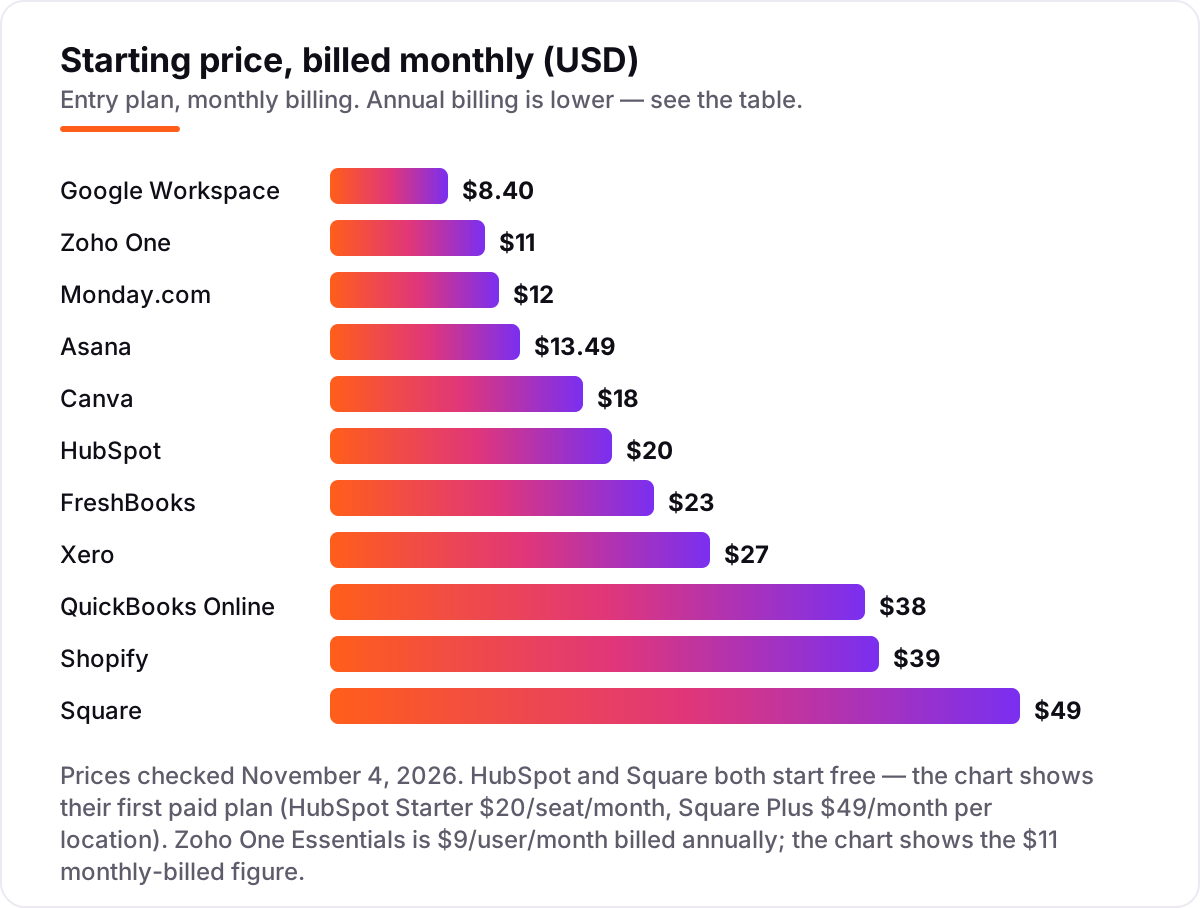
Take a five-person service business that sells online and takes cards in person. The cheapest honest setup is Zoho One Essentials: $11 per user a month billed monthly, or $9 billed annually, which is $55 a month billed monthly or $45 billed annually for all five people — CRM, books, help desk, email and projects on one invoice. That is the number every other stack has to beat.
A best-of-breed stack costs more but gives you the strongest tool for each job. Xero Early is $27 a month and covers unlimited users, Asana Starter is $13.49 per user a month billed monthly — $67.45 for five — Google Workspace Business Starter is $8.40 per user a month on the Flexible plan — $42 for five — and Canva Pro is $18 a month for the one person who designs. HubSpot's CRM costs $0. The monthly total is $154.45, before card processing.
Pay annually and the same stack drops: Asana falls to $10.99 per user a month ($54.95 for five), Google Workspace to $7 ($35 for five), and Canva to $144 a year ($12 a month). The annual total is $128.95 a month — still $83.95 a month more than Zoho One Essentials at $45. That gap buys you better accounting, better project timelines and better email, and only you can say whether it is worth it.
Two costs sit outside every number above. First, the selling costs: Square takes 2.6% + 15¢ on every in-person card payment on its free plan, and Shopify takes 2.9% + 30¢ online, so a business doing $10,000 a month in card sales pays roughly $260–$290 a month in processing alone. Second, the seat traps: Monday.com's 3-seat minimum means a solo owner pays $36 a month billed monthly for Basic, and HubSpot Starter at $20 a seat would add $100 a month for this same five-person team. If you sell products rather than services, compare the accounting side in our guide to the best accounting software for small businesses.
Know the difference: an all-in-one suite vs a best-of-breed stack
The confusion in this category is between buying one suite and buying the best tool for each job. An all-in-one suite like Zoho One gives you CRM, accounting, projects, email and help desk on one invoice, one login and one renewal date. A best-of-breed stack — Xero for the books, HubSpot for customers, Asana for projects, Google Workspace for email — gives you the strongest tool for each job, but four invoices, four logins and four renewal dates.
The suite wins on price and simplicity. Zoho One Essentials costs $45 a month billed annually for five people and covers five jobs; the equivalent stack costs $126.95 a month billed annually and still needs someone to keep the integrations working. The stack wins on depth: Xero's bank reconciliation, HubSpot's pipelines and Asana's timelines are each better than the matching Zoho One app, and the best tool for a job you do every day is worth paying for.
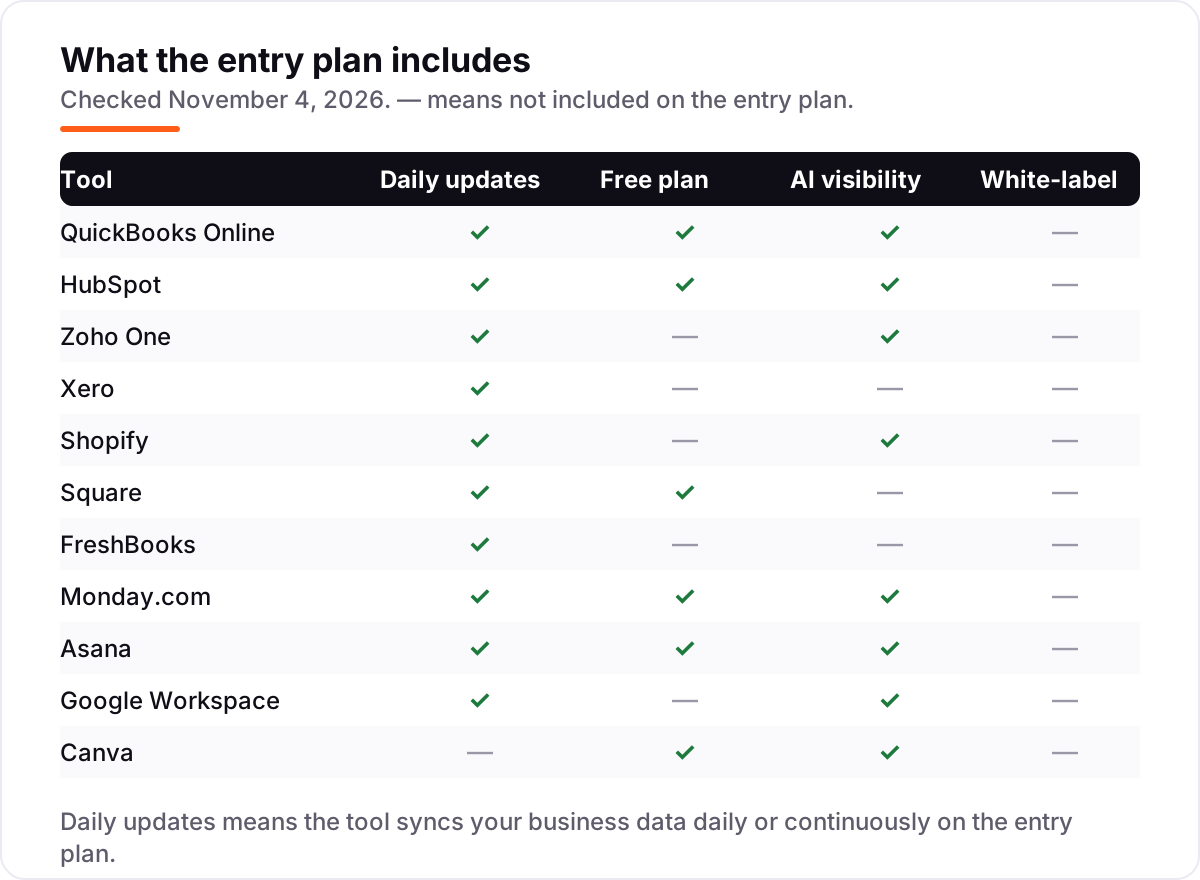
There is a second distinction worth knowing: free is a plan, not a promise. HubSpot's free CRM, Square's free POS, Monday.com's free plan and Canva's free plan are all real products with real limits — 1,000 contacts, processing fees on every sale, 2 seats, 5 GB of storage. A free plan that fits today is a good deal; a free plan you outgrow in a month is just a delayed purchase. Count the limit that bites first before you commit to any of them.
Quick comparison: tool type by need
| Buyer | Best pick | Why |
|---|---|---|
| Most small businesses | QuickBooks Online | The standard accounting choice accountants know, from $38/month |
| Free customer tracking | HubSpot | Real CRM at $0 for up to 1,000 contacts, Starter is $20/seat/month |
| One invoice for everything | Zoho One | 15+ apps from $11/user/month, or $9 billed annually |
| Team that hates per-seat pricing | Xero | Unlimited users on every plan, Early is $27/month |
| Selling products online | Shopify | Full store and checkout, Basic is $39/month |
| Taking payments in person | Square | Free POS, Plus is $49/month per location |
| Service business that bills by the hour | FreshBooks | Invoicing-first design, Lite is $23/month for 5 clients |
| Visual project boards | Monday.com | Boards and timelines, Basic is $12/user/month |
| Projects with deadlines and AI help | Asana | Timelines and Asana AI, Starter is $13.49/user/month |
| Business email and documents | Google Workspace | Gmail, Docs and Meet, Starter is $8.40/user/month |
| Doing your own design | Canva | Templates and Brand Kit, Pro is $18/month |
Mistakes to avoid
- Budgeting on the promo price. The 50–80% introductory discounts in this list last three to six months. The list price is what you pay in month seven, so compare tools on that number.
- Forgetting to multiply by seats. A $13.49 per-user price is $67.45 a month for five people, and HubSpot Starter at $20 a seat is $100. The headline price is never the bill for a team.
- Buying the suite for one app. Zoho One is a bargain when you use three or more of its apps. If you only need the CRM, buy the CRM — do not pay for fifty apps you will never open.
- Ignoring the processing fees. Square and Shopify take a percentage of every sale on top of the subscription. A business doing $10,000 a month in card sales pays roughly $260–$290 a month in processing, dwarfing the plan price.
- Paying for seats nobody uses. Monday.com's 3-seat minimum, Zoho One's all-employee rule and per-seat pricing everywhere else all punish buying licences ahead of hiring. Add seats the month someone starts, not before.
How we chose
We checked each vendor's own pricing page on November 4, 2026 and recorded the starting price exactly as shown, including the annual-billing figure where the page lists one, and we ranked the tools by fit for the most common buyer — a US small business owner with a handful of staff — not by brand size. This list carries no review ratings because the G2 review pages returned 429 rate-limit errors when we tried to open them on November 4, 2026, and we would rather show no rating than a stale or estimated one. No vendor paid for a place in this list, and none of the links here are affiliate links.
What to do next
Start with the free plan or trial of your top pick and run one real week of work through it — real invoices, real customers, real projects. Check that the bank feed reconciles, the CRM holds your contacts, and your team actually opens the tool every day before you commit to a year. If the business is sorted but new customers are not finding you, our monthly SEO service handles the visibility side — or compare providers in our guide to SEO companies for small business. Once your tools are in place, find out what's holding your rankings back.
Your stack only works if people find you
SerpAstra fixes what keeps your site off page one and makes it easy for AI assistants to recommend.
Get a free audit→Sources we checked (11)
- QuickBooks Online pricing — quickbooks.intuit.com/pricing (checked November 4, 2026)
- HubSpot CRM pricing — hubspot.com/pricing/crm (checked November 4, 2026)
- Zoho One pricing — zoho.com/one/pricing (checked November 4, 2026)
- Xero pricing — xero.com/us/pricing-plans (checked November 4, 2026)
- Shopify pricing — shopify.com/pricing (checked November 4, 2026)
- Square pricing — squareup.com/us/en/pricing (checked November 4, 2026)
- FreshBooks pricing — freshbooks.com/pricing (checked November 4, 2026)
- Monday.com pricing — monday.com/pricing (checked November 4, 2026)
- Asana pricing — asana.com/pricing (checked November 4, 2026)
- Google Workspace pricing — workspace.google.com/pricing (checked November 4, 2026)
- Canva pricing — canva.com/pricing (checked November 4, 2026)
Shamim
Founder of SerpAstra
A full-stack SEO and digital marketer who spends most days on Local SEO for dental practices, AI search visibility and lead generation.
Frequently asked questions
What is the best software for running a small business?
QuickBooks Online is the best fit for most small businesses: the accounting most US accountants know, from $38/month. HubSpot's free CRM is the best starting point for customer tracking, and Zoho One is the best value when you want CRM, books and projects on one invoice.
How much does software for running a small business cost?
A five-person team can run on $45–$155 a month, depending on the stack. The cheapest honest setup is Zoho One Essentials at $45/month billed annually for five people. A best-of-breed stack — Xero, Asana, Google Workspace and Canva — costs about $129/month billed annually.
Is there free software for running a small business?
Yes, with limits. HubSpot's CRM is free for up to 1,000 contacts, Square's POS is free until you take a payment, Monday.com is free for 2 seats, and Canva is free for basic design. None of them is a full business system on its own, so most businesses pay for at least one tool.
Should I buy an all-in-one suite or separate tools?
Buy the suite when you will use at least three of its apps and want one invoice — Zoho One Essentials at $9/user/month billed annually is the clearest example here. Buy separate tools when one job matters most, like accounting or selling online, and you want the best tool for that job.
What software does a small business need first?
Accounting first, then customers, then the daily work. Start with QuickBooks Online or Xero for the money, HubSpot's free CRM for contacts and deals, and Google Workspace for business email. Add Shopify or Square when you sell, and Asana or Monday.com when projects start slipping.
Can I switch business software later?
Yes, but plan the move for a quiet week, not mid-month. Export contacts, invoices, products and open orders from the old tool, import them into the new one, and run both systems for a week before cancelling. The hardest part is usually the accounting history, so keep the old books read-only for a year.
Do these tools work together?
Mostly, yes. Xero connects to more than 1,000 apps, QuickBooks Online to more than 800, and Asana to more than 100, including Google Workspace and Slack. HubSpot, Shopify and Square each have their own app marketplaces. Check the integration list before you buy, not after.
Free SEO and AI visibility audit
Find out what is holding your rankings back
Send us your site. Within 2 business days you get a written audit, an AI visibility check and a short fix list ranked by impact. Free, with no contract attached.
Request my free audit→Related guides
 SEO & AI Search12 Best Marketing Platforms for Small Business SEO in 2026, ComparedThe 12 best marketing platforms for small business SEO, compared on real prices, SEO tools and AI visibility. Every price checked November 1, 2026.Read guide →
 SEO & AI Search8 Best SEO Companies for Small Business in 20268 best SEO companies for small business compared on price, contracts and AI visibility, with prices checked on each agency's own site on November 1, 2026.Read guide →
 Accounting, Tax & Finance7 Best Accounting Software for Small Businesses in 2026, ComparedCompare the 7 best accounting software for small businesses on price, free plans, bank feeds and AI features, with every price checked November 2, 2026.Read guide →