
12 Best Tools to Find Long-Tail Keywords in 2026, Compared
Best tool to find long-tail keywords: 12 picks compared on price, free plans, difficulty scores and data depth. Prices checked November 2, 2026.
 Shamim Mia, Founder, SerpAstraLast verified November 2, 202616 min read
We compare pricing pages, documentation and public reviews. We never accept payment for rankings.

Key takeaways
- Mangools is the best all-round pick for most small sites: clear difficulty scores, local data and five tools from $37.70/month billed annually ($61 month to month).
- Ahrefs Starter at $29/month is the cheapest way into deep keyword data, and Google Keyword Planner is free — start there if your budget is $0.
- The single most important buying factor is the difficulty score: a long list of phrases you cannot rank for is worth less than ten you can win.
- Most prices below were checked on the vendor's own pricing page on November 2, 2026; four come from October 2026 readings of those pages — see How we chose. Ratings are G2, except AnswerThePublic (Capterra).
On this page
Quick comparison
| Tool | Best for | Starting price | Free plan |
|---|---|---|---|
| Mangools | Bloggers and small teams who want a simple keyword finder with difficulty scores and local data for about $38/month | $37.70/mo (annual) | Yes (5 lookups/day) |
| Ahrefs | In-house SEOs and content teams who want the deepest keyword data and will pay $29 a month for research alone | $29/mo | Yes (no Explorer) |
| Keysearch | Solo bloggers and affiliate site owners who want cheap keyword research with live SERP analysis for $24 a month | $20/mo (annual) | No (7-day trial) |
| LowFruits | Bloggers and niche-site owners who want to find weak SERPs they can rank in, and will pay per credit or $29.90 a month | $20.75/mo (annual) | No (free credits) |
| Ubersuggest | Solo site owners who want keyword research, audits and rank tracking in one budget tool for $29 a month | $16/mo (annual) | Yes (3 searches/day) |
| SE Ranking | Small agencies and in-house teams who want keyword research plus rank tracking, audits and AI visibility in one suite | $103.20/mo (annual) | No (14-day trial) |
| Semrush | Small teams and agencies that want the largest keyword database plus audits, backlinks and PPC data in one subscription | $117.33/mo (annual) | Yes (10 searches/day) |
| Keyword Tool | Content teams and PPC buyers who need long autocomplete lists from Google, YouTube, Bing and Amazon for one seed term | $89/mo | Yes (suggestions only) |
| AnswerThePublic | Bloggers and content planners who build outlines from the exact questions people type into Google | $10/mo (annual) | Yes (3 searches/day) |
| SpyFu | Marketers who find long-tail keywords by copying what competitors already rank for, with 10-plus years of history | $29/mo (annual) | Yes (limited) |
| Moz Pro | Small in-house teams that want keyword research with Domain Authority metrics in one beginner-friendly suite | $49/mo | No (7-day trial) |
| Google Keyword Planner | Anyone starting keyword research with no budget who wants volume and CPC data straight from Google | Free | Yes (free) |
Make one of these tools?
We re-check this list every quarter. Send a correction, request a review, or ask about a clearly labeled sponsored spot.
Request a listingThe best long-tail keyword tools

Mangools
Best for: Bloggers and small teams who want a simple keyword finder with difficulty scores and local data for about $38/month
Mangools is the easiest recommendation in this list because KWFinder is built for exactly this job: type a seed, get long-tail phrases with a difficulty score you can read at a glance, and see the search results behind each one. Basic costs $37.70 a month billed annually, and it is a five-tool suite, not a single tool — SERPChecker, SERPWatcher, LinkMiner and SiteProfiler come with it, plus AI Search Watcher PRO.
The limits are the caps, not the features. Basic allows 100 keyword lookups a day and 200 tracked keywords, and rank tracking updates weekly rather than daily. The keyword database is also smaller than Ahrefs or Semrush, so very niche B2B terms sometimes come back thin. If you research a few topics a week and want difficulty scores you can trust without learning a suite, start here.
What we like
- KWFinder's keyword difficulty score is the clearest in this list, built for picking long-tail terms a small site can actually rank for
- Five tools in every plan — KWFinder, SERPChecker, SERPWatcher, LinkMiner and SiteProfiler — plus AI Search Watcher PRO on Basic
- Local keyword data for more than 65,000 locations, with SERP analysis on every lookup
Watch out for
- Rank tracking updates weekly on Basic, not daily, so position changes surface slower than on the suites
- Keyword database is smaller than Ahrefs or Semrush, and there is no site audit in the suite

Ahrefs
Best for: In-house SEOs and content teams who want the deepest keyword data and will pay $29 a month for research alone
Ahrefs Keywords Explorer is the deepest research tool in this list, and Starter is the cheapest way into it at $29 a month. Every term carries keyword difficulty, search volume, Parent Topic and Traffic Potential, so you can tell at a glance whether a long-tail phrase deserves its own page or belongs inside a bigger one. The questions and also-rank-for filters turn one seed into hundreds of usable phrases.
Starter is deliberately narrow: 50 tracked keywords, 200 report credits a month and weekly rank updates by default. That is enough for keyword research on a few sites, but not for tracking a client portfolio. There is no free trial, so the $29 is a leap of faith — though Ahrefs Free covers verified site owners with basic data. Buy it for the research depth, not the tracking.
What we like
- Keywords Explorer holds a 110-billion-keyword database with keyword difficulty, Parent Topic and Traffic Potential on every term
- Questions, matching terms and also-rank-for filters turn one seed into hundreds of long-tail phrases
- Sits on one of the largest backlink indexes, so difficulty scores reflect real competition
Watch out for
- Rank Tracker updates weekly by default on Starter — daily updates need the paid Project Boost add-on
- No free trial, and Starter's 200 report credits a month cap how much research you can run

Keysearch
Best for: Solo bloggers and affiliate site owners who want cheap keyword research with live SERP analysis for $24 a month
Keysearch is the cheapest dedicated long-tail tool in this list, and it behaves like one built for niche-site owners. Starter costs $24 a month and gives 200 keyword searches a day with live SERP analysis, so you see the pages you would have to beat before you commit to a phrase. The difficulty score is tuned for small sites: a phrase is only a good target if you can rank for it.
The trade-offs are scale and depth. There is no free plan, only a 7-day trial, and the daily credit cap bites on heavy research days. The keyword database is smaller than Ahrefs or Semrush, and the backlink data is basic. For a solo blogger planning a month of posts, none of that matters much — and $24 a month is hard to beat.
What we like
- 200 keyword searches a day on Starter with live SERP analysis and a difficulty score built for small sites
- YouTube research, competitor keyword checks and an AI content assistant in the same subscription
- Rank tracking for 80 keywords and a site auditor for 2,000 pages a month included from Starter
Watch out for
- No free plan — only a 7-day trial — and daily search credits cap heavy research days
- Keyword database is smaller than the big suites, and backlink data is basic

LowFruits
Best for: Bloggers and niche-site owners who want to find weak SERPs they can rank in, and will pay per credit or $29.90 a month
LowFruits is the only tool in this list built around a single question: can a small site actually rank for this phrase? It scans the top 10 results for weak spots — forums, thin content, low-authority domains — and flags the long-tail terms where the current ranking pages look beatable. The wildcard search then generates combinations your competitors have not thought of, filtered by intent. For a new niche site, that weakness check matters more than raw volume.
It is credit-based, so the economics need attention: each SERP analysis costs 1 credit, and Standard gives 3,000 a month. Occasional researchers can skip the subscription entirely and buy pay-as-you-go credits from $25 for 2,000. There is no backlink index and no audit, so LowFruits is a specialist you pair with another tool, not a replacement for one.
What we like
- Flags weak spots in the top 10 — forums, thin pages, low-authority sites — so you target phrases you can actually win
- Wildcard search generates long-tail combinations competitors miss, with intent filtering built in
- Pay-as-you-go credits from $25 for 2,000 credits suit occasional research without a subscription
Watch out for
- Credit-based pricing: every SERP analysis costs 1 credit, so bulk checks burn the allowance fast
- No backlink index and no site audit, so it covers one job only

Ubersuggest
Best for: Solo site owners who want keyword research, audits and rank tracking in one budget tool for $29 a month
Ubersuggest packs the whole beginner SEO workflow into one $29-a-month plan: keyword ideas with volume and difficulty, content suggestions, a site audit, backlink data and rank tracking for 125 keywords. It also includes AI Search Visibility tracking, which the bigger suites charge extra for. The dashboard is built around a prioritized list of quick wins rather than raw tables, which suits owners doing their own SEO.
The limits are depth and speed. The keyword database is smaller than Ahrefs or Semrush, reviewers report volumes running 15–25% high on some terms, and rank tracking updates weekly on the lower plans. A lifetime purchase from $290 is the unusual option here — it pays for itself in about ten months. For a solo owner on a tight budget, Ubersuggest is the most complete $29 in this list.
What we like
- Keyword ideas with content suggestions, search volume and difficulty in one simple dashboard
- AI Search Visibility tracking included, plus a site audit and backlink data on every plan
- Lifetime purchase option from $290, the only one in this list, alongside monthly and annual billing
Watch out for
- Rank tracking updates weekly on lower plans, not daily
- Keyword database is smaller than Ahrefs or Semrush, and reviewers report search volumes running high

SE Ranking
Best for: Small agencies and in-house teams who want keyword research plus rank tracking, audits and AI visibility in one suite
SE Ranking is the value suite in this list: the entry Core plan tracks 2,000 keywords a day, runs a 250,000-page site audit and includes AI visibility across five engines, all from $103.20 a month billed annually. Its Keyword Research tool covers difficulty, volume and long-tail suggestions, and the tracked-keyword allowance is the largest per dollar here. For a small agency, that is the whole workflow in one subscription.
The trade-off is polish rather than power. Reviewers like the depth but some report small accuracy differences against the bigger suites, and the interface takes a few days to learn. The price also climbs steeply with keyword volume, so a growing agency should price the next tier before committing. If you need a suite that does long-tail research properly, this is the cheapest serious one.
What we like
- Keyword Research tool with difficulty, volume and long-tail suggestions across 2,000 tracked keywords a day on Core
- AI visibility tracking across five engines included on the entry Core plan, at 25 prompts a day
- Full suite in one plan: rank tracking, site audit for 250,000 pages, backlinks and content tools
Watch out for
- Highest entry price among the mid-priced suites here, and the per-keyword cost rises fast above 2,000 keywords
- Some G2 reviewers report small differences in rank-tracking accuracy versus larger competitors

Semrush
Best for: Small teams and agencies that want the largest keyword database plus audits, backlinks and PPC data in one subscription
Semrush is the deepest bench in this list. The Keyword Magic Tool clusters long-tail phrases from a database Semrush puts at more than 27 billion keywords, with search intent and difficulty on every term, and the Keyword Gap tool shows the long-tail terms your competitors rank for that you do not. The entry SEO plan pairs that research with Position Tracking for 500 keywords a day, site audits and backlink analysis.
It is also the priciest way in, and the extras add up: additional users start at $45 a month, and AI prompt tracking needs the $199-a-month Starter bundle rather than the SEO plan. The free account is genuinely useful for a single small site, but ten searches a day will not cover a real content plan. Buy Semrush when you need the research depth, not just the keyword lists.
What we like
- Keyword Magic Tool builds long-tail clusters from a 27-billion-plus keyword database, with intent and difficulty on every term
- Bundles keyword research with Position Tracking for 500 keywords a day, site audits and backlink analysis
- Keyword Gap tool shows the long-tail terms competitors rank for that you do not
Watch out for
- Highest entry price in this list, and extra users start at $45 a month
- SEO plan covers AI Overviews citations only — prompt tracking needs the Starter bundle at $199 a month

Keyword Tool
Best for: Content teams and PPC buyers who need long autocomplete lists from Google, YouTube, Bing and Amazon for one seed term
Keyword Tool works differently from the database tools: it pulls live autocomplete suggestions from Google, YouTube, Bing, Amazon and the app stores, and turns one seed into 750-plus long-tail phrases. That breadth is the point — autocomplete shows what people actually type, including the odd phrasings a database can miss. The questions, prepositions and comparisons filters then split the list into groups you can build content around.
What it does not do is judge the phrases. There is no keyword difficulty score, no backlink data and no audit, so you need a second tool to check whether a phrase is winnable. The free version shows suggestions only; volume, CPC and competition all sit behind Pro Basic at $89 a month. Use it as the idea generator at the start of your workflow, not as the only tool in it.
What we like
- Generates 750-plus long-tail suggestions per seed from live autocomplete across Google, YouTube, Bing, Amazon and app stores
- Questions, prepositions and comparisons filters split one seed into content-ready phrase groups
- No account needed for the free version, and Pro adds volume, CPC, competition and trend data
Watch out for
- No keyword difficulty score, so you must check competition in another tool
- No backlink data and no site audit — it generates ideas, nothing else

AnswerThePublic
Best for: Bloggers and content planners who build outlines from the exact questions people type into Google
AnswerThePublic answers a different question: not how hard a keyword is, but what people actually ask about it. One seed becomes a visual map of questions, prepositions and comparisons — the exact phrasing behind long-tail searches, and ideal outline material. It now pulls from Google, YouTube, Bing, Amazon, TikTok and Instagram, plus ChatGPT, and Starter adds volume data and an AI article writer.
It is a complement, not a complete toolkit. There is no difficulty score and no rank tracking, so you still need another tool to judge whether a question is worth targeting. The free plan allows 3 searches a day, and credits expire after 12 months. At $10 a month billed annually, though, it is the cheapest paid plan in this list — and the fastest way to turn a topic into a content outline.
What we like
- Turns one seed into a visual map of questions, prepositions and comparisons — the raw material for long-tail outlines
- Now covers Google, YouTube, Bing, Amazon, TikTok and Instagram, plus ChatGPT as a data source
- Starter adds CPC and search volume data plus an AI article writer (Composeo) for turning questions into drafts
Watch out for
- No keyword difficulty score and no rank tracking — it finds questions, not ranking odds
- Free plan allows only 3 searches a day, and search volume needs a paid plan

SpyFu
Best for: Marketers who find long-tail keywords by copying what competitors already rank for, with 10-plus years of history
SpyFu finds long-tail keywords the lazy way, and it works: instead of guessing which phrases might bring traffic, you look at the keywords your competitors already rank for. Basic costs $39 a month and shows every keyword a rival ranks for and bids on, with more than ten years of history behind it. Kombat, its gap tool, finds the terms two or three competitors share that you are missing — usually the best long-tail targets of all.
The entry plan is narrow: one Live Site tracking project, one user and weekly rank updates. It is also a research tool, not a writer — there is no content optimization and no audit beyond crawl pages. But for harvesting proven phrases, nothing else in this list is as direct. If your niche has clear competitors, start your keyword list with theirs.
What we like
- Shows every keyword competitors rank for and bid on, with 10-plus years of history — the fastest way to harvest proven long-tail terms
- Kombat keyword-gap analysis finds the terms two or three competitors share that you are missing
- AI brand monitoring included on every paid plan, with 5,000 weekly tracked keywords on Basic
Watch out for
- Basic covers only 1 Live Site tracking project and 1 user, so multi-client work needs a higher plan
- Rank tracking updates weekly, not daily, on the entry plan

Moz Pro
Best for: Small in-house teams that want keyword research with Domain Authority metrics in one beginner-friendly suite
Moz Pro is the friendliest suite in this list, and it owns Domain Authority — the 0–100 site-strength score that appears in countless client reports. Keyword Explorer scores each term for difficulty and opportunity and suggests long-tail variants with click-through estimates, so you can judge a phrase by the traffic it would bring, not just its volume. Starter costs $49 a month for one site, which undercuts every other suite here.
The limits are scope and speed. Starter covers one site and one user, rank tracking updates weekly on Standard, and AI Visibility starts on the $99-a-month Standard plan rather than Starter. The keyword database is also smaller than Ahrefs or Semrush. Buy Moz for the metrics and the learning curve; buy a dedicated finder if long-tail volume is the whole job.
What we like
- Keyword Explorer scores difficulty and opportunity, and suggests long-tail variants with click-through estimates
- Domain Authority, Page Authority and Spam Score built into every plan — the metrics clients already recognize
- Rated the easiest full SEO suite to learn, with Moz Academy training for newer SEOs
Watch out for
- Starter covers 1 site and 1 user, and the pricing page publishes no annual price for Starter
- AI Visibility starts on Standard ($99 a month), not on Starter

Google Keyword Planner
Best for: Anyone starting keyword research with no budget who wants volume and CPC data straight from Google
Google Keyword Planner is the free baseline the other tools here should be judged against. It costs nothing beyond a Google Ads account, and it is the only volume data here that comes straight from Google, not a modeled estimate. Feed it a seed or URL and it returns keyword ideas with CPC estimates, historical volume and forecasts — enough to spot seasonal long-tail phrases before you write.
The gaps are real, and they are why the paid tools exist. There is no difficulty score and no organic competition metric, and without ad spend the volumes show as wide ranges instead of exact numbers. There is no rank tracking and no question data. Use Planner to build your first list for free, then take the promising phrases to a paid tool to check whether you can rank for them.
What we like
- Free with any Google Ads account, and the only volume data in this list that comes straight from Google
- Generates keyword ideas from a seed or a URL, with CPC estimates for every term
- Historical volume and forecasts help you spot seasonal long-tail phrases before writing
Watch out for
- No keyword difficulty score and no competition metric for organic results
- Without ad spend, search volumes show as wide ranges, not exact numbers
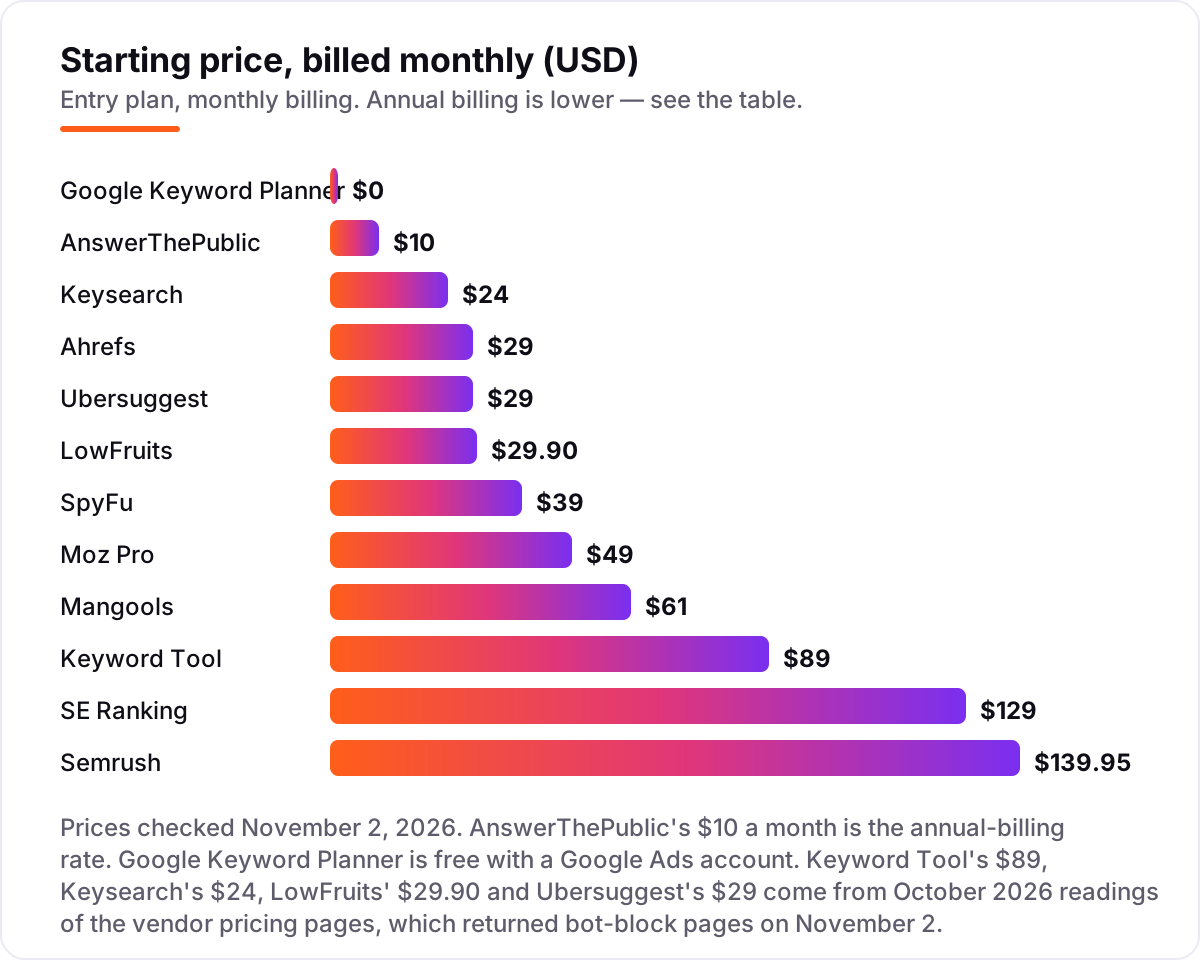
The best tool to find long-tail keywords is the one that tells you two things at once: what people actually type, and whether your site can rank for it. A long list of phrases means nothing without that second half, so this guide ranks 12 tools by how well they answer both questions — and by what they cost to do it. Prices run from free to $139.95 a month, and the right pick depends on your budget and how often you research.
Most buyers in this category are solo bloggers, affiliate site owners and small in-house teams. They do not need enterprise data. They need a difficulty score they can trust, enough searches to plan a month of content, and a price that does not sting. That is the lens for the ranking below: fit for the most common buyer, not brand size.
What the best tool to find long-tail keywords actually does
A long-tail keyword tool turns one seed word into a list of longer, more specific phrases people search for, then attaches the numbers that decide whether each phrase is worth targeting: monthly search volume, keyword difficulty and, on the better tools, click-through estimates and search intent. The point is not the list. It is the filter — knowing which ten phrases out of five hundred a small site can actually win.
The tools here get their data two ways. Database tools such as Ahrefs, Semrush and SE Ranking check their own indexes, which run into the billions of terms: Semrush says its keyword database holds more than 27 billion keywords. Autocomplete tools such as Keyword Tool and AnswerThePublic pull live suggestions from Google, YouTube and other platforms, which catches the odd phrasings a database can miss. Neither approach is wrong; they find different phrases, which is why many teams use one of each.
One more thing the tool should do is show you the search results behind the numbers. A difficulty score is a summary of the top 10 pages, and a tool that hides those pages asks you to trust a number you cannot check. Mangools, Keysearch and LowFruits all show the SERP behind the score, and that transparency is worth more than a bigger database.
Dedicated long-tail finders first
If long-tail research is the job, start with the tools built for it. Mangools, Keysearch, LowFruits, Keyword Tool and AnswerThePublic do not try to be everything — they find phrases, score them and get out of the way. Mangools is the most complete of the five: KWFinder's difficulty score is the clearest in this list, and the five-tool suite behind it covers SERP analysis and tracking too. Keysearch is the cheapest dedicated option at $24 a month, with live SERP analysis on every lookup.
LowFruits takes the most unusual angle. Instead of scoring phrases, it scores the pages already ranking for them and flags the weak ones — forums, thin articles, low-authority sites. That weakness check is the closest thing in this list to a guarantee that a phrase is winnable, and its pay-as-you-go credits suit researchers who work in bursts rather than every week. Keyword Tool and AnswerThePublic sit at the idea end of the spectrum: Keyword Tool pulls 750-plus autocomplete suggestions per seed across Google, YouTube, Bing and Amazon, while AnswerThePublic maps the questions people ask, which is the raw material for outlines and FAQ content.
All-in-one suites that do long-tail well
The suites cost more because they do more, and the question is whether you need the rest. Ahrefs Starter at $29 a month is the exception: it is priced like a dedicated tool but carries Keywords Explorer, the deepest research database in this list, with Parent Topic and Traffic Potential on every term. If your budget is $29 and you want the best data per dollar, Ahrefs wins. SE Ranking is the value suite at $103.20 a month billed annually, with 2,000 keywords tracked daily and AI visibility included — the most complete package under $110 a month.
Semrush is the deepest suite, and the priciest entry at $139.95 a month. Its Keyword Magic Tool clusters long-tail phrases from the 27-billion-plus keyword database, and Keyword Gap shows the terms competitors rank for that you do not. Buy it when the research feeds a team, not a single blog. Ubersuggest is the budget suite: keyword research, audits, tracking and AI Search Visibility for $29 a month, with a lifetime purchase option no one else here offers. Moz Pro is the friendliest suite at $49 a month, and the only one whose headline metric — Domain Authority — clients already ask for by name.
SpyFu belongs in this group by function rather than form. It is not a suite, but it answers the long-tail question sideways: show me the keywords my competitors already rank for. That shortcut is often faster than generating phrases from scratch, and its 10-plus years of history means the terms it surfaces are proven, not guessed.
Free starting points
If your budget is $0, start with Google Keyword Planner and the free tiers, not with a trial you will forget to cancel. Keyword Planner is free with any Google Ads account and gives volume and CPC data straight from Google — the only first-party data in this list. Its weakness is that volumes show as wide ranges without ad spend, and there is no difficulty score, so treat it as a list builder and validate the phrases elsewhere.
The free tiers fill the gaps Planner leaves. Mangools gives 5 keyword lookups a day, Ubersuggest 3 searches a day, AnswerThePublic 3 searches a day, and Keyword Tool shows suggestions without volume data. Between them, a careful researcher can plan a month of posts without paying. The moment research becomes weekly work, though, a paid plan is cheaper than the time lost to daily caps — Keysearch at $24 a month or AnswerThePublic at $10 a month billed annually are the cheapest ways in. If you want a second opinion on the free options, our guide to the best free keyword tool compares them in detail, and our monthly SEO service handles the research for you when the list gets long.
Quick comparison: tool type by need
| Buyer | Best pick | Why |
|---|---|---|
| Solo blogger on a budget | Keysearch or AnswerThePublic | $24/month or $10/month billed annually, with difficulty scores or question maps |
| Small site that needs to win phrases | Mangools or LowFruits | Clear difficulty scores and weak-SERP flags from $37.70 or $20.75/month billed annually |
| Deepest keyword data | Ahrefs or Semrush | 110-billion and 27-billion-plus keyword databases respectively |
| Best value suite | SE Ranking | 2,000 keywords tracked daily plus AI visibility from $103.20/month |
| Steal competitors' keywords | SpyFu | 10-plus years of rival keyword history from $39/month |
| Zero budget | Google Keyword Planner | Free, with volume and CPC data straight from Google |
How to choose: a short decision path
- Set your budget first. Free means Keyword Planner plus the free tiers. Under $30 a month, Keysearch, Ahrefs Starter, Ubersuggest and AnswerThePublic cover the job. Over $100, you are choosing between suites.
- Check the difficulty score. A tool without one — Keyword Planner, AnswerThePublic — can only build lists, not judge them. If you buy one tool, make sure it scores difficulty.
- Count your searches. Free tiers cap at 3–5 searches a day; Mangools Basic at 100 lookups a day; Keysearch at 200. Match the allowance to how many topics you plan a month.
- Decide suite or finder. If you already pay for audits and tracking, buy a dedicated finder. If you need research plus audits and backlinks, a suite costs less than the tools separately.
- Try before you pay. Every tool in this list has a free plan, free credits or a free trial. Run your real seed keywords for a week and compare the difficulty scores against the search results you can see yourself before committing.
Before you publish pages for the keywords you pick, run your titles through the free keyword density checker — it shows whether the phrase actually appears in your copy often enough to rank.
Mistakes to avoid
- Chasing volume and ignoring difficulty. A phrase with 1,000 searches and a difficulty score of 70 brings nothing; one with 200 searches and a score of 15 brings steady traffic.
- Comparing monthly prices without checking billing. Annual billing cuts most prices by 15–45%, and a few tools — Ahrefs Starter, Moz Starter — have no annual option at all.
- Trusting a directory price. Several directories still list Mangools at $29.90 and Long Tail Pro as if it were still sold; the live pricing pages say otherwise. Always check the vendor's own page.
- Paying for a suite when you only need phrases. A $24 finder beats a $129 suite you only open for keyword lists.
- Forgetting the caps. Free tiers and credit-based plans run out mid-project. Count your monthly topics before you count the price.
How we chose
We checked each vendor's own pricing page on November 2, 2026 where it would load, and recorded the starting price exactly as shown, including the annual-billing figure where the page lists one. Four prices come from independent October 2026 readings of the vendor pricing pages instead: Keyword Tool's $89, Keysearch's $24, LowFruits' $29.90 and Ubersuggest's $29 — those pages returned bot-block pages when we tried to read them on November 2, and the figures match multiple October readings. AnswerThePublic's $10 a month is the annual-billing rate shown on its pricing page, which has been repriced since the older $20 monthly figure. Ratings come from G2, except AnswerThePublic, where G2 publishes no score — so we used its Capterra rating instead. Long Tail Pro is not in this list: it shut down on June 5, 2024, its domain now belongs to an unrelated insurance business, and any page still listing its pricing is stale. We ranked the tools by fit for the most common buyer — a solo blogger or small team finding long-tail phrases for a few sites — not by brand size. No vendor paid for a place in this list, and none of the links here are affiliate links.
What to do next
Start with the decision path above: set your budget, check the difficulty score, count your searches. Then take the free plan or trial of your top pick and run your real seed keywords for a week. If the phrases it surfaces match the search results you can see, and the difficulty scores feel honest, you have your tool. If you'd rather have this set up and read for you, request a free SEO + AI visibility audit and get a ranked fix list in 2 business days.
Rather not run the tools yourself?
Tools show you the data. SerpAstra turns it into higher rankings, more map-pack calls and citations in AI answers.
Get a free SEO + AI visibility audit→Sources we checked (22)
- Mangools pricing — mangools.com/plans-and-pricing (checked November 2, 2026)
- Mangools on G2 — 4.7/5, 97 reviews (checked November 2, 2026)
- Ahrefs pricing — ahrefs.com/pricing (checked November 2, 2026)
- Ahrefs on G2 — 4.5/5, 713 reviews (checked November 2, 2026)
- Keysearch pricing — keysearch.co/pricing (checked November 2, 2026)
- LowFruits pricing — lowfruits.io/pricing (checked November 2, 2026)
- Ubersuggest pricing — neilpatel.com/ubersuggest (checked November 2, 2026)
- Ubersuggest on G2 — 4.2/5, 160 reviews (checked November 2, 2026)
- SE Ranking pricing — seranking.com/subscription.html (checked November 2, 2026)
- SE Ranking on G2 — 4.7/5, 1,591 reviews (checked November 2, 2026)
- Semrush pricing — semrush.com/prices (checked November 2, 2026)
- Semrush on G2 — 4.4/5, 4,028 reviews (checked November 2, 2026)
- Keyword Tool pricing — keywordtool.io/pricing (checked November 2, 2026)
- Keyword Tool on G2 — 4.5/5, 19 reviews (checked November 2, 2026)
- AnswerThePublic pricing — answerthepublic.com/pricing (checked November 2, 2026)
- AnswerThePublic on Capterra — 4.6/5, 11 reviews (checked November 2, 2026)
- SpyFu pricing — spyfu.com/pricing (checked November 2, 2026)
- SpyFu on G2 — 4.6/5, 518 reviews (checked November 2, 2026)
- Moz Pro pricing — moz.com/products/pro/pricing (checked November 2, 2026)
- Moz Pro on G2 — 4.3/5, 608 reviews (checked November 2, 2026)
- Google Keyword Planner — ads.google.com/home/tools/keyword-planner (checked November 2, 2026)
- Google Keyword Planner on G2 — 4.7/5, 9 reviews (checked November 2, 2026)
Shamim
Founder of SerpAstra
A full-stack SEO and digital marketer who spends most days on Local SEO for dental practices, AI search visibility and lead generation.
Frequently asked questions
What is the best tool to find long-tail keywords in 2026?
Mangools is the best all-round pick for most small sites: KWFinder's difficulty scores and local data from $37.70/month billed annually. Ahrefs Starter at $29/month is the cheapest route to deep keyword data, and Google Keyword Planner is free. Pick by budget first, then by how much difficulty data you need.
How much does a long-tail keyword tool cost?
Between $0 and $139.95 a month at the entry level. Google Keyword Planner is free, AnswerThePublic starts at $10/month billed annually, and Keysearch at $24/month. The suites cost more — SE Ranking from $103.20/month billed annually and Semrush from $117.33 — because they bundle audits, tracking and backlinks.
Is there a free tool to find long-tail keywords?
Yes. Google Keyword Planner is free with a Google Ads account and gives volume and CPC data straight from Google. Mangools, Ubersuggest, Keyword Tool, AnswerThePublic and SpyFu all have limited free versions. Free tiers work for occasional research; a paid plan is cheaper than the time you lose once you research weekly.
What makes a keyword long-tail, and why does it matter?
A long-tail keyword is a specific, usually longer phrase — three or more words — with lower search volume and lower competition than a short head term. It matters because the searcher knows what they want, so the traffic converts better, and because a small site can actually rank for it. That is the whole bet behind this list.
Do I need a difficulty score, or is search volume enough?
You need the difficulty score. Volume tells you how many people search; difficulty tells you whether you can rank. A phrase with 1,000 searches a month and a difficulty score of 70 will bring you nothing, while one with 200 searches and a score of 15 can bring steady traffic. Every tool in this list except Keyword Planner and AnswerThePublic shows one.
Can I use more than one keyword tool?
Yes, and most small teams should. A common stack is Google Keyword Planner for free volume checks, AnswerThePublic or Keyword Tool for ideas, and one paid tool — Mangools, Keysearch or Ahrefs — for difficulty scores. The tools overlap less than they look: one finds phrases, another judges them, a third tracks them.
What should I check before paying for a keyword tool?
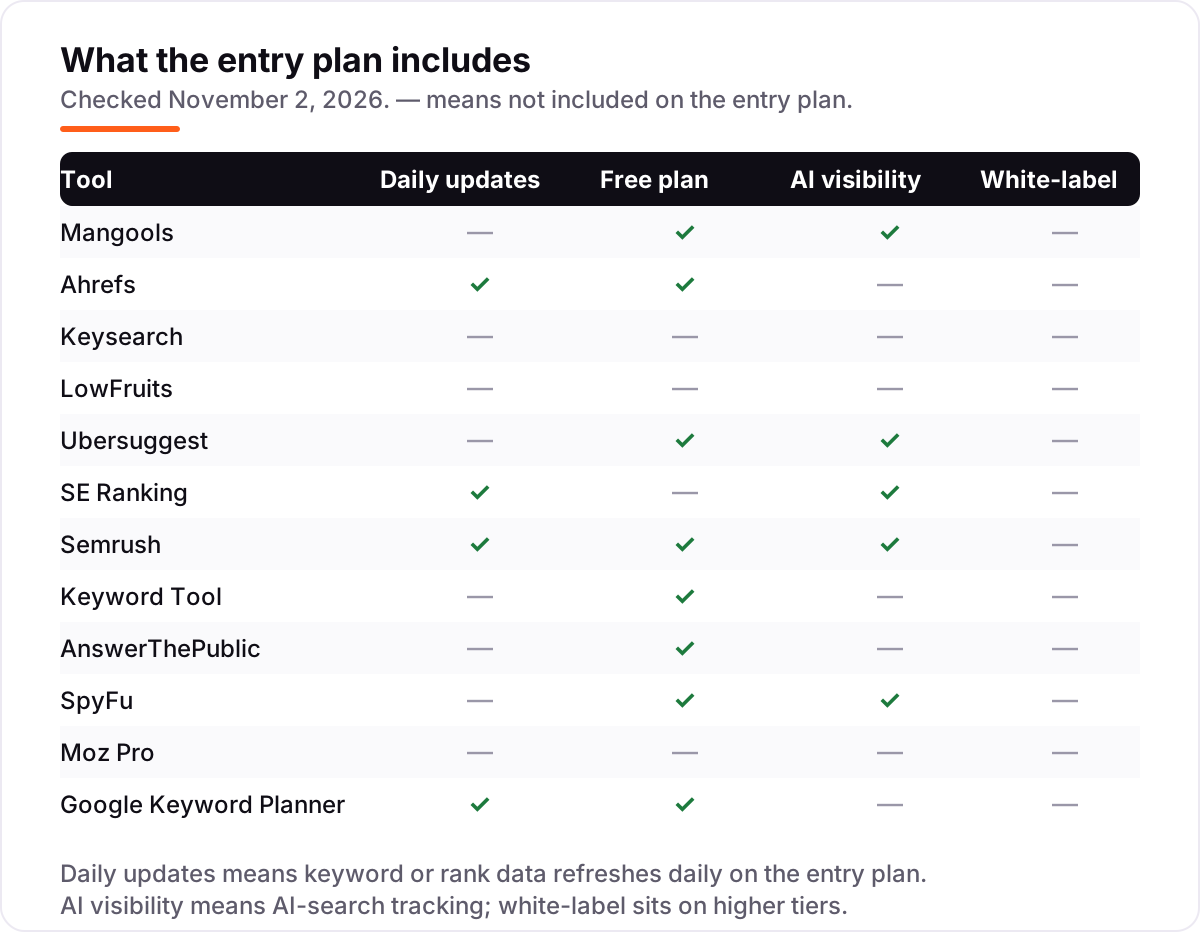
Four things: whether the plan includes a difficulty score or only volume, how many searches or lookups the plan allows a day, whether the data refreshes daily or weekly, and whether the price is monthly or annual billing. All four vary widely — the comparison table at the top of this guide shows the starting price and free plan for each tool.
Free SEO and AI visibility audit
Find out what is holding your rankings back
Send us your site. Within 2 business days you get a written audit, an AI visibility check and a short fix list ranked by impact. Free, with no contract attached.
Request my free audit→Related guides
 SEO & AI SearchBest Free Keyword Tools for 2026: 10 Picks Ranked by What You NeedThe best free keyword tool for your budget: 10 free keyword tools compared on free limits, volume data and upgrade prices, checked November 1, 2026.Read guide →
 SEO & AI Search10 Best Keyword Research Software in 2026, Compared10 best keyword research software tools compared on price, database size and ease of use, with prices checked on each vendor page on November 1, 2026.Read guide →
 On-PageKeyword research for local businesses, step by stepA practical, step-by-step keyword research process for local businesses: find what customers search, map terms to pages, and skip vanity keywords.Read guide →