
12 Best Ad Mediation Platforms for 2026 (Pros, Cons and Pricing)
The 12 best ad mediation platforms for 2026 compared on price, payout terms and G2 ratings — for app and web publishers, checked November 4, 2026.
 Shamim Mia, Founder, SerpAstraLast verified November 4, 202611 min read
We compare pricing pages, documentation and public reviews. We never accept payment for rankings.

Key takeaways
- AppLovin MAX, Google AdMob and Unity LevelPlay are the short list for most app publishers — all three are free, and MAX and AdMob carry the strongest G2 ratings here at 4.2/5 and 4.3/5.
- No mediation platform in this list charges a monthly fee. They earn from the networks' side or a revenue share — so compare payout terms and minimums, not subscription prices.
- The single most important buying factor is who owns the demand: a mediator that also runs an ad network can favour its own bids, so independent options like Appodeal matter.
- Web publishers should start with Google Ad Manager or Prebid, not an in-app mediator — the auction technology is different even though the goal is the same.
- Every price below was checked on the vendor's own site or terms on November 4, 2026. Ratings are G2, with review counts shown; four platforms have no G2 rating, so we show none.
On this page
Quick comparison
| Tool | Best for | Starting price | Free plan |
|---|---|---|---|
| Google AdMob | App publishers of any size who want Google's advertiser demand plus built-in mediation in one free account | $0 | Yes |
| AppLovin MAX | Mobile game studios that want the most widely adopted in-app bidding mediation layer | $0 | Yes |
| Unity LevelPlay | Game studios building in Unity who want mediation integrated into the editor | $0 | Yes |
| Appodeal | Indie and mid-size app developers who want independent mediation with no network conflict of interest | $0 | Yes |
| InMobi | App publishers with audiences in India, Southeast Asia, the Middle East and Africa | $0 | Yes |
| Fyber | Mobile game publishers who want FairBid mediation plus offer-wall revenue | $0 | Yes |
| Chartboost | Mid-size game publishers who want direct-deal campaigns and cross-promotion between their own titles | $0 | Yes |
| BidMachine | App publishers who want an independent in-app bidding exchange with machine-learning price floors | $0 | Yes |
| Google Ad Manager | Web and app publishers who outgrew AdSense and need direct deals plus programmatic in one ad server | $0 | Yes (90M impressions) |
| PubMatic OpenWrap | Larger web and in-app publishers who want transparent programmatic auctions on Prebid technology | Custom quote | No |
| Prebid | Publishers with in-house ad-ops engineering who want full control of their header bidding auction | $0 | Yes |
| Amazon Publisher Services | Enterprise web publishers with direct SSP relationships who want Amazon demand in a server-side auction | $0 | Yes (invite-only) |
Make one of these tools?
We re-check this list every quarter. Send a correction, request a review, or ask about a clearly labeled sponsored spot.
Request a listingThe best ad mediation platforms

Google AdMob
Best for: App publishers of any size who want Google's advertiser demand plus built-in mediation in one free account
AdMob is where most app publishers start, and the reason is demand: Google's advertiser pool fills almost any impression, in almost any country, and the built-in mediation lets other networks compete against it in the same SDK. Banners, interstitials, rewarded ads, native and app-open formats are all covered, and the Firebase reporting is genuinely useful rather than decorative.
The risks are Google's. A policy violation can suspend an account with limited recourse, and support for small publishers is mostly self-serve documentation and forums. Google also does not publish its own revenue split, so you never see exactly what share of an impression's value you keep. Keep a second network in the mediation group so one policy decision cannot zero your revenue.
What we like
- The largest advertiser demand pool in this list, with near-universal fill across banners, interstitials, rewarded ads, native and app-open formats
- Mediation groups and real-time bidding let 15+ third-party networks compete against Google's own demand in one SDK
- Deep Firebase and Google Analytics 4 integration, with a $100 minimum payout and monthly payments
Watch out for
- Policy violations can suspend an account with limited recourse, and support for small publishers is mostly self-serve
- Google does not publish its own revenue split in its help centre, so the publisher's exact share is not transparent

AppLovin MAX
Best for: Mobile game studios that want the most widely adopted in-app bidding mediation layer
MAX is the mediation layer most game studios measure everything else against. It runs a single first-price auction across 25+ networks, so every impression goes to the highest bidder instead of the first network in a waterfall list. Integration is fast for a mediation product — AppLovin says most publishers finish in under a day — and the Mediation Debugger catches bad adapter setups before launch.
The catch is that MAX is free because the networks pay, not because the auction is charity: AppLovin charges bidding networks a fee, and its own network bids in the auction it runs. Payouts stay split across networks, so finance work does not disappear. For a game studio that wants the broadest auction with the least payout friction, MAX is still the default pick.
What we like
- Free for publishers — AppLovin states bidding networks pay it a fee on generated ad revenue, not the publisher
- First-price in-app bidding across 25+ networks, with a Mediation Debugger and automated integration tooling
- Low payout friction: a $20 minimum by ACH or PayPal, paid around the 15th of the following month (net-15)
Watch out for
- Payments from mediated networks stay split across networks — there is no single consolidated payout for every source
- Reviewers note configuration complexity and a dashboard that takes time to learn

Unity LevelPlay
Best for: Game studios building in Unity who want mediation integrated into the editor
LevelPlay is the former ironSource mediation platform, now Unity's core mediation product. For a studio building in Unity, the pitch is the short distance between the editor and a working ad stack: install the Ads Mediation package, configure networks in the LevelPlay Network Manager, and the same dashboard handles segments, A/B tests and real-time reports. The unified auction covers 20+ networks.
Two honest caveats. Unity shut down the ironSource Ads direct-demand business in April 2026 — LevelPlay mediation itself is unaffected, but one demand source is gone. And AdMob cannot bid inside a LevelPlay stack, so publishers who want Google demand in the same auction need a different mediator. G2 still lists the product under its old ironSource name, which is where the 3.9/5 rating comes from.
What we like
- Installs from the Unity Editor through the Ads Mediation package — no separate SDK download for Unity-built games
- Unified bidding auction across 20+ networks, with rewarded, interstitial, banner, MREC and native formats
- Granular controls: user segments, A/B testing of mediation settings and real-time pivot reports
Watch out for
- Unity shut down the ironSource Ads direct-demand business in April 2026, so that demand source is gone from the platform
- AdMob does not support bidding through the LevelPlay mediation layer, which limits the stack for some publishers

Appodeal
Best for: Indie and mid-size app developers who want independent mediation with no network conflict of interest
Appodeal's appeal is independence. Every other big mediator in this list also runs an ad network, which means the auctioneer has a horse in the race. Appodeal owns no network, so its parallel bidding across 70+ demand sources has no reason to favour one bidder over another. The platform automates waterfall decisions by country and placement, and reviewers rate its setup and support the highest in this list.
The trade-off is transparency of a different kind: Appodeal publishes no price list, so the revenue-share terms are agreed per account. And while the mediation is strong, the company is far smaller than Google or AppLovin, so its demand depth depends on the networks you connect. Pick Appodeal when you want a neutral auctioneer and are comfortable negotiating terms directly.
What we like
- Independent mediation: Appodeal owns no ad network, so its optimization has no conflict of interest
- Parallel bidding across 70+ demand sources, with automated waterfall decisions and controls by country and placement
- Highest G2 rating in this list (4.7/5), with reviewers praising effortless setup and responsive support
Watch out for
- Appodeal publishes no price list, so the revenue-share terms are agreed per account rather than listed
- Reviewers mention initial SDK integration challenges and a payment threshold that could be lower

InMobi
Best for: App publishers with audiences in India, Southeast Asia, the Middle East and Africa
InMobi is the global independent in this list, and its strength is geography. In India, Southeast Asia, the Middle East and Africa it often out-fills Western networks, backed by an exchange with 200+ demand-side platforms and more than 5,000 programmatic buyers. Brand-advertiser relationships add premium demand that a pure programmatic stack does not reach.
For purely Western audiences the advantage fades: fill and eCPM trail AdMob and AppLovin in the US and Europe, and reviewers report less reliable earnings outside InMobi's strong regions. Treat InMobi as a second source in a mediation stack for Western traffic, and as a near-essential one if your users are in its home markets.
What we like
- Strongest demand in emerging markets, where its fill often beats Western networks
- An exchange with 200+ demand-side platforms and more than 5,000 programmatic buyers behind the mediation
- Brand-advertiser relationships bring premium demand that pure programmatic stacks miss
Watch out for
- Fill and eCPM trail AdMob and AppLovin for US and European audiences, so it works best as a second source there
- Reviewers report less reliable eCPM outside its strong regions and occasional support delays

Fyber
Best for: Mobile game publishers who want FairBid mediation plus offer-wall revenue
Fyber is Digital Turbine's mediation platform, built around FairBid — a unified in-app auction with unusually transparent reporting on who bid and who won each impression. The extra card in its hand is Offer Wall Edge, a rewarded-task format that pays users in virtual currency for completing offers, which no other mediator in this list offers.
The honest limits: the G2 rating rests on only 4 reviews, so treat the 4.0/5 as a hint rather than a verdict, and Fyber publishes no price list, so the revenue-share rate is negotiated per account. Pick Fyber when you want a transparent auction plus offer-wall revenue from an independent stack.
What we like
- FairBid runs a unified in-app auction with transparent reporting on who bid and who won
- Offer Wall Edge adds a rewarded-task format that other mediators in this list do not offer
- Part of Digital Turbine's independent Mobile Growth Platform, with over 40 billion daily ad opportunities claimed
Watch out for
- Only 4 G2 reviews, so the 4.0/5 rating rests on a very thin base
- Fyber publishes no price list — the revenue-share rate is agreed per account, not listed

Chartboost
Best for: Mid-size game publishers who want direct-deal campaigns and cross-promotion between their own titles
Chartboost is one of the original mobile ad platforms, and its standout has always been the direct-deal marketplace: publishers can negotiate premium campaigns with specific advertisers instead of taking whatever the auction pays. Free cross-promotion between a studio's own games is a second trick the big mediators do not offer. LoopMe's December 2024 acquisition adds brand demand behind the technology.
The trade-offs are scale and evidence. Demand and fill can be unstable for small user bases or low-demand regions, and the review record is too thin and contradictory to publish a rating — G2's figures conflict and rest on very few reviews. Chartboost earns its place as a specialist bidder in a stack, not as the only mediation layer.
What we like
- Direct-deal marketplace lets publishers negotiate premium campaigns outside generic auction pools
- Free cross-promotion for interstitial and video formats between a studio's own games
- Now part of LoopMe (acquired December 2024), adding brand-advertiser demand behind the mediation technology
Watch out for
- G2's published figures conflict and rest on very few reviews, so we show no rating for Chartboost
- Demand and fill can be unstable for small user bases or low-demand regions

BidMachine
Best for: App publishers who want an independent in-app bidding exchange with machine-learning price floors
BidMachine is an independent in-app bidding exchange that competes on pricing intelligence rather than scale. Its price floors are set by machine learning and move with the market, and DIRECT Placements connect publishers with direct demand beyond the open auction. It is also a certified SDK bidder inside Google mediation, so it can fight for impressions in AdMob and Ad Manager stacks.
The catch is cash flow. BidMachine's own terms set a $1,000 minimum payout on net-60 terms — the highest threshold in this list, so a small app earning a few hundred dollars a month waits months for its first payment. Use BidMachine as an added bidder inside MAX or LevelPlay, not as the only layer, and check the payout math before you integrate.
What we like
- Machine-learning price floors move with the market instead of sitting on a fixed number
- DIRECT Placements connect publishers with direct demand beyond the open-market auction
- Certified SDK bidder inside Google mediation, so it can compete for impressions in AdMob and Ad Manager stacks
Watch out for
- A $1,000 minimum payout on net-60 terms is the highest threshold in this list — small apps wait months for a payment
- Smaller demand footprint than the big three mediators, so it works best as an added bidder, not the only layer

Google Ad Manager
Best for: Web and app publishers who outgrew AdSense and need direct deals plus programmatic in one ad server
Google Ad Manager is the ad server most publishers graduate to after AdSense. It is free up to 90 million non-video impressions a month in the US, Canada, Australia and New Zealand, and it holds direct-sold campaigns, programmatic demand, forecasting and Open Bidding in one place. The AdX demand inside it is something no independent server can match.
The limits are real. Ad Manager cannot be white-labeled at any price, the interface assumes trained ad-ops staff, and passing the free tier means Ad Manager 360 — negotiated per publisher, with no published price. It is also Google's house: its publisher policies follow you into direct deals. For a mainstream site with real traffic, it is still the backbone most of the web runs on.
What we like
- Free for small business up to 90 million non-video impressions a month in the US, Canada, Australia and New Zealand
- One place for direct-sold campaigns, programmatic demand, forecasting and Open Bidding with third-party exchanges
- AdX demand no independent server can match, with line-item controls and audience segmentation built in
Watch out for
- Cannot be white-labeled at any price, and the interface is built for trained ad-ops staff, not beginners
- Passing the free tier means Ad Manager 360, whose pricing is negotiated per publisher and not published

PubMatic OpenWrap
Best for: Larger web and in-app publishers who want transparent programmatic auctions on Prebid technology
OpenWrap is PubMatic's enterprise header bidding wrapper, built on Prebid technology. Its selling point is transparency: publishers see where each impression goes and what each intermediary costs, which is rare in a business that usually hides the supply path. Identity Hub adds ID management without another vendor, and the SDK covers in-app banner, video, native and rewarded formats.
The catch is that PubMatic shelved OpenWrap Web in mid-2026, so web publishers are now pointed to partners — the SDK for apps remains the live product. Pricing is negotiated rather than published, and reviewers note difficult customer-service access. OpenWrap fits larger publishers who care about the supply path and can run an enterprise sales process.
What we like
- Prebid-based wrapper with server-to-server and SDK options for in-app banner, video, native and rewarded ads
- Supply-path transparency: publishers see where impressions go and what intermediaries cost
- Identity Hub integration for ID management without extra vendors
Watch out for
- PubMatic shelved OpenWrap Web in mid-2026, so web publishers are pointed to partners instead
- Pricing is negotiated, not published, and reviewers note difficult customer-service access

Prebid
Best for: Publishers with in-house ad-ops engineering who want full control of their header bidding auction
Prebid is the open-source standard almost every wrapper in this list is built on. Prebid.js runs the auction in the browser, Prebid Server runs it server-to-server, and Prebid Mobile brings it to apps — all free, with 300+ demand adapters and no fee taken from the auction. Because you host it, the auction runs under your own brand with full control of timeouts, floors and bidder order.
The price is engineering time. There is no vendor support — the community and the documentation are the help desk — and Google AdX cannot bid inside a Prebid auction, so Google demand still needs Ad Manager line items. Prebid is the right pick when you have in-house ad-ops skill and want the auction to belong to you.
What we like
- Free and open source, with 300+ demand adapters and no fees taken from the auction itself
- Three products cover every surface: Prebid.js for web, Prebid Server for server-side, Prebid Mobile for apps
- Self-hosted, so the auction runs under your own brand with full control of timeouts, floors and bidder order
Watch out for
- No vendor support — the community and documentation are the help desk, and integration is engineering work
- Google AdX cannot bid inside a Prebid auction, so Google demand still needs Ad Manager line items

Amazon Publisher Services
Best for: Enterprise web publishers with direct SSP relationships who want Amazon demand in a server-side auction
Amazon Publisher Services runs two server-side marketplaces for enterprise web publishers. Transparent Ad Marketplace (TAM) charges publishers no fee — only a nominal $0.01 CPM to bidders — and one server-side call runs the auction across 50+ buyers plus Amazon's own demand, with auction-level reporting on who bid and who won.
The gate is the point. APS is invite-only with an approval review, so smaller publishers cannot sign up on their own. TAM is also not a managed service: you keep your own SSP contracts and handle the implementation yourself. The managed path, Unified Ad Marketplace, takes a 10% transaction fee from SSP bids instead. APS fits large publishers with direct demand relationships already in place.
What we like
- Transparent Ad Marketplace charges publishers no fee — only a nominal $0.01 CPM to bidders
- One server-side call runs the auction across 50+ buyers plus Amazon's own demand
- Auction-level reporting shows exactly who bid and who won every impression
Watch out for
- Invite-only with an approval review — smaller publishers cannot sign up on their own
- TAM is not a managed service: you keep your own SSP contracts and handle the technical implementation yourself
A best ad mediation platform runs one auction for every ad impression in your app or on your site, instead of letting a single network set the price. The 12 platforms in this list are ranked by fit for the most common buyer — an app publisher or a web publisher who wants more bidders competing for the same inventory — not by brand size. Dataintelo puts the global ad mediation platform market at $3.2 billion in 2025, and the products below are the ones publishers actually run: the big three in-app mediators, the independents, and the web-side wrappers and ad servers that do the same job for sites.
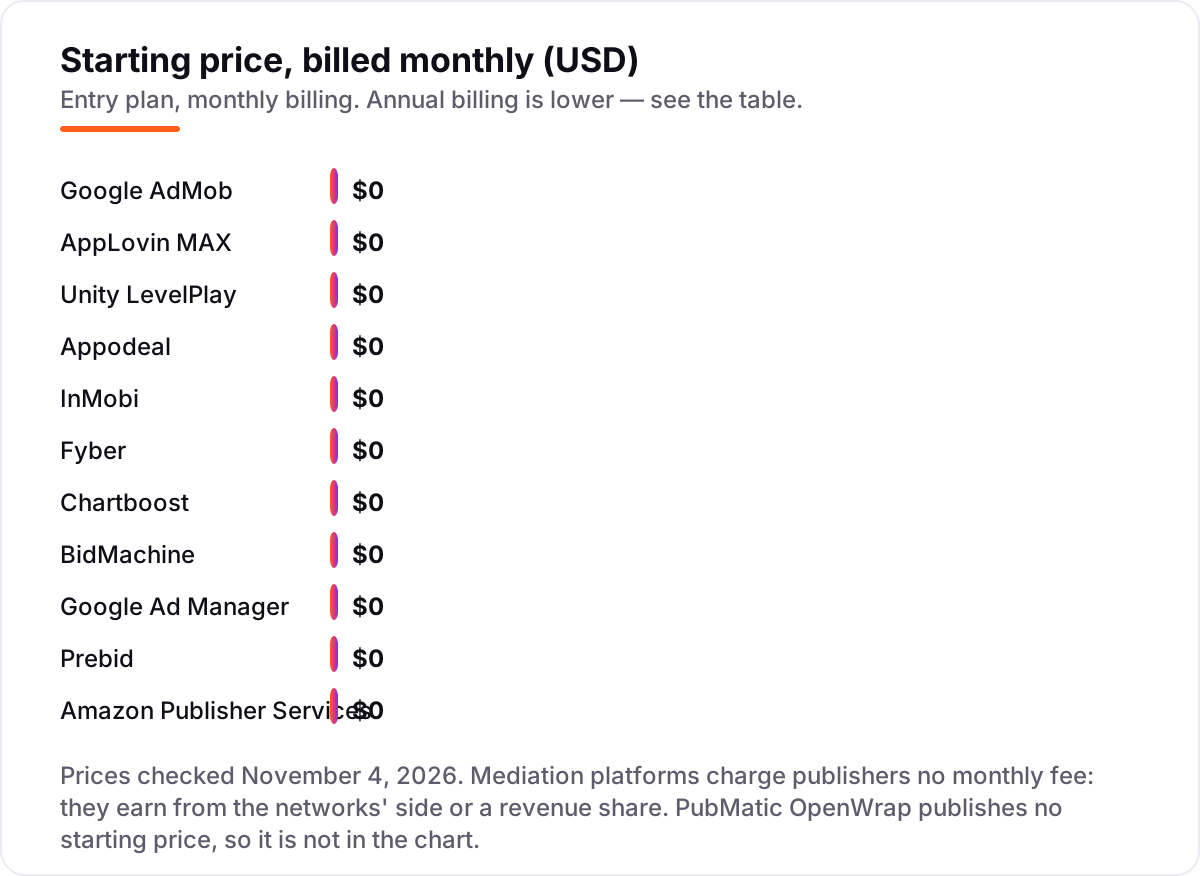
One thing to know before the prices: almost none of these platforms charge a subscription. They are free for publishers and earn from the networks' side or a revenue share, so the real cost comparison is payout terms, minimums and who owns the demand. That is why the price chart below is a row of zeros — and why the payout section matters more than the price column.
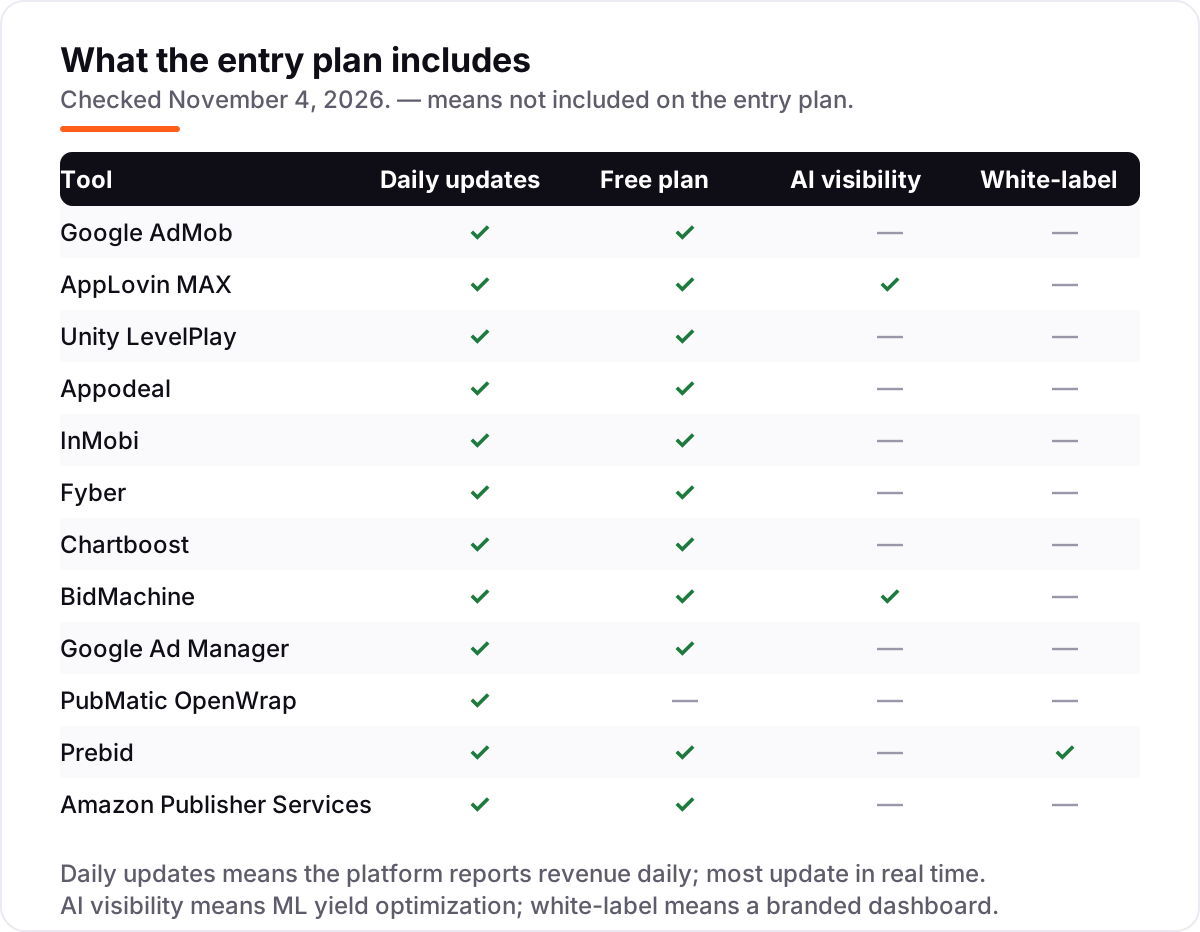
Quick comparison: tool type by need
| Buyer | Best pick | Why |
|---|---|---|
| Solo app developer, first mediation setup | Google AdMob | Free, Google demand plus mediation in one SDK |
| Mobile game studio | AppLovin MAX | Free first-price bidding across 25+ networks |
| Unity-built game | Unity LevelPlay | Free, installs from the Unity Editor |
| Indie app, no conflicts of interest | Appodeal | Free independent mediation, 70+ demand sources |
| Emerging-market audience | InMobi | Free, strongest fill in India, Southeast Asia and the Middle East |
| Web publisher with direct deals | Google Ad Manager | Free up to 90M impressions a month |
| Enterprise web publisher | Amazon Publisher Services | Free on TAM, Amazon demand in a server-side auction |
| Publisher with in-house ad ops | Prebid | Free open source, full control of the auction |
How to choose the best ad mediation platform
- App or web first. In-app mediators (AdMob, MAX, LevelPlay) and web wrappers (Prebid, OpenWrap, APS) solve the same problem with different technology — pick the side your inventory lives on.
- Bidding, not waterfall. Every platform here defaults to real-time bidding in 2026; a waterfall-only setup leaves money on the table.
- Who owns the demand. A mediator that also runs an ad network can favour its own bids. Independent options (Appodeal, Prebid, BidMachine) remove that conflict.
- Payout terms and minimums. MAX pays net-15 with a $20 minimum; LevelPlay and BidMachine pay net-60, and BidMachine needs $1,000 before it pays at all.
- Engineering effort. MAX and AdMob integrate in under a day; Prebid and OpenWrap need real ad-ops engineering.
- Privacy and consent. Check consent-framework support before you integrate — a mediator that cannot pass consent signals will lose European demand.
Before you publish the pages your ads run on, run your titles through the free SERP snippet preview tool — it shows exactly how the title and description will look in Google.
Ad mediation platform pricing: what you will actually pay
Take an app earning $10,000 a month in gross ad revenue through mediation. On MAX, AdMob or LevelPlay there is no platform fee, so the gross figure is what the networks pay out — minus each network's own revenue share, which you cannot see itemised on most platforms. On Amazon's UAM, Amazon takes a 10% transaction fee from SSP bids, so $10,000 of SSP bids becomes $9,000 before your SSPs pay you; on TAM there is no publisher fee at all. Then comes timing: MAX pays around the 15th of the following month with a $20 minimum, so a $10,000 January lands in mid-February. LevelPlay pays net-60 with a $100 minimum, so the same January revenue arrives in March. BidMachine's $1,000 minimum means an app earning $300 a month waits until month four for its first payout. The subscription is free everywhere here — cash flow is the price that actually varies.
Know the difference: mediation platform vs ad network vs ad server
A mediation platform runs the auction between networks; it does not usually buy the impression itself. An ad network (AdMob's own demand, Unity Ads, Liftoff) buys impressions with its own advertisers. An ad server (Google Ad Manager) stores your direct deals, trafficking rules and line items, and decides which demand wins after the auction. A header bidding wrapper (Prebid, OpenWrap) is the web version of a mediation platform: it runs the auction in the browser or on a server before the ad server decides. The confusion is natural because the big names do several jobs at once — AdMob is a network and a mediator, Google Ad Manager is a server with its own exchange, and AppLovin MAX is mediation with AppLovin demand as one bidder. When you compare tools, ask which job you are buying: the auction, the demand, or the trafficking. If search traffic is the bottleneck rather than the ad stack, our monthly SEO service covers that side.
How we chose
We checked each vendor's own site, documentation or terms on November 4, 2026 and recorded the starting price exactly as stated — which, for this category, usually means free. Most mediation platforms publish no price list: they earn from the networks' side or a revenue share, and where the share is not published we say so rather than inventing a number. Ratings come from G2. Chartboost, BidMachine, Prebid and Amazon Publisher Services have no G2 rating shown: Chartboost's published G2 figures conflict and rest on very few reviews, and the other three have no G2 product listing we could verify. LevelPlay's G2 listing still carries its old ironSource name. We ranked the tools by fit for the most common buyer — an app publisher monetising with ads, then a web publisher doing the same — not by brand size. No vendor paid for a place in this list, and none of the links here are affiliate links.
What to do next
Start with the decision path above: app or web, bidding, who owns the demand, and payout terms. Then integrate your top pick alongside your current setup and run both for two weeks — compare the blended eCPM and the fill rate, not one network's dashboard, before you switch fully. If you already run AdMob, add MAX or LevelPlay as the mediation layer and let them compete. Once your tools are in place, find out what's holding your rankings back.
Your stack only works if people find you
SerpAstra fixes what keeps your site off page one and makes it easy for AI assistants to recommend.
Get a free audit→Sources we checked (21)
- AppLovin MAX — applovin.com/en/monetization (checked November 4, 2026)
- MAX by AppLovin on G2 — 4.2/5, 21 reviews (checked November 4, 2026)
- Google AdMob — admob.google.com (checked November 4, 2026)
- Google AdMob on G2 — 4.3/5, 70 reviews (checked November 4, 2026)
- Unity LevelPlay — unity.com/products/levelplay (checked November 4, 2026)
- ironSource on G2 — 3.9/5, 10 reviews (checked November 4, 2026)
- Appodeal — appodeal.com (checked November 4, 2026)
- Appodeal on G2 — 4.7/5, 16 reviews (checked November 4, 2026)
- InMobi — inmobi.com (checked November 4, 2026)
- InMobi on G2 — 3.6/5, 14 reviews (checked November 4, 2026)
- Fyber — fyber.com (checked November 4, 2026)
- Fyber on G2 — 4.0/5, 4 reviews (checked November 4, 2026)
- Chartboost — chartboost.com (checked November 4, 2026)
- BidMachine terms of service — bidmachine.com/terms-of-service (checked November 4, 2026)
- Google Ad Manager — admanager.google.com (checked November 4, 2026)
- Google Ad Manager on G2 — 4.2/5, 236 reviews (checked November 4, 2026)
- PubMatic OpenWrap — pubmatic.com/products/openwrap/ (checked November 4, 2026)
- PubMatic on G2 — 3.2/5, 11 reviews (checked November 4, 2026)
- Prebid — prebid.org (checked November 4, 2026)
- Amazon Transparent Ad Marketplace — aps.amazon.com/aps/transparent-ad-marketplace/ (checked November 4, 2026)
- Ad mediation platform market size — Dataintelo, $3.2 billion in 2025
Shamim
Founder of SerpAstra
A full-stack SEO and digital marketer who spends most days on Local SEO for dental practices, AI search visibility and lead generation.
Frequently asked questions
What is the best ad mediation platform in 2026?
AppLovin MAX is the best fit for most mobile game studios: free first-price bidding across 25+ networks and the widest adoption. Google AdMob is the best default for general apps because of its demand. Unity-built games should start with LevelPlay. Web publishers should look at Google Ad Manager or Prebid instead — the in-app mediators are the wrong tool for sites.
How much does an ad mediation platform cost?
Nothing per month. Every platform in this list is free for publishers — they earn from the networks' side or a revenue share. The exception is negotiated enterprise contracts like PubMatic OpenWrap, which publishes no price. What varies is the revenue share you cannot see, the payout minimum and how fast you get paid.
Is there a free ad mediation platform?
Yes — nearly all of them. AdMob, AppLovin MAX, Unity LevelPlay, Appodeal, InMobi, Fyber, Chartboost, BidMachine, Google Ad Manager, Prebid and Amazon Publisher Services all charge publishers no platform fee. Prebid is the only fully open-source one. Free does not mean no cost: networks take their share before you are paid.
What is the difference between ad mediation and header bidding?
They are the same idea on different surfaces. Ad mediation runs the auction inside a mobile app through an SDK. Header bidding runs it on a web page, usually through Prebid, before the ad server decides. Server-side header bidding (Prebid Server, Amazon TAM) moves the web auction off the page and onto a server, which is closer to how in-app mediation works.
Do I need a mediation platform if I already use AdMob?
AdMob already includes mediation, so a second layer is optional — but many publishers still add one. Running MAX or LevelPlay as the mediation layer lets AdMob compete as one bidder among many, which can raise eCPMs. The trade-off is a second SDK to maintain and split payouts across networks, so test it on one app first.
How do ad mediation platforms pay publishers?
Each network pays you directly in most setups, on its own schedule. MAX pays around the 15th of the following month with a $20 minimum; AdMob pays monthly above $100; LevelPlay pays net-60 above $100; BidMachine pays net-60 above $1,000. Amazon's UAM consolidates payment but takes a 10% transaction fee from SSP bids.
Free SEO and AI visibility audit
Find out what is holding your rankings back
Send us your site. Within 2 business days you get a written audit, an AI visibility check and a short fix list ranked by impact. Free, with no contract attached.
Request my free audit→Related guides
 SEO & AI Search12 Best Marketing Platforms for Small Business SEO in 2026, ComparedThe 12 best marketing platforms for small business SEO, compared on real prices, SEO tools and AI visibility. Every price checked November 1, 2026.Read guide →
 SEO & AI Search9 Best Software for Marketers Focusing on AI Search in 2026, Compared9 best software for marketers focusing on AI search, compared on price, prompt limits and engine coverage. Real prices checked November 2, 2026.Read guide →
 SEO & AI Search8 Best SEO Tools for Affiliate Marketing in 2026, Compared8 best seo tools for affiliate marketing compared on price, keyword research, content scoring and outreach, with real starting prices checked on vendor pages.Read guide →