
12 Best AI-Powered Marketing Automation Platforms in 2026, Compared
12 best ai-powered marketing automation platforms compared on price, AI features and free plans, from HubSpot to Braze. Prices checked November 4, 2026.
 Shamim Mia, Founder, SerpAstraLast verified November 4, 202612 min read
We compare pricing pages, documentation and public reviews. We never accept payment for rankings.

Key takeaways
- HubSpot Marketing Hub, ActiveCampaign and Mailchimp are the short-list for most buyers: HubSpot from $20 per seat a month, ActiveCampaign from $19 a month, Mailchimp from $13 a month.
- Brevo is the cheapest paid start at $9 a month, and Klaviyo is the best value for online stores at $20 a month — both have usable free plans.
- The single most important buying factor is the billing unit: per seat, per contact, per profile or per org changes the real price far more than the headline figure.
- Four enterprise platforms — Marketo Engage, Braze, Iterable and MoEngage — publish no prices at all; budget for a sales conversation and an annual contract.
- Every price below was checked on the vendor's own pricing page on November 4, 2026, and every rating is from G2 with the review count shown.
On this page
Quick comparison
| Tool | Best for | Starting price | Free plan |
|---|---|---|---|
| HubSpot Marketing Hub | Small and mid-size marketing teams that want CRM, email and automation in one system | $20/seat/mo | Yes (free tools) |
| ActiveCampaign | Small businesses and agencies that want deep automation without enterprise pricing | $19/mo | No (14-day trial) |
| Mailchimp | Small businesses and creators who want the simplest path from signup to first campaign | $13/mo | Yes (250 contacts) |
| Brevo | Budget-conscious small businesses that send email, SMS and WhatsApp from one account | $9/mo | Yes (300/day) |
| Klaviyo | Online stores (Shopify, WooCommerce) that sell through email and SMS | $20/mo | Yes (250 profiles) |
| Keap | Service businesses and coaches that want CRM, sales pipeline and automation in one place | $249/mo (annual) | No (14-day trial) |
| Customer.io | Product-led SaaS teams that trigger messages from in-app behavior | $100/mo | No (14-day trial) |
| Salesforce Marketing Cloud | Mid-size and enterprise teams already running Salesforce that need cross-channel journeys at scale | $25/user/mo | No (free trial) |
| Marketo Engage | B2B marketing teams running account-based programs on Salesforce or Dynamics | Custom quote | No (demo only) |
| Braze | Consumer brands with mobile apps that need real-time cross-channel engagement | Custom quote | No (free trial) |
| Iterable | Growth and enterprise teams running sophisticated cross-channel lifecycle programs | Custom quote | No |
| MoEngage | Consumer brands running AI-assisted lifecycle programs across mobile and web | Custom quote | No (demo) |
Make one of these tools?
We re-check this list every quarter. Send a correction, request a review, or ask about a clearly labeled sponsored spot.
Request a listingThe best AI-powered marketing automation platforms

HubSpot Marketing Hub
Best for: Small and mid-size marketing teams that want CRM, email and automation in one system
HubSpot Marketing Hub is the default pick when you want marketing automation sitting on top of a real CRM rather than bolted onto an email tool. The Starter plan covers email campaigns, forms, landing pages, live chat and automation for $20 per seat a month, with 1,000 marketing contacts included, and the free tier handles 2,000 sends a month for teams that are just starting.
The catch is the cliff between Starter and Professional: $890 a month billed monthly, $800 annually, plus a $3,000 onboarding fee, and marketing contacts are sold in blocks on top. New customers may see a lower first-year promo price on the pricing page, but budget on the $20 list price. Buy HubSpot when your sales team already lives in its CRM; otherwise the cheaper tools below do the same email jobs for less.
What we like
- One system for CRM, email, landing pages, forms and automation, so contact data never needs syncing between tools
- Breeze AI writes and summarizes inside the tools you already use, with free AI credits on every plan
- Starter removes HubSpot branding and includes 1,000 marketing contacts from $20 per seat a month billed monthly
- Free tools cover the basics, so a small team can start without paying anything
Watch out for
- Professional jumps to $890 a month billed monthly ($800 annually) plus a $3,000 one-time onboarding fee
- Marketing contacts are billed in blocks, so the price rises with list size even if sends stay flat
- Advanced AI features, including predictive lead scoring, need Professional or Enterprise

ActiveCampaign
Best for: Small businesses and agencies that want deep automation without enterprise pricing
ActiveCampaign is the automation-first pick in this list: the visual builder supports branching, goals and multi-trigger journeys from the $19-a-month Starter plan, and its Active Intelligence features — an AI campaign builder, suggested segments and an automation builder — are included rather than sold as an add-on. A built-in CRM with deal pipelines and lead scoring means sales follow-up lives in the same account.
Starter is deliberately limited: five actions per automation, so a serious onboarding sequence needs Plus at $49 a month. There is no free plan, only a 14-day trial, and because pricing is contact-based, a list that grows from 1,000 to 5,000 contacts pushes Starter from $19 to $79 a month. For a small business that wants real automation depth at a small-business price, it is the strongest value here.
What we like
- Visual automation builder with branching, goals and split conditions on every paid plan, including Starter
- Active Intelligence (AI campaign builder, suggested segments, automation builder) is included from Starter
- Built-in CRM with deal pipelines and lead scoring, so sales follow-up runs in the same tool
- Predictive sending and conditional content arrive on Pro at $79 a month
Watch out for
- No free plan, only a 14-day trial, and Starter caps each automation at 5 actions
- Price is contact-based, so the bill climbs steeply as the list grows past 1,000 contacts
- The interface packs in a lot of options, and new users report a real learning curve

Mailchimp
Best for: Small businesses and creators who want the simplest path from signup to first campaign
Mailchimp is still the easiest way into email marketing: the Essentials plan costs $13 a month for 500 contacts, the builder is the most beginner-friendly here, and the Shopify and WooCommerce integrations make purchase-triggered emails nearly automatic. Standard at $20 a month is where it becomes a real automation tool, with multi-step customer journeys, predictive segmentation and send-time optimization.
Watch the billing rules. Mailchimp counts unsubscribed contacts toward your tier, so a neglected list costs money, and the free plan shrank in early 2026 to 250 contacts and 500 sends a month. The AI layer, Intuit Assist, is still in beta and limited to Standard and Premium in four countries. Pick Mailchimp for simplicity and ecommerce; pick ActiveCampaign when journeys get complex.
What we like
- The easiest onboarding in this list, with templates and a drag-and-drop builder a beginner can use in an afternoon
- Standard at $20 a month adds multi-step customer journeys, predictive segmentation and send-time optimization
- Deep ecommerce integrations with Shopify and WooCommerce, including purchase-triggered automations
- Free plan covers 250 contacts and 500 sends a month, enough to test the platform properly
Watch out for
- The free plan was cut in early 2026 from 500 contacts and 1,000 sends to 250 contacts and 500 sends
- Unsubscribed and non-subscribed contacts still count toward the billing tier until archived or deleted
- Intuit Assist AI is in beta on Standard and Premium only, and only in the US, UK, Canada and Australia

Brevo
Best for: Budget-conscious small businesses that send email, SMS and WhatsApp from one account
Brevo is the cheapest way into paid marketing automation: Starter costs $9 a month for 5,000 emails, the free plan sends 300 emails a day with up to 100,000 contacts stored, and email, SMS, WhatsApp and a CRM all live in one account. Because Brevo charges by send volume rather than contacts, a big list that emails rarely costs far less here than on contact-priced rivals.
The $9 headline needs reading carefully. Starter keeps Brevo branding on your emails unless you add the $9-a-month removal add-on, full multi-step automation starts on Standard at $18 a month, and the $9 tier only stores 500 contacts. Even so, for a small business sending a weekly newsletter plus a welcome sequence, Brevo is hard to beat on price.
What we like
- The cheapest paid start in this list at $9 a month, with a genuinely usable free plan at 300 emails a day
- Pricing follows email volume, not contacts, so a large list with light sending stays cheap
- Email, SMS, WhatsApp and a CRM in one account, with landing pages from Standard
- Aura AI writes subject lines and content on the free and Starter plans
Watch out for
- Starter keeps the Brevo logo on emails unless you pay $9 a month extra to remove it
- Full marketing automation and A/B testing start on Standard at $18 a month, not Starter
- Paid tiers cap stored contacts (500 at the $9 tier), so the contact limit bites before the send limit

Klaviyo
Best for: Online stores (Shopify, WooCommerce) that sell through email and SMS
Klaviyo is the ecommerce specialist: its flows for abandoned carts, browse abandonment and post-purchase follow-up are ready-made for Shopify and WooCommerce, and predictive analytics for churn risk, next order date and lifetime value come with the paid plans. The AI flow builder turns a plain-language description into a complete multi-channel flow, and the free plan covers 250 active profiles.
Billing follows active profiles, not sends, so every profile you could email costs money whether you mail them or not — list hygiene is a budget decision here. The Email plan starts at $20 a month for 251 to 500 profiles and climbs with the list ($150 at 10,000), with SMS billed separately. If you sell online, Klaviyo usually pays for itself; if you do not, the cheaper generalists fit better.
What we like
- Built for ecommerce: abandoned-cart, browse-abandonment and post-purchase flows work out of the box with Shopify
- Predictive analytics (expected next order date, churn risk, lifetime value) are included on paid plans
- AI flow builder creates a full multi-channel flow from a plain-language description
- Free plan covers 250 active profiles and 500 emails a month, with no time limit
Watch out for
- Every active profile counts toward billing, including people you never email, so list hygiene directly controls cost
- No annual discount is published, and SMS is billed separately on top of the email price
- Spending over $10,000 a month moves you to Klaviyo One with a mandatory 20% surcharge

Keap
Best for: Service businesses and coaches that want CRM, sales pipeline and automation in one place
Keap is the all-in-one for service businesses: CRM, sales pipeline, appointment booking, quotes, invoices and payments sit next to email and SMS automation, and its template library carries two decades of small-business campaigns. The AI Content Assistant and AI Automation Assistant can build a campaign from a template in minutes, and every account includes a dedicated Customer Success Manager.
The price is the honest problem. Keap simplified to a single plan at $249 a month billed annually ($299 monthly) for 1,500 contacts and 2 users, and a required implementation package starts at $500 on top. Older Lite, Pro and Max prices still circulate on comparison sites, but they are outdated. Choose Keap when you want the whole business in one system; choose ActiveCampaign when you only need the marketing.
What we like
- One platform for CRM, pipeline, appointments, quotes, invoices and payments, not just email
- Visual automation builder with a library of proven templates built from 20 years of small-business use
- AI Content Assistant and AI Automation Assistant build campaigns from templates in minutes
- A dedicated Customer Success Manager and US-based phone support are included
Watch out for
- A required implementation package starts at $500, so the first bill is far higher than the monthly price
- At $249 a month billed annually it is the priciest small-business option here, with no Lite tier anymore
- G2 reviewers rate it 3.9 out of 5 from only 33 reviews, the lowest score in this list

Customer.io
Best for: Product-led SaaS teams that trigger messages from in-app behavior
Customer.io is built for teams whose messages start with what users do inside the product: signups, trial activity, feature usage and billing events trigger email, push, in-app, SMS and WhatsApp from one visual workflow builder. Essentials costs $100 a month billed monthly for 5,000 profiles and a million emails, with unlimited seats and an AI Agent included.
There is no free plan, only a 14-day trial, and early-stage companies that raised under $10 million can apply for 12 months free through the Startup Program. The step to Premium is steep at $1,000 a month billed annually. For a SaaS team sending lifecycle email from product data, Customer.io is the most direct tool here; for a simple newsletter list, it is overkill.
What we like
- Messages trigger from product events and attributes, not just list membership, with a visual workflow builder
- Unlimited seats on every plan, with email, push, in-app, SMS and WhatsApp in one workspace
- An AI Agent with core execution skills is included on Essentials, plus an MCP server for Claude
- Essentials includes 1 million emails a month for 5,000 profiles at $100 a month billed monthly
Watch out for
- No free plan, and the $100 entry price buys room (5,000 profiles) a small list may not need
- Premium jumps to $1,000 a month billed annually, a tenfold step for HIPAA and higher agent limits
- Reviewers note a learning curve on advanced workflows and reporting that stays shallower than the suites

Salesforce Marketing Cloud
Best for: Mid-size and enterprise teams already running Salesforce that need cross-channel journeys at scale
Salesforce Marketing Cloud is the enterprise end of this list: Journey Builder runs email, SMS, push and WhatsApp from one customer profile, Agentforce builds campaigns and Einstein picks send times, and everything sits natively on the Salesforce platform with Data 360, so there is no CRM sync to maintain. The published entry is Starter at $25 per user a month, with a free trial.
Read that entry price carefully. Starter is a light CRM bundle; the marketing automation most buyers want starts at Growth, $1,500 a month per org billed annually, and Advanced is $3,250. Implementation commonly takes three to six months, and the add-ons — Personalization from $8,000 a month, Marketing Intelligence from $10,000 — are enterprise budgets. Buy it when Salesforce is already your system of record; otherwise it is far more platform than a small team needs.
What we like
- Journey Builder orchestrates email, SMS, push and WhatsApp across one customer profile at enterprise scale
- Agentforce campaign creation and Einstein send-time optimization bring AI into journey building on Growth
- Runs natively on the Salesforce platform with Data 360, so CRM data needs no syncing
- Starter at $25 per user a month gives small Salesforce teams an entry point with a free trial
Watch out for
- Real automation starts at Growth, $1,500 a month per org billed annually — the Starter tier is a light CRM bundle
- Implementation typically takes three to six months, and Premier Support adds 30% of license fees a year
- Reviewers call the interface complex and the setup the hardest in this list for non-technical teams

Marketo Engage
Best for: B2B marketing teams running account-based programs on Salesforce or Dynamics
Marketo Engage is the B2B workhorse: engagement programs, lead scoring and grading, and revenue-cycle modelling are built for sales cycles that run months, not days, and Target Account Management supports real account-based marketing. Its Smart Campaigns trigger on nearly any behavior or data change, and the Salesforce and Microsoft Dynamics integrations are the deepest in this list.
Adobe publishes no pricing at all — Growth, Select, Prime and the highest package are all custom annual quotes driven mainly by database size — and there is no free plan or trial, only demos. Reviewers also rate the interface the most dated here and the learning curve the steepest. Choose Marketo when B2B lead management is the job; for simpler campaigns, HubSpot or ActiveCampaign cost less and move faster.
What we like
- The deepest B2B automation here: lead scoring, engagement programs and revenue-cycle modelling built for long sales cycles
- Target Account Management and predictive audiences support genuine account-based marketing
- Smart Campaigns trigger on almost any behavior or data change, with strong Salesforce and Dynamics integrations
- Scales from 10 users on Growth to enterprise workspaces, partitions and sandboxes on Prime
Watch out for
- Adobe publishes no prices; every package is a custom annual quote driven by database size
- No free plan and no free trial — evaluation runs through demos and the sales team
- Reviewers consistently call the interface dated and the learning curve the steepest in this list

Braze
Best for: Consumer brands with mobile apps that need real-time cross-channel engagement
Braze is the category leader for consumer brands with serious mobile apps: one customer profile, fed by real-time event streaming, drives push, in-app messages, SMS, email and web messages from a single Canvas journey, with Liquid templating for personalization and BrazeAI suggesting segments and content. It holds a 4.5 out of 5 G2 rating from 1,985 reviews, the strongest enterprise score here.
There is no public price and no free tier — only a free trial and a sales conversation, with contracts priced on monthly active users and message credits and entry deals typically running into five figures a year. Salesforce agreed to acquire Braze for $5.66 billion in October 2026, with the deal expected to close in early 2027. Choose Braze when mobile engagement is the business; smaller teams should start with Klaviyo or Customer.io.
What we like
- Real-time event streaming drives push, in-app, SMS, email and web messages from one customer profile
- Canvas journeys with Liquid personalization are the most flexible cross-channel builder in this list
- BrazeAI suggests segments and generates personalized content from customer behavior
- Highest G2 score among the enterprise tools here at 4.5 out of 5 from 1,985 reviews
Watch out for
- No published pricing — every deal is a custom quote priced on monthly active users and message credits
- Entry contracts typically run into five figures a year, with implementation adding more in year one
- Canvas logic and Liquid templating take real time to master, and reporting is less deep than the analytics tools

Iterable
Best for: Growth and enterprise teams running sophisticated cross-channel lifecycle programs
Iterable is the cross-channel lifecycle platform for teams that outgrow email-first tools: Workflow Studio runs email, push, SMS and in-app journeys from one canvas, and catalog-driven personalization pulls product or content data into every message. It scales from growth-stage to enterprise without a rebuild, and its data integrations keep segments synced with the warehouse or CDP.
The buying process is fully sales-led — no published pricing, no free trial, no self-serve checkout — and contracts are annual, with third-party deal data putting most in five figures a year and up. Reporting is also the weak spot reviewers mention most: it covers campaign basics but not the deeper analysis, so mature teams pair it with a BI tool. Shortlist Iterable when cross-channel orchestration justifies an enterprise contract.
What we like
- Catalog-driven personalization pulls product or content data into every message across channels
- Workflow Studio handles complex multi-channel journeys, and the platform scales without rebuilding
- Nova AI agents and Brand Affinity scoring bring AI into journey decisions on higher tiers
- Strong data integrations with warehouses and CDPs, so segments stay in sync with the source of truth
Watch out for
- No published pricing, no free trial and no self-serve option — evaluation starts with a demo and a sales call
- Contracts are quote-based and annual, with third-party data putting most deals in five figures a year and up
- Out-of-the-box reporting is shallower than the price suggests; mature teams export to a warehouse or BI tool

MoEngage
Best for: Consumer brands running AI-assisted lifecycle programs across mobile and web
MoEngage competes head-on with Braze and Iterable for the consumer-brand lifecycle budget, leading with Sherpa AI: churn prediction, best channel and best send time, and journey-path optimization run inside Flows, which orchestrate push, in-app, email, SMS, WhatsApp and web from one builder. It counts 1,350-plus customers and is strongest with consumer apps, retail, food delivery and fintech brands.
Pricing is quote-only on monthly tracked users, with Growth and Enterprise plans carrying a one-year minimum and no published dollar figure; Cards, Personalize and connected channels such as WhatsApp are add-ons on both tiers. Reviewers like the segmentation and the no-code builder but flag slow dashboards on large datasets. Choose MoEngage when you want Braze-style AI journeys at a lower entry point and can buy through sales.
What we like
- Sherpa AI predicts churn, picks the best channel and send time, and optimizes journey paths automatically
- Flows orchestrate push, in-app, email, SMS, WhatsApp and web from one journey builder
- Strong in Asia, the Middle East and Latin America, with growing US adoption and 1,350+ customers
- Typically priced below Braze and Iterable for equivalent reach, per third-party benchmarks
Watch out for
- No published pricing — Growth and Enterprise are custom quotes on monthly tracked users, with a one-year minimum
- Cards, Personalize and connected channels like WhatsApp are paid add-ons on both tiers
- Reviewers note slower dashboards on large datasets and extra costs for features that look included
These are the 12 best ai-powered marketing automation platforms in 2026, ranked by fit for the most common buyer — a small or mid-size team that wants campaigns to run themselves. Every platform here uses AI somewhere real: writing, segmenting, timing sends or optimizing journeys. Prices below come from each vendor's own pricing page, checked November 4, 2026; four enterprise platforms publish no prices at all, and we say so instead of guessing.
The list mixes two kinds of product. The first group — HubSpot, ActiveCampaign, Mailchimp, Brevo, Klaviyo, Keap and Customer.io — publishes prices and sells self-serve, so you can start this week. The second — Salesforce Marketing Cloud, Marketo Engage, Braze, Iterable and MoEngage — sells through sales teams and annual contracts, and the right question there is fit, not the headline price, because there is no headline price.
How to choose the best AI-powered marketing automation platforms
Start with the billing unit, not the brand. Per-seat (HubSpot), per-contact (ActiveCampaign, Mailchimp), per-profile (Klaviyo, Customer.io), per-send (Brevo) and per-org (Salesforce) scale very differently, so model your cost at twice your current list size before you compare headline prices.
- Match the billing unit to your growth. A list that doubles should not triple your bill. Contact-priced tools punish growth; send-priced tools like Brevo punish volume instead. Run both scenarios.
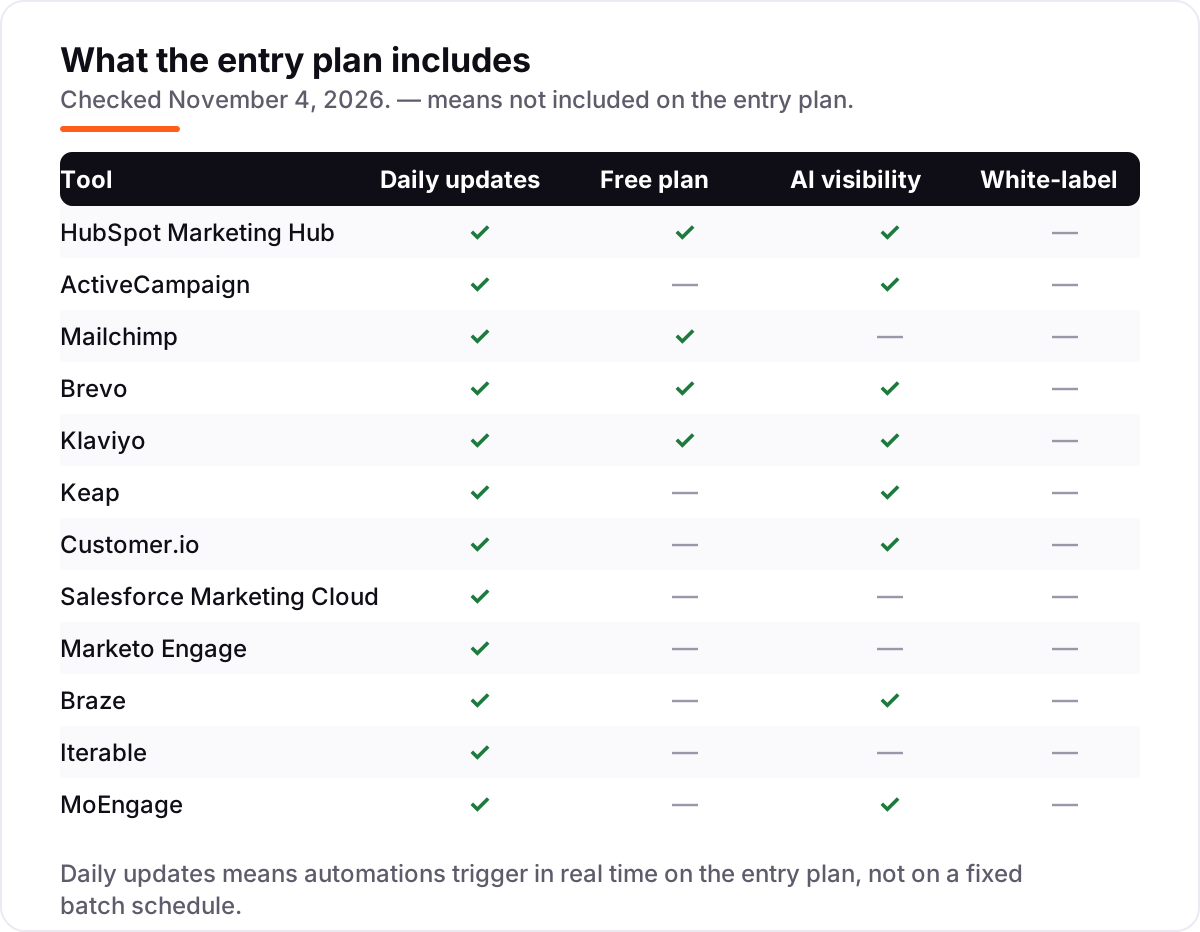
- Check where the AI actually lives. Some platforms include AI writing and segmentation on the entry plan; others keep predictive sending and AI optimization for higher tiers or paid add-ons.
- Count the channels you will really use. Email-only teams overpay for push, SMS and in-app; app-first brands need them from day one.
- Test the automation builder, not the feature list. A visual builder you can use beats a powerful one your team avoids — use the free plan or trial with a real journey.
- Price the exit as well as the entry. Annual contracts, implementation fees and contact-block overages are where cheap tools get expensive; Keap's required implementation and Salesforce's annual-only Growth edition are the clearest examples.
Before you build campaigns, plan how you will measure them — the free UTM builder tags every link so your automation reports show which journey actually drove the click.
AI-powered marketing automation platforms pricing: what you will actually pay
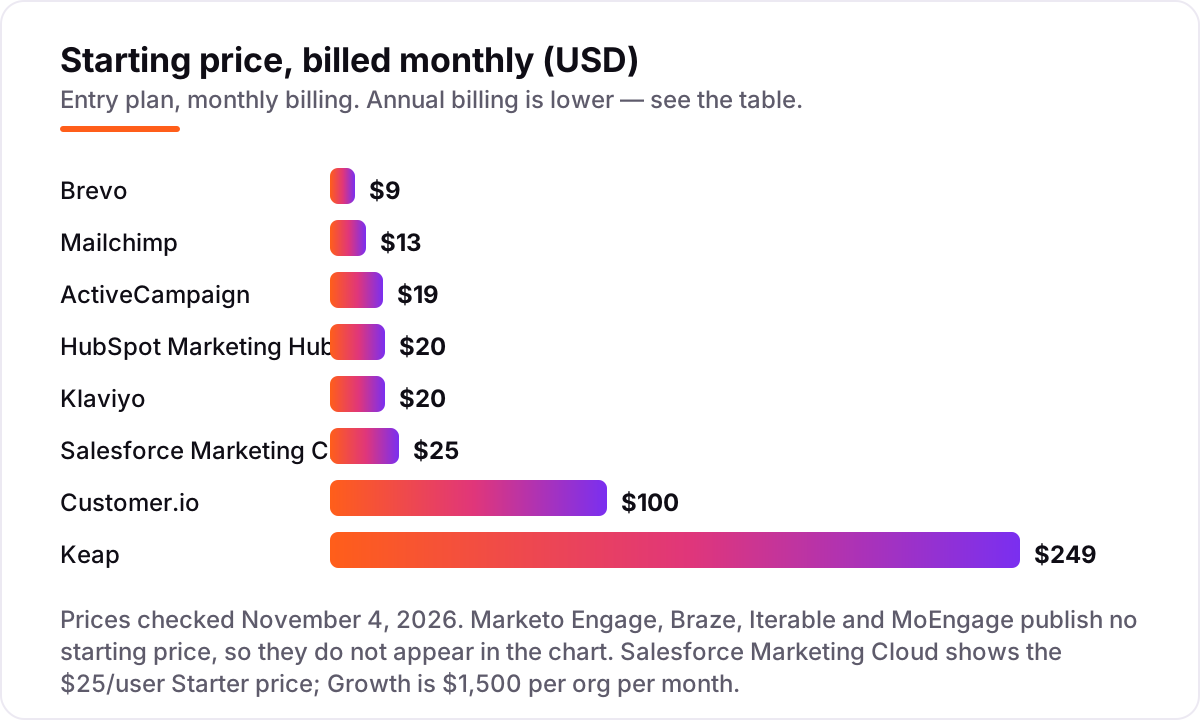
Take a team with 5,000 contacts sending a weekly newsletter plus a welcome series. On Brevo Starter the bill is $9 a month for 5,000 emails, or $17 a month at 10,000 emails. On Mailchimp, 5,000 contacts cost $75 a month on Essentials or $100 a month on Standard. On ActiveCampaign, 5,000 contacts push Starter to $79 a month. On Klaviyo, 5,000 profiles cost $100 a month. On Customer.io, 5,000 profiles are exactly the $100-a-month Essentials tier.
HubSpot charges per seat plus contact blocks at $50 a month per 1,000 marketing contacts, so a 5,000-contact list adds four blocks on top of the seat price. Keap includes 1,500 contacts in its single plan, and more contacts move up the published contact tiers. The four quote-only platforms cannot be priced this way at all — that is itself a cost, because budgeting needs a sales call first.
Know the difference: marketing automation, email marketing and CRM
Marketing automation is the umbrella: multi-step journeys triggered by behavior, across channels, with scoring and branching. Email marketing is one channel inside it — a newsletter tool with a welcome email is email marketing, not automation. A CRM is the database underneath: it stores the contact record and the deal, and the automation reads from it.
HubSpot and Keap bundle all three, which is why they feel complete and cost more; Mailchimp and Brevo started as email tools and added automation and a light CRM; Customer.io and Braze assume you already have a CRM or product database and focus on the messaging layer. Buy the layer you are missing, not a second copy of the one you own. If the tool is in place but the traffic is not, our AI search optimization service works on getting your site recommended by AI assistants — the same visibility problem from the other side.
Quick comparison: tool type by need
| Buyer | Best pick | Why |
|---|---|---|
| Solo business, tight budget | Brevo | $9/month, free plan, automation from Standard |
| Small business that wants real automation | ActiveCampaign | Deepest builder at $19/month |
| Online store | Klaviyo | Ecommerce flows and predictive analytics from $20/month |
| Team that wants CRM + marketing in one | HubSpot | One system, free tools to start |
| SaaS team, event-driven messaging | Customer.io | Product events trigger every channel at $100/month |
| Service business, whole business in one | Keap | CRM, pipeline, payments and automation for $249/month |
| Enterprise on Salesforce | Salesforce Marketing Cloud | Native journeys and Agentforce from $1,500/month per org |
| B2B account-based marketing | Marketo Engage | Lead scoring and account programs, custom quote |
| Enterprise cross-channel (Braze, Iterable, MoEngage) | Quote-only, pick by fit | Braze for mobile apps, Iterable for catalog personalization, MoEngage for AI-led lifecycle |
How we chose
We checked each vendor's own pricing page on November 4, 2026 and recorded the starting price exactly as shown, including the annual-billing figure where the page lists one. Ratings come from G2, opened the same day, with review counts shown. Four pricing pages — HubSpot, ActiveCampaign, Mailchimp and Klaviyo — were verified against search-indexed copies of the vendors' own pricing pages crawled within the previous two days, because the live pages did not load in our reader that morning; the figures match the vendors' published list prices. Keap's $249-a-month figure is the vendor's own starting price, shown on its pricing page and in its vendor-provided G2 pricing block; the page renders the number through a contact-count calculator, so we cross-checked it against three independent reads of the same page. Older Keap Lite, Pro and Max prices still circulate on comparison sites; they are outdated, and we did not use them. We ranked the tools by fit for the most common buyer — a small or mid-size team buying its first serious automation platform — not by brand size. No vendor paid for a place in this list, and none of the links here are affiliate links.
What to do next
Start with the billing unit, not the brand: work out what you will pay at twice your current list size, then take the free plan or trial of your top pick and build one real journey — a welcome series or an abandoned-cart flow — with your actual contacts. If the numbers match what the pricing page promised and the builder feels natural after a day, you have your tool. Once your tools are in place, find out what's holding your rankings back.
Your stack only works if people find you
SerpAstra fixes what keeps your site off page one and makes it easy for AI assistants to recommend.
Get a free audit→Sources we checked (24)
- HubSpot Marketing Hub pricing — hubspot.com/pricing/marketing (checked November 4, 2026)
- HubSpot Marketing Hub on G2 — 4.4/5, 16,050 reviews (checked November 4, 2026)
- ActiveCampaign pricing — activecampaign.com/pricing (checked November 4, 2026)
- ActiveCampaign on G2 — 4.4/5, 14,858 reviews (checked November 4, 2026)
- Mailchimp pricing — mailchimp.com/pricing (checked November 4, 2026)
- Mailchimp on G2 — 4.3/5, 12,998 reviews (checked November 4, 2026)
- Brevo pricing — brevo.com/pricing (checked November 4, 2026)
- Brevo on G2 — 4.5/5, 2,775 reviews (checked November 4, 2026)
- Klaviyo pricing — klaviyo.com/pricing (checked November 4, 2026)
- Klaviyo on G2 — 4.6/5, 1,371 reviews (checked November 4, 2026)
- Keap pricing — keap.com/pricing (checked November 4, 2026)
- Keap on G2 — 3.9/5, 33 reviews (checked November 4, 2026)
- Customer.io pricing — customer.io/pricing (checked November 4, 2026)
- Customer.io on G2 — 4.4/5, 1,004 reviews (checked November 4, 2026)
- Salesforce Marketing Cloud pricing — salesforce.com/marketing/pricing (checked November 4, 2026)
- Salesforce Marketing Cloud on G2 — 4.1/5, 4,852 reviews (checked November 4, 2026)
- Marketo Engage pricing — business.adobe.com/products/marketo/pricing (checked November 4, 2026)
- Marketo Engage on G2 — 4.1/5, 3,345 reviews (checked November 4, 2026)
- Braze pricing — braze.com/pricing (checked November 4, 2026)
- Braze on G2 — 4.5/5, 1,985 reviews (checked November 4, 2026)
- Iterable pricing — iterable.com/pricing (checked November 4, 2026)
- Iterable on G2 — 4.4/5, 842 reviews (checked November 4, 2026)
- MoEngage pricing — moengage.com/pricing (checked November 4, 2026)
- MoEngage on G2 — 4.5/5, 535 reviews (checked November 4, 2026)
Shamim
Founder of SerpAstra
A full-stack SEO and digital marketer who spends most days on Local SEO for dental practices, AI search visibility and lead generation.
Frequently asked questions
What is the best AI-powered marketing automation platform in 2026?
HubSpot Marketing Hub is the best all-round pick for most teams: CRM, email and automation in one system from $20 per seat a month. Small businesses that want deeper automation for less should look at ActiveCampaign from $19 a month, and online stores should start with Klaviyo from $20 a month.
How much does AI marketing automation cost?
From $9 a month for Brevo Starter to custom enterprise quotes in five figures a year. Most small teams pay $13 to $100 a month: Mailchimp from $13, ActiveCampaign from $19, Klaviyo from $20, Customer.io from $100. Enterprise platforms — Marketo, Braze, Iterable and MoEngage — publish no prices.
Is there a free AI marketing automation platform?
Yes, with limits. HubSpot, Mailchimp, Brevo and Klaviyo all have free plans, and Brevo's sends 300 emails a day. ActiveCampaign, Keap, Customer.io and Braze offer free trials instead. No enterprise platform in this list has a free plan; Marketo, Iterable and MoEngage are demo-only.
What is the difference between marketing automation and email marketing?
Email marketing sends campaigns to a list. Marketing automation runs multi-step journeys triggered by behavior — a signup, a purchase, a page visit — across email, SMS, push and in-app, with branching, scoring and timing. Every tool in this list does automation; Mailchimp and Brevo are the closest to pure email tools.
Which platform is best for ecommerce?
Klaviyo, built for Shopify and WooCommerce, with abandoned-cart and post-purchase flows, predictive analytics and an AI flow builder from $20 a month. Mailchimp is the simpler alternative for small stores, and Brevo is the cheapest. Large consumer brands with apps usually move to Braze or MoEngage.
Do I need the enterprise platforms?
Only at real scale. Marketo, Braze, Iterable and MoEngage are built for teams sending millions of messages across channels with dedicated staff. Below that, the self-serve tools do the same jobs for $9 to $249 a month. If a vendor will not publish a price, treat the sales process itself as part of the cost.
Free SEO and AI visibility audit
Find out what is holding your rankings back
Send us your site. Within 2 business days you get a written audit, an AI visibility check and a short fix list ranked by impact. Free, with no contract attached.
Request my free audit→Related guides
 Digital Marketing & Ads10 Best AI Marketing Automation Tools in 2026, Compared10 best AI marketing automation tools compared on price, AI features and free plans — real starting prices checked November 4, 2026, sorted by use case.Read guide →
 Digital Marketing & Ads9 Best Marketing Automation Platforms for Startups in 2026, ComparedThe 9 best marketing automation platform for startups options in 2026, compared on price, free plans and automation depth, with prices checked November 4, 2026.Read guide →
 Digital Marketing & Ads11 Best B2C CRM and Marketing Automation Platforms in 2026, Compared11 best b2c crm and marketing automation platforms compared on price, free plans and automation depth, with every price checked November 4, 2026.Read guide →