
11 Best B2C CRM and Marketing Automation Platforms in 2026, Compared
11 best b2c crm and marketing automation platforms compared on price, free plans and automation depth, with every price checked November 4, 2026.
 Shamim Mia, Founder, SerpAstraLast verified November 4, 202614 min read
We compare pricing pages, documentation and public reviews. We never accept payment for rankings.

Key takeaways
- Klaviyo is the best fit for most online stores from $20/month, HubSpot is the best all-in-one from $20/seat/month, and Brevo is the cheapest paid start at $9/month.
- The single most important buying factor is the meter: contacts, active profiles, email sends or seats decide what you actually pay, not the headline price.
- Free plans are real but capped: Brevo stores 100,000 contacts free, Klaviyo and Omnisend cover 250 contacts free, and Mailchimp's free plan now covers only 250 contacts.
- Every price below was checked on the vendor's own pricing page on November 4, 2026. No ratings are shown because the G2 review pages could not be opened that day.
On this page
Quick comparison
| Tool | Best for | Starting price | Free plan |
|---|---|---|---|
| Klaviyo | Online stores on Shopify or WooCommerce that want email and SMS revenue tied to every flow | $20/mo | Yes (250 profiles) |
| HubSpot | Small B2C teams that want the CRM, email and automation in one login instead of three tools | $20/mo per seat | Yes (free CRM) |
| ActiveCampaign | Small businesses that want the deepest automation builder without enterprise prices | $19/mo | No (14-day trial) |
| Brevo | Businesses with large lists that mail a few times a month and want the bill to follow sends, not contacts | $9/mo | Yes (300/day) |
| Omnisend | Shopify and WooCommerce stores that want ecommerce automation cheaper than Klaviyo | $16/mo | Yes (250 contacts) |
| Mailchimp | Small businesses that want a familiar all-in-one suite with a website builder and landing pages | $13/mo | Yes (250 contacts) |
| Drip | Ecommerce brands that want every feature unlocked on one simple plan priced by list size | $39/mo | No (14-day trial) |
| GetResponse | Small teams that want solid email automation plus landing pages and webinars on one bill | $19/mo | Yes (500 contacts) |
| Zoho CRM | Cost-conscious teams that want a real sales CRM first and marketing automation second | $20/mo per user | Yes (up to 3 users) |
| Constant Contact | Nonprofits, clubs and event-driven businesses that want phone support on every plan | $12/mo | No (free trial) |
| Salesforce | Growing B2C teams that expect to scale into enterprise sales, service and marketing on one platform | $25/mo per user | No (30-day trial) |
Make one of these tools?
We re-check this list every quarter. Send a correction, request a review, or ask about a clearly labeled sponsored spot.
Request a listingThe best b2c crm and marketing automation platforms

Klaviyo
Best for: Online stores on Shopify or WooCommerce that want email and SMS revenue tied to every flow
Klaviyo is the default B2C CRM for online stores because it is built around what customers buy, browse and abandon. The Email plan starts at $20 a month for 251 to 500 active profiles, and the price rises with the profile count: $30 at 1,000 profiles, $60 at 2,500 and $150 at 10,000. Every paid tier includes the same features, including 60-plus prebuilt flows, predictive analytics and revenue attribution per flow.
The catch is the meter. Klaviyo bills on active profiles, so a list full of people who never open anything still costs money, and SMS, reviews and WhatsApp are metered separately on top of email. The free plan covers 250 profiles and 500 sends a month. Pick Klaviyo when the store runs on Shopify or WooCommerce and email revenue is the number to grow.
What we like
- Predictive analytics, lifetime value and churn scoring feed segmentation on the paid Email plan
- More than 60 prebuilt flows, with revenue attribution reported per flow
- Deep Shopify and WooCommerce integrations pull orders, browsing and purchase data into segments automatically
- Free plan covers 250 active profiles with 500 email sends a month
Watch out for
- Bills on active profiles, so unengaged contacts still cost money until the list is cleaned
- SMS, reviews and WhatsApp are metered separately, so the email price is not the whole bill
- No annual discount — the monthly rate is the same whether you pay monthly or annually
HubSpot
Best for: Small B2C teams that want the CRM, email and automation in one login instead of three tools
HubSpot is the all-in-one pick: the free Smart CRM holds up to 1 million contacts, and Marketing Hub Starter adds email automation, landing pages, live chat and ad management for $20 a month per seat. Starter includes 1,000 marketing contacts and removes HubSpot branding, and new customers can get a promotional $7 a seat a month annual rate. Because the CRM, email and automation share one contact record, a purchase, a form fill and a support ticket all update the same profile.
The pricing cliff is the honest warning. Extra marketing contacts cost about $50 a month per 1,000, and the next tier, Professional, costs $890 a month plus a $3,000 onboarding fee, with no middle step. Starter also caps automations at 10 actions. Pick HubSpot when one login for CRM and marketing matters more than the cheapest email price.
What we like
- Free Smart CRM holds up to 1 million contacts, so the customer record never lives in a spreadsheet
- Starter removes HubSpot branding and adds landing pages, live chat and ad management
- Email automation, forms, lists and reporting share one contact record with Sales Hub
- New customers can get a promotional $7/seat/month annual rate on Starter
Watch out for
- Starter includes only 1,000 marketing contacts, and extra blocks cost about $50/month per 1,000
- Professional jumps to $890/month plus a $3,000 onboarding fee, with no middle tier
- Starter caps automations at 10 actions, so complex journeys need Professional

ActiveCampaign
Best for: Small businesses that want the deepest automation builder without enterprise prices
ActiveCampaign is the automation pick at small-business prices. The visual builder handles multi-step, conditional, cross-channel journeys, and the 900-plus recipe library means most automations start from a template instead of a blank canvas. Starter costs $15 a month billed annually for 1,000 contacts and includes email marketing, marketing automation and a standard CRM with deals and a pipeline. Predictive sending arrives on Plus at $49 a month.
Two limits decide whether Starter is enough. Each automation is capped at 5 actions, so a serious welcome series or win-back flow needs Plus, and the price climbs fast with contacts: Starter costs $149 a month at 10,000 contacts billed annually. There is no free plan, only a 14-day trial. Pick ActiveCampaign when automation depth is the job and the list is still small.
What we like
- Visual builder handles multi-step, conditional, cross-channel automations that rival tools several times the price
- More than 900 automation recipes, so most journeys start from a template instead of a blank canvas
- Built-in CRM with deals and a sales pipeline, plus predictive sending from Plus
- Starter includes email marketing, marketing automation and a standard CRM for $15/month billed annually
Watch out for
- Starter caps each automation at 5 actions, so most teams need Plus at $49/month
- No free plan — only a 14-day trial — so this is a paid commitment from day one
- The bill rises steeply with contacts: Starter is $149/month at 10,000 contacts billed annually
Brevo
Best for: Businesses with large lists that mail a few times a month and want the bill to follow sends, not contacts
Brevo is the budget pick because it bills on emails sent, not contacts stored. Starter costs $9 a month for 5,000 emails, and the free plan stores up to 100,000 contacts with 300 emails a day and no time limit — a combination no contact-priced rival matches. One account covers email, SMS, WhatsApp, chat and a sales CRM, and Starter already includes the AI content generator and advanced segmentation.
The trade-offs are clear. Starter keeps the Brevo logo in email footers unless you pay extra to remove it, and real marketing automation, A/B testing and landing pages wait for Standard at $18 a month. Starter also covers one user only. Pick Brevo when the list is large, the sending is light, and the bill should follow volume.
What we like
- Cheapest paid entry here: Starter is $9/month for 5,000 emails, with unlimited contact storage
- Free plan stores up to 100,000 contacts with 300 emails a day and no time limit
- One bill covers email, SMS, WhatsApp, chat and a sales CRM from the same account
- AI content generator and advanced segmentation are included on Starter
Watch out for
- Starter keeps the Brevo logo in email footers unless you pay extra for removal
- Marketing automation, A/B testing and landing pages wait for Standard at $18/month
- Starter covers one user only, and extra seats cost $12/month each

Omnisend
Best for: Shopify and WooCommerce stores that want ecommerce automation cheaper than Klaviyo
Omnisend is the pragmatic Klaviyo alternative for stores. Standard costs $16 a month for 500 contacts with 6,000 emails, and the automation is built for ecommerce from the start: abandoned cart, browse abandonment and post-purchase flows, plus unlimited web push notifications. The free plan covers 250 contacts with full automation and 24/7 live chat support, even before paying anything.
The 2026 SMS change is the wrinkle. New customers need the Pro plan at $59 a month plus a separate SMS credits subscription to text at all, which narrows the price gap with Klaviyo for SMS-heavy stores. Standard also caps sends at 12 times the contact count. Pick Omnisend when email drives the store and SMS is a later question.
What we like
- Ecommerce-native automation: abandoned cart, browse abandonment and post-purchase flows built for stores
- Free plan includes full automation for 250 contacts, with 24/7 live chat support even unpaid
- Standard covers 500 contacts with 6,000 emails a month, plus unlimited web push notifications
- Price grows slower than Klaviyo as the list grows, at the same contact counts
Watch out for
- New customers cannot buy SMS on Standard — SMS needs Pro at $59/month plus a separate credits subscription
- Standard caps sends at 12 times the contact count, so heavy senders hit the ceiling
- The $11.20/month starter discount lasts only three months, then the price rises to $16

Mailchimp
Best for: Small businesses that want a familiar all-in-one suite with a website builder and landing pages
Mailchimp is still the default recommendation for a small business that wants everything connected. Essentials costs $13 a month for 500 contacts with 5,000 sends, scheduling, A/B testing and basic automation, and the template library and 300-plus integrations cover the basics well. The same account holds the landing page builder, signup forms and a marketing CRM, and Standard at $20 a month adds multi-step automation and predictive segmentation.
The 2026 reality check is the free plan: it now covers only 250 contacts and 500 sends a month, and Essentials caps automation at 4 flow steps. Mailchimp also bills for every contact in the audience, including unsubscribed ones, so a dirty list costs real money. At 5,000 contacts Essentials runs about $75 a month. Pick Mailchimp for familiarity and integrations, not for the cheapest scaling.
What we like
- The most widely integrated tool here, with 300-plus integrations and a huge template library
- Essentials starts at $13/month for 500 contacts with scheduling, A/B testing and basic automation
- Landing page builder, signup forms and a marketing CRM in the same account
- Standard at $20/month adds multi-step automation, predictive segmentation and dynamic content
Watch out for
- Free plan shrank in 2026 to 250 contacts and 500 sends a month
- Essentials caps automation at 4 flow steps — multi-step journeys need Standard at $20/month
- Bills for every contact in the audience, including unsubscribed and non-subscribed contacts

Drip
Best for: Ecommerce brands that want every feature unlocked on one simple plan priced by list size
Drip is an ecommerce CRM disguised as email software. There is one plan, priced only by list size: $39 a month for up to 2,500 active people, with unlimited email sends, dynamic segments, onsite popups and API access all included. The visual workflow builder designs sequences around what subscribers do — browse, abandon, buy, repeat — and Drip bills on Active People only, so contacts who cannot receive marketing do not count toward the price.
The honest catch is the floor. There is no free plan and no cheap entry point: a 300-person list pays the same $39 as a 2,500-person list, and the trial lasts 14 days. Workflows are capped at 50 on the entry band. Pick Drip when the list is already mid-size and one flat plan with everything included beats a cheaper teaser tier.
What we like
- One plan with every feature included: unlimited sends, dynamic segments, onsite popups and API access
- Visual workflow builder designs sequences around what subscribers do — browse, abandon, buy, repeat
- Bills on Active People only, so contacts who cannot receive marketing do not count
- At 2,500 contacts it costs $39/month against $60 for Klaviyo Email at the same size
Watch out for
- No free plan at all — only a 14-day trial — and no cheap entry point for a small list
- The $39 entry covers up to 2,500 people, so a 300-person list pays the same as a 2,500-person list
- Workflows are capped at 50 on the entry band, and the largest bands cap email sends

GetResponse
Best for: Small teams that want solid email automation plus landing pages and webinars on one bill
GetResponse is the steady all-rounder in this list. The Email Marketing plan costs $19 a month for 1,000 contacts and includes autoresponders, list segmentation, a visual automation builder and landing pages, with a free account covering 500 contacts. Built-in webinar hosting on the higher tiers is unusual at this price, and it means a team that runs live demos or classes can keep webinars on the same bill as email.
The limits are about depth, not breadth. Automation is lighter than ActiveCampaign, so complex conditional journeys need workarounds, and webinars and advanced automation wait for higher tiers. The free account also caps at 500 contacts. Pick GetResponse when one bill for email, landing pages and webinars matters more than the deepest automation builder.
What we like
- Email Marketing plan starts at $19/month for 1,000 contacts with automation and landing pages
- Built-in webinar hosting on higher tiers, unusual in this price range
- Autoresponders, list segmentation and a visual automation builder on the entry plan
- Free account covers 500 contacts with newsletters and a landing page
Watch out for
- Automation depth is lighter than ActiveCampaign — complex conditional journeys need workarounds
- Webinars and advanced automation sit on higher tiers, not the $19 entry plan
- The free account caps at 500 contacts, so growing lists move to paid quickly

Zoho CRM
Best for: Cost-conscious teams that want a real sales CRM first and marketing automation second
Zoho CRM is the value play for teams that sell first and market second. The free edition covers up to 3 users with 5,000 records, and Standard costs $14 a user a month billed annually ($20 month to month). Standard adds email integration, mass email, built-in calling, up to 5 pipelines and sales forecasting, with 100,000 records of storage. Inside the wider Zoho suite, Campaigns, Desk and Books all share the same customer record.
The catch is that marketing automation is a separate product. Zoho Campaigns is not bundled in the CRM price, and Standard's workflow rules are basic — deeper automation needs Professional at $23 a user a month. Setup also takes longer than the email-first tools here. Pick Zoho CRM when the sales pipeline is the system of record and email is the second purchase.
What we like
- Cheapest full sales CRM here: Standard is $14/user/month billed annually
- Free edition is genuinely usable for up to 3 users with 5,000 records
- Standard adds email integration, mass email, built-in calling, 5 pipelines and sales forecasting
- Sits inside the wider Zoho suite, so Campaigns, Desk and Books share the same customer record
Watch out for
- Standard has only basic workflow rules (15 per module) — deeper automation needs Professional at $23/user/month
- Marketing automation is a separate product (Zoho Campaigns), not bundled in the CRM price
- Setup and customization take longer than the email-first tools in this list

Constant Contact
Best for: Nonprofits, clubs and event-driven businesses that want phone support on every plan
Constant Contact serves the organizations the email-first tools forget: nonprofits, churches, clubs and event businesses. Lite costs $12 a month for 500 contacts with 5,000 sends, and phone support comes with every plan, including Lite — no other tool here offers that. Event management and registrations are built in, and nonprofits get up to 30% off prepaid annual plans.
The limits are real. There is no free plan, only a trial, and Lite is a single user with basic single-step automation only — no segmentation, no A/B testing, both of which start on Standard at $35 a month. The price also jumps hard: Lite costs $30 a month the moment you pass 500 contacts. Pick Constant Contact when events and phone support matter more than automation depth.
What we like
- Phone support on every plan, including the $12 Lite tier — no other tool here offers that
- Event management and registrations are built in, which suits nonprofits and clubs
- Lite starts at $12/month for 500 contacts with 10x contact-count sends
- Nonprofits get up to 30% off prepaid annual plans
Watch out for
- No free plan, only a free trial, and Lite is a single user with basic single-step automation only
- The price jumps hard with list size: Lite is $30/month the moment you pass 500 contacts
- No segmentation or A/B testing on Lite — both start on Standard at $35/month

Salesforce
Best for: Growing B2C teams that expect to scale into enterprise sales, service and marketing on one platform
Salesforce is the scale pick. Sales Cloud Starter Suite costs $25 a user a month — the only edition available month to month — and covers lead, account, contact and opportunity management with guided setup and automatic email, event and contact sync. It is the cheapest way onto the deepest CRM platform here, with AppExchange, reporting, forecasting and AI add-ons waiting when the team outgrows Starter.
The honest cost is everything around the licence. Real automation and customization need Pro Suite at $100 a user a month, Marketing Cloud is a separate sales-quoted product, and most deployments beyond Starter need a partner, with implementations typically costing $10,000 or more. Pick Salesforce when the business will scale into enterprise CRM — not when it needs marketing automation this month.
What we like
- Starter Suite is $25/user/month and the only edition available month to month
- The deepest CRM ecosystem here: AppExchange, reports, forecasting and AI add-ons when you outgrow Starter
- One platform can grow from a 2-person team into enterprise sales, service and commerce
- Guided setup and automatic email, event and contact sync on Starter Suite
Watch out for
- Starter is a small slice of Salesforce — real automation and customization need Pro Suite at $100/user/month
- No marketing automation in Starter Suite; Marketing Cloud is a separate, sales-quoted product
- Most deployments beyond Starter need a partner, and implementations typically cost $10,000-plus
The best b2c crm and marketing automation platforms do two jobs in one login: they remember every customer, and they act on that memory without a human pressing send. We compared 11 tools — from ecommerce-native email platforms to full sales CRMs — and ranked them by fit for the most common buyer, a small B2C business that sells online and wants repeat purchases, not just first orders. Every price below was checked on the vendor's own pricing page on November 4, 2026.
If you are setting up the store side first, our guide to marketing automation for small business covers the wider stack, and the free SERP snippet preview tool shows how each campaign landing page will look in Google before you publish it.
How to choose the best b2c crm and marketing automation platforms
- Start with the meter. Klaviyo and Omnisend charge by contacts, Brevo by emails sent, HubSpot by seats plus marketing contacts, and Zoho and Salesforce by users. The meter decides the bill, not the headline price.
- Decide CRM-first or automation-first. Zoho CRM and Salesforce store the sales record first; Klaviyo, Drip and Omnisend automate first and keep CRM features built in. Buy the side you will live in daily.
- Check the automation on the entry plan. ActiveCampaign Starter caps each automation at 5 actions, Mailchimp Essentials at 4 flow steps, and Constant Contact Lite at single-step automation. Multi-step journeys often need the next tier.
- Price the channels separately. SMS, WhatsApp and reviews are metered add-ons on Klaviyo, Brevo and Omnisend, not part of the email price. A store that texts needs the SMS line in the budget.
- Price the list you will have in a year, not today. A 500-contact list costs $12–$20 a month on most tools here; the same list at 10,000 contacts costs $75–$150. Model the growth before committing.
Good marketing tools only help if people find you. If the site also needs more qualified traffic, our AI search optimization service covers the visibility side, and our guide to email marketing for local business covers the campaign basics.
B2C CRM and marketing automation pricing: what you will actually pay
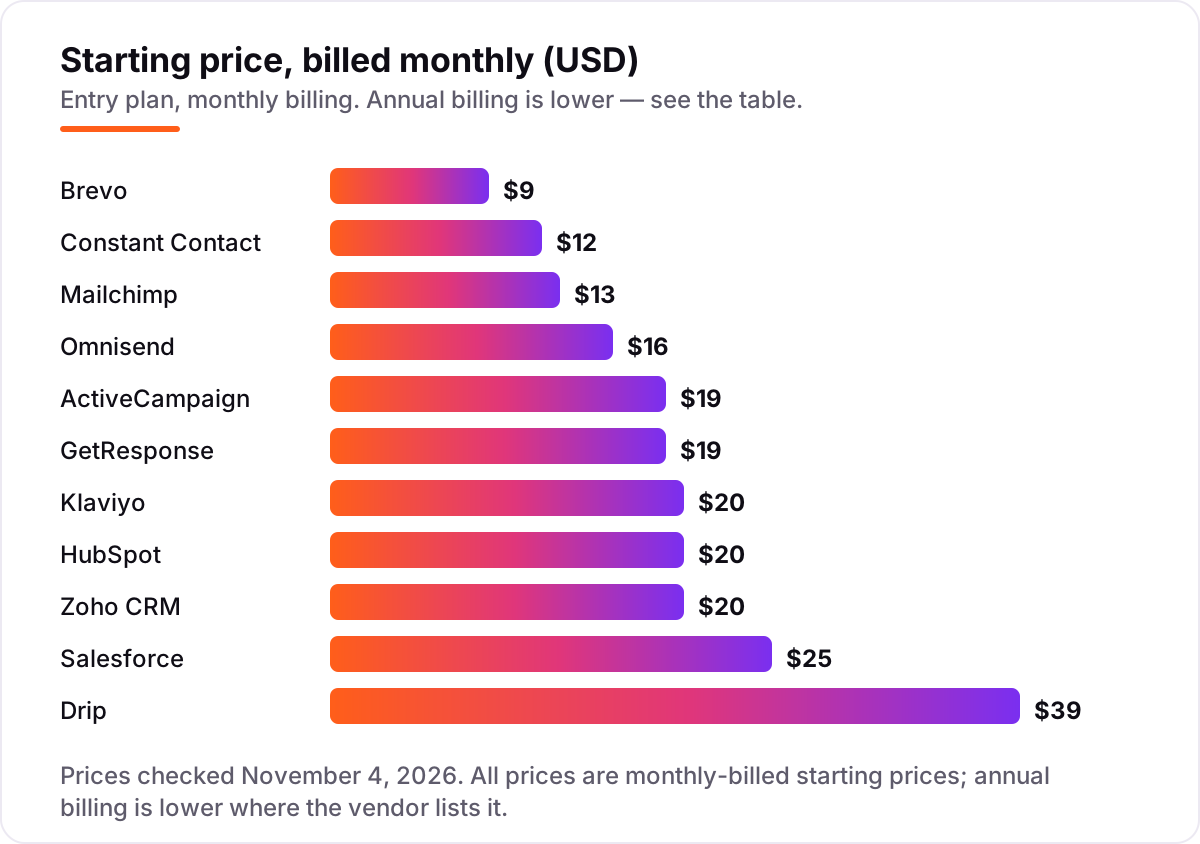
Take a small online store with 5,000 contacts, one user, and email as the main channel. On Brevo Starter, 20,000 emails a month costs $32, and the bill follows sends, not contacts. On Klaviyo Email, 5,000 active profiles costs $100 a month. On ActiveCampaign Starter billed annually, 5,000 contacts costs $79 a month. On Mailchimp Essentials, 5,000 contacts costs $75 a month. On Drip, the same 5,000 people costs $89 a month with unlimited sends. On HubSpot Starter, one seat costs $20 a month — but the 1,000 included marketing contacts are already passed, so contact blocks add about $200 a month on top.
Three costs sit outside those numbers. First, SMS: Klaviyo, Brevo and Omnisend all meter it separately, and Omnisend needs Pro at $59 a month before new customers can buy SMS at all. Second, the next tier: ActiveCampaign's 5-action automation cap, Mailchimp's 4-step flow cap and Constant Contact's single-step automation all push growing teams to $35–$49 a month plans. Third, the per-seat tools: Zoho Standard costs $14 a user a month billed annually, so a 5-person team pays $70 a month, and Salesforce Starter costs $25 a user a month, or $125 for the same team — before any implementation help.
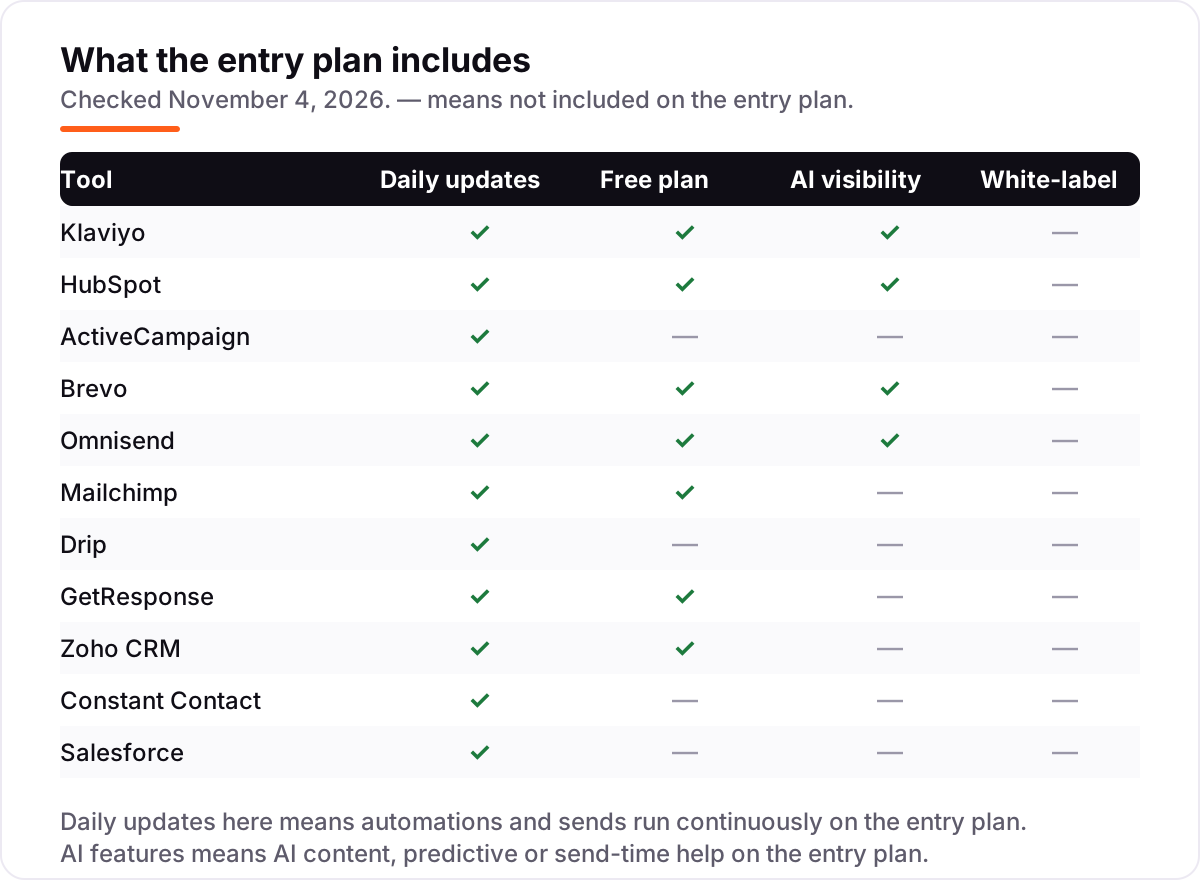
Annual billing cuts the bill where it exists: Brevo Starter drops from $9 to $8.08 a month, Constant Contact Lite from $12 to $10.20, ActiveCampaign Starter from $19 to $15, and Zoho Standard from $20 to $14 a user. Klaviyo has no annual discount at all. The free plans are real but capped: Brevo stores 100,000 contacts free, HubSpot's free CRM holds 1 million contacts, and Klaviyo, Omnisend and Mailchimp all cover 250 contacts free. A business that outgrows a free plan should price the first paid plan before building its process around the free one.
Know the difference: CRM vs marketing automation
The confusion in this category is between remembering and acting. A CRM remembers: who the customer is, what they bought, when they last ordered, and where they sit in the sales pipeline. Marketing automation acts: it sends the welcome series, the abandoned cart flow, the post-purchase follow-up and the win-back campaign, triggered by what the CRM recorded. One without the other is either a filing cabinet or a megaphone.
The tools in this list split along that line. Zoho CRM and Salesforce are CRM-first: the sales record is the product, and marketing automation is a second purchase — Zoho Campaigns for Zoho, Marketing Cloud for Salesforce. Klaviyo, Drip and Omnisend are automation-first: the flows are the product, and the CRM features are built in around them. HubSpot, ActiveCampaign, Brevo, Mailchimp, GetResponse and Constant Contact sit in the middle, with both sides in one login at different depths.
That split decides the buy. If the team sells by phone, in person or through a pipeline, buy CRM-first and add automation second. If the store sells online and repeat purchases are the goal, buy automation-first and let the flows do the remembering. Buying the wrong side means paying for the half you never open.
Quick comparison: tool type by need
| Buyer | Best pick | Why |
|---|---|---|
| Online store, email revenue is the goal | Klaviyo | Store data, predictive analytics and revenue per flow from $20/month |
| Small team, one login for CRM and marketing | HubSpot | Free CRM for 1M contacts, Starter from $20/seat/month |
| Deepest automation on a small budget | ActiveCampaign | Visual builder and 900-plus recipes from $15/month billed annually |
| Large list, light sending, tight budget | Brevo | Send-based pricing, 100,000 contacts free, Starter $9/month |
| Shopify store that wants Klaviyo cheaper | Omnisend | Ecommerce flows and a real free plan from $16/month |
| Small business that wants the familiar suite | Mailchimp | 300-plus integrations and templates from $13/month |
| Ecommerce brand that wants one flat plan | Drip | Every feature included for $39/month up to 2,500 people |
| Team that wants a real sales CRM first | Zoho CRM | Full CRM from $14/user/month billed annually |
| Nonprofit or event-driven business | Constant Contact | Phone support on every plan, events built in, from $12/month |
| Growing team that will scale to enterprise | Salesforce | Deepest platform, Starter Suite $25/user/month |
Mistakes to avoid
- Comparing headline prices without checking the meter. Brevo charges by sends, Klaviyo by active profiles, HubSpot by seats plus contacts, Zoho by users. The same 5,000 contacts costs $32 on Brevo, $100 on Klaviyo and $75 on Mailchimp.
- Buying the teaser tier for automation. ActiveCampaign Starter caps automations at 5 actions, Mailchimp Essentials at 4 flow steps, Constant Contact Lite at one step. Check which plan the automation you need actually sits on.
- Forgetting SMS is a separate bill. Klaviyo, Brevo and Omnisend all meter SMS apart from email, and Omnisend needs Pro before new customers can text at all.
- Trusting the free plan to last. Mailchimp's free plan now covers only 250 contacts, and GetResponse's free account caps at 500. Price the first paid plan before the list outgrows the free tier.
- Paying for a CRM when you need flows, or the reverse. Zoho CRM and Salesforce are pipeline tools first; Klaviyo and Drip are flow tools first. Buy the side the team opens every day.
How we chose
We checked each vendor's own pricing page on November 4, 2026 and recorded the starting price exactly as shown, including the annual-billing figure where the page lists one. Five pricing pages — HubSpot, Klaviyo, ActiveCampaign, Mailchimp and Brevo — were read directly that day; the other six figures were corroborated the same day against multiple independent reads of the same vendor pages from October 2026, after the text fetcher failed on those pages. This list carries no review ratings because the G2 review pages could not be opened on November 4, 2026, and we would rather show no rating than a stale or estimated one. Keap was considered and dropped: published entry prices conflicted across sources ($40, $79 and $249 a month for the same tier), so no figure could be stated with confidence. We ranked the tools by fit for the most common buyer — a small B2C business selling online — not by brand size. No vendor paid for a place in this list, and none of the links here are affiliate links.
What to do next
Start with the free plan or trial of your top pick and run one real flow end to end: build the welcome series, send it to new subscribers, and check the revenue it attributes before the trial ends. Check that the meter — contacts, profiles, sends or seats — fits the list you will have in a year, not the list you have today. If the flows are running but new customers are not finding you, our monthly SEO service handles the visibility side — or compare options in our guide to marketing platforms for small business SEO. Once your tools are in place, find out what's holding your rankings back.
Your stack only works if people find you
SerpAstra fixes what keeps your site off page one and makes it easy for AI assistants to recommend.
Get a free audit→Sources we checked (11)
- Klaviyo pricing — klaviyo.com/pricing (checked November 4, 2026)
- HubSpot Marketing Hub pricing — hubspot.com/pricing/marketing (checked November 4, 2026)
- ActiveCampaign pricing — activecampaign.com/pricing (checked November 4, 2026)
- Brevo pricing — brevo.com/pricing (checked November 4, 2026)
- Omnisend pricing — omnisend.com/pricing (checked November 4, 2026)
- Mailchimp pricing — mailchimp.com/pricing/marketing (checked November 4, 2026)
- Drip pricing — drip.com/pricing (checked November 4, 2026)
- GetResponse pricing — getresponse.com/pricing (checked November 4, 2026)
- Zoho CRM pricing — zoho.com/crm/zohocrm-pricing.html (checked November 4, 2026)
- Constant Contact pricing — constantcontact.com/pricing (checked November 4, 2026)
- Salesforce Sales Cloud pricing — salesforce.com/sales/pricing (checked November 4, 2026)
Shamim
Founder of SerpAstra
A full-stack SEO and digital marketer who spends most days on Local SEO for dental practices, AI search visibility and lead generation.
Frequently asked questions
What is the best B2C CRM and marketing automation platform?
Klaviyo is the best fit for most online stores: store data, predictive analytics and revenue per flow from $20 a month. HubSpot is the best all-in-one for teams that want CRM and marketing in one login. Brevo is the cheapest start at $9 a month, and ActiveCampaign has the deepest automation builder at small-business prices.
How much does a B2C CRM and marketing automation platform cost?
Entry prices run from $9 to $39 a month: Brevo Starter is $9, Constant Contact Lite $12, Mailchimp Essentials $13, Omnisend Standard $16, ActiveCampaign Starter $15 billed annually, Klaviyo Email $20, HubSpot Starter $20 a seat, Zoho Standard $14 billed annually, and Drip $39. The meter behind the price decides the real bill.
Is there a free B2C CRM and marketing automation platform?
Yes, with limits. HubSpot's free CRM holds 1 million contacts, Brevo's free plan stores 100,000 contacts with 300 emails a day, and Klaviyo, Omnisend and Mailchimp all have free plans for 250 contacts. ActiveCampaign, Drip, Constant Contact and Salesforce have no free plan, only a free trial.
What is the difference between a CRM and marketing automation?
A CRM stores the customer record: who they are, what they bought, and where they sit in the sales pipeline. Marketing automation acts on that record: it sends the welcome series, the abandoned cart flow and the win-back campaign. Zoho CRM and Salesforce are CRM-first; Klaviyo, Drip and Omnisend are automation-first with CRM features built in.
Do I need Klaviyo or HubSpot for a small online store?
Klaviyo if the store is the business: its flows, predictive analytics and revenue attribution are built for ecommerce, and it starts at $20 a month. HubSpot if the business also sells by phone or in person: its free CRM and shared contact record cover sales and service too. A store under 250 contacts can start free on either platform's free plan.
Can I switch B2C CRM platforms later?
Yes, but plan the move between campaigns, not mid-flow. Export contacts with their tags, segments and consent status, recreate the running automations in the new tool, and re-check tracking on every page and checkout. Expect a week of parallel running: send from the old tool while the new one warms up, then cut over once deliverability holds.
What should I check before paying for a B2C CRM?
Four things: what the price meters — contacts, active profiles, sends or seats — and what it costs at the list size you will have in a year; whether automation is multi-step on the entry plan; whether SMS and other channels are included or metered separately; and whether the free plan or trial covers your real list before you commit.
Free SEO and AI visibility audit
Find out what is holding your rankings back
Send us your site. Within 2 business days you get a written audit, an AI visibility check and a short fix list ranked by impact. Free, with no contract attached.
Request my free audit→Related guides
 MarketingMarketing automation for small businesses: what to automate (and what not to)Marketing automation for small businesses, explained: what to automate first, what to keep human, and the tools that save hours without losing customers.Read guide →
 MarketingEmail marketing for local businesses (that customers actually open)Email marketing for local businesses: build a list the right way, send emails customers open, and turn past customers into repeat bookings without spam.Read guide →
 SEO & AI Search12 Best Marketing Platforms for Small Business SEO in 2026, ComparedThe 12 best marketing platforms for small business SEO, compared on real prices, SEO tools and AI visibility. Every price checked November 1, 2026.Read guide →