8 Best Apps to Learn German in 2026, Compared
Compare the 8 best apps to learn German on cases and grammar, speaking practice, free plans and yearly cost, from Babbel and Duolingo to Busuu and Pimsleur.
 Shamim Mia, Founder, SerpAstraLast verified November 4, 20268 min read
We compare pricing pages, documentation and public reviews. We never accept payment for rankings.
Key takeaways
- Babbel is the best app for German grammar, because its short lessons explain cases, word order and articles; 12 months cost $107.40, or $17.95 month to month.
- Duolingo is the best free start, with its whole German course on the free plan; Super costs $12.99 a month or $83.99 a year.
- Busuu is the pick for learners heading towards a work or study move, with native-speaker corrections and CEFR certificates for $72.99 a year.
- German cases need explanation and lots of practice, so pair a grammar-led app with a speaking or input tool such as Pimsleur or LingQ.
On this page
Quick comparison
| Tool | Best for | Starting price | Free plan |
|---|---|---|---|
 Babbel | Adults who want German cases, articles and word order explained step by step | $17.95/mo | No (first lesson free) |
 Duolingo | Beginners who want to try German free and build a daily habit | $12.99/mo | Yes (free plan) |
 Busuu | Learners preparing for work or study in Germany who want corrections and certificates | $12.49/mo | Yes (free plan) |
 Pimsleur | Commuters who want to understand and speak German before reading it | $14.95/mo | No (7-day trial) |
 Rosetta Stone | Visual learners who want German immersion without English translations | $19.99/mo | No (7-day trial) |
 LingQ | Intermediate learners who want to read and listen to real German content | $14.99/mo | Yes (free plan) |
 Memrise | Learners who want everyday spoken German from native-speaker clips and AI chat | $24.99/mo | Yes (free plan) |
 Drops | Busy learners who want five minutes of illustrated German vocabulary a day | $12.99/mo | Yes (free plan) |
Make one of these tools?
We re-check this list every quarter. Send a correction, request a review, or ask about a clearly labeled sponsored spot.
Request a listingThe best apps to learn German
Babbel
Best for: Adults who want German cases, articles and word order explained step by step
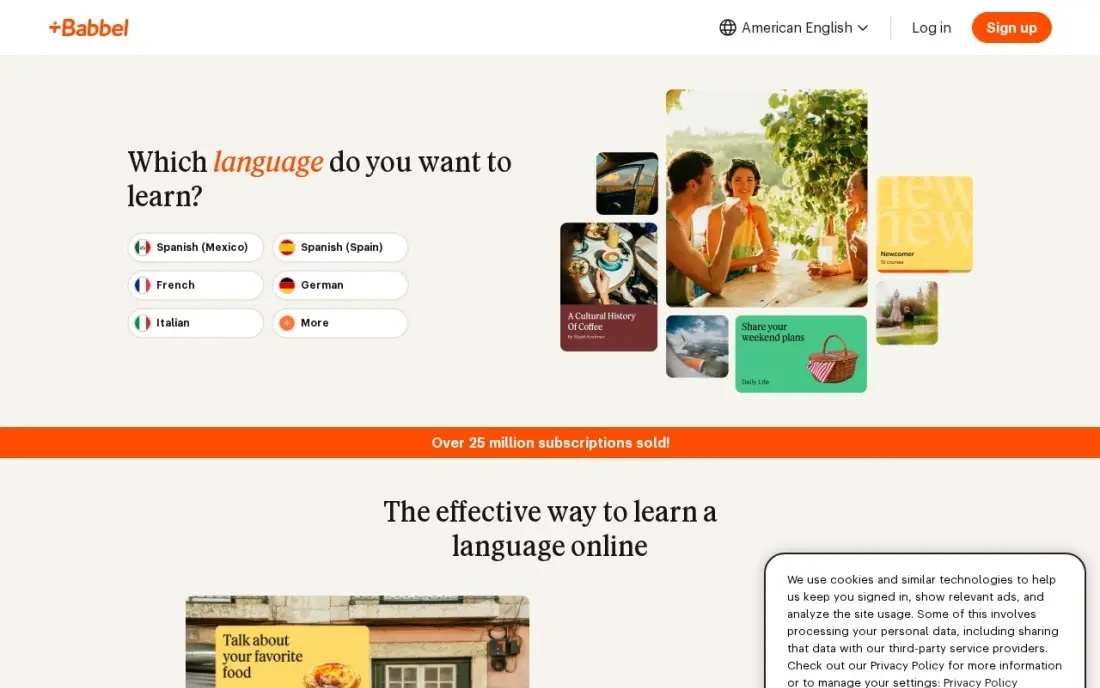
German rewards an app that explains itself, and Babbel does. Its 10 to 15 minute lessons pair a dialogue with notes on the grammar inside it, so the four cases, the der, die and das articles and the verb-at-the-end word order arrive in small, explained pieces. Review sessions repeat vocabulary on a spaced schedule, and Babbel Speak adds AI conversation practice.
Only the first lesson of each course is free. A single month costs $17.95, while the 12-month plan is $107.40 upfront, shown as $8.95 a month. For an English speaker who wants to understand why German sentences are built the way they are, it is the strongest pick in this list.
What we like
- Short 10–15 minute lessons pair dialogues with grammar notes, so you learn why a sentence works
- Review sessions bring words back on a spaced-repetition schedule
- Babbel Speak adds AI conversation practice to rehearse real dialogues
Watch out for
- No free plan — only the first lesson of each course is free
- The $8.95 monthly figure is the 12-month plan paid upfront ($107.40); month-to-month costs $17.95
Duolingo
Best for: Beginners who want to try German free and build a daily habit
Duolingo is the easiest free way to start German. Short lessons cover vocabulary, listening and sentence building, and streaks and leagues keep you returning daily. The free plan includes the whole German course, so you can learn greetings, numbers and present-tense verbs before deciding whether German is for you.
Duolingo teaches grammar mostly by pattern, which works for basic phrases but leaves many learners unsure why the article changes from der to den. The free plan has ads and an energy limit; Super costs $12.99 a month or $83.99 a year, with prices varying by account. Pair it with a grammar resource once cases appear.
What we like
- Free plan covers the full course, so you can learn for months without paying
- Streaks, leagues and short game-like lessons make daily practice easy to keep
- Super removes ads and the energy limit, with unlimited practice and review sessions
Watch out for
- Free plan has ads and an energy limit that stops practice after too many mistakes
- Lessons follow set patterns, so app scores can run ahead of real conversation skill
- Super prices vary by account and test group, from $9.99 to $12.99 a month on the app store
Busuu
Best for: Learners preparing for work or study in Germany who want corrections and certificates
Busuu suits learners with a concrete goal, such as a job or university place in a German-speaking country. Native German speakers in its community correct your written and spoken exercises, which catches wrong endings and word order that self-study misses, and Premium awards CEFR certificates for completed levels, useful as evidence of progress.
The free plan offers basic lessons with ads. Premium costs $12.49 a month or $72.99 a year, about $6.08 a month, and adds grammar review and offline mode; AI Conversations need Premium Plus at $14.90 a month. Busuu tests prices on different visitors, so confirm the figure at checkout.
What we like
- Native speakers correct your written and spoken exercises
- CEFR certificates for completed levels, plus offline mode and grammar review on Premium
- Annual Premium at $72.99 a year works out to about $6.08 a month
Watch out for
- Grammar lessons, offline mode and certificates sit behind the Premium paywall
- AI Conversations need Premium Plus at $14.90 a month
- Busuu tests different prices on different visitors, so the figure you see may differ
Pimsleur
Best for: Commuters who want to understand and speak German before reading it

Pimsleur trains the spoken side of German. Each 30-minute audio lesson asks you to listen, recall a phrase and answer aloud, so you practise the sounds English lacks, such as ü, ö and the ch in ich, and get used to hearing whole sentences at natural speed. It works hands-free on a commute or a walk.
Audio-Only costs $14.95 a month for one language, Premium at $19.95 a month adds Voice Coach and flashcards, and All Access at $20.95 a month covers every language. There is no free plan, only a 7-day free trial with payment details up front. Because German grammar is visual as well as spoken, pair it with a written course.
What we like
- 30-minute audio lessons prompt you to listen, recall and answer out loud from day one
- Hands-free format works on a commute, a workout or household chores
- All Access at $20.95 a month adds every language for $1 more than single-language Premium
Watch out for
- Audio-Only at $14.95 has no practice tools — Voice Coach and flashcards need Premium at $19.95
- No free plan, only a 7-day free trial, and Pimsleur takes payment details first
Rosetta Stone
Best for: Visual learners who want German immersion without English translations
Rosetta Stone teaches German through pictures, audio and German-only text from the first lesson, so you link words to meanings rather than to English. TruAccent speech recognition scores every spoken phrase, and one subscription covers all 25 languages, which helps families or learners adding a second language.
The trade-off is sharper for German than for most languages: with no grammar explanations in English, working out the case system from pictures alone is slow. Sapphire costs $19.99 a month billed monthly or $159 a year billed annually, with a 7-day free trial and tutoring at extra cost. Pair it with a grammar reference.
What we like
- Lessons stay in the target language from the first minute — pictures, sounds and words, no translation
- TruAccent speech recognition scores your pronunciation on every spoken phrase
- One subscription covers all 25 languages, so a second language costs nothing extra
Watch out for
- No grammar explanations in English, so learners who want to know why will feel lost
- No free plan, only a 7-day free trial, and tutoring sessions cost extra
LingQ
Best for: Intermediate learners who want to read and listen to real German content
LingQ takes over when the beginner apps run out. Import a German news article, a podcast transcript or a video, and every unknown word is one tap from a definition and saved for spaced review. German's long compound nouns become manageable when you can look them up in context, and reading real material builds vocabulary far faster than drills.
The free plan caps saved words at 20, which is gone in one lesson, so plan on paying. Premium costs $14.99 a month or $119.99 a year, and AI features need Premium Plus at $29.99 a month. Trustpilot reviewers report bugs and slow support, so trial it before buying a year.
What we like
- Import any article, book or video and study it as a lesson, with every unknown word one tap away
- One subscription covers all 50-plus languages
- Spaced-repetition review is built around the words you actually looked up
Watch out for
- The free plan caps at 20 saved words, which runs out in a single lesson
- AI features and tutoring points sit on Premium Plus at $29.99 a month, not Premium
Memrise
Best for: Learners who want everyday spoken German from native-speaker clips and AI chat
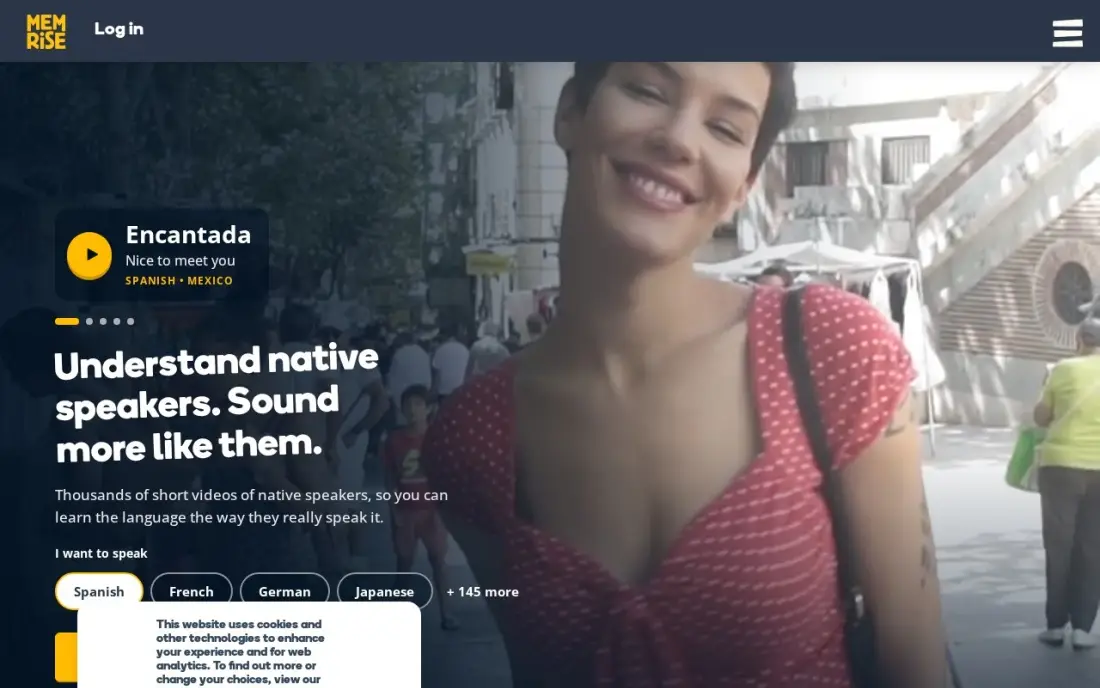
Memrise teaches German vocabulary around practical situations, with short videos of native speakers that show how phrases sound in real conversation rather than in a studio. On Pro, AI Buddies give unlimited speaking practice with grammar help, a low-stakes way to rehearse ordering food or asking directions.
Pro costs $24.99 a month billed monthly but $61.99 a year billed annually, about $5.17 a month, so the annual plan is the sensible way to buy it. Memrise does not teach grammar systematically, which matters in German, so use it alongside Babbel or Busuu rather than instead of them.
What we like
- Native-speaker videos show how words sound in real context, not just in drills
- AI Buddies give unlimited speaking practice with grammar help on Pro
- Annual plan at $61.99 a year is about $5.17 a month
Watch out for
- Paying month to month costs $24.99, nearly five times the annual rate
- No systematic grammar teaching, so it works best paired with another resource
Drops
Best for: Busy learners who want five minutes of illustrated German vocabulary a day
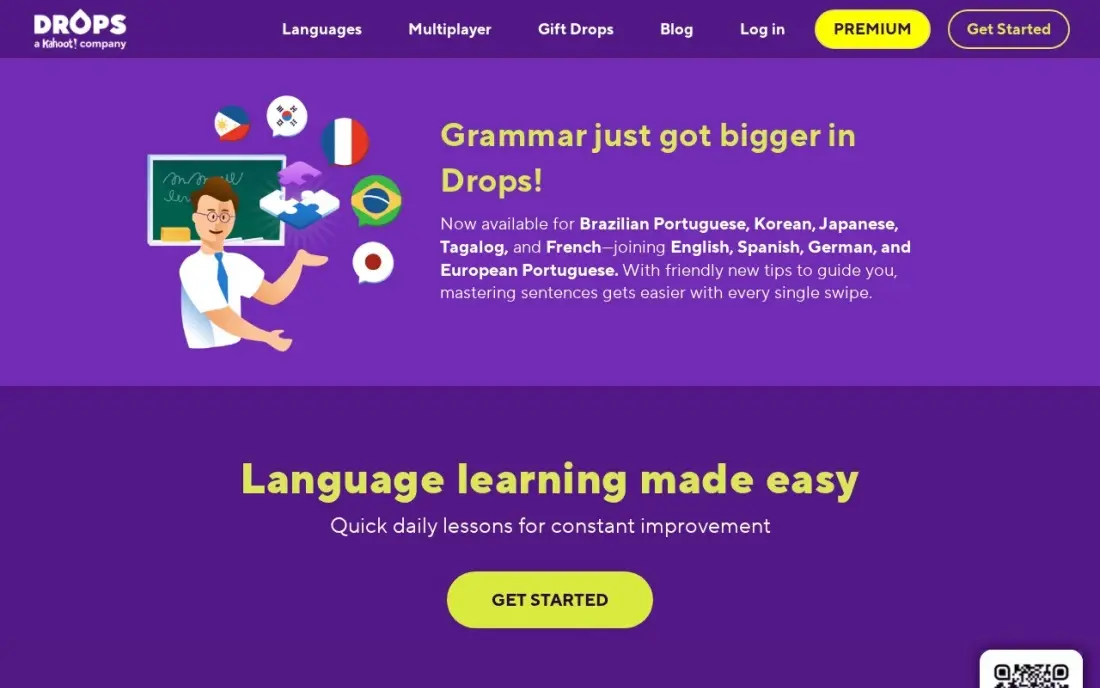
Drops builds German vocabulary in five-minute sessions, with every word shown as an illustration with audio, so you learn Apfel and Bahnhof as images rather than translations. The free plan gives five minutes a day with no end date, which makes it a useful companion to a main course.
It teaches words only, with no grammar, sentences or conversation, so it will not explain why a noun takes die. Premium costs $12.99 a month or $69.99 a year, and a lifetime plan costs $159.99 once. Trustpilot reviewers complain about billing and auto-renewal, so note the renewal date if you start a trial.
What we like
- Every word is taught with an illustration, so vocabulary sticks without translation drills
- Five-minute sessions fit any day, and the free plan never expires
- The annual plan costs $69.99 a year, about $5.83 a month
- A one-time lifetime plan at $159.99 ends the subscription entirely
Watch out for
- Vocabulary only — no grammar, no sentences, no conversation practice
- The free plan stops after five minutes a day, so serious study needs Premium
- Trustpilot scores 2.8 out of 5 from only 16 reviews, with complaints about billing and auto-renewal
The best app to learn German has to do more than drill words: it has to make the four cases, three genders and verb-final word order feel manageable. We compared eight apps that teach German — grammar-led courses, a free game-style app, an audio method, an immersion program and two vocabulary and reading tools — on grammar teaching, speaking practice, free access and yearly cost. Every price below was checked on the vendor's own pages in November 2026.
How to choose the app to learn German
- Prioritise grammar explanations. German cases change articles and endings; an app that explains them, like Babbel or Busuu, saves months of guessing.
- Learn nouns with their article. Pick an app that always shows der, die or das with a noun, and drill them together.
- Make sure you speak aloud. Pimsleur, Rosetta Stone's TruAccent and Memrise's AI Buddies all push you to say German, not just read it.
- Match the app to your goal. A move for work or study needs writing and certificates; travel German needs listening and phrases.
- Check the free tier first. Duolingo, Busuu, Memrise, Drops and LingQ have free plans; Babbel, Pimsleur and Rosetta Stone offer only a first lesson or a trial.
- Buy annual plans only after a trial month. Annual pricing is far cheaper, but only if you keep studying.
For tutoring marketplaces and platforms that teach several languages, see our guide to the best language learning platforms. If you are also learning another language, our guide to the best apps to learn French compares the same tools for French.
German app pricing: what you will actually pay
For a learner studying daily for a year on annual billing, Memrise Pro costs $61.99, Drops $69.99, Busuu Premium $72.99, Duolingo Super $83.99, Babbel $107.40, LingQ Premium $119.99 and Rosetta Stone $159. On monthly billing the same year costs $215.40 for Babbel at $17.95, $239.88 for Rosetta Stone at $19.99 and $299.88 for Memrise at $24.99.
Pimsleur is monthly: twelve months of Audio-Only at $14.95 cost $179.40, and Premium at $19.95 costs $239.40. A sensible German setup — Babbel's 12-month plan for grammar plus Duolingo free for daily practice — costs $107.40 for the year. Adding Busuu Premium for native-speaker corrections brings it to $180.39.
Know the difference: grammar-first apps vs pattern-first apps
Grammar-first apps such as Babbel and Busuu explain the rules as they introduce them: why the article becomes den after certain verbs, why the verb jumps to the end of a clause. That suits most adult English speakers learning German, because the case system is hard to infer from examples alone.
Pattern-first apps such as Duolingo, Rosetta Stone and Memrise show many examples and expect you to absorb the rules. They are more engaging and make daily practice easy, but German learners often hit a wall when cases arrive. The practical approach is to use one of each: a grammar-first course to understand, and a pattern-first app for volume and habit.
Quick comparison: tool type by need
| Buyer | Best pick | Why |
|---|---|---|
| Grammar explained | Babbel | Cases and word order in short lessons, $107.40 for 12 months |
| Free daily habit | Duolingo | Whole German course free; Super $83.99/year |
| Work or study move | Busuu | Native-speaker corrections and CEFR certificates, $72.99/year |
| Speaking and listening | Pimsleur | 30-minute audio lessons from $14.95/month |
| Immersion learners | Rosetta Stone | German-only lessons with TruAccent, $159/year |
| Intermediate reading | LingQ | Learn from imported German articles and podcasts |
| Everyday spoken German | Memrise | Native-speaker clips and AI Buddies, $61.99/year |
| Vocabulary in spare minutes | Drops | Five illustrated minutes a day free |
Mistakes to avoid
- Learning nouns without their article. Memorising Tisch instead of der Tisch means relearning every noun later.
- Avoiding the cases. Skipping accusative and dative practice leaves you stuck at phrasebook German.
- Never writing. German word order shows up most clearly in writing; send short texts for correction on Busuu.
- Paying monthly for a year. Twelve months of Memrise at $24.99 cost almost five times its $61.99 annual plan.
- Forgetting trial end dates. Pimsleur, Rosetta Stone and Drops trials roll into paid subscriptions automatically.
How we chose
We checked each app's own pricing and product pages in November 2026 and recorded prices exactly as shown, with annual and monthly billing stated separately. We compared how each app handles German grammar, pronunciation, listening and vocabulary, what its free tier includes and what a year costs. Where ratings appear, they come from the review pages listed in the sources on the dates shown. No vendor paid for a place in this list, and none of the links here are affiliate links.
What to do next
Try Babbel's free first lesson and Duolingo's free German course side by side for a week, and keep the one that makes the cases click. If you run a language school or course business and want more students to find it online, book a free SEO review.
Frequently asked questions
What is the best app to learn German?
Babbel is the best app to learn German for most adults, because it explains cases, articles and word order in short lessons. Duolingo is the best free start, and Busuu is the best for learners who want native-speaker corrections and CEFR certificates.
Can I learn German for free with an app?
You can reach a basic level for free. Duolingo's free plan includes its whole German course with ads and an energy limit, and Busuu, Memrise and Drops have free plans with limited lessons. Grammar explanations and speaking practice usually need a paid plan or a tutor.
Which app is best for German grammar?
Babbel, because every lesson includes grammar notes on the sentences you just practised. Busuu also covers grammar on Premium and adds corrections from native speakers. Rosetta Stone avoids English grammar explanations entirely, which makes German cases slow to learn.
How much does a German learning app cost?
Billed annually, Memrise Pro costs $61.99 a year, Drops $69.99, Busuu Premium $72.99, Duolingo Super $83.99, Babbel $107.40, LingQ Premium $119.99 and Rosetta Stone $159. Pimsleur is monthly from $14.95.
Can an app prepare me for a German exam?
An app can cover much of the vocabulary and grammar, and Busuu's CEFR-level certificates show progress, but they are not official exam certificates. For an official exam, add practice tests and speaking sessions with a teacher.
Is German hard to learn with an app?
German vocabulary is close to English, but its four cases and word order take practice. Apps that explain grammar, such as Babbel and Busuu, make this easier than apps that teach only by pattern.
Sources we checked (10)
- Babbel — www.babbel.com/pricing (checked November 4, 2026)
- Duolingo — www.duolingo.com/super (checked November 4, 2026)
- Busuu — www.busuu.com (checked November 4, 2026)
- Pimsleur — www.pimsleur.com (checked November 4, 2026)
- Rosetta Stone — www.rosettastone.com/buy (checked November 4, 2026)
- LingQ — www.lingq.com/pricing (checked November 4, 2026)
- LingQ reviews on Trustpilot (checked November 4, 2026)
- Memrise — www.memrise.com (checked November 4, 2026)
- Drops — languagedrops.com (checked November 4, 2026)
- Drops reviews on Trustpilot (checked November 4, 2026)
Make one of these tools?
We re-check this list every quarter. Send a correction, request a review, or ask about a clearly labeled sponsored spot.
Request a listingShamim
Founder of SerpAstra
A full-stack digital marketer and SEO strategist covering technical and local SEO, AI search visibility, paid ads and lead generation for local businesses, e-commerce brands and SaaS teams.
Free SEO and AI visibility audit
Find out what is holding your rankings back
Send us your site. Within 2 business days you get a written audit, an AI visibility check and a short fix list ranked by impact. Free, with no contract attached.
Request my free audit→Related buying guides
 Education & E-Learning8 Best Language Learning Platforms in 2026, ComparedCompare the 8 best language learning platforms, from apps like Duolingo and Babbel to tutor sites like italki and Preply, on method, free plans and real cost.Read guide →
 Education & E-Learning7 Best Free Language Apps in 2026, ComparedCompare the 7 best free language apps on what the free plan really covers, its daily limits, and what the paid upgrade costs if you decide to stay with it.Read guide →
 Education & E-Learning8 Best Apps to Learn French in 2026, ComparedCompare the 8 best apps to learn French on grammar, speaking practice, free plans and real yearly cost, from Duolingo and Babbel to Pimsleur and LingQ.Read guide →