
7 Best Free Language Apps in 2026, Compared
Compare the 7 best free language apps on what the free plan really covers, its daily limits, and what the paid upgrade costs if you decide to stay with it.
 Shamim Mia, Founder, SerpAstraLast verified November 4, 20269 min read
We compare pricing pages, documentation and public reviews. We never accept payment for rankings.
Key takeaways
- Duolingo is the best free language app for most beginners: the free plan covers the full course, with ads and an energy limit as the cost.
- Anki is the only fully free option with no limits on desktop, Android and the web; you supply or download the decks.
- Busuu, Memrise, Mondly, LingQ and Drops all have free plans, but each caps something: lessons, saved words or minutes a day.
- If you upgrade, buy the annual plan: Mondly costs $47.99 a year and Memrise $61.99, against $9.99 and $24.99 a month.
On this page
Quick comparison
| Tool | Best for | Starting price | Free plan |
|---|---|---|---|
| Duolingo | Beginners who want a complete free course and a daily habit | Free; Super $12.99/mo | Yes (free plan) |
| Anki | Self-directed learners who want unlimited free vocabulary review | Free; iOS $24.99 once | Yes (free) |
| Busuu | Learners who want a structured course and feedback from native speakers | Free; Premium $12.49/mo | Yes (free plan) |
| Memrise | Learners who want to hear real native speakers from the first lesson | Free; Pro $61.99/yr | Yes (free plan) |
| Mondly | Casual learners who want one short free lesson a day | Free; Premium $47.99/yr | Yes (free plan) |
| LingQ | Intermediate learners who want to learn from articles, podcasts and videos | Free; Premium $14.99/mo | Yes (free plan) |
| Drops | Visual learners who want a five-minute free vocabulary game every day | Free; Premium $69.99/yr | Yes (free plan) |
Make one of these tools?
We re-check this list every quarter. Send a correction, request a review, or ask about a clearly labeled sponsored spot.
Request a listingThe best free language learning apps
Duolingo
Best for: Beginners who want a complete free course and a daily habit
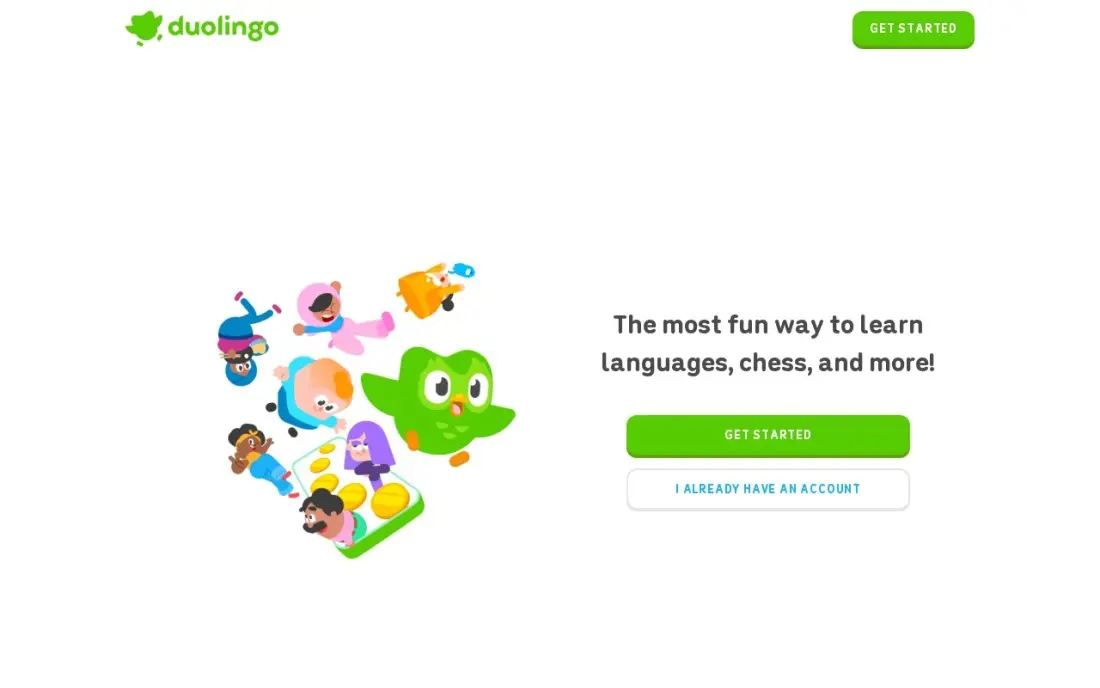
Duolingo is the free language app most people should try first, because its free plan covers the full course rather than a sample. Lessons are short and game-like, and streaks and leagues give a reason to return every day. A learner can study for months without paying and still move through every unit.
The free plan has two costs: ads between lessons and an energy limit that pauses practice after too many mistakes. Super costs $12.99 a month or $83.99 a year and removes both, though Duolingo tests prices, so yours may differ. Lessons follow set patterns, so pair it with real listening or conversation once the basics feel easy.
What we like
- Lessons are short and game-like, so a session fits into a commute or a coffee break
- Free plan covers the full course, so you can learn for months without paying
- Streaks, leagues and short game-like lessons make daily practice easy to keep
- Super removes ads and the energy limit, with unlimited practice and review sessions
Watch out for
- Free plan has ads and an energy limit that stops practice after too many mistakes
- Lessons stay close to set patterns, so learners can score well in the app yet struggle in real conversation
- Super prices vary by account and test group — the app store lists $9.99 and $12.99 monthly and $83.99 to $119.99 yearly

Anki
Best for: Self-directed learners who want unlimited free vocabulary review
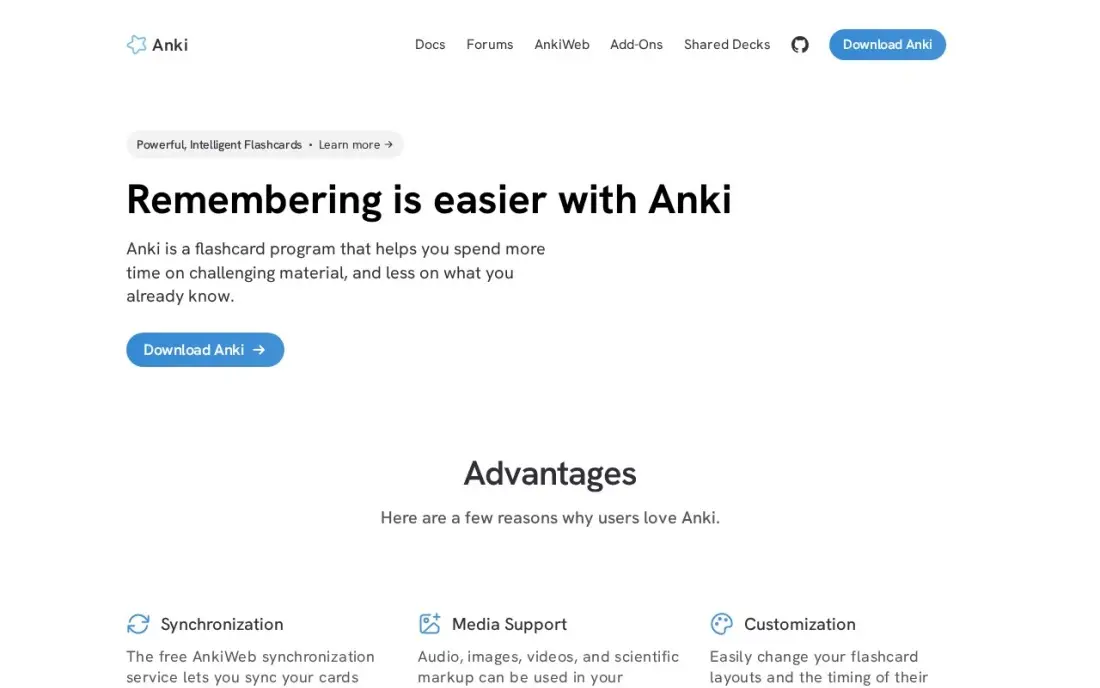
Anki is the only app here that is completely free with no daily caps. It is open source on Windows, Mac, Linux, Android and the web, with free AnkiWeb sync between them, and its FSRS scheduler shows each card just before you would forget it. Shared decks on AnkiWeb cover dozens of languages, so you rarely build from nothing.
It is a memory tool, not a course. There is no grammar teaching or speaking practice, the interface looks dated and the settings take time to learn. The only paid piece is AnkiMobile for iPhone and iPad at $24.99 once. Use it beside a course app to make the words you meet actually stay.
What we like
- Free and open source on Windows, Mac, Linux, Android and the web, with no card or deck limits
- FSRS scheduling adapts intervals to your memory, and the shared-deck library covers medicine, law and languages
- Add-ons extend it with image occlusion, extra stats and bulk import
- Free AnkiWeb sync keeps desktop, Android and the web in step
Watch out for
- The interface looks dated and the settings take a weekend to learn
- You build or find your own decks; there is no ready-made course or content
- AnkiMobile for iPhone and iPad costs $24.99 once, the only paid piece

Busuu
Best for: Learners who want a structured course and feedback from native speakers
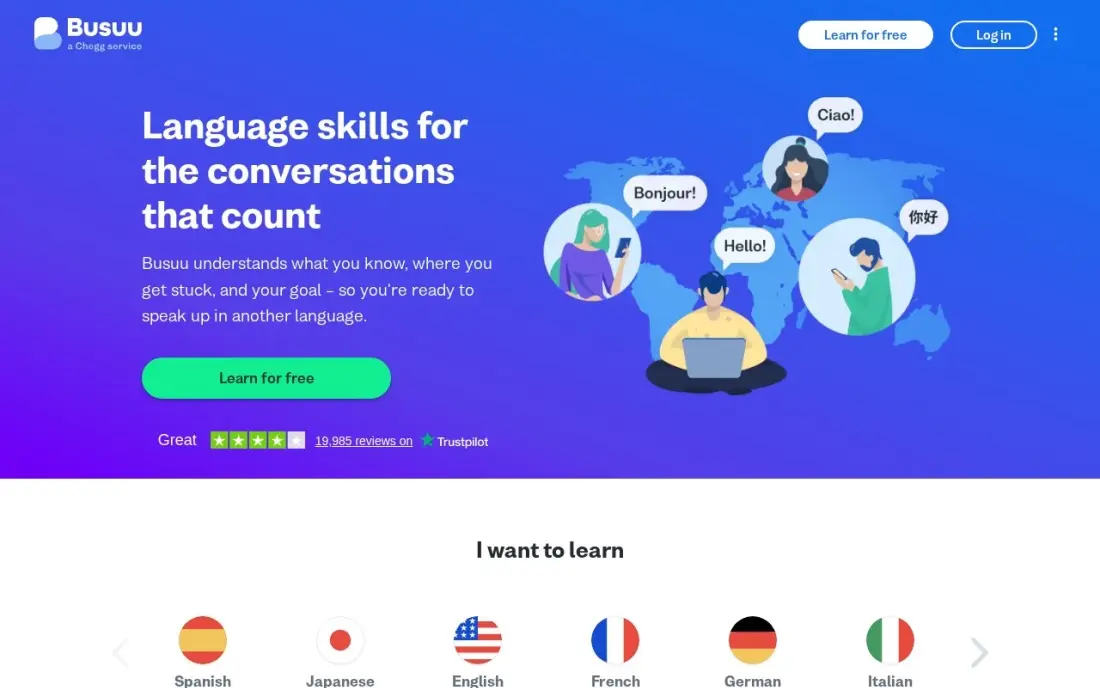
Busuu's free plan is a taster of a properly structured course: basic lessons with ads, set out by level so you can see the path ahead. Its strongest feature is community feedback, where native speakers correct written and spoken exercises, which few apps offer at any price.
Most of the depth sits behind Premium at $12.49 a month or $72.99 a year: grammar lessons, offline mode, community feedback and CEFR certificates for completed levels. AI conversation practice costs more again, on Premium Plus at $14.90 a month. Use the free plan to judge the teaching style, then buy a year if it suits you, since Busuu also tests prices on visitors.
What we like
- Lessons are set out by level, so even the free plan shows the full path ahead
- Native speakers correct your written and spoken exercises, which no other app here offers at this price
- CEFR certificates for completed levels, plus offline mode and grammar review on Premium
- Cheapest structured annual plan here at $72.99 a year, about $6.08 a month
Watch out for
- Most of the best features — grammar lessons, offline mode, certificates — sit behind the Premium paywall
- Premium Plus adds AI Conversations for $14.90 a month, so the AI practice costs extra
- Busuu tests different prices on different visitors, so the figure you see may differ
Memrise
Best for: Learners who want to hear real native speakers from the first lesson
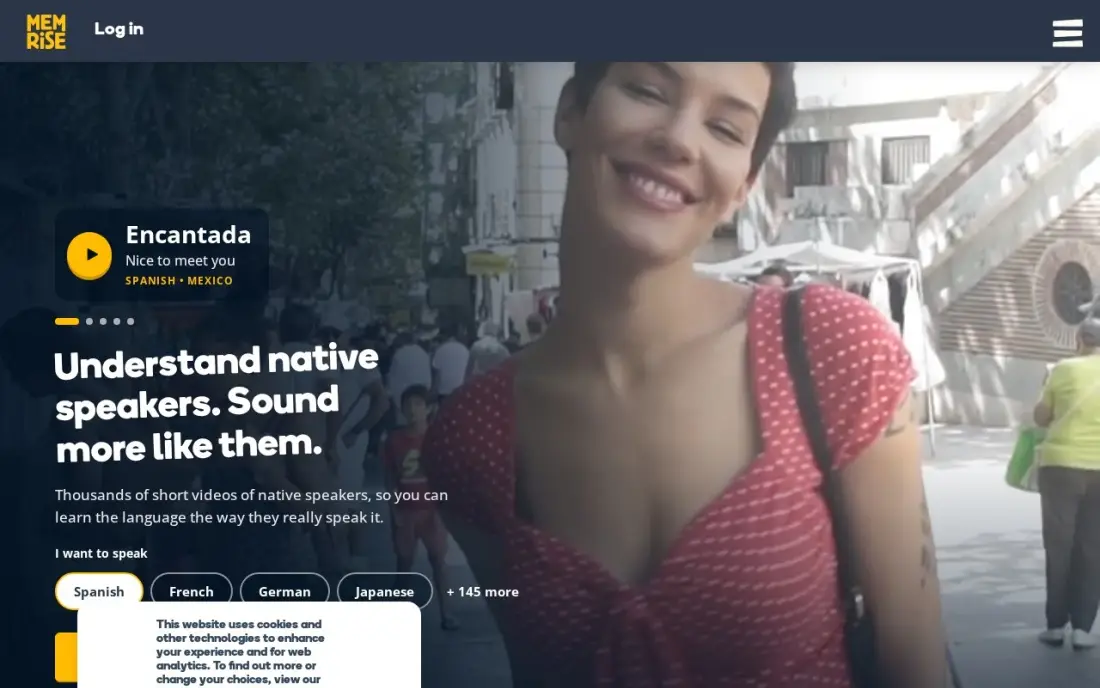
Memrise builds lessons around practical situations and short videos of native speakers, so you hear how a phrase sounds in a real voice rather than a recording studio drill. The free plan covers limited vocabulary lessons and videos, which is enough to see whether the approach helps you remember.
Pro adds unlimited AI conversation practice through AI Buddies, with grammar and conjugation help. Its monthly price of $24.99 is the highest here, but the annual plan costs $61.99, about $5.17 a month. Memrise does not teach grammar systematically, and community-made courses have left the main app, so treat it as a listening and vocabulary tool alongside a course.
What we like
- Lessons are built around practical situations and short native-speaker videos, not drills alone
- AI Buddies give unlimited speaking practice with grammar and conjugation help on Pro
- 30,000 native-speaker videos show how words sound in real context, not just in drills
- Annual plan at $61.99 a year is about $5.17 a month — far cheaper than the monthly rate
Watch out for
- Highest monthly price here at $24.99 — paying month to month costs nearly five times the annual rate
- No systematic grammar teaching, so it works best paired with another resource
- Memrise removed user-generated community courses from the main app, so the catalog is narrower than it once was

Mondly's free tier gives a daily lesson plus basic lessons, built around everyday topics such as travel, family and restaurants. Speech recognition and a chatbot let you rehearse simple dialogues without a real partner, which helps nervous beginners get used to answering out loud.
Premium has the cheapest annual price here at $47.99 a year, about $4 a month, and covers all 41 languages; month to month it costs $9.99 on the web. App-store prices run higher, around $15.90 a month on iOS, so subscribe on the web. Lessons stay shallow across levels, so Mondly suits a holiday learner more than someone working toward fluency.
What we like
- Cheapest annual plan here at $47.99 a year, about $4 a month, with access to all 41 languages
- Chatbot conversations let you rehearse simple dialogues without the pressure of a real partner
- Daily Lesson, speech recognition and grammar guides keep short sessions varied
- Free tier gives a daily lesson, enough to test the style before paying
Watch out for
- App-store prices run higher than the web price — about $15.90 a month on iOS — so buy on the web
- Lessons stay shallow, with little difference between the three learning levels
- No refunds once you pay, according to reviewers, so the trial matters more than the price

LingQ
Best for: Intermediate learners who want to learn from articles, podcasts and videos
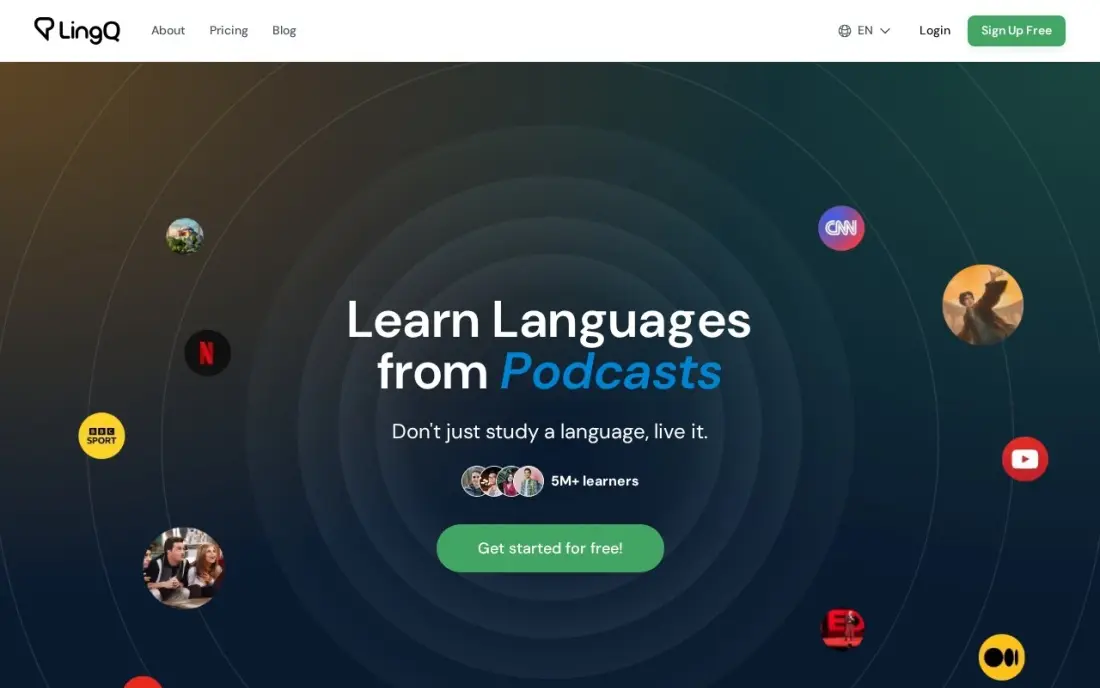
LingQ teaches through content you choose: import an article, podcast transcript or video and every unknown word is one tap from a definition and a flashcard. One account covers more than 50 languages, and review is built around the words you actually looked up, which keeps practice relevant.
The free plan is tight, with 20 saved words and 5 imported lessons, enough for a trial and little more. Premium costs $14.99 a month or $119.99 a year, and AI features need Premium Plus at $29.99 a month. Beginners can feel lost in real content, so use LingQ once you can read simple sentences in your target language.
What we like
- Import any article, book or video and study it as a lesson, with every unknown word one tap away
- One subscription covers all 50-plus languages, including Spanish
- Spaced-repetition review is built around the words you actually looked up
- The 24-month plan drops the price to $8.99 a month
Watch out for
- The free plan caps at 20 saved words, which runs out in a single lesson
- AI features and tutoring points sit on Premium Plus at $29.99 a month, not Premium
- Trustpilot reviewers report bugs and slow support, with a 2.8 out of 5 score from 22 reviews

Drops
Best for: Visual learners who want a five-minute free vocabulary game every day
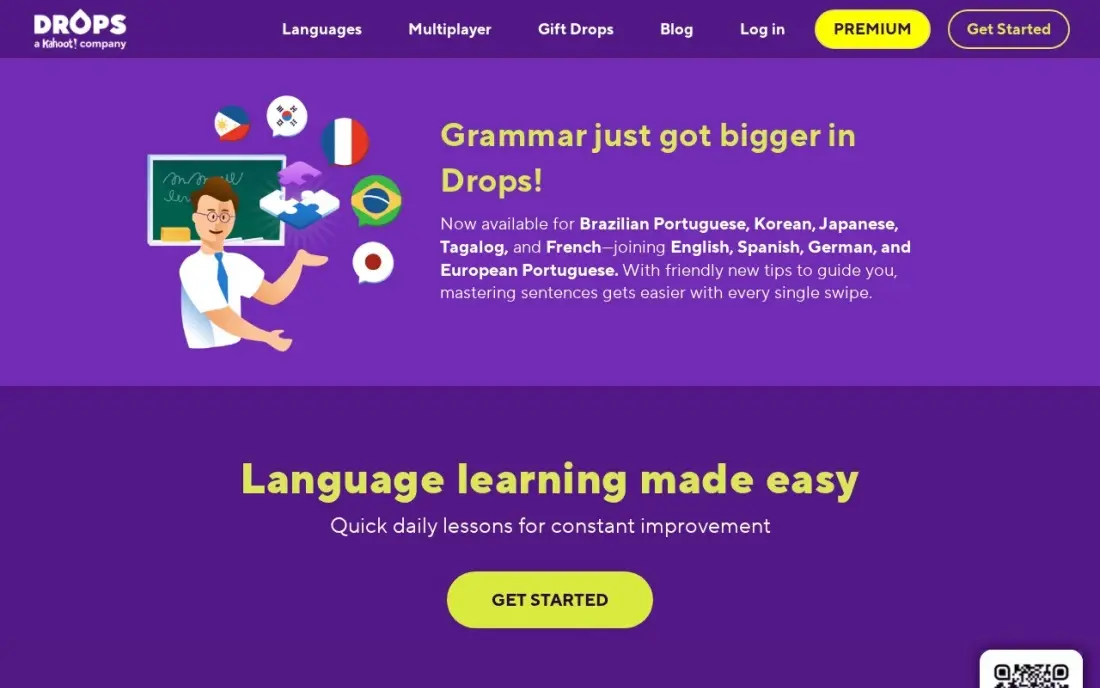
Drops teaches vocabulary through illustrated word games, so you link a word to a picture rather than to a translation. The free plan never expires and gives five minutes of learning a day, which is an easy habit to keep on a commute or a coffee break.
Five minutes is also the ceiling, and Drops teaches words only, with no grammar, sentences or conversation. Premium removes the time limit for $12.99 a month or $69.99 a year, and a lifetime plan costs $159.99 once. Trustpilot reviews mention billing and auto-renewal complaints, so set a reminder before any trial ends. Use it beside a course app, not instead of one.
What we like
- Every word is taught with an illustration, so vocabulary sticks without translation drills
- Five-minute sessions fit any day, and the free plan never expires
- The annual plan costs $69.99 a year, about $5.83 a month
- A one-time lifetime plan at $159.99 ends the subscription entirely
Watch out for
- Vocabulary only — no grammar, no sentences, no conversation practice
- The free plan stops after five minutes a day, so serious study needs Premium
- Trustpilot scores 2.8 out of 5 from only 16 reviews, with complaints about billing and auto-renewal
The best free language apps let you learn for months without paying, and they are clear about what the free plan holds back. We compared seven apps on how much of the course is free, the daily limits on the free plan, the kind of practice each one gives and what the upgrade costs if you stay. Every price below comes from our verified app records, last checked in November 2026.
How to choose the best free language apps
- Check what is free, not just that it is free. Duolingo's free plan is the full course; Busuu and Memrise give samples; Drops gives five minutes a day.
- Match the app to your level. Beginners need guided lessons; intermediate learners get more from LingQ's real content.
- Mix a course with a memory tool. A course app teaches new material and Anki keeps it from fading.
- Look for speaking practice. Speech recognition, chatbots and native-speaker feedback get you answering out loud.
- Read the energy and time limits. Caps on mistakes or minutes decide whether a free plan fits a 30-minute daily habit.
- Upgrade only on annual plans. Monthly prices run two to five times higher than the annual equivalent.
If you teach languages or run a tutoring business, learners are searching for help right now. Our AI search optimization service helps education businesses get named when people ask AI assistants for tutors and courses, and our spaced repetition guide goes deeper on review tools.
Which free language app fits your situation
A complete beginner who does not want to pay anything. Start with Duolingo, because its free plan covers the full course rather than a sample, and add Anki on Android or the web for review. That pairing costs $0. The trade-off is Duolingo's ads and energy limit, and lessons that follow set patterns, so add listening or conversation once the basics feel easy.
A learner who wants structure and real feedback. Busuu's free plan shows a level-based course with ads, and its native-speaker feedback on written and spoken exercises is rare at any price. Most of the depth, including grammar lessons, offline mode and certificates, needs Premium at $72.99 a year, and AI conversation practice costs more on Premium Plus. Busuu tests prices, so the figure you see may differ.
A holiday learner with ten minutes a day. Mondly gives a free daily lesson built around travel, family and restaurants, with speech recognition and a chatbot for practising answers out loud. If you upgrade, Premium is the cheapest annual plan here at $47.99, but buy on the web, since the iOS price runs about $15.90 a month. Drops fits the same buyer for vocabulary, with five illustrated minutes a day on a free plan that never expires.
An intermediate learner who can already read simple sentences. LingQ turns imported articles, podcasts and videos into lessons, with review built around the words you looked up. The free plan's 20 saved words runs out in a single lesson, so treat it as a trial; Premium costs $119.99 a year, and Trustpilot reviewers report bugs and slow support. Memrise suits the same stage for listening, with native-speaker videos and AI Buddies on Pro at $61.99 a year.
A learner on an iPhone who wants unlimited review. Anki is still the answer, but AnkiMobile costs $24.99 once, the only paid piece of Anki. Expect a dated interface and settings that take time to learn, and build decks from the shared library rather than from scratch.
Free language apps pricing: what you will actually pay
Learning with free plans costs $0. Duolingo plus Anki on Android or the web gives a full course and unlimited review without paying anything; on an iPhone, Anki adds $24.99 once.
If you upgrade one app for a year, the annual prices are $47.99 for Mondly, $61.99 for Memrise, $69.99 for Drops, $72.99 for Busuu, $83.99 for Duolingo Super and $119.99 for LingQ. Paying monthly for twelve months costs far more: $119.88 on Mondly, $149.88 on Busuu, $155.88 on Duolingo or Drops, $179.88 on LingQ and $299.88 on Memrise. Drops also sells a lifetime plan at $159.99 once.
Know the difference: course apps vs practice apps
A course app gives you a path. Duolingo, Busuu and Mondly decide what to teach next, introduce grammar step by step and test you as you go. That structure is what most beginners need, because it removes the question of what to study.
A practice app makes something you already met stick or grow. Anki schedules review of words you have learned, Drops drills vocabulary with pictures, Memrise trains your ear with native speakers and LingQ turns real articles and videos into lessons. Use one course app as your spine and add a practice app for the gap you notice most.
Quick comparison: tool type by need
| Learner | Best pick | Why |
|---|---|---|
| Complete beginner | Duolingo | Full course free, with ads and an energy limit |
| Unlimited free review | Anki | Free and open source with shared language decks |
| Structured course with feedback | Busuu | Native speakers correct your exercises |
| Listening to real speakers | Memrise | Native-speaker videos, Pro $61.99/year |
| Casual daily lesson | Mondly | Free daily lesson, cheapest annual plan at $47.99 |
| Intermediate reader | LingQ | Learn from imported articles and videos |
| Visual vocabulary | Drops | Five illustrated minutes a day, free forever |
Mistakes to avoid
- Collecting apps instead of studying. Pick one course app and one practice app, and use them daily for a month before judging.
- Chasing streaks over progress. A long streak of easy lessons teaches less than fewer, harder sessions.
- Skipping speaking. Say every answer out loud, even when the app does not ask you to.
- Paying monthly by default. If an app works for you, the annual plan costs a fraction of twelve monthly payments.
- Letting a trial renew by accident. Set a reminder the day you start any free trial.
Related comparisons: Language Apps for Kids
How we chose
We took each app's free plan and paid prices from our verified records, checked in November 2026, and recorded prices exactly as published, noting where apps test different prices on different users. We ranked the apps by how much a learner can do without paying, then by teaching approach, daily limits and the cost of the annual upgrade. Ratings appear only where we have a verified source, and some apps in this list have none. No app maker paid for a place in this list, and none of the links here are affiliate links.
What to do next
Install Duolingo for your target language and Anki for review, and give both fifteen minutes a day for four weeks before paying for anything. If you run a language school or tutoring business, book a free SEO audit to see how learners find you online.
Frequently asked questions
What is the best free language app?
Duolingo is the best free language app for most beginners because its free plan covers the full course. Anki is the best fully free tool for vocabulary review, and Busuu's free plan suits learners who want a structured course.
Is Duolingo really free?
Yes. The free plan covers the full course, with ads and an energy limit that pauses practice after too many mistakes. Super costs $12.99 a month or $83.99 a year, though Duolingo tests prices by account.
Which language app is completely free with no limits?
Anki is free and open source on Windows, Mac, Linux, Android and the web, with no card limits. The only paid part is AnkiMobile for iPhone and iPad at $24.99 once.
Can you become fluent with free language apps?
Free apps build vocabulary, listening and a daily habit, but fluency needs real conversation and plenty of reading and listening. Combine a course app such as Duolingo with Anki for review and regular speaking practice.
What is the cheapest paid language app?
Among these apps, Mondly Premium has the lowest annual price at $47.99 a year, about $4 a month. Memrise Pro costs $61.99 a year and Drops Premium $69.99 a year.
How much time should I spend on a language app each day?
Fifteen to thirty minutes a day is a realistic target. Drops' free plan stops at five minutes a day, so pair it with a course app if you want longer sessions.
Which free language apps are better than Duolingo?
It depends on what Duolingo is not giving you. Anki is the only app here that is completely free with no daily caps, but it is a vocabulary memory tool, not a course. Busuu's free plan offers a more structured, level-based course, Memrise's free plan adds native-speaker videos, and LingQ suits intermediate learners who want to learn from real articles and podcasts.
Sources we checked (10)
- Duolingo — www.duolingo.com/super (checked November 4, 2026)
- Anki — apps.ankiweb.net (checked November 4, 2026)
- Anki reviews on G2 (checked November 4, 2026)
- Busuu — www.busuu.com (checked November 4, 2026)
- Memrise — www.memrise.com (checked November 4, 2026)
- Mondly — www.mondly.com (checked November 4, 2026)
- LingQ — www.lingq.com/pricing (checked November 4, 2026)
- LingQ reviews on Trustpilot (checked November 4, 2026)
- Drops — languagedrops.com (checked November 4, 2026)
- Drops reviews on Trustpilot (checked November 4, 2026)
Make one of these tools?
We re-check this list every quarter. Send a correction, request a review, or ask about a clearly labeled sponsored spot.
Request a listingShamim
Founder of SerpAstra
A full-stack digital marketer and SEO strategist covering technical and local SEO, AI search visibility, paid ads and lead generation for local businesses, e-commerce brands and SaaS teams.
Free SEO and AI visibility audit
Find out what is holding your rankings back
Send us your site. Within 2 business days you get a written audit, an AI visibility check and a short fix list ranked by impact. Free, with no contract attached.
Request my free audit→Related buying guides
 Education & E-Learning12 Best Spanish Learning Apps for 2026, Tested on Features and PriceCompare the 12 best spanish learning app picks for 2026 on price, free plans and speaking practice, with every price checked November 4, 2026.Read guide →
 Business Software9 Best Spaced Repetition Apps in 2026: Free and Paid Apps RankedCompare the 9 best spaced repetition apps on price, free plans and scheduling, with every price checked November 4, 2026 — from Anki to $24.99/month Memrise.Read guide →
 Education & E-LearningBest Apps to Learn Mexican Spanish (2026): 7 Apps Worth DownloadingCompare the 7 best app to learn mexican spanish options, from Babbel's dedicated Mexican course to Duolingo's free lessons, with real 2026 prices.Read guide →