
7 Best Apps to Learn Japanese for Free in 2026
Compare the 7 best apps to learn Japanese for free: what each free plan covers for kana, kanji and grammar, and what the paid upgrade costs if you need more.
 Shamim Mia, Founder, SerpAstraLast verified November 4, 20267 min read
We compare pricing pages, documentation and public reviews. We never accept payment for rankings.

Key takeaways
- Duolingo is the best free app to start Japanese, with the whole course on its free plan, ads and an energy limit included.
- For kanji, WaniKani's first 3 levels are free and Anki is free on desktop, Android and the web; together they cover reading better than any course app.
- Busuu, Memrise and Drops have useful free tiers, but grammar lessons, AI practice and unlimited time sit on paid plans.
- The best paid upgrade for a serious learner is usually WaniKani at $89 a year for kanji, rather than a second general course app.
On this page
Quick comparison
| Tool | Best for | Starting price | Free plan |
|---|---|---|---|
 Duolingo | Beginners who want a complete free Japanese course to start with | $12.99/mo | Yes (free plan) |
 WaniKani | Learners who want a structured path through kanji, with the first 3 levels free | $9/mo | Yes (levels 1–3) |
 Anki | Self-directed learners who want unlimited free flashcards for vocabulary and kanji | Free | Yes (free) |
 Busuu | Learners who want free Japanese lessons plus corrections from native speakers | $12.49/mo | Yes (free plan) |
 Memrise | Learners who want free clips of native Japanese speakers for listening | $24.99/mo | Yes (free plan) |
 Drops | Busy learners who want five free minutes of illustrated Japanese vocabulary daily | $12.99/mo | Yes (free plan) |
 LingQ | Intermediate learners who want to read real Japanese, with a small free allowance | $14.99/mo | Yes (free plan) |
Make one of these tools?
We re-check this list every quarter. Send a correction, request a review, or ask about a clearly labeled sponsored spot.
Request a listingThe best free apps to learn Japanese
Duolingo
Best for: Beginners who want a complete free Japanese course to start with
Duolingo is the easiest way to start Japanese without paying. Its free plan includes the whole Japanese course, with short lessons on vocabulary, listening and sentence building, and streaks and leagues to keep you practising daily. It is a gentle first step for learners who have never seen Japanese script and want to know whether they will stick with it.
The free plan has ads and an energy limit that pauses practice after too many mistakes; Super costs $12.99 a month or $83.99 a year, with prices varying by account. Japanese grammar is taught mostly by pattern and kanji coverage is limited, so pair it with a kanji tool once the basics are in place.
What we like
- Free plan covers the full course, so you can learn for months without paying
- Streaks, leagues and short game-like lessons make daily practice easy to keep
- Super removes ads and the energy limit, with unlimited practice and review sessions
Watch out for
- Free plan has ads and an energy limit that stops practice after too many mistakes
- Lessons follow set patterns, so app scores can run ahead of real conversation skill
- Super prices vary by account and test group, from $9.99 to $12.99 a month on the app store
WaniKani
Best for: Learners who want a structured path through kanji, with the first 3 levels free
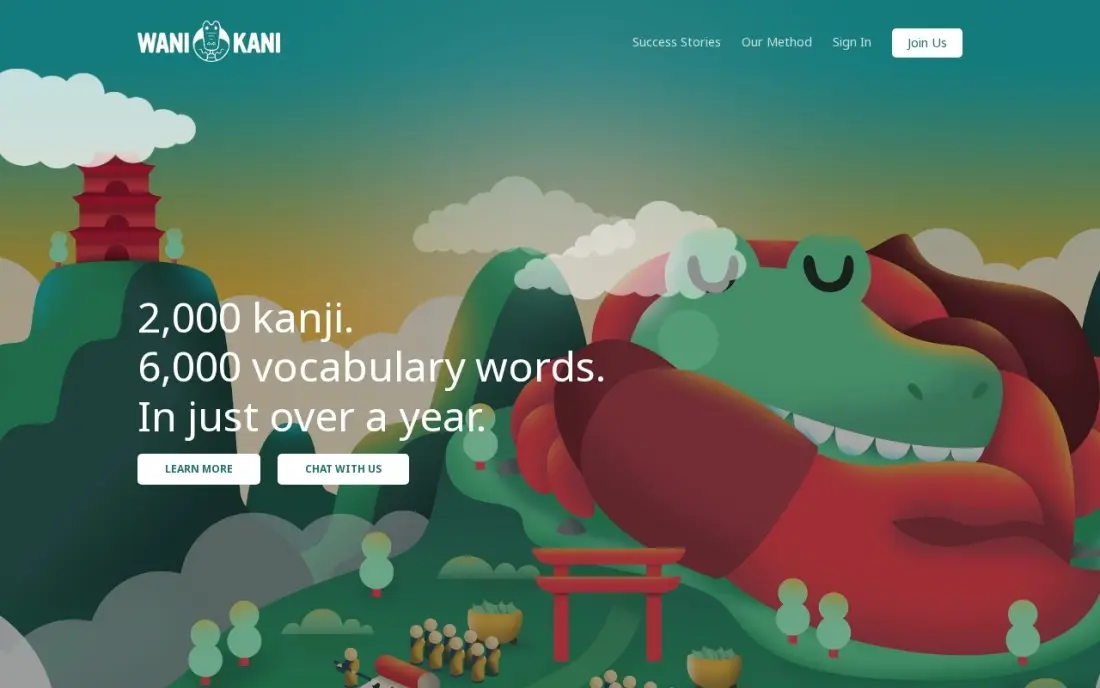
WaniKani teaches kanji in a fixed order — radicals first, then kanji, then vocabulary that uses them — with a mnemonic for every meaning and reading. Its path covers about 2,000 kanji, and spaced reviews bring each item back before you forget it. The first 3 levels are free, which is enough to see whether the method works for you.
It is Japanese reading only, with no grammar, listening or speaking, and typos count as wrong answers. After the free levels, it costs $9 a month, $89 a year or $299 for lifetime access. For learners who keep stalling on kanji, it is the single most useful upgrade.
What we like
- Teaches radicals first, then kanji, then vocabulary, in a locked order that prevents skipping ahead
- Mnemonics for every reading and meaning make abstract characters stick
- First 3 levels are free, enough to test the method properly
- Active community and user scripts extend it with extra stats and reviews
Watch out for
- Japanese only: no use for any other subject or language
- No grammar, listening or speaking, so it must pair with another resource
- Strict typing: a typo counts as a wrong answer and drops the item down the ladder
Anki
Best for: Self-directed learners who want unlimited free flashcards for vocabulary and kanji
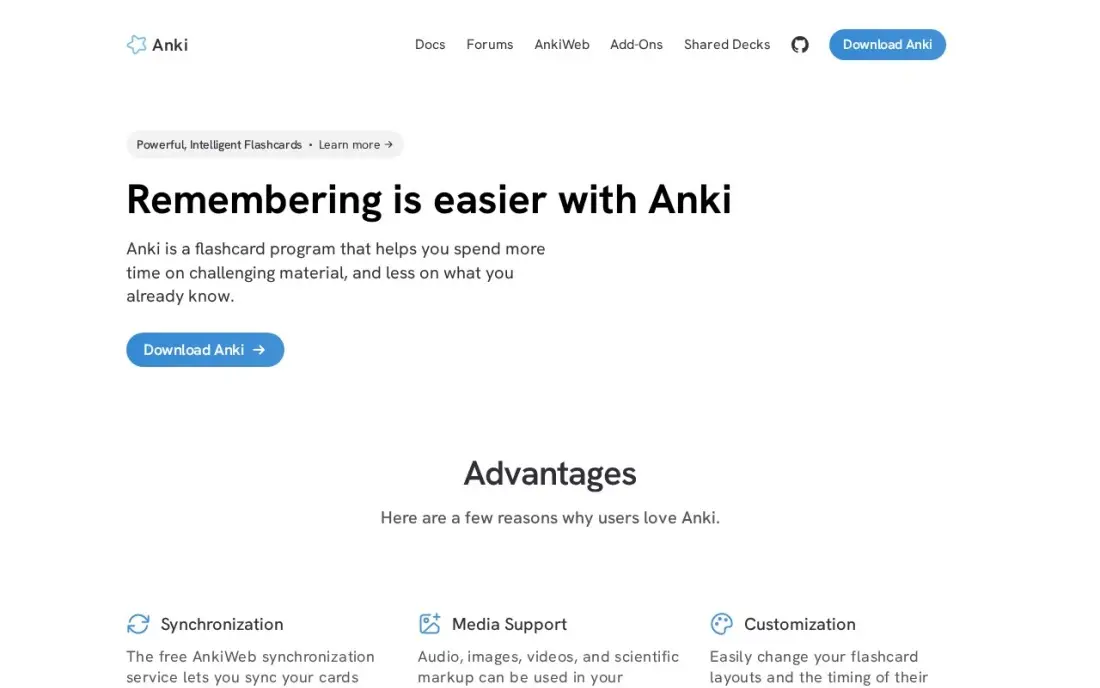
Anki is free and open source on Windows, Mac, Linux, Android and the web, with no limits on cards and free AnkiWeb sync. Japanese learners use it for vocabulary, kanji and sentence cards, and its shared-deck library includes ready-made language decks, so you do not have to build everything from scratch.
There is no course and the settings take time to learn. AnkiMobile for iPhone and iPad costs $24.99 once, the only paid part. Combine it with Duolingo or a textbook, adding the words you meet so that the scheduler brings them back at the right moment.
What we like
- Free and open source on Windows, Mac, Linux, Android and the web, with no card or deck limits
- FSRS scheduling adapts intervals to your memory, and the shared-deck library covers medicine, law and languages
- Add-ons extend it with image occlusion, extra stats and bulk import
- Free AnkiWeb sync keeps desktop, Android and the web in step
Watch out for
- The interface looks dated and the settings take a weekend to learn
- You build or find your own decks; there is no ready-made course or content
- AnkiMobile for iPhone and iPad costs $24.99 once, the only paid piece
Busuu
Best for: Learners who want free Japanese lessons plus corrections from native speakers
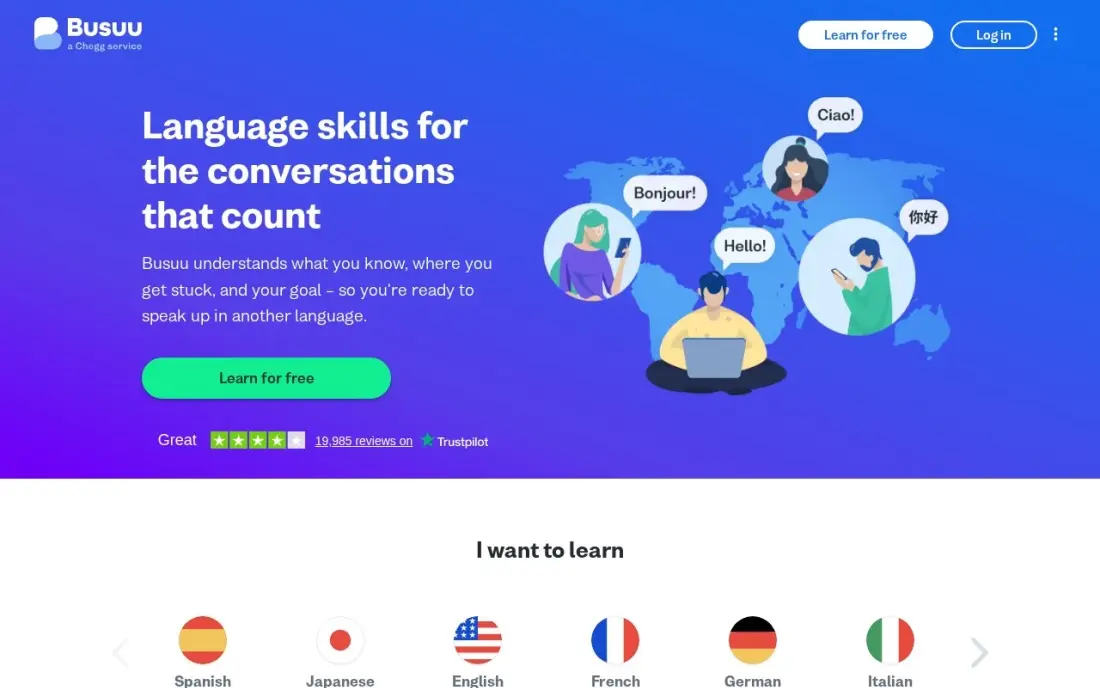
Busuu offers a Japanese course with a free plan of basic lessons and ads, and its community lets native Japanese speakers correct the short written and spoken exercises you submit. That feedback is valuable for politeness levels and particles, which are hard to judge alone.
Grammar lessons, offline mode and CEFR certificates are on Premium, at $12.49 a month or $72.99 a year, about $6.08 a month, and AI Conversations need Premium Plus at $14.90 a month. Busuu tests prices by visitor, so check yours at checkout before you commit to a full year.
What we like
- Native speakers correct your written and spoken exercises
- CEFR certificates for completed levels, plus offline mode and grammar review on Premium
- Annual Premium at $72.99 a year works out to about $6.08 a month
Watch out for
- Grammar lessons, offline mode and certificates sit behind the Premium paywall
- AI Conversations need Premium Plus at $14.90 a month
- Busuu tests different prices on different visitors, so the figure you see may differ
Memrise
Best for: Learners who want free clips of native Japanese speakers for listening

Memrise's free plan includes limited vocabulary lessons and native-speaker videos, so you hear how Japanese phrases are said at natural speed by real people. That helps learners who can read a few hundred words but cannot yet follow speech.
The free tier is narrow; Pro costs $24.99 a month billed monthly or $61.99 a year billed annually, about $5.17 a month, and adds AI Buddies for speaking practice. Memrise does not teach grammar systematically, so it will not explain particles or verb forms. Use it for listening alongside a course app.
What we like
- Native-speaker videos show how words sound in real context, not just in drills
- AI Buddies give unlimited speaking practice with grammar help on Pro
- Annual plan at $61.99 a year is about $5.17 a month
Watch out for
- Paying month to month costs $24.99, nearly five times the annual rate
- No systematic grammar teaching, so it works best paired with another resource
Drops
Best for: Busy learners who want five free minutes of illustrated Japanese vocabulary daily
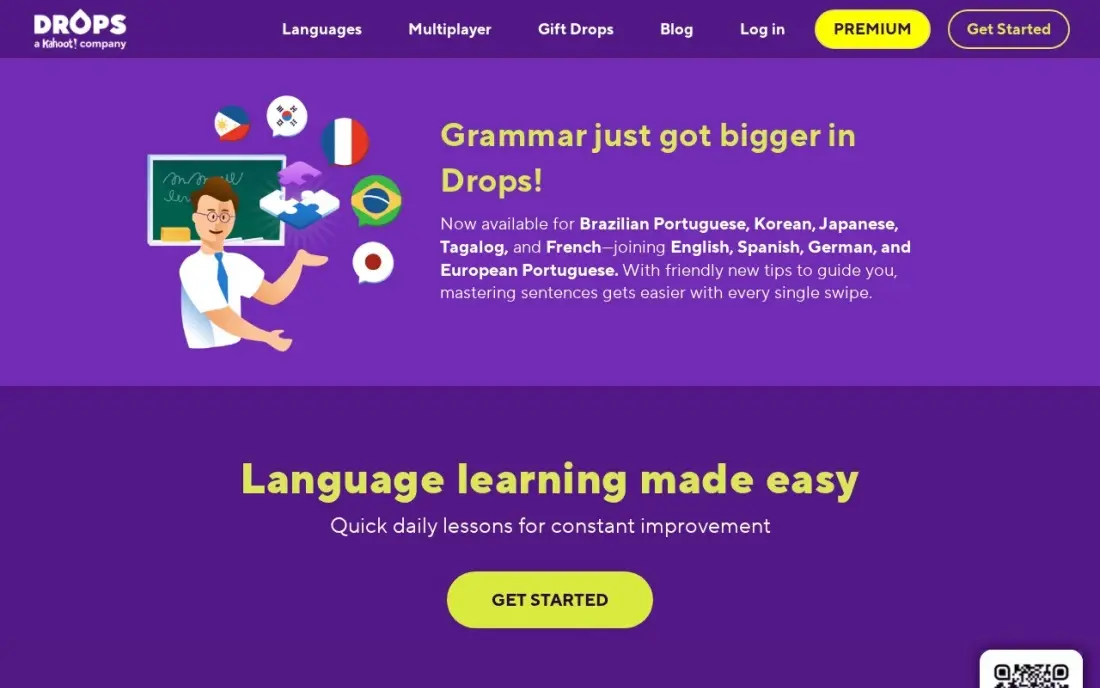
Drops' free plan gives five minutes of Japanese vocabulary a day, forever. Each word is shown with an illustration and audio, which ties the word to a picture rather than to English, and short daily sessions keep vocabulary growing alongside a main course.
It is vocabulary only, with no grammar or sentence practice, so it cannot teach you to put words together. Premium removes the time limit for $12.99 a month or $69.99 a year, and a lifetime plan costs $159.99 once. Trustpilot reviewers raise billing and auto-renewal complaints, so note any trial end date.
What we like
- Every word is taught with an illustration, so vocabulary sticks without translation drills
- Five-minute sessions fit any day, and the free plan never expires
- The annual plan costs $69.99 a year, about $5.83 a month
- A one-time lifetime plan at $159.99 ends the subscription entirely
Watch out for
- Vocabulary only — no grammar, no sentences, no conversation practice
- The free plan stops after five minutes a day, so serious study needs Premium
- Trustpilot scores 2.8 out of 5 from only 16 reviews, with complaints about billing and auto-renewal
LingQ
Best for: Intermediate learners who want to read real Japanese, with a small free allowance
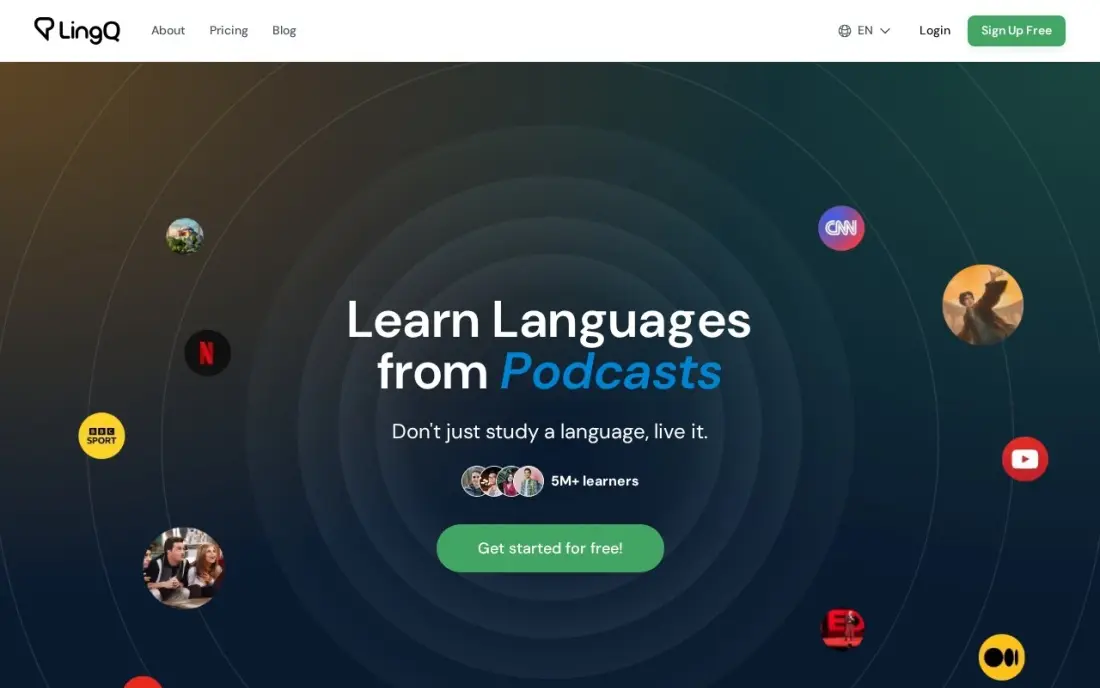
LingQ helps once you can read kana and some kanji. Import a Japanese article, a story or a video transcript, and every unknown word is one tap from a definition, then saved for spaced review. Reading real material is how kanji you learned in WaniKani or Anki start to stick in context.
The free plan is very limited: 20 saved words and five imported lessons, enough to test the method only. Premium costs $14.99 a month or $119.99 a year, and AI features need Premium Plus at $29.99 a month. Trustpilot reviewers report bugs and slow support.
What we like
- Import any article, book or video and study it as a lesson, with every unknown word one tap away
- One subscription covers all 50-plus languages
- Spaced-repetition review is built around the words you actually looked up
Watch out for
- The free plan caps at 20 saved words, which runs out in a single lesson
- AI features and tutoring points sit on Premium Plus at $29.99 a month, not Premium
The best app to learn Japanese for free has to cover three jobs: the two kana scripts, kanji, and grammar that works differently from English. No single free app does all three well, so we compared seven apps by what their free plans actually give a Japanese learner, and what the upgrade costs if you need more. Every detail below was checked on the vendor's own pages in November 2026.
How to choose the free app to learn Japanese
- Learn kana first. Hiragana and katakana take a few weeks; after that, avoid apps that rely on romanised Japanese.
- Plan a separate kanji tool. General course apps teach few kanji; WaniKani and Anki are built for it.
- Check the free plan's limits. Duolingo's free plan covers its whole course; WaniKani stops after level 3, Drops after five minutes a day and LingQ at 20 saved words.
- Find grammar explanations somewhere. Particles and verb forms need explaining; Busuu Premium does it in-app, or use a free grammar guide.
- Get listening in early. Memrise's native-speaker clips and real content through LingQ train your ear beyond app voices.
- Upgrade where you stall. If kanji is the bottleneck, pay for WaniKani rather than a second course app.
For free tools in other languages, see our guide to the best free language apps. If you want paid tutoring or a multi-language subscription, the best language learning platforms guide covers those.
Japanese app pricing: what you will actually pay
A learner who uses only the free plans pays $0: Duolingo's full Japanese course, WaniKani's first 3 levels, Anki on desktop, Android and the web, and the free tiers of Busuu, Memrise and Drops cost nothing. The one-off exception is AnkiMobile for iPhone and iPad at $24.99.
If you pay for one app for a year on annual billing, Memrise Pro costs $61.99, Drops $69.99, Busuu Premium $72.99, Duolingo Super $83.99, WaniKani $89 and LingQ Premium $119.99. WaniKani also sells lifetime access for $299, which pays off after about three and a half years compared with annual billing. A strong budget setup is Duolingo free plus Anki free, adding WaniKani at $89 a year once you are serious about reading.
Know the difference: course apps vs kanji tools
A course app such as Duolingo or Busuu teaches Japanese as a sequence: words, sentences, grammar points and listening, with exercises to check each step. It is the right starting point because it controls difficulty, but course apps introduce kanji slowly, so learners who rely on them alone often cannot read a menu after a year.
A kanji tool such as WaniKani or Anki does one job: it gets thousands of characters and their readings into long-term memory with spaced repetition. WaniKani follows a fixed path with mnemonics; Anki drills whatever deck you load. Neither teaches grammar or speaking. Most successful self-taught learners run one of each in parallel.
Quick comparison: tool type by need
| Buyer | Best pick | Why |
|---|---|---|
| Complete free start | Duolingo | Whole Japanese course free, with ads and an energy limit |
| Structured kanji | WaniKani | First 3 levels free, then $89/year |
| Free flashcards | Anki | Unlimited decks free; iPhone app $24.99 once |
| Free corrections | Busuu | Basic lessons free with native-speaker feedback |
| Free listening clips | Memrise | Limited free lessons with native-speaker videos |
| Five minutes a day | Drops | Illustrated Japanese vocabulary free daily |
| Reading real Japanese | LingQ | Small free allowance, Premium $119.99/year |
Mistakes to avoid
- Staying on romaji. Reading Japanese in Latin letters slows you down and stops kanji from sticking; switch to kana early.
- Skipping kanji until later. Kanji is the biggest long-term job; starting a little each day beats a backlog.
- Adding too many reviews. Anki and WaniKani pile up reviews quickly; keep new items to a number you can review every day.
- Learning words without context. Add example sentences to flashcards so you learn how a word is used.
- Ignoring speaking. Free apps lean to reading; speak aloud during lessons and find a conversation partner when you can.
How we chose
We checked each app's own pricing and product pages in November 2026 and recorded what each free plan includes and what the paid plans cost, with annual and monthly billing stated separately. We ranked the apps by how far a Japanese learner can get without paying, then by the value of the upgrade. Where ratings appear, they come from the review pages listed in the sources on the dates shown. No vendor paid for a place in this list, and none of the links here are affiliate links.
What to do next
Learn hiragana this week, start Duolingo's free Japanese course, and open WaniKani's free levels once you can read kana. If you run a Japanese school or course and want more learners to find it, book a free SEO review.
Frequently asked questions
What is the best app to learn Japanese for free?
Duolingo is the best free app to start Japanese, because its free plan includes the whole course with ads and an energy limit. For kanji, use WaniKani's free first 3 levels and Anki, which is free on desktop, Android and the web.
Can I learn Japanese for free?
You can learn kana, basic grammar and a few hundred kanji free with Duolingo, Anki, WaniKani's free levels and the free tiers of Busuu, Memrise and Drops. Reaching fluent reading and conversation usually needs more practice material and speaking with people.
What is the best free app for kanji?
WaniKani's first 3 levels are free and teach kanji with radicals and mnemonics; after that it costs $9 a month or $89 a year. Anki is free for unlimited kanji flashcards on desktop, Android and the web.
Is Duolingo enough to learn Japanese?
No. Duolingo is a good free start for vocabulary and simple sentences, but its kanji coverage and grammar explanations are limited. Add a kanji tool such as WaniKani or Anki and a grammar resource.
What do the paid Japanese apps cost?
Billed annually, Memrise Pro costs $61.99 a year, Drops $69.99, Busuu Premium $72.99, Duolingo Super $83.99, WaniKani $89 and LingQ Premium $119.99. AnkiMobile for iPhone costs $24.99 once.
Should I learn hiragana before using an app?
Learning hiragana and katakana in the first week or two makes every app easier, because you stop relying on romanised text. Most learners can learn both scripts in a few weeks with daily practice.
Sources we checked (10)
- Duolingo — www.duolingo.com/super (checked November 4, 2026)
- WaniKani — knowledge.wanikani.com/getting-started/account-and-membership/payment-and-billing/wanikani-premium-membership (checked November 4, 2026)
- Anki — apps.ankiweb.net (checked November 4, 2026)
- Anki reviews on G2 (checked November 4, 2026)
- Busuu — www.busuu.com (checked November 4, 2026)
- Memrise — www.memrise.com (checked November 4, 2026)
- Drops — languagedrops.com (checked November 4, 2026)
- Drops reviews on Trustpilot (checked November 4, 2026)
- LingQ — www.lingq.com/pricing (checked November 4, 2026)
- LingQ reviews on Trustpilot (checked November 4, 2026)
Make one of these tools?
We re-check this list every quarter. Send a correction, request a review, or ask about a clearly labeled sponsored spot.
Request a listingShamim
Founder of SerpAstra
A full-stack digital marketer and SEO strategist covering technical and local SEO, AI search visibility, paid ads and lead generation for local businesses, e-commerce brands and SaaS teams.
Free SEO and AI visibility audit
Find out what is holding your rankings back
Send us your site. Within 2 business days you get a written audit, an AI visibility check and a short fix list ranked by impact. Free, with no contract attached.
Request my free audit→Related buying guides
 Education & E-Learning7 Best Free Language Apps in 2026, ComparedCompare the 7 best free language apps on what the free plan really covers, its daily limits, and what the paid upgrade costs if you decide to stay with it.Read guide →
 Education & E-Learning8 Best Language Learning Platforms in 2026, ComparedCompare the 8 best language learning platforms, from apps like Duolingo and Babbel to tutor sites like italki and Preply, on method, free plans and real cost.Read guide →
 Education & E-Learning7 Best Apps to Learn Russian for Free in 2026Compare the 7 best apps to learn Russian for free: what each free plan covers, from Cyrillic to cases, and what the paid upgrade costs if you need more.Read guide →