
Best Apps to Learn Mexican Spanish (2026): 7 Apps Worth Downloading
Compare the 7 best app to learn mexican spanish options, from Babbel's dedicated Mexican course to Duolingo's free lessons, with real 2026 prices.
 Shamim Mia, Founder, SerpAstraLast verified November 4, 202615 min read
We compare pricing pages, documentation and public reviews. We never accept payment for rankings.

Key takeaways
- Babbel leads for most learners at $17.95/month, Duolingo is the best free start with Super at $12.99/month, and Pimsleur is the speaking pick from $14.95/month.
- The single most important buying factor is the variety: pick an app that teaches Latin American or explicitly Mexican Spanish, not Spain Spanish.
- Four of the seven apps have genuinely free plans — Duolingo, Busuu, Memrise and Mondly — so you can study for weeks before paying.
- Annual billing cuts the price by 40–80%: Mondly drops from $119.88 to $47.99 a year, and Memrise Pro from $299.88 to $61.99.
On this page
Quick comparison
| Tool | Best for | Starting price | Free plan |
|---|---|---|---|
| Babbel | Adults who want structured lessons in explicitly labeled Mexican Spanish, with grammar explained | $17.95/mo | No (first lesson free) |
| Duolingo | Beginners who want to start Mexican Spanish free and build a daily habit before paying | $12.99/mo | Yes (free plan) |
| Pimsleur | Commuters and audio-first learners who want to speak Latin American Spanish out loud | $14.95/mo | No (7-day trial) |
| Rosetta Stone | Visual learners who want immersion with no English translations and a Latin American Spanish course | $19.99/mo | No (7-day trial) |
| Busuu | Budget learners who want a long structured course in Latin American Spanish with certificates | $12.49/mo | Yes (free plan) |
| Memrise | Learners who want Mexican vocabulary and expressions from native-speaker videos and AI conversation practice | $24.99/mo | Yes (free plan) |
| Mondly | Casual learners who want quick daily lessons and chatbot conversation practice at the lowest annual price | $9.99/mo | Yes (free plan) |
Make one of these tools?
We re-check this list every quarter. Send a correction, request a review, or ask about a clearly labeled sponsored spot.
Request a listingThe best apps to learn Mexican Spanish
Babbel
Best for: Adults who want structured lessons in explicitly labeled Mexican Spanish, with grammar explained
Babbel is the structured pick and the only app here that lets you choose Mexican Spanish by name. Lessons run 10 to 15 minutes and pair a short dialogue with grammar notes, so you learn why a sentence works instead of just repeating it. The Spanish course runs five levels, and review sessions bring words back on a spaced schedule. The first lesson of each course is free, enough to judge the format before paying.
The catch is the price structure and the ceiling. A single month costs $17.95, while the 12-month plan is $107.40 upfront, shown as $8.95 a month. There is no free plan beyond the first lesson, and the Mexican Spanish course stops before the advanced levels, so advanced learners need other material. Pick Babbel when you want a syllabus and a named Mexican course.
What we like
- The only app here with a dedicated, explicitly labeled Mexican Spanish course — pick it instead of Spain Spanish at sign-up
- Short 10–15 minute lessons pair dialogues with grammar notes, so you learn why a sentence works
- Five levels from A1 to C1 on the Spain course, with review sessions that use spaced repetition
- Babbel Speak adds AI conversation practice to rehearse real dialogues
Watch out for
- No free plan — only the first lesson of each course is free, so you pay before knowing if the style fits
- The Mexican Spanish course stops before the advanced levels, so long-term learners need other material
- The $8.95 monthly figure is the 12-month plan paid upfront ($107.40); month-to-month costs $17.95

Duolingo
Best for: Beginners who want to start Mexican Spanish free and build a daily habit before paying
Duolingo is the easiest place to start, and it costs nothing to begin. The Spanish course mainly teaches Latin American Spanish, the variant spoken in Mexico, and lessons move through vocabulary, listening and sentence building in short bursts. The streak system and leagues push you to return every day, and the free plan covers the full course, so a beginner can study for months before paying anything.
The free plan has real limits: ads interrupt lessons, and the energy system stops practice after too many mistakes until it refills. Super costs $12.99 a month, or $83.99 a year, and removes both limits with unlimited practice and review sessions. The catch is that Duolingo tests prices on users, so your app may show a different figure. Pick Duolingo when you want a free start and a daily habit.
What we like
- The Spanish course mainly teaches Latin American Spanish, the variant spoken in Mexico
- Free plan covers the full course, so you can learn for months without paying
- Streaks, leagues and short game-like lessons make daily practice easy to keep
- Super removes ads and the energy limit, with unlimited practice and review sessions
Watch out for
- Free plan has ads and an energy limit that stops practice after too many mistakes
- Lessons stay close to set patterns, so learners can score well in the app yet struggle in real conversation
- Super prices vary by account and test group — the app store lists $9.99 and $12.99 monthly and $83.99 to $119.99 yearly

Pimsleur
Best for: Commuters and audio-first learners who want to speak Latin American Spanish out loud
Pimsleur is the audio pick: 30-minute lessons that ask you to listen and respond out loud, using graduated recall so words return at increasing intervals until they stick. The Spanish catalog separates Latin American from Spain Spanish, and the Latin American course features native speakers, including speakers from Mexico. You can study hands-free on a commute or a workout, and every level of the course is included.
The entry price needs care. Audio-Only costs $14.95 a month for one language, but it has no practice tools — Voice Coach pronunciation feedback and flashcards need Premium at $19.95. All Access costs $20.95 a month or $164.95 a year and adds every language, so it is the better buy if you might try a second language. Pick Pimsleur when speaking and listening matter more than reading.
What we like
- Separate Latin American and Spain Spanish courses, with native speakers including speakers from Mexico
- 30-minute audio lessons prompt you to listen, recall and answer out loud, so speaking starts on day one
- Hands-free format works on a commute, a workout or household chores
- All Access at $20.95 a month adds every language for $1 more than single-language Premium
Watch out for
- Audio-Only at $14.95 has no practice tools — Voice Coach and flashcards need Premium at $19.95
- No free plan, only a 7-day free trial, and Pimsleur takes payment details first
- The Latin American course is a broad regional model, not a course in Mexican Spanish specifically

Rosetta Stone
Best for: Visual learners who want immersion with no English translations and a Latin American Spanish course
Rosetta Stone teaches by matching pictures, sounds and words, with no English translations in the core lessons. The idea is that you absorb patterns the way a child does, and the Latin American Spanish course covers the Mexican variant, so the pronunciation and everyday words match Mexico rather than Spain. TruAccent speech recognition scores your pronunciation on every phrase you speak.
The price is the highest entry cost in this list: Sapphire costs $19.99 a month or $159 a year, and the 2026 Sapphire app replaced the old Classic product, so new customers can no longer buy a lifetime plan. There is no free plan, only a 7-day free trial, and there are no grammar explanations in English. Pick Rosetta Stone when immersion and pronunciation matter most.
What we like
- Latin American Spanish course, so the pronunciation and vocabulary match Mexico, not Spain
- Lessons stay in Spanish from the first minute — pictures, sounds and words, with no translation
- TruAccent speech recognition scores your pronunciation on every spoken phrase
- One subscription covers all 25 languages, so a second language costs nothing extra
Watch out for
- No free plan, only a 7-day free trial, and the new Sapphire app has no lifetime plan for new customers
- No grammar explanations in English, so learners who want to know why a sentence works will feel lost
- Most expensive entry price here at $19.99 a month, with tutoring sessions costing extra

Busuu
Best for: Budget learners who want a long structured course in Latin American Spanish with certificates
Busuu is the budget structured pick: its Complete Latin American Spanish course runs 510-plus lessons from A1 to C1, with grammar review, vocabulary practice and offline mode on Premium. The feature no rival matches at this price is community feedback — native speakers correct your written and spoken exercises. Premium costs $12.49 a month or $72.99 a year, and completed levels earn CEFR certificates.
The free plan is a taster, not a course: it gives basic lessons with ads and locks grammar lessons and community feedback behind Premium. AI Conversations, pronunciation feedback and Mistake Repair wait for Premium Plus at $14.90 a month. Busuu also tests prices on visitors, so your checkout may show a different figure. Pick Busuu when you want a long structured course for the lowest annual price.
What we like
- Complete Latin American Spanish course with 510+ lessons from A1 to C1
- Native speakers correct your written and spoken exercises, which no other app here offers at this price
- CEFR certificates for completed levels, plus offline mode and grammar review on Premium
- Cheapest structured annual plan here at $72.99 a year, about $6.08 a month
Watch out for
- Most of the best features — grammar lessons, offline mode, certificates — sit behind the Premium paywall
- Premium Plus adds AI Conversations for $14.90 a month, so the AI practice costs extra
- Busuu tests different prices on different visitors, so the figure you see may differ

Memrise
Best for: Learners who want Mexican vocabulary and expressions from native-speaker videos and AI conversation practice
Memrise is the vocabulary pick: a dedicated Spanish (Mexico) course built around practical scenarios, with lessons that use native-speaker videos to show how words and phrases sound in context. Pro adds unlimited AI conversation practice through AI Buddies, plus grammar and conjugation help, and the free plan covers limited vocabulary lessons and videos, so you can test the style first.
The monthly price is the highest in this list at $24.99, which makes the annual plan the only sensible buy — $61.99 a year, about $5.17 a month. Memrise also teaches no systematic grammar, so it works best paired with a structured course like Babbel, and the catalog is narrower since community courses left the main app. Pick Memrise for Mexican vocabulary and listening.
What we like
- Dedicated Spanish (Mexico) course with lessons built around practical scenarios and native-speaker videos
- AI Buddies give unlimited speaking practice with grammar and conjugation help on Pro
- 30,000 native-speaker videos show how words sound in real context, not just in drills
- Annual plan at $61.99 a year is about $5.17 a month — far cheaper than the monthly rate
Watch out for
- Highest monthly price here at $24.99 — paying month to month costs nearly five times the annual rate
- No systematic grammar teaching, so it works best paired with another resource
- Memrise removed user-generated community courses from the main app, so the catalog is narrower than it once was

Mondly
Best for: Casual learners who want quick daily lessons and chatbot conversation practice at the lowest annual price
Mondly is the casual pick: short lessons built around everyday topics such as travel, family and restaurants, mixing listening, speaking and reading in quick exercises. A chatbot lets you rehearse simple conversations without the pressure of a real partner, and the free tier gives a daily lesson, which is enough to test the style. Premium costs $9.99 a month on the web, or $47.99 a year.
The annual plan is the cheapest in this list, but the price depends on where you buy — app-store prices run higher, around $15.90 a month on iOS, so subscribe on the web. Lessons stay shallow, with little difference between the three learning levels, and reviewers report no refunds once you pay. Pick Mondly when you want quick daily practice at the lowest yearly cost.
What we like
- Cheapest annual plan here at $47.99 a year, about $4 a month, with access to all 41 languages
- Chatbot conversations let you rehearse simple dialogues without the pressure of a real partner
- Daily Lesson, speech recognition and grammar guides keep short sessions varied
- Free tier gives a daily lesson, enough to test the style before paying
Watch out for
- App-store prices run higher than the web price — about $15.90 a month on iOS — so buy on the web
- Lessons stay shallow, with little difference between the three learning levels
- No refunds once you pay, according to reviewers, so the trial matters more than the price
The best app to learn mexican spanish is the one that teaches the variety spoken in Mexico — Latin American Spanish — not the Spanish of Spain. Spain Spanish pronounces z, ce and ci like the th in think, uses vosotros for the informal plural you, and swaps in different everyday words, so learning that variety means sounding foreign in Mexico City or Guadalajara. The seven apps below all teach Latin American Spanish, and Babbel and Memrise go further with courses labeled Mexican Spanish by name. Every price was verified on November 4, 2026, and the list is ranked by fit for the most common buyer: an English speaker starting from zero who wants to speak, not just pass quizzes.
Most of these apps sell the same promise — a few minutes a day and you will speak Spanish — but they teach in very different ways. Babbel is a classroom in your pocket, Duolingo is a game, Pimsleur is an audio course, and Rosetta Stone is pictures and sound with no English at all. The cards below show the real starting price for each app, what the free plan actually covers, and where the extra charges hide.
How to choose the best app to learn mexican spanish
- Pick the variety first. Babbel and Memrise label their courses Mexican Spanish; Duolingo, Pimsleur, Rosetta Stone and Busuu teach Latin American Spanish, which is the right family. If an app offers only Spain Spanish, skip it for this goal.
- Decide how you learn. Audio learners do best with Pimsleur, visual learners with Rosetta Stone, readers who want grammar with Babbel, and habit-builders who need a nudge with Duolingo. The method matters more than the brand.
- Check the free plan's real limits. Duolingo's free plan covers the full course with ads and an energy limit; Busuu, Memrise and Mondly give basic lessons free; Babbel gives only the first lesson; Pimsleur and Rosetta Stone give only a 7-day trial.
- Price the annual plan, not the monthly headline. Mondly is $9.99 a month but $47.99 a year, and Memrise Pro is $24.99 a month but $61.99 a year. The monthly figure is the most expensive way to buy every app here.
- Test speaking, not just tapping. A streak proves you opened the app, not that you can order food. Use the trial to speak out loud — Pimsleur forces it, Babbel Speak and Memrise AI Buddies rehearse it, and the rest only grade it.
- Check where the course stops. Babbel's Mexican Spanish course ends before the advanced levels, and no app here takes you to fluency alone. Plan on real conversation — a tutor, a language exchange, a trip — once the course runs out.
Learning a language is one system in your week, not the whole week. If you also run a site about learning Spanish, our guide to Spanish learning apps covers the wider field, and our monthly SEO service handles the visibility side. Before you publish new pages for the courses you sell, run your titles through the free SERP snippet preview tool — it shows exactly how the title and description will look in Google.
Whatever you shortlist, try it with real study before you pay. The free plans and trials in this list are long enough to run one genuine week — your commute, your evenings, your voice — and that week tells you more than any review can. Check two things in the trial: that the app teaches the Mexican variety you need, and that you actually open it every day.
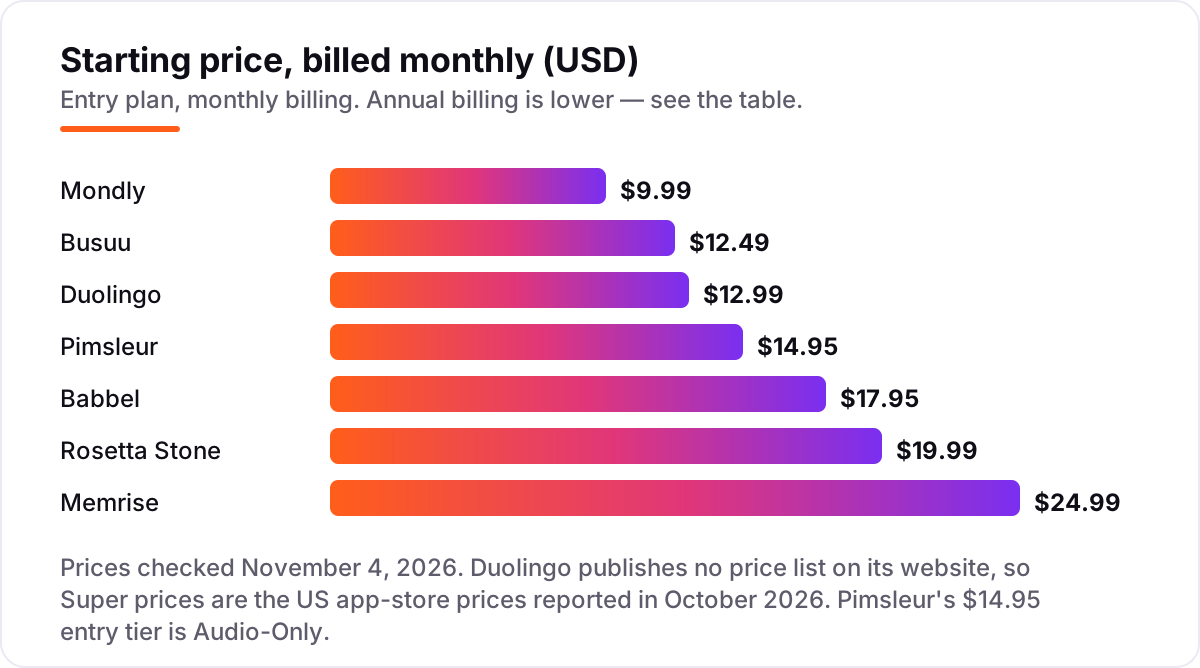
Mexican Spanish app pricing: what you will actually pay
Take one learner studying for a full year. On monthly billing, twelve months cost $119.88 on Mondly Premium, $149.88 on Busuu Premium, $155.88 on Duolingo Super, $179.40 on Pimsleur Audio-Only, $215.40 on Babbel, $239.88 on Rosetta Stone Sapphire and $299.88 on Memrise Pro. The same learner on annual billing pays $47.99 on Mondly, $61.99 on Memrise Pro, $72.99 on Busuu Premium, $83.99 on Duolingo Super, $107.40 on Babbel, $159 on Rosetta Stone and $164.95 on Pimsleur All Access — note Pimsleur's annual plan is All Access only, not the $14.95 Audio-Only tier.
The gap between the two columns is the whole story. Paying monthly instead of annually costs 60% more on Mondly, 51% more on Busuu, 46% more on Duolingo Super, 50% more on Babbel, 34% more on Rosetta Stone and 79% more on Memrise Pro, where twelve monthly payments total $299.88 against $61.99 for the year. If you are sure you will keep going, pay for the year; if you are not sure, pay for one month and decide after thirty days, because every app here renews automatically and the annual plans charge the full year upfront.
Three costs sit outside every number above. First, the tier gap: Pimsleur's $14.95 Audio-Only plan has no practice tools, so the real app experience starts at Premium, $19.95 a month, and Busuu's AI Conversations wait for Premium Plus at $14.90. Second, the channel gap: Mondly costs $9.99 a month on the web but about $15.90 on iOS, and Duolingo's Super price changes with your account and test group, so buy on the web and check the figure at checkout. Third, the ceiling: Babbel's Mexican course stops before the advanced levels, so a learner who sticks with it will eventually pay for a tutor or a second resource. If speaking is the goal rather than the app, compare the AI helpers in our guide to AI Spanish learning apps.
Know the difference: Mexican Spanish vs Spain Spanish
The confusion in this category is between a language and a variety. Spanish is one language, but the Spanish of Mexico and the Spanish of Spain differ in sound, grammar and everyday words — enough that learning the wrong one means sounding foreign where you actually plan to speak. Mexico uses seseo, so z, ce and ci sound like s, while Spain pronounces them like the th in think. Mexico says ustedes for the informal plural you; Spain says vosotros, with its own verb forms. Everyday words change too: a car is a carro in Mexico and a coche in Spain, a computer is a computadora in Mexico and an ordenador in Spain.
A second distinction worth knowing is Latin American Spanish versus Mexican Spanish. Latin American Spanish is a broad family that covers Mexico, Colombia, Argentina and a dozen other countries, and most apps teach that broad variety — Duolingo, Pimsleur, Rosetta Stone and Busuu all do. Mexican Spanish is one variety inside that family, with its own slang, rhythm and expressions, and only Babbel and Memrise label a course Mexican Spanish by name. A broad Latin American course is the right starting point, and it will serve you well in Mexico; a labeled Mexican course is better still, because its dialogues and vocabulary come from Mexico itself.
A third distinction is the course label versus the content. An app can call its course Latin American Spanish and still use speakers from several countries, and a Mexican-labeled course can still stop at the intermediate level — Babbel's does. Check the label, then check the level: an app that teaches Mexican Spanish only through A2 is a beginner tool, not a complete course, and a broad Latin American course that runs to C1 may take you further in the end.
Quick comparison: tool type by need
| Buyer | Best pick | Why |
|---|---|---|
| Adult who wants structure and grammar | Babbel | Dedicated Mexican Spanish course, 10–15 minute lessons, $17.95/month |
| Beginner who wants to start free | Duolingo | Free plan covers the full Latin American Spanish course |
| Commuter who learns by listening | Pimsleur | 30-minute audio lessons, Latin American Spanish, from $14.95/month |
| Visual learner who wants immersion | Rosetta Stone | No English translations, Latin American Spanish, $19.99/month |
| Budget learner who wants a long course | Busuu | 510+ Latin American Spanish lessons, $72.99 a year |
| Learner who needs Mexican vocabulary | Memrise | Spanish (Mexico) course with native-speaker videos, $61.99 a year |
| Casual learner on the cheapest year | Mondly | Daily lessons and a chatbot, $47.99 a year on the web |
Mistakes to avoid
- Paying for Spain Spanish by mistake. If the app offers only a Spain course, or defaults to it at sign-up, you will learn vosotros verb forms and a th sound that mark you as a learner in Mexico. Babbel asks you to choose Mexican or Spain Spanish — pick Mexican. Duolingo, Pimsleur, Rosetta Stone and Busuu teach Latin American Spanish, so the risk is lower, but check the label before paying.
- Budgeting on the annual price while paying monthly. Annual billing is 34–79% cheaper, but it means paying a year upfront. Memrise Pro is $61.99 a year and $24.99 a month; Babbel is $107.40 a year and $17.95 a month. Compare apps on the billing term you will actually use.
- Assuming the free plan teaches the whole course. Duolingo's free plan does cover the full course, but Busuu, Memrise and Mondly give only basic lessons free, Babbel gives only the first lesson, and Pimsleur and Rosetta Stone give only a 7-day trial. A free tier is a test, not a course.
- Buying the cheapest tier without checking what it includes. Pimsleur's $14.95 Audio-Only plan has no practice tools — Voice Coach and flashcards need Premium at $19.95 — and Busuu's AI Conversations need Premium Plus at $14.90. The entry price is real, but it may not be the price of the features you want.
- Expecting one app to take you to fluency. No app here does. Babbel's Mexican course stops before the advanced levels, Duolingo's lessons stay close to set patterns, and Memrise teaches no systematic grammar. Use the app to build the base, then add real conversation — a tutor, a language exchange, a trip — once the course runs out.
How we chose
We checked each vendor's own pricing page on November 4, 2026 and recorded the starting price exactly as shown, including the annual-billing figure where the page lists one, and we ranked the apps by fit for the most common buyer — an English speaker starting from zero who wants to learn the Spanish spoken in Mexico — not by brand size. Three prices needed a workaround. Duolingo publishes no price list on its website, so its $12.99 monthly and $83.99 annual Super prices are the US app-store prices reported by independent reviewers in October 2026, and Duolingo tests prices on users, so your app may show a different figure. Memrise prices vary by channel: we use the US web and App Store figures reported in late October 2026, $24.99 a month and $61.99 a year, while some review pages list $8.99 and $59.99. Mondly's $9.99 monthly and $47.99 annual figures are the web prices; the App Store charges more, around $15.90 a month on iOS, and some review pages list $12.90 and $61.92. Busuu's Premium Plus price also varies between sources, $14.90 or $16.99 a month, but the entry Premium price of $12.49 a month is consistent. Ratings are omitted from this list: the G2 pages for these apps could not be opened on November 4, 2026, and app-store ratings are not G2, Capterra or Trustpilot, so no rating is shown rather than an unverified one. No vendor paid for a place in this list, and none of the links here are affiliate links.
What to do next
Start with the free plan or trial of your top pick and run one real week of study through it. Check that the app teaches the Mexican variety you need, that you actually open it every day, and that the speaking practice — not just the tapping — feels like progress before you commit to a year. If the app is sorted but new customers are not finding your language school or tutoring site, our monthly SEO service handles the visibility side — or compare AI helpers in our guide to AI Spanish learning apps. Once your tools are in place, find out what's holding your rankings back.
Your stack only works if people find you
SerpAstra fixes what keeps your site off page one and makes it easy for AI assistants to recommend.
Get a free audit→Sources we checked (9)
- Babbel pricing — babbel.com/pricing (checked November 4, 2026)
- Duolingo Super — duolingo.com/super (checked November 4, 2026)
- Pimsleur pricing — pimsleur.com (checked November 4, 2026)
- Rosetta Stone plans — rosettastone.com/buy (checked November 4, 2026)
- Busuu pricing — busuu.com (checked November 4, 2026)
- Memrise pricing — memrise.com (checked November 4, 2026)
- Mondly pricing — mondly.com (checked November 4, 2026)
- Best Apps to Learn Spanish (2026) — toolradar.com (checked November 4, 2026)
- Best Apps to Learn Mexican Spanish in 2026 — italki.com (checked November 4, 2026)
Shamim
Founder of SerpAstra
A full-stack SEO and digital marketer who spends most days on Local SEO for dental practices, AI search visibility and lead generation.
Frequently asked questions
What is the best app to learn Mexican Spanish?
Babbel is the best fit for most learners: a dedicated Mexican Spanish course, structured 10–15 minute lessons and grammar notes, from $17.95 a month or $107.40 a year. Duolingo is the best free start, with a Latin American Spanish course and a free plan. Pimsleur is the best choice when speaking and listening matter most.
Can I learn Mexican Spanish for free?
Yes, up to a point. Duolingo's free plan covers the full course with ads and an energy limit, and Busuu, Memrise and Mondly all have free tiers with basic lessons. The free tiers teach vocabulary and basics well, but speaking practice, grammar and full courses sit behind paywalls.
How much does it cost to learn Mexican Spanish with an app?
A year costs $47.99 on Mondly's annual plan and $61.99 on Memrise Pro, against $107.40 for Babbel, $72.99 for Busuu and $159 for Rosetta Stone. Paying month to month costs far more: $119.88 to $299.88 over twelve months. Duolingo Super is $83.99 a year.
Is Duolingo Spanish Mexican or Spain Spanish?
Duolingo's Spanish course mainly teaches Latin American Spanish, the variety spoken in Mexico, and it accepts other varieties as correct answers. It does not label the course Mexican Spanish, and it teaches no specifically Mexican vocabulary, so pair it with an app that does if Mexico is the goal.
Is Babbel or Duolingo better for Mexican Spanish?
Babbel is better when you want structure: it has a dedicated Mexican Spanish course, grammar explanations and five levels. Duolingo is better when you want to start free and build a daily habit. Many learners use Duolingo daily and add Babbel when they want grammar and a named Mexican course.
Do these apps teach you to speak, or just to tap answers?
It depends on the app. Pimsleur's audio lessons make you answer out loud, Babbel Speak and Memrise AI Buddies rehearse conversations, and Mondly's chatbot practices simple dialogues. Duolingo, Rosetta Stone and Busuu add speaking exercises, but none replaces talking to a real person.
Can I switch apps later if I pick the wrong one?
Yes, and it costs nothing but your progress, which does not transfer between apps. Your streak, level and review history stay in the old app. Switch when the method stops fitting, not when a sale appears, and keep the free plan of the old app running for a week while you test the new one.
Free SEO and AI visibility audit
Find out what is holding your rankings back
Send us your site. Within 2 business days you get a written audit, an AI visibility check and a short fix list ranked by impact. Free, with no contract attached.
Request my free audit→Related guides
 Consumer Apps12 Best Spanish Learning Apps for 2026, Tested on Features and PriceCompare the 12 best spanish learning app picks for 2026 on price, free plans and speaking practice, with every price checked November 4, 2026.Read guide →
 AI, Data & Analytics7 Best AI Spanish Learning Apps in 2026: Free and Paid Apps RankedThe 7 best ai spanish learning apps of 2026, ranked with real prices, free plans and AI conversation features — pick the app that fits how you actually study.Read guide →
 Consumer AppsBest Spanish Learning Apps for Kids (2026): 9 Apps Worth DownloadingCompare the 9 best spanish learning app for kids on price, free tiers, ages and speaking practice, with every price checked November 4, 2026.Read guide →