
12 Best Spanish Learning Apps for 2026, Tested on Features and Price
Compare the 12 best spanish learning app picks for 2026 on price, free plans and speaking practice, with every price checked November 4, 2026.
 Shamim Mia, Founder, SerpAstraLast verified November 4, 202615 min read
We compare pricing pages, documentation and public reviews. We never accept payment for rankings.
Key takeaways
- Duolingo is the best free start at $0, Babbel is the best structured course from $17.95/month, and SpanishPod101 is the cheapest paid plan at $8/month — the three-way short-list for most learners.
- The single most important buying factor is how you will actually practice speaking: apps that only drill words will not make you conversational, so pick one with speaking, feedback or live classes.
- Free plans are real but limited — Duolingo caps free practice with daily energy, Drops stops after five minutes a day, and LingQ caps free users at 20 saved words.
- Annual billing cuts most subscriptions by 40–60%: Babbel drops from $17.95 to $8.95 a month, Memrise from $24.99 to about $5.17, and Mondly's annual plan is often on sale at $61.92 a year.
On this page
Quick comparison
| Tool | Best for | Starting price | Free plan |
|---|---|---|---|
| Duolingo | Beginners who want a genuinely free start and a daily habit that sticks | $12.99/mo | Yes (free plan) |
| Babbel | Adults who want a structured, grammar-led course that gets them speaking in real situations | $17.95/mo | No (first lesson free) |
| Busuu | Budget learners who want a structured course plus corrections from native speakers | $12.49/mo | Yes (free plan) |
| Rosetta Stone | Beginners who learn best by immersion, with pictures and speech instead of translation | $19.99/mo | No (7-day trial) |
| Pimsleur | Commuters and hands-free learners who want to speak Spanish, not just read it | $14.95/mo | No (7-day trial) |
| LingQ | Intermediate learners who want to learn Spanish from real articles, podcasts and videos | $14.99/mo | Yes (free plan) |
| Memrise | Learners who remember words best from video of real native speakers | $24.99/mo | Yes (free plan) |
| Mondly | Casual learners who want short, game-like lessons with a chatbot to talk to | $12.90/mo | Yes (free plan) |
| Drops | Visual learners who want five minutes of vocabulary games a day | $12.99/mo | Yes (free plan) |
| SpanishPod101 | Audio learners who want the cheapest paid entry and a huge lesson library | $8/mo | Yes (free account) |
| FluentU | Intermediate learners who want to learn Spanish from real videos with interactive subtitles | $29.99/mo | No (14-day trial) |
| Lingoda | Serious learners who want live classes with a real teacher and a CEFR certificate | $64.99/cycle | No (7-day trial) |
Make one of these tools?
We re-check this list every quarter. Send a correction, request a review, or ask about a clearly labeled sponsored spot.
Request a listingThe best Spanish learning apps

Duolingo
Best for: Beginners who want a genuinely free start and a daily habit that sticks
Duolingo is the easiest place to start Spanish because the full course costs nothing: every lesson is open at $0, with ads and a daily energy limit as the only friction. Super costs $12.99 a month, or $83.99 a year, and removes the ads and the energy cap, adds offline lessons and one streak repair a month. The streaks, leagues and daily goals are the real product — they turn five minutes a day into a habit that survives busy weeks.
The trade-off is depth. Speaking practice is thin, grammar is taught by example rather than explanation, and some sentences sound unnatural. Buy Super when the free energy limit starts interrupting your daily practice; stay free while the habit is still forming, and pair Duolingo with Pimsleur or Babbel once you want to hold a real conversation.
What we like
- The only full Spanish course here that is genuinely free, with every lesson open at $0
- Streaks, leagues and daily goals make a five-minute habit stick better than any other app here
- Super removes the ads and the daily energy limit that interrupt free practice
- More than 40 languages in the same app, so a second language costs nothing extra
Watch out for
- Free practice stops when the daily energy runs out, which pushes most daily learners toward Super
- Speaking practice and grammar explanations stay thin compared with Babbel or Pimsleur
- Duolingo publishes no price list — the Super price shows only inside the app or app store
Babbel
Best for: Adults who want a structured, grammar-led course that gets them speaking in real situations
Babbel is the most structured course in this list: short lessons built by language experts, with grammar explained in plain English and speaking practice from the first unit. The 1-month plan costs $17.95, the 12-month plan costs $107.40 a year — $8.95 a month — and Lifetime costs $299.99 once. Babbel Speak, the AI conversation partner, is included in every paid plan, and speech recognition checks your pronunciation on every speaking exercise.
The catch is the free tier, or rather the lack of one: only the first lesson of each course is free, so you pay before you know whether the method suits you. The 20-day money-back guarantee softens that, and the 12-month plan is the sensible buy. Pick Babbel when you want a real syllabus and clear grammar; pick Duolingo when the budget is $0.
What we like
- Short, structured lessons built by language experts, with grammar explained rather than guessed
- Babbel Speak AI conversation practice is included in every paid plan, not a higher tier
- Speech recognition checks pronunciation on every speaking exercise
- Highest reviewer score here on Trustpilot at 4.4 out of 5 from more than 33,000 reviews
Watch out for
- No real free plan — only the first lesson of each course is free
- The monthly price is the dearest way to buy; the 12-month plan costs $8.95 a month
- Lessons can feel repetitive, and advanced learners outgrow the material

Busuu
Best for: Budget learners who want a structured course plus corrections from native speakers
Busuu pairs a structured course with something no other app at this price offers: native speakers who correct your written and spoken exercises. Premium costs $12.49 a month, or $72.99 a year — about $6.08 a month — and adds grammar and vocabulary review, offline mode and CEFR certificates. The free plan covers one language with basic lessons, which is enough to test the method before paying.
The limits sit on the higher tier. AI Conversations, pronunciation feedback and Mistake Repair need Premium Plus, and Busuu tests different prices on different visitors, so the checkout may show another figure. Choose Busuu when you want human feedback on a budget; choose Babbel when you want deeper grammar and AI speaking practice on the entry plan.
What we like
- Native speakers correct your written and spoken exercises, which no other app at this price does
- CEFR certificates for completed levels are included on Premium
- Annual billing drops Premium to $72.99 a year, about $6.08 a month
- Rated 4.3 out of 5 on G2, the joint-highest G2 score in this list
Watch out for
- AI Conversations and pronunciation feedback need Premium Plus, not Premium
- The free plan covers one language only, with basic lessons and ads
- Busuu tests different prices on different visitors, so your checkout may show another figure

Rosetta Stone
Best for: Beginners who learn best by immersion, with pictures and speech instead of translation
Rosetta Stone teaches Spanish the immersive way: pictures, audio and speech, with no English translation from the first lesson. The new Sapphire app costs $19.99 a month, or $159 a year, and covers all 25 languages, with TruAccent speech recognition on every spoken line and AI Chat Missions for guided conversation. A 7-day free trial starts in the mobile app and converts to the monthly plan unless you cancel.
The method has edges. Grammar is taught by example, never explained, which frustrates learners who want rules, and there is no lifetime plan for new buyers since Sapphire replaced Classic in 2026. Existing lifetime owners keep Classic but do not get Sapphire. Buy Rosetta Stone when immersion suits your brain; buy Babbel when you want the grammar spelled out.
What we like
- The immersion method teaches Spanish without English translation from the first lesson
- TruAccent speech recognition gives feedback on every spoken line
- The new Sapphire app adds AI Chat Missions for guided conversation practice
- Rated 4.2 out of 5 on G2 from 113 reviews
Watch out for
- No lifetime plan for new buyers since the Sapphire app replaced Classic in 2026
- Grammar is taught by example, not explanation, which frustrates learners who want rules
- At $19.99 a month it is one of the dearer subscriptions here, and the trial converts to monthly billing automatically

Pimsleur
Best for: Commuters and hands-free learners who want to speak Spanish, not just read it
Pimsleur is the audio-first course: 30-minute lessons that make you answer out loud, built for the commute, the gym and the dog walk. Audio-Only costs $14.95 a month for one language, Premium costs $19.95 with flashcards and the AI Voice Coach, and All Access costs $20.95 a month — or $164.95 a year — for all 51 languages. Five levels of 30 lessons take a beginner well past tourist Spanish.
The trade-off is the screen. Audio-Only has no practice tools and no transcripts, so reading and spelling lag behind speaking, and the subscription is not refundable — cancel before day 7 if it is not for you. Pick Pimsleur when speaking confidence is the goal; pick LingQ when you want to read and listen to real Spanish instead.
What we like
- Every lesson makes you speak out loud, so pronunciation and recall build faster than with tap-only apps
- Audio-first design fits driving, chores and walking, with no screen needed
- Five levels of 30 lessons take a beginner well past tourist Spanish
- All Access costs only $1 more a month than Premium and covers all 51 languages
Watch out for
- Audio-Only has no practice tools — flashcards and the AI Voice Coach need Premium at $19.95 a month
- No transcripts for the audio lessons, so reading and spelling lag behind speaking
- Subscription charges are not refunded, so cancel before day 7 if it is not for you

LingQ
Best for: Intermediate learners who want to learn Spanish from real articles, podcasts and videos
LingQ is built on a simple idea: learn Spanish from content you actually want to read and hear, not from drills. Import any article, podcast transcript or video, and every unknown word becomes a flashcard with one tap. Premium costs $14.99 a month, or $119.99 a year, and removes the free plan's cap of 20 saved words and 5 imported lessons, with unlimited imports and offline access.
The catch is the starting point. LingQ suits learners who already know some Spanish; true beginners can drown in real content with no handrails. The AI features and tutoring points sit on Premium Plus at $29.99 a month. Choose LingQ once you can read simple Spanish; start with Duolingo or Babbel until then.
What we like
- Import any article, book or video and study it as a lesson, with every unknown word one tap away
- One subscription covers all 50-plus languages, including Spanish
- Spaced-repetition review is built around the words you actually looked up
- The 24-month plan drops the price to $8.99 a month
Watch out for
- The free plan caps at 20 saved words, which runs out in a single lesson
- AI features and tutoring points sit on Premium Plus at $29.99 a month, not Premium
- Trustpilot reviewers report bugs and slow support, with a 2.8 out of 5 score from 22 reviews

Memrise
Best for: Learners who remember words best from video of real native speakers
Memrise teaches vocabulary through thousands of short videos of native speakers, so you learn how Spanish sounds in real life rather than in a studio. Pro costs $24.99 a month — the highest monthly rate in this list — but the annual plan costs $61.99 a year, about $5.17 a month, and unlocks all lessons, unlimited AI conversation practice with AI Buddies, offline downloads and an ad-free experience.
The weakness is structure. Memrise teaches words and phrases, not grammar, so you will need another app to build sentences, and its Trustpilot score of 1.6 out of 5 reflects billing complaints and anger over the 2024 removal of community courses. Buy the annual plan, never the monthly one, and only if video vocabulary is what you are missing.
What we like
- Thousands of short videos of native speakers show how Spanish sounds in real life, not in a studio
- AI Buddies give unlimited conversation practice on the Pro plan
- The annual plan costs $61.99 a year, about $5.17 a month — a fifth of the monthly price
- Spaced-repetition review modes target the words you keep getting wrong
Watch out for
- The $24.99 monthly price is the highest monthly rate in this list by a wide margin
- No grammar instruction — Memrise teaches words and phrases, not how to build sentences
- Trustpilot sits at 1.6 out of 5 from 143 reviews, mostly about billing and the 2024 removal of community courses

Mondly
Best for: Casual learners who want short, game-like lessons with a chatbot to talk to
Mondly is the game-like option: short daily lessons, streaks and leaderboards, with a chatbot that holds simple conversations and speech recognition that checks your pronunciation. Premium costs $12.90 a month, and the annual plan lists at $154.80 but is often on sale — $61.92 for 12 months on the offer page in October 2026. One subscription covers all 40-plus languages, and the free plan gives daily lessons and challenges.
The warnings are about money, not lessons. There are no refunds once you pay, Trustpilot reviewers report trouble cancelling, and the $61.92 annual figure is a sale price that may not be there when you check. Grammar explanations are thin and speaking practice stays basic. Pick Mondly for fun daily practice; pick Babbel when you want a course with depth.
What we like
- Short daily lessons and a chatbot make ten minutes of practice feel like a game
- Speech recognition and AR conversation practice are included on Premium
- The annual plan is often on sale — $61.92 for 12 months on the offer page in October 2026
- One Premium subscription covers all 40-plus languages
Watch out for
- The $61.92 annual figure is a sale price; the list price is $154.80 a year
- No refunds once you pay, and Trustpilot reviewers report cancellation trouble
- Grammar explanations are thin, and speaking practice can feel too basic past beginner level

Drops
Best for: Visual learners who want five minutes of vocabulary games a day
Drops teaches vocabulary the visual way: every word comes with an illustration, and five-minute word games make the daily session feel like play rather than study. The free plan gives five minutes a day forever; Premium costs $12.99 a month, or $69.99 a year, and removes the time limit across all 56 languages. A one-time lifetime plan at $159.99 ends the subscription entirely.
The limit is scope. Drops teaches words only — no grammar, no sentences, no conversation — so it works as a supplement, not a course. Five minutes a day is also a ceiling for serious learners. Use Drops beside Babbel or Pimsleur to build vocabulary fast; do not expect it to make you conversational on its own.
What we like
- Every word is taught with an illustration, so vocabulary sticks without translation drills
- Five-minute sessions fit any day, and the free plan never expires
- The annual plan costs $69.99 a year, about $5.83 a month
- A one-time lifetime plan at $159.99 ends the subscription entirely
Watch out for
- Vocabulary only — no grammar, no sentences, no conversation practice
- The free plan stops after five minutes a day, so serious study needs Premium
- Trustpilot scores 2.8 out of 5 from only 16 reviews, with complaints about billing and auto-renewal

SpanishPod101
Best for: Audio learners who want the cheapest paid entry and a huge lesson library
SpanishPod101 is the cheapest paid entry in this list: Basic costs $8 a month, or $60 a year on the 12-month plan, and opens a library of more than 3,800 audio and video lessons across five levels, from absolute beginner to advanced, for both Spain and Mexican Spanish. The free lifetime account gives a taste of the lessons, and every paid plan carries a 60-day money-back guarantee.
Read the prices carefully. The $4 and $10 monthly figures on the site apply only to 24-month prepayment, and heavy English explanations interrupt immersion while the huge library is hard to navigate. Higher levels also have far fewer lessons than beginner levels. Pick SpanishPod101 for cheap audio lessons; pick Babbel when you want a guided path instead of a library.
What we like
- The cheapest starting price here at $8 a month, and $5 a month on the 12-month plan
- More than 3,800 audio and video lessons across five levels, for Spain and Mexican Spanish
- Every paid plan carries a 60-day money-back guarantee
- Premium adds flashcards, word banks and line-by-line dialogue audio for $25 a month
Watch out for
- The $4 and $10 monthly figures on the site apply only to 24-month prepayment, not month-to-month
- Heavy English explanations interrupt immersion, and the library is hard to navigate
- Higher levels have far fewer lessons than the beginner levels

FluentU
Best for: Intermediate learners who want to learn Spanish from real videos with interactive subtitles
FluentU teaches Spanish through real videos — movie trailers, news clips, music videos — with interactive subtitles that define any word you click. Plus costs $29.99 a month, or $239.99 a year, and adds quizzes, flashcard review and an AI Tutor on the mobile apps. It holds the highest reviewer score in this list: 4.8 out of 5 on Trustpilot from 119 reviews, with a 14-day free trial and a 20-day money-back guarantee.
The price is the problem. At $29.99 a month FluentU is the dearest app subscription here after Lingoda's classes, and it is mostly input: grammar and speaking practice are limited, and the AI Tutor does not work on the web. Pick FluentU when you already know some Spanish and want real listening practice; pick LingQ for a cheaper way into real content.
What we like
- Real videos — trailers, news, music videos — teach the Spanish people actually speak
- Click any word in the subtitles for an instant definition and example sentences
- Rated 4.8 out of 5 on Trustpilot from 119 reviews, the highest score in this list
- A 14-day free trial and a 20-day money-back guarantee lower the risk of the high price
Watch out for
- At $29.99 a month it is the dearest app subscription here after Lingoda's classes
- Grammar and speaking practice are limited — FluentU is mostly input, not output
- The AI Tutor works on the mobile apps only, not on the web, and Super costs $39.99 a month for higher limits

Lingoda
Best for: Serious learners who want live classes with a real teacher and a CEFR certificate
Lingoda is the only entry here that puts you in front of a real teacher: live 60-minute classes with a native speaker and at most four other students, on a CEFR curriculum from A1 to B2 with a certificate at each level. The smallest group plan costs $64.99 per four-week cycle for four classes, or $129.99 for twelve, and classes run 24 hours a day. Lingobot AI conversation practice is built into the subscription.
The billing needs attention. Plans renew every four weeks, not every month, unused credits expire after 12 months, and a class cancelled less than 72 hours ahead costs the credit. The Spanish track also ends at B2, with no C1. Pick Lingoda when live speaking practice is the priority; pick Pimsleur when you want speaking practice without the calendar or the price.
What we like
- Live 60-minute classes with a native-speaking teacher and at most four other students
- A structured CEFR curriculum runs from A1 to B2, with a certificate at each level
- Classes run 24 hours a day, so any schedule fits
- Lingobot AI conversation practice and Lingobites exercises are built into the subscription
Watch out for
- Priced per 4-week cycle, not per month, and unused credits expire after 12 months
- The Spanish track ends at B2 — there is no C1
- A class cancelled less than 72 hours ahead costs the credit, and the Sprint's strict attendance rules have cost learners their cashback
The best spanish learning app for you depends on how you learn, not on which app tops the download charts. This list ranks 12 apps by fit for the most common buyer — an English speaker starting Spanish from zero and hoping to hold a real conversation — and every price below was checked on November 4, 2026. Free plans, trials and the catch behind each headline price are all spelled out, so the number you compare is the number you would actually pay.
How to choose the best Spanish learning app
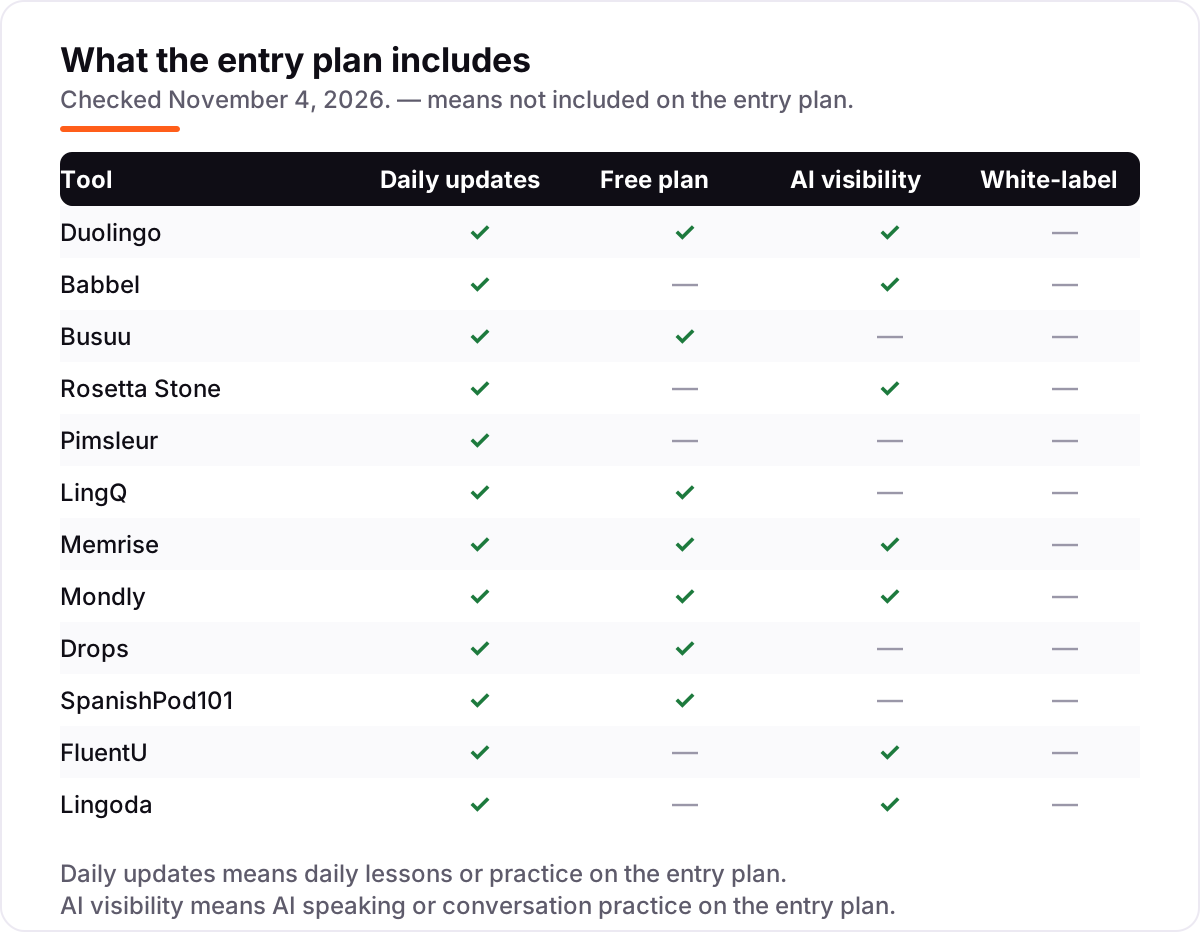
- Decide how you will speak, not just study. An app that only drills words will not make you conversational. Look for speaking practice, speech recognition, AI conversation or live classes — and check whether it sits on the entry plan or a higher tier.
- Read the free plan's real limit. Duolingo caps free practice with daily energy, Drops stops after five minutes a day, and LingQ caps free users at 20 saved words. The limit you hit first is the real price of the free plan.
- Check which Spanish you are learning. Most apps teach Latin American Spanish by default; Spain Spanish, with its vosotros forms and different pronunciation, is a separate track or a separate course on some apps. Pick the variant you will actually use.
- Watch the billing cycle, not just the monthly figure. Lingoda bills per four-week cycle, SpanishPod101's headline rates need 24 months prepaid, and Mondly's annual price is usually a sale price. The month-to-month figure is the honest comparison.
- Try the trial with a real week of study. Seven or fourteen days is enough to finish a full week of lessons, test the speaking tools and see whether the habit sticks. Set a reminder before the trial converts — Pimsleur does not refund subscriptions, and Rosetta Stone's trial rolls into monthly billing.
Learning Spanish is one system in your routine, not the whole routine. If the goal is a website or business that reaches Spanish-speaking customers, our monthly SEO service handles the visibility side. And before you publish Spanish-language pages, run your titles through the free SERP snippet preview tool — it shows exactly how the title and description will look in Google.
Whatever you shortlist, try it with real study before you pay. The free plans and trials in this list are long enough to run one genuine week — your lessons, your speaking practice, your schedule — and that week tells you more than any review can. Check two things in the trial: that the speaking tools work on your device, and that the lessons keep you coming back on day five, not just day one.
Spanish learning apps pricing: what you will actually pay
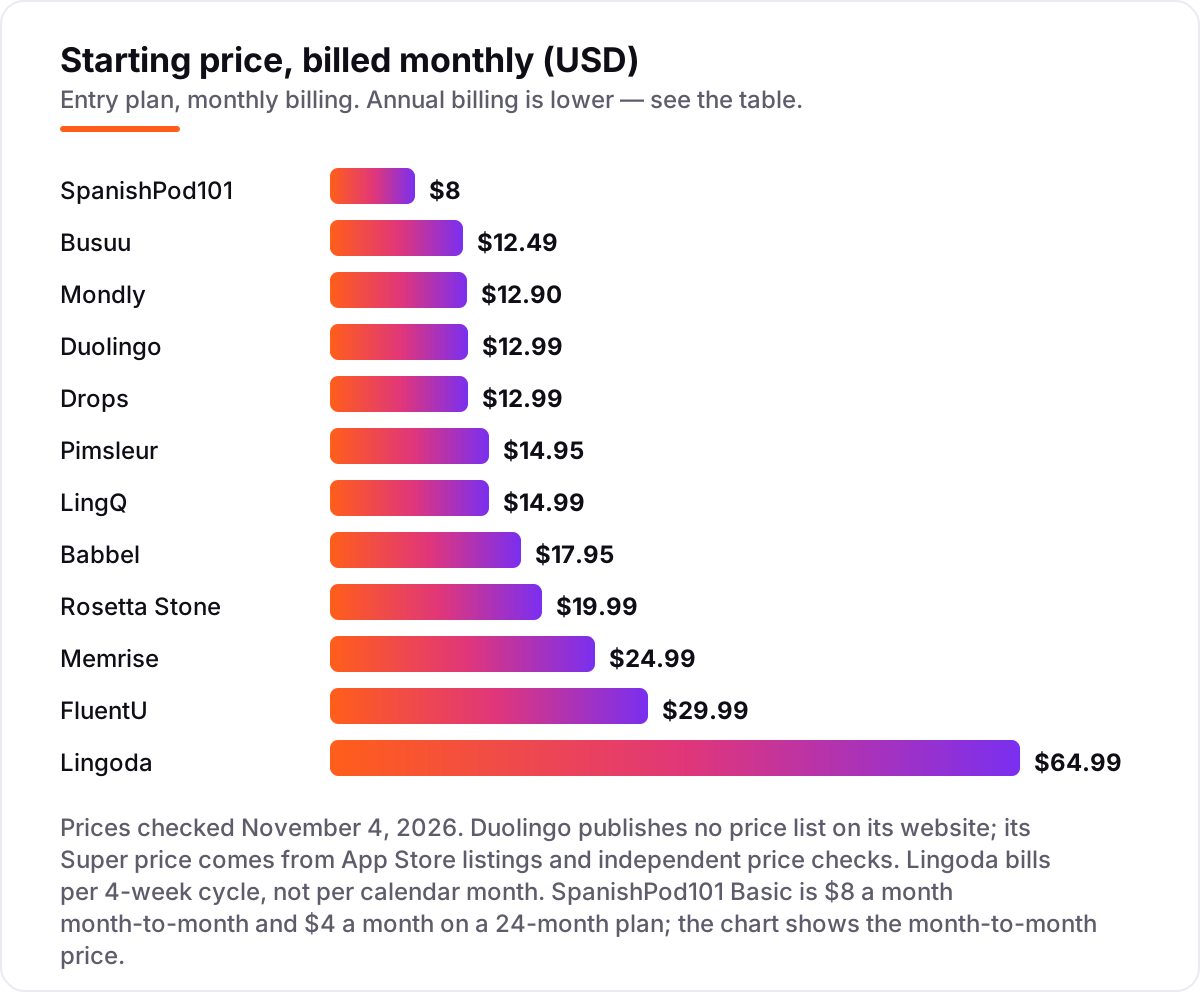
Take one learner studying Spanish for a year. On annual billing, the subscription costs $60 on SpanishPod101 Basic, $61.92 on Mondly Premium at its sale price, $61.99 on Memrise Pro, $69.99 on Drops Premium, $72.99 on Busuu Premium, $107.40 on Babbel, $119.99 on LingQ Premium, $159 on Rosetta Stone, $164.95 on Pimsleur All Access and $239.99 on FluentU Plus. Duolingo Super is $83.99 a year, and Lingoda's smallest group plan is $64.99 per four-week cycle — thirteen cycles in a year, so $844.87 for one class a week.
Paying month to month for the same year costs more everywhere: $96 for SpanishPod101 Basic, $149.88 for Busuu Premium, $154.80 for Mondly Premium, $155.88 each for Drops Premium and Duolingo Super, $179.40 for Pimsleur Audio-Only, $179.88 for LingQ Premium, $215.40 for Babbel, $239.88 for Rosetta Stone, $299.88 for Memrise Pro and $359.88 for FluentU Plus. The gap between monthly and annual billing is the single biggest saving in this list — Memrise Pro alone drops from $299.88 to $61.99 a year.
Three costs sit outside every number above. First, the sale prices — Mondly's $61.92 annual figure and SpanishPod101's $4-a-month figure are promotions, so budget on the list price. Second, the higher tiers: Busuu's AI Conversations, Pimsleur's Voice Coach and LingQ's AI features all sit one tier above the starting price, so price the tier that includes the feature you want. Third, the trial conversions: Rosetta Stone's 7-day trial rolls into the $19.99 monthly plan, and Pimsleur charges are not refunded, so a forgotten trial costs a month. If you want to see how AI changes the choice, compare the AI-first options in our guide to the best AI Spanish learning app.
Know the difference: app lessons vs live classes
The confusion in this category is between a self-study app and a live class. An app teaches on your schedule: lessons, drills and AI conversation whenever you open it, for $8 to $30 a month. A live class puts you in front of a teacher at a fixed time, with other students, corrections in real time and a certificate at the end — and Lingoda charges $64.99 per four-week cycle for four classes, roughly five times the price of the dearest app subscription. Apps build vocabulary and grammar; classes build the habit of speaking to a real person under mild pressure. Most learners need both, in that order: an app for daily practice, and live classes once the basics are in place.
There is a second, quieter confusion: a free plan is not a free trial. A free plan never expires — Duolingo's full course, Drops' five minutes a day — but it is capped forever. A free trial is the full product for 7 or 14 days, and then it charges you: Rosetta Stone's trial converts to the $19.99 monthly plan, and Pimsleur will not refund the charge. Treat a trial as a purchase with a deadline, and set the reminder the day you start it.
A third distinction worth knowing is Spain Spanish versus Latin American Spanish. Most apps default to Latin American Spanish, and several — including SpanishPod101, which covers Spain and Mexican Spanish — let you pick. The differences are real but small at beginner level: pronunciation, the vosotros form and some vocabulary. Pick the variant you will actually speak, and do not switch mid-course.
Quick comparison: tool type by need
| Buyer | Best pick | Why |
|---|---|---|
| Solo beginner on a $0 budget | Duolingo | Free full course, Super is $12.99/month when ads and energy limits get in the way |
| Learner who wants structure | Babbel | Grammar-led lessons, $17.95/month or $8.95 on the 12-month plan |
| Learner on a tight budget | SpanishPod101 | Cheapest paid plan at $8/month, $60 for a year |
| Learner who wants to speak | Pimsleur | Audio lessons that make you answer out loud, from $14.95/month |
| Learner who reads a lot | LingQ | Turn real articles and videos into lessons, $14.99/month |
| Learner who wants a real teacher | Lingoda | Live 60-minute classes, $64.99 per 4-week cycle |
Mistakes to avoid
- Budgeting on the sale price. Mondly's $61.92 annual plan is a sale price against a $154.80 list, and SpanishPod101's $4-a-month figure needs 24 months prepaid. Compare tools on the list price, because the sale may not be there when you buy.
- Buying on the free plan, then finding the speaking practice costs extra. Busuu's AI Conversations need Premium Plus, Pimsleur's Voice Coach needs Premium at $19.95 a month, and LingQ's AI features sit on Premium Plus. If speaking is the goal, price the tier that includes it.
- Ignoring the billing cycle. Lingoda bills per four-week cycle, so a year is thirteen payments, not twelve. SpanishPod101's headline monthly rates assume two years prepaid. Read the cycle before you compare the number.
- Paying monthly when you will study all year. Memrise Pro costs $299.88 month to month and $61.99 a year; Babbel costs $215.40 month to month and $107.40 a year. If you will still be studying in six months, annual billing pays for itself in the first quarter.
- Forgetting the trial converts. Rosetta Stone's 7-day trial rolls into the $19.99 monthly plan, Pimsleur does not refund subscription charges, and Mondly reviewers report cancellation trouble. Set a reminder for the day before the trial ends, and cancel from the app store if you subscribed there.
How we chose
We checked each vendor's pricing page or plan page on November 4, 2026 and recorded the starting price exactly as shown, including the annual-billing figure where one is published, and we ranked the apps by fit for the most common buyer — an English speaker starting Spanish from zero — not by brand size. Duolingo publishes no price list on its website, so its Super price comes from App Store listings and independent price checks; the other eleven prices were cross-checked against independent reviews that read the vendors' own pricing pages in October 2026, because several vendors show prices only after signup or inside the app. Ratings come from G2 and Trustpilot pages opened on November 4, 2026. This list carries no rating for Pimsleur, Lingoda or SpanishPod101: Pimsleur's Trustpilot figures conflicted across sources, and we could not verify a review page for Lingoda or SpanishPod101 on November 4, 2026. No vendor paid for a place in this list, and none of the links here are affiliate links.
What to do next
Start with the free plan or trial of your top pick and run one real week of lessons through it. Check that the speaking tools work on your device and that you still want to open the app on day five before you commit to a year. If the lessons are sorted but new customers are not finding you, our monthly SEO service handles the visibility side — or compare AI-powered options in our guide to the best AI Spanish learning app. Once your tools are in place, find out what's holding your rankings back.
Your stack only works if people find you
SerpAstra fixes what keeps your site off page one and makes it easy for AI assistants to recommend.
Get a free audit→Sources we checked (19)
- Duolingo Super — duolingo.com/super (price shown in-app; checked November 4, 2026)
- Babbel pricing — babbel.com/prices (checked November 4, 2026)
- Busuu pricing — busuu.com/en/pricing (checked November 4, 2026)
- Rosetta Stone pricing — rosettastone.com/buy (checked November 4, 2026)
- Pimsleur pricing — pimsleur.com (checked November 4, 2026)
- LingQ pricing — lingq.com/pricing (checked November 4, 2026)
- Memrise pricing — memrise.com/pricing (checked November 4, 2026)
- Mondly pricing — mondly.com/offer/en (checked November 4, 2026)
- Drops pricing — languagedrops.com (checked November 4, 2026)
- SpanishPod101 pricing — spanishpod101.com (checked November 4, 2026)
- FluentU pricing — fluentu.com/pricing (checked November 4, 2026)
- Lingoda pricing — lingoda.com/en/pricing (checked November 4, 2026)
- Duolingo, Rosetta Stone and Busuu G2 ratings — g2.com/compare/duolingo-vs-rosetta-stone (checked November 4, 2026)
- Babbel Trustpilot reviews — trustpilot.com/review/babbel.com (checked November 4, 2026)
- LingQ Trustpilot reviews — trustpilot.com/review/lingq.com (checked November 4, 2026)
- Memrise Trustpilot reviews — trustpilot.com/review/www.memrise.com (checked November 4, 2026)
- Mondly Trustpilot reviews — trustpilot.com/review/mondly.com (checked November 4, 2026)
- Drops Trustpilot reviews — trustpilot.com/review/languagedrops.com (checked November 4, 2026)
- FluentU Trustpilot reviews — trustpilot.com/review/fluentu.com (checked November 4, 2026)
Shamim
Founder of SerpAstra
A full-stack SEO and digital marketer who spends most days on Local SEO for dental practices, AI search visibility and lead generation.
Frequently asked questions
What is the best Spanish learning app?
Duolingo is the best free start: the full Spanish course costs $0, and Super is $12.99 a month. Babbel is the best structured course, from $17.95 a month, with grammar explained and AI speaking practice included. SpanishPod101 is the cheapest paid plan at $8 a month. Pick by how you learn, not by download charts.
How much does a Spanish learning app cost?
Entry prices run from $0 to $29.99 a month. SpanishPod101 Basic is $8 a month, most apps cost $12 to $20 a month, and FluentU Plus is $29.99. Annual billing cuts most prices by 40 to 60 percent: Babbel drops to $8.95 a month and Memrise Pro to about $5.17. Lingoda's live classes cost $64.99 per four-week cycle.
Is there a really free Spanish learning app?
Yes, with limits. Duolingo's full course is free, with ads and a daily energy limit. Drops gives five minutes a day free, forever, and LingQ's free plan allows 20 saved words. Babbel, Rosetta Stone, Pimsleur and FluentU have no free plan — only a trial. The free plan that fits your routine is worth more than the cheapest paid plan.
Which Spanish learning app is best for speaking?
Pimsleur is the best for speaking confidence: every 30-minute audio lesson makes you answer out loud, from $14.95 a month. Babbel Speak gives AI conversation practice on every paid plan, and Rosetta Stone's Chat Missions do the same. For real humans, Lingoda's live classes start at $64.99 per four-week cycle.
Duolingo vs Babbel: which should I pick?
Pick Duolingo if the budget is $0 or you need a daily habit: the full course is free, and Super is $12.99 a month. Pick Babbel if you want a structured syllabus, grammar explained in plain English and AI speaking practice — $17.95 a month, or $8.95 on the 12-month plan. Many learners use both: Duolingo daily, Babbel for serious study.
Can I become fluent with an app alone?
An app alone rarely gets you to fluency. Apps build vocabulary, grammar and listening well, but fluency needs real conversation — speaking, being corrected and understanding fast, messy speech. Use an app for daily practice, then add conversation: a tutor, a language exchange, or Lingoda's live classes once you reach the intermediate level.
Do these apps teach Spain Spanish or Latin American Spanish?
Most apps in this list default to Latin American Spanish, which is the most widely spoken variant. SpanishPod101 covers both Spain and Mexican Spanish, and several apps let you switch variants in settings. The differences are small at beginner level — pronunciation, the vosotros form and some vocabulary — so pick the variant you will actually speak.
Free SEO and AI visibility audit
Find out what is holding your rankings back
Send us your site. Within 2 business days you get a written audit, an AI visibility check and a short fix list ranked by impact. Free, with no contract attached.
Request my free audit→Related guides
 AI, Data & Analytics7 Best AI Spanish Learning Apps in 2026: Free and Paid Apps RankedThe 7 best ai spanish learning apps of 2026, ranked with real prices, free plans and AI conversation features — pick the app that fits how you actually study.Read guide →
 SEO & AI Search10 Best Platforms for SEO for Education in 2026, ComparedThe best platform for seo for education, compared: 10 picks with 2026 prices, free plans and SEO controls. WordPress, Finalsite and HubSpot, ranked for schools.Read guide →
 AI, Data & AnalyticsBest Chatbot Apps (2026): 8 Apps Worth DownloadingThe 8 best chatbot apps compared on price, AI quality and free plans. Real starting prices checked November 2, 2026, sorted by who each app fits best.Read guide →