
9 Best B2B Marketing Automation Platforms in 2026, Compared
9 best b2b marketing automation platforms compared on price, automation depth and CRM fit — from $9/month to enterprise quotes, verified November 4, 2026.
 Shamim Mia, Founder, SerpAstraLast verified November 4, 202611 min read
We compare pricing pages, documentation and public reviews. We never accept payment for rankings.

Key takeaways
- HubSpot Marketing Hub is the best all-round pick: a free CRM with automation from $20 a seat. ActiveCampaign is the automation value pick at $15 a month billed annually.
- Salesforce teams should start with Account Engagement (Pardot) at $1,250 a month per org; enterprise teams that need the deepest automation should get quotes from Marketo and Oracle Eloqua.
- The single most important buying factor is how the vendor charges: per seat, per contact, per active contact or per org — the same list can cost $20 or $1,250 a month depending on the model.
- Every price below was checked on the vendor's pricing page on November 4, 2026, except where the How we chose section says otherwise. Three G2 ratings are missing because G2 rate-limited our checks — those cards show no rating rather than a stale one.
On this page
Quick comparison
| Tool | Best for | Starting price | Free plan |
|---|---|---|---|
| HubSpot Marketing Hub | Small and mid-sized B2B teams that want marketing automation on top of a free CRM | $20/mo per seat | Yes (free plan) |
| ActiveCampaign | Small B2B teams that want deep email automation and a built-in CRM for the lowest entry price here | $19/mo | No (14-day trial) |
| Salesforce Account Engagement | B2B teams already running Salesforce Sales Cloud who want automation inside the CRM | $1,250/mo per org | No |
| Adobe Marketo Engage | Enterprise B2B marketing teams running complex, multi-channel demand generation | Custom quote | No |
| Brevo | Small businesses on a tight budget that need email, SMS and a free CRM without per-contact pricing | $9/mo | Yes (free plan) |
| GetResponse | Small B2B teams that want automation plus built-in webinars and landing pages in one subscription | $19/mo | No (30-day trial) |
| Act-On | Mid-market B2B teams that want strong CRM integrations and pay only for contacts they actually email | $900/mo | No |
| Mailchimp | Small businesses that want the simplest email automation with a free plan to start | $13/mo | Yes (free plan) |
| Oracle Eloqua | Enterprise B2B teams with large databases that need deep segmentation and campaign orchestration | Custom quote | No |
Make one of these tools?
We re-check this list every quarter. Send a correction, request a review, or ask about a clearly labeled sponsored spot.
Request a listingThe best b2b marketing automation platforms

HubSpot Marketing Hub
Best for: Small and mid-sized B2B teams that want marketing automation on top of a free CRM
HubSpot Marketing Hub is the default pick for a B2B team that wants one system instead of five. The free CRM sits underneath everything, so contacts, deals and campaigns share one record, and Starter adds email automation, lead scoring, landing pages and live chat for $20 a seat. The free plan covers two users and 1,000 contacts — enough to run campaigns before paying.
The catch is the price curve. Starter is cheap for one seat, but every extra seat adds $20 a month and contact add-ons cost $50 per 1,000 contacts a month, so the bill grows with the team and the list. Professional jumps to $890 a month with a $3,000 onboarding fee — a cliff, not a step. Buy HubSpot when you want CRM and automation in one place; buy ActiveCampaign when the budget is the constraint.
What we like
- Free CRM underneath with 1,000 marketing contacts included on Starter, so the database and the automation live in one place
- Visual workflows, lead scoring and email automation included from Starter, with Breeze AI agents on every plan
- Native CRM, email, landing pages, ads and reporting in one login, so small teams stop stitching tools together
Watch out for
- Starter is priced per seat, so a five-person team pays $100 a month before any contact add-ons
- Professional jumps to $890 a month plus a mandatory $3,000 onboarding fee, with no middle tier

ActiveCampaign
Best for: Small B2B teams that want deep email automation and a built-in CRM for the lowest entry price here
ActiveCampaign gives a small B2B team the deepest automation for the least money. The visual builder supports conditional branches, site tracking and lead scoring from the entry plan, and the built-in CRM means marketing and sales work from the same contact record instead of syncing two systems. At $15 a month billed annually for 1,000 contacts, it undercuts every other serious automation tool here.
The limits are in the fine print. Starter allows only five actions per automation and one user, so a team that builds long nurture sequences or shares the account will need Plus at $49 a month. Prices also rise with the list: Starter costs $149 a month at 10,000 contacts. Even so, for a team that lives in email nurture and wants real automation on a small budget, nothing else here matches it.
What we like
- Visual automation builder with conditional logic, site tracking and lead scoring from the entry plan
- Built-in CRM with deal pipelines, so marketing and sales share one contact record
- Integrations with Salesforce, Shopify and Zapier cover the tools most B2B teams already use
Watch out for
- Starter caps each automation at 5 actions and includes only 1 user, so growing teams move to Plus or Pro fast
- Price rises with contact count — Starter is $149 a month at 10,000 contacts, about ten times the entry price

Salesforce Account Engagement
Best for: B2B teams already running Salesforce Sales Cloud who want automation inside the CRM
Account Engagement — the product most teams still call Pardot — is the automation layer for Salesforce, and that is the reason to buy it. Leads, contacts and campaign engagement sync natively into Sales Cloud, so sales sees every email open and form fill on the contact record without middleware. Growth+ includes lead scoring and grading, Engagement Studio nurture programs and 10,000 contacts for $1,250 a month per organization.
The price is the start. Account Engagement requires Salesforce Enterprise or Unlimited Edition, so the bill includes a Sales Cloud subscription, and Growth+ caps at 50 forms, 50 landing pages and 50 automation rules. Teams that outgrow those caps move to Plus+ at $2,750 a month. If Salesforce is your CRM, this is the obvious pick; if it is not, the cheaper tools here will do the same job for less.
What we like
- Native Salesforce sync: leads, contacts and campaign engagement flow into Sales Cloud without middleware
- Lead scoring and grading, plus Engagement Studio nurture programs, from the Growth+ plan
- B2B Marketing Analytics and account-based marketing on the higher editions
Watch out for
- Requires Salesforce Enterprise or Unlimited Edition CRM, so the real cost includes a Sales Cloud subscription
- Growth+ caps at 50 forms and landing pages and 50 automation rules, which growing teams outgrow

Adobe Marketo Engage
Best for: Enterprise B2B marketing teams running complex, multi-channel demand generation
Marketo Engage is the tool enterprise B2B teams graduate to when their database and their campaigns outgrow everything else. Its lead scoring, segmentation and engagement programs are the deepest in this list, and it handles multi-channel demand generation — email, webinars, events and account-based marketing — from one system. Native two-way sync with Salesforce and Microsoft Dynamics keeps marketing and sales on the same data.
Everything about Marketo is enterprise-shaped, including the buying process. Adobe publishes no price, offers no free trial, and G2 reviewers report implementation commonly taking around three months. The interface feels dated next to HubSpot or ActiveCampaign, and new users face a steep learning curve. Choose Marketo when your team runs complex, large-scale B2B programs and has the staff to run it; smaller teams will get more done faster elsewhere.
What we like
- Deepest lead scoring, segmentation and nurture-program tooling in this list, built for large databases
- Revenue attribution and account-based marketing on the higher packages
- Native two-way sync with Salesforce and Microsoft Dynamics
Watch out for
- No published price and no free trial — every deal goes through sales, and implementation commonly takes around 3 months
- Interface feels dated and complex; new users face a steep learning curve, per G2 reviewers
Brevo
Best for: Small businesses on a tight budget that need email, SMS and a free CRM without per-contact pricing
Brevo earns its place as the budget pick by charging for what you send, not who you store. Starter costs $9 a month for 5,000 emails, and the free plan sends 300 emails a day with no credit card required. The same account holds email, SMS, WhatsApp and a free CRM, so a team can run campaigns and keep contact records in one place without a second subscription.
Two limits matter. First, the send cap: emailing a 2,000-person list twice a week uses 16,000 sends a month, pushing you up the volume tiers fast. Second, the automation itself — workflows and A/B testing — starts on Standard at $18 a month, so the $9 plan is email plus CRM, not automation. Pick Brevo when the budget is tight and the list is small; pick ActiveCampaign when workflows are the job.
What we like
- Cheapest paid plan in this list at $9 a month, with pricing by email volume, not contacts
- Email, SMS, WhatsApp and a free CRM in one account, with transactional email included
- Free plan sends 300 emails a day, which covers a small list without paying anything
Watch out for
- Pricing is by email volume, not contacts, so heavy senders outgrow Starter quickly
- Automation and A/B testing sit on Standard ($18 a month), not the $9 Starter plan

GetResponse
Best for: Small B2B teams that want automation plus built-in webinars and landing pages in one subscription
GetResponse is the all-in-one pick for a small team that wants automation plus the channels around it. The Marketer plan bundles unlimited automation workflows with built-in webinars, landing pages and sales funnels, so a team can run a lead-magnet webinar and the nurture sequence behind it without a second tool. Every paid plan includes unlimited monthly email sends, which removes the volume anxiety Brevo and Mailchimp create.
The entry plan is the trap. Starter costs $19 a month but allows only one custom automation workflow, so a team that needs a welcome series and a nurture sequence at the same time has to move to Marketer at $59 a month. Team permissions are also coarse, with no granular roles for junior staff. Buy GetResponse for the webinar and funnel bundle; buy ActiveCampaign if pure automation depth matters more.
What we like
- Unlimited automation workflows, webinars and sales funnels on the Marketer plan ($59 a month)
- Visual workflow builder with lead scoring, tagging and abandoned-cart triggers
- Unlimited monthly email sends on every paid plan
Watch out for
- Starter allows only 1 custom automation workflow, so real automation needs Marketer at $59 a month
- Team permissions are coarse — no granular roles to limit what junior staff can change

Act-On
Best for: Mid-market B2B teams that want strong CRM integrations and pay only for contacts they actually email
Act-On is built for mid-market B2B teams that email a fraction of a large database. Its active-contact pricing means you pay for the contacts you actually email each month, not the whole list sitting in your CRM — a real saving for teams with 50,000 contacts and 5,000 monthly sends. The platform pairs that with native two-way sync to Salesforce, Microsoft Dynamics, NetSuite and SugarCRM, plus AI lead scoring and webinar integrations.
The floor is high: Professional starts at $900 a month for 2,500 active contacts, with no free plan and no free trial, and annual contracts renew automatically. Advanced reporting takes time to learn, and the interface is less polished than HubSpot's. Act-On fits a mid-market team with a big database and a CRM it already trusts; smaller teams will find the same automation cheaper at ActiveCampaign or GetResponse.
What we like
- Active-contact pricing: you pay for contacts you actually email, not your whole database
- Native two-way sync with Salesforce, Microsoft Dynamics, NetSuite and SugarCRM
- AI lead scoring, multichannel campaigns and webinar integrations (Zoom, GoToWebinar) included
Watch out for
- No free plan and no free trial, and the $900 monthly floor is steep for small teams
- Annual contracts with automatic renewal, and advanced reporting takes time to learn

Mailchimp
Best for: Small businesses that want the simplest email automation with a free plan to start
Mailchimp is the easiest way into marketing automation, and the fastest to set up. Most teams go live in under a month, many in under a day, and the free plan covers 250 contacts with 500 emails a month. Customer Journeys — Mailchimp's automation flows — run on every paid plan, and 300+ integrations cover Shopify, WordPress and Zapier, so it slots into a stack a small business already has.
The limits show up as you grow. Essentials caps automation flows at four steps, so a real multi-email journey needs Standard at $20 a month, and prices rise steeply with contact count — the same plan costs far more at 10,000 contacts. Mailchimp is the right pick for a small business that wants simple automation without a learning curve; teams that need deep branching logic should look at ActiveCampaign instead.
What we like
- Easiest setup in this list — most teams go live in under a month, many in under a day
- Free plan covers 250 contacts, and Customer Journeys run on every paid plan
- 300+ integrations, including Shopify, WordPress and Zapier
Watch out for
- Essentials caps automation flows at 4 steps, so real journeys need Standard at $20 a month
- Prices rise steeply with contacts — the same plan costs far more at 10,000 contacts than at 500

Oracle Eloqua
Best for: Enterprise B2B teams with large databases that need deep segmentation and campaign orchestration
Oracle Eloqua is the enterprise heavyweight in this list, built for B2B teams with large databases and long sales cycles. Campaign Canvas orchestrates multi-step, multi-channel campaigns with deep segmentation, and its lead scoring and account-based marketing are designed for organizations that measure pipeline, not opens. Native integrations with Salesforce and Oracle's CX suite keep it inside an enterprise stack.
It is also the hardest tool here to buy and to learn. Oracle publishes no price and offers no free trial, implementation commonly takes one to three months, and it carries the lowest G2 rating in this list at 3.9 out of 5, with reviewers citing a dated interface and a steep learning curve. Choose Eloqua when your database and your campaign complexity genuinely need it; most teams will ship faster on HubSpot or Marketo.
What we like
- Campaign Canvas orchestrates multi-step, multi-channel campaigns with deep segmentation
- Strong lead scoring and account-based marketing for large enterprise databases
- Native integrations with Salesforce and Oracle's own CX suite
Watch out for
- No published price and no free trial — implementation commonly takes 1–3 months
- Lowest rating in this list (3.9/5), with reviewers citing a dated interface and a steep learning curve
Marketing automation is the software that turns a list of contacts into a pipeline: it sends the right email to the right person at the right moment, scores the lead, and hands it to sales when it is ready. The 9 best b2b marketing automation platforms below are sorted by fit for the most common buyer — a small or mid-sized B2B team — not by brand size, and every price was checked on November 4, 2026.
How to choose the best b2b marketing automation platforms
Five questions decide the shortlist. Answer them before you look at a single demo.
- What CRM do you already run? If it is Salesforce, Account Engagement is the native pick; if it is HubSpot's CRM, Marketing Hub is. Switching CRMs to match a marketing tool is the most expensive mistake in this category.
- How does the vendor charge? Per seat (HubSpot), per contact (ActiveCampaign, GetResponse), per active contact (Act-On), per org (Account Engagement) or per email sent (Brevo). The same list can cost $20 or $1,250 a month depending on the model — the pricing section below works the numbers.
- What counts as automation on the plan you would actually buy? Brevo's $9 plan has no workflows, GetResponse's $19 plan allows one, and Mailchimp's $13 plan caps flows at four steps. The automation price is the price of the tier that includes it, not the cheapest tier.
- How long is your sales cycle? Long B2B cycles need lead scoring, grading and nurture programs — Marketo, Eloqua and Account Engagement are built for that. Short cycles just need good email journeys.
- Who will run it? Marketo and Eloqua need a dedicated operator and one to three months to implement; HubSpot, ActiveCampaign and Mailchimp can be live in days.
Before you publish the landing pages behind your first nurture sequence, run your titles through the free SERP snippet preview tool — it shows exactly how the title and description will look in Google.
B2B marketing automation pricing: what you will actually pay
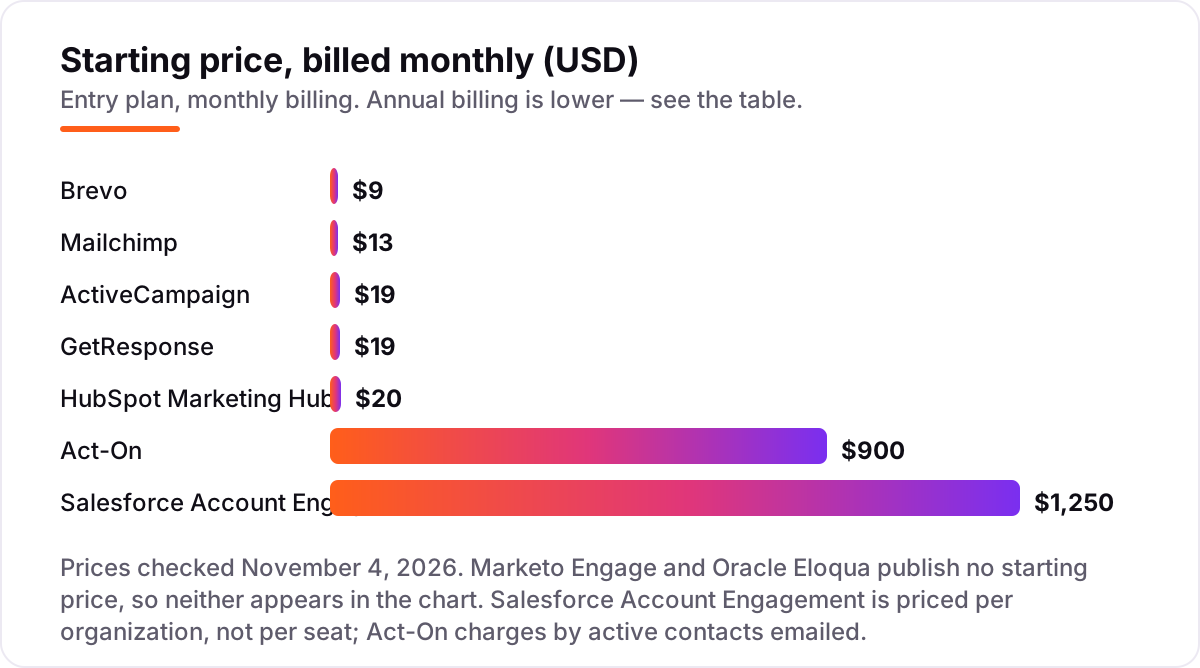
Entry prices hide the real bill, because every vendor here charges by a different unit. Take a team with 5,000 contacts that emails its list twice a week — about 40,000 sends a month. On ActiveCampaign, Starter at 5,000 contacts is $79 a month billed annually. On HubSpot, one Starter seat with 5,000 marketing contacts is about $220 a month: $20 for the seat plus four extra 1,000-contact blocks at $50 each. On Brevo, 40,000 sends a month on Starter is about $46 a month. On GetResponse, the Marketer plan at 5,000 contacts is about $95 a month.
Three lessons follow. First, the cheapest entry price is rarely the cheapest at your list size — Brevo wins this example by a wide margin, and HubSpot costs nearly three times ActiveCampaign. Second, count your sends as well as your contacts: Brevo's bill follows volume, everyone else's follows the list. Third, add the hidden costs before you compare: HubSpot Professional adds a $3,000 onboarding fee, and the enterprise tools add implementation and onboarding fees that only appear in the quote. Always price the plan you will actually use, at your actual list size, before you sign.
Marketing automation vs email marketing: know the difference
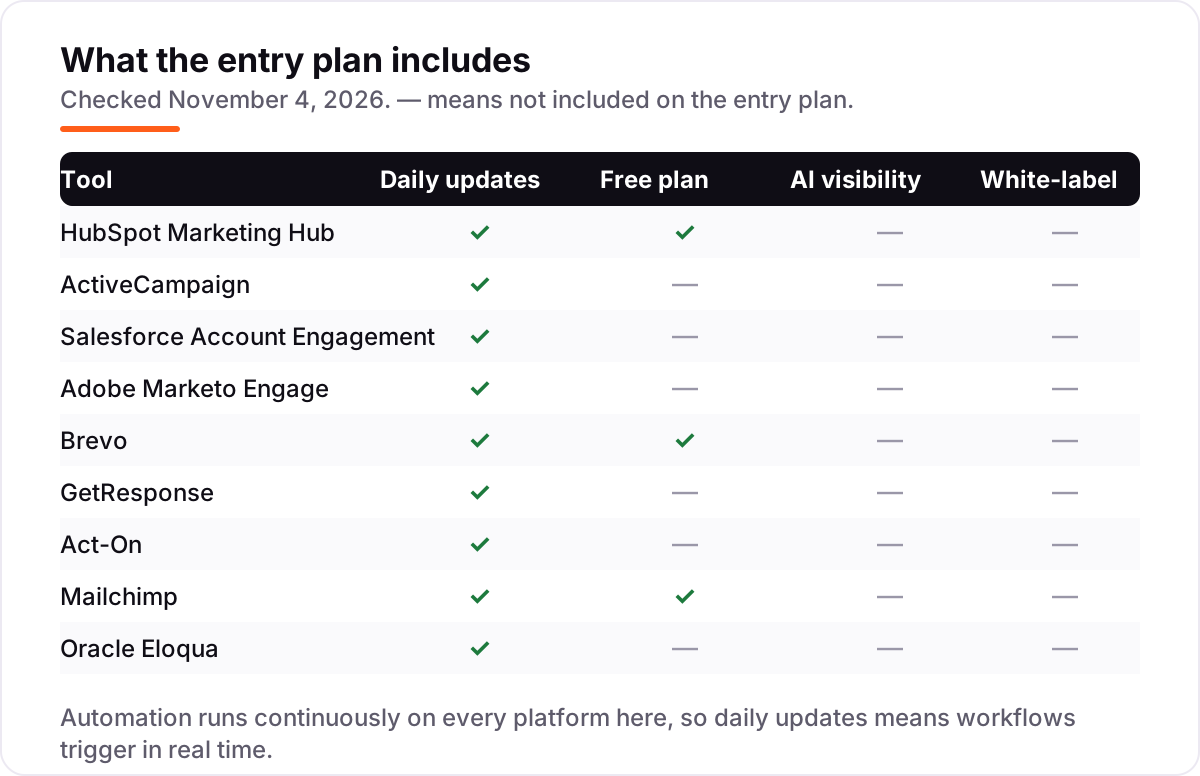
Email marketing sends messages to a list. Marketing automation reacts to what people do: a download triggers a nurture sequence, a pricing-page visit raises the lead score, and a score threshold alerts sales. The difference is the trigger — automation watches behavior and acts on it, while email marketing waits for you to press send.
That is why the cheapest plan is often the wrong plan. Brevo Starter, GetResponse Starter and Mailchimp Essentials are email tools with a little automation attached; the real automation lives one tier up. If all you need is a monthly newsletter, buy the email tool and save the money. If you need leads scored, routed and nurtured while you sleep, buy the automation tier — and judge the price on that tier, not the one below it. Our guide to marketing automation for small business explains the same split from the small-team side.
Quick comparison: tool type by need
| Buyer | Best pick | Why |
|---|---|---|
| Small B2B team, tight budget | ActiveCampaign | Deep automation from $15/month billed annually |
| Team already on Salesforce | Salesforce Account Engagement | Native sync, $1,250/month per org |
| All-in-one CRM + automation | HubSpot Marketing Hub | Free CRM underneath, $20/month per seat |
| Enterprise demand generation | Adobe Marketo Engage | Deepest scoring and nurture, custom quote |
| Cheapest way to start | Brevo | $9/month, free plan sends 300 emails a day |
| Automation + webinars in one | GetResponse | Marketer plan $59/month with webinars and funnels |
| Big database, few emailed | Act-On | Pay only for active contacts, $900/month |
| Simplest setup | Mailchimp | Free for 250 contacts, live in under a day |
| Large enterprise database | Oracle Eloqua | Deepest segmentation, custom quote |
How we chose
We checked each vendor's own pricing page on November 4, 2026 and recorded the starting price exactly as shown, including the annual-billing figure where the page lists one. A few prices needed extra care. Salesforce's Account Engagement page did not load during verification, so its $1,250 Growth+ price is corroborated by independent reads of Salesforce's own pricing page from October 2026. Act-On's $900 price comes from Act-On's own pricing as published on its G2 profile, because the vendor page did not load for us. Mailchimp's pricing page renders its prices in JavaScript and did not expose figures in our read, so its $13 and $20 figures are third-party-sourced from independent reads of the vendor page in October 2026. Marketo Engage and Oracle Eloqua publish no prices at all, so both are listed as custom quote. The worked example in the pricing section uses list-size figures from independent reads of the vendor pages in 2026, since vendors only publish entry-tier prices.
Ratings come from G2 pages opened on November 4, 2026, with score and review count shown. Three tools show no rating: G2 rate-limited our checks for Salesforce Account Engagement, ActiveCampaign and Brevo, so we left the rating out rather than print a stale number. We also looked at SharpSpring (now Constant Contact Lead Gen & CRM), Zoho Marketing Automation and Keap and left them out: SharpSpring's vendor page publishes no price and its G2 profile now belongs to a different Constant Contact product, Zoho's published prices conflict across sources, and Keap's page shows no starting price. We ranked the tools by fit for the most common buyer — a small or mid-sized B2B team — not by brand size. No vendor paid for a place in this list, and none of the links here are affiliate links.
What to do next
Start with the five questions in the how-to-choose section, then price your top two picks at your actual list size — not the entry tier. Take the free plan or trial of your winner and run one real nurture sequence end to end: a form, three emails, a score threshold and a sales alert. If the sequence runs itself and the reports make sense, you have your tool. If you'd rather fix the traffic side first, our monthly SEO service builds the pipeline these tools then automate. Once your tools are in place, find out what's holding your rankings back.
Your stack only works if people find you
SerpAstra fixes what keeps your site off page one and makes it easy for AI assistants to recommend.
Get a free audit→Sources we checked (15)
- HubSpot Marketing Hub pricing — hubspot.com/pricing/marketing (checked November 4, 2026)
- HubSpot Marketing Hub on G2 — 4.4/5, 16,050 reviews (checked November 4, 2026)
- ActiveCampaign pricing — activecampaign.com/pricing (checked November 4, 2026)
- Salesforce Marketing Cloud pricing — salesforce.com/products/marketing-cloud/pricing/ (page did not load during verification; $1,250 corroborated by independent reads of the vendor page, October 2026)
- Adobe Marketo Engage — business.adobe.com/products/marketo.html (no published prices; checked November 4, 2026)
- Adobe Marketo Engage on G2 — 4.1/5, 3,345 reviews (checked November 4, 2026)
- Brevo pricing — brevo.com/pricing/ (checked November 4, 2026)
- GetResponse pricing — getresponse.com/pricing (checked November 4, 2026)
- GetResponse on G2 — 4.3/5, 1,147 reviews (checked November 4, 2026)
- Act-On pricing via G2 — g2.com/products/act-on/reviews (price provided by Act-On; checked November 4, 2026)
- Act-On on G2 — 4.1/5, 1,072 reviews (checked November 4, 2026)
- Mailchimp pricing — mailchimp.com/pricing/marketing/ (page renders prices in JavaScript; $13 and $20 figures third-party-sourced from independent reads, October 2026)
- Mailchimp on G2 — 4.3/5, 12,998 reviews (checked November 4, 2026)
- Oracle Eloqua — oracle.com/cx/marketing/automation/ (no published prices; checked November 4, 2026)
- Oracle Eloqua on G2 — 3.9/5, 628 reviews (checked November 4, 2026)
Shamim
Founder of SerpAstra
A full-stack SEO and digital marketer who spends most days on Local SEO for dental practices, AI search visibility and lead generation.
Frequently asked questions
What is the best B2B marketing automation platform in 2026?
HubSpot Marketing Hub is the best all-round pick: a free CRM with automation from $20 a seat. ActiveCampaign is the best value at $15 a month billed annually. Salesforce teams should pick Account Engagement, and enterprise teams should get quotes from Marketo and Eloqua. The right answer depends on your CRM and your list size, not on brand size.
How much does B2B marketing automation cost?
Between $9 and $1,250 a month at the entry level. Brevo starts at $9, Mailchimp at $13, ActiveCampaign at $15 billed annually and HubSpot at $20 a seat, while Salesforce Account Engagement starts at $1,250 a month per org. Marketo and Eloqua are quote-only. The pricing model matters more than the headline: per seat, per contact and per org scale very differently.
Is there a free B2B marketing automation platform?
Yes, with limits. HubSpot's free plan covers 2 users and 1,000 contacts, Brevo's free plan sends 300 emails a day, and Mailchimp is free for 250 contacts. Free plans work for a small list and simple campaigns; real automation workflows, lead scoring and CRM sync sit on the paid tiers.
What is the difference between marketing automation and email marketing?
Email marketing sends messages to a list when you press send. Marketing automation reacts to behavior: a download triggers a nurture sequence, a pricing-page visit raises a lead score, and a score threshold alerts sales. If you only send newsletters, email marketing is enough; if you need leads nurtured and scored automatically, you need automation.
Do I need marketing automation if I already use a CRM?
A CRM stores contacts and deals; automation acts on them. HubSpot and Salesforce Account Engagement pair the two natively, which is their main advantage. If your CRM is Pipedrive or Zoho, ActiveCampaign or Act-On bolt on well. Without automation, your CRM is a database — nobody follows up until a human remembers to.
Which marketing automation platform is best for a small business?
ActiveCampaign for the deepest automation at $15 a month billed annually, Brevo for the lowest cost at $9 a month, and GetResponse if you also want webinars and landing pages in one subscription. Mailchimp is the simplest start. Avoid the enterprise tools — Marketo, Eloqua and Account Engagement are priced and built for much larger teams.
How long does it take to implement marketing automation?
Days for the small-team tools: Mailchimp teams often go live in under a day, and HubSpot and ActiveCampaign in days to weeks. Marketo and Oracle Eloqua commonly take one to three months, according to G2 reviewers, because they need data mapping, scoring rules and team training. Budget the implementation time, not just the subscription price.
Free SEO and AI visibility audit
Find out what is holding your rankings back
Send us your site. Within 2 business days you get a written audit, an AI visibility check and a short fix list ranked by impact. Free, with no contract attached.
Request my free audit→Related guides
 MarketingMarketing automation for small businesses: what to automate (and what not to)Marketing automation for small businesses, explained: what to automate first, what to keep human, and the tools that save hours without losing customers.Read guide →
 SEO & AI Search12 Best Marketing Platforms for Small Business SEO in 2026, ComparedThe 12 best marketing platforms for small business SEO, compared on real prices, SEO tools and AI visibility. Every price checked November 1, 2026.Read guide →
 MarketingEmail marketing for local businesses (that customers actually open)Email marketing for local businesses: build a list the right way, send emails customers open, and turn past customers into repeat bookings without spam.Read guide →