
12 Best Chiropractic EMR Software in 2026, Compared
Compare the 12 best chiropractic EMR software options for 2026 on price, SOAP notes, billing and AI charting, with every price checked November 7, 2026.
 Shamim Mia, Founder, SerpAstraLast verified November 7, 202614 min read
We compare pricing pages, documentation and public reviews. We never accept payment for rankings.

Key takeaways
- ChiroTouch leads for most practices but sells by custom quote; Platinum System now publishes plans from $299/month, and Atlas is the cheapest published price at $99/month.
- The single most important buying factor is whether you bill insurance or run a cash practice — the two models need different billing machinery.
- Seven of the twelve vendors publish no price at all, so budget for a demo-led sales process and get every module quoted in writing.
- Solo and small clinics can start for $28.05–$59 a month on Noterro, Cliniko or Jane, all of which publish their prices.
On this page
Quick comparison
| Tool | Best for | Starting price | Free plan |
|---|---|---|---|
| ChiroTouch | Chiropractic practices of any size that want the most complete all-in-one platform, from charting to billing and marketing | Custom quote | No (demo only) |
| Platinum System | Clinics that want EHR, billing, CRM, payments and marketing in a single operating system | $299/mo | No (demo only) |
| ClinicMind | Multi-location chiropractic groups that need centralized control from one login | Custom quote | No (demo only) |
| zHealth | Practices that want a modern all-in-one cloud platform for chiropractic and wellness | Custom quote | No (demo only) |
| Atlas Chiropractic System | Established insurance-billing offices that want a stable vendor with a known price floor | $99/mo | No (demo only) |
| EZBIS | Practices that want modular software from the most experienced chiropractic vendor | Custom quote | No (demo only) |
| ChiroSpring | Practices that want a flexible, customizable cloud EHR with strong support | Custom quote | No (demo only) |
| PayDC | Insurance-billing clinics that want documentation, billing and care plans tightly integrated for compliance | Custom quote | No (demo only) |
| Jane | Multi-discipline clinics that want strong charting and broader practice workflows | $59/mo | No (no trial) |
| Cliniko | Small practices that want a simpler scheduling-first system with one flat price | $45/mo | No (30-day trial) |
| Noterro | Solo practitioners and small clinics that want scheduling, charting and billing in one affordable system | $28.05/mo | No (14-day trial) |
| Juvonno | Allied-health clinics that want straightforward cloud scheduling, charting and billing | Custom quote | No (demo only) |
Make one of these tools?
We re-check this list every quarter. Send a correction, request a review, or ask about a clearly labeled sponsored spot.
Request a listingThe best chiropractic EMR software

ChiroTouch
Best for: Chiropractic practices of any size that want the most complete all-in-one platform, from charting to billing and marketing
ChiroTouch is the largest dedicated chiropractic EHR vendor, and its current lineup is organized into three packages. Start covers core EHR and practice management with basic AI charting, payments, appointment reminders, a patient portal and digital intake. Grow adds the AI Scribe, advanced AI charting, reputation management, automatic patient recall, multi-location support and office chat. Scale adds AI review responses, AI translation, AI-powered campaigns, lead management and exercise programs.
The honest catch is the buying process. Nothing is priced on the site, so you book a demo and get a tailored package quote. Directories list around $159 a month, but the vendor never confirms it. Billing is handled through add-ons: the CT Billing Suite plus clearinghouse options. If you want one vendor for charting, payments, billing and marketing, ChiroTouch covers the most ground.
What we like
- Three packages (Start, Grow, Scale) so you buy to your stage of growth
- AI charting with the Rheo assistant and AI Scribe on the higher packages
- Integrated payments (CT Pay) and a billing suite keep money workflows in one system
- More than 12,500 practices use it, so integrations and clearinghouse links are well tested
Watch out for
- No published pricing, so every quote starts with a demo and a sales call
- Insurance billing tools are paid add-ons, not part of the base packages
- Advanced features such as reputation management and multi-location support sit on higher tiers

Platinum System
Best for: Clinics that want EHR, billing, CRM, payments and marketing in a single operating system
Platinum System pitches itself as a practice operating system rather than an EHR, and it is the rare vendor here that now publishes a price: plans start at $299 a month across three tiers called Align, Strengthen and Thrive. The Core OS covers EHR documentation with structured SOAP notes, scheduling with patient flow boards, billing and revenue cycle management, payments with recurring plans, and a patient app.
The Growth side adds digital presence, review and listings management, lead pipelines and social automation. AI runs through both: a clinical scribe, posture and movement analysis, X-ray assistance, and a communication assistant that answers patient messages. The catch is scope: a lean cash practice pays for shelfware it never uses. But for insurance-heavy clinics juggling an EHR, a billing service, a review tool and a marketing login, one bill is a genuine saving.
What we like
- Nine modules on one platform, so charts, schedule, claims, payments and messages share one record
- Built-in CRM with reputation, listings, SEO and lead pipelines, which most EHRs do not attempt
- AI scribe, posture and movement analysis, and an AI receptionist included rather than bolted on
- No setup or implementation fees, and onboarding and data migration are included
Watch out for
- At $299 a month it is the most expensive published starting price in this list
- The all-in-one pitch means you pay for marketing and CRM modules even if you only wanted an EHR
- Enterprise pricing for multi-location groups is a custom quote

ClinicMind
Best for: Multi-location chiropractic groups that need centralized control from one login
ClinicMind is the current name of the product long known as Genesis Chiropractic Software, and it targets the group-practice segment: multiple locations managed from one login, with no per-location subscriptions. The platform covers AI-assisted SOAP documentation, integrated claims submission with real-time eligibility verification and denial tracking, automated appointment reminders and two-way texting, online patient intake and payments, and managed credentialing for new providers.
The honest catch is fit for single locations. The full-suite platform, with credentialing, virtual front-desk staffing and multi-location administration, is built for groups; solo and two-doctor practices will find simpler tools cheaper and faster. Pricing is demo-based with no public tiers, though directories list around $97 a month — a figure the vendor does not publish. For groups standardizing documentation and billing across locations, the single-login administration is the reason to shortlist it.
What we like
- Built for multi-location groups with centralized reporting and administration from a single login
- AI-assisted SOAP notes with integrated billing, clearinghouse and denial management
- Patient engagement (PatientHub), credentialing (CredEdge) and payments (ClinicMind Pay) in one platform
- More than 10,000 providers use the platform, according to the vendor
Watch out for
- No published pricing, so every deal goes through a demo and a sales call
- The full-suite platform carries more scope than a single-location practice needs
- Group-oriented administration adds setup overhead for small offices

zHealth
Best for: Practices that want a modern all-in-one cloud platform for chiropractic and wellness
zHealth is an all-in-one practice management platform built for chiropractors and wellness providers, aimed at increasing new patients, improving retention and automating clinic workflow. Beyond the core scheduling, SOAP notes and billing, it bundles engagement tools that many EHRs charge extra for: automated reminders, recall campaigns, review generation, two-way texting, a mobile app, exercise tracking and membership plans. An AI scribe assists documentation, and the SOAP template library is built from provider-contributed templates.
The honest catch is verification. The feature list is broad, which is great if you want one platform for engagement and operations, but confirm in a demo that the chiropractic documentation and billing depth matches your workflow, especially for insurance practices. Pricing is quote-based with no public tiers, though directories list around $119 a month, which the vendor does not publish.
What we like
- All-in-one platform covering scheduling, reminders, recall, reviews, texting, mobile app, AI scribe, billing, SOAP notes, payments and membership plans
- SOAP note template library built with provider input, with custom templates on request
- One-on-one onboarding with a customer success executive
- Patient engagement tools that many EHRs charge extra for are bundled in
Watch out for
- No published pricing on the vendor site, so every deal goes through a demo
- Serves wellness providers broadly, so chiropractic-specific depth should be verified in a demo
- The wide feature list means more configuration decisions than simpler tools

Atlas Chiropractic System
Best for: Established insurance-billing offices that want a stable vendor with a known price floor
Atlas Chiropractic System has served chiropractic offices for more than two decades, and its current platform covers the full visit cycle: custom SOAP charting with macros and compliance automation, paperless intake, scheduling and check-in, insurance and billing, two-way messaging with SMS reminders, online booking, and a patient safety-net module for reactivating lapsed patients. Reviews, email and SMS campaigns, and referral tracking round out the growth side.
The pricing page is unusually straight for this market: Essential at $99 a month and Professional at $199, month-to-month, with charting, scheduling, billing, claims and reminders all included and no add-on modules — only SMS credits cost extra. The catch is that longevity cuts both ways: Atlas has the published pricing and the long user base, but verify the current interface and onboarding in a demo rather than relying on the marketing copy.
What we like
- Rare published starting price in this market: Essential at $99 a month, Professional at $199
- More than 20 years serving chiropractic offices, with practitioners in 27 countries
- Combines SOAP charting, scheduling, insurance billing, payments, reviews and reactivation in one platform
- Month-to-month billing with no long contract, and the vendor says the price has not risen in 10 years
Watch out for
- The $99 starting figure is a floor, with higher tiers for more features
- Marketing-heavy site makes it hard to judge the product before a demo
- SMS credits are charged on top of the subscription

EZBIS
Best for: Practices that want modular software from the most experienced chiropractic vendor
EZBIS has been building chiropractic software since 1980, which predates nearly every competitor by decades. The product is EZBIS Office, a modular practice management and EHR system: you choose the combination of features that fits the office, from electronic health records to billing, scheduling with automated reminders, online scheduling, insurance payment auto-posting, credit card processing, inventory control and a patient portal. A waiting-room app handles patient self-check-in.
The honest catch is modernity. EZBIS wins on depth of chiropractic-specific workflow and support, not on looking like a 2026 cloud app. Practices that want AI scribes and sleek patient apps will find ChiroTouch or Platinum more current. But for offices that value a vendor that has survived four decades of regulation changes and answers the phone with people who know chiropractic billing, that track record is worth more than a fresh interface.
What we like
- In business since 1980, the longest track record of any vendor here
- Modular design lets you buy only what you need, from EHR to billing to scheduling
- Strong reputation for US-based customer support from people who know chiropractic billing
- Insurance payment auto-posting and a waiting-room self-check-in app are included
Watch out for
- No published pricing, so costs only appear after a demo
- The product shows its age next to cloud-native competitors in interface polish
- Modular pricing can add up once you stack several modules

ChiroSpring
Best for: Practices that want a flexible, customizable cloud EHR with strong support
ChiroSpring is the current name of the product long known as ClinicDr: the old clinicdr.com domain now serves the ChiroSpring site. It is a cloud-based chiropractic EHR covering the full patient journey from scheduling and intake through documentation, billing and claims to reporting. Documentation uses flexible templates, macros and an Advanced Spine module, now enhanced with AI that turns conversation into structured notes and summarizes patient history. Billing tools surface claim risks before submission.
The honest catch is the rebrand. Longtime ClinicDr users will find the same product under a new name, but new buyers researching reviews will hit both names and wonder if they are comparing two products. Pricing is demo-based with tailored plans, though directories list around $149 per provider a month, which the vendor does not publish.
What we like
- Built as a multi-flex app, so workflows and documentation adapt to how the practice actually works
- AI-assisted clinical documentation, claim-risk surfacing and reporting
- Consistently top-rated customer support on review platforms
- Flexible templates, macros and an Advanced Spine module for technique-specific notes
Watch out for
- The ClinicDr name now redirects to ChiroSpring, which confuses anyone researching the old brand
- No published pricing, so costs only appear after a demo
- Customization depth means more setup decisions than a turnkey system

PayDC
Best for: Insurance-billing clinics that want documentation, billing and care plans tightly integrated for compliance
PayDC is built around one idea: documentation that defends your revenue. The SOAP note engine is chiropractic-specific rather than adapted from medical templates, and completed notes generate CMS-1500 claim forms directly, with scrubbing and CPT guideline checks to cut rejections. Care plans build in minutes, align automatically with the SOAP notes, and present out-of-pocket estimates to patients to improve plan acceptance. Two-way texting covers reminders and reactivation campaigns.
The newer PayDC Genie AI converts patient conversations into SOAP notes and answers patient questions. The honest catch is audience. Everything here, from claim scrubbing to audit-risk reduction, is tuned for practices that bill insurance. For insurance-heavy clinics where documentation quality determines collections, the documentation-to-billing integration is the reason to shortlist PayDC — and the 2.6/5 G2 rating warns you to test support responsiveness in the trial.
What we like
- SOAP notes generate CMS-1500 claim forms directly, with claim scrubbing and CPT coding checks before submission
- Care-plan tools align plans with documentation and estimate patient out-of-pocket costs
- AI features (PayDC Genie) including conversation-to-SOAP conversion and patient-facing Q&A
- Two-way texting covers reminders plus reactivation campaigns
Watch out for
- No published pricing, so every deal goes through a demo
- The compliance-first positioning suits insurance practices more than pure cash practices
- A smaller vendor than ChiroTouch, so the integration ecosystem is narrower

Jane
Best for: Multi-discipline clinics that want strong charting and broader practice workflows
Jane is a practice management platform built in North Vancouver that serves more than 240,000 practitioners across about 40 disciplines in Canada, the US and the UK — including chiropractic, physiotherapy and massage clinics. One subscription covers scheduling, online booking, charting, telehealth, invoicing and card payments. The plans are simple: Balance at $59 a month for one practitioner and up to 20 appointments a month, Practice at $79, and Thrive at $99.
Extra practitioners cost $35 a month full-time on Practice and $40 on Thrive, so a three-person group pays $149 a month on Practice. The catches are the caps and add-ons: Balance has no SMS reminders and cannot add practitioners, US insurance billing is a $20 a month add-on plus a separately billed Claim.MD account, and there is no free trial or annual discount.
What we like
- One subscription covers scheduling, online booking, charting, telehealth, invoicing and card payments
- Unlimited admin staff on every plan, with one-to-one telehealth included
- Clean, simple interface that staff pick up fast, with support reviewers praise
- More than 240,000 practitioners use Jane across about 40 disciplines
Watch out for
- Balance caps at 20 appointments a month, so most practices need Practice at $79/month
- US insurance billing is a $20/month add-on plus a separate Claim.MD account
- No free trial and no annual billing, so you pay the monthly rate from day one

Cliniko
Best for: Small practices that want a simpler scheduling-first system with one flat price
Cliniko is practice management software built for allied health — physiotherapy, chiropractic, podiatry, psychology and similar practices — and it prices differently from almost everything else here: one flat price by practitioner band, with every feature included on every plan. One practitioner costs $45 a month, 2–5 cost $95, 6–8 cost $145, 9–12 cost $195, 13–25 cost $295, and 26–200 cost $395. Admin and reception users cost nothing, and neither do extra locations.
Everything is included: scheduling, treatment notes, online booking, invoicing, payments, telehealth and reporting, with SMS credits at 10 cents a message on top. The limits are scope, not price: no native AI scribe, no chiropractic-specific billing machinery, and little native marketing. Pick Cliniko when the practice is small, the workflow is straightforward, and a single flat bill beats a feature ladder.
What we like
- One flat price by practitioner band, with every feature included on every plan
- Unlimited admin and reception users, locations, storage and patients at no extra charge
- Prices unchanged since June 2011, according to the vendor's own pricing page
- 30-day free trial with no card required, and free data migration
Watch out for
- Priced by practitioner band, so the 6th practitioner jumps the bill from $95 to $145 a month
- No native AI scribe, so note-taking help needs a separate tool
- Limited native marketing features compared with the all-in-one chiropractic platforms

Noterro
Best for: Solo practitioners and small clinics that want scheduling, charting and billing in one affordable system
Noterro is a cloud-based clinic management platform built for small and growing clinics, and it is the cheapest published price in this list: the Core plan starts at $28.05 a month when billed annually, or $33 a month billed monthly, with a 14-day free trial. It combines scheduling, electronic charting, billing and patient engagement in one system, with customizable SOAP note templates, a built-in AI Scribe, a clinic-branded booking app, and online intake forms patients complete before the visit.
The Plus plan is $55 a month per practitioner and Max is $77, with extra seats at $22 and $27.50 on the monthly-billed figures listed by directories. Noterro suits mobile chiropractors and small clinics, especially ones offering several services such as massage or physiotherapy, because one subscription covers the whole visit cycle.
What we like
- The cheapest published starting price here at $28.05 a month billed annually
- Customizable SOAP note templates with a built-in AI Scribe
- Cloud-based with a clinic-branded booking app, so mobile chiropractors can run the practice from a phone
- TELUS eClaims support for Canadian clinics, plus HIPAA and PIPEDA compliance
Watch out for
- No free plan, only a 14-day trial, and the cheapest price needs annual billing
- Per-practitioner pricing scales fast as the team grows
- A multi-discipline tool, so chiropractic-specific billing is less deep than the chiropractic-only vendors

Juvonno
Best for: Allied-health clinics that want straightforward cloud scheduling, charting and billing
Juvonno is a cloud practice management platform for allied health practices including chiropractors, physical therapists and massage therapists. It brings scheduling, electronic charting, billing, online booking, reporting and patient communication into one secure system, with HIPAA, PIPEDA and PCI compliance plus two-factor authentication. Charting is flexible, with AI-assisted tools, customizable SOAP notes and treatment plans.
Patients book online, complete intake forms, view and pay invoices, and access exercise plans through a portal, while built-in telehealth runs video sessions without third-party apps. The honest catch is chiropractic depth. A platform serving many disciplines will not match the technique-specific documentation of chiropractic-only vendors, and complex insurance billing should be verified in a demo. For multidisciplinary or wellness-leaning clinics that value simplicity and a modern patient experience over chiropractic-specific billing machinery, Juvonno is the easiest platform on this list to adopt.
What we like
- Clean cloud platform covering scheduling, charting and EMR, billing, online booking, telehealth and patient communication in one place
- Flexible charting with AI assistance, customizable SOAP notes, treatment plans and intake forms
- Built-in telehealth runs video sessions without third-party apps
- HIPAA, PIPEDA and PCI compliance plus two-factor authentication
Watch out for
- No published pricing, so costs only appear after a demo
- A multi-discipline platform, so chiropractic-specific documentation is less deep than chiropractic-only vendors
- Advanced communications features are marked premium
The best chiropractic EMR software does one job well: it moves a high-volume clinic through the day — intake, technique-specific SOAP notes, care plans, scheduling, billing and reminders — without making the doctor finish notes in the evening. We ranked the twelve tools below by fit for the most common buyer, a US chiropractic practice choosing its first or next system, and every price was checked on the vendor's own pricing page on November 7, 2026, or marked as a custom quote where the vendor publishes none.
How to choose the best chiropractic EMR software
- Decide your billing model first. Insurance practices need claim scrubbing, ERA posting, eligibility checks and audit-ready notes; cash practices need card-on-file payments, care-plan presentation and online booking. Buy for the model you run.
- Check the SOAP note workflow. Technique-specific templates, macros and an AI scribe decide how fast notes get done. Ask for a live demo with your own visit types, not a scripted tour.
- Count the add-ons. Billing suites, clearinghouse access, reputation tools and AI scribes are often sold separately. Get the full quote in writing before you compare prices.
- Check the trial and the contract. Cliniko offers 30 days and Noterro 14 days; most others sell through demos with month-to-month or annual terms. Atlas is month-to-month with no long contract.
- Think about who else touches the system. If your front desk, billing staff and doctors all log in daily, multi-location support, permissions and a patient portal matter as much as the note templates.
A clinic also needs to be found online, not just run well. Our guide to chiropractic marketing companies covers the visibility side, and our local SEO service handles Google Maps rankings for clinics. Before you publish new pages for the services you sell, check that your business details match everywhere with the free NAP consistency checker — mismatched listings cost local rankings.
Whatever you shortlist, try it with real patients before you pay. The trials and demos in this list are long enough to run one genuine week — your intake forms, your note templates, your billing workflow — and that week tells you more than any review can. Check two things in the trial: that a note can be finished before the patient leaves the room, and that the billing workflow matches how you actually collect payment. Every tool here is built for chiropractic first, so there is no reason to buy before your staff have tried it.
Chiropractic EMR software pricing: what you will actually pay
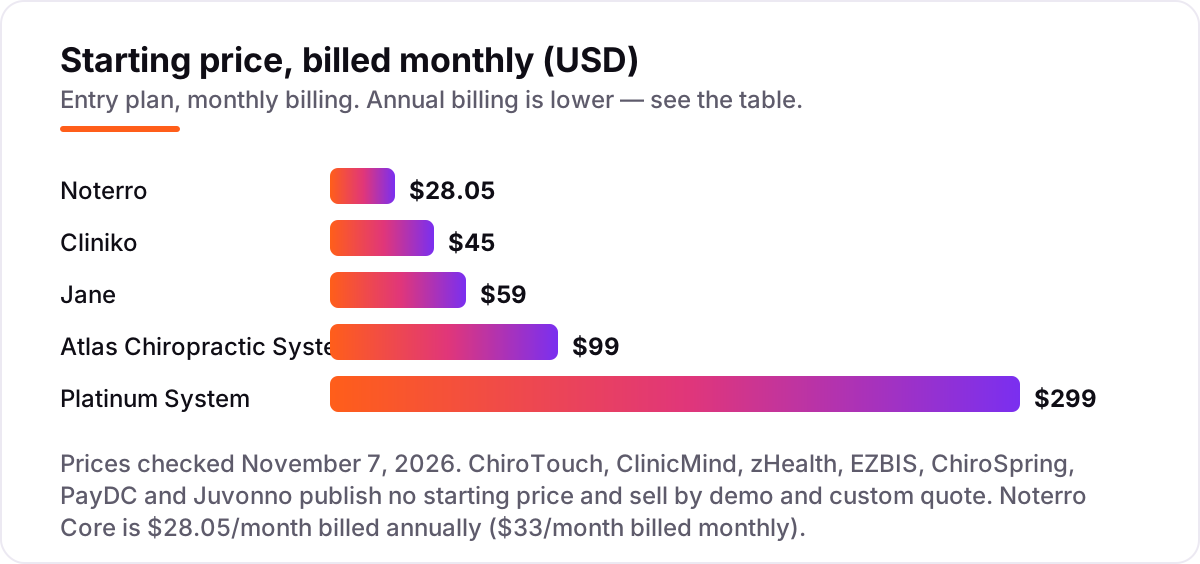
Take a solo chiropractor seeing about 100 visits a month. On list prices, the subscription costs $28.05 a month on Noterro billed annually, $45 on Cliniko, $59 on Jane Balance, $99 on Atlas Essential and $299 on Platinum System. Two of those numbers need adjusting before they are real: Jane Balance caps at 20 appointments a month, so a busy solo practice needs Practice at $79 a month, and Noterro billed monthly is $33, not $28.05.
Over a year, that is $337 on Noterro billed annually, $540 on Cliniko, $708 on Jane Balance or $948 on Jane Practice, $1,188 on Atlas Essential and $3,588 on Platinum System. The same solo doctor and the same 100 visits cost $337 a year at the cheap end and $3,588 at the dear end — a $3,251 gap that comes entirely from scope and billing model, not from features alone.
Three costs sit outside every number above. First, the quote-only vendors: ChiroTouch, ClinicMind, zHealth, EZBIS, ChiroSpring, PayDC and Juvonno publish no price, and directories estimate roughly $55–$300 a month for them — treat those estimates as rumors, not prices, and get a written quote. Second, the add-ons: billing suites, clearinghouse access, AI scribes and insurance billing are often sold separately, and Jane charges $20 a month plus a Claim.MD account for US insurance billing. Third, the per-practitioner math: Cliniko jumps from $95 to $145 a month at the sixth practitioner, and Jane charges $35–$40 per extra full-time practitioner. If you run a group practice, price the whole team before you commit to a tool for one doctor. For the visibility side of the same budget, see our guide to SEO for chiropractors.
Know the difference: chiropractic EMR vs generic medical EHR
The confusion in this category is between a system built for chiropractors and one built for physicians. A chiropractic EMR is built around high-volume visit flow, technique-specific SOAP notes, care plans with prescribed visit frequencies, and chiropractic coding. A generic medical EHR is built around physician encounters, hospital workflows and complex insurance rules that do not match a chiropractic office. Chiropractors on generic systems consistently report slower documentation, because every note has to be forced into templates designed for a different kind of visit.
There is a second, quieter confusion: practice management software is not the same as an EMR. A scheduling tool books appointments and takes payments; it does not keep clinical records, produce SOAP notes, or give you audit-ready documentation. All twelve tools in this list cover clinical documentation as well as scheduling and billing, which is what the phrase "chiropractic EMR" means here. If a tool only books appointments, it belongs in a different list.
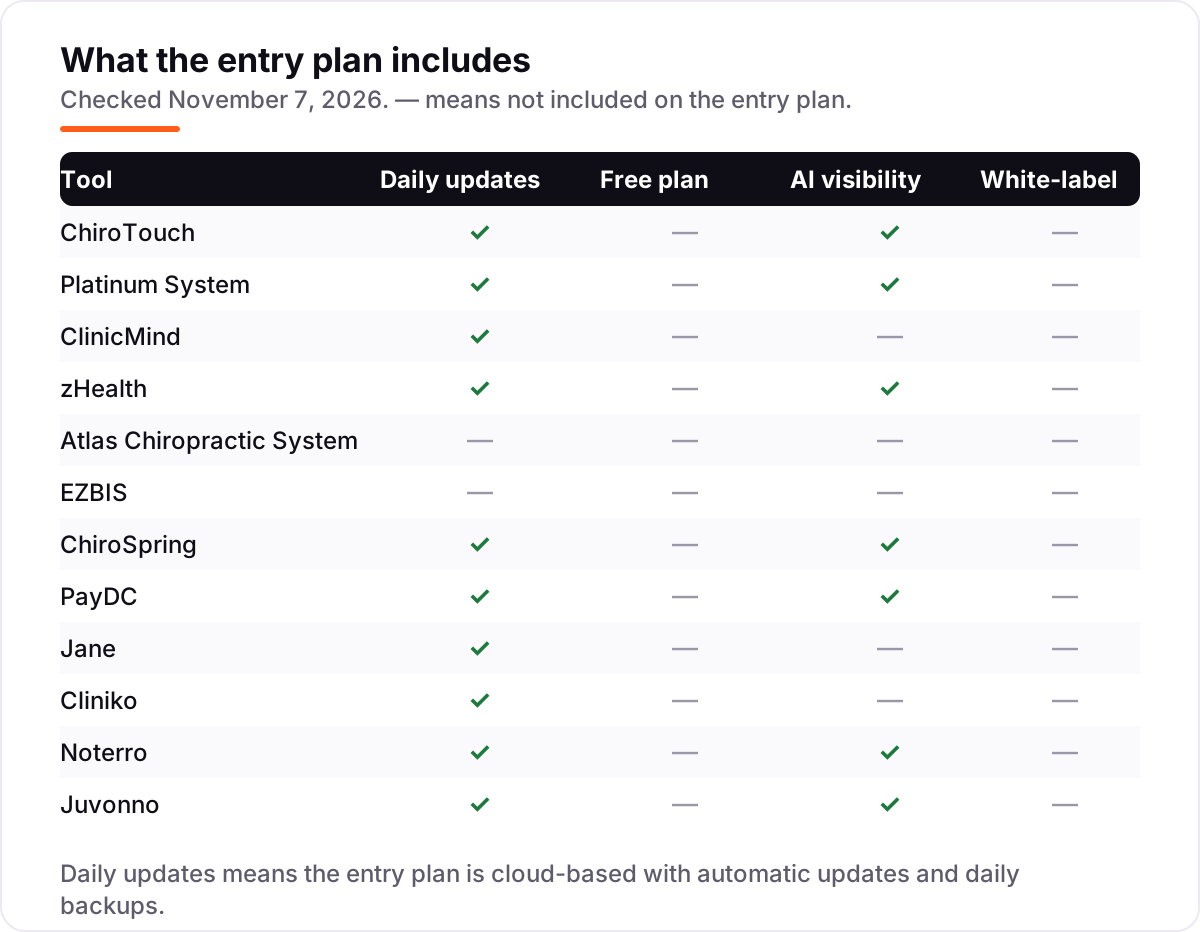
A third distinction worth knowing is cloud versus server. Most of the systems here are cloud-based now: ChiroTouch, ChiroSpring, PayDC, Platinum, zHealth and Juvonno run in the browser with automatic updates and no server in the closet. That is the right default for new practices. EZBIS and Atlas serve many established practices on older server-based systems, and both have paths forward — but moving to the cloud means migrating years of patient records, retraining staff, and trusting a vendor with your data, so get the migration plan in writing before you sign anything.
Quick comparison: tool type by need
| Buyer | Best pick | Why |
|---|---|---|
| Most chiropractic practices | ChiroTouch | The largest dedicated chiropractic EHR, sold by custom quote |
| Clinic that wants one operating system | Platinum System | Nine modules on one bill, from $299/month |
| Multi-location group | ClinicMind | One login runs every location, sold by custom quote |
| Established office that wants a known price | Atlas Chiropractic System | Essential is $99/month, month-to-month |
| Solo practice on a budget | Noterro | Core is $28.05/month billed annually, with a 14-day trial |
| Small practice that wants one flat price | Cliniko | Every feature included, $45/month for one practitioner |
Mistakes to avoid
- Budgeting on a directory price. Seven vendors here publish no price, and the $55–$300 figures in directories are estimates, not quotes. Compare tools only on written quotes that list every module.
- Buying an insurance platform for a cash practice. You will pay for clearinghouse integrations, compliance scans and claim workflows you never open, and your staff will click past them every day.
- Ignoring the appointment cap. Jane Balance at $59 a month stops at 20 appointments, so a busy solo practice needs Practice at $79. The cap you hit first is your real starting price.
- Forgetting the add-ons. Billing suites, clearinghouse access, AI scribes and insurance billing are often sold separately. Price the whole stack, not the headline plan.
- Skipping the migration plan. Moving years of patient records is the hardest part of switching. Get the migration plan, the downtime estimate and the training scope in writing before you sign anything.
How we chose
We checked each vendor's own pricing page on November 7, 2026 and recorded the starting price exactly as shown, or as a custom quote where the vendor publishes none. Platinum System's $299/month comes from its own pricing page, read in a fresh crawl on November 5, 2026; Atlas's $99/month comes from its own pricing page; Cliniko's $45/month from its own pricing page, read in fresh October 2026 captures; Jane's $59/month from its own US pricing page as read in October 2026, corroborated by Capterra listing $59; and Noterro's $28.05/month from the vendor's own site, with the $33/month monthly-billed figure coming from third-party listings. Ratings come from G2 or Capterra pages checked November 7, 2026. Noterro carries no rating here because we could not verify a Capterra review page URL for it, and we would rather show no rating than an unverified one. Directory price estimates for the quote-only vendors ($55–$300 a month) are third-party figures, not vendor prices, and are labeled as such wherever they appear. No vendor paid for a place in this list, and none of the links here are affiliate links.
What to do next
Start with the demo or trial of your top pick and run one real week of visits through it. Check that notes can be finished before the patient leaves the room and that the billing workflow matches how you actually collect payment before you commit to a year. If the software is sorted but new patients are not finding you, our local SEO service handles the visibility side — or compare providers in our guide to chiropractic marketing companies. Once your tools are in place, find out what's holding your rankings back.
Your stack only works if people find you
SerpAstra fixes what keeps your site off page one and makes it easy for AI assistants to recommend.
Get a free audit→Sources we checked (23)
- ChiroTouch pricing — chirotouch.com/pricing (checked November 7, 2026)
- Platinum System pricing — platinumsystem.com/pricing (checked November 7, 2026)
- ClinicMind (Genesis) — genesischiropracticsoftware.com (checked November 7, 2026)
- zHealth — zhealthehr.com (checked November 7, 2026)
- Atlas Chiropractic System pricing — atlaschirosys.com/pricing (checked November 7, 2026)
- EZBIS — ezbis.com (checked November 7, 2026)
- ChiroSpring — clinicdr.com (checked November 7, 2026)
- PayDC — paydc.com (checked November 7, 2026)
- Jane pricing — jane.app/pricing (checked November 7, 2026)
- Cliniko pricing — cliniko.com/pricing (checked November 7, 2026)
- Noterro pricing — noterro.com/pricing (checked November 7, 2026)
- Juvonno — juvonno.com (checked November 7, 2026)
- ChiroTouch reviews — g2.com/products/chirotouch/reviews (checked November 7, 2026)
- EZBIS reviews — g2.com/products/ezbis/reviews (checked November 7, 2026)
- ChiroSpring reviews — g2.com/products/chirospring/reviews (checked November 7, 2026)
- PayDC reviews — g2.com/products/paydc-chiropractic-software/reviews (checked November 7, 2026)
- ClinicMind reviews — g2.com/products/clinicmind-clinicmind/reviews (checked November 7, 2026)
- zHealth reviews — g2.com/products/zhealth/reviews (checked November 7, 2026)
- Juvonno reviews — g2.com/products/juvonno/reviews (checked November 7, 2026)
- Platinum System reviews — capterra.com/p/95936/Platinum-system/reviews (checked November 7, 2026)
- Atlas Chiropractic System reviews — capterra.com.au/software/128414/atlas (checked November 7, 2026)
- Jane reviews — capterra.co.uk/software/178984/jane-app (checked November 7, 2026)
- Cliniko reviews — capterra.co.uk/software/180878/cliniko (checked November 7, 2026)
Shamim
Founder of SerpAstra
A full-stack SEO and digital marketer who spends most days on Local SEO for dental practices, AI search visibility and lead generation.
Frequently asked questions
What is the best chiropractic EMR software?
ChiroTouch is the best fit for most practices: the largest dedicated chiropractic EHR, with three packages covering charting, billing and marketing. Platinum System is the better pick when you want one operating system for EHR, CRM and marketing. Solo practices should start with Noterro, Cliniko or Jane instead.
How much does chiropractic EMR software cost?
Published prices run from $28.05 a month on Noterro (billed annually) to $299 a month on Platinum System, with Cliniko at $45, Jane at $59 and Atlas at $99 in between. Seven of the twelve vendors publish no price at all and sell by custom quote, so expect a demo-led sales process and get every module in writing.
Is there a free chiropractic EMR?
No tool in this list has a free plan. The cheapest way in is a free trial: Cliniko offers 30 days and Noterro offers 14 days, both without a card for the trial period. The other vendors sell through demos. A cash practice that only needs scheduling can start cheaper, but a real EMR always costs something.
What is the difference between chiropractic EMR and generic medical EHR?
Chiropractic EMRs are built around high-volume visit flow, technique-specific SOAP notes, care plans with prescribed visit frequencies, and chiropractic coding. Generic medical EHRs are built around physician encounters and hospital workflows that do not match a chiropractic office. Chiropractors on generic systems consistently report slower documentation.
Can I migrate patient records from my old system?
Usually yes, but it is the hardest part of switching. Vendors offer data migration services, typically covering patient demographics, appointment history and clinical notes, though note formatting rarely transfers perfectly. Ask each vendor for their migration plan, timeline and cost during the demo, and budget staff time for cleanup after go-live.
Do chiropractic EMRs handle online booking and appointment reminders?
All twelve systems here include digital intake forms and automated appointment reminders by text or email. The differentiators are what happens next: AI summarization of intake into SOAP notes on ChiroTouch, two-way texting with reactivation campaigns on PayDC, and patient apps with self-scheduling on Platinum System.
Should a cash practice buy the same EMR as an insurance practice?
No. Cash practices should prioritize online booking, card-on-file payments, care-plan presentation and reminders, and skip the insurance billing modules. Insurance practices need claim scrubbing, ERA auto-posting, eligibility checks and audit-ready documentation. Buying across your model means paying for features you never use.
Free SEO and AI visibility audit
Find out what is holding your rankings back
Send us your site. Within 2 business days you get a written audit, an AI visibility check and a short fix list ranked by impact. Free, with no contract attached.
Request my free audit→Related guides
 Local SEO10 Best Chiropractic Marketing Companies in 202610 best chiropractic marketing companies compared on price, services and contracts, with prices checked November 4, 2026 — from $99/month to custom quotes.Read guide →
 Local SEOSEO for chiropractors: a practical patient-growth guideSEO for chiropractors: win the map pack, build service pages patients trust, earn reviews, and turn searches into booked appointments. A practical guide.Read guide →
 Digital Marketing & AdsBest Medspa Software for 2026: 12 Options Compared by Use CaseCompare the 12 best medspa software options for 2026 on price, charting, booking and marketplace fees, with every price checked November 5, 2026.Read guide →