
8 Best Cloud Platforms for Developers in 2026, Compared
Compare the 8 best cloud platforms for developers, from Vercel and Render to AWS and DigitalOcean, on free tiers, pricing model and real monthly cost.
 Shamim Mia, Founder, SerpAstraLast verified November 6, 20269 min read
We compare pricing pages, documentation and public reviews. We never accept payment for rankings.
Key takeaways
- Vercel and Render are the fastest way to ship: push to Git and the platform builds and runs the app, with free tiers on both and paid plans from $20 a developer seat and $25 a workspace a month.
- AWS, Google Cloud and Azure are pay-as-you-go with no fixed starting price; their free credits — up to $200, $300 and $200 — make them free to learn, not free to run.
- DigitalOcean is the best middle ground for small teams, with flat pricing from $4 a month and egress around $0.01 per GB.
- Hetzner Cloud is the cheapest per core for Europe-leaning workloads, but it has no managed Kubernetes or managed databases.
On this page
Quick comparison
| Tool | Best for | Starting price | Free plan |
|---|---|---|---|
| Vercel | Front-end and full-stack JavaScript developers who want Git-push deploys with previews | Free; Pro $20/seat/mo | Yes |
| Render | Developers who want web services, workers and Postgres on one Git-deployed platform | Free; from $7/mo | Yes |
| DigitalOcean | Small teams that want flat monthly prices and managed databases without hyperscaler complexity | $4/mo | No (trial credit) |
| Amazon Web Services | Developers who need the widest service catalog and the largest hiring ecosystem | Pay as you go | Yes (credits + free tier) |
| Google Cloud | Developers building data, AI and container-heavy products | Pay as you go | Yes ($300 credit) |
| Microsoft Azure | Developers building on .NET, SQL Server or inside a Microsoft-centered company | Pay as you go | Yes ($200 credit) |
| Akamai Connected Cloud | Developers who want flat virtual machine pricing with generous transfer allowances | $5/mo | No (trial credit) |
| Hetzner Cloud | Cost-sensitive developers with Europe-based users who are happy to manage their own stack | €5.49/mo | No |
Make one of these tools?
We re-check this list every quarter. Send a correction, request a review, or ask about a clearly labeled sponsored spot.
Request a listingThe best cloud platforms for developers

Vercel
Best for: Front-end and full-stack JavaScript developers who want Git-push deploys with previews
Vercel is the shortest path from a Git repository to a live app: connect the repo, push, and every branch gets its own preview URL while the main branch goes to production on a global CDN with serverless functions beside it. Hobby is free with 1M CDN requests, 1M function invocations, 100 GB Fast Data Transfer and 200 build minutes a month.
Pro costs $20 a month per developer seat and includes $20 of usage credit, with unlimited viewer seats. Hobby is capped and cannot buy extra usage, while Pro usage past the credit is uncapped pay-as-you-go — function invocations start at $0.60 per 1M — so set spend alerts. Pair it with a database host for anything stateful.
What we like
- Git-push deploys with preview URLs for every branch, no server setup
- Hobby is free with 1M function invocations and 100 GB Fast Data Transfer a month
- Pro includes $20 of usage credit per month, with viewer seats unlimited
- Serverless functions, a CDN and a firewall in the same platform
Watch out for
- Hobby is hard-capped — you cannot buy extra usage without moving to Pro
- Pro usage past the credit is pay-as-you-go and uncapped, so a traffic spike can raise the bill
- Not built for long-running back-end services or self-managed databases

Render
Best for: Developers who want web services, workers and Postgres on one Git-deployed platform
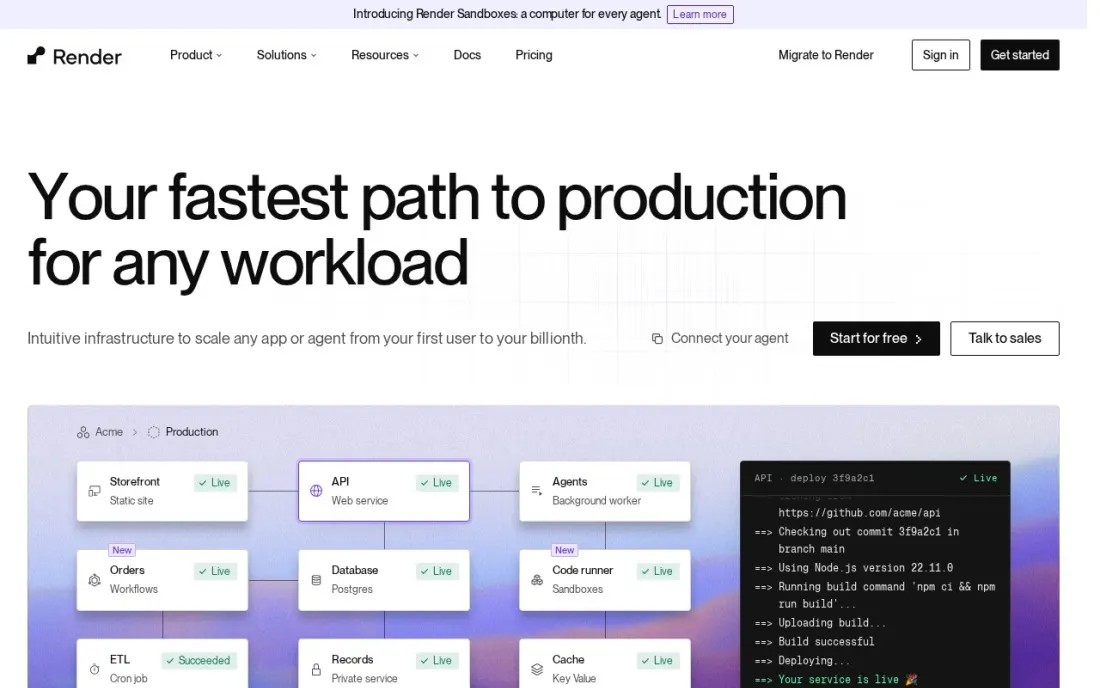
Render fills the gap Vercel leaves: long-running web services, background workers, cron jobs and managed Postgres deployed from Git with no servers to patch. Instance prices are flat and published — a free 512 MB instance, then $7 a month for 512 MB, $25 for 1 CPU and 2 GB, and $85 for 2 CPU and 4 GB. Postgres starts free, and the first paid database costs $6 a month.
The bill has two parts: a workspace plan plus compute. Hobby is $0 with up to 25 services and 5 GB of bandwidth; Pro at $25 a month adds unlimited seats, 25 GB of bandwidth, autoscaling and full-stack previews. For a typical API plus database it is the simplest full-stack home here.
What we like
- Runs long-lived web services, background workers and managed Postgres, not just functions
- Flat, published instance prices from $7 a month for 512 MB
- Pro workspace at $25 a month adds unlimited seats, autoscaling and full-stack previews
Watch out for
- Workspace fee and compute are billed separately, so the bill has two parts
- Hobby includes only 5 GB of bandwidth a month
- Smaller managed-service catalog than the hyperscalers

DigitalOcean
Best for: Small teams that want flat monthly prices and managed databases without hyperscaler complexity
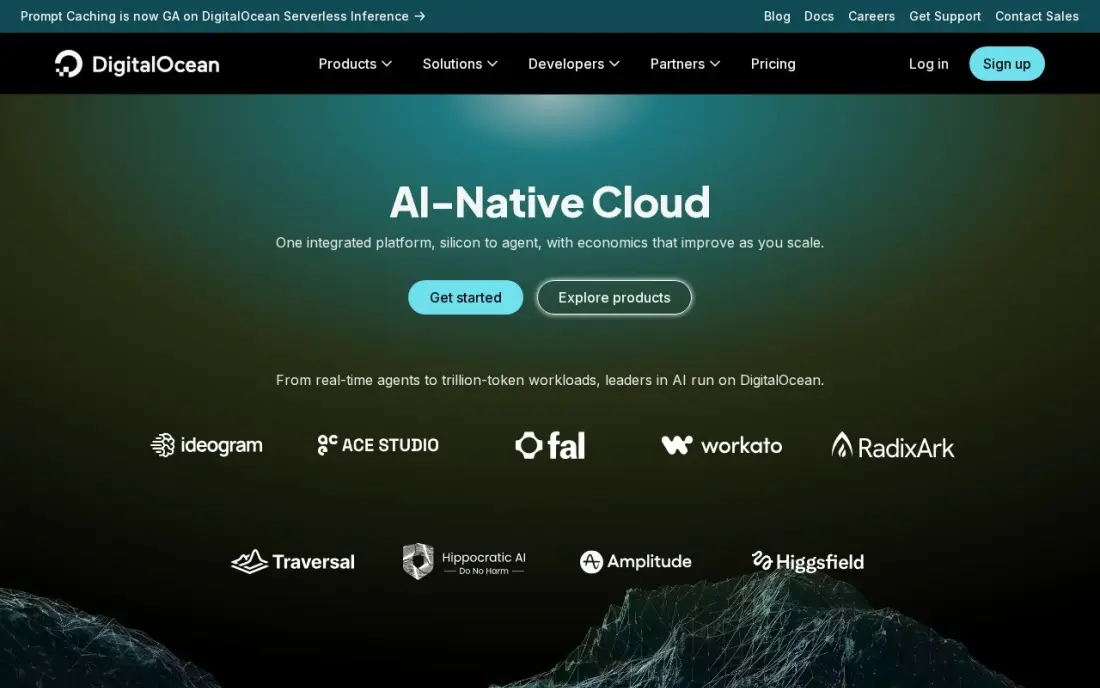
DigitalOcean sits between the deploy platforms and the hyperscalers. Droplets, managed databases, Kubernetes, object storage and App Platform cover most early products, and the console is simple enough to learn in an afternoon. The cheapest Basic Droplet costs $4 a month for 512 MiB, billed per second with a monthly cap.
Egress runs about $0.01 per GB, roughly a ninth of AWS, which matters for APIs and media. There is no free plan, only trial credit for new accounts, and backups add 20% to the Droplet price. The catalog, region count and compliance list are smaller than the big three, so fast-growing products sometimes migrate later.
What we like
- Flat monthly droplet pricing from $4, billed per second with a monthly cap
- A console a new developer can learn in an afternoon, with strong tutorials and community content
- Egress around $0.01 per GB, roughly a ninth of AWS
- Managed databases, Kubernetes and App Platform cover most early products
Watch out for
- A far smaller service catalog than the hyperscalers, with fewer regions and compliance certifications
- No free plan, and backups cost 20% on top of the droplet price
- Enterprise support and controls are thinner than the big three

Amazon Web Services
Best for: Developers who need the widest service catalog and the largest hiring ecosystem
AWS has the widest catalog in cloud computing, with more than 200 services across compute, storage, databases and AI, so a developer rarely has to leave it to find a managed version of something. New accounts get up to $200 in credits, and more than 30 services have always-free allowances, which makes learning it cheap.
Pricing is pay-as-you-go with no fixed starting price, and it is hard to forecast: egress runs about $0.09 per GB, and paid support costs extra. The console and service names take time to learn. Choose AWS when the product needs specific managed services or the team already knows it.
What we like
- More than 200 services across compute, storage, databases and AI, the widest catalog in this list
- The largest global region footprint of the big three, with the deepest partner and hiring ecosystem
- New accounts get up to $200 in credits, and 30+ services have always-free allowances
- Savings Plans and Reserved Instances cut steady compute costs sharply
Watch out for
- Pricing is genuinely hard to forecast, and egress at about $0.09 per GB punishes media-heavy workloads
- Paid support plans cost extra on top of usage, and the free tier of support covers billing questions only
- The console and service names take real time to learn
Google Cloud
Best for: Developers building data, AI and container-heavy products
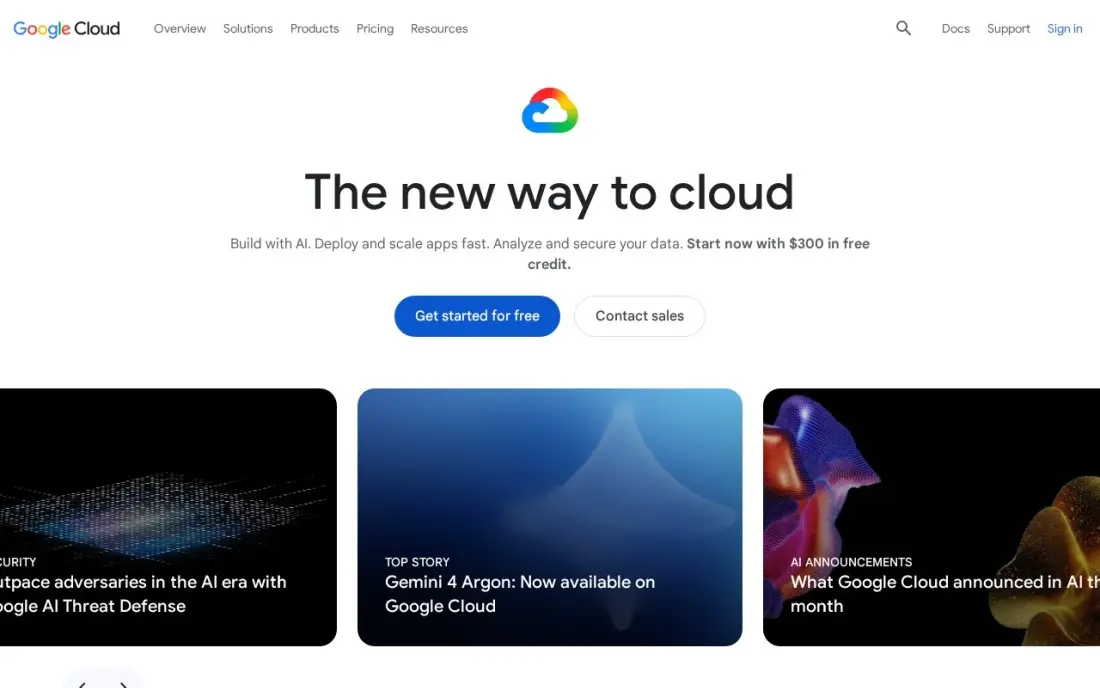
Google Cloud is the developer favorite for data and containers: BigQuery is a benchmark serverless warehouse, GKE is a leading managed Kubernetes service, and Vertex AI covers machine learning. New accounts get $300 of credit for 90 days, and the always-free tier includes one e2-micro VM.
Pricing is pay-as-you-go with no fixed starting price, but sustained-use discounts apply automatically with no commitment, and list prices on standard compute often land a little below AWS and Azure. The partner ecosystem is smaller, and good support costs extra. Pick it when analytics, AI or Kubernetes is the core of the product.
What we like
- BigQuery is the benchmark serverless data warehouse, and GKE is a leading managed Kubernetes service
- Sustained-use discounts apply automatically, with no commitment to buy
- Strong AI stack with Vertex AI and TPUs
- List prices on standard compute often land a little below AWS and Azure
Watch out for
- Smaller partner ecosystem and enterprise sales footprint than AWS or Azure
- Fewer regions than Azure, and some services change faster
- Support quality varies by tier, and good support costs extra

Microsoft Azure
Best for: Developers building on .NET, SQL Server or inside a Microsoft-centered company
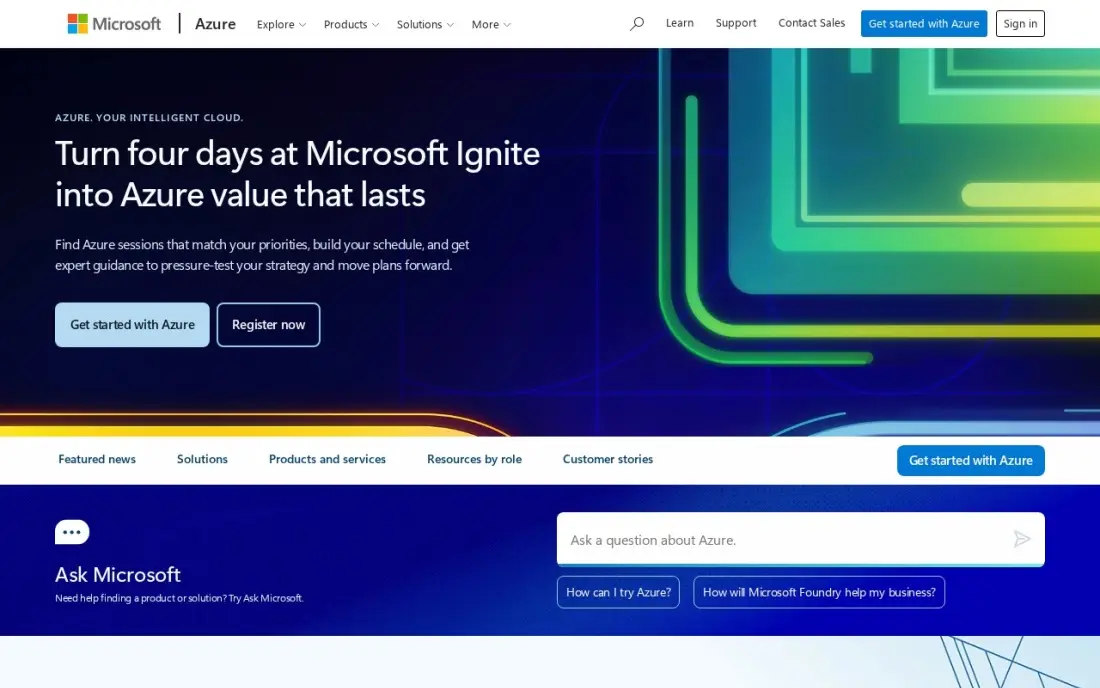
Azure is the natural cloud for .NET, SQL Server and teams already on Microsoft 365 and Entra identity, and Azure OpenAI gives access to OpenAI models inside a Microsoft contract. New accounts get a $200 credit for 30 days, 12 months of popular free services and more than 65 always-free services. It also has the largest region count of the three hyperscalers.
Pricing is pay-as-you-go with no fixed starting price, list prices match AWS on most compute, and egress runs near $0.08 per GB. The portal and naming take time to learn. Choose Azure when the stack or the employer is already Microsoft.
What we like
- The natural home for Windows Server, SQL Server and Active Directory estates
- Strongest hybrid story here: Azure Arc and Azure Hybrid Benefit bridge on-premises and cloud
- The largest region count of the three hyperscalers
- Azure OpenAI gives enterprise access to OpenAI models inside a Microsoft contract
Watch out for
- List prices match AWS on most compute, and real enterprise prices depend on negotiated agreements
- The portal and service naming take time to learn
- Egress near $0.08 per GB adds up fast for media-heavy workloads

Akamai Connected Cloud
Best for: Developers who want flat virtual machine pricing with generous transfer allowances
Akamai Connected Cloud is the former Linode: virtual machines with flat pricing and transfer allowances large enough that egress rarely dominates the bill. The Shared CPU Nanode costs $5 a month for 1 GB of RAM, and managed Kubernetes and managed databases cover the usual next steps. G2 reviewers rate its support 9.1 out of 10.
The pricing pages are less simple than they were before the Akamai rebrand, and prices vary by region. The managed-services catalog is smaller than the hyperscalers', and Akamai's focus is enterprise edge and media delivery. For a developer who wants predictable VM bills with strong DDoS protection, it is still a solid choice.
What we like
- Flat $5 shared-CPU pricing with a generous bundled transfer allowance
- Backed by Akamai's global edge network, with strong DDoS protection built in
- Support reviewers rate the highest among the independents here, 9.1 out of 10 on G2
- Managed Kubernetes (LKE) and managed databases cover the usual next steps
Watch out for
- Pricing pages have grown less simple since the Akamai rebrand, and prices vary by region
- A smaller managed-services catalog than the hyperscalers
- Developer mindshare is drifting to rivals, and the old Linode brand is gone

Hetzner Cloud
Best for: Cost-sensitive developers with Europe-based users who are happy to manage their own stack
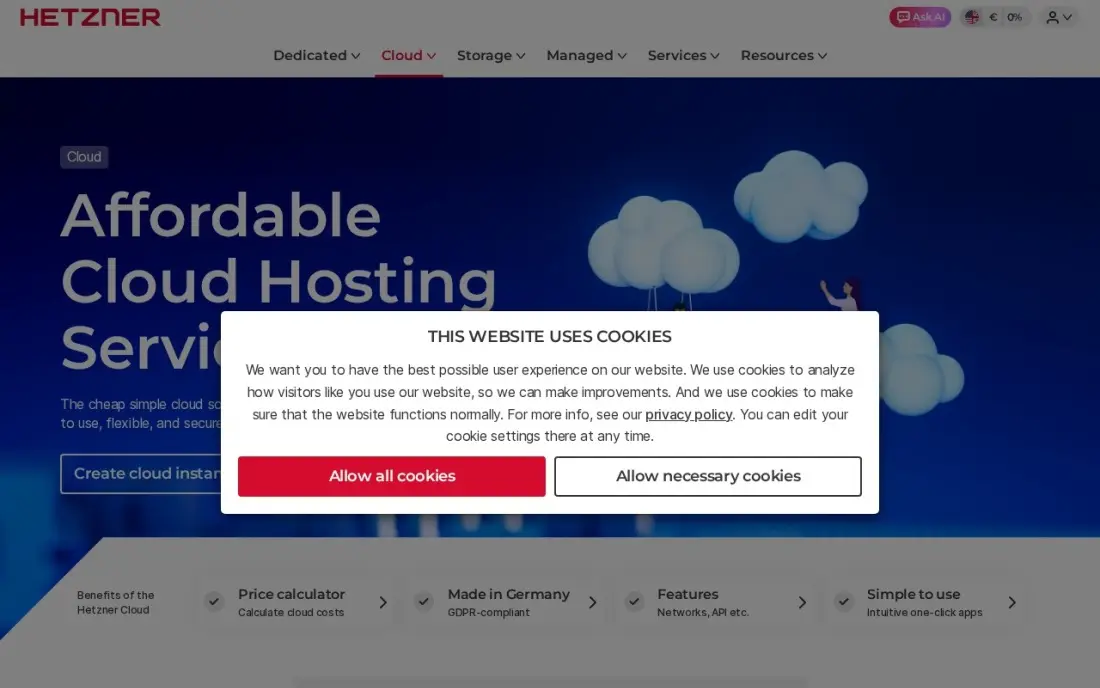
Hetzner Cloud is the price leader for raw compute. A CX23 server with 2 vCPUs and 4 GB of RAM lists at €5.49 a month, with IPv4 €0.50 extra, and EU servers include 20 TB of traffic, so the egress bill barely exists. Hourly billing is capped at the monthly price, and Hetzner runs its own data centers in Germany, Finland, the US and Singapore.
There are trade-offs. The cheap CX plans were listed as limited or not available in October 2026, and the orderable CPX22 costs €19.49. There is no managed Kubernetes or managed database, and no formal uptime SLA on cloud servers. It suits developers comfortable running their own stack.
What we like
- The lowest per-core prices on the open market, with 20 TB of traffic included in EU regions
- Simple hourly billing capped at the monthly price, with no egress surprises
- Own data centers in Germany, Finland, the US and Singapore
- G2 reviewers praise its competitive pricing above everything else
Watch out for
- Cost-optimized CX plans were listed as limited or not available in October 2026; the orderable CPX22 costs €19.49
- No managed Kubernetes and no managed databases — you run those yourself
- No formal uptime SLA on cloud servers, and support is ticket-based
The best cloud platform for developers lets you ship code without fighting the infrastructure, then grows with the product without a surprise bill. We compared eight platforms across the three ways developers use the cloud — Git-push deploy platforms, simple virtual machine clouds and the hyperscalers — on free tiers, pricing model and what a small app really costs, and every price below comes from the vendor's own pricing page as checked in November 2026.
How to choose the best cloud platform for developers
- Decide how much infrastructure you want to run. A deploy platform such as Vercel or Render handles servers for you; a VM cloud or hyperscaler hands you the controls and the maintenance.
- Match the platform to the workload. Front-end and serverless apps suit Vercel; long-running APIs, workers and databases suit Render, DigitalOcean or a hyperscaler.
- Price egress, not just compute. Outbound data transfer ranges from about $0.01 per GB on DigitalOcean to about $0.09 on AWS, which can outweigh the server cost.
- Read the free tier as a trial. Credits expire and hard caps stop the app, so check what happens when you pass the limit.
- Check managed services you will need. A managed database, queue or Kubernetes cluster saves hours every month compared with running your own.
- Think about hiring. AWS and Azure skills are the easiest to hire for; a niche platform may mean training every new developer.
A fast, well-hosted app still needs to be found. If your product site or docs need search traffic, our SEO audit checks the technical side, and the free robots.txt tester confirms crawlers can reach your pages.
Cloud platform for developers pricing: what you will actually pay
Take a small production app: a web front end, an API and a Postgres database. On Render, a Pro workspace at $25 a month, a 1 CPU, 2 GB web service at $25 and the $6 entry Postgres instance come to $56 a month, or $672 a year. On Vercel Pro, one developer seat costs $20 a month with $20 of usage credit, but you still need a database host, so add a database from elsewhere.
On the VM clouds, a DigitalOcean Basic Droplet starts at $4 a month and an Akamai Nanode at $5, while a Hetzner CX23 lists at €5.49 a month — if you are willing to install and run the database yourself. Managed databases on those platforms are extra.
AWS, Google Cloud and Azure publish no fixed starting price; they bill every resource by usage. New-account credits — up to $200 on AWS, $300 for 90 days on Google Cloud and $200 for 30 days on Azure — cover learning and prototypes, but a production bill depends on instance size, storage and egress, so model it in the vendor's calculator before you launch.
Know the difference: platform as a service vs infrastructure as a service
A platform as a service runs your code for you. With Vercel or Render you connect a Git repository, push, and the platform builds the app, provisions the servers, adds TLS and scales it. You give up some control over the machine and pay a premium per unit of compute, but you save the hours that would go into patching, monitoring and configuring servers.
Infrastructure as a service gives you virtual machines, networks and storage to build on. DigitalOcean Droplets, Akamai Nanodes, Hetzner servers and AWS EC2 work this way. The per-unit price is lower and nothing is hidden, but every security update, backup and scaling decision is yours. Many teams start on a platform and move heavy, steady workloads to infrastructure once the bill justifies the extra work.
Quick comparison: tool type by need
| Buyer | Best pick | Why |
|---|---|---|
| Front-end and serverless apps | Vercel | Git-push deploys and previews, free Hobby, Pro $20/seat |
| Full-stack apps with Postgres | Render | Services, workers and databases, instances from $7/month |
| Small teams on a budget | DigitalOcean | Flat pricing from $4/month, egress about $0.01/GB |
| Widest service catalog | Amazon Web Services | 200+ services, up to $200 in new-account credits |
| Data, AI and Kubernetes | Google Cloud | BigQuery, GKE and Vertex AI, $300 credit for 90 days |
| .NET and Microsoft shops | Microsoft Azure | Microsoft stack and Azure OpenAI, $200 credit for 30 days |
| Predictable VM bills | Akamai Connected Cloud | Nanode from $5/month with bundled transfer |
| Lowest cost per core | Hetzner Cloud | CX23 at €5.49/month with 20 TB EU traffic |
Mistakes to avoid
- Launching without spend alerts. Usage-based plans have no ceiling by default, so set a budget alert on day one.
- Ignoring egress. An app that serves large files can spend more on data transfer than on servers.
- Running a database on a free tier in production. Free instances have small limits; keep production data on a paid, backed-up database.
- Building on a hyperscaler too early. A small app rarely needs AWS's catalog, and the setup time is real.
- Locking into proprietary services without a plan. Platform-specific functions and databases are convenient but harder to move, so know what a migration would take.
Related comparisons: AI Tools for Software Developers · Ecommerce Platforms for Developers · Software for Real Estate Developers · Cloud Contact Center Software
How we chose
We checked each vendor's own pricing page in November 2026 and recorded the plan prices, included usage and free-tier limits exactly as shown, including where a page leaves something unstated. We grouped the platforms by how much infrastructure the developer manages and ranked them by fit for the most common buyer, a developer or small team shipping a web app. Ratings come from G2 pages checked on the dates shown in the sources; where we did not read a review page we show no rating. No vendor paid for a place in this list, and none of the links here are affiliate links.
What to do next
Deploy the same small app to one deploy platform and one VM cloud for a week, then compare the bill, the deploy time and the hours you spent on setup. Once the product is live and needs users, book a free call about getting it found in search.
Frequently asked questions
What is the best cloud platform for developers?
For shipping a web app fast, Vercel and Render are the easiest, with free tiers and paid plans from $20 a developer seat and $25 a workspace a month. For flat-priced servers and managed databases, DigitalOcean is the best middle ground from $4 a month. For the widest catalog, AWS leads.
Which cloud platform has the best free tier for developers?
Google Cloud gives new accounts $300 of credit for 90 days plus an always-free e2-micro VM, and AWS and Azure give up to $200. For hosting an app at no cost, Vercel Hobby and Render Hobby both have free plans, with Render's free web instance at 512 MB.
Is AWS or Google Cloud better for developers?
AWS has more services and a bigger hiring ecosystem; Google Cloud is stronger for data, AI and Kubernetes, and applies sustained-use discounts automatically. Both are pay-as-you-go with no fixed starting price, so the better choice is the one whose managed services your product needs.
What is the difference between PaaS and IaaS?
A platform as a service such as Vercel or Render runs your code from Git and handles servers, scaling and patching. Infrastructure as a service such as AWS EC2, DigitalOcean Droplets or Hetzner Cloud gives you virtual machines you configure and maintain yourself.
How much does a cloud platform cost for a small app?
A small app can run free on Vercel Hobby or Render Hobby. Paid starting points are $4 a month for a DigitalOcean Droplet, $5 for an Akamai Nanode, €5.49 for a Hetzner CX23, $7 a month for a Render instance, and $20 a developer seat for Vercel Pro.
Why are cloud bills hard to predict?
Usage meters such as outbound data transfer, function invocations and storage requests add up separately from compute. Egress runs about $0.09 per GB on AWS and near $0.08 on Azure, against about $0.01 on DigitalOcean, so data-heavy apps feel the difference most.
Which cloud platform is best for web development?
For a front-end or full-stack JavaScript web app, Vercel is the shortest path: push to Git and every branch gets a preview URL, with a free Hobby plan and Pro at $20 a month per developer seat. Render suits web apps that need long-running services, background workers and managed Postgres, with a free 512 MB instance and paid compute from $7 a month.
What are the top cloud platforms?
The three hyperscalers are Amazon Web Services, Google Cloud and Microsoft Azure. AWS has the widest catalog, with more than 200 services; Google Cloud leads on data, AI and Kubernetes with BigQuery and GKE; and Azure has the largest region count of the three and suits .NET and Microsoft shops. All three are pay as you go, with free credits for new accounts.
Sources we checked (14)
- Vercel — vercel.com/pricing (checked November 16, 2026)
- Render — render.com/pricing (checked November 16, 2026)
- DigitalOcean — www.digitalocean.com/pricing (checked November 6, 2026)
- DigitalOcean reviews on G2 (checked November 6, 2026)
- Amazon Web Services — aws.amazon.com/pricing (checked November 6, 2026)
- Amazon Web Services reviews on G2 (checked November 6, 2026)
- Google Cloud — cloud.google.com/pricing (checked November 6, 2026)
- Google Cloud reviews on G2 (checked November 6, 2026)
- Microsoft Azure — azure.microsoft.com/en-us/pricing (checked November 6, 2026)
- Microsoft Azure reviews on G2 (checked November 6, 2026)
- Akamai Connected Cloud — www.akamai.com/cloud-computing (checked November 6, 2026)
- Akamai Connected Cloud reviews on G2 (checked November 6, 2026)
- Hetzner Cloud — www.hetzner.com/cloud (checked November 6, 2026)
- Hetzner Cloud reviews on G2 (checked November 6, 2026)
Make one of these tools?
We re-check this list every quarter. Send a correction, request a review, or ask about a clearly labeled sponsored spot.
Request a listingShamim
Founder of SerpAstra
A full-stack digital marketer and SEO strategist covering technical and local SEO, AI search visibility, paid ads and lead generation for local businesses, e-commerce brands and SaaS teams.
Free SEO and AI visibility audit
Find out what is holding your rankings back
Send us your site. Within 2 business days you get a written audit, an AI visibility check and a short fix list ranked by impact. Free, with no contract attached.
Request my free audit→Related buying guides
 Developer Tools7 Best Hosting for React Apps in 2026, ComparedCompare the 7 best hosting for React app projects on free tiers, build limits, server rendering and real monthly cost, with prices checked on vendor pages.Read guide →
 IT Management9 Best Cloud Hosting Services in 2026, ComparedCompare the 9 best cloud hosting services on starting price, free credits, egress costs, managed services and support, with every price checked on vendor pages.Read guide →
 Business Software11 Best Cloud Infrastructure Services Reviews in 2026The 11 best cloud infrastructure services reviews compared on price, free tiers, egress and AI features, with every price checked November 6, 2026.Read guide →