
9 Best Content Experience Platforms for 2026 (Pros, Cons and Pricing)
Compare the 9 best content experience platforms for B2B teams on price, free plans and AI features, with every price checked November 10, 2026.
 Shamim Mia, Founder, SerpAstraLast verified November 10, 202611 min read
We compare pricing pages, documentation and public reviews. We never accept payment for rankings.

Key takeaways
- PathFactory leads for B2B content hubs (custom quote), Folloze leads for ABM experiences (custom quote), and Hushly is the only one with a free plan ($0) and a $99/month Starter.
- The single most important buying factor is the pricing model: six of the nine tools are custom-quote, so budget on the annual contract, not a monthly list price.
- Only Paperflite ($30/user/month) and Zoomforth (from $250/month) publish starting prices alongside Hushly's free plan; the rest require a sales quote.
- Every price below was checked on the vendor's own pricing page on November 10, 2026, or marked custom quote where the vendor publishes no price.
On this page
Quick comparison
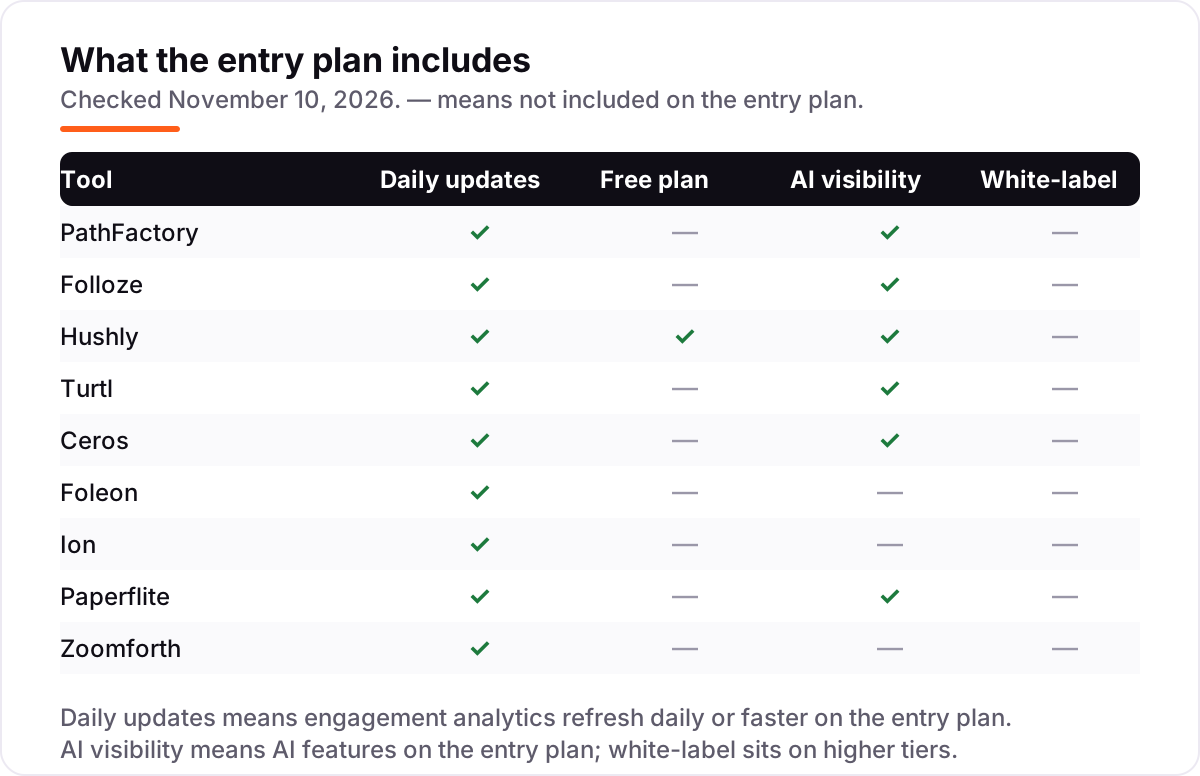
| Tool | Best for | Starting price | Free plan |
|---|---|---|---|
| PathFactory | B2B marketing teams with large content libraries who want hubs and journeys tied to pipeline | Custom quote | No (demo only) |
| Folloze | ABM teams shipping personalized microsites, event hubs and deal rooms every week | Custom quote | No (demo only) |
| Hushly | B2B teams that want AI personalization and lead capture starting free, then scaling up | Free; Starter $99/mo | Yes (free plan) |
| Turtl | Analytics-first B2B teams turning PDFs and decks into trackable interactive documents | Custom quote | No (demo only) |
| Ceros | Design-led marketing teams building interactive landing pages and reports without code | Custom quote | No (Starter trial) |
| Foleon | Marketing and communications teams publishing branded interactive documents at volume | Custom quote | No (demo only) |
| Ion | Enterprise marketers building quizzes, calculators and assessments that capture declared data | Custom quote | No (demo only) |
| Paperflite | Small B2B teams that want a content hub and microsites with published per-user pricing | $30/user/mo | No (free trial) |
| Zoomforth | Enterprise teams building branded microsites for proposals, portals and ABM pages | From $250/mo | No (14-day trial) |
Make one of these tools?
We re-check this list every quarter. Send a correction, request a review, or ask about a clearly labeled sponsored spot.
Request a listingThe best content experience platforms

PathFactory
Best for: B2B marketing teams with large content libraries who want hubs and journeys tied to pipeline
PathFactory is the hub-and-analytics end of this list. It gathers a team's blog posts, ebooks and videos into content hubs, then builds personalized journeys — playlists and dynamic landing pages — that change with each visitor's stage. Its reporting shows which accounts engaged, for how long, and whether that engagement shows up in pipeline.
The price is the catch, and it is a big one: there is no published price, and the quote is built around monthly active visitors, so a busy hub costs more than a quiet one. Implementation most often takes under a month to three months, and teams without someone to own the platform day to day report a steep learning curve. Buy it when proving content's effect on revenue is the job; buy Folloze when shipping ABM experiences fast matters more.
What we like
- Content hubs, playlists and dynamic landing pages personalized to each visitor's journey stage
- Engagement analytics tie content consumption to pipeline and revenue, not just views
- Integrates with Marketo, HubSpot, Salesforce and 6sense to share engagement data with sales
Watch out for
- No published pricing — every contract is a custom quote priced by monthly active visitors
- Implementation most often takes under a month to three months, so plan onboarding time
- Reviewers flag a dated interface and a learning curve for teams without dedicated operations support

Folloze
Best for: ABM teams shipping personalized microsites, event hubs and deal rooms every week
Folloze is built for one motion: account-based marketing at volume. Its no-code boards turn a campaign into a personalized microsite — a hub, an event page or a deal room — that sales can send to a named account without waiting on the web team. Templates and AI Agents do the heavy lifting, generating personalized content and flagging buying signals as accounts engage.
The trade-off is transparency. There is no published price and no free plan or trial, so every deal starts with a demo and a sales call, and third-party benchmarks put the median contract near $57,000 a year. Reviewers also note limits in design flexibility. Buy Folloze when your team ships ABM experiences weekly; buy PathFactory when the content library itself is the asset.
What we like
- No-code boards let marketing ship personalized account experiences without developer tickets
- Embedded AI Agents generate personalized content and flag buying signals at scale
- G2 reviewers rate ease of use and customer support among the best in this category
Watch out for
- No published pricing and no free plan or trial — every deal starts with a sales call
- Reviewers note limits in design flexibility and template options
- Running many board variations takes steady upkeep or the content goes stale

Hushly
Best for: B2B teams that want AI personalization and lead capture starting free, then scaling up
Hushly is the only tool here with a real free tier. Its pricing page lists a $0 Free plan for PageSherpa, a $99-a-month Starter, and Enterprise from $24,000 a year — the clearest pricing in the whole list. The platform combines AI-driven personalization with content hubs, self-nurturing landing pages and lead capture, so a small team can start free and grow into the full product.
Read the tiers carefully before you celebrate the free plan: it covers PageSherpa only, and the full platform — ContentSherpa, AccountSherpa and GEOSherpa — waits for Enterprise. Pricing also runs on credits, so a busy month costs more than a quiet one. Hushly is the right first step for a team testing personalization; it is the wrong pick for a team that needs the whole platform on day one.
What we like
- The only free plan here: PageSherpa at $0 forever, with Starter at $99 a month
- AI-driven personalization, content hubs and self-nurturing landing pages in one platform
- Enterprise starts at $24,000 a year with the full product bundle and a dedicated CSM
Watch out for
- The full platform — ContentSherpa, AccountSherpa and GEOSherpa — only comes with Enterprise
- Credit-based pricing means heavy usage pushes the bill up even on the $99 plan
- Directories still list old per-view and per-lead prices, so confirm the quote in writing

Turtl
Best for: Analytics-first B2B teams turning PDFs and decks into trackable interactive documents
Turtl turns the documents teams already have — PDFs, decks and reports — into Turtl Docs: interactive, scrolling experiences that track every reader. Its analytics show what each account read, for how long, and where they dropped off, which is the closest thing in this list to proof that a document did its job. The Hatch AI agent builds and personalizes content from inside the platform.
There is no published price and no free trial, so expect a demo and a quote. The only public anchor is the Grow AI plan, listed from $45,000 a year on G2 with pricing supplied by Turtl, and licences are annual with a one-year minimum. Buy Turtl when your best content is trapped in PDFs and you need to know who actually read it; buy Foleon when brand control matters more.
What we like
- Turtl Docs turn static PDFs and presentations into interactive, measurable reading experiences
- Reader analytics show what each account actually read, down to the section
- Hatch AI agent builds and personalizes content from inside the platform
Watch out for
- No published prices and no free trial — every plan is quoted after a demo
- Grow AI is listed from $45,000 a year on G2, so this is enterprise pricing
- Licences are annual subscriptions with a one-year minimum commitment

Ceros
Best for: Design-led marketing teams building interactive landing pages and reports without code
Ceros is the design tool of this list. Its no-code Flex editor lets designers build interactive landing pages, reports and microsites without a developer, and every plan includes unlimited publishing with unlimited reviewers. Flex AI is available to all subscribers on a monthly credit allocation, so even the entry plan gets AI help with the creative work.
The catch is price opacity: Starter, Growth and Enterprise are all quoted, and the only public figures come from third-party benchmarks, which put small teams in the low-to-mid five figures a year. Starter also covers just one creator and three editors. Buy Ceros when the experience has to look designed; buy Turtl when the reading data matters more than the layout.
What we like
- No-code Flex editor lets designers build interactive experiences without developers
- Unlimited publishing on every plan, with unlimited reviewers
- Flex AI is available to all subscribers via a monthly credit allocation
Watch out for
- No published prices — Starter, Growth and Enterprise are all quoted
- Starter covers only 1 creator and 3 editors, so teams pay more for more makers
- Built for design-led content; engagement analytics are lighter than the analytics-first tools here

Foleon
Best for: Marketing and communications teams publishing branded interactive documents at volume
Foleon is for teams that publish documents the way publishers do: branded, interactive and controlled. Brand Kits and templates keep every brochure, report and proposal on-brand without a designer checking each one, and the Scale plan includes unlimited live documents. Team adds workspaces and collaboration, while Enterprise adds locked document settings and custom SLAs.
Like most of this list, Foleon publishes no prices — Scale, Team and Enterprise are all quoted after a demo, and there is no free trial on the website. Annual subscriptions are the only option, so the commitment starts at a year. Buy Foleon when your team publishes a steady stream of branded documents; buy Ceros when each piece needs a bespoke design.
What we like
- Brand Kits and templates keep every document on-brand without designer review
- Scale includes unlimited live documents, and Team adds workspaces and collaboration
- ISO 27001 certified, with locked document settings on Enterprise
Watch out for
- No published prices — Scale, Team and Enterprise are all quoted after a demo
- No free trial on the website; evaluation runs through a demo
- Annual subscriptions, so the commitment starts at a year

Ion
Best for: Enterprise marketers building quizzes, calculators and assessments that capture declared data
Ion, by Rock Content, is the format specialist of this list. It builds quizzes, ROI calculators, assessments and interactive infographics with no code, then captures the declared data — the answers buyers type in themselves — and syncs it with your CRM and marketing automation. Built-in A/B testing and responsive Quick Start templates mean a team can launch a calculator in days, not weeks.
The buying process is enterprise all the way down: four custom-priced plans, no published prices, and no free trial confirmed on the vendor site. TrustRadius also lists a $5,500 setup fee, so the first year costs more than the subscription alone. Buy Ion when interactive formats are the strategy; buy PathFactory or Folloze when you need the hub that holds them.
What we like
- Quizzes, ROI calculators, assessments and interactive infographics with no code
- Captures declared, high-intent data and syncs it with CRM and marketing automation
- Built-in A/B testing and responsive Quick Start templates speed up launches
Watch out for
- No published pricing — four custom-priced plans, all quoted by sales
- A $5,500 setup fee is listed on TrustRadius, so budget beyond the subscription
- No free trial is confirmed on the vendor site; evaluation runs through a demo

Paperflite
Best for: Small B2B teams that want a content hub and microsites with published per-user pricing
Paperflite is the transparent option in a category of custom quotes. Its Starter plan costs $30 a user a month — $27.50 billed annually — and includes the content hub, personalized microsites and SEEK AI-powered search, with a free trial that needs no credit card. For a small team that wants to know the price before the sales call, that alone sets it apart.
The fine print is the five-user minimum, which puts the real floor at $150 a month, and the features that growing teams want — white labeling and SSO — wait for Professional at $50 a user a month. Enterprise is custom-priced. Buy Paperflite when a small team needs a hub and microsites on a known budget; buy Folloze when ABM scale matters more than price clarity.
What we like
- The only published per-user price among the hub tools here, from $30 a user a month
- Starter includes the content hub, microsites and SEEK AI-powered search
- Free trial with no credit card required, and no setup fee
Watch out for
- A 5-user minimum puts the real floor at $150 a month, not $30
- White labeling and SSO need Professional at $50 a user a month
- Enterprise is custom-priced, and services and migration fees are not published

Zoomforth
Best for: Enterprise teams building branded microsites for proposals, portals and ABM pages
Zoomforth builds multi-page microsites for the moments around the deal: proposals, RFP responses, client portals and onboarding hubs. Every plan includes unlimited sites, visitors and media storage, with visitor analytics and brand themes throughout, and a 14-day trial runs in a secure sandbox with sample content. It is the simplest buying decision in this list.
The price is published — from $250 a month — but the final quote still depends on team size and add-ons such as single sign-on and custom domains, and contracts carry a 12-month minimum. It is also microsite-focused rather than a full content hub. Buy Zoomforth when proposals and portals are the job; buy PathFactory when you need the hub and the analytics behind it.
What we like
- Plans start from $250 a month — a published price in a category of custom quotes
- Unlimited sites, visitors and media storage on every plan, with visitor analytics included
- 14-day trial in a secure sandbox, plus full onboarding on every plan
Watch out for
- Contracts run a 12-month minimum, with discounts only for longer terms
- The final quote depends on team size and add-ons such as SSO and custom domains
- Microsite-focused — it is not a full content hub or analytics platform
The best content experience platforms turn a pile of PDFs, blog posts and videos into a place buyers actually want to spend time: a hub, a personalized journey or an interactive document that reports back on what each account read. This list is ranked by fit for the most common buyer, a B2B marketing team that needs to publish interactive experiences and prove they moved pipeline, not by brand size. Six of the nine tools publish no price at all, so expect a sales conversation for most of them; the priced options and the one free plan are flagged in every card.
How to choose the best content experience platforms
- Start with the format. Hubs and journeys (PathFactory, Folloze) suit teams with large libraries; interactive documents (Turtl, Foleon, Ceros) suit teams publishing reports and proposals; quizzes and calculators (Ion) suit lead capture.
- Check who builds it. Every tool here is no-code, but the build effort differs: Folloze boards and Paperflite microsites ship in hours, while PathFactory implementations most often take under a month to three months.
- Ask what the analytics prove. The point of a content experience platform is the read data: who read what, for how long, and whether it moved the deal. PathFactory and Turtl lead here.
- Price the whole contract. Six tools are custom-quote with annual minimums; ask about setup fees, credits and renewal uplifts before signing.
- Check the integrations. The experience data only matters if it reaches your CRM and marketing automation — Salesforce, HubSpot and Marketo cover most teams here.
Before you buy, run one real campaign through the trial or demo and watch the analytics, not the demo data. A content hub only works if buyers find it in the first place, and our monthly SEO service covers the search side while the platform handles the experience.
Content experience platform pricing: what you will actually pay
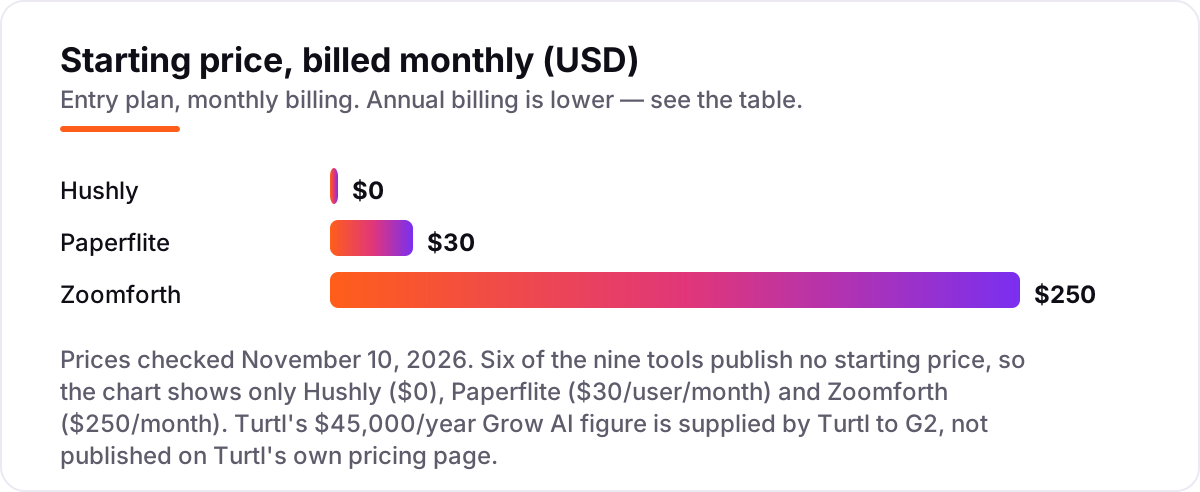
Take a team of five marketers publishing one hub and a monthly campaign. On published prices, the first year costs $0 on Hushly Free, $1,188 on Hushly Starter at $99 a month, $1,650 on Paperflite Starter billed annually ($27.50 per user a month for five users), and $3,000 on Zoomforth from $250 a month. Hushly Enterprise starts at $24,000 a year, and Turtl's Grow AI is listed from $45,000 a year on G2, supplied by Turtl. For the custom-quote tools, third-party contract benchmarks are the only guide: Vendr puts the median PathFactory contract at $43,000 a year, ranging from $19,250 to $69,768, and the median Folloze contract at $56,794 a year. Ceros, Foleon and Ion publish no prices at all, so their cost is whatever the sales quote says.
Three costs sit outside every number above. First, implementation and services: Vendr notes PathFactory onboarding and integration often add 15 to 25 percent to first-year costs, and Ion lists a $5,500 setup fee on TrustRadius. Second, usage pricing: Hushly runs on credits and Turtl on credits too, so heavy publishing months cost more than quiet ones. Third, renewal uplifts: PathFactory contracts commonly carry a 5 percent annual uplift, so ask for the year-two price in writing before you sign.
Know the difference: content experience platform vs CMS vs interactive content tool
The confusion in this category is the layer each tool sits on. A CMS — WordPress, for example — stores and publishes your pages; it is where the content lives. A content experience platform sits on top of it and packages that content into personalized, trackable experiences: hubs, journeys, boards and interactive documents, with analytics on who read what. An interactive content tool is narrower still: it builds one format, such as a quiz or calculator, and usually plugs into a CMS or a platform rather than replacing either.
You do not replace your CMS with a content experience platform — you add the platform when the CMS stops telling you anything. If your question is "which accounts read our buyer's guide and for how long," a CMS cannot answer it and a quiz tool answers only its own format. That is the job the platforms in this list exist for, and it is why their analytics, not their editors, decide most buying decisions.
Quick comparison: tool type by need
| Buyer | Best pick | Why |
|---|---|---|
| Large B2B library, needs pipeline proof | PathFactory | Hubs plus engagement-to-revenue analytics, custom quote |
| ABM team shipping every week | Folloze | No-code boards and AI Agents, custom quote |
| Small budget, wants to start free | Hushly | Free PageSherpa plan, Starter is $99/month |
| Reports and proposals as interactive docs | Turtl | Reader analytics down to the section, custom quote |
| Design-led interactive pages | Ceros | No-code Flex editor, Starter free to try |
| Published price, microsites fast | Paperflite or Zoomforth | $30/user/month and from $250/month |
Mistakes to avoid
- Budgeting on a monthly list price that does not exist. Six tools here are custom-quote with annual contracts, so the real question is the yearly total, not a monthly figure.
- Buying the platform before counting the formats. A hub tool is wasted on a team that only publishes one report a quarter, and a document tool cannot run an ABM program.
- Ignoring the implementation and services bill. Setup fees, onboarding and credit-based usage sit outside the subscription — PathFactory services can add 15 to 25 percent in year one.
- Treating a free plan as the full platform. Hushly Free is PageSherpa only; the full platform waits for Enterprise at $24,000 a year.
- Forgetting the renewal. Most contracts here run 12 months minimum, and PathFactory renewals commonly carry a 5 percent uplift — get the year-two price in writing.
Before a new hub page goes live, run the copy through the free readability checker — if buyers cannot read it easily, the analytics will show it.
How we chose
We checked each vendor's own pricing page on November 10, 2026 and recorded the starting price exactly as shown — or custom quote where the vendor publishes no price. PathFactory publishes no pricing page at all, and Folloze, Foleon and Ion publish no prices either. Turtl's $45,000-a-year Grow AI figure is supplied by Turtl to G2 rather than published on Turtl's own pricing page, and the PathFactory and Folloze medians in the pricing section come from Vendr contract benchmarks, not the vendors. Ratings come from G2 pages we opened on November 10, 2026 — PathFactory and Folloze only. Further G2 checks were rate-limited that day, so no other ratings are shown rather than estimated. Two familiar names are missing on purpose: SnapApp was discontinued in July 2022, and Uberflip has been maintenance-only since PathFactory acquired it in July 2024, with no new features — new buyers are directed to PathFactory. No vendor paid for a place in this list, and none of the links here are affiliate links.
What to do next
Shortlist two tools that match your main format — a hub, a board or a document — and run a demo with your own content, not the vendor's sample. Ask for the full first-year cost in writing, including implementation, credits and the year-two renewal price. Then buy the one whose analytics answer the question your team actually asks in pipeline reviews. Once your tools are in place, find out what's holding your rankings back.
Your stack only works if people find you
SerpAstra fixes what keeps your site off page one and makes it easy for AI assistants to recommend.
Get a free audit→Sources we checked (14)
- PathFactory pricing — pathfactory.com (no published pricing; checked November 10, 2026)
- PathFactory on G2 — 4.4/5, 203 reviews (checked November 10, 2026)
- Folloze pricing — folloze.com (no published pricing; checked November 10, 2026)
- Folloze on G2 — 4.7/5, 53 reviews (checked November 10, 2026)
- Hushly pricing — hushly.com/pricing (checked November 10, 2026)
- Turtl pricing — turtl.co/pricing (checked November 10, 2026)
- Turtl pricing on G2 — Grow AI from $45,000/year, supplied by Turtl (checked November 10, 2026)
- Ceros pricing — ceros.com/pricing (checked November 10, 2026)
- Foleon pricing — foleon.com (no published pricing; checked November 10, 2026)
- Ion pricing — ceros.com interactive content tools guide, Ion plans custom-priced (checked November 10, 2026)
- Paperflite pricing — paperflite.com (checked November 10, 2026)
- Zoomforth pricing — zoomforth.com/faq, plans from $250/month (checked November 10, 2026)
- PathFactory pricing benchmarks — vendr.com (median $43,000/year; checked November 10, 2026)
- Folloze pricing benchmarks — vendr.com (median $56,794/year; checked November 10, 2026)
Shamim
Founder of SerpAstra
A full-stack SEO and digital marketer who spends most days on Local SEO for dental practices, AI search visibility and lead generation.
Frequently asked questions
What is the best content experience platform in 2026?
PathFactory is the best fit for most B2B teams: content hubs and personalized journeys with engagement analytics tied to pipeline. Folloze is the better pick for ABM teams shipping personalized boards every week, and Hushly is the best starting point on a budget, with a free plan and a $99-a-month Starter. The right choice depends on whether you need a hub, a board or a document.
How much does a content experience platform cost?
From $0 to about $57,000 a year. Hushly is free to start and $99 a month on Starter, Paperflite costs $30 a user a month with a five-user minimum, and Zoomforth starts at $250 a month. The enterprise tools are custom-quote: third-party benchmarks put PathFactory at a $43,000 median and Folloze at $56,794 a year, and Turtl's Grow AI is listed from $45,000 a year.
Is there a free content experience platform?
One, with a catch. Hushly's free plan costs $0 forever but covers PageSherpa only; the full platform starts at $24,000 a year on Enterprise. Ceros lets you try its Starter plan free, and Paperflite and Zoomforth both offer free trials. The other tools in this list have no free plan and no trial — evaluation runs through a demo.
What is the difference between a content experience platform and a CMS?
A CMS stores and publishes your pages — it is where the content lives. A content experience platform sits on top of it and packages that content into personalized, trackable experiences such as hubs, journeys and interactive documents, with analytics on who read what. You add a platform when the CMS stops telling you anything about your buyers.
What happened to Uberflip?
PathFactory acquired Uberflip in July 2024 and placed it in maintenance mode: existing customers get bug fixes, but there is no new development and all product work goes to PathFactory. New buyers are directed to PathFactory instead. That is why Uberflip is not in this list, even though it was once the best-known name in the category.
Do I need a content experience platform if I already have a CMS?
Not always. If your CMS already publishes well and your team only needs a few landing pages, a platform is overkill. It earns its price when you need personalization at scale — different content for different accounts — and proof of what each account read. Without those two needs, spend the money on content and search instead.
How long does it take to get started with a content experience platform?
Days for the document and microsite tools: Folloze boards, Paperflite microsites and Ceros experiences can go live within a week. PathFactory is the slowest start here — G2 reports implementation most often taking under a month to three months. Whichever tool you pick, plan a pilot on one campaign before rolling it out to the whole team.
Free SEO and AI visibility audit
Find out what is holding your rankings back
Send us your site. Within 2 business days you get a written audit, an AI visibility check and a short fix list ranked by impact. Free, with no contract attached.
Request my free audit→Related guides
 Digital Marketing & Ads10 Best Content Marketing Software in 2026, Compared10 best content marketing software tools compared on price, planning, optimization and publishing, with starting prices and the right pick for every team size.Read guide →
 AI, Data & Analytics12 Best Content Analytics Software in 2026, ComparedCompare the 12 best content analytics software options for 2026, with real starting prices, free plans and G2 ratings — from free GA4 to Parse.ly.Read guide →
 Digital Marketing & Ads7 Best B2B Content Marketing Companies in 20267 best B2B content marketing companies compared on price, services and fit for B2B teams, with real published prices checked November 4, 2026.Read guide →