
8 Best Content Syndication Platforms for 2026 (Pros, Cons and Pricing)
8 best content syndication platforms compared for B2B lead generation: CPL and CPC costs, pros, cons and ratings, with every price checked November 10, 2026.
 Shamim Mia, Founder, SerpAstraLast verified November 10, 202612 min read
We compare pricing pages, documentation and public reviews. We never accept payment for rankings.

Key takeaways
- NetLine leads for most B2B marketers at $14 per lead self-serve, followed by DemandScience and TechTarget Priority Engine, both custom quote.
- The single most important buying factor is how you pay: cost per lead, cost per click or a custom annual quote decides the budget, not the feature list.
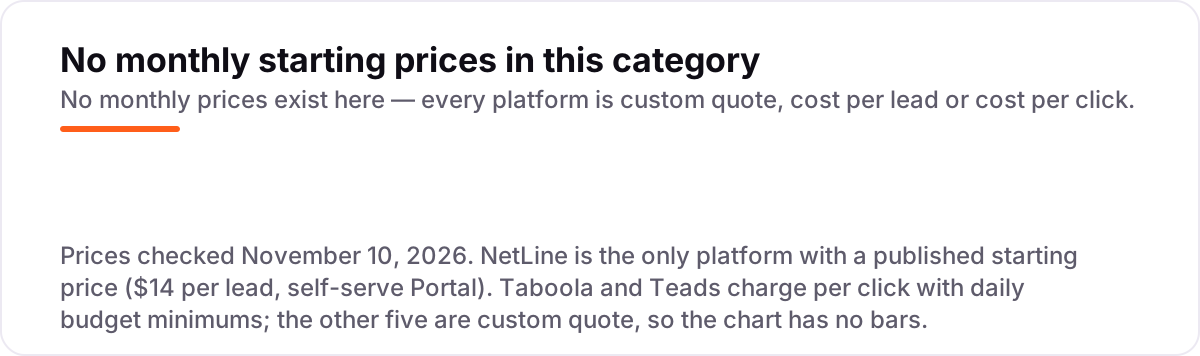
- Only NetLine publishes a starting price; Taboola and Teads charge per click with daily minimums, and the other five are custom quote.
- Syndicated leads are top-of-funnel: plan a 90-day nurture before judging the channel on pipeline.
On this page
Quick comparison
| Tool | Best for | Starting price | Free plan |
|---|---|---|---|
| NetLine | Mid-market B2B marketers who want self-serve content syndication and pay only for leads delivered | From $14/lead | No (pay per lead) |
| DemandScience | Enterprise demand-gen teams that want fully managed syndication, ABM and BANT-qualified leads | Custom quote | No (demo only) |
| TechTarget Priority Engine | Technology vendors selling to IT buyers who want prospect-level intent with their syndication | Custom quote | No (talk to sales) |
| Taboola | B2B marketers with a tested content funnel who want self-serve native distribution at scale | CPC; $50/day recommended | No (pay per click) |
| Teads (formerly Outbrain) | B2B marketers who want premium publisher placements for content-led campaigns | CPC; $20/day minimum | No (pay per click) |
| Madison Logic | Enterprise ABM teams running content syndication plus display, LinkedIn, CTV and audio to named accounts | Custom quote | No (demo only) |
| Integrate | Enterprise demand-gen teams running syndication across many vendors who need clean, governed lead data | Custom quote | No (demo only) |
| pharosIQ (formerly CONTENTgine) | B2B marketers who want intent-scored syndication leads with content performance analytics | Custom quote | No (talk to sales) |
Make one of these tools?
We re-check this list every quarter. Send a correction, request a review, or ask about a clearly labeled sponsored spot.
Request a listingThe best content syndication platforms

NetLine
Best for: Mid-market B2B marketers who want self-serve content syndication and pay only for leads delivered
NetLine is the only platform here with a published price: the Portal starts at $14 per lead, and you set your cost per lead in an open bidding marketplace instead of accepting a vendor's rate card. NetLine says its network reaches 125 million visitors across 15,000 web properties and processes 700,000 leads a month. Campaigns can go live in under a day, with lead activity shown in real time.
The $14 figure is a floor, not a promise. Tight filters on job title, company size and industry push the cost per lead to $20-$40 or more, and target account lists carry a surcharge. Full-service programs are quoted separately, so the self-serve price covers only campaigns you run yourself. Buy NetLine to test syndication on a budget; buy a managed vendor when you want someone else to run the program.
What we like
- The only published starting price here: self-serve campaigns start at $14 per lead on the NetLine Portal
- Open bidding marketplace lets you set your own cost per lead instead of accepting a fixed rate card
- First-party audience of 125 million monthly visitors across 15,000 web properties, per NetLine
- Campaigns can go live in under a day, with real-time lead activity in the dashboard
Watch out for
- Tight job-title and account filters push the cost per lead well above the $14 starting figure
- Target account lists carry a surcharge, per G2 reviewers
- Full-service programs are custom quote, so the self-serve price does not cover managed campaigns

DemandScience
Best for: Enterprise demand-gen teams that want fully managed syndication, ABM and BANT-qualified leads
DemandScience is a managed service first and a platform second. You hand over the asset, the targeting and the budget, and its team runs the syndication, ABM display and intent programs, then delivers the leads. That fits enterprise teams that want lead volume without building a syndication operation in-house. The company grew from PureB2B and absorbed Terminus in November 2024, so syndication now sits beside ABM and BANT lead programs in one vendor.
The trade-off is control and transparency. There is no published price and no self-serve dashboard: every program is a custom quote, and campaign changes go through an account manager. Third-party benchmarks put targeted campaigns at $55-$120 per lead with $5,000-$15,000 minimum pilots. G2 reviewers praise the lead quality and the support team, but note reporting gets hard to follow across several campaigns at once.
What we like
- Fully managed service: the team runs targeting, delivery and optimization, so no in-house syndication operation is needed
- Syndication, ABM display, intent data and BANT qualification in one vendor after the 2024 Terminus merger
- G2 reviewers praise lead quality and a responsive support team that adapts campaigns on request
Watch out for
- No published pricing at all; every program is a custom quote with $5,000-$15,000 minimum pilots, per third-party benchmarks
- No self-serve access: campaign changes go through an account manager, not a dashboard you control
- G2 reviewers note reporting can be hard to follow when several campaigns run at once

TechTarget Priority Engine
Best for: Technology vendors selling to IT buyers who want prospect-level intent with their syndication
TechTarget Priority Engine is the intent-first entry in this list. Its first-party data comes from more than 220 owned technology sites, and it names the individual prospect researching your category, not just the account. That makes it the strongest fit for technology vendors, where knowing who is reading matters more than raw lead volume. Syndication, intent data and BrightTALK webinars all run inside the Informa TechTarget portal.
The limits are scope and price. Outside technology buying, the network sees far less, so a general B2B team pays for reach it cannot use. There is no published price: third-party contract data puts the median near $92,000 a year, and annual commitments are standard. Implementation takes about two months, per G2, and reviewers report inconsistent contact data. Buy it when you sell to IT buyers and intent quality decides the deal.
What we like
- First-party intent from 220+ owned technology sites names the individual prospect, not just the account
- Syndication, intent data and BrightTALK webinars run in one Informa TechTarget portal
- Prospect Insights shows exactly which asset each prospect downloaded or engaged with
Watch out for
- Technology buyers only: coverage outside IT is thin, so general B2B teams pay for reach they cannot use
- No published price; third-party contract data puts the median near $92,000 a year
- G2 reviewers report inconsistent contact data and a roughly two-month implementation

Taboola
Best for: B2B marketers with a tested content funnel who want self-serve native distribution at scale
Taboola is the scale play. Its native network, now the Realize advertiser platform, puts your content in recommendation feeds across thousands of publisher sites, and self-serve campaigns launch without a sales call. There is no platform fee: you pay only for clicks or impressions, and performance bidding optimizes toward conversions once the campaign has enough signal. Site-level controls cut placements that send traffic but no leads.
The catch is that clicks are not leads. There is no rate card, so competitive US placements cost far more than the $0.01 minimum bid, and Taboola's $50-a-day guidance means a serious test starts around $1,500 a month in media. Ad approvals can be slow and inconsistent, per G2 reviewers. Taboola fits a team with a tested funnel and a landing page that converts; it punishes a team still guessing at its offer.
What we like
- The largest native network here, with self-serve campaigns you can launch without a sales call
- Performance bidding (Realize) optimizes toward conversions once the campaign has enough signal
- No platform fee on self-serve: you pay only for clicks or impressions
- Site-level controls let you cut placements that send traffic but no leads
Watch out for
- No rate card: click costs are pure auction, so competitive US placements cost far more than the $0.01 minimum bid
- The $50-a-day guidance means a serious test starts around $1,500 a month in media
- Ad approvals can be slow and inconsistent, per G2 reviewers of the Realize platform

Teads (formerly Outbrain)
Best for: B2B marketers who want premium publisher placements for content-led campaigns
Teads is what Outbrain became: Outbrain acquired Teads in February 2025, the combined company took the Teads name in June 2025, and the old Outbrain advertiser platform was retired. What survives is the recommendation-feed inventory on premium publisher sites, sold per click with a $20-a-day minimum budget documented in the Outbrain help center. Conversion Bid Strategy adjusts bids toward a target CPA, ROAS or maximum conversions.
The $20 minimum makes Teads the cheapest self-serve entry among the native networks here, but standards are strict and volume is lower than Taboola's. Its G2 score of 3.4/5 from 91 reviews is the lowest in this list, with reviewers citing high minimum spend and mixed ROI. Teads fits a content-led campaign that needs trusted placements more than cheap clicks, not a team chasing volume at the lowest cost.
What we like
- Premium publisher inventory, including major news sites, with strict editorial standards
- Conversion Bid Strategy adjusts bids toward target CPA, ROAS or maximum conversions
- The $20-a-day minimum is the lowest self-serve entry among the native networks here
Watch out for
- Outbrain's standalone advertiser platform was retired after the Teads merger; buying now runs through Teads
- Lowest G2 score in this list at 3.4/5, with reviewers citing high minimum spend and mixed ROI
- Teads publishes no rate card, and managed video flights carry negotiated five-figure minimums

Madison Logic
Best for: Enterprise ABM teams running content syndication plus display, LinkedIn, CTV and audio to named accounts
Madison Logic is an ABM platform that treats content syndication as one channel among many. From the same platform it runs syndication, display, LinkedIn ads, connected TV and audio against a named account list, powered by Bombora intent data and its own publisher network. A new Intent Dashboard and AI Planner turn objectives into audiences and channel mixes. That breadth is why enterprise ABM teams pick it over single-channel vendors.
The price is enterprise too. There is no public price list, and third-party benchmarks put all-in programs at $30,000-$150,000 a year, with the platform fee included in the media buy. G2 reviewers call the interface unintuitive and the learning curve steep, and its leads skew top-of-funnel. Buy Madison Logic when several channels must hit the same accounts; buy NetLine when a single syndication campaign is the whole job.
What we like
- Multi-channel activation from one platform: syndication, display, LinkedIn, connected TV and audio
- Bombora-powered intent plus its own publisher network, with a new Intent Dashboard and AI Planner
- G2 reviewers praise lead quality, support and reporting that ties campaigns to demand goals
Watch out for
- No public price list; third-party benchmarks put all-in programs at $30,000-$150,000 a year
- G2 reviewers call the interface unintuitive and the learning curve steep
- Syndication leads skew top-of-funnel, so sales needs a nurture plan before expecting pipeline

Integrate
Best for: Enterprise demand-gen teams running syndication across many vendors who need clean, governed lead data
Integrate does a different job from the rest of this list: it does not supply the audience, it governs the demand. Its platform connects every third-party channel, validates, deduplicates, enriches and routes each lead, and delivers only clean, marketable records to the CRM or marketing automation system. One dashboard shows fulfillment, spend and trend data across vendors, so performance is comparable side by side.
That makes Integrate a second purchase, not a first: you still pay publishers or vendors for the media, and the platform fee is a custom annual contract with no published price. Setup can be time-consuming, with a learning curve, per G2 reviewers. Buy Integrate when syndication runs across several vendors and bad lead data costs sales time; skip it while one vendor and a spreadsheet cover the job.
What we like
- Validates, deduplicates, enriches and routes every lead before it reaches the CRM or marketing automation
- One dashboard governs all third-party demand channels, so vendor performance is comparable side by side
- G2 reviewers praise lead validation and customer support most
Watch out for
- It orchestrates syndication rather than supplying the audience: media spend with publishers is separate
- No published pricing; enterprise contracts are quoted per program
- Initial setup can be time-consuming, with a learning curve, per G2 reviewers

pharosIQ (formerly CONTENTgine)
Best for: B2B marketers who want intent-scored syndication leads with content performance analytics
pharosIQ is the new name for CONTENTgine: the vendor retired the CONTENTgine brand and now sells under pharosIQ, so older reviews and directory listings still use the old name. The platform pairs content syndication with account intent scoring, detailed engagement insights and content performance analytics, and it also runs webinar lead generation. G2 reviewers report fast campaign launches and leads delivered on the agreed schedule.
There is no published pricing, so every program is quoted by the vendor, and the public evidence is thin: G2 lists 8 reviews, too few to judge the platform on ratings alone, so this card carries none. That thin record is the honest reason to shortlist pharosIQ beside a better-reviewed vendor and compare the quotes side by side, rather than buying it on the strength of its feature list alone.
What we like
- Intent scoring and engagement analytics show which accounts are researching your category
- Syndication, webinar lead generation and content performance reporting in one platform
- G2 reviewers report fast campaign launches and leads delivered on schedule
Watch out for
- No published pricing; contact the vendor for a quote on every program
- The CONTENTgine brand was retired in favor of pharosIQ, so older reviews and listings use the old name
- Only 8 G2 reviews, too few to judge the platform from public ratings alone
The best content syndication platforms put your gated whitepapers, ebooks and reports in front of B2B buyers who are already researching a purchase, then hand you the contact details of everyone who downloads. The eight platforms below are ranked by fit for the most common buyer, a B2B marketer distributing gated content for leads, and every price was checked on November 10, 2026. Only one platform publishes a starting price, so read the pricing section before you shortlist: most of these are custom quote, cost per lead or cost per click.
How to choose the best content syndication platforms
- Pick the payment model first. Cost per lead, cost per click or a custom annual quote are three different budgets. A $14 lead and a $50-a-day click campaign cannot be compared on headline price alone.
- Check who owns the audience. NetLine and TechTarget run on their own first-party networks; DemandScience and Madison Logic buy across publisher partners. First-party audiences are easier to verify and harder to fake.
- Ask what counts as a billable lead. A download, a form fill and a BANT-qualified lead are three different products at three different prices. Get the definition in writing before you compare cost per lead figures.
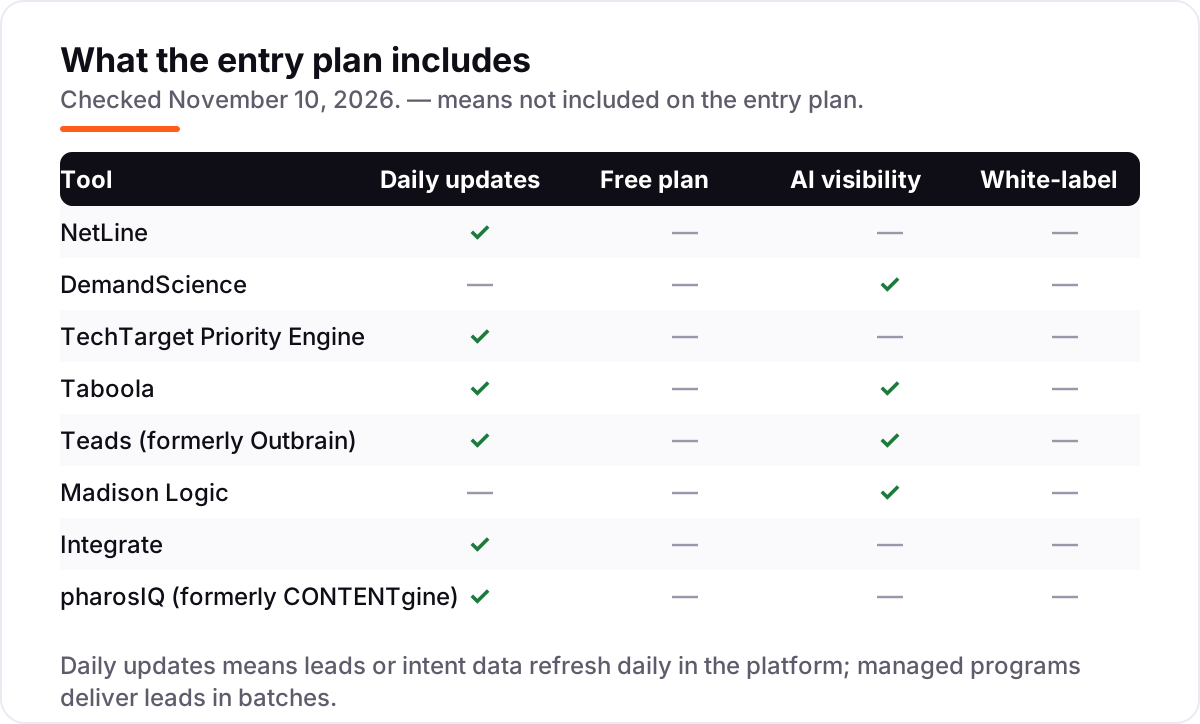
- Check lead delivery and CRM routing. Leads that arrive in a weekly spreadsheet age fast. NetLine and Integrate push leads in real time; managed vendors deliver in batches, so ask for the schedule.
- Check the intent data. TechTarget, Madison Logic and pharosIQ score accounts by research behavior, which is what turns a download list into a sales priority list.
- Match the minimum to your budget. A $5,000 pilot minimum or a $92,000-a-year median contract rules out a small team before the feature list matters.
Syndication amplifies content; it does not fix content that nobody finds on its own. If your own site is not showing up when buyers search, our local SEO service covers that side first, and the syndication budget then goes further.
Content syndication platform pricing: what you will actually pay
Take a team that wants 100 leads a month. On NetLine's self-serve Portal at $14 per lead, that is $1,400, before tight filters push the cost per lead to $20-$40 or more. On DemandScience, third-party benchmarks put targeted campaigns at $55-$120 per lead, so the same 100 leads cost $5,500-$12,000, with $5,000-$15,000 minimum pilots on top. On Taboola, the $50-a-day recommended budget means a 30-day test costs $1,500 in media, and clicks only become leads if the landing page converts. On Teads, the $20-a-day minimum sets a $600 floor for a 30-day test. TechTarget does not sell by the lead at all: third-party contract data puts the median near $92,000 a year for intent plus syndication.
Then comes the number that decides whether the channel pays: cost per opportunity. At a 3-5% lead-to-SQL rate, per Sotros 2026 benchmarks, 100 leads yield 3-5 sales-qualified leads. NetLine's $1,400 therefore buys SQLs at roughly $280-$467 each, before nurture costs, while DemandScience's $5,500-$12,000 buys the same 3-5 SQLs at $1,100-$4,000 each. The dearer lead can still win if it converts better, which is why the pilot matters more than the rate card. Tag every syndicated link with the free UTM builder so you can see which vendor's leads actually convert, not just which one delivered the most names.
Know the difference: content syndication vs native advertising vs content distribution
The confusion in this category is the pricing unit, not the feature list. Content syndication distributes a gated asset through a publisher network and charges per lead: you pay for contact details, and the vendor owns the audience. Native advertising, like Taboola and Teads, charges per click and sends traffic to your page: you pay for visits, and a lead only happens if the visitor converts on your landing page. Content distribution is the umbrella term for all of it, including free channels you own — your site, your email list, your LinkedIn — which cost time instead of media spend.
The three need different budgets and different proof. Syndication is judged on cost per lead and cost per opportunity; native ads are judged on cost per click and landing-page conversion rate; owned distribution is judged on reach you already have. A team that buys clicks expecting leads will call the channel a failure in week two. DemandScience cites research that 65% of B2B marketers scale content marketing with syndication, but that figure describes the channel's popularity, not its conversion rate — the leads still need 18-24 touches of nurture before sales should expect a conversation.
Quick comparison: tool type by need
| Buyer | Best pick | Why |
|---|---|---|
| Mid-market B2B marketer, self-serve | NetLine | Only published price here: $14 per lead, no sales call |
| Enterprise team, fully managed | DemandScience | Managed syndication plus ABM and BANT, custom quote |
| Technology vendor selling to IT | TechTarget Priority Engine | Prospect-level intent from 220+ owned tech sites |
| Marketer with a tested funnel, big reach | Taboola | Largest native network, self-serve CPC, $50/day recommended |
| Premium placements, low entry | Teads (formerly Outbrain) | Trusted publisher inventory, $20/day minimum |
| ABM team, several channels at once | Madison Logic | Syndication plus display, LinkedIn, CTV and audio |
Mistakes to avoid
- Comparing a $14 lead with a $50-a-day budget. Cost per lead, cost per click and an annual quote are different units. Convert every option to cost per opportunity for your own funnel before ranking them.
- Buying on the headline cost per lead. Tight filters, target account surcharges and BANT qualification all raise the real figure. Get the cost per lead in writing for your exact filters, not the broad-audience rate.
- Judging the channel in week one. Syndicated leads are top-of-funnel and need 18-24 touches of nurture. A pilot judged on week-one pipeline will always look like a failure.
- Skipping the lead-quality check. Check the first batch against your ICP, verify the contact data and count duplicates before the pilot scales. Bad data paid for by the lead is the most expensive kind.
- Forgetting the nurture cost. The media or per-lead fee is only half the spend. Email sequences, scoring and SDR follow-up run for 90 days, and a team without that capacity will waste the leads it buys.
How we chose
We checked each vendor's own pricing page on November 10, 2026 and recorded the starting price exactly as shown, and we ranked the tools by fit for the most common buyer, a B2B marketer distributing gated content for leads, not by brand size. NetLine's $14 per lead comes from its own Portal page, opened November 10, 2026. Taboola's $50-a-day figure is Taboola's own guidance as reported by third-party guides, and Teads' $20-a-day minimum comes from the Outbrain help center as reported by OpenAdLibrary in October 2026. The DemandScience $55-$120 per-lead range, the TechTarget median near $92,000 a year and the Madison Logic $30,000-$150,000 range are third-party benchmarks, not vendor prices, and are labeled as such wherever they appear. Ratings are G2 as shown on pages crawled November 3-10, 2026. Taboola carries no rating because its G2 page was last crawled 43 days ago, and pharosIQ because its G2 base is 8 reviews. Two names changed since older lists were written: Outbrain's advertiser platform is now Teads, and CONTENTgine is now pharosIQ. No vendor paid for a place in this list, and none of the links here are affiliate links.
What to do next
Start with NetLine if you want to test syndication yourself: one asset, one audience, 100 leads at the published rate, and check the first batch against your ICP before spending more. If the pilot works, get quotes from DemandScience and Madison Logic for the managed route and compare them on cost per opportunity, not cost per lead. If the leads convert but your own site still does not rank, our monthly SEO service handles the visibility side. Once your tools are in place, find out what's holding your rankings back.
Your stack only works if people find you
SerpAstra fixes what keeps your site off page one and makes it easy for AI assistants to recommend.
Get a free audit→Sources we checked (17)
- NetLine Portal — portal.netline.com ($14 per lead, checked November 10, 2026)
- NetLine on G2 — 4.6/5, 188 reviews (checked November 10, 2026)
- DemandScience on G2 — 4.4/5, 763 reviews (checked November 10, 2026)
- DemandScience pricing — prospeo.io (no published price; CPL benchmarks, third-party)
- TechTarget Priority Engine on G2 — 4.3/5, 453 reviews (checked November 10, 2026)
- Informa TechTarget pricing — prospeo.io (Vendr median $92,000/year, third-party)
- Taboola minimum budget — nativeyukti.com ($50/day guidance, third-party)
- Outbrain advertising cost — openadlibrary.com ($20/day minimum, Outbrain help center)
- Madison Logic on G2 — 4.3/5, 275 reviews (checked November 10, 2026)
- Madison Logic pricing — zenabm.com (no public price list, third-party)
- Integrate on G2 — 4.4/5, 85 reviews (checked November 10, 2026)
- Integrate pricing — salesbox.ai (custom enterprise contracts, third-party)
- CONTENTgine is now pharosIQ — contentgine.com (redirect, checked November 10, 2026)
- CONTENTgine pricing — research.com (no public pricing)
- Outbrain Direct Response on G2 — 3.4/5, 91 reviews (checked November 10, 2026)
- B2B content syndication CPL benchmarks — sotrosinfotech.com (lead-to-SQL rates, 2026)
- Content syndication in B2B — takethemarket.com (DemandScience 65% stat and 18-24 touches)
Shamim
Founder of SerpAstra
A full-stack SEO and digital marketer who spends most days on Local SEO for dental practices, AI search visibility and lead generation.
Frequently asked questions
What is the best content syndication platform?
NetLine is the best fit for most B2B marketers: self-serve campaigns from $14 per lead, no sales call and no annual contract. DemandScience is the better pick for enterprise teams that want a fully managed program, and TechTarget Priority Engine is the pick for technology vendors that need prospect-level intent. The right choice depends on whether you want to run the campaign or have it run for you.
How much does content syndication cost per lead?
NetLine starts at $14 per lead self-serve, with tight filters pushing it to $20-$40 or more. Third-party benchmarks put DemandScience at $55-$120 per lead for targeted campaigns, and the market range runs roughly $25-$100 per lead depending on targeting. BANT-qualified leads cost more, typically $150-$400, because a live call verifies each one.
Is there a free content syndication platform?
No. NetLine lets you create a free account, but you pay for every lead delivered, and Taboola and Teads charge per click with no free tier. The closest thing to free is distributing content yourself through your own site, email list and LinkedIn, which costs time rather than media spend. Every platform here charges for the audience it delivers.
What is the difference between content syndication and native advertising?
Syndication distributes a gated asset through a publisher network and charges per lead: you pay for contact details. Native advertising, like Taboola and Teads, charges per click and sends traffic to your page; a lead only happens if the visitor converts there. Syndication buys leads, native ads buy visits, and the two need different budgets and different landing pages.
How long do syndicated leads take to become pipeline?
Plan on 90 days of nurture. Syndicated leads downloaded a whitepaper, so they are early in the buying process, and DemandScience puts the nurture load at 18-24 touches before these leads are ready to talk to sales. At a 3-5% lead-to-SQL rate, most leads never become opportunities. Judge the channel on cost per opportunity after a full quarter, not on cost per lead in week one.
Should I run content syndication myself or use a managed vendor?
Run it yourself on NetLine, Taboola or Teads if you have a tested asset, a landing page that converts and time to optimize weekly. Use a managed vendor like DemandScience or Madison Logic if you need volume without building the operation, or if ABM and intent data must run with the syndication. Managed programs cost more per lead but remove the weekly work.
What should I check before signing a content syndication contract?
Ask what counts as a billable lead, how duplicates and bad data are credited, and what the minimum commitment is. Get the cost per lead in writing for your exact filters, not a headline rate. Confirm lead delivery timing, CRM routing and whether intent data is included. Then run a small pilot and check the first batch of leads against your ICP before committing to a quarter.
Free SEO and AI visibility audit
Find out what is holding your rankings back
Send us your site. Within 2 business days you get a written audit, an AI visibility check and a short fix list ranked by impact. Free, with no contract attached.
Request my free audit→Related guides
 Digital Marketing & Ads10 Best Content Marketing Software in 2026, Compared10 best content marketing software tools compared on price, planning, optimization and publishing, with starting prices and the right pick for every team size.Read guide →
 Digital Marketing & Ads7 Best B2B Content Marketing Companies in 20267 best B2B content marketing companies compared on price, services and fit for B2B teams, with real published prices checked November 4, 2026.Read guide →
 AI, Data & Analytics12 Best Content Analytics Software in 2026, ComparedCompare the 12 best content analytics software options for 2026, with real starting prices, free plans and G2 ratings — from free GA4 to Parse.ly.Read guide →