
12 Best CRM Email Marketing Software in 2026, Compared
12 best crm email marketing software tools compared on price, CRM depth and automation, with real starting prices checked on November 4, 2026.
 Shamim Mia, Founder, SerpAstraLast verified November 4, 202612 min read
We compare pricing pages, documentation and public reviews. We never accept payment for rankings.

Key takeaways
- HubSpot is the best all-round pick: a real CRM plus email from $20 a seat a month, with a free CRM for up to 1 million contacts.
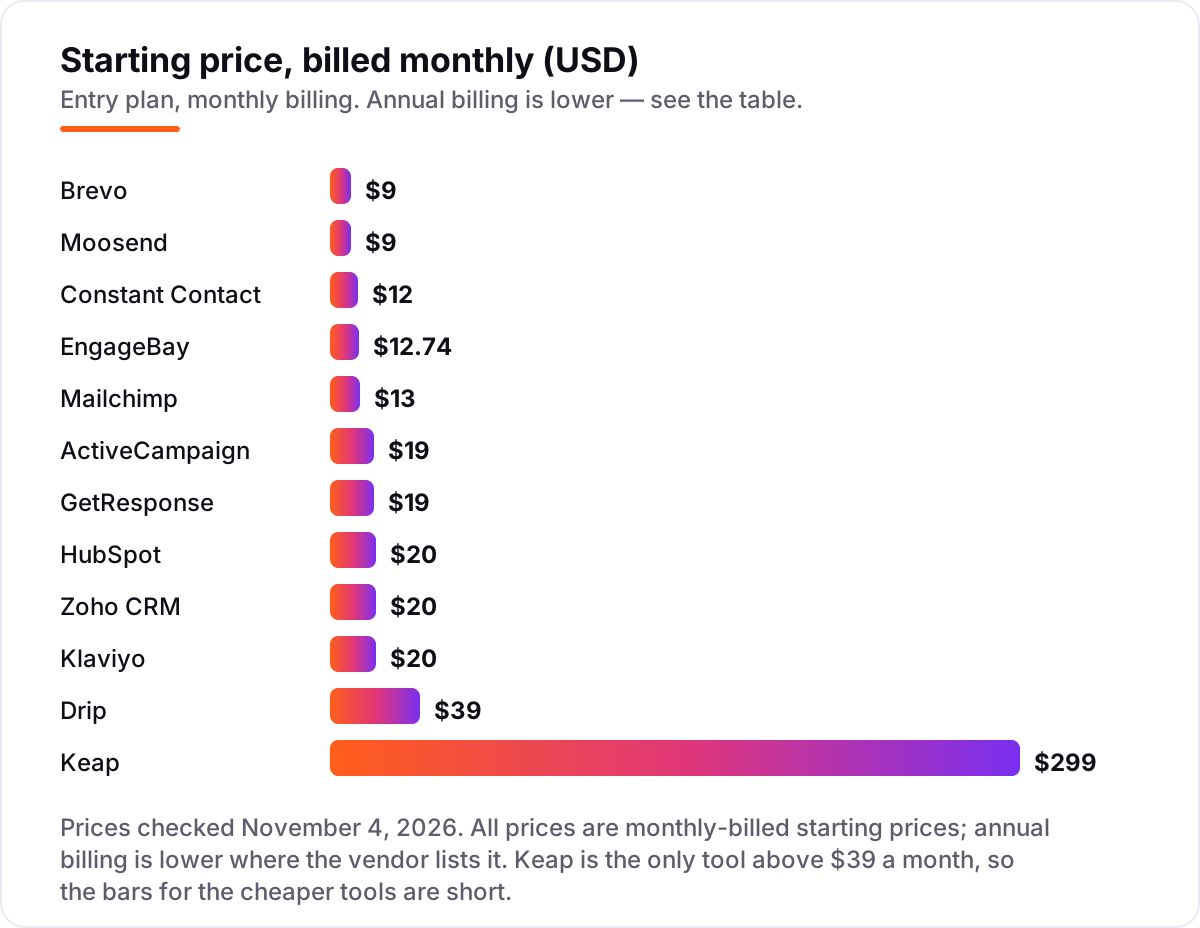
- Brevo and Moosend are the cheapest paid entries at $9 a month; Brevo prices by emails sent, Moosend by contacts with unlimited sends.
- The single most important buying factor is the billing unit: per seat, per contact or per email sent changes the real monthly cost more than the plan name.
- Every price below was checked on the vendor's own pricing page on November 4, 2026. Ratings are G2, with review counts shown.
On this page
Quick comparison
| Tool | Best for | Starting price | Free plan |
|---|---|---|---|
| HubSpot | Small B2B teams that want a real CRM and email marketing in one login, with room to grow into sales and service tools | $20/mo per seat | Yes (free CRM) |
| ActiveCampaign | Small businesses that want behavior-based email automation tied to a deal pipeline | $15/mo (annual) | No (14-day trial) |
| Brevo | Budget-conscious senders with a large list who email infrequently and want a built-in CRM | $9/mo | Yes (300/day) |
| Zoho CRM | Small sales teams that need a full CRM first and email marketing second, at the lowest per-user price | $14/mo per user (annual) | Yes (up to 3 users) |
| GetResponse | Small businesses that want email, landing pages and webinars in one subscription | $15.58/mo (annual) | Yes (500 contacts) |
| Mailchimp | Small businesses and creators who want polished templates and a familiar email tool with light CRM features | $13/mo | Yes (250 contacts) |
| Constant Contact | Nonprofits, clubs and local businesses that send a regular newsletter and want phone support | $12/mo | No (14-day trial) |
| Klaviyo | Online stores that run email around purchase behavior, carts and product data | $20/mo | Yes (250 profiles) |
| Keap | Service businesses and coaches that sell by phone and appointment and want CRM, email and payments in one place | $249/mo (annual) | No (14-day trial) |
| EngageBay | Startups that want CRM, email, landing pages and helpdesk in one low-cost subscription | $12.74/mo per user | Yes (250 contacts) |
| Drip | Ecommerce brands that want behavior-based email automation priced by list size alone | $39/mo | No (14-day trial) |
| Moosend | Small senders who want unlimited emails and full automation at the lowest price in this list | $7/mo (annual) | No (30-day trial) |
Make one of these tools?
We re-check this list every quarter. Send a correction, request a review, or ask about a clearly labeled sponsored spot.
Request a listingThe best crm email marketing software

HubSpot
Best for: Small B2B teams that want a real CRM and email marketing in one login, with room to grow into sales and service tools
HubSpot is the most complete CRM-plus-email option in this list because the CRM is the product, not an add-on: every email open, click and form fill lands on the same contact record your sales team works from. The free tier is genuinely usable, with the free CRM holding up to 1 million contacts and the free Marketing Hub sending 2,000 emails a month, which makes it the easiest free start here.
Starter costs $20 a seat a month and includes 1,000 marketing contacts, branding removal, landing pages and simple automation. The catch is the double meter: each extra seat and each extra block of 1,000 contacts adds to the bill, so a 5,000-contact list with three seats costs far more than the headline price. Buy HubSpot when the CRM matters as much as the email.
What we like
- One shared contact record for sales and marketing, so email engagement shows on the deal timeline without a sync tool
- Free CRM supports up to 1 million contacts, and the free Marketing Hub sends 2,000 emails a month
- Starter removes HubSpot branding, adds landing pages, live chat and simple automation for $20 a seat
Watch out for
- The bill grows two ways at once: extra seats cost $20 each and extra marketing contacts cost $50 per 1,000 a month
- Professional jumps to $890 a month, so teams that outgrow Starter face a steep step up

ActiveCampaign
Best for: Small businesses that want behavior-based email automation tied to a deal pipeline
ActiveCampaign pairs the strongest automation builder in this list with a real deal pipeline, so a click can move a contact to a new stage, add a tag and alert a rep without any manual step. Starter covers 1,000 contacts for $19 a month billed monthly, or $15 billed annually, with 10,000 sends a month and a visual builder that most teams learn in a day.
The limits sit in the details: each Starter automation stops at 5 actions, only one user is included, and the price climbs fast as the list grows, reaching $149 a month at 10,000 contacts billed annually. If your follow-up is a simple welcome series, Starter is enough; if you run multi-branch journeys, budget for Plus at $49 a month billed annually.
What we like
- Visual automation builder with tagging, lead scoring and deal pipelines in one place
- Sends up to 10 times the contact limit a month on Starter, so 1,000 contacts means 10,000 sends
- Predictive sending and conditional content arrive on Plus, one step up from Starter
Watch out for
- Starter caps each automation at 5 actions and includes only 1 user, so teams pay more for a second seat
- Price rises steeply with list size: Starter costs $149 a month at 10,000 contacts billed annually

Brevo
Best for: Budget-conscious senders with a large list who email infrequently and want a built-in CRM
Brevo is the cheapest paid entry in this list at $9 a month, and it prices by emails sent rather than contacts, which flips the usual math: a large list that hears from you twice a month can cost less here than on any per-contact tool. The free plan stores up to 100,000 contacts and sends 300 emails a day, and the paid plans add a built-in sales CRM with deals and pipelines.
The catch is the contact cap on the cheap tier: Starter at $9 stores only 500 contacts, so a 5,000-contact list needs the 20,000-email tier at $32 a month. Automation is solid for newsletters and simple sequences but shallower than ActiveCampaign, and removing the Brevo logo costs extra. Pick Brevo when send volume, not list size, drives your bill.
What we like
- Cheapest paid entry here at $9 a month, and the free plan stores up to 100,000 contacts
- Pricing follows emails sent, not list size, so a big quiet list stays cheap
- Built-in sales CRM with deals and pipelines, plus SMS and WhatsApp on the same account
Watch out for
- Starter stores only 500 contacts at the $9 tier, so the contact cap bites before the send limit does
- Removing the Brevo logo costs extra, and automation depth trails ActiveCampaign and HubSpot

Zoho CRM
Best for: Small sales teams that need a full CRM first and email marketing second, at the lowest per-user price
Zoho CRM is the cheapest real CRM in this list: Standard costs $14 a user a month billed annually, or $20 billed monthly, and includes pipelines, forecasting, workflow rules and email integration for up to 100,000 records. The free edition covers 3 users, and the wider Zoho suite shares the same contact data, so the CRM can grow into invoicing, support and campaigns without a migration.
Email is the weak spot: CRM handles sales mail and mass email up to 250 a day, while bulk campaigns live in Zoho Campaigns, a separate product with its own price. Setup also takes longer than the simpler tools here, and the interface can feel crowded. Choose Zoho when the sales pipeline matters more than the newsletter, and pair it with Campaigns for bulk sends.
What we like
- Full CRM for $14 a user a month billed annually, with pipelines, forecasting and workflow rules on Standard
- Mass email is built in (250 a day per organization), and Zoho Campaigns connects for larger sends
- Free edition covers 3 users, and the wider Zoho suite shares the same contact data
Watch out for
- Email marketing is split across two products: CRM handles sales mail, Campaigns handles bulk sends
- Setup and navigation take longer than the simpler tools here, and support replies can be slow

GetResponse
Best for: Small businesses that want email, landing pages and webinars in one subscription
GetResponse bundles email with landing pages, forms and webinars, which makes it the most complete marketing kit at this price: Starter costs $19 a month billed monthly, or $15.58 billed annually, for 1,000 subscribers (a promotional rate of $13.30 is currently shown). The visual automation builder covers welcome series, abandoned cart and lead scoring, and the free plan covers 500 contacts with no time limit.
The trade-off is CRM depth: there is no deal pipeline on the entry plan, so sales follow-up lives in tags and lists rather than stages. Reviewers also rate deliverability and template design as mixed, and the interface feels dated next to Mailchimp. Pick GetResponse when webinars and landing pages matter as much as the email itself, and pair it with a real CRM if you run a sales pipeline.
What we like
- Starter bundles email, landing pages, forms and a visual automation builder for $19 a month
- Built-in webinar hosting, which no other tool at this price includes
- Free plan covers 500 contacts with no time limit
Watch out for
- The CRM is lighter than HubSpot or Zoho, with no deal pipeline on the entry plan
- Deliverability and template design draw mixed reviews, and the interface feels dated in places

Mailchimp
Best for: Small businesses and creators who want polished templates and a familiar email tool with light CRM features
Mailchimp is still the easiest email tool to start with: the template library is the largest in this list, the drag-and-drop builder takes a day to learn, and tags, segments and a basic customer journey builder cover most small-business needs. Essentials starts at $13 a month for 500 contacts, with 5,000 sends a month, A/B testing and 3 seats.
Two things to price before you commit: Essentials caps automations at 4 journey steps, so full automation needs Standard at $20 a month, and Mailchimp charges for unsubscribed contacts until you archive them. The free plan also shrank to 250 contacts and 500 sends a month in February 2026. Buy Mailchimp for polished campaigns, not for deep CRM work.
What we like
- Largest template library in this list, with a drag-and-drop builder most teams learn in a day
- Tags, segments and a basic customer journey builder cover most small-business needs
- 500+ integrations, including Shopify, WooCommerce and Zapier
Watch out for
- Essentials caps automations at 4 journey steps, and full automation needs Standard at $20 a month
- Charges for unsubscribed contacts until you archive them, and the free plan shrank to 250 contacts in February 2026

Constant Contact
Best for: Nonprofits, clubs and local businesses that send a regular newsletter and want phone support
Constant Contact is the simplest tool in this list to run a regular newsletter: the campaign builder is plain, event management and social posting are built in, and phone support is included, which suits teams without a marketing specialist. Lite starts at $12 a month for 500 contacts, with no send cap at that tier and a 14-day free trial.
The limits are automation and price growth. Lite has no automated welcome series, and deeper automation needs Standard, while the price jumps to $50 a month at 1,000 contacts, one of the steepest early climbs here. There is also no free plan, only the trial. Choose Constant Contact for a steady newsletter with human support, not for behavior-driven automation.
What we like
- Simplest campaign builder here, with event management and social posting built in
- Phone support included, which suits teams without a marketing specialist
- Lite covers 500 contacts for $12 a month with no send cap at that tier
Watch out for
- Automation is basic: Lite has no automated welcome series, and deeper automation needs Standard
- Price jumps to $50 a month at 1,000 contacts, one of the steepest early climbs in this list

Klaviyo
Best for: Online stores that run email around purchase behavior, carts and product data
Klaviyo is the strongest email tool in this list for online stores because it is built on purchase data: orders, carts, browsing and predicted lifetime value feed every segment, and 150+ pre-built flows cover abandoned cart, welcome, win-back and post-purchase sequences. The Email plan starts at $20 a month for 500 active profiles, with 5,000 sends a month and a free plan for 250 profiles.
The price follows every active profile, even ones you never email, so a list kept for records still raises the bill, and there is no annual discount to soften it. It is also built for stores: a B2B team pays for ecommerce features it will never use, and SMS pricing sits on a separate plan. Buy Klaviyo when the store is the business, not when email is a side channel.
What we like
- Deepest ecommerce data in this list: orders, carts and predicted lifetime value feed every segment
- 150+ pre-built flows, including abandoned cart, welcome and win-back sequences
- One unified customer profile for email, SMS and WhatsApp, with no double-counting of contacts
Watch out for
- Built for stores: B2B teams pay for ecommerce features they will never use
- Billing counts every active profile, even ones you never email, so the price climbs as the list grows

Keap
Best for: Service businesses and coaches that sell by phone and appointment and want CRM, email and payments in one place
Keap sells one plan that does the whole job for a service business: CRM, email, visual automation, appointments, quotes and invoicing, with no feature ladder to climb. It costs $299 a month billed monthly, or $249 billed annually, for 1,500 contacts and 2 users, and the visual builder plus lead scoring make it a strong fit for consultative sales where follow-up happens by phone.
The price is the honest problem: $249 a month billed annually is the highest entry in this list, and new accounts also pay a mandatory implementation fee from $500. The G2 profile under the Thryv rebrand holds only 33 reviews, and reviewers cite rising costs and a steep learning curve. Pick Keap when one tool must run sales, email and billing for a service business.
What we like
- Visual automation builder plus pipeline, appointments, quotes and invoicing in a single plan
- One plan includes everything, so there is no feature ladder to climb as the business grows
- Strong fit for consultative sales: tags, lead scoring and behavior-triggered follow-up
Watch out for
- Starts at $249 a month billed annually, the highest entry price here, plus a mandatory implementation fee from $500
- Only 33 G2 reviews on the current profile, and reviewers cite rising costs and a steep learning curve

EngageBay
Best for: Startups that want CRM, email, landing pages and helpdesk in one low-cost subscription
EngageBay is the budget all-in-one in this list: the All-in-One Basic plan bundles CRM, email, landing pages, SMS, live chat and helpdesk for $12.74 a user a month billed monthly. Pricing is flat per user with no contact-based jumps inside the tier, and the free plan includes CRM, email and live chat for 250 contacts, which makes it easy to try the whole stack.
The limits are scale and polish. Basic covers only 500 contacts and 3,000 branded emails a month, so a growing list upgrades fast, and the integration library is smaller than HubSpot or ActiveCampaign, with basic reporting. Support is email and chat on the entry plan. Choose EngageBay when one cheap subscription must cover CRM, email and support for a small team.
What we like
- All-in-One Basic bundles CRM, email, landing pages, SMS and live chat for $12.74 a user a month
- Flat per-user pricing with no contact-based price jumps inside the plan tier
- Free plan includes CRM, email and live chat for 250 contacts
Watch out for
- Basic covers only 500 contacts and 3,000 branded emails a month, so growing lists upgrade fast
- Smaller integration library than HubSpot or ActiveCampaign, and reporting is basic

Drip
Best for: Ecommerce brands that want behavior-based email automation priced by list size alone
Drip prices by list size alone and includes the whole product at every size: unlimited sends, segmentation, up to 50 workflows and on-site forms and quizzes for $39 a month at up to 2,500 people. The visual workflow builder runs on purchase, browse and cart triggers, which is why it fits online stores better than any general-purpose tool at this price.
There is no annual billing discount and no free plan, so $39 a month is the floor, and the price rises to $89 at 5,000 people and $154 at 10,000. The ecommerce-first data model also fits B2B teams poorly, and reporting is thinner than Klaviyo. Pick Drip when a store wants behavior-based email at a flat list-size price with no feature tiers.
What we like
- One price buys the whole product: unlimited sends, up to 50 workflows and segmentation at every list size
- Visual workflow builder with purchase, browse and cart triggers built for stores
- On-site forms, pop-ups and quizzes included for list building
Watch out for
- No annual billing discount, and no free plan, so $39 a month is the floor
- Ecommerce-first data model fits B2B teams poorly, and reporting is thinner than Klaviyo

Moosend
Best for: Small senders who want unlimited emails and full automation at the lowest price in this list
Moosend keeps pricing simple: one Pro plan with unlimited sends, automation, landing pages and forms, starting at $9 a month billed monthly, or $7 billed annually, for 500 contacts. The price follows the contact count only, so a 5,000-contact list costs $48 a month billed monthly, which is the cheapest way to mail a list that size in this list.
The trade-off is CRM depth: there is no deal pipeline or sales automation, so Moosend is an email tool with contact management rather than a CRM, and most teams pair it with a separate CRM. It also lists only a handful of native integrations, so most connections run through Zapier. Pick Moosend when the email bill matters more than the pipeline.
What we like
- Single Pro plan includes unlimited sends, automation, landing pages and forms from $9 a month
- Cheapest way to mail a 5,000-contact list here: $48 a month billed monthly
- 30-day trial needs no credit card
Watch out for
- CRM features are light: no deal pipeline or sales automation, so it pairs with a separate CRM
- Only 4 native integrations on G2, so most connections run through Zapier
The best crm email marketing software does two jobs in one login: it keeps the customer record and it sends the email. When the two share one database, an open, a click or a purchase updates the contact record itself, so the next email and the next sales call both start from the same facts. This list compares 12 tools that combine a contact database with email sending, sorted by fit for the most common buyer: a small business that wants one tool instead of two subscriptions.
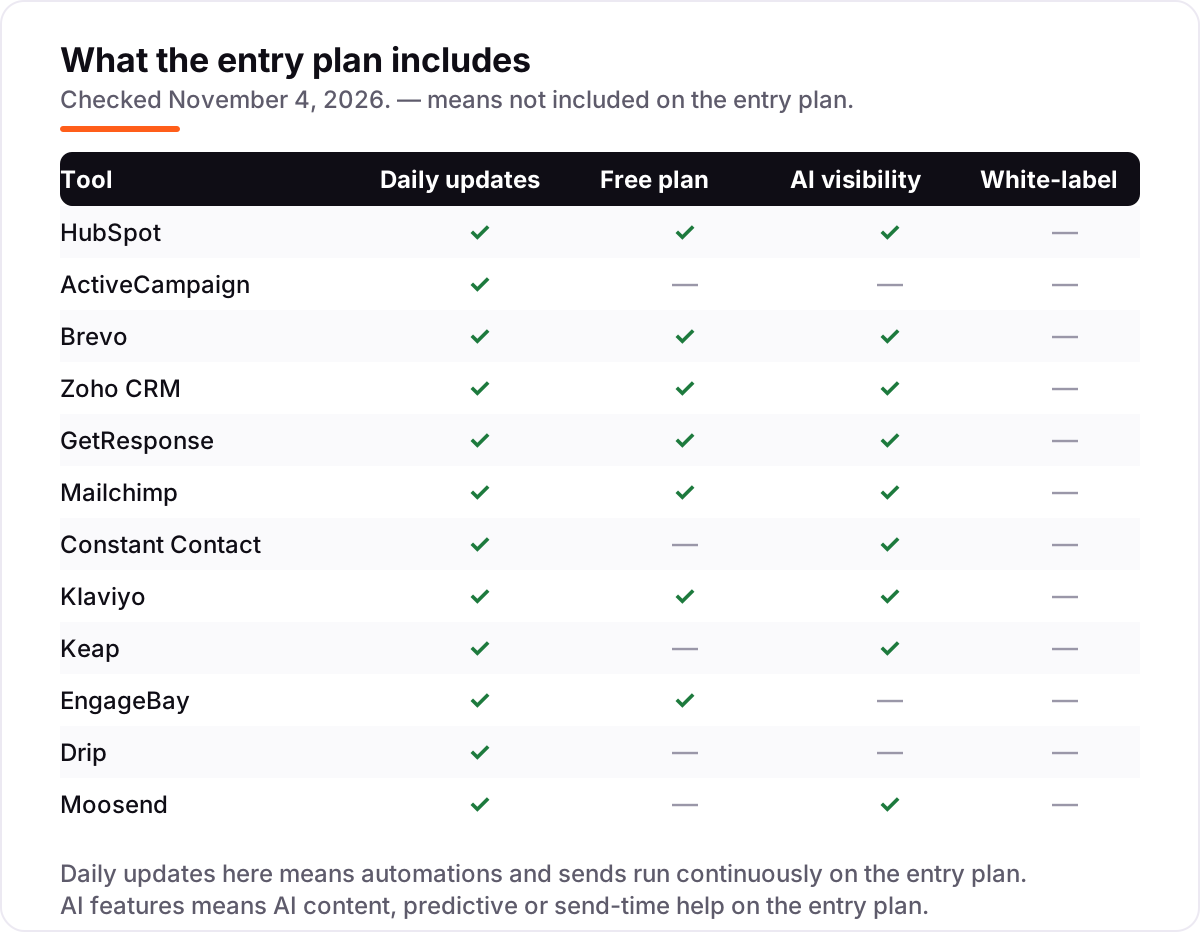
One number shows why the free tier matters here: HubSpot's free CRM holds up to 1 million contacts, and Brevo's free plan stores up to 100,000 contacts. Those two free plans alone cover most small businesses, which is why the cheapest way to start is usually free, and the cheapest paid plan is rarely the cheapest bill once seats and contacts are counted.
How to choose the best crm email marketing software
- Billing unit first. Per seat (HubSpot, Zoho CRM, EngageBay), per contact (ActiveCampaign, Mailchimp, Klaviyo, Moosend) or per email sent (Brevo) — the unit, not the plan name, decides the bill at your list size.
- CRM depth. A real pipeline with deals and stages (HubSpot, Zoho CRM, Keap) beats tags and lists when you sell by phone; tags are enough when email is the whole job.
- Automation on the entry plan. Check whether the welcome series, abandoned cart and behavior triggers you need are included, or gated behind the next tier.
- Price at your real list size. Quote the price at 5,000 and 10,000 contacts, not the entry band — the pricing section below works the example out.
- Deliverability and support. Phone support (Constant Contact), a dedicated IP option and a clean sending domain matter more than a template library once you mail weekly.
- Free plan or trial. A free plan you can keep (HubSpot, Brevo, Zoho CRM) beats a 14-day trial when you are still building the list.
Tag your email links with the free UTM builder so clicks show up properly in your analytics instead of arriving as unattributed traffic.
CRM email marketing software pricing: what you will actually pay
Take a 5,000-contact list, mailed weekly — about 20,000 sends a month — with a team of 3 seats. The entry prices in the cards do not describe this buyer, so here is the same buyer priced on each tool:
- Brevo Starter: $32 a month for the 20,000-email tier, which is $384 a year. Brevo bills by sends, so the list size does not raise the price further.
- Moosend Pro: $48 a month for 5,000 contacts with unlimited sends, which is $576 a year.
- Mailchimp Essentials: $75 a month at 5,000 contacts, which is $900 a year.
- ActiveCampaign Starter: $99 a month billed monthly at 5,000 contacts, or $79 a month billed annually, which is $1,188 a year on monthly billing.
- HubSpot Starter: 3 seats at $20 a seat is $60 a month, plus 4,000 extra marketing contacts beyond the included 1,000 at $50 per 1,000, which is $200 a month — $260 a month in total, or $3,120 a year.
- Keap: $299 a month billed monthly, which is $3,588 a year, or $249 a month billed annually, which is $2,988 a year — plus the mandatory implementation fee from $500 in year one.
The pattern is the lesson: the two cheapest entries, Brevo and Moosend, stay the cheapest at 5,000 contacts, while HubSpot and Keap cost five to eight times more for the same list because they bill for seats and contacts together. Price the list you have, not the list on the pricing page.
Know the difference: CRM software vs email marketing software
A CRM is the system of record: it stores contacts, companies, deals, pipeline stages, tasks and every conversation, and it answers the question "who is this customer and where are they in the deal?" Email marketing software is the sending engine: it builds campaigns, manages templates and deliverability, tracks opens and clicks, and runs automations, and it answers "what did we send them and what did they do?"
A combined tool shares one record, so an email click can move a deal to a new stage, add a tag and alert a rep without any sync. That is what HubSpot, ActiveCampaign, Zoho CRM and Keap do: the email and the pipeline read the same contact. A pure email tool such as Mailchimp, Klaviyo, Drip or Moosend keeps its own contact data, and a pure CRM such as Zoho CRM on its own needs a second product for bulk sends.
The buying question is therefore not "CRM or email tool" but "where does the customer record live?" If your team sells by phone, the record should live in a CRM and the email should read from it. If you sell online and never make a sales call, the record can live in the email tool and a CRM adds cost without adding value.
Quick comparison: tool type by need
| Buyer | Best pick | Why |
|---|---|---|
| Small business, one tool for everything | HubSpot | Real CRM plus email from $20 a seat, with a free CRM to start |
| Tightest budget | Brevo or Moosend | $9 a month entry; Brevo bills by sends, Moosend by contacts |
| Online store | Klaviyo or Drip | Purchase data drives every flow and segment |
| Sales-led team on a budget | Zoho CRM | Full CRM for $14 a user a month billed annually |
| Service business with appointments | Keap | CRM, email, quotes and payments in one plan |
| Newsletter-first small team | Constant Contact | Simplest builder, phone support, $12 a month |
How we chose
We opened each vendor's own pricing page on November 4, 2026 and recorded the starting price exactly as shown, including the annual-billing figure where the page lists one. Several of these pages render their prices with JavaScript, so where the crawled page text did not expose the dollar figure we cross-checked it against independent direct reads of the same vendor page dated October and early November 2026 that agreed on it; no price here comes from a single third-party roundup. Ratings come from G2 pages opened the same day, with one note: Keap's G2 profile now sits under the Thryv rebrand as "thryv-keap" and holds only 33 reviews, so its 3.9/5 score rests on far less evidence than the others. We ranked the tools by fit for the most common buyer — a small business that wants one tool for contacts and email — not by brand size. No vendor paid for a place in this list, and none of the links here are affiliate links.
What to do next
Start with the decision path above: name your billing unit, check the price at your real list size, and confirm the automation you need is on the entry plan. Then take the free plan or trial of your top pick and send your real list for two weeks, watching deliverability and unsubscribes rather than open rates alone. If the numbers hold and the reports make sense to your team, you have your tool. If email is only part of the problem, our monthly SEO service covers the search side while the new tool handles the inbox. Once your tools are in place, find out what's holding your rankings back.
Your stack only works if people find you
SerpAstra fixes what keeps your site off page one and makes it easy for AI assistants to recommend.
Get a free audit→Sources we checked (24)
- HubSpot pricing — hubspot.com/pricing/marketing (checked November 4, 2026)
- HubSpot Marketing Hub on G2 — 4.4/5, 16,050 reviews (checked November 4, 2026)
- ActiveCampaign pricing — activecampaign.com/pricing (checked November 4, 2026)
- ActiveCampaign on G2 — 4.4/5, 14,858 reviews (checked November 4, 2026)
- Brevo pricing — brevo.com/pricing (checked November 4, 2026)
- Brevo on G2 — 4.5/5, 2,775 reviews (checked November 4, 2026)
- Zoho CRM pricing — zoho.com/crm/zohocrm-pricing.html (checked November 4, 2026)
- Zoho CRM on G2 — 4.1/5, 2,957 reviews (checked November 4, 2026)
- GetResponse pricing — getresponse.com/pricing (checked November 4, 2026)
- GetResponse on G2 — 4.3/5, 1,147 reviews (checked November 4, 2026)
- Mailchimp pricing — mailchimp.com/pricing/marketing (checked November 4, 2026)
- Mailchimp on G2 — 4.3/5, 12,998 reviews (checked November 4, 2026)
- Constant Contact pricing — constantcontact.com/pricing (checked November 4, 2026)
- Constant Contact on G2 — 4.1/5, 7,625 reviews (checked November 4, 2026)
- Klaviyo pricing — klaviyo.com/pricing (checked November 4, 2026)
- Klaviyo on G2 — 4.6/5, 1,371 reviews (checked November 4, 2026)
- Keap pricing — keap.com/pricing (checked November 4, 2026)
- Keap on G2 — 3.9/5, 33 reviews (checked November 4, 2026)
- EngageBay pricing — engagebay.com/pricing (checked November 4, 2026)
- EngageBay on G2 — 4.6/5, 801 reviews (checked November 4, 2026)
- Drip pricing — drip.com/pricing (checked November 4, 2026)
- Drip on G2 — 4.4/5, 482 reviews (checked November 4, 2026)
- Moosend pricing — moosend.com/pricing (checked November 4, 2026)
- Moosend on G2 — 4.6/5, 746 reviews (checked November 4, 2026)
Shamim
Founder of SerpAstra
A full-stack SEO and digital marketer who spends most days on Local SEO for dental practices, AI search visibility and lead generation.
Frequently asked questions
What is the best CRM email marketing software in 2026?
HubSpot is the best all-round pick: a real CRM plus email from $20 a seat a month, with a free CRM for up to 1 million contacts. Brevo and Moosend are the cheapest paid entries at $9 a month. Online stores should look at Klaviyo, and sales-led teams at Zoho CRM, which costs $14 a user a month billed annually.
How much does CRM email marketing software cost?
Entry prices in this list run from $9 to $299 a month. Brevo and Moosend start at $9, Constant Contact at $12, Mailchimp at $13 and HubSpot at $20 a seat. The headline price is rarely the bill: most tools charge by seats, contacts or emails sent, so check the price at your real list size before you compare.
Is there a free CRM email marketing software?
Yes, with limits. HubSpot's free CRM covers up to 1 million contacts with 2,000 emails a month, Brevo's free plan stores 100,000 contacts, Zoho CRM is free for 3 users, Klaviyo is free for 250 profiles and GetResponse is free for 500 contacts. Free plans work for a small list; growing lists need a paid plan.
What is the difference between a CRM and email marketing software?
A CRM stores the customer record: contacts, deals, pipeline stages and every conversation. Email marketing software sends campaigns, tracks opens and clicks, and runs automations. Combined tools share one record, so an email click can move a deal to a new stage. Separate tools need a sync, usually through Zapier, to keep the record current.
Can I switch from Mailchimp to a CRM email tool later?
Yes. Export your contacts, tags and segments from Mailchimp as a CSV, import them into the new tool, and rebuild your automations there, since journeys do not transfer between platforms. Expect a day of setup for a small list, plus a warm-up period for the new sending domain. Keep Mailchimp running until the first campaigns from the new tool land well.
Do I need a separate CRM if I use Klaviyo or Mailchimp?
It depends on how you sell. Online stores usually do not: Klaviyo and Mailchimp hold the customer record, segments and purchase history in one place. Sales-led teams that work deals by phone should add a CRM such as Zoho CRM or HubSpot, because neither Klaviyo nor Mailchimp has a real deal pipeline on its entry plan.
Which CRM email tool is cheapest for 5,000 contacts?
Brevo Starter at $32 a month for 20,000 emails, and Moosend Pro at $48 a month with unlimited sends. Mailchimp Essentials costs $75 a month at 5,000 contacts, and ActiveCampaign Starter costs $99 a month billed monthly. The cheapest option depends on how often you mail: Brevo wins for infrequent sends, Moosend for frequent ones.
Free SEO and AI visibility audit
Find out what is holding your rankings back
Send us your site. Within 2 business days you get a written audit, an AI visibility check and a short fix list ranked by impact. Free, with no contract attached.
Request my free audit→Related guides
 Digital Marketing & Ads11 Best B2C CRM and Marketing Automation Platforms in 2026, Compared11 best b2c crm and marketing automation platforms compared on price, free plans and automation depth, with every price checked November 4, 2026.Read guide →
 Digital Marketing & Ads11 Best Email Marketing Software for Small Business in 2026, ComparedThe 11 best email marketing software for small business, compared on real 2026 prices, free plans and automation — Brevo starts at $9/month.Read guide →
 Digital Marketing & Ads7 Best AI Tools for Email Marketing in 2026 (Free and Paid, Compared)7 best AI tools for email marketing compared on price, AI features and free plans, with real starting prices checked November 4, 2026 and sorted by use case.Read guide →