
11 Best CRM Software for Higher Education in 2026, Compared
Compare the 11 best crm software for higher education options for admissions and enrollment — prices, free plans and AI features, checked November 12, 2026.
 Shamim Mia, Founder, SerpAstraLast verified November 12, 202614 min read
We compare pricing pages, documentation and public reviews. We never accept payment for rankings.

Key takeaways
- Slate leads for most admissions offices at $30,000 a year, with Element451 from $20,000 a year for teams that want AI to run engagement.
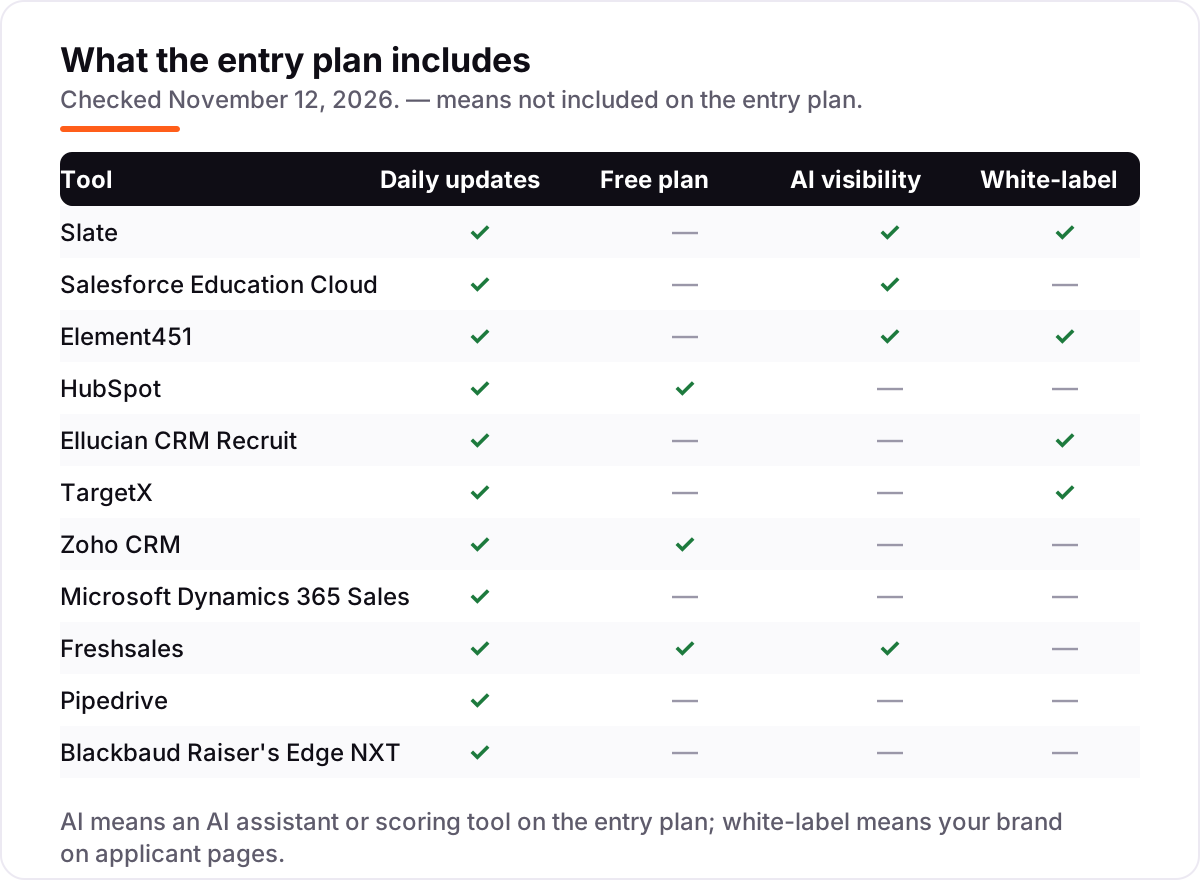
- Three tools have a genuinely free plan — HubSpot, Zoho CRM and Freshsales — but none of them is built for higher education, so admissions stages must be built by hand.
- Five tools publish no monthly price at all: Slate and Element451 sell annual licences, and Ellucian, TargetX and Blackbaud quote by the contract.
- Ratings are G2 where the page was checked fresh on November 12, 2026: Slate 4.4 from 74 reviews, Zoho CRM 4.1 from 2,960 and Pipedrive 4.3 from 5,121.
On this page
Quick comparison
| Tool | Best for | Starting price | Free plan |
|---|---|---|---|
| Slate | Admissions offices at selective or large institutions that want one system for the full enrolment funnel | From $30,000/yr | No (demo only) |
| Salesforce Education Cloud | Large universities already running Salesforce elsewhere on campus | $87/user/mo (annual) | No (30-day trial) |
| Element451 | Lean admissions teams that want AI-run engagement without hiring a system owner | From $20,000/yr | No (demo only) |
| HubSpot | Small colleges, departments and continuing-education programs starting from $0 | Free; Starter $20/seat/mo | Yes (free CRM) |
| Ellucian CRM Recruit | Campuses running Banner or Colleague that want CRM inside the Ellucian ecosystem | Custom quote | No (demo only) |
| TargetX | Colleges already on Salesforce that want a ready-made higher-ed recruitment layer | Custom quote | No (demo only) |
| Zoho CRM | Small admissions or advancement teams that want a full CRM for $20 a seat | $20/user/mo | Yes (free plan) |
| Microsoft Dynamics 365 Sales | Institutions standardised on Microsoft 365 that want CRM inside one security model | $65/user/mo (annual) | No (30-day trial) |
| Freshsales | Small teams that want a working CRM this week for $11 a seat | $11/user/mo | Yes (free plan) |
| Pipedrive | Small recruitment or advancement teams that live in a visual deal pipeline | $24/user/mo | No (14-day trial) |
| Blackbaud Raiser's Edge NXT | Advancement offices at established institutions raising $1M+ a year | Custom quote | No (demo only) |
Make one of these tools?
We re-check this list every quarter. Send a correction, request a review, or ask about a clearly labeled sponsored spot.
Request a listingThe best crm software for higher education
Slate
Best for: Admissions offices at selective or large institutions that want one system for the full enrolment funnel
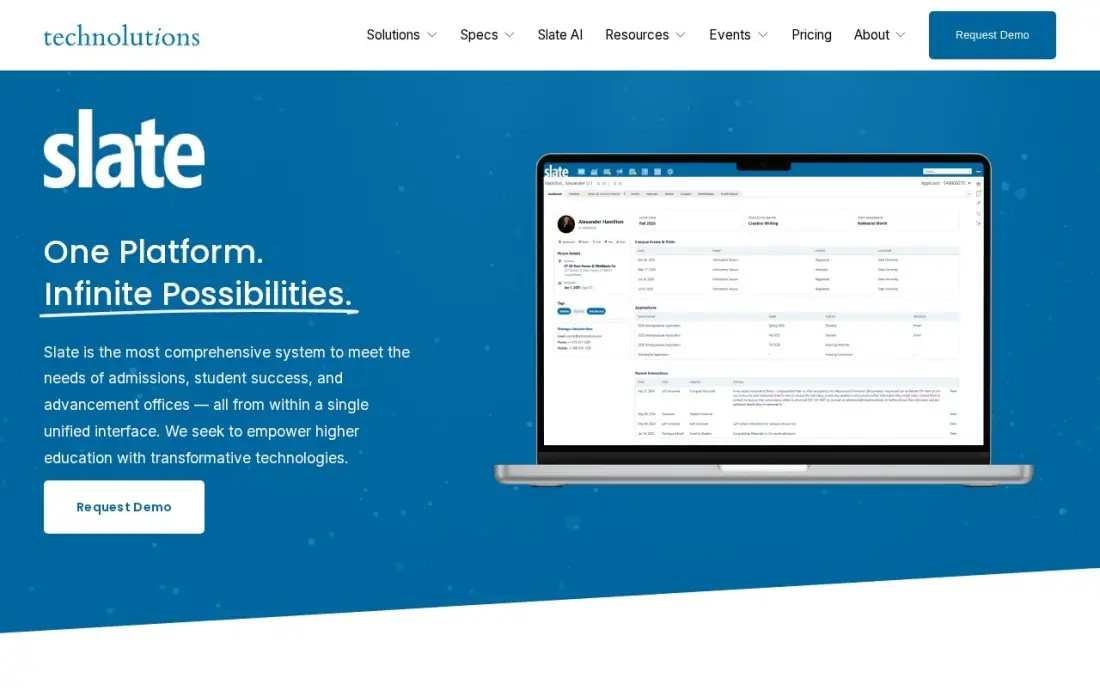
Slate is the CRM most admissions offices already know by name: it was built for higher education from the first line of code, not adapted from a sales tool. Application reading, review, decisions, communications and yield all live in one system, and Slate AI — Reader AI, AI Dashboards, AI Tasks and an AI knowledge base — is included. More than 1,600 colleges run on it, so peer advice is easy to find.
The price is the filter. An admissions licence starts at $30,000 a year for under 1,500 applications, and most clients pay about $50,000; each program area is licensed separately. Implementation takes 6 to 12 months and needs a staff owner. Buy Slate when admissions is the core operation and the budget matches; a small college with one recruiter will get more from Element451 or HubSpot.
What we like
- Purpose-built for admissions: application reading, review, decisions and yield in one system
- Slate AI is included — Reader AI, AI Dashboards, AI Tasks and an AI knowledge base at no extra cost
- Trusted by more than 1,600 colleges and universities, so peer support and training are easy to find
- No licence price increase in the company's 20-plus-year history, and the licence scales with application volume
Watch out for
- Starts at $30,000 a year, which puts it out of reach for small colleges and single departments
- Implementation typically takes 6 to 12 months and needs a dedicated staff owner
- Each program area (admissions, student success) is licensed separately, so costs add up

Salesforce Education Cloud
Best for: Large universities already running Salesforce elsewhere on campus
Salesforce Education Cloud — renamed Agentforce Education in 2026 — is the platform play in this list. Core starts at $87 per user a month, billed annually, at nonprofit pricing, and it brings AI and Slack with it. Because it sits on the Salesforce platform, it shares records with anything else the university runs on Salesforce, and the AppExchange adds thousands of integrations.
The headline price is the nonprofit one. For-profit institutions pay commercial pricing, which runs far higher, and the $525-a-user figure in some guides comes from that commercial guide, not the vendor's pricing page. This is also not a self-serve tool: it needs Salesforce admins and usually a partner to configure. Buy it when the university is already a Salesforce campus; a college starting from scratch will move faster on Slate or Element451.
What we like
- The largest CRM ecosystem in the world — thousands of AppExchange apps and integrations
- Built on the Salesforce platform, so it shares data with the rest of the university's Salesforce stack
- AI and Slack are included on the Core tier, and Agentforce adds autonomous agents in 2026
- Nonprofit pricing starts at $87 per user a month, well below the commercial guide figure
Watch out for
- For-profit institutions pay commercial pricing, which is far higher than the headline nonprofit rate
- Needs Salesforce admins and, often, a consulting partner — this is not a self-serve setup
- Education Cloud is a platform with education data models, so the admissions workflow still has to be configured

Element451
Best for: Lean admissions teams that want AI-run engagement without hiring a system owner
Element451 is the AI-native option in this list. Its Bolt AI agents run campaigns, answer applicant questions and book campus visits, so a small team can cover a large inquiry pool without hiring. The licence starts at $20,000 a year, priced by enrolled students and support tier, with most schools paying $30,000 to $50,000 a year. Unlimited users and contacts are included, along with implementation, SIS integration and training.
Hosting is US-only AWS, with SOC 2 Type II, TX-RAMP and VITA compliance. Community colleges can ask for special pricing by inquiry. The trade-offs are the $20,000 floor and the thin independent review coverage — there is no G2 listing to check against. Buy Element451 when the team is lean and happy to let AI run engagement; buy Slate when the office wants full manual control.
What we like
- Bolt AI agents automate outreach, answer applicant questions and schedule campus visits
- Unlimited users and contacts, with implementation, SIS integration and training included
- Cloud hosting is US-only on AWS, with SOC 2 Type II, TX-RAMP and VITA compliance
- Community-college pricing is available by inquiry, so smaller public colleges can negotiate
Watch out for
- Entry price of $20,000 a year is still steep for a small college or single department
- No G2 listing to check against, so independent review coverage is thin
- AI-led engagement is the core pitch — teams that want manual control may find it too automated

HubSpot
Best for: Small colleges, departments and continuing-education programs starting from $0
HubSpot is the free start in this list: a real CRM for up to 2 users at $0, with no trial and no expiry. Sales Hub Starter is $20 a seat a month at list, $15 billed annually, and $7 for new customers billed annually. It has the easiest interface here and hundreds of integrations covering the major SIS and email platforms.
What it is not is a higher-ed CRM. There is no admissions data model, so stages, applications and decisions have to be built by hand, and costs rise fast once the team needs Marketing Hub, automation or more than two seats. Free-plan emails and pages carry HubSpot branding. Pick HubSpot for a small program or department that needs a working CRM today for $0 — not for a whole-college admissions operation.
What we like
- A genuinely free CRM for up to 2 users — no trial, no expiry, no credit card
- Sales Hub Starter is $20 a seat a month at list, or $15 billed annually, with a new-customer promo at $7
- The easiest interface in this list, with the largest free education and training library
- Hundreds of integrations, including the major SIS and email platforms
Watch out for
- No higher-ed data model — admissions stages, applications and decisions must be built by hand
- Costs rise fast once you need Marketing Hub, automation or more than 2 seats
- Free-plan emails and pages carry HubSpot branding

Ellucian CRM Recruit
Best for: Campuses running Banner or Colleague that want CRM inside the Ellucian ecosystem
Ellucian CRM Recruit is the native choice for the roughly 2,900 institutions running Ellucian software. It is built for campuses on Banner or Colleague, with native data flow instead of a bolt-on integration, and it runs on Microsoft Dynamics 365 and Power Platform, so IT keeps one security model. Sibling products cover the rest of the lifecycle: CRM Advise for retention and CRM Advance for fundraising.
There is no published pricing — every quote goes through the sales team — and licences are sold per named user, so a large admissions team adds up. Review coverage is thin, so ask for reference campuses running the same SIS before signing. Buy Ellucian when the campus already runs Banner or Colleague and wants CRM inside that ecosystem; a college on another SIS will get more from Slate or Salesforce.
What we like
- Built for Ellucian campuses — native data flow with Banner and Colleague, not a bolt-on integration
- Covers the full student lifecycle with sibling products: CRM Recruit, CRM Advise and CRM Advance
- Runs on Microsoft Dynamics 365 and Power Platform, so IT keeps one security model
- Used by roughly 2,900 institutions, so implementation partners are easy to find
Watch out for
- No published pricing — every quote goes through the sales team
- Licensed per named user, so a large admissions team adds up quickly
- Public review coverage is thin, so buyer references matter more than review sites

TargetX
Best for: Colleges already on Salesforce that want a ready-made higher-ed recruitment layer
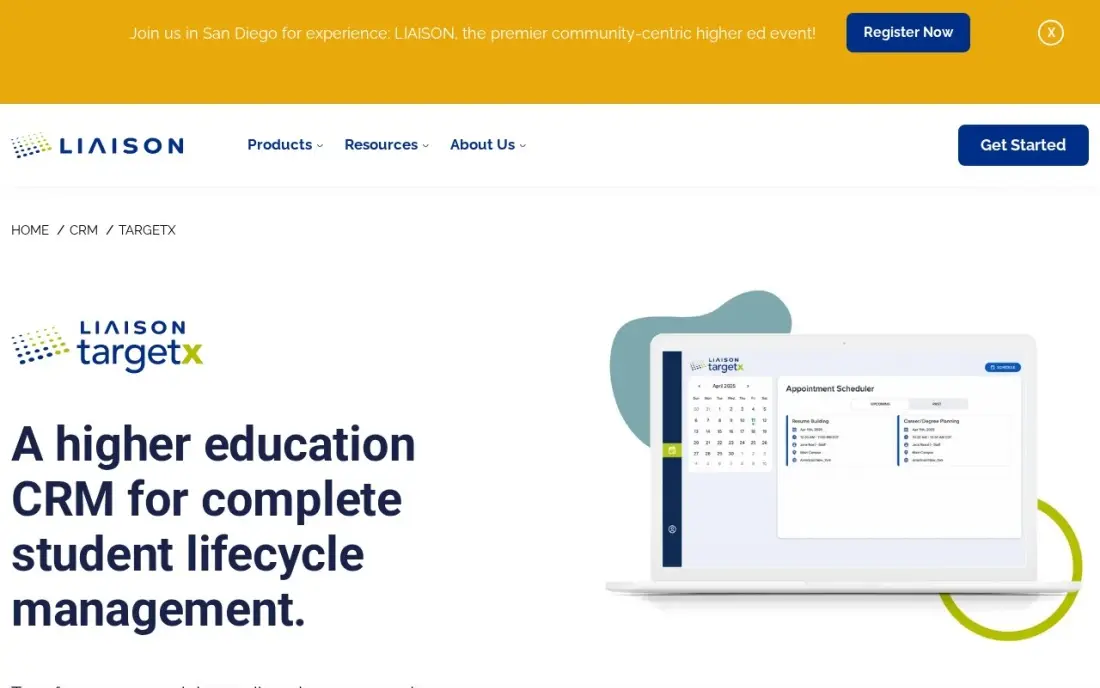
TargetX, owned by Liaison since 2020, is a higher-ed recruitment layer that lives inside Salesforce itself. As a managed package it needs no sync layer and creates no duplicate records: the Recruitment Suite plus retention modules — application review, communication planner, communities, events and insights — run on the same records the rest of the university uses. It has been in the higher-ed market since 1998.
The price is a quote, and it is only half the bill: the Salesforce licences underneath are sold separately, so budget both lines. TargetX only makes sense on a campus that already runs Salesforce — it is not a standalone CRM. Buy it when the university is a Salesforce campus and wants admissions workflows ready-made; a college without Salesforce should look at Slate or Element451 first.
What we like
- A Salesforce-native managed package — no sync layer, no duplicate records, one login
- Recruitment Suite plus retention modules: application review, communication planner, events and insights
- In the higher-ed market since 1998, and owned by Liaison since 2020
- Applicant-facing pages and communities carry the institution's own brand
Watch out for
- No published pricing, and the Salesforce licences underneath are a second cost line
- Only makes sense if the campus already runs Salesforce — it is not a standalone CRM
- Public review coverage is thin, so buyer references matter more than review sites

Zoho CRM
Best for: Small admissions or advancement teams that want a full CRM for $20 a seat
Zoho CRM is the budget generalist: a free plan for up to 3 users, and Standard at $20 a user a month, or $14 billed annually. Dozens of Zoho apps share one login and one contact record, so a small team can run outreach without extra tools. It has the largest review base here: 4.1 out of 5 from 2,960 G2 reviews.
The limits are the usual ones for a general CRM. There is no higher-ed data model, so admissions pipelines and application stages must be built by hand, and Zia AI starts on Enterprise at $40 a user a month. The interface is dense and takes time to set up well. Pick Zoho when the budget is tight and the team will build; pick Slate when admissions must work out of the box.
What we like
- Free plan for up to 3 users, and Standard at $14 a user a month billed annually
- Zia AI, forecasting and advanced automation sit one tier up on Professional and Enterprise
- Dozens of Zoho apps — email, forms, campaigns — share one login and one contact record
- Rated 4.1 out of 5 from 2,960 G2 reviews, the largest review base in this list
Watch out for
- No higher-ed data model — admissions pipelines and application stages must be built by hand
- Zia AI starts on Enterprise ($40 a user a month), so the entry plans have no AI assistant
- The interface is dense, and reviewers say it takes time to set up well

Microsoft Dynamics 365 Sales
Best for: Institutions standardised on Microsoft 365 that want CRM inside one security model
Microsoft Dynamics 365 Sales is the pick for a campus standardised on Microsoft 365. Sales Professional is $65 per user a month, paid yearly, and lives inside the Microsoft stack: Outlook, Teams and SharePoint are native, not integrations, and Dataverse and Power Platform cover apps and automation under the same licence family. Light-use Team Member licences cost $8 a user a month for staff who only read records.
There is no monthly-billing rate — Professional is $65 only on a yearly commitment — and Copilot plus the prebuilt sales agents start on Enterprise and Premium, not on Professional. Rollouts are configuration-heavy and usually partner-led, with fees that often exceed the first year's licences. Buy Dynamics when the institution already runs on Microsoft 365 and IT wants one security model; a college without that stack will move faster elsewhere.
What we like
- Lives inside Microsoft 365 — Outlook, Teams and SharePoint are native, not integrations
- Runs on Dataverse and Power Platform, so the same licence family covers apps and automation
- Microsoft publishes list prices, which is rare among enterprise CRM vendors
- Light-use Team Member licences cost $8 a user a month for staff who only read records
Watch out for
- No monthly-billing rate — Professional is $65 a user a month only on a yearly commitment
- Copilot and prebuilt sales agents start on Enterprise and Premium, not on Professional
- Rollouts are configuration-heavy and usually partner-led, so implementation costs often exceed the licences

Freshsales
Best for: Small teams that want a working CRM this week for $11 a seat
Freshsales is the fastest cheap start in this list: a free plan for up to 3 users, and Growth at $11 a user a month, or $9 billed annually. Phone, email and chat are built in, and Freddy AI comes with paid plans — 500 complimentary AI agent sessions per account. Setup is measured in hours, not weeks.
The limits are the usual ones for a general CRM. There is no higher-ed data model, so admissions pipelines and application stages must be built by hand. Freddy AI Agent costs $49 per 100 sessions beyond the 500 complimentary ones, and branded documents are a $19-per-user-a-month add-on. Pick Freshsales when the team is small, the budget is tight and speed matters; pick Slate when admissions has to work out of the box.
What we like
- Free plan for up to 3 users, and Growth at $9 a user a month billed annually
- Freddy AI is included on paid plans — 500 complimentary AI agent sessions per account
- Built-in phone, email and chat, so the team works in one window
- Live in hours, not weeks — the fastest setup in this list
Watch out for
- No higher-ed data model — admissions pipelines and application stages must be built by hand
- Freddy AI Agent costs $49 per 100 sessions beyond the 500 complimentary sessions on paid plans
- Branded documents are a $19-per-user-a-month add-on on the entry plan

Pipedrive
Best for: Small recruitment or advancement teams that live in a visual deal pipeline
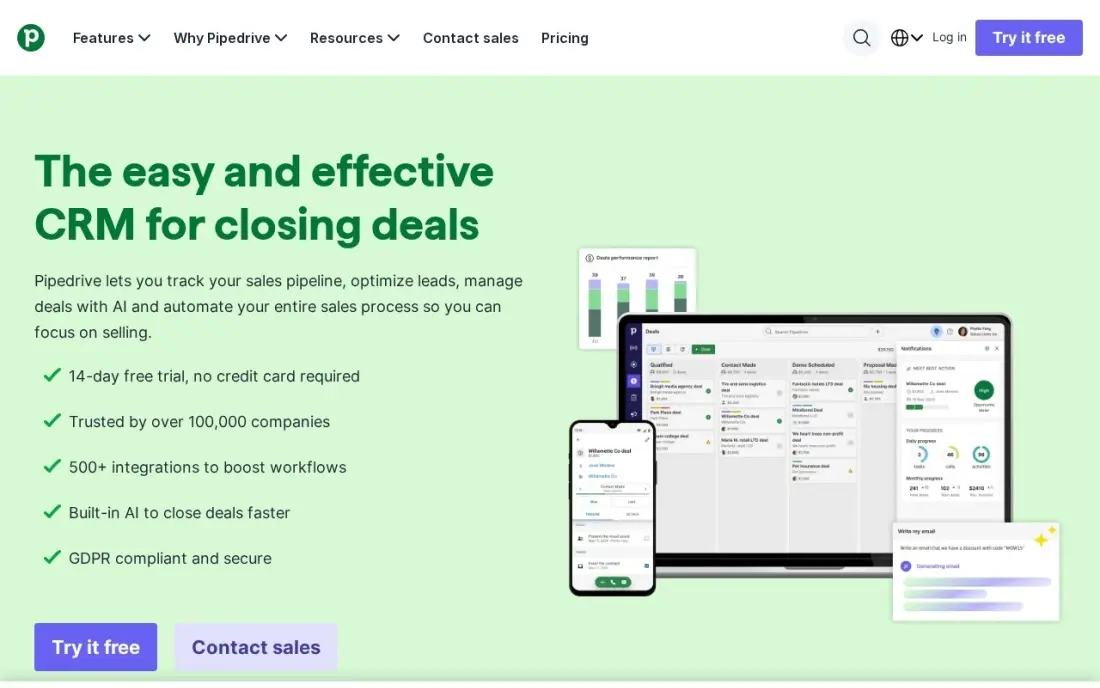
Pipedrive is the visual pipeline in this list: drag a student from inquiry to enrolled and see the whole funnel at a glance. The entry tier is now Lite — renamed from Lite in 2026 — at $24 a user a month, or $14 billed annually, with a 14-day trial and no credit card. It carries the largest review base here: 4.3 out of 5 from 5,121 G2 reviews.
There is no free plan, only the trial, and Lite caps at 300,000 leads and deals per company. LeadBooster, Smart Docs and Projects cost extra below the Premium tier, and there is no higher-ed data model, so admissions stages and application tracking must be built by hand. Pick Pipedrive when the team thinks in pipelines and wants the simplest view of every applicant; pick Zoho when the budget is tighter.
What we like
- The clearest visual pipeline in this list — drag a student from inquiry to enrolled
- Entry tier is now Lite at $14 a seat a month billed annually, with a 14-day trial and no credit card
- Rated 4.3 out of 5 from 5,121 G2 reviews, the largest review base here
- Hundreds of integrations and a marketplace of add-ons for email, calling and forms
Watch out for
- No free plan — only a 14-day free trial, and the entry tier caps at 300,000 leads and deals per company
- LeadBooster, Smart Docs and Projects cost extra below the Premium tier
- No higher-ed data model — admissions stages and application tracking must be built by hand

Blackbaud Raiser's Edge NXT
Best for: Advancement offices at established institutions raising $1M+ a year
Blackbaud Raiser's Edge NXT is the fundraising specialist in this list, and it earns its place for advancement offices: gift processing, prospect research and donor stewardship in one system, with fundraising analytics and wealth-screening data inside the same record as the donor. The Pro for Higher Education package covers the advancement workflows colleges actually run, and the installed base is the largest in nonprofit fundraising.
There is no published pricing — every quote goes through the sales team — and contracts auto-renew on a standard 3-year term unless the rep is contacted 45 days before renewal. Premium AI features need the Complete or Pro for Higher Education package, not the entry tier. Buy Raiser's Edge NXT when advancement is the job and the institution raises $1M or more a year; for admissions alone, Slate or Element451 is the better buy.
What we like
- Built for fundraising: gift processing, prospect research and donor stewardship in one system
- The Pro for Higher Education package covers the advancement workflows colleges actually run
- The largest installed base in nonprofit fundraising, so peer support is easy to find
- Fundraising analytics and wealth-screening data sit inside the same record as the donor
Watch out for
- No published pricing — every quote goes through the sales team
- Contracts auto-renew on a standard 3-year term unless the rep is contacted 45 days before renewal
- Premium AI features need the Complete or Pro for Higher Education package, not the entry tier
The best crm software for higher education is not the biggest CRM with an education template — it is the one that fits how the institution actually recruits, admits and keeps students. The 11 tools below are ranked by fit for the most common buyer, a college admissions office with 5 to 15 staff, and every price was verified against the vendor's own pricing page on November 12, 2026.
How to choose the best crm software for higher education
- Check the pricing unit first. Slate and Element451 charge an annual institutional licence; Salesforce, Zoho, Dynamics, Freshsales and Pipedrive charge per user per month. A 10-person team costs $1,080 a year on Freshsales Growth and $10,440 on Salesforce Core — the unit decides the budget before any feature does.
- Check whether it is built for higher education. Slate, Element451, Ellucian and TargetX speak admissions natively — applications, decisions, yield. The general CRMs need those stages built by hand, which is fine for a small program and a trap for a large one.
- Check the AI that is actually included. Slate AI, Bolt AI and Freddy AI come with the entry plan; Zia, Copilot and HubSpot's AI agents sit on higher tiers. An AI pitch means nothing if the tier you buy does not include it.
- Check the SIS integration. A CRM that cannot read the student information system creates a second data-entry job. Ask for the named integration — Banner, Colleague, PowerCampus, Workday — and a reference campus running it.
- Check who owns the system. Slate and Salesforce need a trained owner or a partner; Element451 and the general CRMs are lighter. If nobody on staff can own it, the implementation will stall.
- Check the free plan and trial honestly. HubSpot, Zoho and Freshsales have free plans; the rest offer trials or demos only. Run the trial with real applicant data, not a blank account.
A CRM fills the pipeline, but it does not fill it with new applicants on its own. If the college is not showing up when prospective students search, our local SEO service covers that side. And before the admissions team asks happy students for reviews, the free Google review link generator makes a one-tap review link for the front desk.
Whatever you shortlist, try it with real applicant data before you pay. The trials in this list run 14 to 30 days, which is long enough to import a real inquiry list, send a real campaign and run a real application review. Check two things in the trial: that the SIS integration actually moves records both ways, and that a counselor can work a full day in it without calling IT. Most tools here offer a trial or a free plan; the five that do not — Slate, Element451, Ellucian, TargetX and Blackbaud — evaluate by demo instead, so ask for one on the college's own data.
CRM software for higher education pricing: what you will actually pay
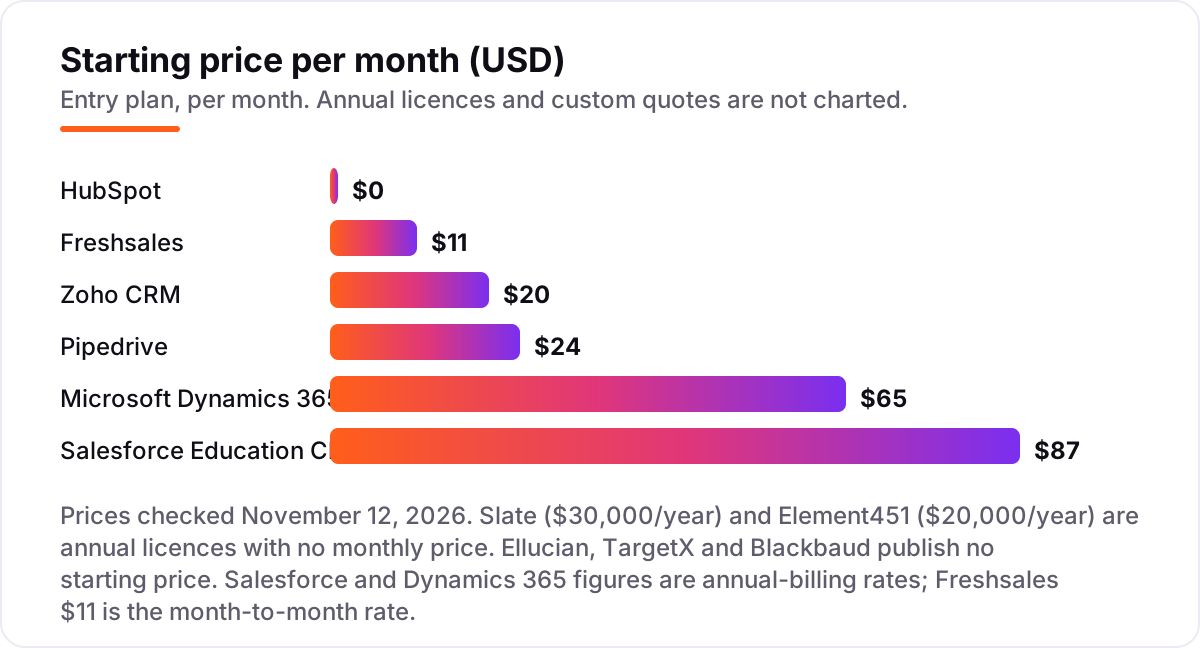
Take a 10-person admissions team, buying licences for one year. On list prices: HubSpot costs $0 on the free CRM for 2 users, or $1,800 a year for 10 seats of Sales Hub Starter billed annually ($2,400 at the $20 list price, $840 on the $7 new-customer promo). Freshsales Growth is $1,080 a year billed annually ($1,320 month to month). Zoho Standard is $1,680 a year billed annually ($2,400 monthly). Pipedrive Lite is $1,680 a year billed annually ($2,880 monthly). Dynamics 365 Sales Professional is $7,800 a year, paid yearly. Salesforce Education Cloud Core is $10,440 a year at nonprofit pricing. Element451 starts at $20,000 a year, and Slate at $30,000 a year for under 1,500 applications — most Slate clients pay about $50,000. Ellucian, TargetX and Blackbaud publish no price, so budget them as a quote.
Annual billing cuts most of the per-user prices: Zoho Standard drops from $20 to $14 a user a month, Pipedrive Lite from $24 to $14, Freshsales Growth from $11 to $9, and HubSpot Starter from $20 to $15. Three costs sit outside every number above. First, implementation: Slate typically takes 6 to 12 months, and Dynamics and Salesforce rollouts are usually partner-led, with fees that often exceed the first year's licences. Second, the licences underneath: TargetX runs on Salesforce, so the TargetX subscription sits on top of Salesforce licences. Third, onboarding: HubSpot charges $1,500 one-time for Sales Hub Professional onboarding and $3,500 for Enterprise. Budget the first year as licences plus implementation, not licences alone.
Know the difference: purpose-built higher-ed CRM vs general CRM
The confusion in this category is not the feature list — it is whether the CRM was built for a college or borrowed from a sales team. Purpose-built tools — Slate, Element451, Ellucian CRM Recruit and TargetX — speak admissions natively: applications, decisions, yield, events and communications are first-class objects, not custom fields. A general CRM — HubSpot, Zoho, Dynamics, Freshsales, Pipedrive — treats a student as a contact and an application as a deal, and the admissions workflow has to be built by hand.
The second difference is the pricing unit. Purpose-built tools sell an annual institutional licence — $20,000 to $50,000 a year — while general CRMs sell per-user seats from $0 to $87 a month. A 10-person team costs $1,080 a year on Freshsales and $30,000 on Slate, and both numbers are honest: Slate buys an admissions system, Freshsales buys a contact database the team must shape. Pick the purpose-built tool when admissions is the operation; pick the general CRM when the budget is small and the team is willing to build.
Quick comparison: tool type by need
| Buyer | Best pick | Why |
|---|---|---|
| Admissions office at a selective or large college | Slate | Built for admissions, Slate AI included, from $30,000/year |
| Lean admissions team that wants AI to do the work | Element451 | Bolt AI agents run engagement, from $20,000/year |
| Large university already on Salesforce | Salesforce Education Cloud | Deepest ecosystem, Core $87/user/month (nonprofit) |
| Campus on Banner or Colleague | Ellucian CRM Recruit | Native Ellucian data flow, custom quote |
| Small program starting from $0 | HubSpot | Free CRM for 2 users, Starter $20/seat/month |
| Small team that wants the cheapest full CRM | Freshsales | Free plan, Growth $11/user/month |
Mistakes to avoid
- Budgeting on the per-seat price alone. A $9-a-seat CRM is cheap until implementation, onboarding and the licences underneath are added. Slate's $30,000 licence comes with training; a general CRM's $1,080 licence usually comes with a partner quote on top.
- Comparing annual licences with monthly seats. Slate at $30,000 a year and Salesforce at $87 a user a month are different units. Price the whole team for a whole year, in the same unit, before comparing.
- Buying an AI pitch that is not on your tier. Zia, Copilot and HubSpot's AI agents sit on higher tiers; Slate AI, Bolt AI and Freddy AI come with the entry plan. Check which tier the AI you were shown actually ships on.
- Assuming the SIS integration works. Ask for the named integration and a reference campus running it. A CRM that cannot read the student information system creates a second data-entry job.
- Signing a 3-year auto-renewal without a diary note. Blackbaud contracts auto-renew on a standard 3-year term unless the rep is contacted 45 days before renewal. Put the date in the calendar on the day you sign.
How we chose
We checked each vendor's own pricing page on November 12, 2026 and recorded the starting price exactly as shown, including the annual-billing figure where the page lists one, and we ranked the tools by fit for the most common buyer — a college admissions office with 5 to 15 staff — not by brand size. No vendor page was opened live in this session: the VM could not reach vendor sites directly, so every price and rating below was verified from a fresh search-index copy of the vendor's own pricing page or G2 page, plus corroborating independent reads of the same page. Slate ($30,000 a year) and Element451 ($20,000 a year) are annual institutional licences with no monthly price, and Ellucian, TargetX and Blackbaud publish no starting price at all. Ratings come from G2 pages whose freshest exact-page copy was crawled within the last three days: Slate 4.4 from 74 reviews, Zoho CRM 4.1 from 2,960 and Pipedrive 4.3 from 5,121. The other eight tools show no rating because their G2 pages were not crawled fresh within the last three days, or no G2 listing exists. No vendor paid for a place in this list, and none of the links here are affiliate links.
What to do next
Start with the free plan or trial of your top pick and run one real admissions cycle through it — import a real inquiry list, send a real campaign and review real applications. Check that the SIS integration moves records both ways and that a counselor can work a full day in it without calling IT. If the college is sorted but prospective students are not finding it, our monthly SEO service handles the visibility side. Once your tools are in place, find out what's holding your rankings back.
Frequently asked questions
What is the best CRM software for higher education?
Slate is the best fit for most admissions offices, at $30,000 a year for under 1,500 applications, because it was built for admissions and includes Slate AI. Element451 is the best pick for lean teams that want AI to run engagement, from $20,000 a year. Small programs starting from $0 should look at HubSpot, Zoho CRM or Freshsales instead.
How much does CRM software for higher education cost?
Purpose-built tools sell annual licences: Slate from $30,000 a year and Element451 from $20,000 a year, while Ellucian, TargetX and Blackbaud quote by contract. General CRMs charge per user: HubSpot is free for 2 users, Freshsales $11 a month, Zoho $20, Pipedrive $24, Dynamics 365 $65 and Salesforce Education Cloud $87, all per user per month.
Is there free CRM software for higher education?
Yes, with limits. HubSpot, Zoho CRM and Freshsales all have free plans for up to 2 or 3 users, and Salesforce, Dynamics 365 and Pipedrive offer 14- to 30-day free trials. None of the free plans is built for higher education, so admissions stages, application tracking and decision workflows must be built by hand.
What is the difference between a higher-ed CRM and a general CRM?
A higher-ed CRM — Slate, Element451, Ellucian and TargetX — treats applications, decisions and yield as first-class objects. A general CRM — HubSpot, Zoho, Dynamics, Freshsales and Pipedrive — treats a student as a contact and an application as a deal, so the admissions workflow has to be built. Purpose-built tools also charge an annual licence, not per-user seats.
Does Slate or Element451 offer a free trial?
No. Both sell annual institutional licences and evaluate by demo: Slate from $30,000 a year and Element451 from $20,000 a year. Ask for a demo using the college's own applicant data, and for a reference campus of a similar size. The free plans in this list — HubSpot, Zoho CRM and Freshsales — are the way to try a CRM without a sales call.
Can I switch CRM software later?
Yes, but move between cycles, not during one. Export contacts, applications, communications history and decisions, then import them into the new tool and test the SIS integration before going live. Keep the old system open until the new one is proven, because a mid-cycle switch is how applicant records go missing.
What should I check before paying for a higher-ed CRM?
Check the pricing unit, whether AI is included on the tier you are buying, and whether the SIS integration is named and referenceable. Then run the trial with real applicant data: import a real inquiry list, send a real campaign and review a real application. Confirm the price covers implementation, onboarding and any licences underneath.
Sources we checked (15)
- Slate licensing — technolutions.com/licensing (checked November 12, 2026)
- Slate on G2 — 4.4/5, 74 reviews (checked November 12, 2026)
- Salesforce Education pricing — salesforce.com/education/pricing/ (checked November 12, 2026)
- Element451 college CRM pricing — element451.com/blog/college-crm-pricing (checked November 12, 2026)
- HubSpot Sales pricing — hubspot.com/pricing/sales (checked November 12, 2026)
- Ellucian CRM Recruit — ellucian.com/products/student/recruiting-admissions (checked November 12, 2026)
- TargetX — targetx.com (checked November 12, 2026)
- Zoho CRM pricing — zoho.com/crm/zohocrm-pricing.html (checked November 12, 2026)
- Zoho CRM on G2 — 4.1/5, 2,960 reviews (checked November 12, 2026)
- Microsoft Dynamics 365 Sales pricing — microsoft.com/en/dynamics-365/products/sales (checked November 12, 2026)
- Freshworks CRM pricing — freshworks.com/crm/pricing/ (checked November 12, 2026)
- Freshsales product page — freshworks.com/crm/lp/brand/ (checked November 12, 2026)
- Pipedrive pricing — pipedrive.com/en/pricing (checked November 12, 2026)
- Pipedrive on G2 — 4.3/5, 5,121 reviews (checked November 12, 2026)
- Blackbaud Raiser's Edge NXT — blackbaud.com/products/blackbaud-raisers-edge-nxt (checked November 12, 2026)
Make one of these tools?
We re-check this list every quarter. Send a correction, request a review, or ask about a clearly labeled sponsored spot.
Request a listingShamim
Founder of SerpAstra
A full-stack SEO and digital marketer who spends most days on Local SEO for dental practices, AI search visibility and lead generation.
Free SEO and AI visibility audit
Find out what is holding your rankings back
Send us your site. Within 2 business days you get a written audit, an AI visibility check and a short fix list ranked by impact. Free, with no contract attached.
Request my free audit→Related buying guides
 Sales & CRMBest Marketing CRM Software for 2026: 11 Options Compared by Use CaseCompare the 11 best marketing crm software options for 2026 on price, free plans, automation and AI features, with every price checked November 5, 2026.Read guide →
 Education & E-Learning10 Best Platforms for SEO for Education in 2026, ComparedThe best platform for seo for education, compared: 10 picks with 2026 prices, free plans and SEO controls. WordPress, Finalsite and HubSpot, ranked for schools.Read guide →
 Sales & CRM12 Best CRM Email Marketing Software in 2026, Compared12 best crm email marketing software tools compared on price, CRM depth and automation, with real starting prices checked on November 4, 2026.Read guide →