
8 Best CRM Software for Restaurants in 2026, Compared
Compare the 8 best CRM software for restaurants on guest profiles, marketing, free plans and real monthly cost, with every price checked on vendor pages.
 Shamim Mia, Founder, SerpAstraLast verified November 5, 202610 min read
We compare pricing pages, documentation and public reviews. We never accept payment for rankings.
Key takeaways
- SevenRooms is the deepest restaurant guest CRM in this list, but it publishes no price; Eat App is the value pick with a free plan up to 100 covers a month and Lite at $99 a month.
- Most restaurants already own half a CRM: reservation tools (SevenRooms, Eat App, OpenTable) and POS systems (Toast, Square) each build guest profiles from the data they touch.
- Bloom Intelligence is the pick for groups that want one guest profile from WiFi, POS, ordering, reviews and surveys, at $115 a month per location billed monthly.
- A general CRM such as HubSpot or Zoho only makes sense for the sales side of a restaurant — catering, private events and corporate accounts — where both offer free plans.
On this page
Quick comparison
| Tool | Best for | Starting price | Free plan |
|---|---|---|---|
| SevenRooms | Restaurant groups that want the deepest guest profiles and marketing automation tied to reservations | Custom quote | No |
| Eat App | Independent restaurants that want a guest CRM with a free start and flat monthly pricing | Free; Lite $99/mo | Yes (free plan) |
| Bloom Intelligence | Multi-location restaurant groups that want one guest profile built from WiFi, POS, ordering and reviews | $115/mo | No (no trial published) |
| Toast | Restaurants already on Toast POS that want guest data from every check without another system | $69/mo | Yes ($0 Starter Kit) |
| Square for Restaurants | Counter-service restaurants that want customer profiles from the POS on a free plan | Free; Plus $60/mo | Yes (free plan) |
| OpenTable | Restaurants that rely on OpenTable for bookings and want guest notes and marketing on top | $149/mo | No |
| HubSpot CRM | Restaurants that sell catering, private events or corporate accounts and need a sales pipeline | Free; Starter $20/seat/mo | Yes (free CRM) |
| Zoho CRM | Restaurant groups on a budget that need a catering and events pipeline for a small team | $20/mo | Yes (3 users) |
Make one of these tools?
We re-check this list every quarter. Send a correction, request a review, or ask about a clearly labeled sponsored spot.
Request a listingThe best CRM software for restaurants

SevenRooms
Best for: Restaurant groups that want the deepest guest profiles and marketing automation tied to reservations
SevenRooms is the closest thing to a purpose-built restaurant CRM: reservations and table management sit on top of guest profiles that record visits, spend, tags, allergies noted by staff and preferences, and that data drives automated email and SMS campaigns. DoorDash bought SevenRooms in a deal that closed in June 2025.
The catch is the buying process. SevenRooms publishes no price, sells Starter, Growth and Premium packages behind a demo, and operators report setup fees from a few hundred dollars to $5,000 or more, plus annual contracts with a 90-day notice to cancel. It earns that cost for a multi-venue group that markets every week.
What we like
- The deepest guest CRM here: profiles, tags, marketing automation and reporting
- No per-cover fee or reservation commission on any channel
- Starter, Growth and Premium packages scale from one venue to groups
- Owned by DoorDash since June 2025, with delivery and ordering links in the same group
Watch out for
- No published price: every plan is quote-only behind a demo
- Reported setup fees run from a few hundred dollars to $5,000 or more
- Annual contracts with a 90-day cancellation notice, per operator reports

Eat App
Best for: Independent restaurants that want a guest CRM with a free start and flat monthly pricing
Eat App gives an independent restaurant the core of a guest CRM — profiles built from every booking, visit history, notes and tags — with a free plan for up to 100 covers a month. Lite at $99 a month, or $69 billed annually, removes the cover cap and adds WhatsApp and SMS messaging. There is no per-cover fee on any paid plan, and the restaurant keeps the guest data rather than sharing it with a marketplace.
The bill grows through add-ons rather than the plan price. POS and payments integration costs $39 a month extra on Lite and Core, and the waitlist, deposits and email marketing are each $19 to $39 a month. Even with two add-ons, it is the sensible first CRM for a restaurant that has never had one.
What we like
- A real free plan: reservations and table management at $0 for up to 100 covers a month
- Flat monthly pricing with no per-cover fees and no cover cap on paid plans
- The restaurant owns its guest data rather than sharing it with a marketplace
- Guest CRM with WhatsApp and SMS messaging built in from Lite
Watch out for
- POS and payments integration costs $39 a month extra on Lite and Core
- Waitlist, deposits and email marketing are paid add-ons, $19 to $39 a month each
- Free plan stops at 100 covers a month, so a busy weekend outgrows it fast

Bloom Intelligence
Best for: Multi-location restaurant groups that want one guest profile built from WiFi, POS, ordering and reviews
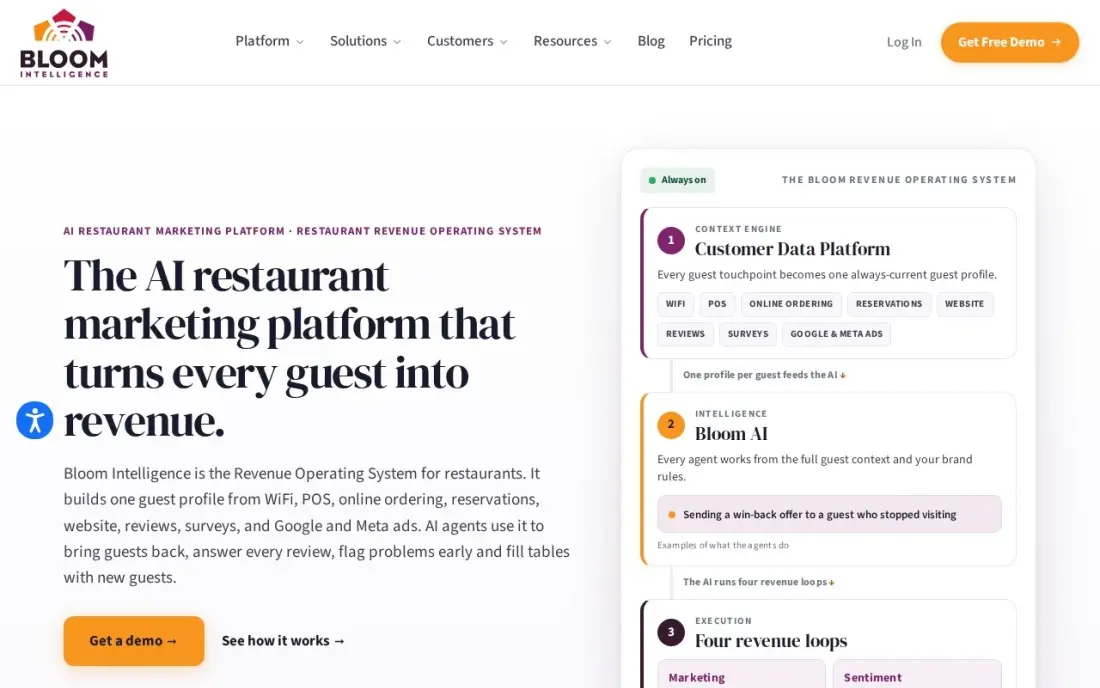
Bloom Intelligence solves the problem every restaurant CRM runs into: most guests never make a reservation, so a booking-based CRM never sees them. Bloom captures them through guest WiFi logins and then joins that data with POS, online ordering, reservations, reviews and surveys into one profile. The Customer Data Platform costs $115 a month per location billed monthly, or $105 billed annually.
It is the most expensive entry in this list, and every plan is on a contract, though Bloom allows cancellation anytime in the first 90 days. For a group of fast-casual sites where walk-ins outnumber bookings, it is the only tool here that sees most of the guests.
What we like
- One guest profile built from WiFi, POS, online ordering, reservations, reviews and surveys
- Published per-location pricing, with multi-location groups paying as little as $70 per location
- Marketer tier adds campaigns built, sent and measured for the restaurant group
- Cancellation allowed anytime in the first 90 days on every plan
Watch out for
- The most expensive entry here at $115/month billed monthly, or $105 billed annually
- Every plan is on a contract, even though cancellation is allowed anytime in the first 90 days
- Campaigns built and sent for you wait for Marketer at $175/month billed monthly

Toast
Best for: Restaurants already on Toast POS that want guest data from every check without another system
For a restaurant that runs Toast, the POS is already collecting customer data on every card payment, online order and loyalty sign-up, and Toast's marketing, loyalty and gift card add-ons turn that into a working CRM inside the same system. The Point of Sale plan costs $69 a month.
The trade-off is that the CRM features are paid add-ons, so the real bill runs well above $69 a month once loyalty and marketing are switched on. Toast hardware is Toast-only, contracts typically run two years and you must process payments through Toast. If you are already committed to Toast, adding its marketing tools is simpler than syncing a separate CRM; if you are not, the CRM alone is no reason to switch POS.
What we like
- Built only for restaurants: menu, coursing, handheld ordering, kitchen display and online ordering in one stack
- The $0 Starter Kit lets a new restaurant start with no monthly software fee
- Point of Sale at $69/month pairs core POS with 2.49% + 15c card-present processing
- Largest restaurant POS install base in the US, so staff often already know it
Watch out for
- Online ordering, loyalty, gift cards and the kitchen display are paid add-ons, so the real bill runs well above $69/month
- Hardware is Toast-only — you cannot bring your own terminals
- Contracts typically run two years, and you must use Toast for payment processing

Square for Restaurants
Best for: Counter-service restaurants that want customer profiles from the POS on a free plan
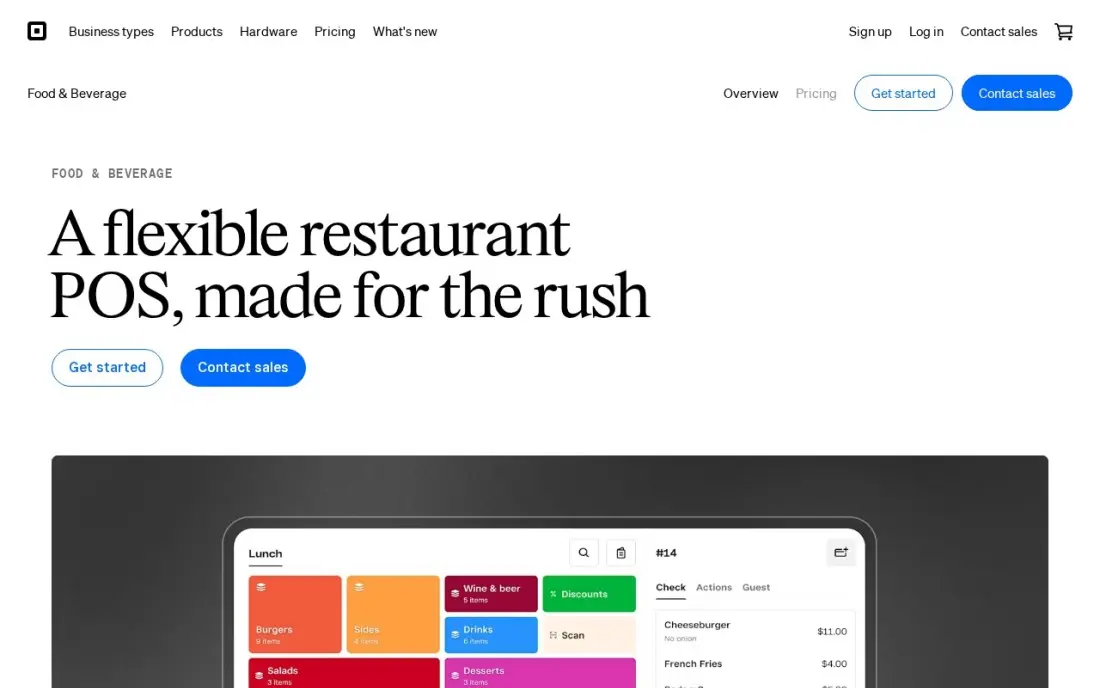
Square for Restaurants builds a customer directory from card payments, so a quick-service counter gets basic guest profiles without paying for a CRM at all. The Free plan costs $0 with unlimited devices and locations and charges only the 2.6% + 10c in-person processing rate; Plus at $60 a month per location adds advanced reporting, unlimited kitchen display screens and 24/7 support. There are no long-term contracts and no hardware leases.
Square's limit as a CRM is that loyalty and marketing are separate products, not part of the restaurant POS plans, so a full guest-marketing setup means adding them on. For a single-location counter that wants to see who its repeat customers are before spending money on software, it is the cheapest way in.
What we like
- A genuinely free plan: unlimited devices and locations, menu manager and order manager at $0
- No long-term contracts and no hardware leases — cancel anytime
- Plus at $60/month per location adds unlimited kitchen display screens, advanced reporting and 24/7 support
- Flat 2.6% + 10c in-person processing with no monthly fee on the Free plan
Watch out for
- Advanced features such as coursing and live sales reporting need Plus at $60/month per location
- A standalone kitchen display subscription costs extra on the Free plan
- Online ordering and loyalty are separate products, not part of the restaurant POS plans

OpenTable
Best for: Restaurants that rely on OpenTable for bookings and want guest notes and marketing on top
OpenTable is first a booking marketplace, but every plan keeps guest profiles with visit history and notes, and Pro at $499 a month adds the guest CRM and marketing automation. Basic costs $149 a month and Core $299, with phone and walk-in reservations carrying no fees on any plan and no charge for no-shows or cancellations.
As a CRM it is an expensive route. Network covers cost $1.50 each on Basic, so 750 network covers a month add $1,125 to the bill, and the standard contract runs a year and auto-renews unless you give 30 days' notice. Choose OpenTable for its diner network; if what you want is guest marketing, a direct-booking tool with a CRM built in costs far less.
What we like
- The largest US diner network, so new guests find you without ads
- Published prices: Basic $149, Core $299 and Pro $499 a month
- Phone and walk-in reservations carry no fees on any plan
- No charge for no-shows or cancellations, only for seated diners
Watch out for
- Per-cover fees scale with success: 750 network covers a month add $1,125 to the $149 Basic bill
- Standard contract runs one year and auto-renews unless you give 30 days' notice
- Guest CRM and marketing automation wait for Pro at $499 a month

HubSpot CRM
Best for: Restaurants that sell catering, private events or corporate accounts and need a sales pipeline
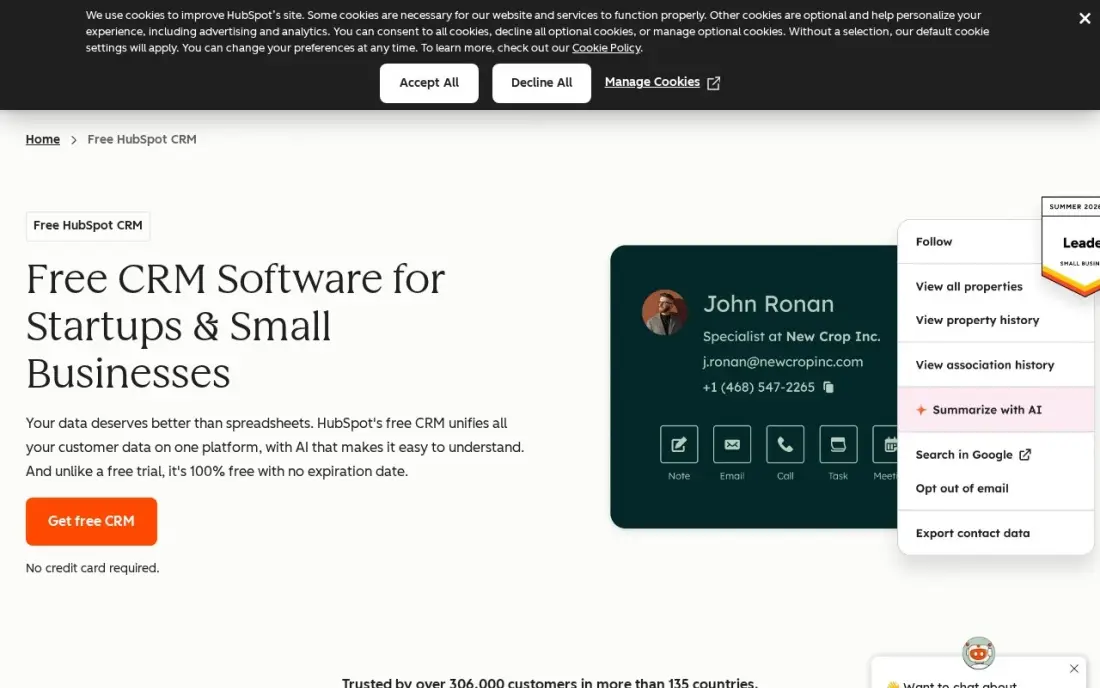
HubSpot is not a guest CRM, and it will not know who sat at table 12. Where it fits a restaurant is the sales side: catering enquiries, private dining, corporate lunch accounts and event bookings, which behave like any B2B deal. The free CRM covers unlimited contacts and companies, one deal pipeline, email tracking and meeting scheduling for up to two users, with apps on iOS and Android.
That makes it a good free tool for an events or catering manager who is tracking quotes in a spreadsheet today. Two free users is the ceiling, though: a third teammate needs a paid Starter seat at $20 a month, and automation and reporting wait for Professional at $90 a seat a month.
What we like
- Free CRM with unlimited contacts and companies, one deal pipeline and email tracking
- Every contact carries its full history — emails, calls, meetings and deals — on one timeline
- Apps on iOS, Android, Windows and Mac, plus a web app that syncs everywhere
Watch out for
- Two free users only — a third teammate forces a paid Starter seat at $20/month
- Automation and reporting live on Professional at $90/seat/month, a steep step up

Zoho CRM
Best for: Restaurant groups on a budget that need a catering and events pipeline for a small team
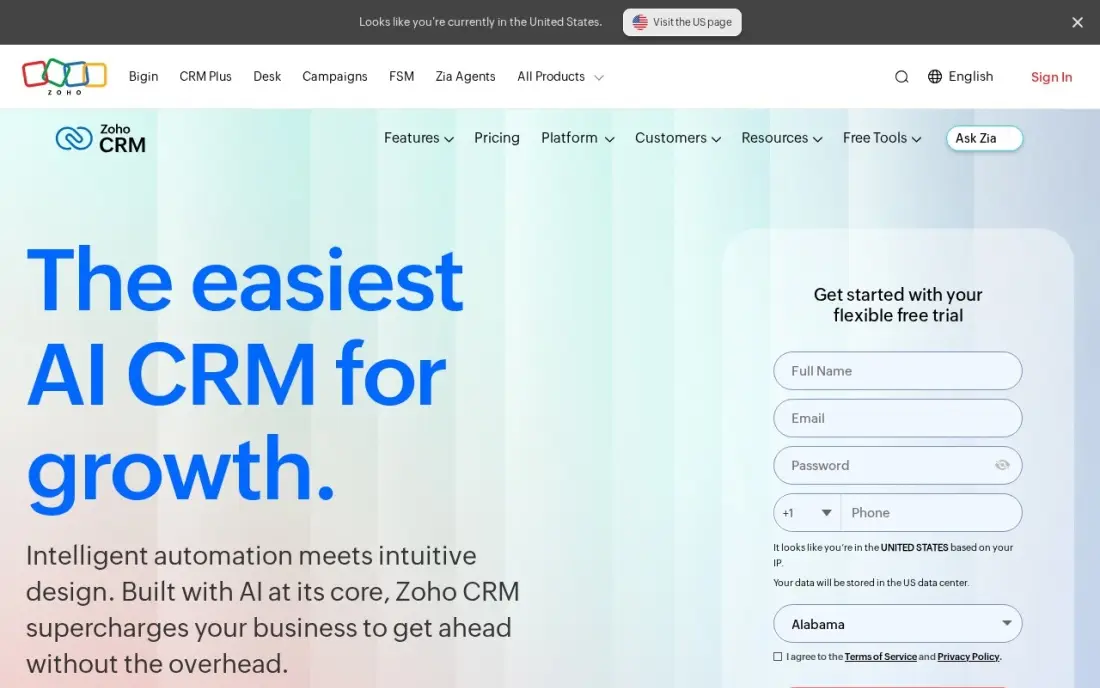
Zoho CRM does the same job as HubSpot for a restaurant's sales side but stretches further for free: the free plan covers up to three users with pipelines, leads and contacts, which suits a group with a catering lead, an events manager and an owner. Standard costs $14 a user a month billed annually, or $20 billed monthly, and adds built-in calling, five pipelines and sales forecasting.
Its weak points are setup and support: G2 reviewers rate ease of setup lower than HubSpot and Pipedrive, and add-ons for storage and support sit outside the seat price. Like HubSpot, it holds companies and contacts rather than diners, so pair it with a reservation or POS CRM rather than expecting it to replace one.
What we like
- Free plan covers up to 3 users with pipelines, leads and contacts — the only free tier here that fits a tiny team, not just a solo user
- Zia, Zoho's AI assistant, predicts deal outcomes, flags anomalies and suggests the best time to contact a lead on Enterprise and the top tier
- The cheapest full-featured ladder here: Standard $14, Professional $23 and Enterprise $40 a user a month billed annually
Watch out for
- Zia's predictions and AI features need Enterprise at $40 a user a month — Standard buyers get scoring rules, not the AI assistant
- G2 reviewers rate ease of setup 8.0, the lowest here, and support scores trail HubSpot and Pipedrive
- Add-ons for support tiers, storage and training sit outside the seat price, so the invoice can exceed the plan price
The best CRM software for restaurants remembers your guests so your staff do not have to: who came in, how often, what they spent and what they need next time. We compared eight tools across the three kinds of restaurant CRM — reservation platforms, POS systems and guest-data platforms — plus two general CRMs for the catering and events side, and every price below comes from the vendor's own pricing page as checked in November 2026.
How to choose the best CRM software for restaurants
- Start with where your guests leave data. If most guests book ahead, a reservation CRM sees them; if most walk in and pay by card, a POS CRM does; if they sit and use the WiFi, a WiFi platform catches the rest.
- Check what a guest profile actually holds. Visit history, spend, allergies and seating notes are the basics — make sure staff can add notes at the host stand without leaving the booking screen.
- Price the marketing, not just the CRM. Several tools here keep profiles on the base plan but charge extra for email, SMS or loyalty, which is the part that brings guests back.
- Ask who owns the guest list. Marketplaces keep their diners' details; direct-booking tools and your own POS hand the data to you, and only data you own can be exported if you leave.
- Read the contract terms. SevenRooms is annual with a 90-day notice, OpenTable runs a year and auto-renews, and Toast typically runs two years — Eat App and Square let you leave month to month.
- Keep sales separate from service. Catering and private events are a sales pipeline, not a guest list, and a general CRM handles them better than a reservation tool.
A CRM keeps the guests you already have; search brings new ones. If the restaurant also needs to show up on Google Maps, our local SEO service covers that side, and the free local business schema generator helps Google read your hours, menu and booking link correctly.
CRM software for restaurants pricing: what you will actually pay
Take one restaurant that wants guest profiles plus regular email or SMS to its regulars. On list prices, Square for Restaurants costs $0 a month on the Free plan before processing, Eat App costs $0 up to 100 covers a month and $99 a month on Lite, Toast's Point of Sale plan costs $69 a month before its marketing and loyalty add-ons, Bloom Intelligence costs $115 a month billed monthly, and OpenTable Pro — the plan with its CRM and marketing automation — costs $499 a month before network cover fees.
Over a year that is $1,188 for Eat App Lite billed monthly, or $828 at its $69 annual rate; $1,380 for Bloom Intelligence billed monthly, or $1,260 billed annually; and $5,988 for OpenTable Pro before covers. Toast and Square depend on which add-ons you switch on, so price loyalty and marketing before you compare them with a flat-fee tool. SevenRooms publishes no price, and operators report setup fees from a few hundred dollars to $5,000 or more, so get the full first-year cost in writing.
The catering side is cheaper. HubSpot's free CRM covers two users and Zoho's covers three, so a restaurant can run its catering and private events pipeline for $0 until the team outgrows it. Paid seats start at $20 a month on HubSpot Starter and $14 a month on Zoho Standard billed annually.
Know the difference: guest CRM vs sales CRM
A guest CRM is built around diners. It counts visits and covers, remembers the corner table and the nut allergy, and sends a birthday offer or a we-miss-you message. SevenRooms, Eat App, Bloom Intelligence and the CRM tools inside OpenTable, Toast and Square all work this way, and they get their data from bookings, card payments or WiFi logins.
A sales CRM is built around deals. It tracks a corporate client asking for a lunch quote, a wedding party comparing venues, or a catering contract up for renewal, and it moves each one through a pipeline to won or lost. HubSpot and Zoho are sales CRMs. They are excellent at that job and useless at the host stand, which is why most restaurants that need both run one of each rather than forcing one tool to do the other's work.
Quick comparison: tool type by need
| Buyer | Best pick | Why |
|---|---|---|
| Multi-venue groups | SevenRooms | Deepest guest profiles and automated marketing, priced by quote |
| Independent restaurants | Eat App | Free up to 100 covers a month, Lite $99/month with no cover fees |
| Walk-in heavy groups | Bloom Intelligence | One profile from WiFi, POS, ordering and reviews, from $115/month per location |
| Already on Toast | Toast | Guest data from every check, with marketing and loyalty as add-ons |
| Counter service on a budget | Square for Restaurants | Free POS plan with a customer directory, no contract |
| OpenTable restaurants | OpenTable | Guest CRM and marketing on Pro at $499/month |
| Catering and private events | HubSpot CRM | Free pipeline for up to 2 users |
| Small events team | Zoho CRM | Free for up to 3 users, Standard from $14/user/month |
Mistakes to avoid
- Buying a CRM that cannot see most of your guests. A reservation CRM in a walk-in restaurant records a fraction of the trade — match the tool to where your guests leave data.
- Collecting data without consent. Guest emails and phone numbers need marketing consent before you send campaigns; check that the tool records the opt-in, not just the address.
- Paying for marketing you never send. A CRM earns its fee only when someone sends the win-back and birthday messages — if nobody owns that job, start on a free plan.
- Running two guest lists. If the POS and the reservation tool both keep profiles that never sync, staff end up with two half-pictures of every regular; pick one source of truth or pay for the integration.
- Signing a long contract before a trial. SevenRooms, OpenTable and Toast all tie you in for a year or more, so run a real week on a month-to-month tool first if you are unsure.
How we chose
We checked each vendor's own pricing page in November 2026 and recorded the starting price exactly as shown, including the annual-billing figure where the page lists one. We grouped the tools by where they get guest data — reservations, POS or WiFi — and ranked them by fit for the most common buyer, an independent restaurant or small group that wants to bring regulars back more often. SevenRooms publishes no price, so we list it as custom quote rather than repeating a third-party estimate. Ratings come from G2 pages checked on the dates shown in the sources. No vendor paid for a place in this list, and none of the links here are affiliate links.
What to do next
Start with the free plan or trial that matches where your guests leave data, and run one real month through it: tag your regulars, send one win-back message and count how many come back. If the regulars are covered but new guests are not finding you, our monthly SEO service handles the visibility side. See where you rank locally, free.
Frequently asked questions
What is the best CRM software for restaurants?
SevenRooms is the most complete restaurant guest CRM, with profiles and marketing automation tied to reservations, but it is quote-only. Eat App is the best value, with a free plan up to 100 covers a month and Lite at $99 a month, and Bloom Intelligence is the pick for groups that want WiFi, POS and review data in one profile.
Do restaurants need a separate CRM?
Usually not at first. Reservation systems such as SevenRooms, Eat App and OpenTable and POS systems such as Toast and Square already build guest profiles from the data they touch. A separate CRM such as HubSpot or Zoho makes sense only for catering, private events and corporate accounts.
Is there a free CRM for restaurants?
Yes. Eat App has a free plan up to 100 covers a month, Square for Restaurants has a free POS plan with a customer directory, and HubSpot and Zoho both have free CRMs for catering and events pipelines — HubSpot for up to 2 users and Zoho for up to 3.
How much does a restaurant CRM cost?
On published prices, Eat App Lite costs $99 a month, Bloom Intelligence costs $115 a month per location, Toast's POS starts at $69 a month plus add-ons, and OpenTable Pro, the plan with its CRM tools, costs $499 a month. SevenRooms publishes no price, so get a written quote.
What data should a restaurant CRM collect?
At minimum, visit history, spend, contact details with marketing consent, and staff notes such as dietary needs and seating preferences. The best tools add how the guest found you, which lets you send a win-back message to a regular who has not visited for a set number of weeks.
Can a restaurant CRM capture walk-in guests?
Only if it has a way to see them. A reservation CRM sees bookings, a POS CRM sees card payments and a WiFi platform such as Bloom Intelligence sees guests who log in to the network. Groups with mostly walk-in trade should favour the POS or WiFi route.
Sources we checked (16)
- SevenRooms — www.sevenrooms.com (checked November 8, 2026)
- SevenRooms reviews on G2 (checked November 8, 2026)
- Eat App — restaurant.eatapp.co/pricing (checked November 8, 2026)
- Eat App reviews on G2 (checked November 8, 2026)
- Bloom Intelligence — bloomintelligence.com/pricing (checked November 5, 2026)
- Bloom Intelligence reviews on G2 (checked November 5, 2026)
- Toast — pos.toasttab.com/blog/on-the-line/toast-pricing (checked November 8, 2026)
- Toast reviews on G2 (checked November 8, 2026)
- Square for Restaurants — squareup.com/us/en/point-of-sale/restaurants/pricing (checked November 8, 2026)
- Square for Restaurants reviews on G2 (checked November 8, 2026)
- OpenTable — www.opentable.com/restaurant-solutions/plans (checked November 8, 2026)
- OpenTable reviews on G2 (checked November 8, 2026)
- HubSpot CRM — www.hubspot.com/products/crm (checked November 12, 2026)
- HubSpot CRM reviews on G2 (checked November 12, 2026)
- Zoho CRM — www.zoho.com/crm/pricing (checked November 12, 2026)
- Zoho CRM reviews on G2 (checked November 12, 2026)
Make one of these tools?
We re-check this list every quarter. Send a correction, request a review, or ask about a clearly labeled sponsored spot.
Request a listingShamim
Founder of SerpAstra
A full-stack SEO and digital marketer who spends most days on Local SEO for dental practices, AI search visibility and lead generation.
Free SEO and AI visibility audit
Find out what is holding your rankings back
Send us your site. Within 2 business days you get a written audit, an AI visibility check and a short fix list ranked by impact. Free, with no contract attached.
Request my free audit→Related buying guides
 Retail, Restaurants & Hospitality10 Best Restaurant Reservation Software in 2026, ComparedCompare the 10 best restaurant reservation software options on price, per-cover fees and free plans, with every price checked November 8, 2026.Read guide →
 Retail, Restaurants & Hospitality10 Best POS for Quick Service Restaurant in 2026Compare the 10 best pos for quick service restaurant systems on price, free plans and offline mode, with every price checked November 8, 2026.Read guide →
 MarketingBest Wifi Marketing Software for 2026: 8 Options Compared by Use CaseCompare the 8 best wifi marketing software options for venues on price, free plans and guest-data capture, with every price checked November 5, 2026.Read guide →