
10 Best EHS Software for Contractors in 2026, Compared
Compare the 10 best EHS software for contractors on price, free plans, mobile apps and OSHA features, with every price checked November 7, 2026.
 Shamim Mia, Founder, SerpAstraLast verified November 7, 202613 min read
We compare pricing pages, documentation and public reviews. We never accept payment for rankings.
Key takeaways
- Mitti and Safesite are the only free starting points here: Mitti covers teams up to 10 seats free, Safesite is free for unlimited members, and both put inspections and incident reporting on a phone.
- Seven of the ten tools publish no price at all — HammerTech, SALUS, SiteDocs, Procore, EHS Insight, VelocityEHS and Cority are all custom-quoted, so budget on a demo and a per-contract quote, not a list price.
- The real cost driver is the pricing unit: per-seat tools like Mitti at $24 a seat a month get expensive as the crew grows, while HammerTech and Procore charge no per-user fee at all.
- SALUS has the highest user rating here at 4.7 out of 5 on G2, and Procore has the deepest review base at 4.6 out of 5 from 4,667 reviews.
On this page
Quick comparison
| Tool | Best for | Starting price | Free plan |
|---|---|---|---|
| Mitti (by SafetyCulture) | Small contractors that want to digitize inspections fast, starting free, with AI built into every plan | $24/seat/mo | Yes (free plan) |
| Safesite | Small contractors that want to start free and grow, with OSHA recordkeeping built in | $16/member/mo | Yes (free plan) |
| SALUS | US trade contractors that need crew-level adoption, with field capture by QR, voice and photo | Custom quote | No (demo) |
| HammerTech | Large contractors standardizing safety across many projects, with no per-user fees | Custom quote | No (demo) |
| SiteDocs | Contractors building a safety compliance program around forms, orientations and certifications | Custom quote | No (free trial) |
| Procore | Contractors already running Procore for project management who want safety in the same system | Custom quote | No (demo) |
| EHS Insight | Mid-market contractors that want modern EHS without legacy complexity | Custom quote | No (free trial) |
| VelocityEHS | Large contractors needing enterprise EHS breadth, including environmental compliance | Custom quote | No (demo) |
| Intelex | Contractors that want EHS and quality management in one system | $44/user/mo | No (free trial) |
| Cority | High-risk contractors with heavy compliance demands across many sites | Custom quote | No (demo) |
Make one of these tools?
We re-check this list every quarter. Send a correction, request a review, or ask about a clearly labeled sponsored spot.
Request a listingThe best ehs software for contractors

Mitti (by SafetyCulture)
Best for: Small contractors that want to digitize inspections fast, starting free, with AI built into every plan
Mitti is the new name for the platform contractors have used for years as SafetyCulture and iAuditor, and the rebrand changed the name without changing the job: turn paper checklists into phone-based inspections. A small crew can download the app, pick a template from the library, and file its first inspection the same day, with the free plan covering teams of up to 10 seats.
Premium costs $24 per seat per month billed annually, or $29 billed monthly, and adds unlimited templates, advanced analytics and training, plus AI that creates issues from site photos. The cost to watch is headcount: every paid seat is $288 a year, so a 25-person crew pays $7,200 a year before the Enterprise tier. Buy Mitti when speed matters most and the crew is small enough for the free plan to carry the pilot.
What we like
- Free plan covers teams up to 10 seats with inspections, tasks and training
- Huge template library, so most checklists already exist before you build one
- AI features included on every plan, including photo-based issue creation
- Offline mobile app that field crews already know from the iAuditor years
Watch out for
- Premium per-seat pricing adds up fast once the crew grows past the 10-seat free plan
- Per-seat billing means every subcontractor login is a paid seat on Premium
- The August 2026 rebrand from SafetyCulture to Mitti still confuses some buyers and reviewers

Safesite
Best for: Small contractors that want to start free and grow, with OSHA recordkeeping built in
Safesite is the contractor-friendly pick because its free plan has no seat cap: unlimited members and guests get the mobile app, inspections, incident reporting, toolbox talks and equipment checks. A small contractor can stop doing safety on paper this week without spending anything, and the paid tiers add the reporting depth a growing program needs.
Premium costs $16 per member per month billed monthly, or $12.80 billed annually, and unlocks unrestricted reporting history, group reporting and the OSHA 300 recordable incident log. The catch is the free plan's 30-day reporting window, which pushes any serious program toward Premium. Buy Safesite when the budget is zero today and the crew needs to start now.
What we like
- Genuinely free plan with unlimited members and guests, not a seat-capped trial
- Premium at $16/member/month is straightforward published pricing
- Covers inspections, incidents, OSHA 300 logs, toolbox talks and equipment checks
- Multilingual mobile app (English, Spanish, French, Portuguese) with offline mode
Watch out for
- Free plan limits reporting history to the last 30 days
- Advanced features like loss analysis and telemedicine sit in the top tier
- Only 6 G2 reviews, so the public rating rests on a thin base

SALUS
Best for: US trade contractors that need crew-level adoption, with field capture by QR, voice and photo
SALUS starts with the crew, not the office. The platform is built for US trade contractors — electrical, mechanical, heavy civil and structural steel — and field capture runs by QR code, voice, photo and signature, working offline on remote jobsites. Its AI assistant, Rosie, handles admin work and surfaces risk from the field data crews actually collect.
The pitch is adoption: safety software only works if the field uses it, and the vendor reports 14,000 companies and 400,000 users as proof crews do. The trade-off is transparency — pricing needs a sales conversation, and there is no published tier to budget against. Book a demo when toolbox talks and inspections keep dying on paper because the office tool never reached the field.
What we like
- Built specifically for US trade contractors, not general industry
- Highest user rating in this list at 4.7 out of 5 on G2 from 74 reviews
- Crew-first capture by QR, voice, photos and signatures, working offline
- AI assistant Rosie handles admin work and surfaces risk from field data
Watch out for
- Pricing requires a sales conversation — no published tiers to budget against
- Trade-contractor focus means general contractors may find it narrow
- Some reviewers report occasional glitches that interrupt field compliance

HammerTech
Best for: Large contractors standardizing safety across many projects, with no per-user fees
HammerTech built its reputation with large general contractors — DPR, Holder, Gilbane and PCL run safety on the platform — and its standout commercial term is no per-user pricing. Every worker gets in, including subcontractors, so reporting coverage is genuinely company-wide instead of limited to the staff with paid seats.
The platform covers inductions, pre-starts, permits, incident tracking, inspections and AI-powered risk insights, and it integrates with Procore so safety data flows into project workflows. The trade-off is scale: pricing is custom and aimed at larger operations, with a longer sales cycle. Shortlist HammerTech when you are standardizing safety across dozens of projects and seat fees would keep subcontractors out.
What we like
- No per-seat fees, so subcontractors and field workers are included at no extra cost
- Trusted by major ENR Top 400 contractors including DPR, Holder and Gilbane
- Mobile-first design built for jobsites, with inductions, permits and pre-starts
- Integrates with Procore, so safety data flows into project workflows
Watch out for
- Pricing is custom and aimed at larger operations
- Enterprise orientation means longer sales and implementation cycles
- Overkill for small specialty contractors that only need inspections
SiteDocs
Best for: Contractors building a safety compliance program around forms, orientations and certifications
SiteDocs is purpose-built for safety compliance rather than general EHS: digital forms, worker orientations, certification tracking, incident management, corrective actions, hazard management and equipment management, with AI callouts beside the dashboards. The company joined the Nemetschek Group, which gives it backing inside the construction technology world.
Pricing is an annual subscription based on company size, with logins for all workers included, but the exact figure needs a quote — no tiers are published. The vendor cites one contractor estimating $100,000 in first-year admin savings. Buy SiteDocs when OSHA-style compliance is the job and a full environmental suite would be more software than you need.
What we like
- Deep focus on contractor compliance: forms, orientations, certifications, equipment
- Annual subscription by company size, with logins for all workers included
- SOC 2 certified, with strong customer stories on time saved
- AI surfaces callouts beside dashboards to flag what needs attention
Watch out for
- Pricing is quote-only with no published tiers
- Narrower than full EHS suites, with less on environmental and sustainability
- Some reviewers find document editing and navigation time-consuming

Procore
Best for: Contractors already running Procore for project management who want safety in the same system
Procore is the construction management platform, and its safety tools — observations, inspections, incidents, daily logs and toolbox talks — live where the project data already lives. Pricing is volume-based and tied to annual construction volume, with unlimited users, which makes adding safety access for the whole team frictionless.
The evaluation question is simple: if the company already runs Procore, turning on its safety tools is usually cheaper and faster than buying a separate EHS platform. If it does not, buying Procore just for safety rarely makes sense — dedicated tools like Mitti or Safesite serve a safety-only need better and cheaper. Choose Procore safety when the project platform is already Procore.
What we like
- Safety tools live inside the project platform the team already uses
- Volume-based pricing with unlimited users, so the whole crew gets access
- Deepest review base here: 4.6 out of 5 from 4,667 G2 reviews
- Strong mobile apps for field crews, with observations, inspections and daily logs
Watch out for
- Safety is a module inside a much bigger platform, not a dedicated EHS suite
- Pricing is custom and tied to annual construction volume
- Overkill if you only need safety and do not run Procore already

EHS Insight
Best for: Mid-market contractors that want modern EHS without legacy complexity
EHS Insight sells itself as the un-legacy EHS platform: incident management, audits, inspections, risk and ESG reporting in one AI-powered system, without the implementation pain of older software. The mobile app gives field teams full platform access with offline mode, which matters on construction sites with poor signal.
Construction is a named industry vertical, and the Cajun Industries case study shows a national construction firm consolidating incidents, job safety analyses, audits and inspections onto the platform. Pricing is not published, so treat the free trial as the real evaluation. Shortlist EHS Insight when the program has outgrown free tools but does not need an enterprise suite.
What we like
- Purpose-built for safety program management with deep US regulatory coverage
- Strong mobile app with offline mode for sites with poor connectivity
- Ranked #1 in six G2 Fall 2026 EHS index reports, including usability
- Construction is a named industry vertical, with national construction customers
Watch out for
- Pricing is quote-only, so the trial is the real evaluation
- Some workflows take several steps and feel less intuitive than they should
- Support after go-live runs through email tickets, which some reviewers find slow

VelocityEHS
Best for: Large contractors needing enterprise EHS breadth, including environmental compliance
VelocityEHS is the heavyweight in this list: more than 30 years in EHS, a connected Accelerate platform covering safety observations, chemical management, contractor safety, ergonomics and sustainability reporting, with AI embedded across the workflows. Its contractor safety and permit-to-work module speaks directly to construction use cases.
This is the tool for contractors operating at enterprise scale, especially those with environmental compliance duties alongside safety — energy, industrial and infrastructure work. Smaller contractors will find it too much software and too long an implementation. Shortlist VelocityEHS when the EHS program spans safety, industrial hygiene and environmental compliance under one roof.
What we like
- One of the broadest EHS suites: safety, chemical management, contractor safety, environmental compliance and sustainability
- 30-plus years in EHS, with 15,000-plus customers and a named contractor safety module
- AI embedded across workflows, with permit-to-work for construction
- Named a Leader in Verdantix Green Quadrant: EHS Software (2026)
Watch out for
- Enterprise scale means enterprise implementation and enterprise pricing
- Feature breadth can slow down simple safety programs
- Reviewers find some navigation confusing, especially around OSHA recordability

Intelex
Best for: Contractors that want EHS and quality management in one system
Intelex, part of Industrial Scientific, positions its EHSQ platform around a simple idea: the best days are uneventful days. It brings incident management, audits, training, document control and quality workflows into one connected system, with AI that helps frontline teams report faster. G2 lists an Essentials tier from $44 per user per month, though Intelex itself publishes no prices.
For contractors, the differentiator is quality management alongside EHS. Firms with formal QA and QC programs, especially in industrial and infrastructure construction, get more from Intelex than from safety-only tools. A free trial lowers the evaluation barrier, but expect enterprise contracting for full deployment. Choose Intelex when quality and safety share one program.
What we like
- Combines EHS and quality management, which suits contractors with formal QA programs
- Free trial lowers the evaluation barrier before the sales conversation
- AI features help frontline teams report faster
- Workflow automation routes corrective actions and sends reminders automatically
Watch out for
- Enterprise pricing and sales process for full deployment
- The quality angle adds complexity if you only need safety
- Reviewers call the interface dated and report-heavy, with a steep learning curve

Cority
Best for: High-risk contractors with heavy compliance demands across many sites
Cority is the enterprise end of this list: a CorityOne platform covering EHS, quality, sustainability, occupational health and industrial hygiene, with Cortex AI agents embedded in workflows to flag operating risks early. It is deeply configurable, so forms, workflows and dashboards bend to each region's rules instead of forcing one process on every site.
The cost is complexity and time — G2 reviewers report about five months to implement, and a long learning curve once live. Pricing is custom and substantial. Shortlist Cority when the contractor works in high-risk environments with heavy compliance demands across many sites, and the safety program needs the same platform as health and sustainability.
What we like
- Deep configurability: forms, workflows and dashboards bend to each region's rules
- Strongest breadth for occupational health, industrial hygiene and sustainability alongside safety
- Responsive 24/7 support that reviewers praise by name
- Cortex AI embeds AI agents into workflows to flag operating risks early
Watch out for
- Long learning curve and long implementation — about 5 months on average per G2
- Pricing is custom and substantial, with cost cited as a limiting factor
- Report building uses niche jargon and needs admin knowledge to do well
An incident investigation that drags on for three weeks usually has one root cause: nobody can find the paperwork. The inspection form was on a clipboard in a truck, the toolbox talk sign-in sheet never made it to the office, and the near miss lived in someone's head. The best ehs software for contractors ends exactly that: every inspection, permit, incident, corrective action and certificate in one system the field will actually use. We ranked the ten tools below by fit for the most common buyer — a contractor moving safety off paper — and every price was checked on November 7, 2026.
How to choose the best ehs software for contractors
- Start with the pricing unit, not the headline price. Per-seat tools charge for every login, so a 25-person crew pays 25 times the listed rate. HammerTech and Procore charge no per-user fee at all, and SiteDocs prices by company size — the unit decides the bill more than the rate does.
- Check the free plan's real limit. Mitti caps at 10 seats, so an 11th worker forces Premium. Safesite is free for unlimited members but limits reporting history to the last 30 days, which pushes a serious program toward Premium at $16 a member a month.
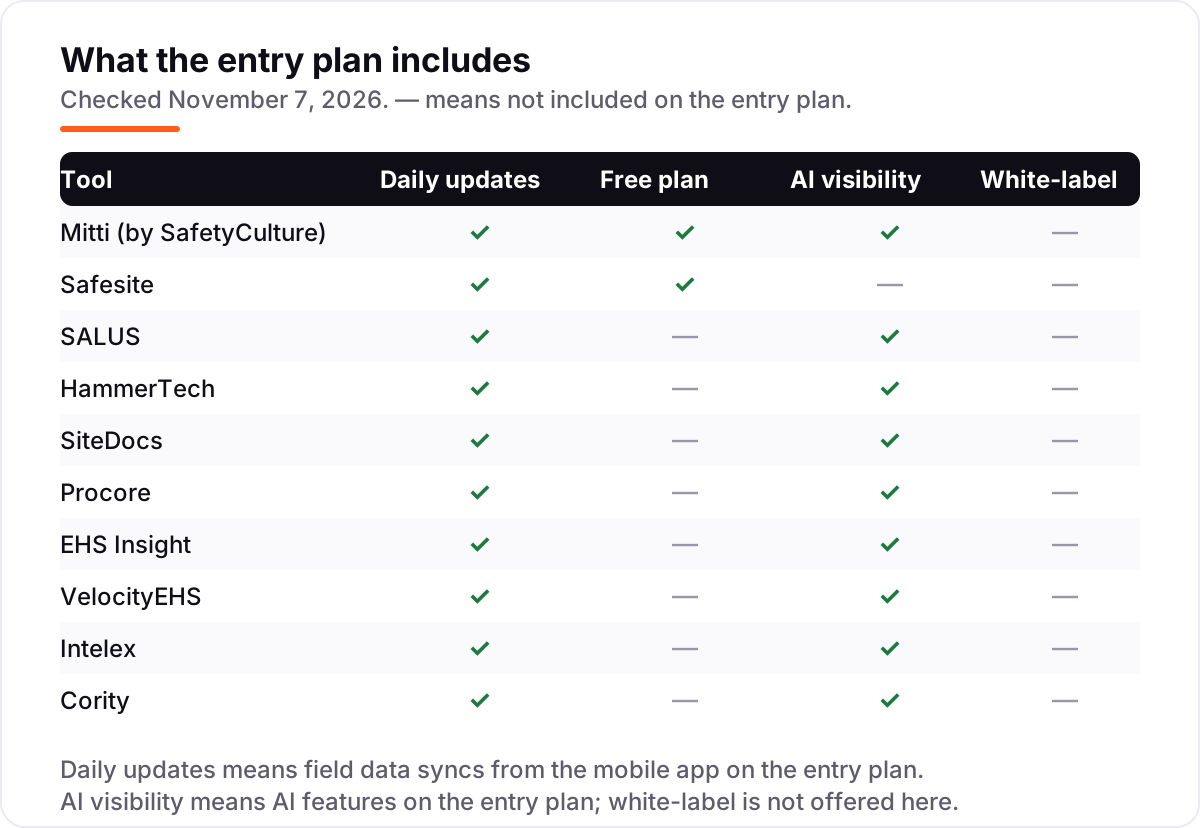
- Test the mobile app on a real jobsite. Offline mode, gloves, sunlight and a dead zone are the real test. Mitti, Safesite, SALUS, EHS Insight and SiteDocs all claim offline capture — verify it on your own site before you buy.
- Match the depth to the program. If the job is inspections, toolbox talks and incidents, a free tool or a compliance tool like SiteDocs is enough. If the program spans environmental compliance and sustainability, only the enterprise suites cover it.
- Ask what the quote includes. Seven tools here are custom-quoted, and implementation, training and data migration are often priced separately. Get the whole number in writing before you compare.
Software is one system in the stack, not the whole stack. If the firm also needs to be found by local clients, our local SEO service covers the visibility side. And before you publish new service pages for the work you win, run your titles through the free SERP snippet preview tool — it shows exactly how the title and description will look in Google.
Whatever you shortlist, try it with real data before you pay. The free plans and trials in this list are long enough to run one genuine week — your inspections, your crew, your sites — and that week tells you more than any review can. Check two things in the trial: that field workers file reports without calling the office for help, and that the OSHA 300 log exports cleanly. If either fails, the tool fails, whatever the demo promised.
EHS software for contractors pricing: what you will actually pay
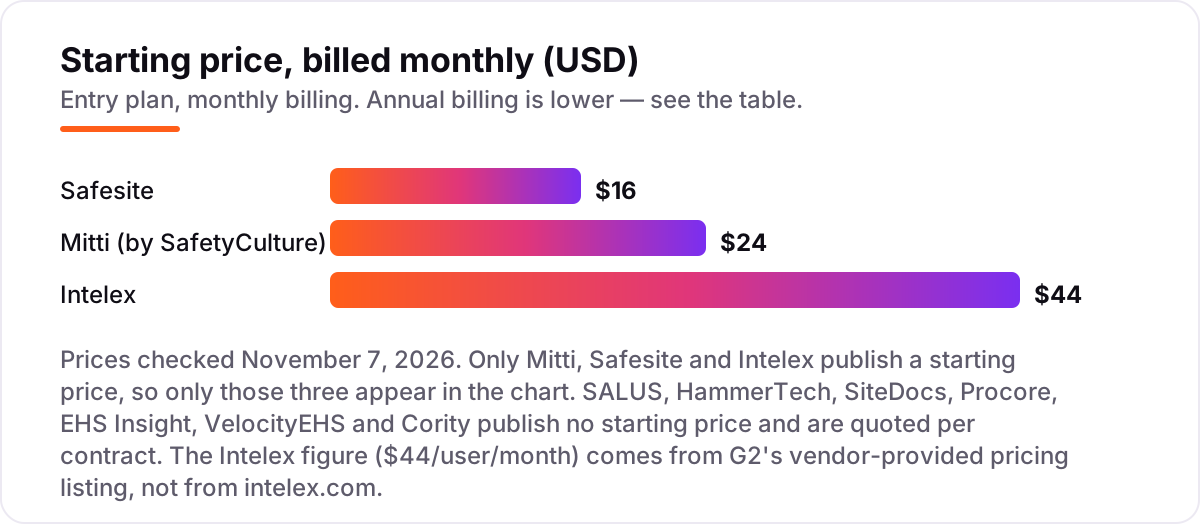
Take a 25-person crew that needs inspections, incidents and toolbox talks on every job. On published list prices, the subscription costs $400 a month on Safesite Premium, $600 a month on Mitti Premium billed annually, and $1,100 a month on Intelex Essentials. Billed annually, those drop to $320 on Safesite, stay $600 on Mitti at the annual rate, and stay $1,100 on Intelex, since no annual discount is published for it.
Over a year, that is $3,840 on Safesite billed annually, $7,200 on Mitti Premium billed annually, and $13,200 on Intelex Essentials. A 10-person crew pays $0 on Mitti's free plan and $0 on Safesite's free plan, so the cheapest honest starting point for a small crew is free — the bill only starts when the crew outgrows the free tier or needs reporting beyond 30 days.
The seven custom-quoted tools cannot be priced this way, and that is the point: HammerTech, SALUS, SiteDocs, Procore, EHS Insight, VelocityEHS and Cority all price per contract, so the only honest comparison is a demo and a written quote for the same crew size and site count. Three costs sit outside every number above. First, implementation: G2 reviewers report about four months for EHS Insight and five months for Cority, and that time is usually billed. Second, training the field crew, which is where most rollouts actually fail. Third, the per-seat trap on Mitti and Safesite: every subcontractor login is a paid seat, so count them before you sign.
Know the difference: EHS software vs a checklist app
The confusion in this category is between a full EHS platform and a digital checklist app. A checklist app digitizes inspections: forms, photos, signatures, done. A full EHS platform adds incident investigations, corrective actions, audits, training records, compliance obligations, permits and environmental reporting, all linked so one incident updates the risk picture everywhere. Mitti started as inspections and grew outward; Cority and VelocityEHS started as the whole platform.
There is a second confusion: Procore is neither. Procore is construction project management — budgets, schedules, submittals — with safety tools inside it. If the firm already runs Procore, its safety module is usually the cheapest path to digital safety. If the firm only needs safety, a dedicated tool fits better and costs less than adopting a whole project platform for one module.
A third distinction worth knowing is free plan versus free trial. Mitti and Safesite have free plans that keep working at $0, with limits. EHS Insight, SiteDocs and Intelex offer free trials that end. A trial is for evaluation; a free plan is for running the business. Do not build a safety program on a trial and discover the price on day 31.
Quick comparison: tool type by need
| Buyer | Best pick | Why |
|---|---|---|
| Small crew starting free | Mitti | Free up to 10 seats, Premium is $24/seat/month billed annually |
| Free plan with no seat cap | Safesite | Free for unlimited members, Premium is $16/member/month |
| Trade contractor, crew-first | SALUS | Built for US trade contractors, rated 4.7/5 on G2 |
| Large contractor, no seat fees | HammerTech | No per-user pricing, trusted by ENR Top 400 firms |
| Compliance-first program | SiteDocs | Forms, orientations and certifications, priced by company size |
| Already running Procore | Procore | Safety inside the project platform, volume-based pricing |
| Mid-market, modern EHS | EHS Insight | Full EHS depth without legacy complexity, free trial |
| Enterprise breadth | VelocityEHS | Broadest suite, including environmental compliance |
| EHS plus quality | Intelex | One system for safety and QA, Essentials from $44/user/month |
| High-risk, heavy compliance | Cority | Deep configurability for global high-risk work |
Mistakes to avoid
- Budgeting on the free plan, then finding reporting costs extra. Safesite's free plan limits reporting to the last 30 days. If the safety manager needs a full year of history, count Premium at $16 a member a month from day one.
- Paying per seat for subcontractors. On Mitti and Safesite every login is a paid seat. If subcontractors rotate through jobs, a no-seat-fee tool like HammerTech or a company-size price like SiteDocs can cost less than a per-seat list price suggests.
- Buying an enterprise suite for an inspections-only need. Cority and VelocityEHS are built for multi-site compliance programs with months of implementation. A crew that only needs inspections and toolbox talks will drown in them.
- Skipping the offline test. A safety app that needs signal is useless on a remote site. Run the trial on a real jobsite with a dead zone before signing, not in the office on Wi-Fi.
- Forgetting implementation time. EHS Insight averages about four months to go live and Cority about five, according to G2 reviewers. A tool bought in November is not running in December — plan the rollout, the training and the data migration into the schedule.
How we chose
We checked each vendor's own pricing page on November 7, 2026 and recorded the starting price exactly as shown. Two prices need a note. The Mitti pricing page would not load for a direct read on the day, so its $24 a seat a month figure rests on multiple independent October 2026 reads of the vendor's own pricing page plus G2's vendor-provided pricing, which all agree. The Intelex $44 a user a month figure comes from G2's vendor-provided pricing listing, not from intelex.com, which publishes no prices. Seven tools publish no starting price at all and are listed as custom quote. Ratings come from each tool's G2 review page opened on November 7, 2026; Safesite's 4.5 out of 5 rests on only 6 reviews. We ranked by fit for the most common buyer — a contractor moving safety off paper — not by brand size. No vendor paid for a place in this list, and none of the links here are affiliate links.
What to do next
Start with the free plan or trial of your top pick and run one real week of inspections through it. Check that field workers file reports without help, that offline capture syncs, and that the OSHA 300 log exports cleanly before you commit to a year. If the safety side is sorted but new clients are not finding the firm, our monthly SEO service handles the visibility side — or compare providers in our guide to marketing software for contractors. Once your tools are in place, find out what's holding your rankings back.
Your stack only works if people find you
SerpAstra fixes what keeps your site off page one and makes it easy for AI assistants to recommend.
Get a free audit→Sources we checked (20)
- Mitti pricing — miti.com/pricing (checked November 7, 2026)
- Safesite pricing — safesitehq.com/pricing (checked November 7, 2026)
- SALUS pricing — salus.com/pricing (checked November 7, 2026)
- HammerTech pricing — hammertech.com/pricing (checked November 7, 2026)
- SiteDocs pricing — sitedocs.com/pricing (checked November 7, 2026)
- Procore pricing — procore.com/pricing (checked November 7, 2026)
- EHS Insight pricing — ehsinsight.com/pricing (checked November 7, 2026)
- VelocityEHS pricing — ehs.com/pricing (checked November 7, 2026)
- Intelex pricing — intelex.com/pricing (checked November 7, 2026)
- Cority pricing — cority.com/pricing (checked November 7, 2026)
- Mitti (by SafetyCulture) reviews — g2.com/products/safetyculturehq/reviews (checked November 7, 2026)
- Safesite reviews — g2.com/products/safesite/reviews (checked November 7, 2026)
- SALUS reviews — g2.com/products/salus/reviews (checked November 7, 2026)
- HammerTech reviews — g2.com/products/hammertech-global-hammertech/reviews (checked November 7, 2026)
- SiteDocs reviews — g2.com/products/sitedocs/reviews (checked November 7, 2026)
- Procore reviews — g2.com/products/procore/reviews (checked November 7, 2026)
- EHS Insight reviews — g2.com/products/ehs-insight/reviews (checked November 7, 2026)
- VelocityEHS reviews — g2.com/products/velocityehs-ehs-software-to-outpace-risk/reviews (checked November 7, 2026)
- Intelex reviews — g2.com/products/intelex-ehsq/reviews (checked November 7, 2026)
- CorityOne reviews — g2.com/products/corityone/reviews (checked November 7, 2026)
Shamim
Founder of SerpAstra
A full-stack SEO and digital marketer who spends most days on Local SEO for dental practices, AI search visibility and lead generation.
Frequently asked questions
What is the best EHS software for contractors?
Mitti is the best fit for most small contractors: a free plan up to 10 seats, a huge template library, and Premium from $24 a seat a month. Safesite is the better free pick for larger crews, since its free plan has no seat cap. Large contractors should shortlist HammerTech for its no-seat-fee model and Procore if they already run it.
How much does EHS software for contractors cost?
Published prices run from $0 to $44 a user a month. Mitti Premium is $24 a seat a month billed annually, Safesite Premium is $16 a member a month, and Intelex Essentials is listed at $44 a user a month. The other seven tools are custom-quoted, so expect a per-contract price that depends on headcount, sites and modules.
Is there really free EHS software for contractors?
Yes, with limits. Mitti is free for teams up to 10 seats, and Safesite is free for unlimited members and guests. Mitti's free plan caps templates at five, and Safesite's free plan limits reporting history to the last 30 days. Both are real working tools, not trials, and either one can carry a small crew paperless.
What is the difference between EHS software and Procore?
Procore is construction project management with safety tools inside it; EHS software is built for safety first. If the firm already runs Procore, its safety module is usually the cheapest path. If the firm only needs safety, a dedicated tool like Mitti, Safesite or SALUS fits better and costs less than adopting Procore.
Does EHS software replace OSHA paperwork?
No, it organizes it. The software digitizes inspections, incidents, training records and certifications, and tools like Safesite generate the OSHA 300 log from the data. The legal duties stay the same — recordable injuries still need recording — but the records stop living on clipboards in trucks and become searchable in one system.
Can field workers use EHS software offline?
Yes, on most tools here. Mitti, Safesite, SALUS, EHS Insight and SiteDocs all offer mobile apps with offline mode, so inspections and incident reports can be filed from sites with no signal and synced later. Test offline capture on a real jobsite during the trial, because offline depth varies between vendors.
How long does it take to roll out EHS software?
Free tools go live the same day: download the app, pick a template, and file the first inspection. Mid-market tools like EHS Insight average about four months to implement, according to G2 reviewers. Enterprise suites take longer — Cority averages about five months — so plan training and data migration into the schedule.
Free SEO and AI visibility audit
Find out what is holding your rankings back
Send us your site. Within 2 business days you get a written audit, an AI visibility check and a short fix list ranked by impact. Free, with no contract attached.
Request my free audit→Related guides
 Digital Marketing & Ads7 Best Marketing Software for Contractors in 2026, ComparedCompare the 7 best marketing software for contractors on price, reviews and trade-specific features, with every price checked November 5, 2026.Read guide →
 Local Business & Vertical Software10 Best Accounting Software for Contractors in 2026, ComparedCompare the 10 best accounting software for contractors on price, job costing, AIA billing and free plans, with every price checked November 7, 2026.Read guide →
 Local Business & Vertical Software12 Best Construction Inventory Software Reviews in 2026, ComparedCompare the 12 best construction inventory software reviews on price, free plans, barcode tracking and QuickBooks sync, with prices checked November 7, 2026.Read guide →